



Abstract
Service learning is a 21st-century pedagogy that can address critical health needs found in our communities, and it can provide opportunities for health education students to grow personally and professionally. Universities are increasingly offering service learning as a method to foster collaboration between campuses and partners, to meet community needs, and to prepare students to be engaged citizens capable of working in diverse communities. Health education preparation programs are recognizing the value of this beyond the classroom approach to learning and the opportunities it presents for students to develop professionalism. This article describes the development, implementation, and evaluation of a Latino Service Learning Project (SLP) in an accelerated, MPH community health course for health education students. As part of a SLP during a graduate community health course, students planned and implemented a health education project for a Latino community. Students partnered with a Latino health agency for a nationally sponsored health promotion event. Lessons learned and the benefits of service learning are presented. Students’ reflection papers were analyzed and served as the primary evaluation method to determine the effects of the SLP on them. Students reported that the SLP provided benefits to include improvements in cultural competence, growth in health education professional development skills, and personal growth such as an enhanced sense of civic responsibility. Understanding how to integrate service learning into a community health education course may help faculty adopt this teaching method.
Universities are increasingly offering service learning as a valuable pedagogic method to foster collaboration between campuses and partners, to meet identified community needs, and to prepare students to be engaged citizens capable of working in diverse communities (Campus Compact, 2007; Holsapple, 2012; Seifer, Connors, & O’Neil, 1996). By definition, service learning is a form of experiential learning that incorporates student engagement in structured learning opportunities that address community needs with explicit learning objectives, classroom preparation, and reflection on the experiences (Furco, 2011; Greenberg, 1997). Health education preparation programs are recognizing the value of this beyond the classroom approach to learning and the opportunities it presents for students to develop professionalism in the discipline.
In 2011, the Council of Education for Public Health (CEPH), the accrediting body for MPH programs in the United States, revised its accreditation standards to include a new standard on service. In order for a program to be accredited, it must offer students opportunities to contribute to practice through community service activities (CEPH, 2011). The authors designed their course with a required service learning project (SLP) so that it would fully meet the CEPH service learning criteria, as well as to help students develop health education skills in the community. In addition, making the SLP a mandatory course requirement allowed faculty to easily track and document community service activity involvement by participant, number of hours completed, and by site location, which is also a requirement for CEPH service within an MPH program.
This article describes the development, implementation, and evaluation of an SLP in an MPH community health course for community health education students. Service learning programs are designed to ensure that students learn skills from the course content, which are applied in community settings by collaborating with partners. Students reflect on these activities as engaged citizens of the community. These structured opportunities are most often delivered in course-based, credit-bearing learning experiences where students are involved in organized service activities to address community needs, while developing their academic skills, sense of civic duty, and commitment to the community (Bringle & Hatcher, 1995).
The empirical evidence on the outcomes and benefits of service learning in health education and the professional health sciences literature is deepening as this method evolves and expands. Some benefits of service learning in health education include development of cultural competence (Flannery & Ward, 1999; Housman, Meaney, Wilcox, & Cavazos, 2012), health education skill development (Champagne, 2006; Greenberg, 1997), improvements in advocacy for school health education and internalization of health education competencies (Hodges & Videto, 2008), and improvements in knowledge of course content, health issues, and the community (Butler, Jeter, & Andrades, 2002). Positive outcomes noted in the health sciences include improvements in team work, community collaboration among community nutrition students (Pierce, Havens, Poehlitz, & Ferris, 2012), increases in professional communication and cultural competencies among pharmacy students (Kearney, 2013), and improvements in cultural competence among nursing students (Amerson, 2010; Chen, McAdamns-Jones, Tay, & Pecker, 2012).
There seems to be limited literature on the development and integration of service learning into graduate community health education courses and the MPH curriculum, in particular. Therefore, the purpose of this article is to describe the development, implementation, and evaluation of an SLP in a community health course for MPH health education students. Lessons learned and benefits of the project are discussed in the hope that other health educators can learn about the process employed to facilitate further adoption.
Course Design
In 2014, an SLP was developed and integrated into an accelerated MPH community health assessment course by the authors at West Chester University, in the Department of Health. The course, “Community as a Basis for Health,” was selected because it is a required core course for the MPH degree in community health education. It was well suited for service learning because of its focus on needs assessment in the community, planning for community health/health education, and social justice. The course met for 7 consecutive weeks for 6 hours in the evening, with a required 8-hour SLP in a Latino community.
Prior to offering the course, the university’s Office of Service Learning and Volunteer Programs (OSL&VP) recommended that faculty involved in service learning complete at least one 4-hour training in service learning. The authors attended the training and also received a small grant from the OSL&VP under the Community Engagement Scholar Program. The purpose of the grant was to deepen university and community partnerships by establishing service learning experiences by training student leaders to assist faculty who are teaching academic service learning courses. The primary author identified an exemplary MPH student to serve as the Community Engagement Scholar, and she assisted in planning and implementing the SLP.
Planning Phases of the SLP
The SLP was based on recommended best practices for service learning to include the four phases of service learning: planning, action, evaluation and reflection, and celebration (Greenberg, 2002). Figure 1 illustrates the planning phases and tasks that were used to integrate the service learning project into the MPH community health education course. These included identification of a community partner to facilitate the community-based learning (planning phase), identification of a service need by the community partner (planning phase), linking a course-based SLP to meet community needs (planning and action phase), the development and implementation of the students’ SLPs in the community (action phase), student evaluation and reflection on the experience after the SLP (reflection phase), and a celebration of the SLP after the planned activities (celebration phase).

Integrating a service learning project (SLP) in an MPH community health course.
The initial planning phase took place 9 months prior to the semester the course was taught. The lead author identified a service learning partner, La Communidad Hispana (LCH), located in Kennett Square, Pennsylvania. Kennett Square is a semirural borough located in southeastern Pennsylvania and is well known as a mushroom farming region. This health and social service agency is dedicated to working with disadvantaged communities, with an emphasis on Latinos. Many are of Mexican descent and have migrated from the state of Guanajuato, Mexico, to work in the local mushroom industry. The SLP was a natural extension of a long-standing partnership between the lead author and LCH. For the past 10 years, the lead author has worked with LCH on a number of program initiatives to include research on the needs of Latinos in the local community, health education programs to meet these needs, coordinating the use of health education student volunteers at Latino community events, coordinating health education interns at LCH, and teaching a 7-day health and cultural immersion course to students who traveled to Guanajuato, Mexico. Due to these initiatives, the lead author was very familiar with the needs of the Latino community, and she used her expertise of the community along with the expertise of LCH’s Community Engagement Coordinator (CEC), in the development of the SLP. Meetings were held between these parties, to determine the community’s needs and to develop appropriate service learning activities to meet these needs. Activities to benefit the provider [students] and the recipient [community partner] were identified and prioritized so mutual benefit could be established (Furco, 2011).
As part of the SLP, community health students were involved in the planning and implementation of health education activities for the Latino community by partnering with LCH for the nationally sponsored Latino wellness event: Vive tu Vida! Get Up! Get Moving! Together, the lead author and CEC discussed and identified the leading health education issues found within this community, which would be appropriate for the course and that would benefit community members. Specifically, the needed health topics for the wellness event were diabetes education, nutrition education, strategies to promote exercise, Lyme disease education, and oral health education.
The academic course content of the SLP was organized to fit the 7-week course format. The first class included an overview of needs assessment within the community, an overview of the needs of the local Latino community provided by the course instructor and LCH’s CEC, and an orientation to service learning concepts. The CEC for the event visited the first class to describe the agency, community needs, event logistics, and planning and health education services needed.
For the next 2 weeks, student teams of four members worked on the development of bilingual health education learning stations for the Latino event. Each team had to create a Latino health education learning station for the event to consist of a visual display (poster) to meet an identified Latino community health need, a culturally appropriate written lesson plan targeted for specific age groups within the Latino community, and interactive health education activities for the event with bilingual health education materials. Bilingual students helped translate the health education materials into Spanish.
In the action phase (Weeks 4 and 5), students continued to be involved in research on the Latino health need, the best methods to design and implement the lesson plans at the Latino community event, the design of the visual display (poster), and implementing the learning stations and activities at the event, as well as setting up and cleaning up after the event. In the post-SLP evaluation and reflection phase (Weeks 6 and 7), students wrote reflection papers about the SLP, participated in class discussions about the project, and presented an oral presentation about the SLP to the class after the event. The celebration phase was held during the last class (Week 7) where students had the opportunity to present their Latino health learning stations to fellow class members and invited MPH faculty and students. Food and prizes were a part of the celebration with awards provided for the best SLP.
Syllabus and Course Structure
The community health course was structured as an accelerated course that provided health education students in an MPH program the opportunity to analyze community health needs through the completion of a community needs assessment and SLP. Since the major purpose of this article is to describe the integration of the SLP into the course, only brief information will be presented on the community needs assessment under the course assignment section of this article. The course objectives included development of a community needs assessment paper for a local underserved community, development of an SLP within the context of community health assessment using participant/observation, health education strategies and reflection/assessment techniques, and development of skills in curriculum design, lesson planning, and health promotion planning and implementation. The class was divided into health teams of four for these projects. Most students chose to do their community-wide health assessments in the local Latino community of Kennett Square, Pennsylvania, so it would increase their understanding of the Latino community for the SLP.
Course Assignments
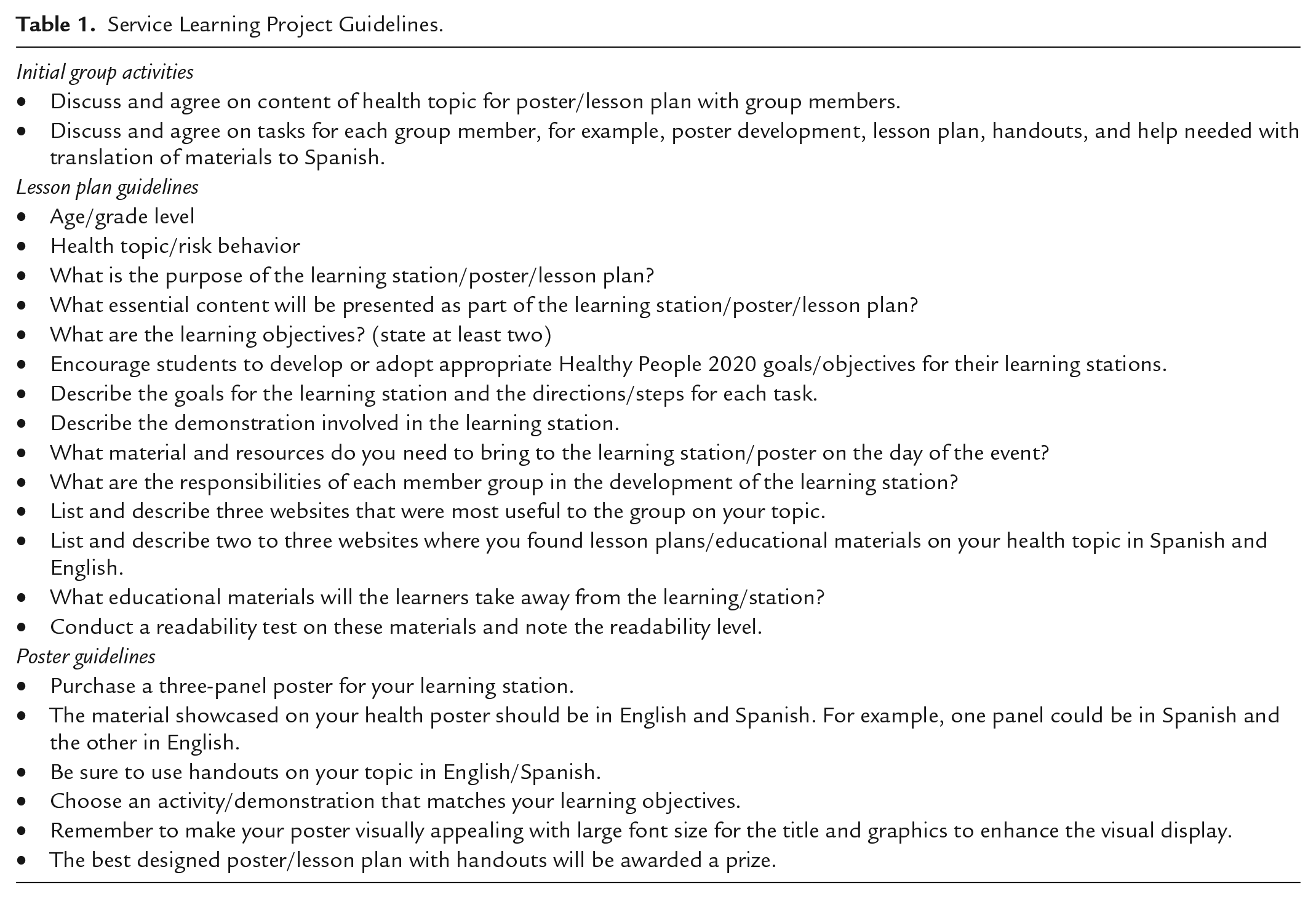
The SLP was worth 30 points of the total grade for the course. Students were divided into health teams of four to create the Latino health education learning stations, written lesson plans, visual displays (posters), and educational handouts in English and Spanish for the community participants according to the SLP Guidelines presented in Table 1. The project had three components: development of a written lesson plan with specific, measurable, learning objectives for Latino health (10 points); development of a visual display (poster) in English and Spanish on the community health issue (10 points); and a written reflection paper (10 points) on the student’s perception of the SLP experience and its impact on them. Each team had to draft a lesson plan and poster for instructor feedback by the third week of the course. As described previously, the health learning stations consisted of health topics covering diabetes education, nutrition education, strategies to promote exercise, Lyme disease education, and oral health education. The health education learning stations centered on demonstrations of the health topic. For example, a team of four students was involved in the heart health learning station where students taught community residents how to locate their pulse and take their resting and moving heart rate, and for the Lyme disease learning station students demonstrated how to remove a tick and tick prevention methods. Handouts at appropriate literacy levels were distributed in English and Spanish on the community health topics. Interpreters were provided by LCH for each health learning station to ensure communication.
Service Learning Project Guidelines.
A community health needs assessment research paper constituted the other major course assignment worth 60 points, and homework assignments were worth10 points. Student teams had to research and write a comprehensive needs assessment paper about a local underserved community that included a description of the community, an analysis of population demographics, an analysis of the community’s health status and factors influencing it, an analysis of community stakeholders, an analysis of health care resources in the community, a ranking of health problems found in the community, and recommendations to improve the health status of the community. Students were encouraged to use the same Latino community for their respective needs assessment paper and their SLP to increase their understanding of this community.
Course Participants and Methods
Thirty-five students enrolled in the health course from diverse backgrounds to include India, Pakistan, Egypt, Jamaica, Nigeria, Sierra Leone, Ghana, Mexico, China, and the United States. The majority of students were first year MPH students majoring in community health education. Students were asked to write a reflection paper about the SLP and the impact of the experience on them. Institutional review board approval from the university was obtained to conduct an analysis of the reflection papers and discussion questions by the authors. Qualitative content analysis was the primary method used to analyze the papers, and student responses were identified and classified into themes and subthemes. In addition, a few questions about the SLP with dichotomous response categories of (yes/no) were analyzed using SPSS.
Student Feedback and Evaluation
Multiple methods of student feedback and evaluation were used to assess the SLP. The primary method for evaluation of the SLP consisted of written reflection papers on the experience and the effects on the participants. Other methods to elicit student feedback included faculty-led group class discussions using a series of reflective questions before, during, and after the SLP (see Table 3), a final in-class group oral presentation and demonstration of the SLP, and some general course evaluation questions on the SLP.
The service learning reflection papers consisted of a 5- to 10-page, double-spaced, typed paper where students reflected on what they learned from the service learning experience. Questions included the following: Did you learn any new information about the Latino community from this event? If yes, what did you learn about the Latino community from this event? What did you learn about serving the needs of others from this event? What did you learn about health education service learning from this event? What observations did you note about the community and the event? How would you reflect on the SLP? Did you grow professionally? Did you grow personally? Did you learn or enhance any skills in cultural competence? If yes, in what ways? What did you like best about the SLP? What would you suggest to improve the SLP for future classes?
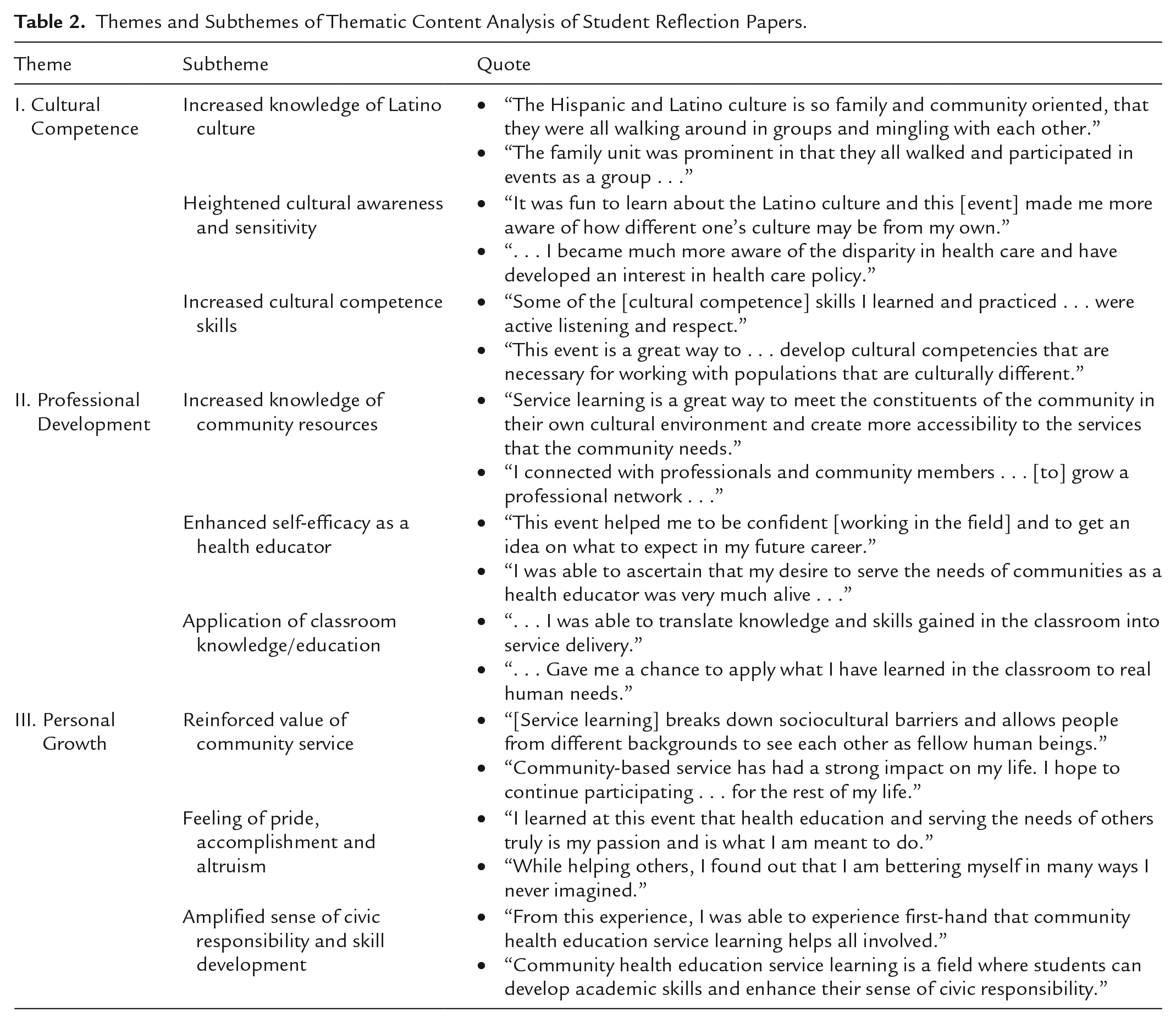
Student reflection papers were analyzed to determine the effects of the SLP on them. The content from these reflection papers were analyzed using qualitative content analysis, to identify major themes and subthemes, and then, the themes were organized into a table format (Table 2) to display them (Miles, Huberman, & Saldana, 2013).
Themes and Subthemes of Thematic Content Analysis of Student Reflection Papers.
Results
Overall, students reported that participating in an SLP was a positive experience (Table 2). Students reported increases in knowledge-based learning related to the local Latino community, improvements in their knowledge of the network of community-based resources serving Latinos, increases in the affective domain related to improved sensitivity and awareness in working with Latinos, improvements in their skill level related to cultural competence, for example, improvements in cross-cultural communication with Latinos, and an enhanced sense of civic responsibility.
When students were asked if they had learned any new information about the Latino community as a result of participation in the project, the vast majority reported that they had learned new information about the Latino community (93%). In addition, when students were asked about whether they had grown professionally and personally as a result of the project, close to 90% reported that they had grown in both of these areas. Eighty-two percent reported that they had enhanced their cultural competency skills as a result of the project.
Student Reflection Papers
Students reported a number of benefits from participation in the SLP. Through thematic content analysis, three major themes and nine subthemes were identified and categorized, and two examples of student reflection paper quotations from each of the nine subthemes are presented in Table 2. The three major subthemes of benefits reported by the participants were improvements in cultural competence, growth in professional development such as health education teaching skills, and personal growth such as an enhanced sense of civic responsibility.
The three subthemes related to improvements in cultural competency included increased knowledge of the Latino culture and community, heightened cultural awareness and sensitivity in working with Latinos as a result of the SLP, and better intercultural communication skills from their personal encounters and interactions with the Latino community. The three subthemes related to professional development included increased knowledge of the network of community resources available to the Latino community, improvements in self-efficacy related to community assessment and teaching health education in the community, and application of classroom knowledge and health education competencies related to planning and implementing a project in a community-based setting. The three subthemes related to personal growth included a reinforced value for community service as the result of developing and implementing an SLP; a new found feeling of accomplishment, pride, and altruism in serving the needs of others; and a better sense of civic responsibility.
In-Class Discussion Reflection Questions and Exercises: Weeks 1, 3, and 7
Reflection is considered a critical component of service learning that affects student learning outcomes (Eyler & Giles, 1999). Students need opportunities to critically reflect on the service learning experience and connect it to back to what they learned in the classroom and in the community.
In order to elicit student feedback on the SLP experience, a series of in-class reflective discussion questions and exercises were formulated before the project commenced (Week 1), at the project midpoint (Week 3), and post project (Week 7); see Table 3. Creating a classroom climate where students had the opportunity to reflect continuously on the SLP experience was an intentional component of the course design.
Service Learning Project (SLP) in Class Discussion Reflection Questions & Project Update Exercises: Weeks 1, 3, 7.
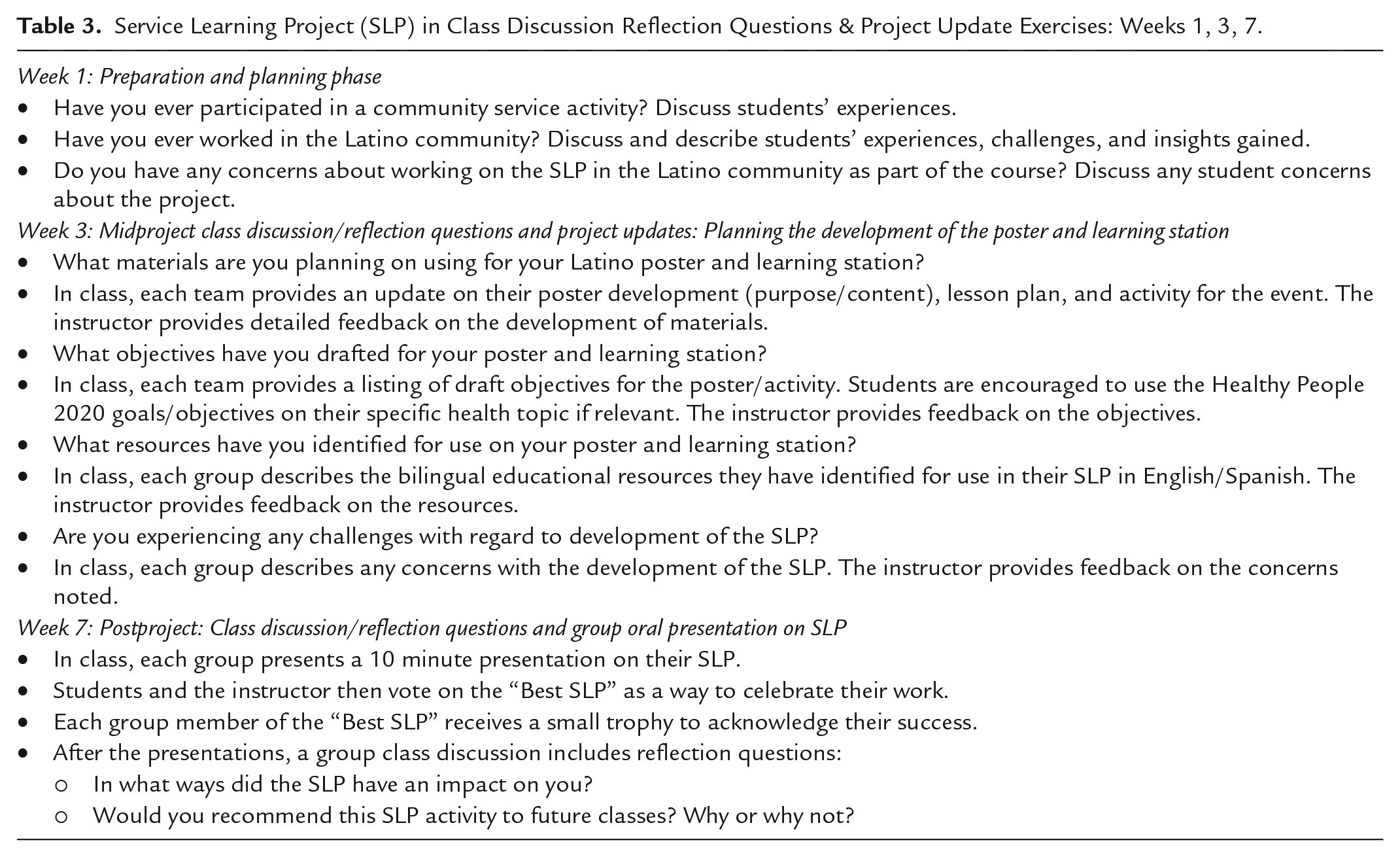
In terms of student responses to the preproject questions, many students noted that they had been involved in community service activities prior to the course, but only a limited number had experience working in a Latino community. As such, the main concern students cited early on was their ability to communicate with Latinos. Since most students did not speak Spanish, the instructor reassured students that interpreters would be available at each learning station on the day of the event to help with interpretation.
In addition, students and faculty who were fluent in Spanish helped with translating the learning materials into Spanish.
The midpoint “Week 3: Reflection Questions and Project Update Exercise” was an important part of the students’ learning process. This classroom activity allowed the faculty member to assess student progress early on in the development of the poster and learning station. For example, although most students have been taught how to write learning objectives, many times these objectives are unrealistic (due to the limited practice opportunities in the community). Providing students with immediate feedback on their learning objectives, and allowing them in-class time to revise them, was an important part of course design. During the group project updates, the faculty member served as a valuable resource to the learning groups and provided critical feedback on the content and design of the poster, literacy level, lesson plan and activity, available consumer materials in English/Spanish on the health topic, and provided help and resources with translating materials into Spanish. Students cited this type of faculty feedback was invaluable in helping them develop high-quality learning stations.
Week 7 postproject questions focused primarily on the impact of the SLP on the students. Students noted the project helped them expand their skill set in conducting community assessments, writing learning objectives and lesson plans, and the development and implementation of a culturally appropriate health education learning station for a Latino community. In addition, many noted that working on a “real world project,” which has the potential to affect and benefit community members, was meaningful to them. Several mentioned the project reinforced their commitment to the profession of health education. Finally, in response to the last question whether the SLP should be recommended for future classes, it is notable that all students recommended the continuation of the SLP for future classes. Reasons included opportunity to practice a professional skill set, opportunity to interact with a diverse community, and an opportunity to network and give back to the community.
Final In-Class Group Oral Presentation on SLP
Students were given the opportunity to showcase their SLP during the final class in a 10-minute oral presentation to fellow classmates. Students were asked to provide written feedback to their fellow classmates by group topic on what they liked best about the SLP oral class presentations, and any areas they thought the student teams needed to improve on. The class then voted by secret ballot on the best SLP (not including their own), and a trophy was awarded to the group that had the highest number of votes. Pictures were taken of each learning station that were then highlighted in the MPH newsletter.
Students as part of the final course evaluation were also asked about any improvements needed for the SLP, and if the course had adequately prepared them for the SLP. In terms of SLP improvements, some students noted that they would benefit from additional resources to help with translation of the health education materials into Spanish, a few students mentioned that the course should offer alternate opportunities for completing the SLP, and a small number noted that additional class time should be allocated to the SLP.
The final course evaluation question asked students to report on how well the course had prepared them to develop the SLP according to the following categories: excellent, very good, good, fair, or poor. Ninety-three percent reported that the course had prepared them in the excellent or very good category; and the remaining 7% reported preparation in the good category. Thus, students felt the course had prepared them well for their service projects.
Lessons Learned
After the course was taught, the authors and partners met to discuss the SLP evaluation and what was learned from the experience. A number of lessons were gleaned from the integration of the SLP into the course and the MPH curriculum:
Devote adequate time to establish the campus-community partnership. Creating an SLP with a community partner requires adequate preparation time to agree on the project, the community partner and faculty roles, the community’s needs, learning objectives, and the service learning activities. Starting at least one semester before the course is taught is necessary to ensure the community–campus partnership is established with a suitable SLP identified.
Involved and committed faculty are essential to the success of service learning. Creating a service learning experience requires time, resources, and meetings among partners, students, other faculty, and the institution. Some faculty may be unwilling to commit to the time and effort needed to develop this type of pedagogical approach. However, faculty who are willing to devote the necessary time to collaborate with community partners will make valuable contributions to community service learning.
Develop an infrastructure to support service learning based on the institution’s policies and procedures. Many universities now have designated service learning offices. It is important to partner with these resources and utilize their expertise in developing service learning opportunities. In this course, the authors worked in partnership with the university’s OSL&VP to develop the SLP based on best practice methods in service learning and the community’s needs. Faculty who developed the course and SLP participated in on-campus trainings in service learning before the class started.
Create a culture within the academic department and with the university’s OSL&VP to support and institutionalize service learning for its long-term maintenance. The lead author established a Service Learning Committee in the Department of Health to establish policies, procedures, and best practices for service learning. One outgrowth of the committee was that the course was approved by the university’s curriculum committee, as the first required course with a mandatory SLP in health education for the MPH program. This type of approval helps maintain and sustain a commitment by the department and the institution to support service learning. After the course was developed, faculty continue to attend training opportunities in this area to maintain skills.
Design an evaluation system to elicit feedback and reflection from course participants before, during, and after the service learning. This type of approach was used in the design and integration of the SLP into the course. Students evaluated the SLP by writing reflection papers after the experience and by participating in class reflection sessions before, during, and after the project, and in postcourse evaluations. This type of multifaceted evaluation is consistent with the research literature on reflection and its importance in service learning. Reflection should be designed so that it is continuous reflection (before, during, and after the course), connected (linked to course objectives), challenging (provide opportunities for students to explore questions), and contextualized (the form fits the experience; Eyler, Giles, & Schmiede, 1996). Making sure students reflect on what they do in the community and connect it to what they have learned in the classroom helps ensure that the service learning is successful and meaningful. Obtaining feedback from the community partner is also critical in order to improve the experience. After the course, meetings were held with the community partner to discuss an evaluation of the experience.
Conclusion
Service learning in health education can provide abundant opportunities for students to grow personally and professionally, and for the community to benefit from interactions with students involved in these activities. Students who participated in the SLP reported a range of benefits, including improvements in cultural competence, growth in professional development skills in health education, and personal growth such as an enhanced sense of civic responsibility. The integration of service learning into a graduate MPH health education curriculum has the potential to benefit students in their future careers as health educators and as service conscious individuals with a social responsibility to help others. Having an understanding of service learning pedagogy and best practice methods for its success can help health education faculty adopt and expand this teaching method.
Footnotes
Acknowledgements
I would like to thank the Office of Service Learning & Volunteer Programs, West Chester University, for their assistance with the development of the service learning project in the course.
Declaration of Conflicting Interests
The authors declared no potential conflict of interest with respect to the research, authorship, and/or publication of this article.
Funding
The authors received no financial support for the research, authorship, and/or publication of this article.