




Abstract
Cultivating professionalism among students is a key goal of the Master of Public Health (MPH) practicum. Achieving this goal, however, can be pedagogically challenging. We provide guidance on implementing and using an online student discussion board as a vehicle for promoting professional development, based on our experience overseeing the MPH internship (practicum) at a large urban university school of public health. Our approach is derived from the professional development literature identifying active reflection on practice experiences as a critical means of facilitating the process of developing mastery and proficiency. We have found that an online discussion board provides a supportive environment for discussing numerous professional challenges encountered in the internship and sharing strategies for addressing these challenges. Our experience suggests that online discussion boards are a useful tool to help MPH students develop their professional skillset, conduct, and values.
The goal of Master of Public Health (MPH) education is to provide students with a broad range of skills needed to serve as competent public health professionals. Traditionally, most public health schools and programs have focused on necessary training in technical competencies. Less attention is given to helping students develop the skills and qualities comprising professionalism, which are also critical to career success. Employers place a premium on staff that can demonstrate a number of professional practice skills including problem solving, teamwork, leadership, and the ability to quickly integrate into the organization, and they note the need to incorporate more management and communication skills in public health education (Association of Schools and Programs of Public Health, 2013b). Public health employees report feeling unprepared in a number of important areas related to professional skills, including program management, communication, and responding to dynamic situations (Sellers et al., 2015). Many MPH faculty are familiar with the complaint of the professionals who hire our students that while our graduates are technically proficient, they fall short on the skills needed to function effectively in an organization.
How can public health programs address this gap in professional development training? As a required element of MPH training, the practicum provides all MPH students with the opportunity to work in “real world” settings and develop professional practice skills and professionalism. The experiential aspect of the practicum compels students to learn how to respond to everyday challenges in public health work and sets the course for their professional conduct and expression. The purpose of this coaching article is to share our experiences as public health faculty in using an online discussion board as a means of promoting professionalism among MPH students engaged in their practicum.
Harnessing the Potential of the Practicum to Promote Professionalism
Our approach evolved as we observed the benefits of asking MPH students engaged in their practicum to discuss challenges they were confronting and how they resolved them. Students often responded with thoughtful statements about learning to be effective in areas such as communication and understanding an organization’s culture and operations. This prompted us to take a closer look at reflection as a pedagogical tool. There is a sizable literature discussing how development of professionalism requires reflection, involving a process of mindful attention to how one assesses and responds to situations that pose new challenges and entail complex solutions (Ginsburg et al., 2000; Rogers, 2001). Reflection is particularly useful in experiential learning to help foster creative problem solving and professional progression (Regehr & Mylopoulos, 2008). Reflecting on real-life situations encountered during professional training helps adult learners think about their experiences and critically analyze how to improve performance (Dunfee, Rindflesch, Driscoll, Hollman, & Plack, 2008). Methods for stimulating reflection include use of structured exercises, typically involving journals, guided questionnaires, diaries, essays, or portfolios (Alley, Jackson, & Shakya, 2015; Pagano & Roselle, 2009; Rogers, 2001; Sasnett & Ross, 2012; Wallman, Lindblad, Gustavsson, & Ring, 2009; Wozniak, 2012). These pedagogical strategies facilitate students’ active engagement in critically assessing their professional capacities and practices, supporting ongoing professional development.
Online discussion boards are a particularly useful format for facilitating the process of professional reflection. Discussion boards offer a forum for students to work through professional development issues in a self-directed, problem-solving–oriented manner and help develop a community of practice among students (Yang, 2009). Electronic discussion boards have been used successfully in clinically oriented health sciences professional training programs to help students connect classroom knowledge to practice (e.g., developing research questions and analyzing data) and support higher-order thinking (Dunfee et al., 2008; Evans, Yeung, Markoulakis, & Guilcher, 2014). Participation in discussion boards can be a means of promoting debate and in-depth discussion among students (Resnik, 2005). An online discussion board is a useful tool for stimulating student-centered active learning (Hudson, 2014; Teikmanis & Armstrong, 2001) and facilitates peer-to-peer interaction among students (Linjawi, Walmsley, & Hill, 2012; Martyn, 2005).
Incorporating Professional Development and Reflection Into Our Curriculum
We decided to employ an online discussion board in our public health internship (practicum) course as a means of promoting student reflection by providing a semistructured format for students to examine their practice experiences and share problem-solving insights with each other. The discussion board was one of several vehicles for prompting reflection on professional development among the internship students.
At our school of public health in a large private university, students in two MPH concentrations with a health promotion focus enroll in a one-semester 3-credit internship seminar course concomitant with their internship fieldwork. During the 2014-2015 academic year, as new faculty for the course, we reviewed the existing seminar curriculum and decided to redesign it in order to have greater focus on professional development issues and provide students with structured reflection opportunities. This comprised inviting guest speakers to discuss the realities of working in public health; progress reports, which included required reflection on the student’s internship experiences for topics such as how teams function, fitting into the organizational culture, perceptions of how organizations operate, and challenges encountered and solutions employed; a final report, which also included structured reflection sections; and required participation in the online discussion board. Students receive direct feedback on their performance from their preceptors, who are asked to assess the student’s professional development as well as technical skills in formal midpoint and final evaluations; these evaluations are shared with course instructors and the student. The evaluations include open-ended questions on assessing the quality of the student’s work and professional behavior, observed professional strengths, and areas for improvement. We also include close-ended questions to rate the student’s communication skills and various behaviors and attributes related to professionalism, for example, working on teams, taking initiative, working independently, following through on assigned work, accepting ideas and suggestions of others, punctuality, and dependability.
Implementing an Online Discussion Board
We find the discussion board to be an accessible and relatively simple mechanism to execute. It worked well in our class sizes, ranging from 4 to 17 students. Based on our experiences, we recommend the following guidelines:
Use available online course management systems. Postings are made using the discussion forum function of the university’s electronic course management platform, which is functionally similar to Blackboard. Postings and discussion threads appear in the course site and can easily be followed by students and the instructors.
Make the discussion board a required element of the practicum/internship. Our course syllabus instructs students to post at least three separate items for discussion on the course discussion board and respond to at least three items posted by other students. There is no minimum or limit to the number of students who can respond to a particular posting. Due dates are given for new postings and responses to other postings, spread throughout the semester. Each posting is worth a certain number of points toward the final grade in the course. We originally asked for four postings but found that students were finding it hard to come up with fresh topics and thoughts by the end of the semester. We found it more useful to allocate only a few days between original postings and responses in order to keep the students engaged and the discussion active.
Allow flexibility in discussion focus, with some direction from instructors. Students can be given freedom to decide on discussion topics to ensure that their issues and voices are given full expression. We note in the syllabus that postings should focus on problems, challenges, tips, and lessons learned encountered in the internship. Students can base items on issues they raised in their progress reports or broach new topics. No further guidance regarding topics was provided, but we expect that as recurring themes are noted across semesters, we may suggest a few specific subjects. While we did not encounter any problems with inappropriate, insensitive, or confidential postings, providing some basic ground rules for participation would likely be useful in the future.
Use the discussion board to monitor issues confronted in the internship. The discussion board also enables faculty to keep an eye on problems and offer advice to both individual students and the whole class when appropriate. We used the discussion forum to identify common issues, highlighting them in our own postings. While we did not respond to every posting or discussion thread, we added advice or encouragement when a topic seemed to capture the attention of a number of students. In addition, we communicated directly with individual students in response to a posting when faculty advisement seemed warranted. We also selected common discussion board topics for further discussion during internship seminar meetings. We note the potential of discussion boards as an approach that enables faculty to be more directly engaged in guiding students’ professional development during the practicum.
Assessing Discussion Boards
Faculty may find it useful to compile and examine discussion topics as part of an experiential learning assessment approach both for the course and educational program. A discussion board provides valuable documentation of student professional development unavailable through typical assignments or direct observation at the internship sites. We present below our method for compiling information from the discussion and findings from this assessment.
Method
We examined postings from several semesters (fall 2014, with five students enrolled, and spring 2014, with 24 students enrolled across two sections and a total of 259 postings). We reviewed the discussion board entries independently and sorted them into themes based on consensus. We tallied the number of entries related to a particular theme, including initial postings and responses.
Summary of Findings
Our assessment helped us identify a number of themes, which can be used proactively in future semesters to help students address key issues confronted through the internship. The themes tended to coalesce around several general areas: (a) mastering professional behaviors, (b) technical skills development, and (c) transitioning from internship to career. Across all areas, the discussions usually focused on identifying particular challenges encountered in the internship and sharing advice and strategies for dealing with these challenges. Under these themes, related specific topics discussed most frequently (in at least 20 postings) included, as shown in Table 1: being well-organized and learning to balance multiple demands of school, internship, and job (28 postings); how to work on teams and interact with coworkers (25); requests for assistance with specific technical skills and sharing of related resources (56); how to wrap things up at the end of the internship (21); advice for the job search and career planning (37); and reflections on the practice and value of public health (22). Other popular topics mentioned in at least 10 postings included time management (13); being flexible, for example, learning to deal with project implementation delays (14); learning to work proactively and independently yet ask for guidance when needed (17); gaining confidence in the work and feeling comfortable speaking up (10); development of such professional qualities as maintaining a positive attitude, diplomacy, and leadership (12); and developing and applying skills learned in the classroom or new skills needed for the internship (17).
Student Discussion Board Entries.
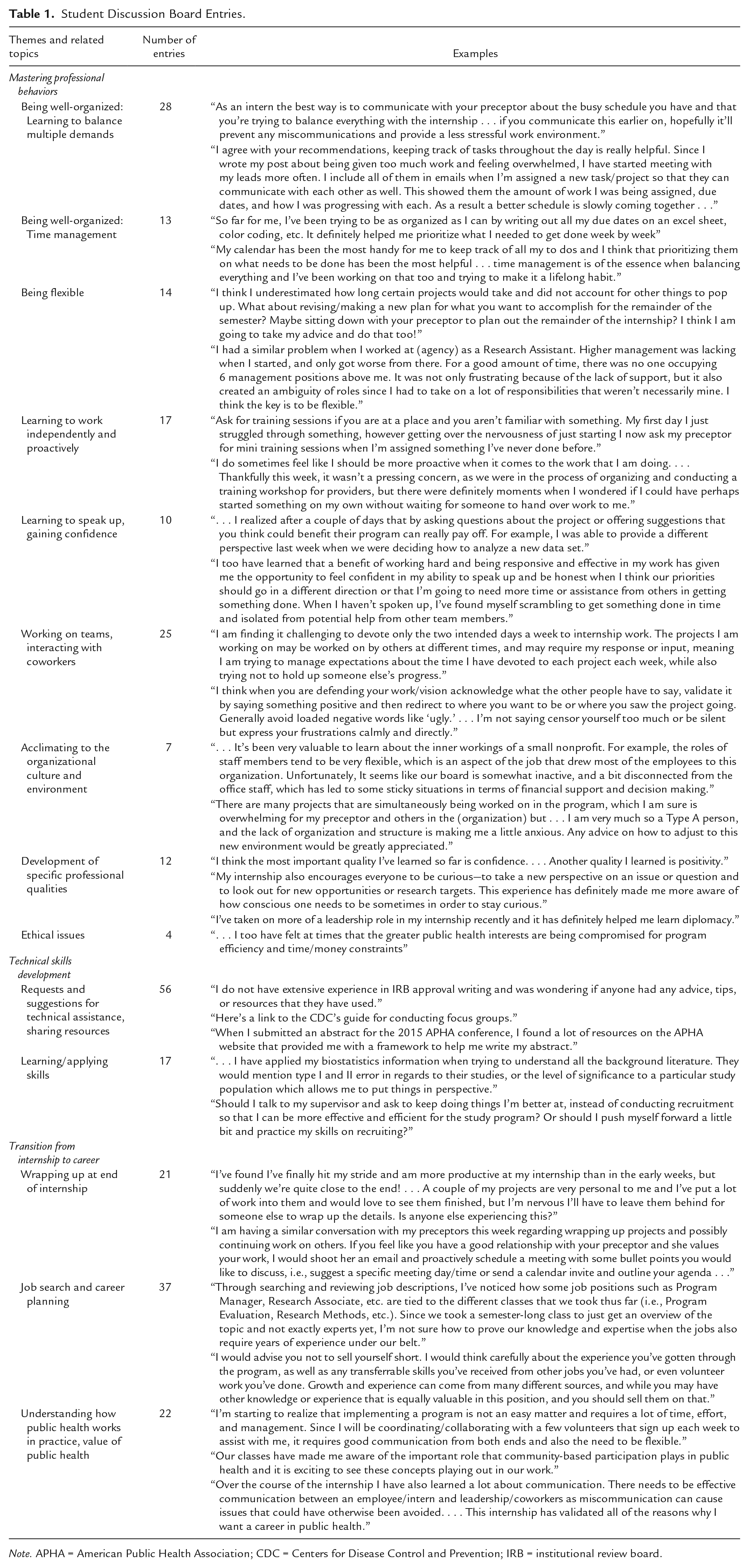
Note. APHA = American Public Health Association; CDC = Centers for Disease Control and Prevention; IRB = institutional review board.
In general, postings made early in the internship tended to focus on time management, balancing competing time demands, and learning how to best function in the organizational environment. Later entries involved discussion of postgraduation plans and reflections on what was learned in the internship. The discussion threads revealed students’ struggles and resolutions as they learned how to be flexible, take initiative, deal with ambiguity, and respond to other challenges presented by the real world of public health practice. Sample student entries for each topic are presented in Table 1.
Examples of Student Interaction
As noted above, we required each student to respond to a minimum number of postings by other students to help foster a learning community. The following is an example of an exchange between students:
. . . I am in my third week and it’s hard to say no even though I’m exhausted by the end of the day. I work with three program leads and keep getting projects and other assignments to work on simultaneously with due dates that are days apart. . . . It’s hard as a new intern to say no when you’re still getting used to the surroundings and understanding people’s roles. . . . Any words of advice?
I have been having similar issues at my internship and feeling quite overwhelmed as well. I finally sent out an email to my supervisors telling them politely how I prefer to work and a suggested, realistic timeline for all of my projects. They all agreed with my timelines and now my projects are much more spaced out. Perhaps just taking a little authority or control where you can, may establish some parameters? I hope this helps!
Examples of Peer Support
As suggested by the above, the tone of the exchanges was very supportive, with words of encouragement. When responding to postings by their peers, students always provided empathy and often gave specific advice for how to deal with issues raised. Students appeared to find it reassuring that others were experiencing similar issues, for example, “I am really relating to the posts this week . . .” Comments contributed to a sense of sharing and motivation, for example, “I hope everyone has been having a positive experience at their internship and that you feel just as proud about and inspired by the work you are doing.”
Summary
Online discussion boards can be a useful tool to help MPH students address a range of professional development issues. Discussion boards provide a platform for encouraging students to raise issues they are confronting in the practicum in real-time and in a supportive, nonjudgmental setting. They serve as a vehicle for helping students engage with each other and develop their peer networks. The breadth of the discussions exposes students to a range of professional issues in real-world contexts and helps students with limited public health work experience better understand the public health workplace and its expectations.
Future Directions
Next steps in advancing use of online discussion boards in MPH education include evaluating the outcomes of participation. Evaluation of experiential learning is an emerging topic in the clinical health professions, with little attention to date in public health. Assessing the contribution of active reflection on practice-based experiences to the process of developing public health competencies and professionalism presents many challenges in terms of methods, measures, and standards (Koole et al., 2011; Leijen, Valtna, Leijen, & Pedaste, 2012). One promising approach is the use of assessment rubrics to establish expectations in defined content areas and provide scoring metrics for discussion board participation (Greenberg, 2015; Phillippi, Schorn, & Moore-Davis, 2015). Assessment rubrics also could facilitate comparison of student entries with preceptor observations in related areas, both for individual students and for cohorts of students. Employing qualitative techniques, as we did, is a valuable approach for examining the substance and meaning of discussion board comments and conversations. Public health education would benefit from future evaluations designed to examine the impact of online discussion boards on such issues as improvements in specific professional competencies, student performance in the internships, and peer-to-peer networking.
Online discussion boards have the potential to enable students to reflect on experiential learning, develop technical and problem-solving skills, and cultivate professionalism. These critical outcomes parallel the taxonomy for competency-based education recommended by the Association of Schools and Programs in Public Health, which comprises cognitive (knowledge), psychomotor (skills), and affective (attitudes) domains (Association of Schools and Programs of Public Health, 2013a). Discussion boards are a useful and easy to implement tool for providing MPH students engaged in their practicum with structured opportunities for professional reflection and development.
Footnotes
Declaration of Conflicting Interests
The authors declared no potential conflicts of interest with respect to the research, authorship, and/or publication of this article.
Funding
The authors received no financial support for the research, authorship, and/or publication of this article.