



Abstract
Although there has been a surge of recommendations and best practices for developing undergraduate public health curricula, nascent research and national recommendations provide limited concrete guidance on evidence-based curricula practices to use and teach the social determinants of health framework to undergraduate students. This descriptive practice article will briefly describe the curriculum and instructional practices of a public health elective course within a U.S. university with a newly offered graduate program in public health but no formal undergraduate public health program of study and will specifically address some of the challenges and lessons learned in teaching the social determinants of health to ensure that the undergraduate student is “becoming an educated citizen.” To ensure that students are grounded, the social–ecological model is used weekly in class lectures and exercises to provide a visual framework through which the social determinants of health, starting at the individual level, can be illustrated through the various nested ecological systems of the model. Pedagogical approaches to using and addressing social determinants of health and health disparities include documentaries, peer wellness coaching, student engagement, and critical self-reflection. Student feedback and lessons learned are provided.
Although the Institute of Medicine’s (2003) report Who Will Keep the Public Healthy? recommended that “all undergraduates should have access to education in public health,” there have been incremental advances in the state of undergraduate public health since the release of this document (Gebbie, Rosenstock, & Hernandez, 2003; Riegelman, Albertine, & Wykoff, 2015). According to 2008 data from the Association of American Colleges and Universities, 16% of 4-year universities were offering undergraduate public health majors or minors, and among this group offering a bachelor’s degree in public health, 5% of those programs existed in institutions without graduate public health education (Hovland, Kirkwood, Ward, Osterweis, & Silver, 2009). There have been substantial advances in curricula recommendations, faculty development, and burgeoning research in undergraduate public health education (Cashman & Seifer, 2008; Mincey, 2015; Riegelman et al., 2015), including the Framing the Futures Report, the Undergraduate for Public Health Education Annual Meeting, and the Educated Citizen Initiative (Riegelman & Albertine, 2008; Wykoff, Petersen, & Weist, 2013). These efforts provide much-needed guidance and language for universities considering offering undergraduate public health curricula and programs. This best practice article will briefly describe the curriculum and instructional practices of a public health elective course within a university with a newly offered graduate program in public health but no formal undergraduate public health program of study and will specifically address some of the challenges and lessons learned in teaching the social determinants of health (SDH) to ensure that the undergraduate student is “becoming an educated citizen.”
In Riegelman and Albertine’s (2011) article, “Under-graduate Public Health at 4-Year Institutions: It’s Here to Stay,” the authors made a critical distinction between traditional models of public health education delivery and the core competencies and curricula recommendations advanced by the Educated Citizen and Public Health (ECPH) initiative (Riegelman & Albertine, 2011). They discussed the “personal health and wellness” courses and related approaches that focus on individual behavior and prevention with limited discussion of sociostructural factors that influence health compared to the professional education approach that prepares student for specific specialist professions, such as health education. They furthermore outline the ECPH approach, which first emerged in 2006 and was solidified by an Associated Schools of Public Health (2012) Framing the Futures report, which developed the critical component elements (CCEs) for undergraduate education (Wykoff et al., 2013). The 2012 Framing the Futures recommendations elevates the primacy of SDH in undergraduate education as “determinants of health” are explicitly included as one of nine public health domains (Association of Schools and Programs of Public Health, 2012). However, nascent research and national curricula recommendations provide limited concrete guidance on evidence-based curricula practices to use and teach the SDH framework to an undergraduate student audience (Chokshi, 2010; Gould, Mogford, & DeVoght, 2010).
It is important to briefly mention the positioning of the ECPH as an expansion of the personal health and wellness and professional education public health approaches since the course and curriculum practices that will be described sit at a nexus between a formerly established personal health course at the university and personal interest in elevating and using the SDH framework to more explicitly illustrate the multiple factors that influence health outcomes, at both individual and population levels. Given the historical reputation of this course at this university, this task has been more challenging than anticipated, and those reasons will be outlined in the “Lessons Learned section. In this article, evidence is provided to support the need for explicitly teaching and using the SDH framework within public health curricula courses at the undergraduate level, providing specific pedagogical approaches that have been used in this course to ensure that students are moving beyond their individual frame of reference, and understanding factors that influence population-level health and wellness, thus striving to cultivate empathy and critical health awareness among undergraduate students.
Social Determinants of Health and Undergraduate Public Health Education
The social determinants of health (SDH) as defined by the World Health Organization are the “conditions in which people are born, grow, work, live and age, and the wider set of forces and systems shaping the conditions of daily life” (World Health Organization, 2015). A substantial amount of research and national attention and investment, evidenced by the prominence of SDH in the Healthy People 2020 report, has been dedicated to the SDH in the United States, adding to the literature regarding the direct and indirect effects of factors such as housing, geographic area, income, and education in producing and shaping health outcomes (Braveman, Egerter, & Williams, 2011; U.S. Department of Health Human Services, 2011). To illustrate the role of context in shaping the health outcomes of an individual nested within an ecological setting, this course specifically explores health disparities and health topics that are relevant to the geographic location and developmental period of the students, for example, undergraduate students (W. R. Smith et al., 2007). For example, Vermont has received unprecedented national- and state-level attention and energy to curb the heroin and prescription opiate drug epidemic, evidenced by Governor Peter Shumlin’s (2014) state of the state address and a recent Centers for Disease Control Prevention grant awarded to Vermont (1 of 16 states to receive federal support) to assist in addressing and preventing the prescription drug opiate overdose epidemic (Centers for Disase Control and Prevention, 2015; Shumlin, 2014). Additionally, colleges and universities are becomingly increasingly scrutinized for a lack of comprehensive sexual violence and assault prevention strategies as well as transparent systems for investigation and accountability (Fedina, Holmes, & Backes, 2016; Yung, 2015). As such, sexual assault on college campus must be a public health educational priority to address outside of the traditional venues (e.g., through voluntary seminars, freshman orientation, or sexual health courses) for this content and to ensure that the SDH framework is used when discussing sexual violence, to avoid individual-level conversations (rape culture) about a societal and sociostructural problem (Hayes, Abbott, & Cook, 2016).
Course Overview and Guiding Theoretical Frameworks
This is a three-credit elective lecture course open to all undergraduate students enrolled in a degree-seeking program as well as non–degree-seeking students in a midsize public university in the northeast. This course is typically a large enrollment course with an average of 60 students each semester, with the majority of students enrolled in this course as an elective and from outside the College of Education and Social Services (from where the course is offered). This course is designed to explore various personal and public health issues, particularly pertinent to college student health and wellness. To ensure that students are grounded, the social–ecological model is used weekly in class lectures and exercises to provide a visual framework through which SDH, starting at the individual level, can be illustrated through the various nested ecological systems of the model (McLeroy, Bibeau, Steckler, & Glanz, 1988). This model draws on Bronfenbrenner’s (1977) ecological system theory, which is a seminal child developmental theoretical framework that laid foundational work to advance the current social–ecological model adopted by many public health professionals. To illustrate the utilization of the social ecological model in the course content and instructional materials, Figure 1 includes specific examples that represent a typical weekly course lecture that applies the social–ecological model to the respective health topic (Figure 1A) as well as a class exercise in which students critically evaluate the various social ecological influences on their daily diet (Figure 1B).

Application of social–ecological model. (A) Course lecture on intimate partner violence; (B) Class exercise on social–ecological influences on personal diet.
Pedagogy and Assignments
The pedagogy of this course is based on reciprocal and coconstructed learning with students through various modalities of learning. Peer-led class discussions and student group work are embedded throughout the course to encourage learning and growth among students. Additionally, given the importance of public health statistics, data, and research to contextualize an issue and, more important, help drive solutions, the start of each class typically begins with statistics and data to help guide the conversations, usually starting with aggregate national statistics often presented visually through a map of the United States. When possible, local or even university-level data are identified and used to increase the saliency for students. The visual sociogeographic patterning of health disparities across the United States becomes quite evident for students and reinforces the concept of health disparities. For example, Southern states are often fairing worse on health indicators explored, for example, infant mortality, obesity, physical activity, fruit and vegetable consumption, teen pregnancy, and cardiovascular disease. During the exploration of data, students are encouraged to critically think about the underlying social determinants that might explain some of the geographic and social-cultural patterning of health and wellness. Furthermore, the concepts of aggregates versus outliers are explored throughout the course—meaning that data are presented using aggregate population-level statistics on the prevalence of a given disease or health indicator, but the prevalence statistics across sociodemographic groups are also displayed, which is an impressive exercise to showcase health disparities.
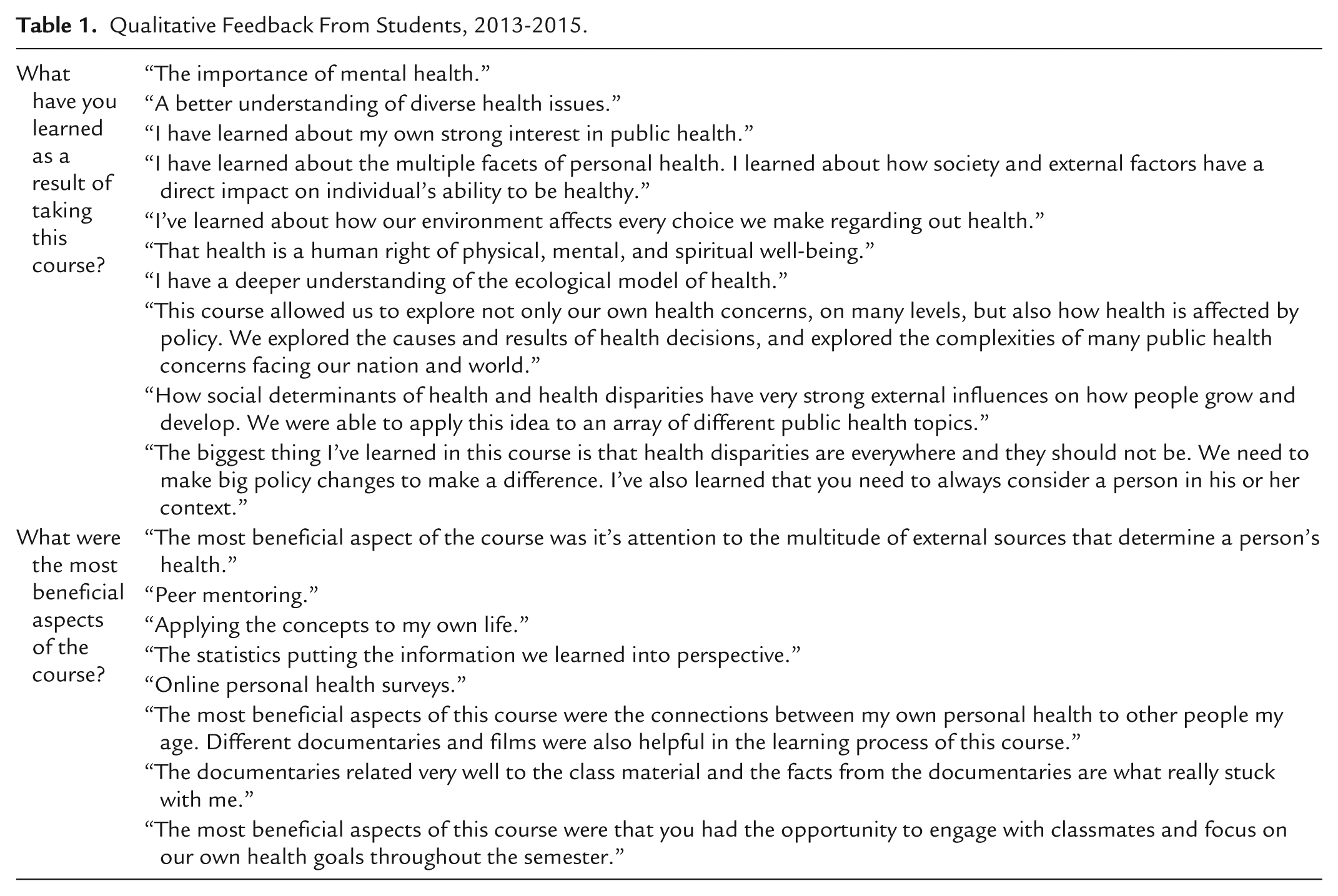
For many of the students, this class is their first exposure to the field of public health, and as a result many express a newly discovered interest in public health (see Table 1). Thus, to further pique their interest and connect the material to their own lives, documentaries are embedded throughout the course that address contemporary public health issues, especially relevant for college health (see Figure 2). The documentaries highlighted address obesity (FedUp), sexual violence on college campuses (Hunting Ground), and prescription opiate drug epidemic (Hungry Heart), specific to Vermont. It is evident from the course evaluations and conversations with students that the documentaries are a powerful tool to supplement class material and resonate with the current lived experiences of the students in class. As one student noted in their course evaluation, “The documentaries related very well to the class material and the facts from the documentaries are what really stuck with me” (see Table 1). Students practice critical self-reflection after the documentaries and, through this process, practice empathy and perspective–taking, as these documentaries, either implicitly or explicitly, showcase the social–ecological model of health and wellness and work toward removing individual blame often associated with obesity, sexual violence, or addiction. Through the documentaries and other class activities, students are encouraged to critically engage with the word “choice” as often health behaviors are reduced to the volitional control of individuals, particularly with highly stigmatized health outcomes such as obesity and addiction, without fully considering the social, political, and economic factors that contribute to the social patterning of these behaviors and outcomes.
Qualitative Feedback From Students, 2013-2015.
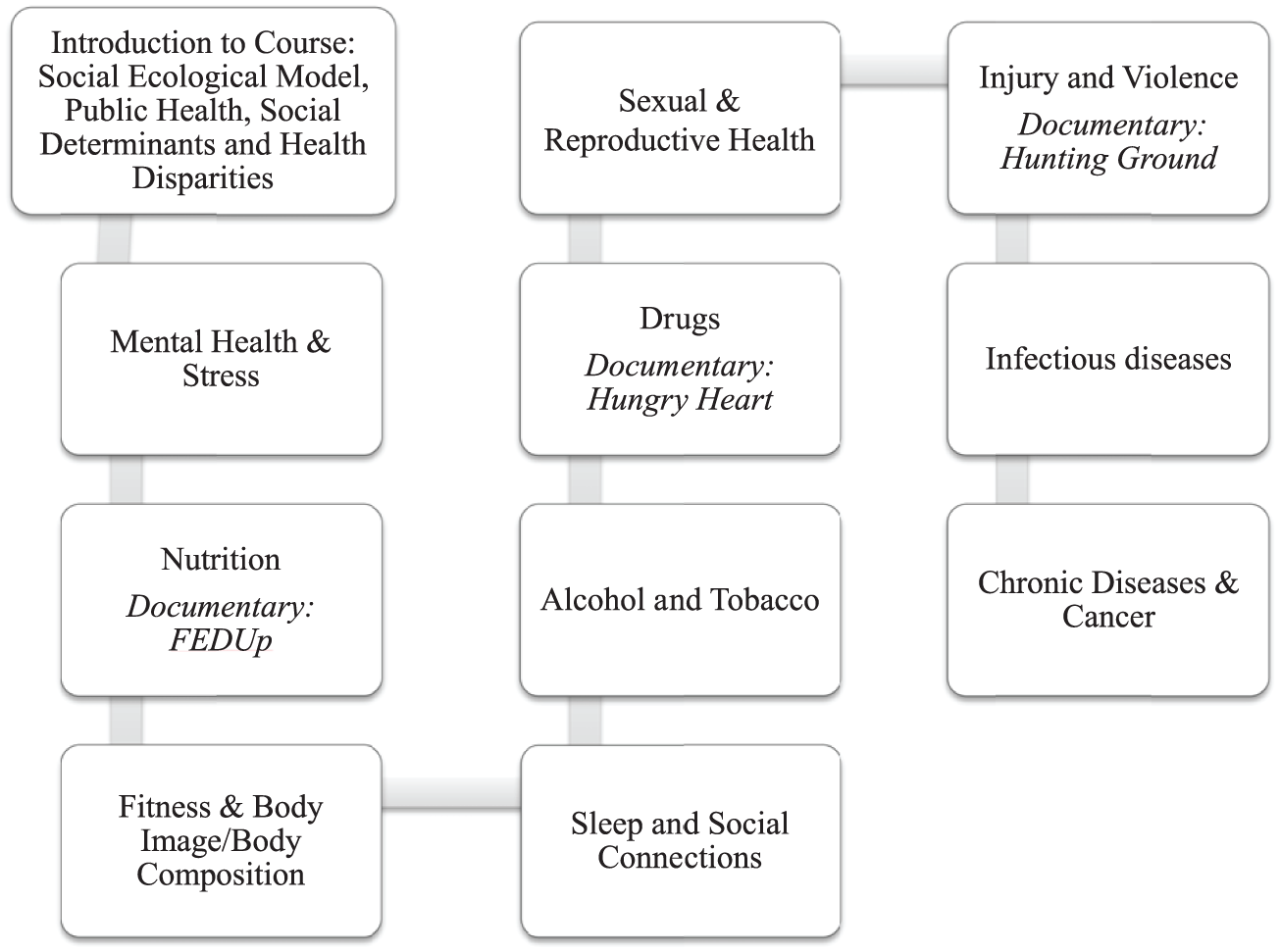
Course road map.
Assignments
Peer Wellness Coaching
As risky sexual behavior, substance abuse, poor diets, and chronic sleep deprivation are often hallmarks for an undergraduate university experience; it is critical that students use this class to first examine their own individual health behaviors, in context. To achieve this end, this course incorporates principles of peer mentoring and peer wellness coaching (Budge, 2006; Sloane & Zimmer, 1993; T. Smith, 2008; Swarbrick, Murphy, Zechner, Spagnolo, & Gill, 2011; White, Park, Israel, & Cordero, 2009) in order to provide students with an opportunity to practice strategies from motivational interviewing and health behavior change with a randomly assigned peer on respective health goals set at the beginning of the semester (Miller & Rollnick, 2012). Prior to the first peer mentoring session, the core principles and strategies of motivational interviewing and peer wellness coaching are discussed as a class with an opportunity for students to role-play and dissect video footage of motivational interviewing sessions, to ensure that students have a foundational grounding in this material. Additionally, after each peer mentoring session, students have an opportunity to share out best practices and challenges related to the peer mentoring session facilitation with their peers to encourage student-led learning. It is clear from course evaluations that students value this experience and time to critically reflect on their own health behaviors and have the opportunity to use a peer for support. As one student noted in the course evaluation, “The most beneficial aspects of this course were that you had the opportunity to engage with classmates and focus on our own health goals throughout the semester” (see Table 1). At the end of the semester, students are asked to write a culminating reflection paper on the peer mentoring experience and reflect on their success of achieving their health goals.
Self-Reflection
In addition to the peer wellness coaching, each week, students are prompted to complete an online survey answering questions about health behaviors corresponding to the designated health topic and space to reflect provided through the course e-book. These short surveys each week provide the students with a general overview of their own health and wellness. At the end of the semester students are asked to reflect on that experience and address issues that surprised or challenged them about their own health. As this class was designed out of the traditional personal health and wellness pedagogical tradition, this assignment reflects individual approach to health and behavior. However, when coupled with the peer wellness coaching and SDH—which is a backbone of the lectures and in-class material—these opportunities for self-refection on individual health provide an opportunity for students to examine their own status and privileges as it relates to their health and wellness, further reinforcing the importance of empathy and perspective taking.
Student Feedback and Evaluations
Overall, this class has received strong and positive evaluations from the students who have completed this course. More important, from reviewing the qualitative feedback from students about what they have learned as a result of taking this course, students are indicating that they are learning about health disparities, SDH, and the social–ecological model. For example, one student noted learning “how social determinants of health and health disparities have very strong external influences on how people grow and develop. We were able to apply this idea to an array of different public health topics.” As this course is titled “Personal Health” and has a historical reputation on campus of being relatively easy, the instructor was concerned that students would not be able to connect the course material to larger societal issues of power and privilege that are discussed each week through the lens of health disparities and social determinants; however, the course evaluations illustrated complex thinking and a connection between the traditional personal wellness course and the principles of public health education. This course was inherited 3 years ago, and the larger goal for this content is to create an interdisciplinary undergraduate public health program.
Finally, the qualitative responses related to the most beneficial aspects of the course, highlighted the various pedagogical approaches that are discussed in this article, which reinforce the need to critically engage students in the learning process and present material that is relevant to their own lives and developmental perspectives. Aligning with the almost 20 years since Institute of Medicine stated that “all undergraduates should have access to education in public health,” faculty need to ensure that the multiple entry points to this material resonate with the current health priorities of undergraduate students.
Lessons Learned
Critical importance of student self-care, given the intensity and relevancy of topics to their own lived experiences, for example, addiction and sexual violence: Given the class size, it is a pedagogical challenge to best ensure that the students in the course are not adversely triggered by material presented and that they seek appropriate outlets for support. This must be a consideration of any health-related course with young people. To proactively address the potential impact of the sensitive topics covered, during the first class each semester the university’s student mental health and wellness providers visit with the students to describe the range of services offered and also lead the students through a brief mindfulness exercise. Students have expressed gratitude for this visit, as many students are unaware of the breadth of depth of behavioral health services offered at this university.
Given the point above about the lack of a coherent and systematic public health curriculum at this university, the sustainability of impact of content is questionable if these issues are not addressed or discussed through multiple entry points to an individual’s curriculum.
Aligning and modifying the course content with timely issues affecting the health and well-being of college students to increase content saliency is an important course development process. This has proven to be an effective strategy and also one that reveals the often-overlooked health and wellness needs of the undergraduate population.
There is still a strong influence of the historical course reputation on the growth and extension of material and elevation of expectations for student work and learning outcomes, given that this course is known to be an “easy course” and the modifications to the course described in this article require more engagement, critical thinking, and self-reflection from students compared to previous offerings.
Although the course content and delivery intentionally expose the stigma and individual-blaming mentality associated with addiction and obesity, through an explanation of health disparities and social determinants of these outcomes, it is still possible that the stigma, related to volitional control and choice, is still perpetuated. This would indicate that empathy and perspective-taking may not be an accessible strategy for something that may seem so distant to a student’s reality or lived experiences, for example, the othering effect (Thompson & Kumar, 2011). However, current course evaluations and student feedback do not explicitly address this assertion, but future planned student evaluations should include questions related to empathy and stigma to empirically evaluate this concern.
Implications
To distance this personal health course from the historical reputation of its predecessor and to reflect the central importance of college student health, there are plans to submit a modification to the title of the course to “College Health.” Additionally, an organic bubbling of interest from students and faculty across the campus about public health has solidified an interdisciplinary working group to create an undergraduate major and minor proposal in public health. The course discussed in this article would be embedded in that larger curriculum design framework, therefore ensuring that students have multiple opportunities and entry points to critically engage with SDH.
Footnotes
Declaration of Conflicting Interests
The author declared no potential conflicts of interest with respect to the research, authorship, and/or publication of this article.
Funding
The author received no financial support for the research, authorship, and/or publication of this article.