



Abstract
The mission of the Region IV (R-IV) Public Health Training Center (PHTC), headquartered at the Rollins School of Public Health at Emory University in Atlanta, Georgia, is to develop and implement programming to train public health professionals in the U.S. Department of Health and Human Services Region IV. The emphasis on public health accreditation, as well as the reality of high personnel turnover and a workforce with little formal training, point to the need for PHTCs that provide workforce training. PHTCs use distance-based education to reach those in need of training by minimizing or eliminating cost and travel barriers. However, many experienced public health trainers who are able to provide effective and engaging trainings in person lack the knowledge and skills necessary to adapt existing curricula to a distance format. Distance Education And Learning (DEAL) is an online course designed by the R-IV PHTC to increase the capacity of public health trainers to teach in the distance learning environment. The course includes four 3-hour synchronous online sessions with additional asynchronous presession and intersession activity requirements. This article describes the development and implementation of the DEAL course, including how it is used by the R-IV PHTC to increase the number of public health trainers with the skills needed to develop and implement distance-based training, which thereby builds the training capacity within the region and addresses issues of sustainability.
Introduction
Funded in 2014 by the Health Resources and Services Administration (HRSA), the Region IV Public Health Training Center (R-IV PHTC) is 1 of 10 regional training centers that make up the national Public Health Learning Network. Included in the national network is the National Coordinating Center for Public Health Training and 40 local performance sites (LPSs) that work with their respective regional PHTCs to assess local training needs and provide marketing, outreach, education, training, and program evaluation. The mission of the national network is to improve the nation’s health system by strengthening the technical, scientific, managerial, and leadership competencies of the current and future public health workforce (HRSA, n.d.). Consistent with the national network’s mission, the R-IV PHTC seeks to build knowledge and skills in the public health workforce in the eight states that make up U.S. Department of Health and Human Services (HHS) Region IV (Alabama, Florida, Georgia, Kentucky, Mississippi, North Carolina, South Carolina, and Tennessee) and to develop and implement programming to train public health professionals using a variety of modalities, including distance-based education. The work of the R-IV PHTC is carried out by the Central Office located at the Rollins School of Public Health at Emory University and six LPSs (East Tennessee State University, Florida A&M University, Medical University of South Carolina, University of Alabama at Birmingham, University of Louisville, and University of North Carolina Wilmington).
The governmental public health workforce is vast and comprises a myriad of disciplines. Consistent with the R-IV PHTC’s mission, distance-based training is used to reach the broader workforce and affords many benefits to learners, including community building, instruction tailored to individual learner needs, flexibility, convenience, and the ability to access instruction anywhere and anytime (Cook et al., 2008; Liu et al., 2016; Moore, Perlow, Judge, & Koh, 2006; Wojciechowski & Palmer, 2005). An R-IV PHTC rapid needs assessment conducted in 2014 determined that the Central Office and all six LPSs had, at a minimum, a learning or event management system that could be used to support the provision of distance-based learning. Some sites had additional hardware and software resources (e.g., web conferencing or satellite broadcast systems) and/or institutional units designed to support distance-based training development and dissemination. The rapid assessment also found that many R-IV states had budgetary limitations that prevented personnel from traveling outside their local area for training. Thus, the growing need to provide distance-based training is clear; however, many experienced trainers lack the knowledge and skills necessary to adapt existing curricula to a distance format.
Distance Education And Learning (DEAL) is an online course designed by the R-IV PHTC to increase the capacity of public health trainers to teach in the distance environment. The development and implementation of the DEAL course is described here, including how it is used by the R-IV PHTC to increase the number of public health trainers who have the skills needed to develop and implement distance-based public health training and build training capacity within the region, thereby addressing issues of sustainability.
Background
Public Health Workforce Development
In 2000, a study of the public health workforce by Gebbie, Merrill, Hwang, Gebbie, and Gupta (2003) concluded that nearly 450,000 salaried public health workers were employed at the local, state, and federal levels. A more recent study estimated that there were up to 516,193 governmental public health workers in the United States (University of Michigan Center of Excellence in Public Health Workforce Studies, 2013). This workforce is responsible for overseeing essential services, such as disease surveillance, environmental safety (including water safety), and immunization programs, as well as contemporary issues such as emerging infectious diseases and bioterrorism threats (Gebbie et al., 2003). Although the public health workforce plays a critical role in ensuring the health and well-being of the population, the U.S. Department of Health and Human Services, Health Resources and Services Administration estimates that only 20% of the nation’s public health workforce has the formal education and training necessary to do their jobs effectively (as cited in Kennedy & Baker, 2005). Additionally, Sellers et al. (2015) report that 42% of current employees at state health agencies may leave public health by 2020 due to retirement or other reasons.
The push toward public health accreditation further influences the need for training. Domain 8 of the Public Health Accreditation Board (PHAB) standards and measures relates to having a competent public health workforce that can perform the essential functions of public health. Health departments seeking PHAB accreditation must have a workforce development plan that includes a strategy for addressing current and emerging training needs and must be able to document partnerships with educational programs to provide training in public health fields and/or promote public health as a career (PHAB, 2013).
The need for public health accreditation, as well as the reality of high personnel turnover and a workforce with little formal training, points to the need for PHTCs that provide workforce training. PHTCs use distance-based education to reach those in need of training by minimizing or eliminating cost and travel barriers.
Instructional Approach
The methods used by the R-IV PHTC in developing training are consistent with the contemporary principles of adult learning theory and long-standing principles of professional development (Dreyfus & Dreyfus, 1986; Merriam & Caffarella, 1999). In part, these principles advise that instructional products be competency-based experiences that address the needs of the targeted workforce and reflect the context of the workplace. R-IV PHTC courses, including the DEAL course, are also developed to be mindful of standards associated with Culturally and Linguistically Appropriate Services (CLAS; HHS, 2013) and 508 Compliance (GSA, n.d.) related to the development of instructional products.
Course Development and Design
The DEAL course was developed by a group of six individuals at the R-IV PHTC Central Office with experience in developing and/or implementing public health training in distance-based environments. The lead course instructor, who also serves as the director of the Rollins School of Public Health’s distance-based Master of Public Health program, has more than 15 years of experience teaching graduate public health education in a distance environment. Collectively, team members have more than seven decades of experience in traditional and distance-based training.
Target Audience
The target audience for the DEAL course is current public health educators with extensive experience conducting training, primarily in-person. Promotional emails describing the DEAL course were sent to the R-IV PHTC LPSs and Steering Committee for further dissemination to their state and local partners and trainers. In addition, flyers were disseminated in person and by email to (a) Georgia Society for Public Health Education (SOPHE) members; (b) former Emory PHTC trainers; (c) previous PHTC training participants with a background in the fields of training, health education, and/or health promotion; and (d) Certified Health Education Specialists/Master Certified Health Education Specialists (CHES/MCHES) in the eight R-IV states (n = 2,176).
Applications involved the submission of a résumé and a Google Docs application form used to collect the following information:
Name
Job Title
Organization
What is your experience in training the public health workforce?
Please list the title of the trainings you have conducted within the past two years.
Have you ever trained in a distance-based environment?
How will this training help you meet the training needs of the public health workforce in Region IV?
Do you have an existing curriculum that is ready to be adapted for distance-based learning? If yes, please give a brief explanation.
We will be offering a follow-up training during summer 2016. Participants in this training will adapt a curriculum of their choice to the distance environment. How interested would you be in the follow-up training?
How did you hear about this opportunity?
All applicants were screened by the course development team. Questions considered during the review process included the following:
To what extent does the applicant have experience training the public health workforce?
How likely will this applicant help our Center meet the training needs of the public health workforce in Region IV?
Does this applicant have an existing curriculum that is ready to be adapted for a distance-based environment?
Could the applicant be a potential future trainer for the PHTC?
Course Description and Learning Objectives
Course Description
As society becomes more technologically advanced and funding constraints limit access to in-person trainings, educators need to reach a wider audience by offering trainings online with as much vigor and engagement as those offered face-to-face. The DEAL course is designed for experienced public health educators who are currently delivering in-person trainings and who want to adapt existing curricula for a distance-based audience. The competency-based course gives public health trainers tools and guidance to become effective educators in a distance-based environment, building on their skills as experienced instructors and providing opportunities for practice and discussion.
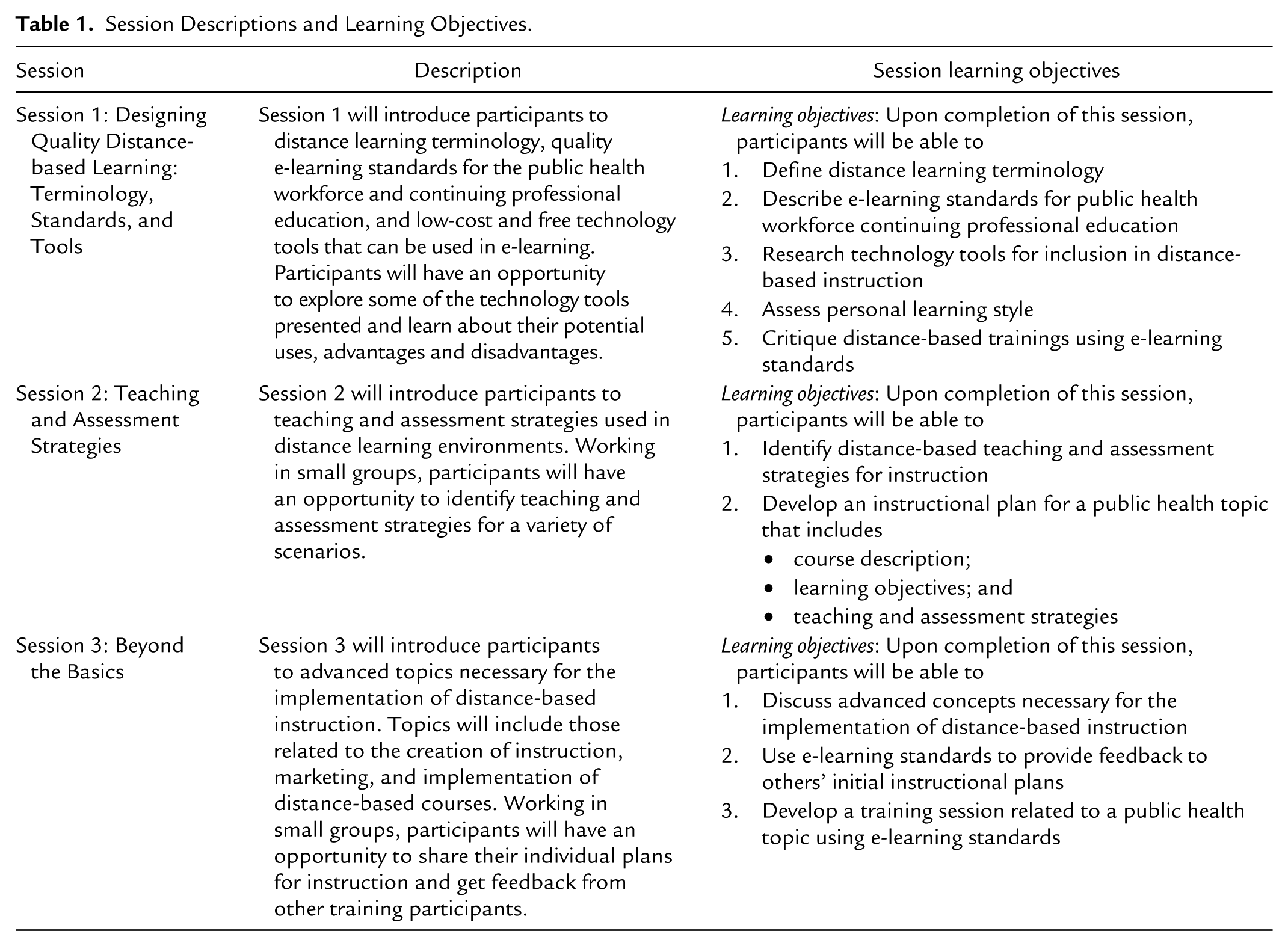
The DEAL course is divided into four 3-hour synchronous online modules with additional asynchronous presession and intersession activity requirements. The first three synchronous sessions are primarily didactic, with discussion and breakout group activities: (a) Designing Quality Distance-based Learning: Terminology, Standards, and Tools; (b) Teaching and Assessment Strategies; and (c) Beyond the Basics. (See Table 1 for a description and learning objectives for these three synchronous sessions.) The fourth synchronous session serves as the course capstone.
Session Descriptions and Learning Objectives.
During the fourth synchronous session, participants deliver a 10-minute final presentation outlining a distance-based training they are planning to develop. Each capstone presentation provides an overview of the participant’s training and includes (a) intended audience, (b) description of training, (c) learning objectives, (d) teaching strategies, (e) assessment strategies, (f) technology(ies) to be used, and (g) challenges. Participants take part in one of the two capstone sessions offered.
Overall Course Learning Objectives
Upon completion of the DEAL course, participants will be able to
Discuss the use of e-Learning standards in distance education
Describe tools used in distance-based instruction
Critique distance-based trainings using e-learning standards
Incorporate distance-based teaching and assessment strategies to create a plan for instruction
Develop a plan for a distance-based training session related to a public health topic
Course Structure
The DEAL course uses both synchronous and asynchronous course delivery methodologies. In addition to four online synchronous sessions lasting 3 hours each, participants watch an asynchronous presession module prior to each synchronous session and complete additional intersession assignments. (See Figure 1 for a graphical representation of the course structure.)

Structure of the Distance Education And Learning (DEAL) course.
The synchronous sessions are facilitated using Adobe Connect and include both large group discussion and small breakout group activities. The presession modules are approximately 15 minutes in duration and were created using Adobe Captivate. The presession modules are intended to provide participants with an introduction to the content that will be further discussed during the synchronous sessions.
The course is hosted on the CourseSites by Blackboard learning management system. In addition to hosting course materials (course overview, session materials, intersession assignments) and discussion forums, the DEAL course site includes resources related to (a) sources for public health trainings, (b) curriculum basics, (c) creating distance learning courses, and (d) teaching and assessment strategies.
Course Assignments and Completion
Presession Activities
Prior to each synchronous session, participants are asked to watch a presession module of approximately 15 minutes that serves as an introduction to the synchronous session. In addition, prior to the first synchronous session, participants introduce themselves and post their picture on a discussion board in the course site.
Intersession 1
Between the first and second synchronous sessions, participants are asked to find an example of a distance-based training to review. Using a worksheet developed by the R-IV PHTC (based on the Quality Matters e-Learning standards and modified for public health professionals by the de Beaumont Foundation), participants assess the training and determine how well it adhered to a set of e-learning standards presented in Session 1 (de Beaumont Foundation, 2016; Quality Matters, 2015). As part of Intersession 1, participants are also asked to post their comments about two technology tools they researched during the first synchronous session.
Intersession 2
Between the second and third synchronous sessions, participants are asked to select a public health topic related to their area of expertise and develop an initial (pre-capstone) training plan. At a minimum, the plan is to include (a) course description, (b) learning objectives, (c) teaching and assessment strategies, and (d) description of technology tools to be used in instruction. Each participant shares their plan during the third synchronous session and receives feedback from other course participants.
Capstone Presentations
In the final synchronous session, each participant shares a 10-minute presentation of the distance-based training that they are planning to develop. The presentation provides an overview of their training and includes (a) intended audience, (b) description of training, (c) learning objectives, (d) teaching strategies, (e) assessment strategies, (f) technology(ies) to be used, and (g) challenges.
Course Completion
Successful completion of the DEAL course is demonstrated by participation in all synchronous sessions, including the capstone, and submission of intersession activities. Participants who successfully complete the DEAL course receive a certificate of completion from the R-IV PHTC.
Preliminary Evaluation Results
The DEAL course was offered for the first time in spring 2016. Course participants were recruited from October 2015 to January 2016. Of the 20 individuals who applied, 14 were selected for participation and all 14 began the course. After the first synchronous session, one individual dropped out due to a conflicting schedule at work. Participants worked for organizations in Florida, Georgia, North Carolina, and Tennessee. Six of the 13 participants worked for governmental public health or tribal organizations at the federal, state, or local levels. Three worked for universities and the remaining four participants were consultants or worked with other public health agencies. Seven of the 13 participants reported that they had conducted trainings in a distance-based environment before participating in the DEAL course. Participants had an average of 8.3 years of public health training experience (range: 1-30 years).
Course Participants’ Evaluation
Course participants were asked to complete an evaluation measuring participant satisfaction and learning after each synchronous session. Follow-up evaluation data to determine if and how participants have used what they learned in the workplace will be collected 6 to 12 months after the conclusion of the course.
When asked about their confidence performing each learning objective prior to and following the training sessions, on average, scores improved. All participants agreed or strongly agreed that the lead instructor presented the materials clearly, spoke at an appropriate speed, was respectful to participants, and was knowledgeable about the material covered; most participants agreed or strongly agreed that the lead instructor engaged the participants in discussion. Overall, the majority of course participants felt that they were able to contribute to the breakout group activities that occurred during the synchronous sessions. Additionally, the majority of participants felt that the activities added to their comprehension of the material covered.
Some participants encountered technical issues during the first synchronous session, primarily related to audio problems. After the initial synchronous session, the R-IV PHTC instructional designer met with those individuals for additional troubleshooting and the issues were resolved before subsequent synchronous sessions.
When asked about the most and least helpful parts of the synchronous sessions, participants indicated that some of the least helpful parts centered on the breakout group activities and the need for more time to accomplish them. Additionally, course participants commented on the need for more breaks. Participants indicated that the most helpful components were the content and hearing from other participants. Likewise, participant evaluation data showed that participants believed that the course content and design was appropriate for the achievement of the course objectives, indicating a success in the design of the course.
Course Developers’ Evaluation
As part of the formative evaluation, a focus group was held with the DEAL course developers to identify changes for the remaining sessions and future course offerings. Course developers suggested that there was value in using a team approach to course development and delivery, as each member brought different experiences, perspectives, and skills.
Engaging participants was found to be both a success and an area for improvement. The course developers noted that participant engagement in the synchronous sessions increased throughout of the course, but that engagement could have been better during the breakout group activities. The latter may have been due to breakout group members relying on the course facilitators, who were also present in the breakout groups, for leadership. Another area identified for improvement was the use of CourseSites. Rather than solely using this as a place to store materials, it was recommended that, in the future, instructors use CourseSites to more fully engage the participants during the intersession portions of the course. An additional area of improvement related to staffing. In the spring 2016 course, seven staff collaborated to support the implementation of each synchronous session (course facilitator, lead instructor, instructional designer who helped with technology troubleshooting, and additional facilitators for each of the breakout groups). For a training to be cost efficient, it is important to determine how to deliver the DEAL course with fewer staff.
Lessons Learned
The first offering of the DEAL course illustrated the importance of knowing the learners—both those experienced trainers who participated in the course and those members of the public health workforce who may be the recipients of distance-based learning. Individuals who participate in distance-based trainings must have access to the technology used, but they must also have supervisory support. It is also important to know the technological skills of the learners and have staff available to assist with technology-related questions. In the example of the DEAL course, in which Adobe Connect was used to deliver the synchronous sessions, it was vital to have someone who could assist participants with technical issues.
Additionally, while the DEAL course development team decided to have a group facilitator in every breakout group, this may have stifled small group discussion because participants looked to the facilitator for leadership instead of looking within the group itself. An additional staffing challenge was that each synchronous session had seven staff for a course with only 13 participants. Although the staffing model provided a good experience for the training participants, it was resource heavy and not realistic in the long term. Going forward, the R-IV PHTC will explore improving efficiencies in delivering the course, including determining which staff are essential for course implementation.
Also noted was that the DEAL course is time intensive, not only for the developers but for the learners as well. Course participants committed to four 3-hour synchronous sessions, in addition to pre- and intersession activities. It is important to communicate time expectations and firm dates for each synchronous session in the promotional materials and call for applications.
A final lesson learned is that participant interaction is important but can be difficult to achieve in a distance-based learning environment. The course development group felt that participant interaction increased with each subsequent session, perhaps because participants became more comfortable with each other. In a course in which participants may not know each other or have the opportunity to meet in person, it is important to think about ways in which participants and instructor(s) can get to know each other. For the DEAL course, everyone was asked to post an introduction—including a photograph—on the CourseSites discussion board prior to the first session. It is also important to recognize that when offering distance-based instruction, participants may have simultaneous distractions such as email, which adds to the challenge of engaging the participants in meaningful ways.
Next Steps
The R-IV PHTC will offer the DEAL course once a year, and it is anticipated that a follow-up course, Distance Education And Learning Trainings (DEALT), will be offered for a subset of individuals who completed the DEAL course. In DEALT, participants will fully develop a distance-based course. The DEALT curriculum will consist of consultation and some didactic interaction. Individuals who fully develop a distance-based course in the DEALT class will be invited to become part of the R-IV PHTC’s Master Trainer Network and provide trainings to the public health workforce in HHS Region IV on behalf of the Region IV PHTC.
The DEAL course and its follow-up activities—the DEALT course and Master Trainer Network—are designed to increase the availability of training for the public health workforce in HHS Region IV by increasing the capacity and capability of educators to conduct training at a distance. By teaching seasoned public health trainers how to teach in a distance environment and providing them with the resources to translate a course from in-person to distance, the R-IV PHTC is able to address barriers to in-person training and reach the broader public health workforce, building sustainable training capability in the region.
Footnotes
Acknowledgements
We would like to acknowledge all our Region IV Public Health Training Center colleagues at the Central Office and Local Performance Sites as well as the Steering Committee and practice partners who have provided support and input to the program.
Authors’ Note
The information or content and conclusions are those of the authors and should not be construed as the official position or policy of, nor should any endorsements be inferred by the Health Resources and Services Administration, the U.S. Department of Health and Human Services, or the U.S. government.
Declaration of Conflicting Interests
The author(s) declared no potential conflicts of interest with respect to the research, authorship, and/or publication of this article.
Funding
The author(s) disclosed receipt of the following financial support for the research, authorship, and/or publication of this article: This program is sponsored by the Region IV Public Health Training Center, which is supported by the Health Resources and Services Administration of the U.S. Department of Health and Human Services under Grant Number UB6HP27875, Affordable Care Act (ACA) Public Health Training Centers.
Supplement Issue Note
This article is part of a Pedagogy in Health Promotion: The Scholarship of Teaching and Learning supplement, “U.S. Public Health Learning Network: Innovative Competency-Based Training for the Public Health Workforce,” which was supported by the Society for Public Health Education and the Region IV Public Health Training Center, Health Resources and Services Administration of the U.S. Department of Health and Human Services under Grant Number UB6HP27875, Affordable Care Act (ACA) Public Health Training Centers. The entire supplement issue is available open access for one year at  .
.