



Abstract
The objective of this article is twofold: (a) demonstrate the utility of cooperative–experiential learning within the health sciences curriculum and (b) diversify student classroom experiences through a health campaigns project that challenged students to creatively and strategically develop health messages. Cooperative–experiential learning is a hybrid pedagogy that exposes students to many of the complexities they can expect to face within their career, thus bridging the gap between the classroom and workplace. The health campaigns project used to appraise the value of cooperative–experiential learning in this article tasked upper-level undergraduate student groups from two unique college courses (Health Promotion and Visual Communication) to design, launch, and analyze health-relevant campaigns on the authors’ college campus. At two points throughout the semester, students independently completed reviews (cooperation reports) of their group dynamics and progress—these reports became the data set for our analysis of cooperative–experiential learning. Using a grounded theory approach (open, axial, and selective coding), the results that emerged from our analysis point to four significant themes of cooperative–experiential learning: development of communication skills, problem solving and critical thinking through cooperation, workplace preparedness, and student satisfaction. Student quotes are used to help extrapolate these four outcomes. Suggestions are offered for how to effectively incorporate cooperative–experiential learning into curriculum.
This article outlines a cooperative–experiential health campaigns project that was completed over the course of a 15-week semester between two unique upper-level undergraduate courses (Health Promotion; Visual Communication). Small student groups from the Health Promotion course were paired with small student groups from the Visual Communication course to codevelop and launch multichannel health campaigns on the authors’ college campus. Centered on student responses at two points throughout the semester, the objective of this article is to highlight the applicability of incorporating cooperative–experiential learning, as well as diversifying the student experience, into the health science curriculum. With its focus on team-based learning by doing and active reflection, cooperative and experiential learning can serve as bridges between classroom experience and workplace preparedness, which will help learners as they transition from the college classroom to career. A brief project overview is provided before outlining the theoretical framework that grounds our analysis.
Project Overview
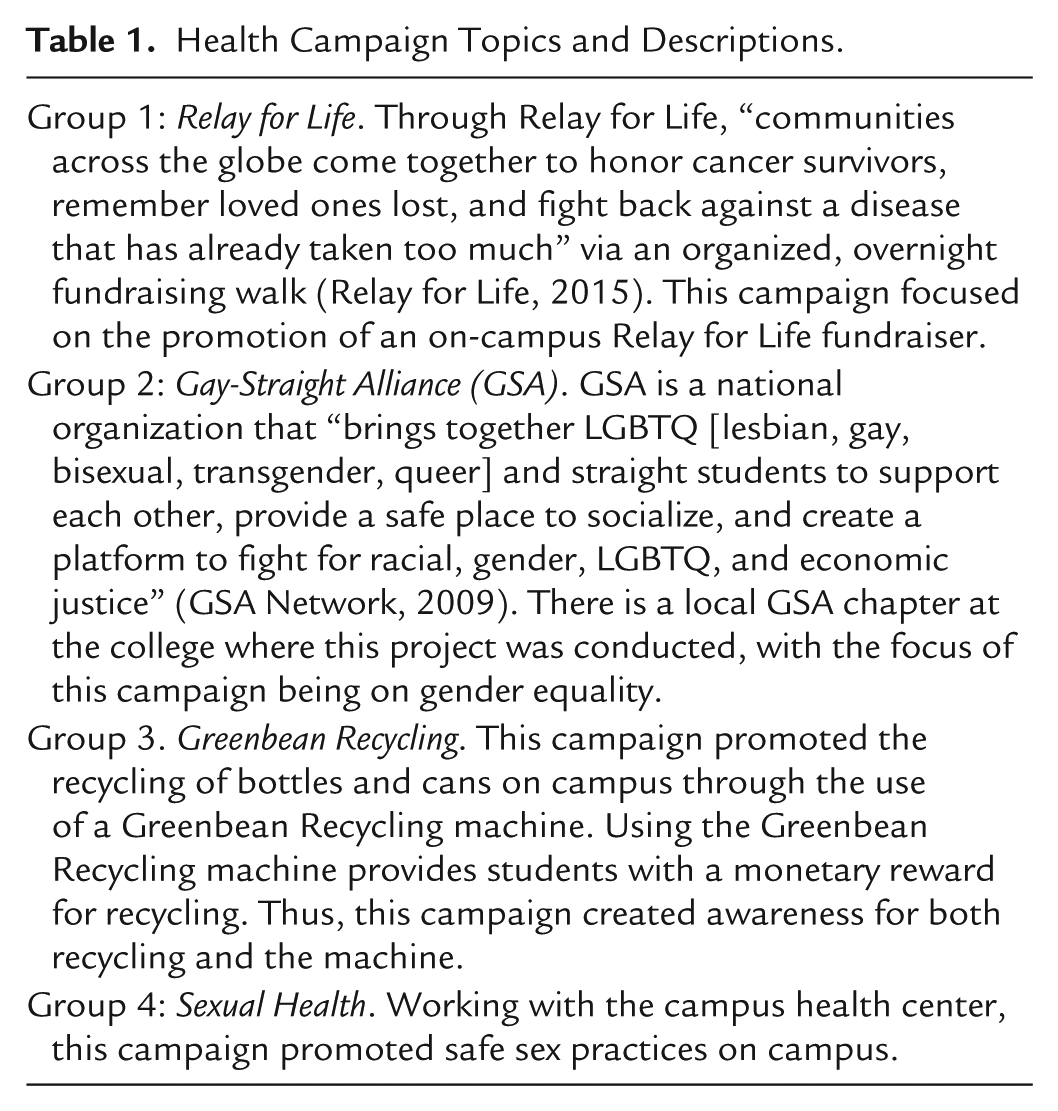
Over the course of a 15-week semester, small groups from each unique course were paired to work on a multichannel campaign. Student groups from the Health Promotion class selected topics (see Table 1), identified relevant theories, generated and tested message designs, and communicated their ideas to the corresponding student groups from the Visual Communication class. Groups in the Visual Communication course took this initial proposal and created drafts of campaign materials (e.g., posters, TV and online advertisements, and sticky-branded items). Groups then worked cooperatively from drafts to final products, having to navigate intra- and interclass group challenges (e.g., leadership and personality dynamics, transparency between courses, interpersonal communication difficulties across courses, and competing visions for the project). Thus time management, open lines of communication, and clarity of instruction were paramount to this project. After the campaigns were active for 1 week, students from the Health Promotion class self-developed quantitative surveys to measure audience (students on campus) attitudes/reactions, comprehension, and knowledge/behavioral shifts regarding their respective campaigns. Students from Health Promotion then used these data to propose next steps and extensions to the campaign. This final step occurred during the last week of the semester. Cooperative and experiential learning were used to provide the necessary pedagogical framework to guide the health campaign project across the semester.
Health Campaign Topics and Descriptions.
Theoretical Framework
Cooperative learning is “the instructional use of small groups through which students work together to maximize their own and each other’s learning” (Johnson, Johnson, & Holubec, 1994, p. 4). Through cooperative learning, group members are responsible for individualized information, teaching that information to their group members, and maximizing the effectiveness/efficiency of the group. This pedagogical approach deviates from traditional student–instructor/student–content interactions to student–student interactions, where groups submit work as a collective (McInnerney & Roberts, 2004). Furthermore, cooperative learning places an emphasis on reflection, which occurred formally at two points throughout the semester in the form of cooperative reports. These cooperative reports asked students questions related to their intra- and intergroup experiences and the status of the health campaign project.
In addition to cooperative learning framing student and instructor roles, an experiential approach was incorporated to foreground the importance of learning by doing (de Jong, 2006). Kolb (1984) asserts, “Learning is the process whereby knowledge is created through the transformation of experience” (p. 38). Based on this central principle of learning via transformative experience, experiential learning is more about the journey students take than the end product. This journey is broken into four phases where students: (a) work through a tangible experience, (b) reflect on that process, (c) abstractly conceptualize that experience through small group discussion, and (d) actively experiment and consider alternative approaches (Kolb, 1984). As summarized by Goby and Lewis (2000), “We have an experience, think about it, form opinions about it, consider the implications of these opinions for our understanding of our total experience and then approach the next similar experience in terms of our refined understanding” (p. 43). By working through Kolb’s four phases, it was expected that students would be able to foster communicative ingenuity because creativity and imagination tend to form out of the tension that arises as students learn by doing (Kolb, 1984).
When implemented effectively, the benefits of cooperative and experiential learning are impressive and include increases in comprehension of course content (Sharan, 1980), social skills (Johnson, Johnson, & Smith, 2007), student responsibility (Panitz, 1999), student achievement (Pray Muir & Tracy, 1999), as well as higher order critical thinking skills (Windschitl, 1999), more in-depth understanding of course content (Shimazoe & Aldrich, 2010), and increases in workplace preparedness (Shertzer & Schuh, 2004). While cooperative and experiential learning have previously functioned independently, the goal of this article is to demonstrate the utility of cooperative–experiential learning through a health campaigns project. This emergent hybrid project-based pedagogy model insists that many of the complexities of the working world are organically embedded in the student’s learning experience. Our analysis of student cooperative reports was guided by the following overarching question:
Method
Participants
Thirty-three students across the two upper-level undergraduate courses, Health Promotion (n = 19) and Visual Communication (n = 16), participated in the Health Campaigns Project. Two students were enrolled in both courses, and they were required to work on separate projects across courses.
Cooperative Reports
To assess how the intra- and interclass groups worked together on the campaign project, students completed cooperative reports during midterms and finals of a 15-week semester. The cooperative reports asked students to outline the relationships within and between groups, the effectiveness and efficiency of the intergroup experience, and to address any challenges. The midterm cooperative reports (completed Week 8) allowed the instructors to evaluate the group dynamics and mitigate any issues. Cooperative reports collected during finals (completed at the completion of Week 15) were meant to assess any intergroup dynamic shifts that occurred over the course of the semester and to gauge each student’s satisfaction with their final health campaign.
Data Analysis
Data analysis consisted of several steps, following a grounded theory approach. First, all cooperative reports were analyzed separately using open coding (Strauss & Corbin, 1990) to organize the presented data around salient processes. After the completion of open coding, the authors discussed their results. Based on these discussions, the authors organized and collapsed data into categories and subcategories to provide an overall view of participant descriptions (axial coding; Glaser & Strauss, 1967). In the final phase of data analysis, both authors worked jointly to further refine the previously identified categories (selective coding; Glaser, 1998) around the core theme of cooperation. On completion of selective coding, it was determined that saturation had been met as further analysis did not produce the need for additional categories (Strauss & Corbin, 1990).
Results
Before extrapolating the student responses, it is important to note that a number of the students acknowledged their excitement for the novelty of cooperative–experiential learning. This sentiment was succinctly summarized by “Rob” (Visual Communication student [VCS]; all student names are pseudonyms), “I like this project it’s definitely different, which I dig.” This project allowed us to diversify the classroom experience of our students, which can be observed in the student responses that follow four emergent themes: Communication Channels, Collective Experience, Workplace Preparedness, and Student Satisfaction.
Communication Channels
At the core of cooperative–experiential learning is the development of interpersonal skills. This was the most commonly identified theme by students in their cooperative reports. In discussing intra- and intergroup communication, students frequently stressed their reliance on electronic modes of communication—while also acknowledging that this reliance on technology contributed to communication difficulties throughout the project. As mentioned by Sam (Health Promotion student [HPS]),
In terms of between group, email is the main strategy. Unfortunately, it is not the best strategy because sometimes the overall meaning is lost in an email. In person is much more productive and free flowing. Also, things can be easily misinterpreted through email, which can also be problematic.
While students acknowledged the difficulties due to their reliance on e-mail and also noted the benefits of face-to-face meetings, few groups actually met face-to-face. Opportunities were developed for groups to have face-to-face interactions, yet students reported that conflicting schedules made it difficult to consistently meet in-person. A key learning opportunity is that students started to recognize the benefits of face-to-face interactions, the amount of effort it takes to schedule group tasks, and challenges associated will reliance on electronic means of communication.
Expanding on students’ difficulties with communication, many of the students discussed intra- and intergroup communication as a means of team building. As mentioned by Sam (HPS), “[This project] taught me how to work and vibe well within groups. With such a big project, it was interesting working with different viewpoints and ideas. It taught me how to better work in a team.” What is interesting about this quote is that Sam not only focused on how communication was integral to the success of his group, but that he also learned a valuable workplace-based skill set.
Collective Experience
One of the core competencies embedded in cooperative–experiential learning is the notion of academic development through problem solving and critical thinking. A majority of students felt the specialization of both classes aided the effectiveness of their overall health campaign:
I think working with the other group was beneficial because we were able to take our semi-complex ideas and bring them to life with help from the Visual Communication group. The digital design aspect of the project is their area of expertise, and no one in our group would have been able to pull that off. (Kim, HPS)
Students also expressed that an additional benefit of the cooperative–experiential process was that they were able to test their messages on group members before formally testing them on campus. Per Rene (HPS),
The benefit of working with the other class was getting more perspectives, especially from those who are not as familiar with Relay [-for-Life] as we are. This was beneficial because we were able to get the view of the audience members who don’t know a lot or anything about Relay and they offered good perspectives of how to make others understand it.
We noticed that as students developed the above skills, their uncertainty toward the novelty and uniqueness of this project shifted in their cooperative reports. Jessica (HPS) illustrates this juxtaposition nicely: “It has been a nightmare. The Visual Communication group has their own problems, which make working with them even harder. My health group is nice but the Visual Communication group is a mess.” This same student 7 weeks later stated,
They [Visual Communication group] were willing and unoffended to make whatever edits we suggested. They always had things done on time and had great communication with us. We compromised a little with them on [one of the posters] and it made all the difference in their attitudes towards us.
This particular student was highly vocal about her displeasure with the Visual Communication group, but shortly after midterms, rough drafts of the health campaign materials were due. These shifts commonly occurred for students as they began to see what the final product might look like. This shift was summarized concisely by Ken (VCS), “We finally got to see how our visuals tied in with the theory that [the other group implemented]. We became very much on the same page with how we want things to turn out.”
Overall, these positive student reactions are encouraging for the introduction of cooperative–experiential learning opportunities across discrete courses.
Workplace Preparedness
Students also seemed cognizant of how this project lined up with workplace-related projects, and expressed a desire to develop such skill sets. Corey (HPS) provides a nice review of this phenomenon, “Overall the experience working with our classmates and other students has been positive. It is beneficial to work with other groups and a variety of people because it is prominent in the workplace outside of college.” Mary (VCS) further articulated this point, “You get the real life ‘company & client’ aspect. You listen to what they want and then you [do] your best to give them what they didn’t know they wanted.” Kim (HPS) effectively summarized the workplace preparedness aspect of this project when she reported, “I will be putting this project on my resume.”
A slightly different perspective was offered by Elizabeth (VCS), “The (seemingly) group leader has a closed mind, instead of doing creative work she wants us to do her vision, which I guess is prepping us for the real world but is also frustrating.” While Elizabeth’s quote can be interpreted as defeating, it poses a clear learning opportunity. The ability to work in teams, while learning how to manage conflict and different personalities, is at the core of cooperative–experiential learning, and is also an esteemed workplace value.
Student Satisfaction
While it is important to consider learning through the process within cooperative–experiential projects, one cannot overlook the final product and associated satisfaction levels. Overall, most of the students’ final assessment of their own work was positive. As stated by Alex (VCS), “I am satisfied overall. There were areas I would have changed had it been entirely a one-woman project. But I am proud of our work and stand by it.” Demonstrating a little more satisfaction in the final product, Kim (HPS) stated,
I am extremely happy with our campaign. I didn’t think that we were going to end up with this successful of a final product, but I am glad we did. It is an important cause that needs to be advocated for. . . . I am proud of our campaign.
Regardless of the challenges faced by both the students and instructors, the overall theme of satisfaction was prevalent in the final cooperative reports. This project, then, provides a solid foundation that we look to build on at our college and also offers support for instructors looking to develop cooperative–experiential project-based learning that challenges students and places them in a context with which they are otherwise unfamiliar.
Discussion
Cooperative–experiential learning provides a unique, yet grounded pedagogical experience both in and out of the classroom. In their final cooperative reports, students acknowledged the benefits of being responsible for specific, detailed components of the overall campaign. This allowed students to develop an in-depth knowledge of their part, while also understanding how it contributed to the entirety of the project—a core tenet of cooperative learning (Johnson & Johnson, 1999). Group members were held accountable to one another, which manifested in the cooperative reports where students discussed member input and goal identification. Additionally, this project afforded students the opportunity to develop interpersonal and mediated communication skill sets, as well as problem-solving and critical thinking skills—all highly valued by employers (National Association of Colleges and Employers, 2009). Last, their ability to work cooperatively had a positive impact on the overall quality of and student satisfaction with their health campaign project. They were able to recognize the learning and development that occurred through the process of idea generation to implementation.
In both classes, students were taken through the four phases of Kolb’s (1984) holistic experiential learning model: having a concrete experience, reflecting on that experience, abstract conceptualization through small group discussion, and active experimentation. It was our hope that students would be able to foster communicative and persuasive ingenuity—as Kolb (1984) points out, creativity and imagination tend to form out the tension that arises as students move through the four phases of experiential learning. Indeed, commentary from the midterm cooperative reports point to tensions (both literal and figurative) that at the time were frustrating, even paralyzing. Yet, as indicated on the final cooperative reports, tension leads to particularly creative and imaginative health campaigns that were self-analyzed as more successful than if the student had to work on his or her own.
From a hybrid cooperative–experiential learning perspective, one cannot deny that the process of getting from start to finish greatly benefited the groups as it was their responsibility to make sure the project was completed and met certain standards (Johnson & Johnson, 1999; Kolb, 1984). It was through this process that incidental, subterranean learning took place. We also noticed that students learned through their management of uncertainty, which occurs when individuals are presented with a situation that is unpredictable and/or ambiguous (Brashers, 2001). The final cooperative reports allowed students to reflect on these experiences, and on looking back over the course of the semester, were able to recognize that uncertainty is not inherently negative as it challenged them to assimilate with the group and focus on the process instead of hyperfocusing on the end goal.
Student responses throughout the cooperative reports, even those that were critical of the project, strongly correlate with the objectives of cooperative–experiential learning: development of communication competencies, problem solving, critical thinking, and workplace preparedness. This article should be seen as a call-to-action to integrate assignments into the classroom that not only provide students with a theoretical/conceptual foundation but also allow students to learn by doing. While cooperative–experiential pedagogy takes a significant time commitment from the instructor(s), the outcomes are invaluable to student development. Helping students develop an understanding of course content, as well as how to apply that content, should be the goal of educators. Cooperative–experiential projects address that goal.
Incorporating Cooperative–Experiential Pedagogy
To complete a cross-course project-based cooperative–experiential project of your own, consider the following action steps as your prepare your courses and the parameters of your project.
First, be sure the classes meet at the same time; this will ensure that no students will end up in both classes and perhaps more importantly will provide groups with a built-in time when all students can meet. Second, identify health-related causes and organizations for students to work with, rather than simulations. This will provide students the opportunity to work on deliverables that are tangible and measurable. If possible, incorporating external organizations into the project opens students up to the benefits of working with people exogenous to the insular college campus setting to truly highlight the experiential components of the project.
Third, collaborate as instructors to work out as many logistics on the front end to be sure details like grading rubrics and project expectations are fair and clearly explicated across both courses. Fourth, have a plan for how to “take the temperature” of each group at multiple points throughout the semester (either in the form of face-to-face meetings with each instructor or in the form of written midterm and final evaluations of the project).
Fifth, prepare to be flexible in your pedagogy as this type of cooperative–experiential project is less predictable than standard pedagogies. Like the arc our students experienced, as instructors we went from deep uncertainty and tension about the cross-course project to great satisfaction and a sense of accomplishment as we moved through the semester. Experiential learning is about the process, not the end goal (Kolb, 1984), and we found that we learned the most about how to make this type of project a success while in the thick of working with our students on their projects.
Footnotes
Declaration of Conflicting Interests
The authors declared no potential conflicts of interest with respect to the research, authorship, and/or publication of this article.
Funding
The authors received no financial support for the research, authorship, and/or publication of this article.