




Abstract
Innovative learning strategies are constantly developed to increase student engagement and application of course content to improve learning outcomes. Gameful Learning pedagogy is one such strategy that builds students’ intrinsic motivation, confidence, and engagement to course material by allowing them to choose from a menu of optional assignments to earn points toward a grade. Little is known about student perceptions and outcomes from applying this pedagogy to dietetics and nutritional sciences graduate-level curricula. This article describes the implementation of Gameful Learning to an Accreditation Council for Education in Nutrition and Dietetics–accredited nutritional sciences graduate degree course and evaluates student perceptions and outcomes. Two student cohorts from 2016 (pre–Gameful Learning) and 2017 (implementation of Gameful Learning) who were enrolled in a nutritional sciences graduate-level course were compared. Student teaching evaluations were compared across cohorts. Specific items measuring student perceptions of fairness, knowledge gained, and workload were analyzed. Mann–Whitney nonparametric tests compared groups and Spearman’s rank correlation coefficient measured associations. There was a positive correlation between total points and optional points (Pearson’s r = 0.513, p = .0001). There was an overall increased perception toward the excellence of the course (3.82 to 4.13; 5-point Likert-type scale), improved sense of fairness (3.79 to 4.17; p = .036), and increased perception of workload (2.35 to 2.20; where 1 student indicated more work and 5 indicated less work). Although challenges in workload exist, Gameful Learning strategies aid in improving student outcomes and perceptions of course material by facilitating student autonomy and engagement with course content.
When students are given autonomy for coursework they will develop a stronger sense of motivation and relatedness to the material that they learn (Ryan & Deci, 2000). Gameful Learning is a pedagogical approach developed based on elements of the self-determination theory (SDT) (Ryan, Kuhl, & Deci, 1997) which promotes intrinsic motivation (i.e., doing something for your own sake) with the notion that this type of motivation leads to cognitive and social development. Given the framework of SDT, Gameful Learning pedagogy then leverages student autonomy, abilities, and interests to produce intrinsic motivation when engaging in course assessments (Aguilar, Holman, & Fishman, 2018). Thus, if students understand their own strengths and what they are interested in, when given a difficult assignment, they will have confidence and motivation to complete that task successfully. Given this sense of confidence and motivation, they can connect with the course material and assignments and find these purposeful (Lee & Doh, 2012). Naturally, this pedagogy builds up metacognition within students so they are in tune with how they learn, what skills they have and use, and what type of skills they need to improve (Coutinho, 2007; Millis, 2016).
To develop a Gameful Learning pedagogy, multiple optional assignments are created by the instructor so students choose to engage in a select series of assessments in addition to a handful of required assignments. It is best practice if each assignment has clear learning objectives and outcomes (Gameful Learning Team, 2018; Holman et al., 2015). The students are not expected to engage in every assignment yet should have enough choices to be able to work on more than one type of assignment. Students in a course using the Gameful Learning approach start with zero points and gain points toward a prespecified target associated with a grade. They earn points with the intent that they will choose assignments based on their interests and the types of assessments they know they do well on, find enjoyable, or are interested in attempting. This structure allows students an opportunity to engage in work they are interested in, yet they know will be challenging and do not know if they will succeed or enjoy engaging in the work; thus, it allows students freedom to take risks, be creative, and potentially fail, given they can earn points elsewhere (Holden et al., 2014; Songer & Miyata, 2014).
We describe the process of implementing this pedagogy within a required course for an Accreditation Council for Education in Nutrition and Dietetics–accredited nutritional sciences graduate degree program (Commission on Dietetic Registration, 2017). We report on student outcomes represented by summative assessments and course evaluations as compared with the previous cohort that experienced a traditional pedagogy. Finally, we offer insight to the barriers we faced before, during, and after the semester. To our knowledge, the innovative pedagogy of Gameful Learning has yet to be described in a nutritional sciences– or dietetics-based course.
The course that we implemented the Gameful Learning pedagogy is called Nutritional Sciences: Principles of Nutrition; it is a required and foundational course for all Nutritional Sciences graduate students at the University of Michigan. This is the first course taken as part of their graduate program, and currently the only one using a Gameful Learning pedagogy. This course covers nutrient biochemistry, gastrointestinal physiology, endocrinology, and metabolism and is a prerequisite for subsequent classes that MPH, PhD, and MS students take during their training. Students come from diverse academic backgrounds and enter the nutrition program with a variety of interests and career goals. These range from working as a clinical dietitian to practicing public health nutrition or nutritional sciences research. This course has historically presented several challenges. Students with a limited biochemical background find the material dense and overwhelming, and thus, challenging to relate to their interests. Alternatively, students with a strong background in biochemical nutrition find the course content repetitive, and consequently, does not pose sufficient intellectual challenge.
As such, Aguilar et al. (2018) report that factors such as “preview achievement” and “interest in class” are not associated with a student’s willingness to attempt novel assignment types; thus, we decided that a Gameful Learning approach may alleviate some of these challenges. Our goal was not only to maintain a rigorous set of core competencies but also to provide students intellectual space to explore areas of interest and pursue assessments interesting, meaningful and relevant to those interests. By providing choices of assessments and a range of topics through Gameful Learning pedagogy, we provided students the opportunity to engage with course content in a meaningful way with a clearly defined path ending in the achievement of all expected learning outcomes. As noted by Lefers and Birkenkrahe (2016), the context of curriculum, quality of users, and design quality were key factors that determined the overall success of gameful strategy.
Methods and Materials
Process of Developing and Implementing Gameful Learning
Required assignments are still valuable with Gameful Learning to ensure that students are able to master core competencies. As instructors, we wanted to make certain students would not solely focus on optional assignments without demonstrating mastery of the courses’ core competencies. The required assignments, midterms, quizzes, and in-class assignments were set to be worth a point value such that if a student earned 100% on each of these, the total points would be enough to result in an A (Table 1). We set an A grade to be worth 1,000 points, with every 50 points below resulting in a drop in grade level (i.e., 1,000 points = A, 950 points = A−, etc.). Based on the previous year, the median student received 86% on these assignments, so we expected the median student to receive 860 points from required assignments, and therefore, would need to gain 140 points from optional assignments to earn an A (Table 1).
List of Core and Optional Assignments.

Note. TBD = to be decided.
Students were instructed on the first day of class to plan out their semester using a “GradePredictor” tool in GradeCraft, a web-based learning management system (Holman, Aguilar, & Fishman, 2013). The students were reminded to update their projections following each exam. A detailed list of assignments, their descriptions, and points were explained in the syllabus. For optional assignments and rubric examples, please refer to Supplemental Appendices A and B (available in the online version of this article).
Students were encouraged to choose from a variety of optional assignments such as in-class presentations, written reports, peer grading, and formulating review questions (Table 1). Depending on time and intellectual effort that the instructors estimated would be required to complete the optional assignment, points were distributed accordingly. For example, students were given the option to submit one written report on a topic of their choice related to the course, worth a maximum of 75 points (Table 1; Supplemental Appendix A). The instructors estimated that this was an assignment that would take a sufficient amount of time, intellectual effort, and thought, and is one such assignment with a higher point value.
Assignments were submitted through GradeCraft. GradeCraft also housed grades and rubrics for each assignment as well as GradePredictor giving the student (and instructor) an easy-to-access platform to monitor points earned throughout the semester. Another tool we used in Gradecraft was the Badge award system. A list of badges was created to motivate student performance. Badges were awarded for events such as advancing a level/grade, signing up for an in-class presentation, or asking an interesting question in class.
Data Analysis
Teaching evaluations were compared from the year in which Gameful Learning pedagogy was implemented (2017; n = 32 of 51 students enrolled) to the prior cohort (2016; n = 34 of 48 students enrolled), wherein the course content was similar and students only completed the required assessments which determined their grade (noted in Table 1). We compared anonymous end-of-course evaluation scores from the Gameful Learning cohort with the course evaluation scores from the pre-Gameful Learning cohort. Specific evaluation questions were measured reflecting student’s perceptions on the general areas of “Fairness,” “Knowledge Gained,” and “Workload.”
Statistical significance was defined as p < .05. Analyses were done in R version 3.5.0 (R Core Team, 2018) using Mann–Whitney nonparametric tests to compare groups or Spearman’s rank correlation coefficient to interrogate associations. The study protocol was approved by the institutional review board at the University of Michigan as exempt (IRB: HUM00145801). Student consent was obtained through authenticated email.
Results
Student Outcomes
The final points and grade distribution are shown in Figure 1A. In comparison with the previous year, more students received an A grade, but as shown in the distribution, a large number of students had substantially more points than required for an A (i.e., >1,000 points). As intended, the majority of points obtained by students were from the required assignments, with the median student obtaining 78% of their points (799 overall points) from these assignments. This was slightly lower than predicted a priori (860 points). The median learner earned 228 points (22% of total points) from optional assignments (Figure 1B). There was a positive correlation between total points and optional points (Pearson’s r = 0.513, p = .0001).
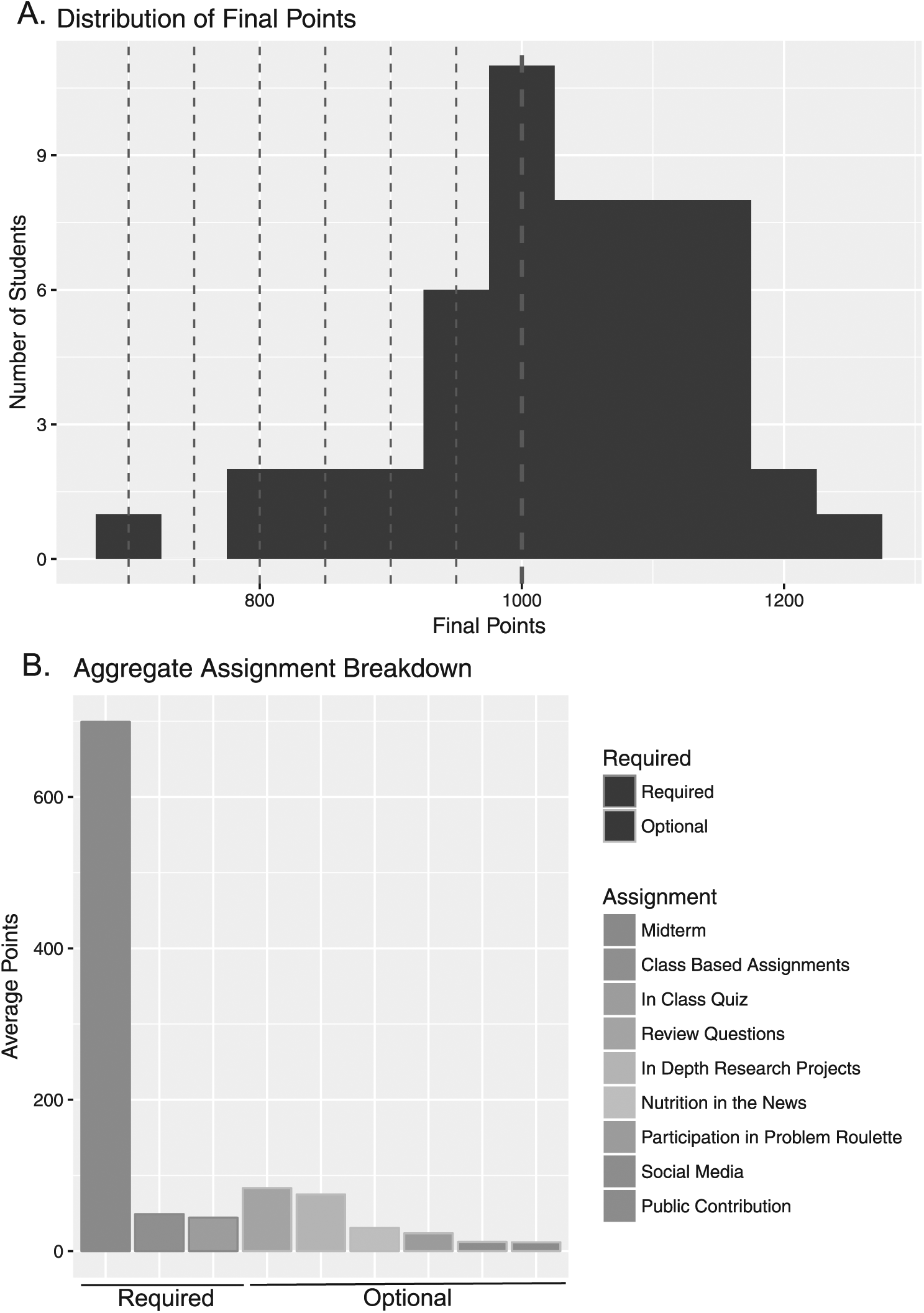
Allocation of student points: (A) distribution of the final points where 1,000 points is the cutoff for an A grade and (B) average points earned from each assignment type.
Student Perceptions
Feedback from end-of-course evaluations indicated an overall positive perception toward the course and an improved sense of fairness, but a concern about overall workload. Students were asked to evaluate the statement “This is an excellent course” on a 5-point Likert-type scale. As shown in Figure 2A, we observed an average increase in mean student ratings from 3.82 to 4.13 after Gameful Learning implementation.
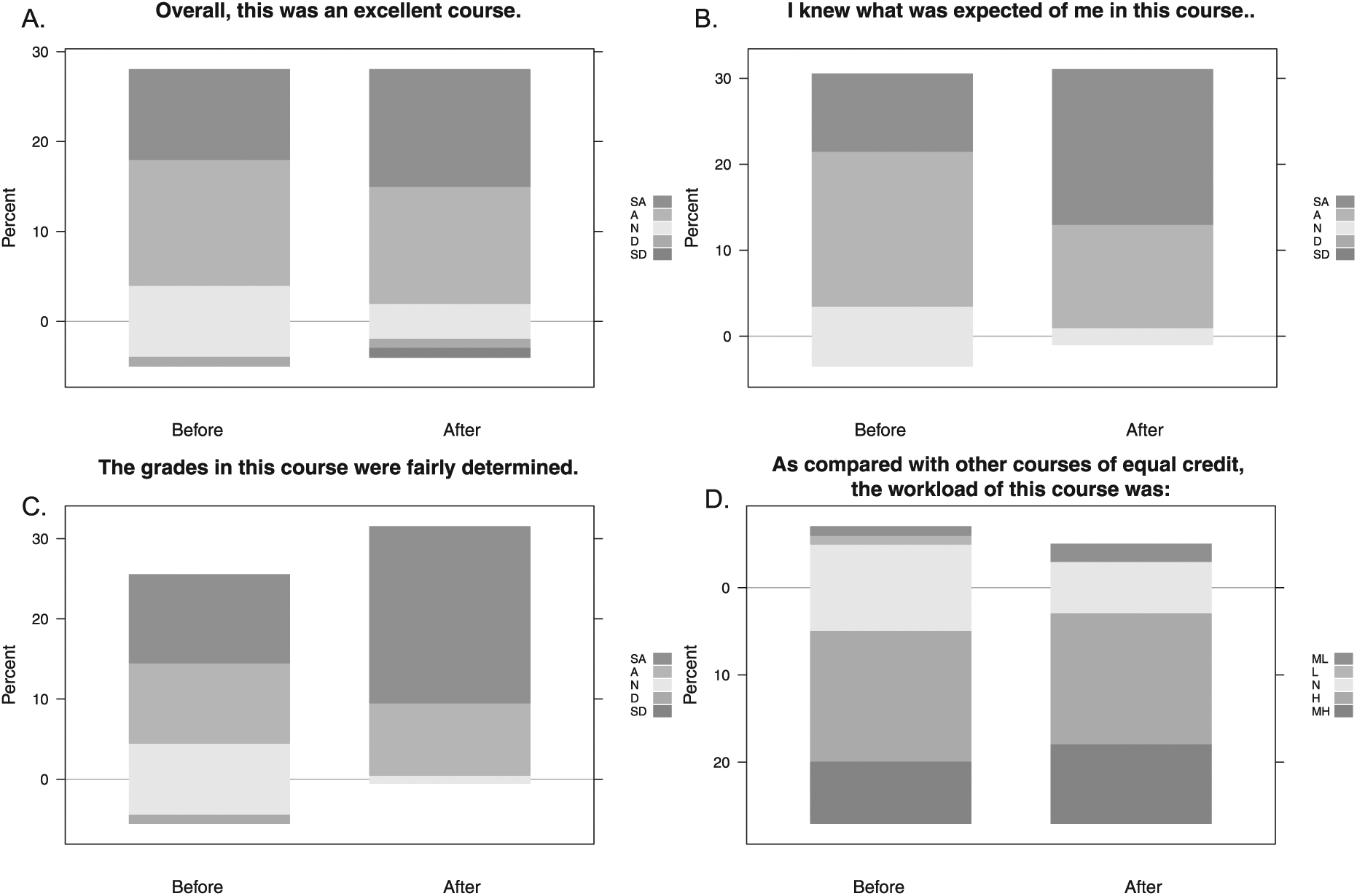
Distribution of evaluation scores of the Gameful Learning cohort compared with the pre–Gameful Learning cohort.
We observed increased affinity toward the evaluation statement representing fairness “I knew what was expected of me in this course” which increased from an average of 3.79 to 4.17 (p = .036). Similarly, the statement “The grades in this course were fairly determined” increased from a mean rating of 3.82 to 4.30 (p = .022; Figure 2B and C). Alternatively, we saw a decrease in the statement “When compared with other courses of equal credit, the workload of this course was . . .” which decreased from 2.35 to 2.20 where 1 indicates more work and 5 indicates less work (Figure 2D).
Discussion
Student Outcomes and Perceptions
A substantial proportion of students earned more points than required for an A grade. One possible explanation is that student interest in optional assignments led them to do more of these than needed for an A (Figure 1A). Furthermore, students indicated that the course load was heavy compared with other courses of the same credit hours. The perception of heavy work load may also relate to the large number of assignments available. If students had a challenging time predicting their grade, then they may have engaged in more assignments than needed for security measures. Alternately, one of the main purposes of Gameful Learning pedagogy is to increase student engagement with course material under the principle that directly spending more time with content will lead to higher cognitive student learning outcomes (Ericsson, Krampe, & Tesch-Römer, 1993). Thus, perception of a heavy work load may indicate that students are engaging more with the material in ways that they do not within conventional classrooms.
We were surprised there was a positive correlation between total points and optional points, indicating that high-performing students gained more points from optional assignments. In other words, students who performed poorly on examinations did not compensate by attempting to earn more points from optional assignments. Aguilar et al. (2018) have illustrated that although Gameful Learning leads to increased autonomy and engagement, there is still a subset of students who heavily rely on standard grading. This may indicate that poor-performing students (in terms of course exams) are not choosing extra-optional assignments simply because they are resistant to change. We originally postulated that students who performed poorly on tests would be able to self-assess this and select other assignments to compensate. Future work will test whether self-assessment of skills to successfully complete an assignment correlates with active choices to select this type of assignment. We will also test whether prompting students to think about their self-efficacy will change their assessment choices. It will also be of value to explore whether students using web-based learning management systems show increases in self-efficacy and learning outcomes at the end of the course, as suggested by Fuchs and Wolff (2016).
Students indicated that they knew their expectations throughout the duration of the course and felt that their grade was fairly determined. These data suggest the ability to choose assignments with transparent point values enhanced feelings of fairness. Perceptions of transparency may also be compounded by active engagement in deciding which assessments to complete. This is not surprising given the emphasis of student autonomy with Gameful pedagogy (Ryan & Deci, 2000). While one may predict that gaining or losing points would be equivalent in the mind-set of a student, prospect theory demonstrates that the aversion to a loss is stronger than the value from an equivalent gain. It stands to reason then, that losing points would result in a disproportionately larger reduction in student motivation and engagement than gaining points. While this study did not directly test this hypothesis, we believe that it is reflected by in increased perceptions of fairness.
Student Benefits
Several benefits were reaped by students after engaging in Gameful Learning such as autonomy and increased engagement with course material. One illustration of this is the ability for students to expand their knowledge in a nutrition topic of interest, or on the contrary, to challenge themselves by delving into a topic they had no prior knowledge of (Arnab, 2016). Among optional assignments, students were awarded most points for in-depth research projects including written reports, oral presentation, peer-review of oral presentations, and development of review questions (Table 1). These types of assignments push the students beyond the limitations of earning a grade by performing well on traditional assessments like exams. This learning process allows for high-contact engagement with course material (Dweck, 1986; Nolen, 1988).
Written reports were designed as an in-depth research project allowing students to thoroughly explore a topic related to course content. Engagement in this assignment allowed students to develop research skills and builds the ability to filter through published literature within various scientific databases, formulate a cohesive understanding on the subject matter, and accurately communicate information in a written manner. For students in the Nutritional Sciences Department pursuing a career in dietetics or research, this assignment results in lifelong transferable skills since dietetics is an evidence-based field (Gray & Gray, 2002), as stated by a student “I learned how to thoroughly examine journal articles with respect to the type and quality of study, how to critically interpret results, and understand confounding and limitations in a study.”
Students were provided the option to peer-review in-class presentations. This was an assignment that students could engage in multiple times throughout the semester if they signed up for an oral presentation or written report. The reviewer’s responsibility was to reflect on the presentation and presenter by reviewing the content, presentation style, relevance, and responsiveness. With practice and exposure to multiple peer-review assignments, students are able to develop communication skills of providing constructive feedback to their peers in a positive manner (Cassidy, 2006; Nofziger, Naumburg, Davis, Mooney, & Epstein, 2010). These are important skills to be gained for future practitioners in the field of nutrition because they not only aid in the exchange of ideas, values, and perspectives with fellow peers but also allow them a space to reflect on how they behave as the recipients of feedback (Borton & Anderson, 2018).
The review questions assignment was another prime example of translating learned material in class to formulate broad course concept questions. Students developed three multiple-choice questions from each week’s course content to be used for review sessions prior to each exam. Developing review questions can be considered an effective learning strategy that uses the concept of elaborative interrogation and self-explanation which involves validating a particular fact/concept or relating new information to what is already known (Lokse, Lag, Solberg, Andreassen, & Stenersen, 2017).
With many assignment options available, our hope was for students to use these resources to navigate the best course of action for their style of learning and personal interests giving them a full sense of autonomy. This is illustrated by the student comment, “I liked the GradeCraft assignments because it gave you opportunities to learn and apply materials differently.” Students were encouraged to plan and choose their own path to an A grade by combining core and optional assignments, and frequently use GradeCraft’s grade predictor tool to make sure they were on their desired track. This methodology provides students with the ability to develop successful planning and monitoring skills to become effective learners beyond this nutrition course. As presented by Holman et al. (2015), use of the grade predictor tool significantly increased leading up to exams and in response to assignment due dates, suggesting that there is potential for providing students with opportunities and tools to empower and provide autonomy over their own learning outcomes. As it is a terminal professional degree for the majority of students in this program, Gameful Learning pedagogy is an important tool for students to build lifelong self-directed learning. By learning to select, manage, and assess their own activities, students develop individual responsibility and initiative taking which are key skills that will benefit successful choice-making in their career (Pintrich, 2000). As future dietitians, this type of practice can be applied to motivational interviewing, a common type of counselling that invites patients to generate their own set of ideas about behavior change and identify changes that are most intrinsically rewarding and most likely to be successful (Resnicow & McMaster, 2012). The number of choices must be balanced versus feelings of too many choices. In our conception, we offered 11 optional assignments, slightly more than the 2 to 9 optional assignments typically offered in courses using a Gameful Learning pedagogy (Gameful Learning Team, 2018).
Barriers to Developing and Implementing
One barrier in Gameful Learning is identifying appropriately valued assignments. Our approach, to aim for ~80% of final points to be based on required assignments and 20% to be based on optional assignments, seemed prudent to ensure that all students would be assessed properly on core competencies. We overestimated the points students ultimately earned from required assignments potentially because in previous years these required assignments comprised their entire grade, and now students could deprioritize these assessments in favor of other activities. We surveyed students for their perception of whether an assignment was fairly rewarded. Students found that written reports were undervalued and social media posts were overvalued. Built in to our initial designation of point scores in Table 1 was to incentivize certain assignments (peer-reviews, summative review questions, written reports) by intentional overvaluation due to our view of how useful these are as learning tools to gain professional skills.
Another challenge is to allow for sufficient student choice, but to balance with feelings of being overwhelmed. It has been found that with too many choices within an academic course, students find the material difficult to manage (Crawford, 2000). It was clear that many students felt the workload to be heavy and breadth of assignments overwhelming. Many students earned far more points than necessary to earn an A, further suggesting that students had difficulty effectively choosing assignments to balance points and effort.
From an instructor perspective, we found challenges while implementing the pedagogy such as training students in the mechanisms of the class when only 2 of 51 students reported prior experience with Gameful Pedagogy. Last, the diversity and quantity of grading increased from previous offerings. The instructional team (two faculty and one teaching assistant) divided grading and developed rubrics for each assessment, yet the grading workload was increased and consistent rather than having planned times throughout the semester to grade summative assessments.
Future Directions
Given the overall positive feedback and improvements in course evaluations, our instructional team plans to continue to use Gameful Learning in this nutritional sciences course. We will address constructive feedback given by students aimed to improve optional assignments (see Table 1). We also plan to explore targeted learning outcomes. One benefit of this pedagogy is that by having assignments that can be completed multiple times (e.g., peer-review), the instructors have more opportunities to provide feedback, and the student has multiple opportunities to learn from their mistakes and improve their work. By engaging in this iterative process students are developing metacognition, a professional attribute crucial for nutrition professionals, which can be taught through a Gameful Learning experience (Cho & MacArthur, 2010; Ericsson et al., 1993).
Supplemental Material
PHP814022_Supplemental_Appendix_A – Supplemental material for Increasing Student Engagement Within the Core Nutritional Sciences Curriculum: A Gameful Learning Approach
Supplemental material, PHP814022_Supplemental_Appendix_A for Increasing Student Engagement Within the Core Nutritional Sciences Curriculum: A Gameful Learning Approach by Dave Bridges, Rina Hisamatsu and Olivia S. Anderson in Pedagogy in Health Promotion
Supplemental Material
PHP814022_Supplemental_Appendix_B – Supplemental material for Increasing Student Engagement Within the Core Nutritional Sciences Curriculum: A Gameful Learning Approach
Supplemental material, PHP814022_Supplemental_Appendix_B for Increasing Student Engagement Within the Core Nutritional Sciences Curriculum: A Gameful Learning Approach by Dave Bridges, Rina Hisamatsu and Olivia S. Anderson in Pedagogy in Health Promotion
Footnotes
Acknowledgements
We would like to thank Evan Straub from the Office of Academic Innovation at the University of Michigan for her guidance in implementing Gameful Learning.
Declaration of Conflicting Interests
The authors declared no potential conflicts of interest with respect to the research, authorship, and/or publication of this article.
Funding
The authors disclosed receipt of the following financial support for the research, authorship, and/or publication of this article: Author DB would like to acknowledge the salary support of his NIH Grant R01DK107535.
Supplemental Material

References
Supplementary Material
Please find the following supplemental material available below.
For Open Access articles published under a Creative Commons License, all supplemental material carries the same license as the article it is associated with.
For non-Open Access articles published, all supplemental material carries a non-exclusive license, and permission requests for re-use of supplemental material or any part of supplemental material shall be sent directly to the copyright owner as specified in the copyright notice associated with the article.
