



Abstract
To ensure student engagement and optimal preparation of the future workforce, academic educators frequently and repeatedly update curricula and pedagogic approaches. Evaluation of these updates often focuses on how well the chosen educational technique achieves its goal. For updates that add a new learning goal, it is important that evaluation considers the value of the goal in a crowded curriculum. Peer-to-peer feedback and coaching provides a low-investment and timely method of evaluation and can be facilitated by conferences focused on pedagogy. This coaching article uses a case study of an assignment for postgraduate students incorporating student-produced videos developed independently at three Australian universities. The authors learned of one another’s work in preparation for delivering presentations at a conference focused on teaching public health and decided to collaborate on a single workshop. In the process, they reinforced and expanded their understanding of the benefits and important considerations for a video assignment and engaged in two-way coaching with conference delegates from across Australasia. Benefits include teaching students skills that will become increasingly important in their future careers, the potential for enhanced student engagement due to novelty, and resistance to plagiarism. Important considerations include explaining the aim and parameters of the assessment as well as minimizing student anxiety. Preparation for the workshop led to refinements in some of the assessments. This article is simultaneously an affirmation of the value of peer-to-peer coaching opportunities that can arise at pedagogy conferences and an argument for the value of video assignments in public health education.
Introduction
With rapid change in the Australian tertiary education sector (rapid growth, increased student numbers, internationalization, and reduced funding), public health academics have many demands on their time, requiring prioritization based on the best return on investment. Possibilities include maintaining health subject matter expertise, publishing, administrative work, as well as activities to directly support individual classes and students. Such support requires frequent updates to curricula to keep pace with changes in technology, student demographics, and expectations. Updates are ideally built on a solid evidential basis, but time constraints and novelty can limit educators’ capacity to compile and assess the evidence.
There are a variety of techniques for evaluating curriculum changes, including before and after the change has occurred, and academics need to determine the most appropriate evaluation method. This determination should consider how much time such evaluation will take, given the associated opportunity costs. A review of the literature is helpful provided the literature is mature. However, each teaching context is different, and no previous study is directly transferable to an academic’s classroom. Important variables affecting the utility of a published pedagogical approach include the academic discipline and cultural context in which it is employed (Fuller & Clarke, 1994). The United States is the origin for much of the literature on public health pedagogy. For instance, this journal is the first substantive journal focused on the pedagogy of health promotion and public health. Of the 30 first authors in Volume 1 of this journal, 26 listed their first affiliation as an American institution. Academics outside of the United States are frequently challenged to estimate how unwritten cultural factors might affect transferability.
Updates in response to new opportunities require deeper appraisal. This includes an evaluation of whether the intended effects of the teaching update are worthwhile. For example, video production technology is proliferating, and there is increasing use of social media platforms by those working in health promotion. Using an assignment incorporating a student-produced video (hereafter referred to as video assignment) to teach students about public health is one potential update. The novelty introduces additional levels of evaluation. This includes judgements about whether a video assignment is a good way of teaching students about public health and how it can be optimized. More deeply, educators need to evaluate whether the goal of teaching students about public health with a video assignment is a worthwhile goal in the first place. Early on, there may be no or little literature assessing a chosen technique for achieving this goal against alternatives, or, about the value of that goal in a crowded curriculum. This is the case for video assignments in public health and, more generally, where the literature is small and still developing. This increases the relative value of peer coaching in making curriculum decisions involving video assignments.
Peer-to-peer coaching, including that facilitated by pedagogy conferences, is an important option for academics evaluating updates in their curricula. Advantages include relatively little investment of time and utility either before or after an update has occurred. Peer feedback is an ideal way to evaluate teaching especially early on in the implementation of updates.
Multifocal Coaching
The aim of this article is primarily to provide coaching to academics about the use of video assignments in teaching public health to postgraduates. In doing so, it underlines the value of conferences in which academics can discuss pedagogy. This creates a second level of coaching within this article, aimed at maximizing the utility of conferences for participants and conference organizers. As part of this discussion, it highlights how conference presenters can act as coaches for one another and for their audience while active audiences can also coach presenters. There were several key elements that maximized the opportunity for coaching in this example. The first was having a mechanism for conference organizers to detect and act on presentations with similar topics. For the relatively small conference discussed here, it meant having one person read all abstracts and group-accepted presentations in the program. The conference presentation types also allowed for multifocal coaching. In this case, a workshop format allowed for dialogue between and among presenters and the audience. A spirit of collegiality and mutual assistance between the presenters ahead of the presentation ensured a free flow of information designed to honestly assess strengths and weaknesses in each university’s assignment. A systematic approach to this led to the creation of the forerunner to Table 1. Finally, the presentation itself was structured to seek feedback from the audience on a number of key issues, with time reserved for this after an initial description of the three video assignments described here. With presenters recognizing that this type of assignment was new and improvement was therefore possible, a spirit of dialogue pervaded rather than a “sage on the stage” presentation.
Key Variables in the Assessment Between the Three Universities.

Video Assignment: A Case Study
This coaching article recounts the experience and outcomes of three academics using a video assignment in teaching public health to postgraduate medical and public health students. Two of the authors (SH and AB) independently submitted abstracts for presentations about video assignment to an Australian teaching and learning forum held annually by the Council of Academic Public Health Institutions Australasia (CAPHIA). CAPHIA is the representative organization for institutions that teach and research public health in Australasia. In reviewing abstracts, the third author (DCB) noted the overlap in topic and had recently assumed responsibility for a course that had implemented a video assignment. SH and AB’s abstracts were accepted, and the two were invited to combine their work to give a workshop, in turn inviting DCB to add experiences from his university. This article describes the motivation for using video assignments in public health education and outlines the design, implementation, and initial evaluation of these assessments from postgraduate public health courses at three universities across Australia (Table 1). In doing so, it demonstrates the value of coaching opportunities that can arise at pedagogically focused conferences. The evaluation at Macquarie University has ethical approval from Macquarie University Human Research Ethics Committee (Project ID: RR03294). The authors considered the evaluation of the assessment from The University of Western Australia to be consistent with the National Health and Medical Research Council Quality Assurance and Evaluation Activities; hence, no formal review was sought from the institutional review board (National Health and Medical Research Council, 2014).
Video Assignment Background
Among the core competencies for public health graduates are evidence based practice and health communication. In Australia, this has been recognized by the CAPHIA in the Foundation Competencies for Public Health Graduates in Australia (Somerset, Robinson, & Kelsall, 2016). Public health practitioners are frequently called on as experts to interpret research findings clearly, accessibly, and concisely. Traditionally, this skill has been assessed via an in-class presentation. Video technology has become more accessible, which has enabled greater use for practice and assessment in education. A video assignment may improve student engagement and higher order thinking. It reinforces content and is less vulnerable to plagiarism. Furthermore, with video technology and platforms proliferating, video production is an increasingly useful skill for those working in public health.
Benefits of a Video Assignment
In the process of collaborating, the three authors understood that their perceptions of the benefits of a video assignment were similar, though the process expanded the understanding of each. Student engagement with activities can be increased when they are novel (Mitchell & Carbone, 2011). Video-based assignments in education have been in use for more than 10 years; however, they are still relatively new in tertiary public health education (Kearney & Schuck, 2005). Novel tasks can also increase student motivation about assignments and subsequent pride in the results (Greene & Crespi, 2012; Kearney & Schuck, 2005).
The creation of a video is an active learning process for students. They are required to critically review the literature, conceptualize a target audience, tailor an argument or design a “story” for a specific audience, as well as create, record, and edit the video. The process of reviewing the evidence base, synthesizing a message, and creating the video uses higher order thinking and is increasingly recognized as a necessary skill for the workforce (Miller & Dumford, 2016). The pedagogical literature supports this interpretation, with students’ perceptions of learning reported as high with a video creation assignment (Ritchie, 2016).
Video assignments can also be a powerful learning tool, as synthesizing information to create an argument or a story for a video and then editing the video is typically iterative. The students prepare and write key pieces of information and then film and edit. Each step provides students with opportunities to review, strengthen, and reinforce content material.
It is important for public health graduates in either undergraduate or postgraduate courses to have applied public health practice that prepares them for employment in the public health workforce. Authentic learning experiences that allow students to “learn by doing” with tasks that reflect real-world scenarios allow the learner to turn information into useful transferrable knowledge (Lombardi, 2007), and therefore learning tasks become more meaningful (Boud & Falchikov, 2007).
An additional benefit of video assignments is to minimize the opportunity for academic misconduct by students via plagiarism or ghost writing as students typically feature as the characters or actors in their video assignments (Ako Aotearoa National Centre for Tertiary Teaching Excellence, 2016). This reduces the concerns of plagiarism faced currently in tertiary education.
Video assignments allow for additional review by both the assessor and the student. The assessor is able to review the video at a later date, in contrast to the nature of in-class presentations. Additionally, students are not always able to recall their communications from an in-class presentation, so a recording allows them the opportunity to reflect, practice, and refine their skills.
Importantly, the independent development of a video assignment at three Australian universities at a similar time enhances the face validity of the goals of such an assessment. It is evidence of a growing view that video production is understood as an important competency for public health graduates.
Considerations for Planning and Designing a Video Assignment
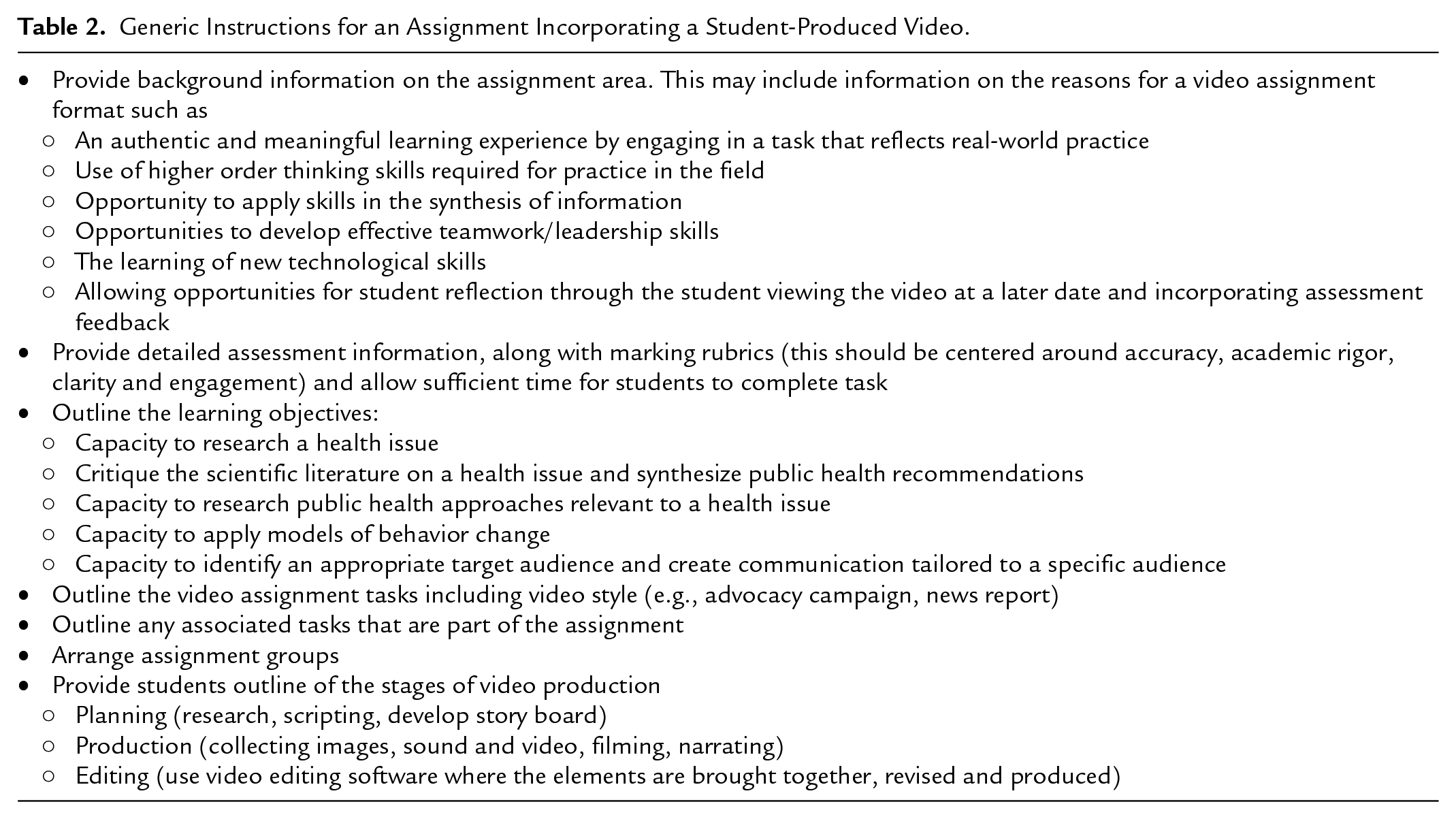
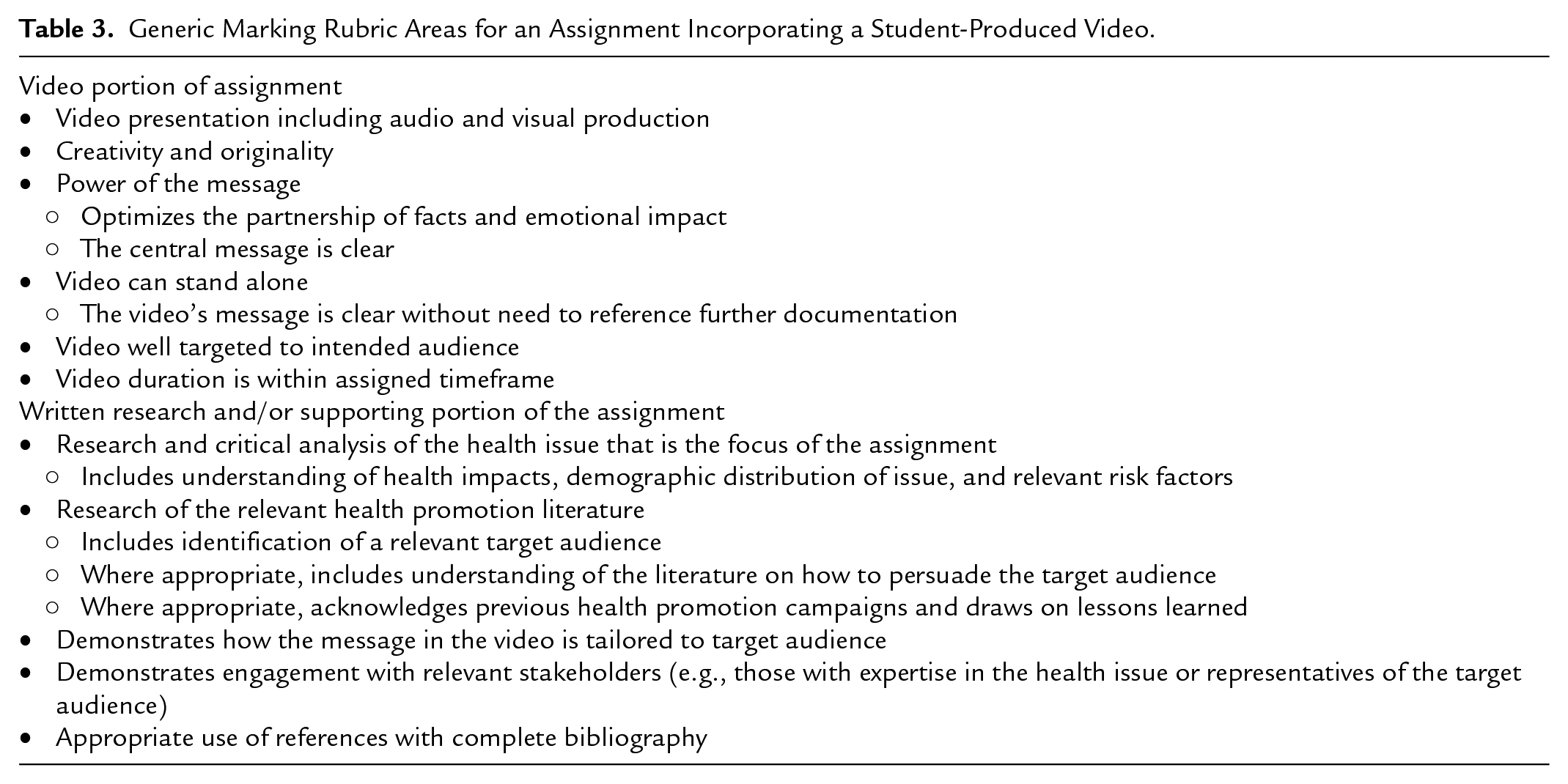
The three authors had similar considerations for planning and designing the video assignment. Table 2 outlines generic instructions for an assignment incorporating a student-produced video. Careful planning and design including clear guidelines is required to facilitate effective learning experiences and was considered essential for this novel assessment. It is also important to support or scaffold the assessment with other learning activities and provide a clear and fair grading rubric for students. Clearly communicating the aim and learning outcomes of the assessment to students can be a challenge given its novelty as students may get sidetracked by the videography process; hence, it is important that the learning outcomes are conveyed to students at the outset. Table 3 outlines a generic marking rubric for both a video and an accompanying written assignment.
Generic Instructions for an Assignment Incorporating a Student-Produced Video.
Generic Marking Rubric Areas for an Assignment Incorporating a Student-Produced Video.
While novel assessments have the potential to increase student engagement, they may also increase student anxiety in some contexts. It is important that students are supported in their preparation of the video assignment with other learning activities that teach aspects of or build toward the final video assignment. Some examples of scaffolded activities for a video assignment include a task on compiling and evaluating public health information, a task positioning a group of students as an expert panel on a public health topic, an in-class debate on a public health topic and in-class student presentations, an online module on health promotion theory and practice, and tasks on effective teamwork, leadership, and the importance of storytelling. Another activity is to require students to undertake a literature review on the health topic and relevant health promotion approaches for this topic. If scaffolded activities are not possible, then an alternative would be assisting the students in breaking the overall assessment into smaller assessment tasks.
Implementation of Video Assignments: Experience From Three Australian Universities
The University of Western Australia
A video assignment was first implemented in a nutrition unit in the Master of Public Health degree at The University of Western Australia in 2016. It was repeated with minor refinement in 2017 and 2018. This unit was considered ideal, as media reports frequently contain nutrition information and there has been an explosion of nutrition information on the Internet, yet this has not necessarily increased people’s knowledge. Public health practitioners are frequently called on to interpret the latest research findings, presenting an ideal content area for students to apply evidence-based analytical skills and demonstrate health communication skills. Furthermore, it provides an opportunity to communicate health information for a particular topic area in a holistic and comprehensive context. The assessment was described to students at the beginning of the unit, and scaffolded learning activities that prepared students for the video assignment were provided. In the weeks prior to the assessment due date, students were given a list of available topics for their video assignment. During class time students brainstormed information on these topics and discussed what they knew and what was important, including relevance to overall health. Students were then shown examples of videos of similar topics to provide a guide.
The final video assignment was divided into two tasks. The first task required students to prepare and annotate a bibliography that demonstrated a review of the evidence of health risks and benefits of their chosen topic. The second task was to prepare a 3-minute video for a lay audience as a news report, media interview, public service announcement, mini documentary, demonstration, or dramatization. Students completed the video assignment individually as this unit is taught during summer school and coordinating common time with peers can be difficult. There was a range of creative videos presented; however, the majority reflected the examples shown and were in an interview or news report format. Most students performed well in their critical analysis of the scientific literature. One variable component was the translation of the information for a lay audience, with accessibility impeded by overuse of scientific language in some videos. Only a handful of students managed to give ideal consideration of their recommendation in the context of overall health with the majority discussing the relative merits or lack of merits in isolation.
Macquarie University
This video assignment was first used at Macquarie University in 2017 as part of the first offering of the Master of Public Health program. It was specifically included in the core unit Innovation in Leadership, Teamwork and Advocacy with minor refinements made in 2018. This authentic video assignment was designed to reflect the collaborative nature of public health practice, which often entails working with colleagues from diverse backgrounds and professions. It provided an opportunity for students to work in an intercultural environment and allowed students freedom to choose an area of public health advocacy about which they were passionate. Students were allocated groups randomly with minimal changes by the unit convener to ensure diversity in cultural background and a range of academic ability in each group. This allocation was purposeful rather than having students self-select group members. Rienties, Nanclares, Jindal-Snape, and Alcott (2012) found that instruction design can have a strong impact on how students develop cross-cultural learning, and heterogeneity is an important factor in improving individual performance in cooperative learning environments (Blumenfeld, Marx, Soloway, & Krajcik, 1996). Cultural competency is also outlined in the foundation competencies for public health graduates (Somerset et al., 2016). Additionally, Blowers (2010) asserts that the method of randomly selecting students for group work more accurately reflects the workplace.
Students were asked to create a 3-minute public health advocacy campaign on a topic of their choice. The video was to stand alone and project a message powerfully. All videos were shown to students at a Flickerfest-style film evening. A connected assessment asked students to reflect on their role within the group as well as reflect on the overall campaign the group developed within the context of the other campaigns presented at the Flickerfest. Learning activities were scaffolded to assist students; however, minimal information was provided on video platforms due to their rapidly changing nature. Although some students were initially apprehensive about this, they reported valuing this freedom greatly as it allowed them to gain new skills.
Australian National University
A longitudinal project incorporating video production was initiated in 2018 at Australian National University for students in Years 3 and 4 of a 4-year Doctor of Medicine and Surgery degree. As part of the public health component of this degree, students complete online training in three areas: health promotion, quality improvement, and research skills. There is also a large project in one of the three areas or “streams.” The health promotion project includes production of a video, as part of a larger body of work that spans 18 months. This includes a 3,500 word written assignment and a 15-minute group presentation. As part of the assignment, students are required to consult with stakeholders. For students starting in 2018, this is a hurdle assessment that students need to pass. Starting in 2019, the assignment will contribute 10% to students’ overall grade for their third and fourth years. Videos have not yet been submitted for final assessment for either cohort, precluding formal evaluation of the project.
Evaluation
The collaboration in preparation for the CAPHIA Teaching and Learning Forum workshop provided the three authors with a degree of assurance that the pedagogical goals of their assessments were reasonable. This was strengthened during the workshop, with positive feedback from delegates and support for a CAPHIA and Public Health Association of Australia collaboration to offer a prize in an interuniversity video competition. CAPHIA has agreed to develop this idea.
There are limitations to the assurance individual educators have when evaluating their own innovations. Even when time permits formal evaluation, educators rarely have time to evaluate a new idea using more than a single approach and are often hindered by relatively small numbers. The authors benefited from being able to compare evaluations from The University of Western Australia and Macquarie University. The evaluation from The University of Western Australia was drawn from the end of unit course evaluation and a comparison of student responses from before and after the implementation of the video assignment. Responses to the course evaluation after implementation of the video assignment were largely positive indicating acceptance of this assessment format with one student describing how this activity gave them confidence and readiness to accept a media interview from a local radio station.
The evaluation appraisal from Macquarie University was similarly drawn from the end of unit evaluations from 2017 and 2018, as well as from student reflections on the overall program. Students reported enjoying the practical aspect of the task, and 96% of students agreed that this video assignment helped them understand public health advocacy better. Assessments were rated as the second highest component of the unit that students learnt the most from, and 87% of students agreed that the connected reflective task helped consolidate their learning. The advocacy campaign was often reported as one of the best aspects of the unit with students valuing its practical focus and reporting that the assessment was unique, innovative, enjoyable, and challenging. Students also reported it helped them develop new skills in both advocacy campaign development and working in a diverse team with one student reporting they “learnt skills in assertive communication, collaboration, decision-making and time management.” Another student reported that as a result of the video assignment, they now wanted to work in the area of public health advocacy. Student feedback in 2017 suggested the inclusion of a group peer feedback, and this was implemented in the 2018 offering.
Exposure to the work of the other authors inspired and informed improvements to the assessments. For example, the video competition at Macquarie University informed the decision to have a prize for the project at Australian National University.
Summary Impressions
The collaborative experience of preparing this workshop and interacting with participants supports the view that video assignments are a practical, relevant, and authentic way of teaching graduate students how to communicate evidence-based messages in public health. A media format assignment provides students with the opportunity to develop new skills as well as to apply knowledge learnt in a pragmatic and innovative way. A set of considerations and generic instructions educators could use in tailoring a similar assignment for their own teaching has been outlined in Table 2 and a generic marking rubric in Table 3. The workshop highlighted this teaching technique to representatives of universities from Australia, New Zealand, and Papua New Guinea. The idea to have an interuniversity competition should result in continued collaboration and exchange of ideas between universities and educators.
Footnotes
Acknowledgements
The video assignment at the Australian National University Medical School was developed prior to the arrival of Devin C. Bowles. The authors acknowledge the work of Ranil Appuhamy, Claudia Sliming, and Rafat Hussain in developing the assignment. The development of the video assignment at Macquarie University was based on the successes of a separate assignment used elsewhere in the Faculty of Medicine and Health Sciences. The authors acknowledge the work of Taryn Joes in developing the assessment. The authors acknowledge the assistance of Gina Arena in the development of the video assessment at The University of Western Australia.
Declaration of Conflicting Interests
The authors declared no potential conflicts of interest with respect to the research, authorship, and/or publication of this article.
Funding
The authors received no financial support for the research, authorship, and/or publication of this article.
