



Abstract
COVID-19 has altered public health higher education and its impact on pedagogy will be felt long into the future. In response to social distancing measures, teaching academics implemented a number of changes to curricula. It is important to better understand and begin to evaluate these changes, as well as set a course for future changes to public health curricula both during and after the pandemic to best enable transformative learning. Teaching academics have an understanding of academic hierarchies and student perceptions and are well placed to provide insights into current and future changes to pedagogy in response to the pandemic. A survey was developed to examine changes that academics had made to their teaching in response to COVID-19. Responses were received from 63 public health teaching academics from five universities in Australia, the United States, and Canada. Public health teaching academics rapidly implemented a number of changes to their teaching, including alterations that enabled online teaching. The great majority of changes to teaching were related to tools or techniques, such as synchronous tutorials delivered in a video meeting room. There remains further work for the public health pedagogy community in reevaluating teaching aims and teaching philosophies in light of the COVID-19 pandemic. This could include examination of the weighting of different topics, including communicable diseases, in curricula. A series of questions to assist academics reformulating their curricula is provided. Public health teaching evolved rapidly to meet the challenges of COVID-19; however, ongoing adaptation is necessary to further enhance pedagogy.
Teaching for transformative learning aims to change how a person experiences, conceptualizes, and interacts with course content throughout their education (Hogan, 2016) and has long been the goal of many public health academics, who recognize its potential to progress health systems and health outcomes (Van Schalkwyk et al., 2019). Transformative learning in public health is critical to graduating future professionals with the capacity and creativity to enhance these systems. The current pandemic brings to the forefront the relevance and exigency of this type of learning in public health. COVID-19 has disrupted many aspects of public health education, providing both challenges and opportunities for transformative learning in both the short and longer terms (Bowles & Sendell, 2020). Short-term challenges have included rapid shifts to online learning due to social distancing requirements. As a consequence, standard informal benchmarking such as peer discussion, peer observation, and evaluation of pedagogical activities among academics have been disrupted. A key longer-term challenge will be delivering high-quality education at a time when the tertiary education sector is facing significant funding pressure. While online learning and teaching are not new, the accelerated implementation of this approach during COVID-19 provides an opportunity to review these adjustments for future semesters of teaching and online learning.
In most institutions, teaching academics are the primary source of contact for many university and college students. They also bear primary responsibility for curriculum development and implementation. They possess insights into both university hierarchies and student perceptions, making their views valuable in assessing how well universities are adapting to teaching during the COVID-19 pandemic and how this can be enhanced.
In this study, we aimed to gain a better understanding of the changes made by public health teaching academics during the COVID-19 pandemic. Academics were surveyed at universities across Australia and North America to capture a diverse range of perspectives and insights. The specific objectives were to (1) identify barriers to quality teaching, (2) describe enhanced teaching and learning strategies public health academics have used to overcome these barriers, and (3) outline teaching methods that worked well in the online environment. The information will be valuable for academics in developing their plans to strengthen their own pedagogical practices in future semesters of teaching during the COVID-19 pandemic.
Method
Sample Frame and Distribution Procedures
The selection of universities was done through convenience sampling and comprised three in Australia, one in Canada, and one in the United States. Invitations to complete an online survey were distributed to public health teaching academics teaching in areas such as epidemiology, biostatistics, qualitative research methods, health economics, and health promotion. Ethical approval to conduct the survey at these sites was received from The University of Western Australia Human Research Ethics Committee (#RA/4/20/6203) and Macquarie University Medicine and Health Science Subcommittee (#6724). The universities surveyed varied in their international ranking and the proportion of their students who are international. Participants and their universities remained anonymous, and participants did not receive any remuneration or reward for participation.
In Australia, approximately 125 lecturers were invited to participate. In North America, there were approximately 10 academics invited to participate in total due to the survey being distributed outside of standard teaching periods. The invitation to complete the survey was distributed on May 26, 2020, and closed on June 10, 2020. Potential respondents were provided with up to two reminder emails over this time. The invitation included a link to a survey on Qualtrics (Qualtrics, Provo, UT), the web-based platform on which respondents completed the survey.
Survey Design
The survey comprised both multiple choice and open-ended questions (Supplemental Appendix 1). Preliminary information was collected about respondents’ professional roles (e.g., permanent or contract employment, and previous exposure to online teaching). No other demographic information was collected from participants to protect participant confidentiality. More comprehensive information was collected on teaching strategies and experiences during COVID-19.
Data Analysis
Descriptive analysis was undertaken of closed questions via Qualtrics software version XM (2020). Responses to open-ended questions were analyzed according to survey objectives. To facilitate rapid dissemination of the survey results, we conducted simple content analysis of these data and grouped them according to topics (Schreier, 2012).
Results
Demographics, Prior Experience, and Access to Teaching Support
Overall, 63 public health educators responded to the survey (52 complete and 11 partial responses), which equated to a 47% (63 of ~135) response rate. Based on broad location data, responses were received from all invited universities. The majority of respondents were employed on a full-time (84%; 51 of 63) and permanent basis (63%; 40 of 63). Four respondents were employed on a casual basis. The majority of survey participants had some prior experience teaching online (89%) with more than half reporting three or more years’ experience.
Adaptations
Academics reported having to make rapid adaptations to their teaching due to the COVID-19 pandemic (Table 1). For some, the forced online teaching gave them the opportunity to consolidate and extend their existing online teaching methods, while for others, the changes proved challenging.
Examples of Online Teaching Adaptations.
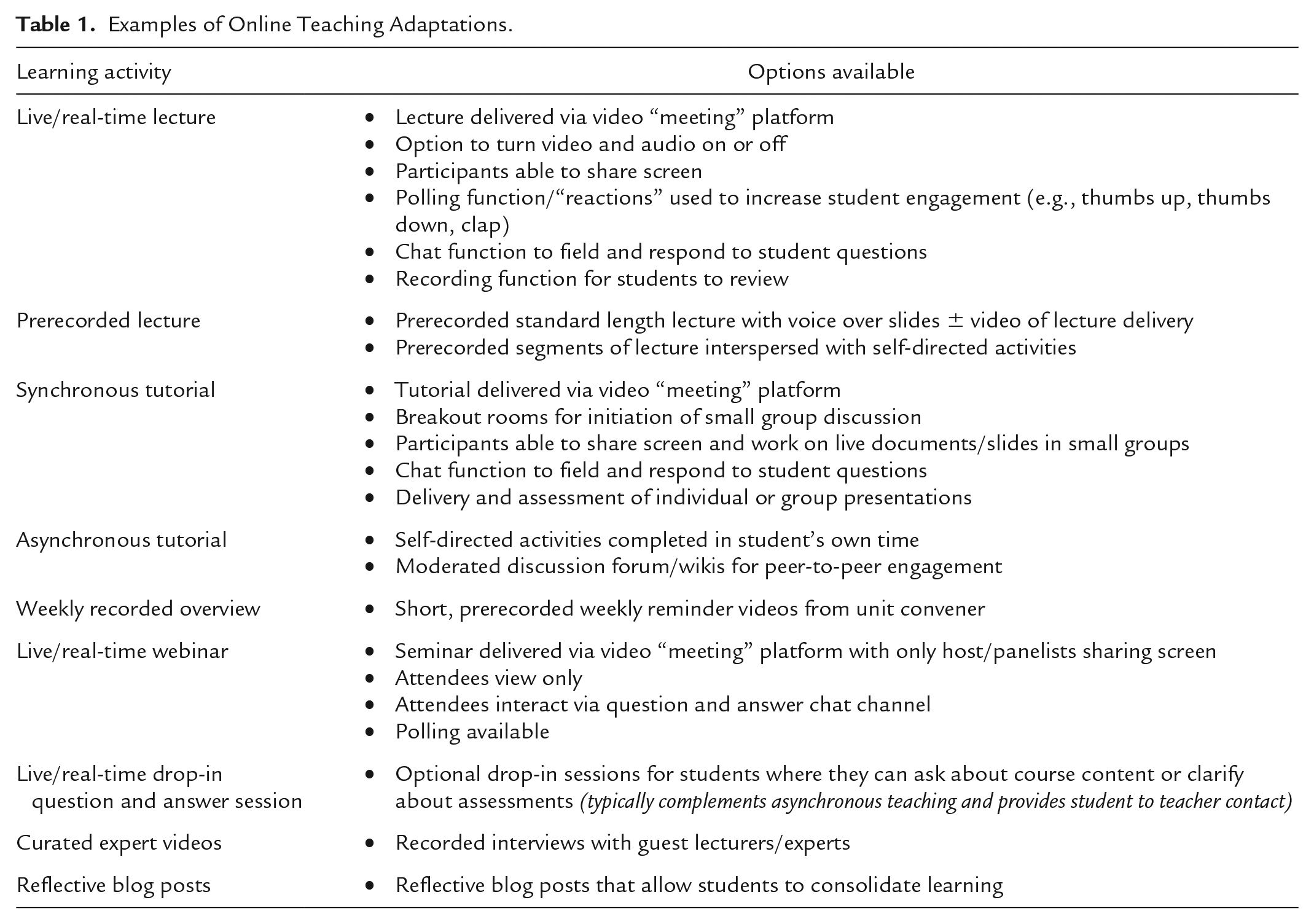
Results of the survey indicated that academics frequently used online teaching methods that mimicked the traditional lecture (46%) and tutorial format (52%), with online tutorials and live lectures typically using a videoconferencing platform such as Zoom or Microsoft Teams. Prerecorded lectures also featured prominently. A key successful activity within these traditional formats were breakout rooms, sessions within videoconferencing that are split from the main meeting room and allow students to work in smaller groups with opportunities for peer-to-peer learning. Academics described students as less likely to participate in discussions in a large, online video tutorial room, however, more inclined to discuss with a smaller group.
A number of academics also reported success with the provision of additional self-directed tasks, especially when learning activities were supported with clear instructions and optional drop-in sessions to answer course content or administrative questions.
What Are the Barriers to Quality Learning and Teaching?
Challenges with student engagement, information technology (IT) issues, and time constraints were the most frequently cited barriers to quality learning and teaching. Other reported barriers were limited peer support and interaction, limited access to educational technologists, regular changes to teaching processes and policies, and competing demands of academics in relation to their own family and life stresses.
Academics commented that challenges with student engagement included difficulties connecting with students, difficulties building rapport and a sense of community, and a loss of interaction compared with face-to-face teaching less “by the way” learning from students, and a few academics reported students were less engaged with online-only learning.
IT issues and time constraints were perceived by academics as challenging from both the educator and student perspective. Academics expressed that IT issues were a barrier, as well as technical issues with recording and uploading of lectures, and a reluctance to reach out for assistance due to IT staff reporting high workloads.
Academic time constraints included a lack of time to design and develop quality materials the speed of having to learn and apply new technologies alongside other work demands. Participants also reported students experiencing significant time pressures while adapting to learning online students having different learning experience . . . while also trying to deal with stress, uncertainty, worry about family and friends, worry about job security as a result of the COVID-19 pandemic.
What Opportunities for Learning and Teaching Are Presented by COVID-19?
Opportunities presented by COVID-19 for academics were the learning and mastery of new technologies, including synchronous video and audio “meetings” and using a range of digital platforms. In addition, COVID-19 for some academics provided increased student attendance during lockdown students were limited with their extra-curricular activities and so “attendance” was good, increased flexibility self-paced lectures provide a chance to be slower or faster depending on student understanding of content, and student engagement. A few academics reported that synchronous teaching online allowed them to reach students who had to relocate, often across continents, due to COVID-19, and an ability to teach synchronously over large distances (including when my students had to evacuate [developing country] for [home] mid-course). In addition, academics believed that COVID-19 presented opportunities for students to apply key public health competencies to a current global public health event that was saturating discussions students have been able to apply concepts and learnings to COVID, it has helped them to visualize the material we are teaching.
What Is “Missing”?
Academics remarked on a loss of interaction and connection with students with online learning the energy of the classroom, all the subtle cues that support dialogue and discussion, and the pleasure that attends social engagements and so deeply underpins teacher and student motivation and learning. The ability to gauge student understanding of concepts was also described as “missing” with online learning.
Evaluation and Assessment
Informal student feedback and personal reflections on teaching were the most frequently reported forms of evaluation. Formal evaluation was rarely cited. Some academics mentioned time commitments as a reason for not conducting formal evaluation. For many, the timing of the request for items to be used in formal university-wide evaluation surveys occurred prior to being required to deliver teaching online. Others suggested that formal university-wide evaluations are not fit to evaluate teaching during the COVID-19 climate and questions were not able to be adapted in the short time available. This meant evaluations tended to be informal or based on personal reflections. A few academics provided examples of self-reflection and commented that due to the COVID-19 pandemic and changed expectations of students, there was an opportunity to experiment with new online methods. We were all thrown into this together, so I think everyone has been very flexible and understanding of instances where perhaps things didn’t go to plan, or technical hiccups slowed some process down.
Academics also reported on their perceived evaluations of students’ mastery of knowledge and skills. When comparing students taught during the COVID-19 pandemic with students taught at other times, their knowledge and skills were found to be similar. However, the assessment of knowledge was perceived as somewhat easier to assess in the online environment than their skills. Another necessary adjustment that was reported due to COVID-19 was the inclusion of online examinations.
Perceived Learning Needs of Students
Pastoral care demands, which includes supporting students’ social, emotional, physical, and moral well-being, were also reported by some academics to have increased as students came under a variety of stressful personal circumstances, including disrupted learning and concern for the health of themselves and their loved ones. While several academics reported an increased volume of email enquiries from students, including pastoral care, this was not reflected across all survey respondents. Approximately half of the survey participants welcomed this increased contact as it provided an opportunity to engage with students. Others reported struggling to manage the sheer volume of emails.
Student groups that were perceived as having difficulties adapting to online learning included students with poor access to or knowledge of IT. International students and more specifically those with English as a second language were also identified as having difficulties with the change to online course delivery.
Future Support for Online Learning
To enhance teaching in the online space, participants were seeking more support from educational designers and technologists. This included guides on how to structure online delivery, instructions on how to take attendance for large class sizes, training in resources and tools available, evidence-based teaching strategies, and innovative ideas to increase student engagement.
The need to move beyond Zoom basics was also frequently reported as a future requirement, as well as knowledge of other platforms and tools available. Some academics identified the necessity for more administrative and IT support, good IT support that have staff familiar with the hardware and software needs of the teaching tools being used.
Academic peer support and having colleagues share their experiences was recognized as helpful—for example, demonstration classes by experienced and innovative teachers. This appeared to be enhanced by managers’ facilitation of a supportive environment that allowed the sharing of ideas, space for staff to share ideas and learnings about the rapid adaptation to online teaching.
The survey participants were also asked what future support their managers could provide for online teaching. The most common response was increased access to educational technologists. Other responses included the need to foster improved sharing of ideas and material among staff together with acknowledgment of increased workload. With many changes made in a short time frame, some academics also sought greater strategic planning and administrative support to incorporate these changes for future semesters, not just for COVID-19.
Discussion
COVID-19 is likely to continue to constrain public health education well into 2021. After a semester of rapid adaptation to enable students to progress their academic careers, with the aim of transformative learning, it is important that the public health academic community collectively review teaching adaptations that have worked well and those that have been less successful. Acknowledgment and continued discussion about the pedagogical challenges are necessary to enhance the quality of future teaching while reducing burden on academics. Our study aims to inform this review.
The survey uncovered a variety of learning activities and teaching methods that public health academics have used in adapting for online learning. Given these ongoing constraints to teaching, academics will need to consider that many students will be taught in ways they did not choose at the outset of their degrees. This is important, as students who chose to study face-to-face may not appreciate a move to online learning or have the skills to do so successfully, especially as face-to-face learning can be perceived as superior to online learning (Kite et al., 2020).
Little formal evaluation was reported in the present survey. This may have been deprioritized due to time constraints and because of a perception that future semesters will be unlike the current semester, so there may be limited opportunity to constructively use feedback results. Future semesters of online teaching present an opportunity for a more planned evaluation of pedagogical changes made due to COVID-19.
Preparing students for the changes to learning also warrants consideration. Providing students with information on university IT support and assistance may help address this problem.
In our survey, international students and more specifically those with English as a second language were perceived as having greater difficulties with online course delivery. While we cannot confirm that these students did indeed have greater difficulties, studies conducted in other contexts have found this to be the case. For example, Chen and Bennett (2012) explored the experiences of international students and suggested a number of strategies to help overcome these difficulties. These included smaller discussion group sizes and synchronous video tutorials so that international students can read the body language of their peers and/or academics. Such changes should be explored by academics for online teaching during and beyond the pandemic.
Building on the key findings from this study, we propose a number of considerations for planning teaching for online delivery during COVID-19 and beyond (Table 2).
Considerations for Teaching Online During COVID-19.
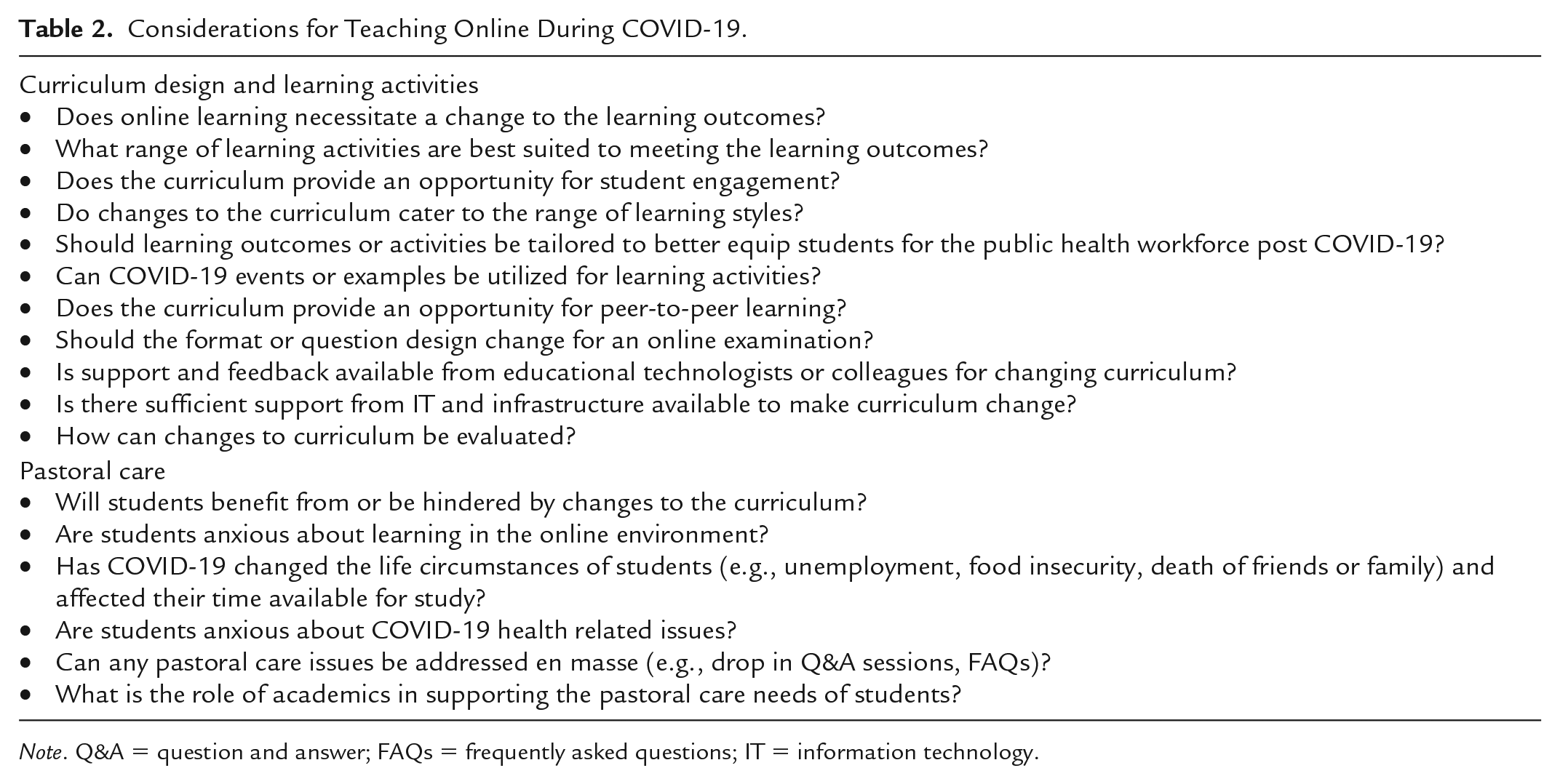
Note. Q&A = question and answer; FAQs = frequently asked questions; IT = information technology.
An important finding of this survey was that most of the adaptations and other measures listed by academics were technical in the sense that they relied on changing use of technology or learning activities such as small-group video discussions. There were virtually no reported alterations to learning objectives or teaching philosophy. While this might be an artifact of survey design (which asked about changes generally rather than specifically about teaching objectives or teaching philosophy), their omission is nevertheless notable. It suggests that most academics were endeavoring to use technology and new techniques to allow them to teach in much the same way that they had previously taught face-to-face classes. Given the very short time frames in which to adapt curricula, this is unsurprising. Additional time for academics to reflect is likely to allow opportunities for further engagement with theoretical and philosophical questions related to their teaching.
Among the core competencies recognized for public health graduates in Australia is public health advocacy (Somerset et al., 2016), and practitioners have highlighted its value in addressing public health issues such as the COVID-19 pandemic (David et al., 2019). The government and health system response to the COVID-19 pandemic varied substantially between Australia and North America. In Australia, the number of deaths from the pandemic across the whole population of approximately 25.5 million (Australian Bureau of Statistics, https://www.abs.gov.au/ausstats) was about 100 people at the time of the survey (Australian Government Department of Health, https://www.health.gov.au/). This is approximately 0.1% of the rate of deaths from the pandemic per population observed in the United States (approximately 330 million; Census Bureau, https://www.census.gov/) at the same time (CDC Coronavirus, https://www.cdc.gov/coronavirus/2019-ncov/index.html). The better health outcomes observed in some countries are not necessarily due to superior health knowledge among experts but may be a result of knowledge translation potentially due to different political climates, the early implementation of effective health measures, and by public compliance with health measures (Eastwood et al., 2010). Consideration should therefore be given to whether the public health workforce requires additional training in advocacy and public relations.
Many public health academics view themselves as creating a future public health workforce. The health system’s variable response to the pandemic could influence review of learning objectives to highlight advocacy of public health and teaching philosophy. Transformative learning in public health is critical to graduating future professionals with the capacity and creativity to enhance these systems. In this light, the lack of comments about enhancing students’ capacity to influence policy is notable, especially since survey respondents were from both Australia and North America. Similarly, there were virtually no comments about teaching philosophy, despite the links between teaching philosophy and development of a workforce with particular characteristics (Sawatzky et al, 2009). Again, this is not surprising given the quick switch to online teaching and learning.
In time, there will likely be discussion about whether the relative emphasis of noncommunicable and communicable diseases in public health curricula requires reassessment. In addition, there may be discussions about how well curricula draw out the increased vulnerabilities of a population with a high level of noncommunicable diseases to exposure to communicable diseases. Relatedly, the confluence of the pandemic and surge in support for the Black Lives Matter movements highlight the need to integrate discussions of health equity with learning about both communicable and noncommunicable diseases. The field of public health education therefore remains ripe for a deeper review of learning outcomes and curricula design over the medium-term together with consideration of adaptive learning and teaching philosophies.
Strengths and Limitations
The findings of this research should be understood within the contexts of its strengths and limitations. Strengths include surveying academic from universities in Australia and North America. With the range of experiences captured, the findings can be applied to a wider public health academic community. However, the sample size was relatively small and the response rate modest at 47%. A consideration may be that academics had limited capacity to respond to the survey given the increase in personal demands due to COVID-19. Also worth noting is the possibility of response bias, as we would expect respondents to be more likely to be deeply engaged with their teaching than nonresponders, potentially biasing the response toward a more proactive adaptation to teaching. While academics’ perspectives were captured at a single point in time, with responses based on teaching experiences over an approximate 2- to 3-month period, the timing for the majority of participants allowed for incorporation of all teaching experiences up to the end of the teaching semester. There are also likely to be successful teaching adaptations public health academics have introduced to their teaching that have not been included in this article. Regardless, the examples collected here are useful considerations for public health academics seeking to enhance their online teaching.
In essence, the survey was necessarily limited by the context of the early months of the pandemic. It was important to implement the survey quickly as the social and pedagogical environment caused by the pandemic was in a state of rapid flux. While the authors aimed for as widespread a distribution of survey respondents as possible, time allowed only for a sample that was biased heavily toward Australian academics. While no obvious trends were detected by country of respondent, this may still be important. The Australian government and other key sources of information provided clearer and more consistent messaging about the pandemic than that characterized in some other countries, including America. Australia had infection rates lower than that in many countries possibly due to this clear messaging and timely, evidence-based limitations on movement and interactions. Together, these factors may have reduced the level of anxiety of both educators and their students, which may have affected results. Responses included little discussion about alterations to teaching objectives and teaching philosophy. As acknowledged above, this may have been partly due to survey design, which necessarily balanced a more comprehensive survey with the knowledge that educators were especially time poor due to the need to adapt to the pandemic. A larger number of longer qualitative questions would likely have reduced the response rate but would have also allowed more specific inquiry about teaching objectives and teaching philosophy. A more focused approach on these topics would allow more definitive conclusions. It is notable, however, that three questions (Supplemental Appendix 1: Q9, Q13, and Q14) would have enabled respondents to raise these topics if they judged them of high importance. Including qualitative questions with longer answers would have permitted additional methods of qualitative analysis, which were not appropriate for the responses received. While these limitations are genuine, they are also reasonable compromises in a study design adapted to almost unprecedented conditions.
Furthermore, while participant responses were limited by survey design, the timing of data collection and subsequent findings bring insight into what might also reflect an undercurrent of shifting priorities in pedagogy that was transpiring well before the pandemic and subsequently highlighted by it. As the demands of teaching in higher education continue to increase (e.g., do more but with less), the lack of emphasis on transformational learning in survey responses may also be a reflection of the ways in which pedagogy has yet to transform and be transformed. Transformational learning is by definition about change and creativity. Yet responses to the survey were somewhat predictable and could even be compared with the notion of triaging. The pandemic, in many ways, offers an opportunity to reflect on our default pedagogical practices that were not transformational or necessarily creative. We are left asking ourselves the question of what could a rapid transformational response to pedagogical practice look like? How embedded is the philosophy of transformational learning in our teaching and our thinking? These are important questions to ask and explore amid pedagogical first responders. How might we do this differently the next time?
Conclusion
Taken as a whole, the results from this survey suggest that many rapid adaptations were made by public health academics, and this is worthy of commendation. The changes undertaken were largely to maintain teaching plans that were set at the commencement of 2020. Together with the presented considerations for online teaching, there remains an opportunity to optimize teaching further in a transformative learning framework through alterations to learning outcomes and teaching philosophies for future online learning.
Supplemental Material
sj-docx-1-php-10.1177_2373379920987264 – Supplemental material for Adapting to Teaching During a Pandemic: Pedagogical Adjustments for the Next Semester of Teaching During COVID-19 and Future Online Learning
Supplemental material, sj-docx-1-php-10.1177_2373379920987264 for Adapting to Teaching During a Pandemic: Pedagogical Adjustments for the Next Semester of Teaching During COVID-19 and Future Online Learning by Siobhan Hickling, Alexandra Bhatti, Gina Arena, James Kite, Justin Denny, Nancy L. I. Spencer and Devin C. Bowles in Pedagogy in Health Promotion
Footnotes
Acknowledgements
The authors acknowledge the contribution of all survey participants who took the time to complete the survey and share their experiences of teaching and learning during COVID-19, especially considering the high workload demands faced by many teaching academics at this time.
Declaration of Conflicting Interests
The author(s) declared no potential conflicts of interest with respect to the research, authorship, and/or publication of this article.
Funding
The author(s) received no financial support for the research, authorship, and/or publication of this article.

References
Supplementary Material
Please find the following supplemental material available below.
For Open Access articles published under a Creative Commons License, all supplemental material carries the same license as the article it is associated with.
For non-Open Access articles published, all supplemental material carries a non-exclusive license, and permission requests for re-use of supplemental material or any part of supplemental material shall be sent directly to the copyright owner as specified in the copyright notice associated with the article.
