



Abstract
Community-engaged classrooms offer advantages to both students and community-based organizations by creating an environment where students become agents of change and contribute to meeting communities’ health needs. However, most community-engaged classroom research is done in high-income contexts in advanced curriculums with graduate students. This article explores a community-engaged classroom project at a minority- and indigenous-serving undergraduate institution, focusing on indigenous student empowerment. Commercial tobacco use prevention is of particular importance to indigenous contexts and resulted in a college policy change to reflect indigenous values. Students designed, implemented, and evaluated a tobacco product education campaign to effect change using a community-engaged approach. The educational activities included (1) understanding the tobacco context, (2) health communication course design, (3) forming key partnerships, (4) facilitating student activities through behind-the-scenes work, (5) designing and implementing a campaign, and (6) student growth and empowerment. We illustrate how academic and state partnerships can align interests in implementing public health policies and providing students with real-world public health communication and health equity experience.
Keywords
Higher education has embraced teaching students with strategies that engage active learning, including inquiry or problem-based learning (Boyer, 1990; Smith et al., 2005). Experiential learning strategies facilitate the creation of embodied knowledge—as supported by constructivist educational theory (Champagne, 2006; Felter & Baumann, 2019; Flannery & Ward, 1999)—as well as facilitate learning that is vital for the changing nature of the public health workforce (Chávez et al., 2006; Marcus et al., 2011). Importantly, fusing community-engaged classrooms with empowerment education is particularly relevant in the context of a minority and indigenous student population who have a valuable opportunity to experience empowerment within the classroom (Jernigan et al., 2015; Wallerstein & Bernstein, 1988). Empowerment education is an effective health education and prevention model for personal and social change (Wallerstein & Bernstein, 1988). Using participatory pedagogical strategies increases public health students’ capacity to do community-based work both during and after their time in the classroom (Chávez et al., 2006; Marcus et al., 2011).
With principles from community-engaged classrooms and empowerment education, we engage public health students using a participatory learning strategy to value diversity, shift the center of attention from faculty to students, and empower students to lead their learning. The benefits of such a strategy have included increased understanding, problem-solving skills, critical thinking, student responsibility, interaction with peers, and increased and improved contact with faculty (Kreisberg, 1992; Smith et al., 2005; Wallerstein & Bernstein, 1988). A community-engaged classroom models the community engagement principles needed for effective future work within public health to engage social justice while applying a systematic approach to health improvement.
Our goal here is to describe applying a community-engaged classroom to empowerment education, shifting the responsibility of project-based learning from the professor to students. We do this through a case study of a health communication course project implemented in 2019. Specifically, in the context of a health communication course, students helped bring awareness to a state-mandated campus tobacco ban in a manner that adapted to local cultural needs in partnership with local public health and other community partners. This article describes the context in which this project took place, the course’s process and outcomes, and the implication for health promotion pedagogy more broadly. Here, we describe how the tobacco prevention project illustrates how pedagogical strategies increase public health students’ capacity to do community-based work, especially in an indigenous- and minority-serving institution.
Context
Fort Lewis College is a public liberal arts college located in rural southwestern Colorado. It currently enrolls approximately 3,000 undergraduates and 200 graduate students annually. Fort Lewis College’s complex history as a boarding school guarantees tribally enrolled students a tuition waiver. Further information about this history is detailed in Figure 1. Thus, Fort Lewis College’s student body is currently 43% American Indian or Alaska Native (AI/AN), with more than 170 tribal affiliations represented at the college. Given this cultural context, which has a rich, nuanced history with tobacco, the health communication course implementation’s primary focus was a campaign to promote understanding about the difference between commercial and traditional tobacco use among indigenous communities and specifically at Fort Lewis College.
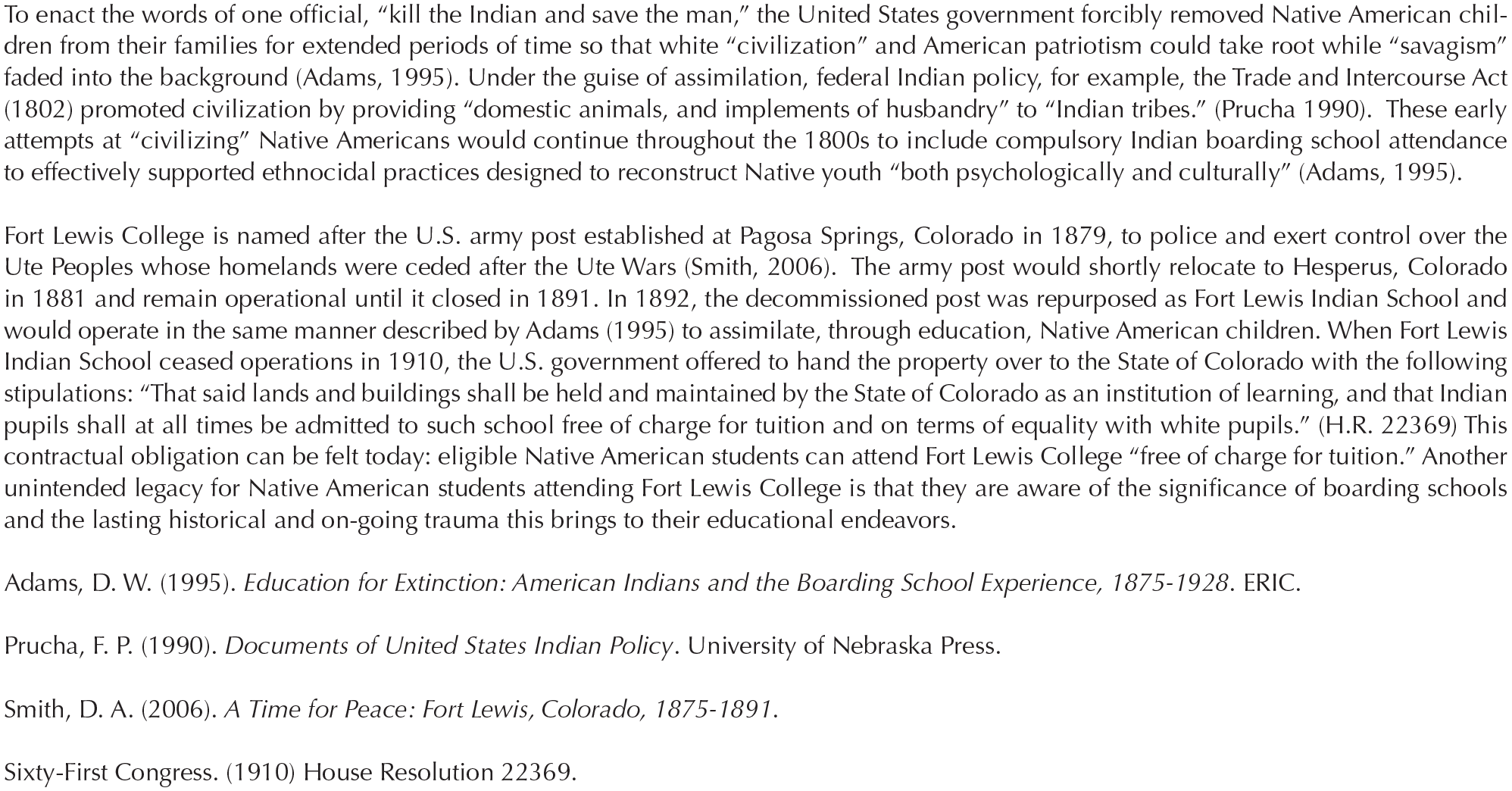
Historical context at Fort Lewis College.
Indigenous Perspective on Tobacco
Lakota holy man, Black Elk, relates the significance of fragrant smoke when sweetgrass (Savastana odorata or hierochloë odorata) is burned: We shall burn the sweetgrass as an offering to Wakan-Tanka [the Big Mystery], and the fragrance of this will spread throughout heaven and earth; it will make the four-leggeds, the wingeds, the star peoples of the heavens, and all things as relatives. (Brown, 1971, p. 41)
In addition to sweetgrass, many other traditional plants are used for purification and ceremonial purposes that are released only on burning or smoking.
According to Gilmore (1991), tobacco (Nicotiana quadrivalvis) was cultivated by all the tribes in Nebraska and along the Missouri River, while Eastern woodland tribes and tribes east of the Mississippi river cultivated another variety of tobacco (Nicotiana rustica). Tobacco was smoked in ceremonial and social contexts. Wilson (1987) writes of Buffalo Bird Woman’s recollections of Hidatsa tobacco gardens: Tobacco was cultivated in my tribe only by old men. Our young men did not smoke much; a few did, but most of them used little tobacco or almost none. They were taught that smoking would injure their lungs and make them short-winded so that they would be poor runners. . . . Tobacco gardens, as I remember them, were almost universal in my tribe when I was five or six years of age. (p. 121)
Black Elk (Brown, 1971) explained that “Ree” tobacco (Nicotiana quadrivalvis), cultivated by the Mandan, Hidatsa, and Arikara tribes, was used in the “crying for a vision” ceremony: We shall also need the Ree to twist tobacco, kinnikinnik, a tobacco cutting board, buckskin for the tobacco-offering bags, sweetgrass, a bag of sacred earth, a knife, and a stone hatchet. These things you must secure yourself, and when you are ready, we shall purify ourselves. (p. 48)
Kinnikinnick, an Algonquin word, is generally used to refer to the numerous mixtures that incorporate dried leaves and tree barks with tobacco. Kindscher (1992) recounts Dr. Edwin James’ 1810 report of his long expedition among the Omaha on their use of smooth sumac (Rhus glabra) in Omaha-made smoking mixtures: “Kinnecanick, or as the Omawhaws call it, Ninnegahe, mixed or made tobacco, which they use for smoking in their pipes, is composed partly of tobacco, and partly of the leaves of the sumack” (p. 184). Kindscher also relates that a Kiowa peyote leader remarked that sumac “was not a medicine but used to ‘purify’ the body and mind so the peyote, the real medicine, could effect a cure more easily” (p. 185).
Thus, tobacco use on the Fort Lewis College campus has wildly different meanings and uses, especially when considering the deeper cultural meaning with the diversity of tribal representation. When the policy was initially announced, there was no distinction between traditional and commercial tobacco. Nonnative students were broadly unaware of the distinction between traditional and commercial tobacco, while many native students were unhappy with this blanket ban. This student reaction on campus led to developing a student-led education campaign about the differences between commercial and sacred tobacco.
Health Communication Course Design
This article describes a public health communication course that utilized a community-engaged learning approach to improve student learning and application of health promotion concepts and address a pressing local public health issue.
The instructor coordinated a semester-long project by combining community-engaged learning and empowerment education to implement a culturally responsive health communication campaign. The application of these principles to the course is described in Table 1. Problem-based models integrate teaching, research, and application, allowing students, instructors, and community partners to collaborate and co-learn. The learning objects for the course were to
Apply theory and strategy-based approaches in the development and evaluation of social and behavioral science interventions
Apply evidence-based communication principles across different settings and audiences
Develop public health programs and strategies responsive to the communities’ diverse cultural values and traditions being served (Calhoun et al., 2008)
Project Objective and Outcomes.

In using a project-based learning approach, classroom participants take on new roles. The faculty’s role as a facilitator means that students must take responsibility for learning (Calhoun et al., 2008). P-Process is a framework to structure health communication programs and structured course activities (Health Communication Capacity Collaborative, 2013). Students had a total of five group reflection assignments that followed the steps of the P-Process: Inquire, Design Strategy, Create and Test, Mobilize and Monitor, and Evaluate and Evolve. In addition to the written portion, groups share lessons with the class. As a result, the classroom became a community learning laboratory—where ideas were exchanged between students and faculty, and community views were incorporated. The effect is that students have real-world experience in participatory methods that will support their future community health work.
Students, faculty, and community partners worked together to identify areas of intervention within tobacco prevention. The instructor used a modified version of the nominal group technique adapted to the classroom to determine student group composition so that students (1) had guidance and autonomy in the specific program they designed and (2) were able to voice their preference on a topic (Dunham, 1998). There were seven student groups, two focused on indigenous tobacco use, and all focused on tobacco policy promotion. While the other groups had similarly involved projects, this article focuses on a single case study of a single group and how this pedagogical approach facilitates course learning objectives.
Forming Key Partnerships
A central tenet of a community-engaged approach to health promotion is forming equal partnerships to shift power through bidirectional learning and sharing resources (Wallerstein & Duran, 2010). This experiential learning course aims to lay the infrastructure to apply these principles within the classroom.
As the instructor had little content knowledge in tobacco use prevention, bringing in the local rural public health department’s substance abuse prevention specialist was key to the curriculum. At the start of the semester, the prevention specialist introduced students to critical tobacco policy implementation concepts. From there, her role shifted from lecturer to partner. Our approach was to truly engage with students as partners in this process instead of empty vessels to be filled (Wallerstein & Bernstein, 1988). All student groups were centered on tobacco prevention at Fort Lewis College and utilized the P-Process to structure their projects (Health Communication Capacity Collaborative, 2013).
Facilitating Student Activities Through Behind-the-Scenes Work
The central tenet of student facilitation is stepping back from the course’s control to empower students in their campaigns. Besides working with public health partners, student groups on campus, and college administration, the instructor and prevention specialist worked together behind the scenes to support student projects. Students had control, power, and autonomy in their partner relationships, campaign activities, and implementation strategies, which is reflected in Figure 3.
With a focus on mentoring students in engaging with each group’s partner, the instructor and specialist were available to smooth communication, provide resources in talking to partners, and help launch student projects. Additionally, the instructor facilitated an in-class review process where student groups provided feedback on student project drafts and provided quality assurance by meeting with each group.
Student Project Case Study: Implementing Campus Tobacco Ban
Commercial and Ceremonial Tobacco in the Context of an Indigenous-Serving Institution
A crucial part of the community-engaged approach is understanding and recording all participating community members’ perspectives and the health issue we are addressing (Wallerstein & Duran, 2010). Tobacco use prevention has long focused on health education and health promotion (Behringer et al., 2019; Ennett et al., 2001; Huang et al., 2019; Sy & Glanz, 2008; Williams et al., 2003). However, traditional tobacco, used in AI/AN contexts, has a significantly different meaning, practices, and health effects than commercial tobacco (Daley et al., 2011; Margalit et al., 2013; Nadeau et al., 2012).
Smoking prevalence is higher among AI/AN populations, and data suggest that AI/AN adolescents start experimenting with tobacco earlier and are more likely to begin smoking than non-Native adolescents (Daley et al., 2011; Margalit et al., 2013; Nadeau et al., 2012; Struthers & Hodge, 2004); thus, commercial tobacco use prevention is essential in AI/AN communities. With more than 170 tribal and indigenous group affiliations represented at Fort Lewis College, this issue is of particular importance to Fort Lewis College’s student population.
Designing and Implementing the “Keep Tobacco Sacred” Event
The “keep tobacco sacred” group decided to host an event to educate the campus community on traditional tobacco; the discussion focused on two practices: traditional tobacco smoked in a ceremonial context and the cultural tradition of smudging or purifying through the burning of sage, cedar, or sweetgrass. Students created a poster for the event (Figure 2). The students hosted a panel consisting of a tobacco prevention specialist, a Native American and Indigenous studies professor, a college administrator, and several AI/AN students and screened an indigenous made film about sacred tobacco. There were 238 attendees at the event and a robust discussion around the institution’s role and commercial and sacred tobacco. Rexine Williams, a student, and coauthor, reflected on the course process and her development as a scholar in Figure 3.
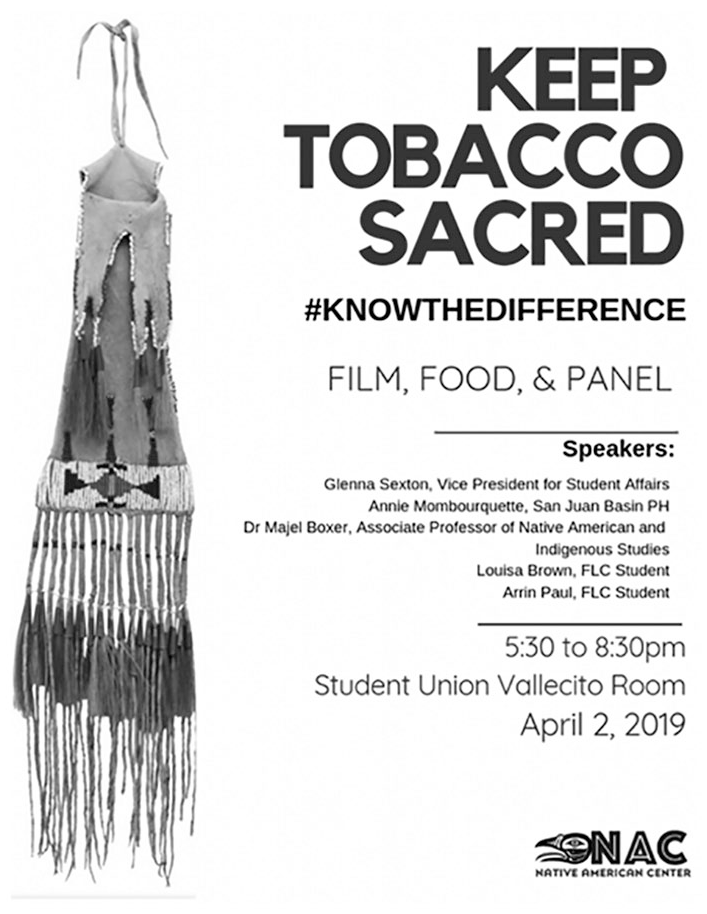
Event flyer.
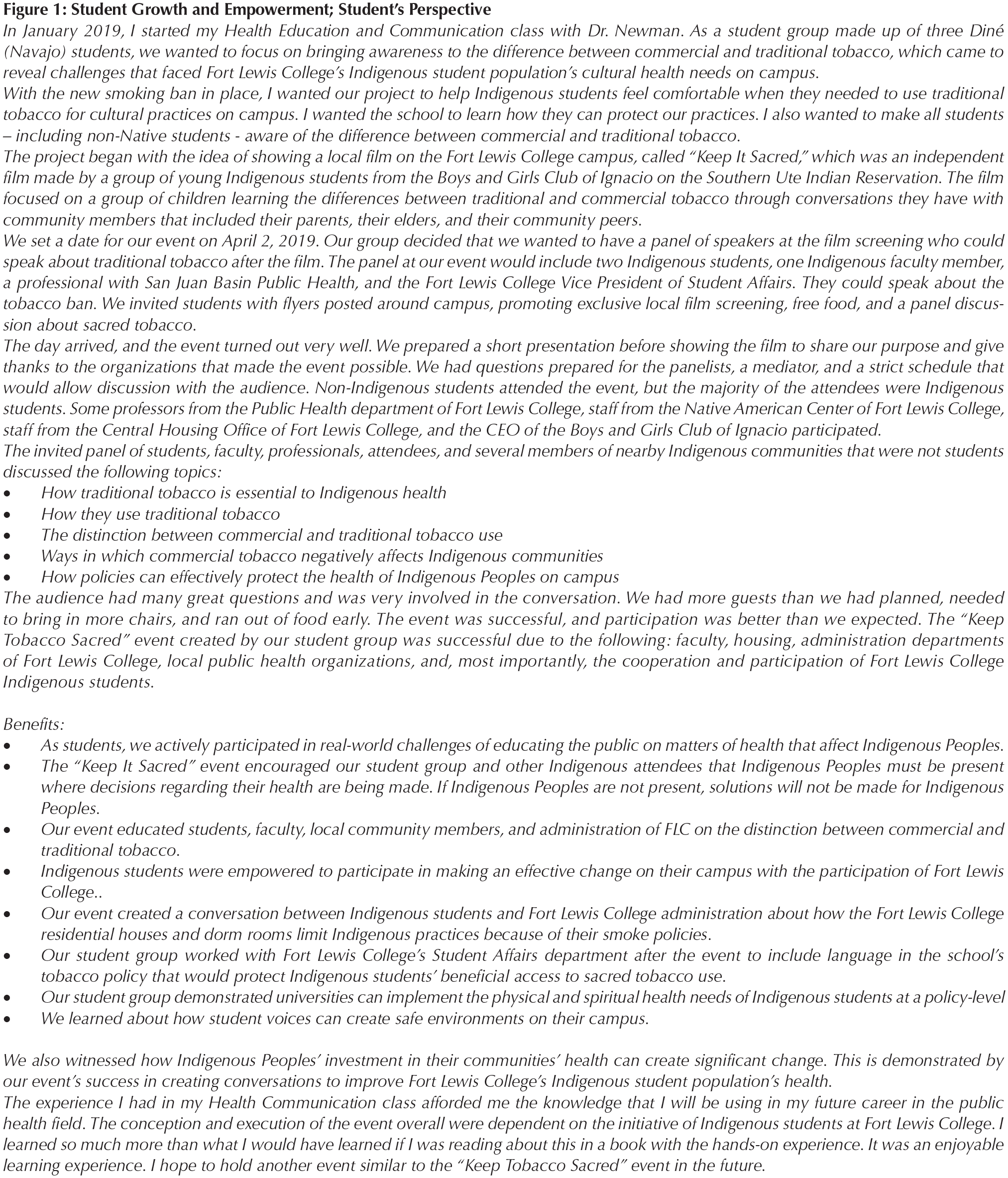
Student growth and empowerment: Student’s perspective.
Prevention work is long-term work. As a result, it can be difficult to see progress. A semester-long project produces tangible outcomes for the students working on the project—and the campus as a whole. As a result of student projects, the campus moved toward more equitable practices around traditional tobacco use. Students—especially non-Native students—in the classroom gained a better understanding of privilege and power concerning the social justice implications of commercial and traditional tobacco. The panel students put together increased campus awareness as well.
Project Objectives
The semester-long project used a specific health behavior—commercial tobacco use—to guide the learning process and design and implement health communication materials targeted at specific audiences and public health areas. The project’s goal was for students to implement health communication materials regarding the commercial tobacco ban on campus.
Discussion
This article used the case study of a student and the indigenous-led health campaign “Keep Tobacco Sacred” at Fort Lewis College to describe how a community-engaged project-based approach to teaching Health Communication develops students’ capacity for real-world health promotion work. A result of this campaign and event was that the Fort Lewis College policy was changed to reflect commercial tobacco language instead of a blanket tobacco ban. Additionally, it shifted the professor’s power to the students who put in additional work to have a large successful project, in alignment with empowerment education principles. Developing, implementing, and evaluating a public health communication campaign in a single semester requires the instructor and partners to have similar goals and commitment to the project, the ability to devote extra time to the course, the flexibility inherent in community-engaged work and support, and buy-in from the campus administration. While the article only focused on one group, the instructor is coordinating multiple projects of this scope, which can create additional challenges to instructor time and resources.
While principles and benefits of active learning strategies are well documented (Champagne, 2006; Felter & Baumann, 2019; Flannery & Ward, 1999), extending applied project-based courses to partnering with community members public health professionals is less common, especially in undergraduate courses. Extending beyond only a project-based course, students actively engaged with key campus constituents, community members, and public health professionals to help prepare students to engage in community-engaged activities. A recent publication by a faculty member at the University of Arizona successfully involved an entire graduate class in engaging in community-based participatory research in a qualitative health class (Reinschmidt et al., 2019). While the course described in this article was not research based, it was a community-engaged student-empowered approach to design, implement, and evaluate a health communication campaign. A similar approach to health communication was described by Felter and Baumann (2019). However, this course was at an undergraduate level and incorporated an empowerment approach appropriate for an indigenous- and minority-serving institution.
Creating a co-learning environment is challenging, as is managing group work with differing levels of engagement and time available to devote to the course project outside of dedicated coursework time. Given the nature of health promotion and public health as vital to teamwork, this course’s group nature is an additional pedagogical tool to help future health promotion professionals. The additional time required is also a challenge in Fort Lewis College’s underserved environment, where many students have outside jobs or pressing family obligations. Thus, not all students can devote the hours outside of class needed for these types of activities. Additionally, not all student groups were successful in their targeted campaigns. Trials like these are part of the process to expose students to the challenges inherent in real-world public health communication campaigns.
Empowerment and community participation are key strategies worldwide to reduce health disparities, especially within indigenous contexts due to a history of forced removal, genocide, and historical and ongoing trauma (Auger et al., 2016; Sotero, 2006; Tsey et al., 2010; Walters et al., 2002). Empowerment is a social action process that promotes people and communities’ participation toward goals of increased individual and community control, improved quality of life, and social justice (Tsey et al., 2010). While less acknowledged in U.S. contexts, in Australia and Canada a lack of control or mastery has long been recognized as one aspect of a broader experience of powerlessness that needs to be addressed to reduce the current preventable Indigenous burden of disease and close the health disparity gap (Auger et al., 2016; Tsey et al., 2010; Wallerstein, 2002, 2006). Rexine Williams, coauthor and student of the course, reflects on this empowerment experience in Figure 3.
While the health impacts of their project were not measured, we hope to measure potential student health impacts and community health impacts in the future of student-led campaigns given this model. We hope to develop departmental and college infrastructure to evaluate outside of the curricular course in the future. We hope to do this through independent study, faculty research work, or partnership with community partners.
Beyond engaging students in experiential learning, this project provided students with the potential to make real-world positive health impacts in their campus community. The course structure supports students learning how to effectively engage with multiple stakeholders while promoting student autonomy and power. While instructor buy-in and devoted public health partners were undoubtedly the backbone of this project’s success, campus administrative support is vital for sustaining these efforts. Support can include limited enrollment for smaller classes, additional instructors for classes, and funding for communication materials. An ideal place to start for this project would be to have a small funding stream available for students who wish to promote health on campus. A future direction could mean partnering with local community organizations that need this support, which may also have a small funding stream. We encourage health promotion and public health courses to engage students, even undergraduates, to partner with campus communities to design, implement, and evaluate their health communication campaigns.
Footnotes
Declaration of Conflicting Interests
The authors declared no potential conflicts of interest with respect to the research, authorship, and/or publication of this article.
Funding
The authors received no financial support for the research, authorship, and/or publication of this article.
