




Abstract
In 2017, the University of Minnesota Extension launched an online program called “Systems Approaches to Healthy Communities” that targets public health professionals and health promotion advocates to address how policy, systems, and environment interact with their work. This program was developed through evaluation of existing programs and content to expand reach for Minnesota Extension. Through five modules (Frameworks for Healthy Communities, Taking a Systems Approach, Engaging with Communities, Knowing Your Community, Putting It All Together), participants are informed on their role in public health efforts, barriers to lasting change in communities, and how to coordinate their work with local partners they might not have otherwise. Systems Approaches to Healthy Communities was developed following a number of pilots and revisions, which will benefit others looking to develop novel online programming or translate existing curricula to new modalities.
In 2017, a web-based professional development program called Systems Approaches to Healthy Communities (SAHC) was launched by the University of Minnesota (UMN) Extension Supplemental Nutrition Assistance Program Education (SNAP-Ed) program to promote the integration of policy, systems, and environmental (PSE) change interventions with educational strategies for more effective health promotion by public health professionals and paraprofessionals. The purpose of this article is to describe the development and evolution of SAHC, including its multimodal program model using the Prevention Institute’s Spectrum of Prevention (1999) framework and best practices in online and distance learning. This development and evolution had three primary drivers: First, the program emerged from a widespread shift in programmatic focus, resulting in a clear need for extensive training and retraining. Second, the program evolved in response to documented needs and requests, expanding gradually from a pair of modules into a comprehensive professional development program. Third, each step in the evolution of the program was informed by extensive evaluation, user input, and review. This article will describe lessons learned through this development and implementation process.
Background
In recent years, several initiatives at the federal level and within Minnesota emerged to promote the integration of direct education with PSE change approaches, particularly in health promotion programs. This program uses the PSE definitions from the U.S. Department of Agriculture’s (USDA) SNAP-Ed Plan Guidance (U.S. Department of Agriculture Food and Nutrition Service, 2018). Policy is defined as “a written statement of an organizational position, decision, or course of action.” Unlike policy changes, systems changes are unwritten, ongoing, organizational decisions or changes that result in new activities reaching large proportions of people the organization serves. Systems changes alter how the organization or network of organizations conducts business. Systems changes may come before or after a written policy.
Finally, environment “includes the built or physical environments which are visual or observable.” Environment also includes “economic, social, normative or message environments.”
Long-standing public health programs and SNAP-Ed programs have focused for decades on direct education to influence individual behavior change to achieve health outcomes (U.S. Government Accountability Office, 2019). However, emerging public health research showed that social determinants of health such as income, race, housing status, public safety, and education, among others, have significant impacts on individual health and long-term health outcomes for populations (Commission on Social Determinants of Health, 2008; Lowe, 2010; Scribner et al., 2017). PSE approaches have been increasingly adopted by public health professionals as the primary way to address and improve population health (Benson et al., 2019).
In 2006, Minnesota was first in overall health in national health rankings, but one of the worst in health disparities (United Health Foundation, 2006). State leaders noticed that rankings in areas crucial to future health outcomes—such as healthy behaviors, socioeconomic conditions, and geographic disparities—were not as strong. Bipartisan cooperation and support in 2008 resulted in Minnesota’s landmark health reform initiative and the creation of the Statewide Health Improvement Program, an integral public health component dedicated to helping Minnesota’s live longer, healthier lives by preventing the key risk factors that lead to chronic disease with the explicit goals to decrease rates of obesity and promote tobacco prevention and cessation.
A few years later, two federal grants were leveraged to accelerate PSE change approaches. Between 2011 and 2014, Community Transformation Grant funds through the Centers for Disease Control and Prevention provided support for the Minnesota Department of Health to contract with UMN Extension in order to provide technical assistance and training for local public health staff to deliver healthy eating strategies. In addition, the Healthy, Hunger-Free Kids Act (2010) transformed SNAP-Ed into a nutrition education and obesity prevention grant program, explicitly adopting obesity prevention as an emphasis and allowing comprehensive PSE change approaches. These different funding streams provided an opportunity for Minnesota to develop a series of online trainings about using PSE to promote healthy eating strategies for public health staff. Out of three online training modules proposed, two were ultimately developed and completed in 2014. In addition to the modules, and based on feedback from UMN Extension staff needs assessment in 2015, the program has expanded to include a two-part toolkit and additional program components designed to increase engagement and learning and support program rollout. In 2016 and 2017, the program was adapted for a national audience of organizations whose work focuses on health promotion, as shown in Table 1.
Timeline of Systems Approaches to Healthy Communities Development.

Note. SAHC = Systems Approaches to Healthy Communities; EFNEP = Expanded Food and Nutrition Education Program; SNAP-Ed = Supplemental Nutrition Assistance Program Education; PSE = policy, systems, and environmental.
Course Development and Design
Target Audience
Though adapted from content developed for Minnesota Department of Health, the target audience for the internal pilot phase of the program was SNAP-Ed implementing agencies. The program was designed as a professional development tool to assist staff in adapting to the new USDA SNAP-Ed guidance on PSE change. Based on the results of the internal pilot, the program was expanded to include four modules and was piloted with SNAP-Ed and Expanded Food and Nutrition Education Program educators at UMN Extension. The expanded version was then peer-reviewed and pilot tested by another SNAP-Ed program and a local public health agency to ensure relevance for both audiences. As a result of this internal pilot phase, UMN Extension staff identified the potential usefulness of making some or all of the program content accessible to their community partners and coalitions, leading to the creation of an additional module and a two-part toolkit. The target audience for the current course also includes these community groups, state agencies, coalitions, and nonprofits engaged in health education, promotion, or PSE efforts.
Course Description and Learning Objectives
Systems Approaches to Healthy Communities is a web-based, professional development program that promotes the integration of PSE interventions with educational strategies. The program helps staff teams understand and act on factors that influence whether individuals can easily make healthy choices. The objectives and content of the program fall into three primary categories: (1) basic terminology and examples of systems; (2) skills for staff to expand their own programs across multiple levels to affect policies, systems, and environments; and (3) strategies and tools for strengthening engagement, communicating with partners, and understanding community context.
Designed for organizations, departments, networks, or coalitions to take together, the program is composed of
Five asynchronous online modules
A coaching guide
Two toolkits with additional resources for applying the concepts
Three synchronous web-based consultations to assist organizations in implementing the program
A tool for organizations to examine their own internal practices to support this work
Each of the five online modules has its own objectives, as shown in Table 2.
Systems Approaches to Healthy Communities Learning Objectives.

Course Structure
Five online modules are the primary source of content for the program. Modules average about 60 minutes each, with material presented through activities, examples, stories, reflection questions, and interactive exercises. Online content can be completed individually or in groups and is intended to be conducted over a flexible time frame of approximately 10 to 12 weeks.
The modules are accessed via Canvas, the Learning Management System used by the UMN.
The instructional design of the program was grounded in adult education and constructivist learning theories, and the modules included numerous opportunities for participants to apply content to their personal experiences, work, and interactions with colleagues or partners (Harlow et al., 2007; Knowles et al., 2012). An essential component of this design is the emphasis on a coach model that helps participants make meaningful connections between the content and their own work. Coaches are internal to the participant organization, and they may be supervisors, team leaders, and/or peer mentors. Using the “Coach Guide” provided with the program, coaches meet with course participants either individually or in small groups throughout the program. The coaching materials are also accessed via Canvas.
Program Development Process
Pilot 1: Internal
In 2015, a needs assessment was completed by 52 of the UMN Extension staff (Table 1). The survey used the Spectrum of Prevention to assess staff comfort with using both direct education and PSE approaches. Only 40% of respondents reported being comfortable working in the community on “changing organizational practices,” and just 15% reported being comfortable working in the community on policy change level. This compares with 98% reporting comfort with “strengthening individual knowledge and skills.” These results reinforced the need for additional professional development around approaches at a PSE level.
The program was then piloted for the first time with the UMN Extension staff in July through September of 2015. This version of the program included only four modules. A fifth module was piloted with UMN Extension staff in October of 2016. The modules, once created and implemented, were evaluated three different ways. Table 3 shows the evaluation results from the postsurvey conducted at the end of each of the four modules and an open-ended question at the beginning of Modules 2, 3, and 4 that asked participants to reflect on how participating in the prior module had influenced their work. Third, 6-month postinterviews were conducted with seven educators in March and April 2016, exploring how they applied the content of the modules to their work.
Pilot Evaluation Results (Modules 1–4).
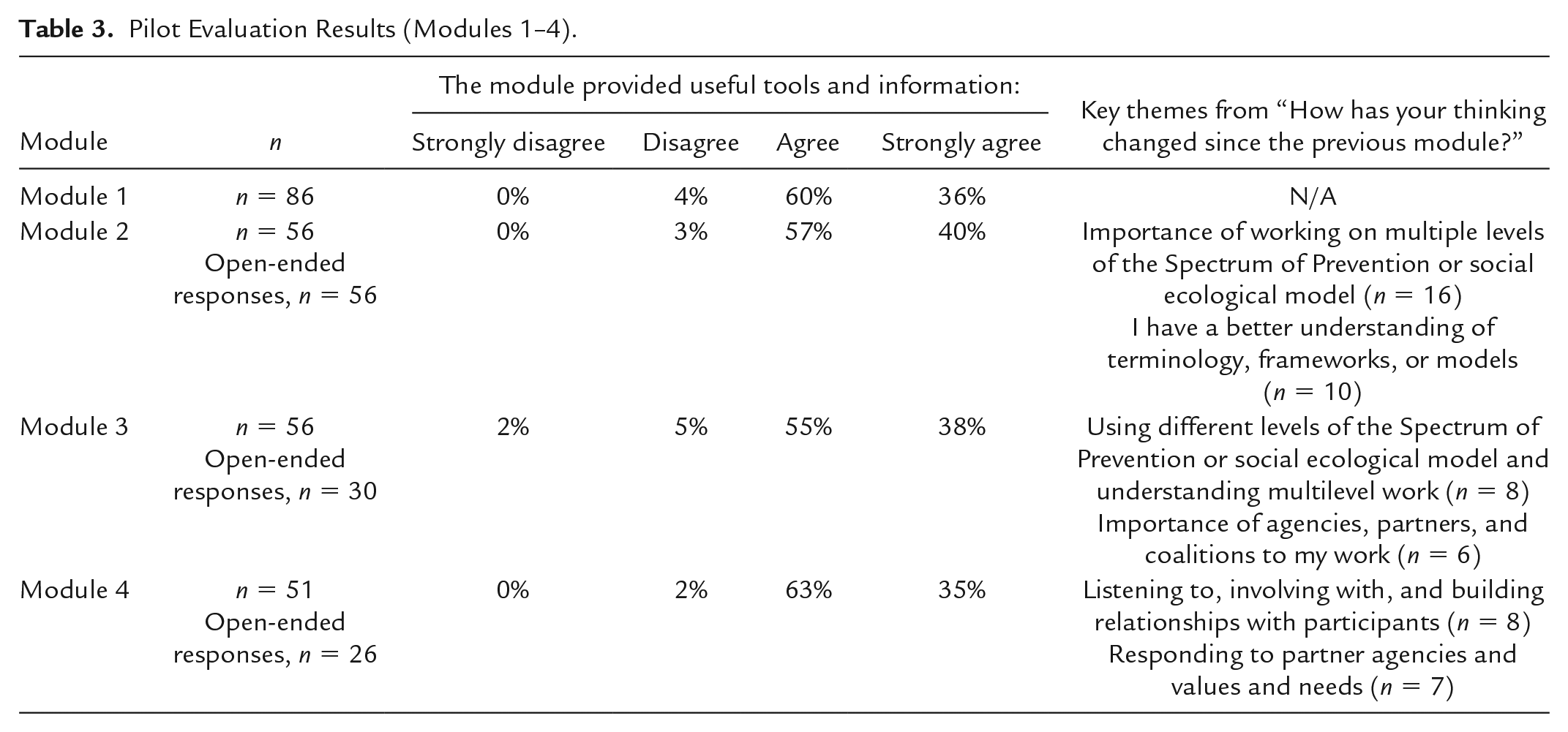
In addition to finding the modules relevant and useful, 95% of participants (n = 86) either agreed or strongly agreed after Module 1 that “after participating in the module they felt better able to be comfortable with terminology like social-ecological model; Policy, Systems and Environment; and Spectrum of Prevention.” Additionally, 98% of participants (n = 86) responded that they felt better able to “understand how systems impact the ability to make the healthy choice the easy choice.”
Table 3 also shows key themes from the open-ended responses, the largest number of which noted that they now had a stronger understanding of how to build on direct education with multilevel, PSE work. Additional context from the 6-month postinterviews (n = 7) reinforced how the program helped participants link their direct education and PSE efforts and that the program offered a practical road map for applying concepts to their day-to-day work. This provided additional support for the creation of Module 5, which consisted of the description of toolkit activities to use to better bring course concepts into community-based work.
Peer Review
Based on the success of this initial, internal pilot, the program development team decided to bring the program to organizations nationally. The first step in taking the program nationally was a peer review. The peer review was conducted by staff from Cornell University and Michigan State University Extension (MSUE) in the summer of 2016. Based on the peer review, several revisions to the program were made, including the following:
Emphasis on the integration of educational strategies with PSE as the central objective and focus (concept/skills)
Balanced use of the Spectrum of Prevention with the social ecological model
More consistent narration, using fewer voices throughout the modules
Changes to the title to decrease the emphasis on the Spectrum of Prevention
Removal of language that was relevant only to UMN Extension staff
Pilot 2: External
Once the revisions based on peer review and the first pilot results were complete, a second pilot was conducted with MSUE and the Iowa Department of Public Health (DPH). This pilot took place from January to April of 2017 with approximately 150 MSUE staff and 15 Iowa DPH staff and contractors. Evaluation for this pilot included a presurvey and a postsurvey (completed after Module 5). Participants also completed a brief survey following each individual module (Modules 1 through 5). Postsurveys for individual modules used a retrospective pretest model in which participants were asked to report their agreement with a statement after participating in the module and then retrospectively report their agreement before participating in the module. The retrospective pretest methodology was chosen as a feasible way to gauge change when teaching complex concepts that are gradually clarified during the course (Goedhart & Hoogstraten, 1992).
Preliminary evaluation data from the second pilot provided an understanding of how participants moved through the course as well as general trends in knowledge and behavior change. A majority of the participants were nutrition program instructors (n = 102), while the remainder of the sample were a mix of extension educators/agents, associate program leaders, supervisors, or other miscellaneous roles (n = 50). Overall, the data suggest that the program was effective in achieving its objectives. Between the presurvey and the postsurvey, participants increased their familiarity with PSE terminology, integration of PSE with direct education, community engagement, assessment, and continuous learning. A majority of participants reported that the course was well-organized, held their interest, and included examples relevant to their work, and that they planned to use the information they learned. From presurvey to postsurvey, 30% more participants agreed with statements related to their comfort at meeting the objectives of the course.
Lessons Learned
The two pilots and peer review of the course indicated that an online professional development program could be successful in increasing staff capacity and comfort with PSE approaches and integration of PSE approaches with direct education. As the evaluation results showed, the course was well received overall. Evaluation results also uncovered opportunities for improvement, which included the following:
Adding additional interactive activities and modifying activities that were confusing
Highlighting real-life stories by including videos and real photos
Creating troubleshooting resources for potential technical issues
Shortening the third module to reduce redundancy
Renaming the fourth module “Knowing your community” instead of “Assessment” to emphasize a less formal process
Providing a slide deck for each module to allow for note taking
Reorganizing the course site for easier navigation
In addition, through the second pilot, much was learned about the need to create a system of support for organizations to implement this program, in order to make a flexible, sustainable, and scalable model. As a result, three additional program components were developed prior to the national launch of the program: an Implementation Guide, online consultations with the trainers, and the “Knowing Your Organization” tool. The Implementation Guide provides detailed descriptions of program components, a suggested implementation process, and sample communications (e.g., emails to staff prior to and during participation in the program). In addition, three web-based consultations are offered as an opportunity for the implementation team from an organization to connect with the program design team as they implement the program. These opportunities to connect with the program designers add a personal connection to the web-based program, in addition to the opportunity to immediately troubleshoot any problems or provide clarification on program implementation and/or content. Consultations include suggestions for implementation, suggested roles for staff overseeing the course, guidance on the coaching process, and time for questions and problem solving. Organizations sign up for consultations and use the Zoom meeting platform. Consultations are also used by the program design team to solicit additional feedback about the course and compile suggestions for future iterations.
The “Knowing Your Organization” tool allows organizations to reflect on current internal policies and practices and promote conversations about whether and how existing organizational policies and practices support the integration of PSE approaches into staff’s work. For example, the tool asks organizations to consider whether staff are supported in using work time to participate in coalitions or whether their work on PSE approaches is incorporated into their performance evaluations. The tool is designed to be used as a conversation starter and includes a series of questions drawn from the documented experiences of coaches, leadership, and course participants as they participated in the pilot phases of the program.
Systems Approaches to Healthy Communities was designed to be completed over a 10- to 12-week timeframe. However, organizations have access to the online program for 18 months. This allows existing staff to complete the modules and still have time to review the materials and toolkit as they apply the concepts to their day-to-day work. It also provides an opportunity for organizations to use the program in the onboarding of new staff.
Next Steps
In October of 2017, the revised program was released for organizations to purchase and is preapproved for 5 hours of continuing education units from three national professional organizations. Our team researched other professional development programs that offered continuing education units to develop our pricing structure. We customize the program to fit different budgets and needs as we do not want finances to be the barrier to participation. At the time of publishing, approximately 2,700 individuals representing more than 40 organizations have participated or are currently participating in the program. Organizational participants range from other cooperative extension and local public health to national foundations and health promotion organizations. The program includes pre-, post- and follow-up surveys to continue to evaluate the impact. While the program was designed for organizations to purchase and complete as a group, the program design team has created an option for individual participation. Individual participants work at their own pace and complete self-reflection activities to support learning. Lessons learned from the development of SAHC were implemented in developing other online-only programs hosted by UMN Extension that address disease prevention and physical activity.
Organizations creating similar programs should look at how the models they teach can inform the design and delivery. Our team realized early on that we would be more successful teaching models like the Spectrum of Prevention if we also used them to create a comprehensive approach to both adult learning and organizational change in the design. For SAHC, we wanted participants to learn systems thinking and expand their skills in order to work in community-engaged and contextually relevant ways. Early in the development of the program, our team recognized the importance of designing the program with appropriate supports that would address not only the individual learner but also the system, community, and context in which they were working. This resulted in the creation of the coaching process, implementation resources for organizational leaders, communications resources, a leadership assessment, toolkit resources to use with community partners, and a series of live consultations with key organizational leaders to assist in implementation and integration of the educational modules and learnings. SAHC includes strong content on community engagement and building strong relationships. It was important to us that the design team was highly engaged and represented different roles, backgrounds, and perspectives from our own organizational community. This team was coled by individuals with strong project management and facilitation skills who fostered a team culture of humility and shared gratitude for everyone’s contributions. This strong team culture is a necessary component of success as it engenders the trust necessary to have challenging conversations about what methods and content should be included. We strongly believe that these practices are essential in creating a useful and meaningful professional development program.
Footnotes
Acknowledgements
The authors would like to thank the following individuals and organizations for their contributions to the development of this Systems Approaches to Healthy Communities program.
Program Contributors: Evalyn Carbrey, JoDee Christianson, Annette Shepardson, Takalya Lightfield, Jamie Bain, Hannah Jastram Aaberg, Ruth Ellis, Mary Vitcenda, Jessica Barnes, Sarah Wangen, and Jody Hornvedt
Peer Reviewers: Michigan State University Extension staff, Iowa Department of Public Health staff and contractors, and Cornell University Extension staff
Pilot Participants: University of Minnesota Extension SNAP-Ed and EFNEP staff, Michigan State University Extension staff, and Iowa Department of Public Health staff and contractors.
Declaration of Conflicting Interests
The author(s) declared no potential conflicts of interest with respect to the research, authorship, and/or publication of this article.
Funding
The author(s) disclosed receipt of the following financial support for the research, authorship, and/or publication of this article: This material was funded by USDA’s Supplemental Nutrition Assistance Program Education grant—SNAP-Ed—through the University of Minnesota Extension.
