



Abstract
There is increasing attention regarding the preparation of doctoral students in schools of public health (SPH) to teach; however, few studies have examined pedagogical preparation for doctoral students in public health-related disciplines. This study aimed to describe the pedagogical training and experiences available for doctoral students in behavioral and social sciences (BSS) programs in SPH and examine the facilitators and barriers to offering pedagogical training and experiences. Qualitative semi-structured interviews were completed with 13 pedagogy instructors, program directors, or administrators in SPH with BSS doctoral programs. Data were analyzed using thematic analysis. Just over half (54%) of the doctoral programs offered or planned to offer a pedagogy course in their curricula. Doctoral students in most programs had access to other teaching training opportunities, most commonly through university centers for teaching and learning. All doctoral programs required or provided students with the option to serve as a teaching assistant and, in some cases, instructor. Key factors contributing to if pedagogical training and experiences were available in the doctoral programs were the degree of priority placed on teaching preparation for doctoral students; logistic challenges, such as time and funding constraints; the level of need to fill teaching assistant and instructor positions; and competencies requiring teaching training for Doctor of Public Health students. Doctoral programs considering changes or expansion of pedagogical training and experiences should consider how to overcome common barriers and leverage facilitators in order to provide students with the best possible pedagogical preparation for both academic and non-academic careers.
Background
Schools of public health (SPH) play a key role in training the next generation of public health professionals. The quality of students’ academic training is instrumental for preparing them for public health practice. Therefore, faculty must be able to effectively support student learning and skills development in the classroom. However, doctoral programs, which are crucial in training future faculty, traditionally focus on preparing doctoral students for careers in research, with less emphasis on teaching (Gambescia, 2018; Pryce et al., 2011).
Recently there has been increased attention regarding the need for SPH to better prepare doctoral students to teach and to value pedagogical training (Gambescia, 2018; Godley et al., 2020; Pember, 2019). In 2016, the Council on Education in Public Health (CEPH) added new foundational competencies for Doctor of Public Health (DrPH) programs that apply to teaching. These competencies require that DrPH students should be able to “Assess an audience’s knowledge and learning needs,” “Deliver training or educational experiences that promote learning in academic, organizational or community settings,” and “Use best practice modalities in pedagogical practices” (Council on Education for Public Health, 2016). These developments indicate a need for expanded opportunities for doctoral students in public health programs to gain training and experiences in teaching.
Teaching courses and training programs across multiple disciplines have been shown to increase teaching self-efficacy (Boman, 2013; Connolly et al., 2018; Greer et al., 2016; Lederer et al., 2016; Wilkerson et al., 2017), teaching knowledge and skills (Lederer et al., 2016; Vergara et al., 2014), self-reported feelings of being prepared to teach (Bonner et al., 2020; Koblinsky et al., 2015), and effectiveness in course planning and teaching methods (Connolly et al., 2018). Longer training programs—such as semester-long courses—compared to shorter teaching workshops, appear to be more effective in preparing doctoral students to teach (Dimitrov et al., 2013). Doctoral students may also gain practical experience in teaching through opportunities ranging from guest lecturing, teaching assistantships, mentored co-teaching, and being the instructor of record. Experiential teaching opportunities allow doctoral students to observe instructors’ approaches to teaching, become familiar with the tasks involved in teaching, practice developing and delivering lessons, and receive feedback on their teaching (Baltrinic et al., 2016).
Little information is available on pedagogical preparation for doctoral students in public health. Current research focuses on the evaluation of single training programs or pedagogy courses. Koblinsky et al. (2015) describe a professional development program that aims to broadly prepare students for their future careers, particularly in the areas of research, teaching, and service. The teaching-related elements include seminars and mentored teaching experiences as teaching assistants or instructors. Ninety percent of program alumni reported feeling well-prepared to teach. Two other studies evaluated pedagogy courses for doctoral students studying behavioral and social (BSS) sciences (Lederer et al., 2016; Wilkerson et al., 2017). Both of these courses incorporated didactic pedagogical training and teaching experiences in undergraduate or master level public health courses, which allowed students to apply what they learned in the pedagogy courses. The doctoral students reported improvements in their teaching knowledge and skills, a clearer understanding of what teaching entails, and a greater awareness of the importance of developing a classroom environment that supports all students (Lederer et al., 2016; Wilkerson et al., 2017). While these studies offer insights into the effectiveness of different training models, the literature lacks a broader understanding of the teaching training and experiences available to BSS students across SPH in the United States. BSS is the fastest growing area for undergraduate public health education and a core discipline in graduate education (Leider et al., 2015, 2018); therefore, a focus on the pedagogical training for doctoral students in BSS programs is warranted.
This study aims to expand what is known about pedagogical training for doctoral students in BSS programs at SPH. The twofold purpose of this qualitative study was to: (1) describe the pedagogical training and experiences available for doctoral students in BSS programs and (2) examine the facilitators and barriers to offering pedagogical training and experiences.
Methods
This paper focuses on the qualitative phase of a mixed methods study with an explanatory sequential design (Creswell & Clark, 2017). First, survey data were collected via an online survey platform (Quatrics) and analyzed. The survey included questions about the availability and types of doctoral teaching preparation (e.g., courses and workshops) and experiences (e.g., teaching assistantships and guest lecture), perceptions about doctoral teaching training, and participant and program characteristics (e.g., participant title, PhD or DrPH program). Survey questions were developed based on the researchers’ previous work (Lederer et al., 2016; Walker et al, 2016) and prior research on graduate-level pedagogy courses (O’Loughlin et al., 2017; Robinson et al., 2019). More information on the survey phase is reported elsewhere (Lederer et al., 2019). Next, the qualitative phase aimed to gain an in-depth understanding of the survey findings regarding pedagogy training and experiences available to BSS doctoral students at SPH, as well as interviewees’ perspectives on the facilitators and barriers to offering pedagogical training and experiences. The Institutional Review Boards of Tulane University and Emory University approved all study procedures.
Sample
In the quantitative phase, the survey was sent to the doctoral program directors of the 55 BSS doctoral programs in US SPH as of 2019. Programs without a BSS focus were excluded. The survey was completed by 22 doctoral program directors (40% response rate). The qualitative phase involved in-depth interviews to expand upon the survey responses and learn more about the range of pedagogical training and experiences available to BSS doctoral students. Twenty survey respondents—all of the survey respondents except for those at the researchers’ institutions—were emailed an invitation to take part in an interview and the consent form. Survey respondents from the researchers’ institutions were excluded to minimize bias. If potential participants felt that another person at their institution would be better suited to be interviewed, they were asked to forward the email or let the researchers know. Interviewees emailed their completed and signed consent form prior to the interview.
Qualitative Interviews
The researchers developed a semi-structured interview guide with open-ended questions on the following topics: available pedagogy training and experiences, interviewees’ perspectives on the pedagogy skills students should gain by the end of the doctoral program, satisfaction with available training and experiences, and challenges and facilitators in offering training and/or teaching experiences. The interview guide was informed by the findings from the survey. For example, the survey findings showed that some programs had offered a doctoral pedagogy course for multiple years, while other programs had newly developed a course within the past year. Therefore, interview questions were added about recent changes in pedagogy training and, if applicable, factors that led the development of new courses or training opportunities.
Between September to December 2019, in-depth interviews were completed with 13 doctoral program directors, administrators, or pedagogy course instructors (65% of potential participants). Prior to the interview, the interviewer reviewed each participant’s survey responses in more detail about available opportunities for teaching training and experiences. Interviews were conducted over Zoom or by phone by a researcher with expertise in qualitative methods. All interviews were digitally recorded. The average length was 33.5 minutes, with a range of 27 to 44.5 minutes. The interviewer wrote detailed notes after each interview to capture the main topics that were discussed. Participants were offered a $25 gift card to compensate them for their time.
Data Analysis
The interviews were transcribed verbatim by a professional transcriptionist, deidentified, and uploaded into MAXQDA version 20 (Version 20, VERBI software, Berlin, Germany) for data management and analysis. A codebook was developed in an iterative process. Deductive codes were derived from the interview guide (e.g., teaching training, teaching experiences, skills, barriers, and facilitators) and inductive codes were developed by reviewing interview notes and transcripts. (e.g., mentoring, faculty pedagogical training; specific subcodes under skills, barriers, and facilitators). Two members of the research team independently applied the initial code list to three interviews, discussed and compared coding, and adjusted the codebook accordingly (e.g., added a code for university-level training). After another round of independently coding three interviews then collaboratively discussing coding, the codebook was finalized. The two researchers then used the final codebook to independently code the remaining seven interviews. The coding was compared, minor adjustments to coding were made as needed, and a final coded set of transcripts was compiled.
The analysis process was guided by thematic analysis, which is a flexible method for identifying main patterns or themes in the data (Braun & Clarke, 2006). First, memos were written to summarize key topics for each main code, with a focus on describing pedagogical training and experiences, and the barriers and facilitators to offering such training. The researchers created a matrix (Miles et al., 2020) that included doctoral program characteristics, pedagogical training and experiences, and barriers and facilitators in order to examine common themes by program type and pedagogical offerings.
Reflexivity
Throughout the study, the researchers recognized their disciplinary background in BSS and investment in pedagogical training, which shapes their interests in and perspectives on this research. They examined their assumptions and biases in order to fully consider the range of responses, particularly through discussion and memoing. The first and second authors have extensive training in teaching and the scholarship of teaching and learning (SoTL), and actively conduct SoTL research. The first author currently teaches a departmental doctoral pedagogy course and mentors doctoral students during their teaching experiences. The second author designed and currently teaches a school-level doctoral pedagogy course. The third author, who was a doctoral candidate during this study, taught several courses as a doctoral student.
Results
Of the 13 interviewees, 8 were directors of BSS doctoral programs, 8 were administrators, 4 taught a doctoral pedagogy course, and 1 supervised doctoral teaching assistants (TAs). Nine of the programs offered a Doctor of Philosophy (PhD) degree, three programs offered a Doctor of Public Health (DrPH) degree, and one program offered both degrees. Table 1 shows the characteristics of the interviewees, doctoral programs, and pedagogy training and experiences available to the students. Compared to the survey sample, the sample for the qualitative phase included a similar percentage of programs with a required pedagogy course (survey: 36%; qualitative: 39%) and a larger percentage of programs with any teaching experience requirement (survey: 46%; qualitative: 69%). The results described below center on the themes regarding available pedagogical training and experiences for doctoral students and the barriers and facilitators to providing pedagogical training and experiences.
Characteristics of Interviewees (n = 13), Behavioral and Social Science Doctoral Programs, and Pedagogy Training and Experiences.
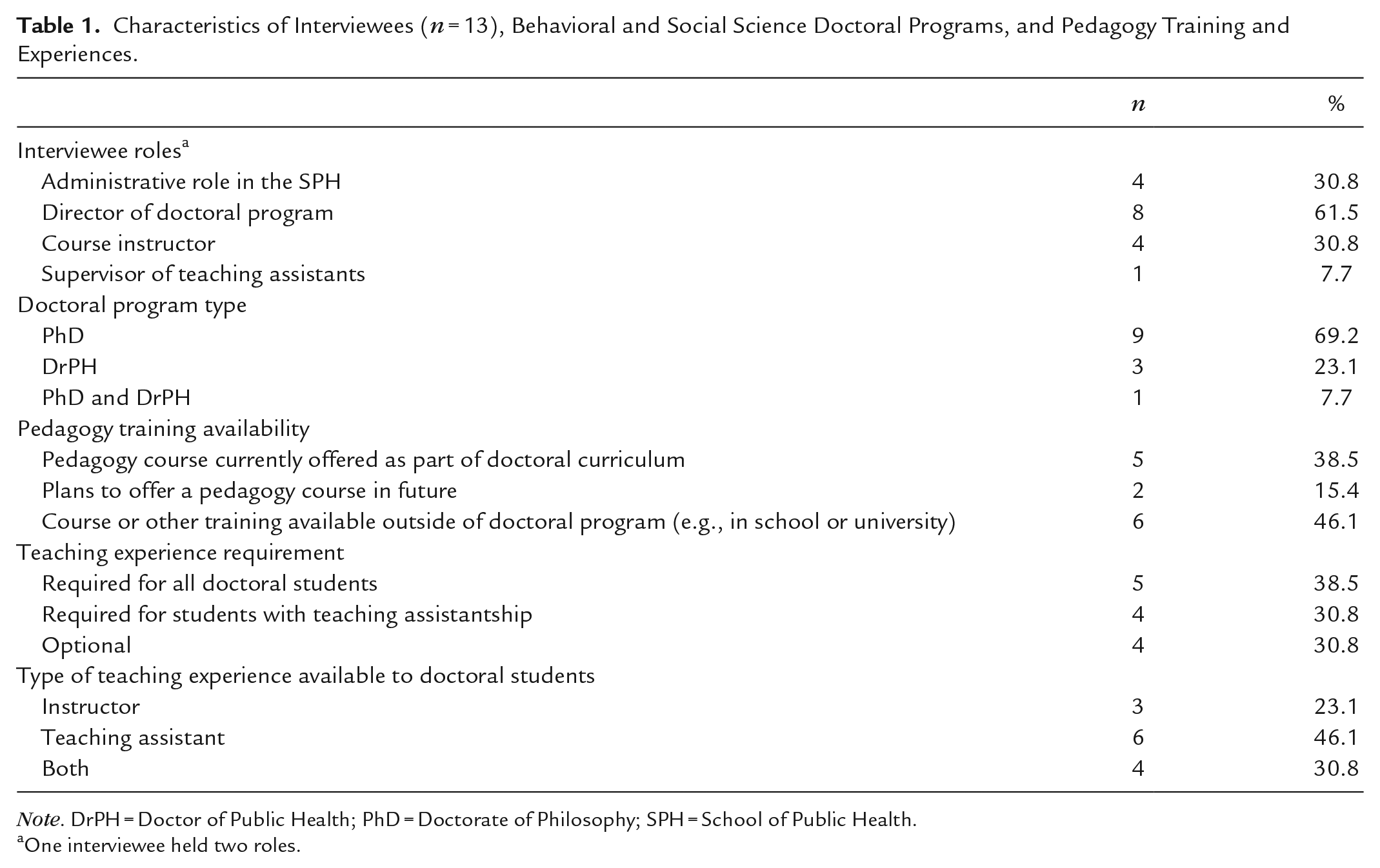
Note. DrPH = Doctor of Public Health; PhD = Doctorate of Philosophy; SPH = School of Public Health.
One interviewee held two roles.
Opportunities Available to BSS Doctoral Students for Pedagogical Training and Experiences
Interviewees described a range of opportunities available to doctoral students for pedagogical training and experiences.
Pedagogical training opportunities
Pedagogical training opportunities varied in the degree of formality, being required or optional, and setting (i.e., taking place within the program-, school-, and/or university). Most interviewees discussed opportunities for optional teaching training through university Centers for Teaching and Learning (CTLs) or SPH, which included pedagogy courses, certificates, TA training or orientation, or workshops. CTLs were most commonly mentioned as having training and resources that doctoral students could access if desired. One interviewee explained, “The Center for Teaching and Learning is excellent, so there’s always a place where [doctoral students] can ask questions and. . .go for help.” Interviewees described how CTLs could fill a gap when pedagogical training was not available within a doctoral curriculum. Doctoral students typically had to take the initiative to access these optional pedagogical training opportunities at CTLs. As one interviewee mentioned, “[The CTL is] a great resource, but again, if you’re going to use it, you have to decide that you’re going to put that effort in.” However, several interviewees mentioned efforts by CTLs to ensure that doctoral students were included, welcomed, and encouraged to attend the trainings.
In this sample, 54% of programs offered or were in the process of developing a pedagogy course as part of the doctoral curriculum. These courses were either required for all doctoral students, required for students with teaching assistantships or who were in a DrPH program, or offered as an elective. Several of the pedagogy courses included a teaching experience, ranging from a guest lecture to the course being linked with a teaching assistantship. Two programs planned to offer a pedagogy course in the near future, in order to enhance current teaching training and/or to meet new competencies set forth by the CEPH for DrPH programs (Council on Education for Public Health, 2016). An interviewee from one of these programs described the reasons for developing a new pedagogy course: . . .we found that our graduate teaching assistants were not always equally prepared and the orientation that the university offers. . .was not sufficient. Number two, . . .the CEPH criteria and its emphasis on being able to relay information. . .was also a driver, and then finally we wanted some of our doctoral [students] to have the opportunity to engage in teaching assistantships for those who are interested in going on to academia.
Key pedagogical skills that interviewees felt doctoral students should gain focused on three areas. The first area was course and syllabus development, with the ability to apply adult learning principles. One participant noted, “. . .we’d love both for the PhD and the DRPH [students] to have some sense of adult learning and what it takes to put a constructive course together. . .” The second main area was development and alignment of course objectives, activities, and assessments, particularly through the use of backward design. In addition to “. . .getting their. . .learning objectives matched with the content and activities and evaluations,” interviewees mentioned the importance of developing clear assessments and rubrics to gauge student learning. The third set of skills encompassed effective teaching methods. Interviewees noted specific active learning strategies that doctoral students should gain experience with, including small group discussions, flipped classrooms, and team-based exercises. An interviewee said that it is important for doctoral students to know, “. . .how to keep students engaged, how to make the material seem relevant to students, and tie it back to practice.” Other topics mentioned less frequently were inclusive pedagogical approaches, classroom management techniques, and developing a teaching philosophy.
Opportunities for gaining teaching experience
All of the programs included required or optional teaching experiences for doctoral students. In the sample, the teaching opportunities were evenly divided between being required for all doctoral students, being required only for students with teaching assistantships, or being optional. In many programs, teaching assistantships provided financial support for doctoral students. Doctoral students served as TAs for undergraduate and graduate courses, including introductory public health courses, behavioral theory, introduction to research methods, and other specialized courses. Most courses occurred in person, but almost half of the programs had opportunities for doctoral student to TA online. In a few programs, students could teach as the instructor of record, mainly later in the doctoral program.
TAs were involved the courses in a variety of ways, including facilitating class activities, grading, and managing course logistics. A few interviewees discussed that ideally there should be differences between a traditional TA, who functions mainly in a support role, and a doctoral student TA, who is learning to teach and therefore should be involved at a higher level. One interviewee noted, “. . .instead of them just performing work, that [the TA experience] be something that they improve their skills. So that might be classroom observation, so being observed like a regular faculty member would.”
An emergent theme was the central role of mentorship in the teaching experiences. Most interviewees described a mentored teaching experience for doctoral students, usually a teaching assistantship, where students worked with the faculty instructor. Faculty instructors model teaching and how to structure a course for the doctoral students. One interviewee described that since their program does not offer a formal pedagogy course, “. . .we’re kind of offering. . .[a] learn by doing approach and I think it’s a very mentored approach in that you’re working closely with the lead instructor.” A few interviewees mentioned the importance of TAs feeling like they are part of the teaching team. One person described: Well, one of the things we’re very proud of was how the doctoral student teaching assistants told us that they felt like they were actually part of the team and that their voices were heard, and that’s because our philosophy is at this level you’re a junior colleague in training.
Several interviewees noted that the mentoring of TAs was not standard across their programs and a few mentioned that their departments were in conversations to better define or standardize the TA role and expectations for the faculty mentors. One person said, Some [faculty] invest more in [teaching assistantships] as a learning experience. . .and a training experience and a professional development experience, and others maybe not so much, so I think that’s again something we would like to try and systematize more within our department.
Barriers and Facilitators to Offering Pedagogical Training and Experiences
Several barriers and facilitators to offering pedagogical training and experiences were identified at the university, school, program, faculty, and student levels (see Table 2).
Barriers and Facilitators to Offering Pedagogy Training and Experiences in Behavioral and Social Sciences Doctoral Programs.

Note. BSS = behavioral and social sciences; CEPH = Council on Education for Public Health; DrPH = Doctor of Public Health; TA = teaching assistant.
Barriers
The most common barriers to offering teaching training and experiences included lower prioritization of teaching compared to research, limited space in the curriculum, and funding constraints. Several interviewees noted that the focus of their PhD program was to train researchers and to prepare students for positions in which teaching would not be the primary role. Teaching was seen as a lower priority for some faculty and students. One interviewee said, “. . .faculty tend to devalue teaching I think. I think it’s not really rewarded like. . .research is rewarded.” Interviewees noted that not all students were interested in teaching, particularly if they were not planning on pursuing an academic career.
Key logistical barriers to offering teaching training and experiences included adding a teaching course in an already full doctoral curriculum, securing funding to pay a faculty member to teach a pedagogy course, or finding funding to expand teaching opportunities for doctoral students. Some interviewees also noted that students had little time to focus on teaching because of their coursework and research. One interviewee summarized how logistical barriers intersect with prioritization of teaching training, “I guess having the time and money to devote to it, both on the faculty side, you know, who’s going to teach it, and for the students to be able to devote the time. . . And to make it a priority. It’s hard to make it a priority.”
Another logistical challenge to offering formalized teaching experiences was the variation in SPH policies around doctoral students being listed as instructors of record. While several schools allowed students to teach as the primary instructor, this option was not available at other schools. One interviewee said, “. . .if there was a true opportunity for them to. . .be able to teach [as the instructor of record]. . .and get that exposure for a full semester, I think that would be ideal, for especially those that are on the trajectory of wanting to be a teaching or a tenured faculty.”
Facilitators
Key facilitators to offering teaching training and experiences included prioritizing teaching as a valuable aspect of students’ overall doctoral training, the degree of need for TAs and instructors, and the CEPH competencies on teaching and facilitation skills. Many interviewees acknowledged that teaching training and experiences can provide transferrable skills in instruction, training, mentoring, and public speaking.
Teaching training and experience was seen as a key element to be competitive for faculty positions when doctoral students go on the job market and to be successful in academia. Several interviewees described how teaching experience prepared doctoral students for faculty positions and gave them the confidence to design and teach a variety of courses. One person commented, “I would like to think that our students are more prepared to walk into a university and teach than [students in programs] that choose not to teach pedagogy.”
Interviewees also viewed teaching as necessary preparation for students to become effective in non-academic careers. Several interviewees noted that teaching skills are a core element of behavioral and social science work and are important for effective training and presenting. One interviewee said, “And even for those who swear up and down that they don’t want to teach. . .my argument would be at some point you’re going to be training or mentoring someone and that too is a form of teaching.”
Interviewees from several SPH noted that teaching experiences are offered because doctoral students can help meet the need for TAs and instructors. Some SPH are expanding or adding undergraduate programs, thus increasing the demand for instructors. One person mentioned, “. . .we do have a developing undergrad program and. . .we anticipate in the next year or two that [doctoral students] could actually be teaching bachelors level courses as part of a student assistantship.”
The recent changes to CEPH competencies for DrPH programs facilitated the initiation or continuation of teaching courses and experiences in schools offering such programs. An interviewee described that adding a teaching course “. . .was something that we had been thinking about would be nice to add, but the real motivator was the CEPH accreditation competencies, the DrPH competencies. . .that are tied to adult learning and training and pedagogy.”
Discussion
This study provides an in-depth examination of pedagogy training and experiences offered to students in BSS doctoral programs in SPH. All of the programs included in this study provided doctoral students with the opportunity to gain teaching experience as TAs and/or instructors. Just over half of the programs in this sample offered or were developing a pedagogy course as part of the doctoral curriculum, and many doctoral students had access to other teaching training, such as though CTLs. Key factors contributing to the availability of a pedagogy course and teaching experiences were the degree of priority placed on teaching for doctoral students; logistic challenges, such as time and funding constraints; the SPH’s need for TAs and instructors; and competencies requiring teaching training for DrPH students. The findings suggest several implications to strengthening pedagogical training for BSS doctoral students, including prioritizing pedagogical preparation in doctoral programs, recognizing the benefits of teaching training for academic and non-academic positions, the need to explore creative models to provide doctoral students with pedagogical preparation, establishing shared expectations and guidelines for mentored teaching experiences, and the potential for doctoral students to engage as instructors who contribute to the teaching mission of SPH. These implications are discussed below in further detail.
A key factor in whether a pedagogy course was offered as part of the doctoral curriculum in BSS programs was the degree to which teaching was valued or prioritized in the school and program. Interviewees from doctoral programs that focused heavily on research (i.e., mainly PhD programs rather than DrPH) expressed that teaching training was of lower priority for their students. Similarly, in other disciplines that require faculty to secure extramural funding, such as life sciences, doctoral students report a culture that prioritizes research over teaching, which presents challenges to gaining access to teaching training and experiences (Lane et al., 2019). However, doctoral students also acknowledge the benefits of gaining skills and confidence in teaching (Jordan & Howe, 2018). Notably, recent research suggests that teaching training does not negatively affect doctoral students’ research productivity (Feldon et al., 2011; Shortlidge & Eddy, 2018). Feldon et al. (2011) found that doctoral students in STEM disciplines who had teaching experience showed greater improvement in research skills compared to those who did not. The authors argue that teaching experiences in doctoral programs should be reframed as a “value-added component of graduate research training” (Feldon et al., 2011). Several interviewees echoed this sentiment and added that teaching training should be a priority for BSS doctoral students because these skills are important for both academic and non-academic positions. This viewpoint is supported by recent estimates of how faculty spend their time, which indicate that most faculty, including those focusing on research, spend a moderate to large amount of their time on teaching (BrckaLorenz et al., 2018; Jackson et al., 2015).
Another factor prompting the development and offering of pedagogy courses was the competencies for DrPH programs set forth by CEPH in 2016 that focus on education and workforce development (Council on Education for Public Health, 2016). This finding aligns with other research showing that many DrPH programs have expanded teaching experience opportunities for their students (Park et al., 2021a) and restructured curricula in response to the CEPH criteria to better address current public health issues and to clarify distinctions from PhD programs (Park et al., 2021b). Interviewees from DrPH programs, in particular, noted the applicability of pedagogical training and experience to public health practice, training, mentoring, and presenting public health content.
While there is evidence to indicate that a pedagogy course is likely to be more effective in developing teaching skills compared to shorter workshops (Dimitrov et al., 2013), other opportunities for teaching training can be important for doctoral students, especially if a pedagogy course is not offered in their doctoral curriculum. At the university level, CTLs offer valuable opportunities for training on teaching and learning (Lancaster et al., 2014). Most interviewees mentioned training available through CTLs, from workshops to certificate programs. Many interviewees noted that CTL programming is available to doctoral students; however, it is typically incumbent upon the student to make the effort to attend. The training opportunities described by interviewees in this study centered on pedagogy courses within the doctoral program or trainings through the CTL, with only a few interviewees mentioning teaching training opportunities at the SPH level. Offering teaching trainings at the department or SPH level could be a way to incorporate a focus on teaching in public health or BSS, particularly for doctoral programs without a pedagogy course.
All of the BSS doctoral programs in this study offered students opportunities to gain teaching experience through teaching assistantships and, in some SPH, being the instructor of record. At the time of data collection, which occurred before the on onset of the COVID-19 pandemic, most teaching opportunities for doctoral students were in-person, but almost half of programs had opportunities to TA online. The rapid shift to online teaching in SPH due to the pandemic highlighted the feasibility of widespread distance learning modalities (Armstrong-Mensah et al., 2020) and prompted calls to continue to flexibly integrate educational technology in courses (Sullivan et al., 2020). Moving forward, preparing doctoral students to teach both in-person and online could provide them with valuable skills for the changing landscape in public health education.
An important aspect of the teaching experience included mentorship from the faculty instructor to support the doctoral students’ development of teaching skills. As noted by the interviewees, doctoral teaching assistants should be involved in the course in meaningful ways that can support their development as teachers, beyond simply attending classes and grading assignments. Meaningful engagement can include TAs participating in the development of the course and syllabus, delivering content and facilitating learning activities, and providing feedback to students. While mentored teaching is acknowledged as an important way to support doctoral students in their pedagogical development (Baltrinic et al., 2016; Silverman, 2003; Walters & Misra, 2013), some of the interviewees noted that challenges arise when faculty mentoring is uneven. This finding suggests that programs, faculty instructors, and doctoral TAs could benefit from shared expectations and a structured approach for mentoring doctoral students in teaching.
A few programs provided doctoral students with the opportunity to teach their own course, with support from the program and faculty mentors. Policies on whether doctoral students can be instructors of record varied across the SPH in the sample. Allowing doctoral students to be instructors provides the potential benefits of meeting a department’s teaching needs and allowing the doctoral student the opportunity to further develop their teaching skills while receiving financial support. As undergraduate programs of public health continue to expand (Resnick et al., 2018), doctoral students with teaching training could step in as instructors. SPH would benefit from doctoral instructors and TAs with solid pedagogical training, who can facilitate inclusive classrooms, actively engage students using effective teaching strategies, and further develop their skills (Evans & Schwartz, 2019).
Strengths and Limitations
The main strength of this study is that it offers the first-known in-depth examination of pedagogical training and experiences for doctoral students in BSS programs and the facilitators and barriers to offering teaching preparation and experiences. Future research could involve a more in-depth examination of the skills and content included in public health pedagogy courses. Additionally, a qualitative study of the perceptions and experiences doctoral students and recent graduates who have completed a pedagogy course or other teaching training and experiences could provide valuable information about how to shape pedagogical preparation in public health.
There are several limitations. First, the people who agreed to an interview may have been more favorable toward or held stronger views about teaching training and experiences compared to the people who did not participate. Second, this study may not have captured the full range of teaching training offerings and perspectives about pedagogy training and experiences. For example, participants from only three DrPH programs were interviewed; therefore, there may be aspects specifically related to DrPH programs that could be further explored. Future research could also explore pedagogical training and experiences among doctoral programs in other public health disciplines. Third, although topic saturation was likely reached, theoretical saturation may not have been fully realized due to the somewhat low sample size (Hennink et al., 2017). Additionally, the interview length was limited by the participants’ availability and schedules. Interviewees seemed to speak candidly about their programs, but there could have been a degree of social desirability in their responses.
Conclusion
Students in BSS doctoral programs have access to a range of opportunities for pedagogy training and experiences, although these opportunities are not consistently integrated into curricula across programs. Given the limited information about pedagogy courses and experiences for BSS doctoral students, we encourage programs who offer or are considering ways to offer teaching opportunities to disseminate their syllabi, processes for course development and implementation, models for supporting doctoral students in gaining teaching training, and guidelines for mentored teaching experiences. BSS doctoral programs should consider how to nurture facilitators and overcome barriers in order to provide students with the best training possible for their careers.
Footnotes
Declaration of Conflicting Interests
The author(s) declared no potential conflicts of interest with respect to the research, authorship, and/or publication of this article.
Funding
The author(s) disclosed receipt of the following financial support for the research, authorship, and/or publication of this article: This study was funded by a Tulane University Carol Lavin Bernick Faculty Grant.
