




Abstract
Historical analysis is a vital but underutilized tool for analyzing and teaching public health and health promotion. An applied history of public health course, designed to meet a Council on Education for Public Health (CEPH) competency and learning objective, was qualitatively evaluated to determine the extent to which the course shaped students’ and alumni’s views on public health values, identities, and practices. A second aim examined the course’s impact on students’ and alumni’s public health work and their ability to discuss structural biases, inequities, and racism and health. Semi-structured interviews were conducted with 12 alumni and 11 students. Data were analyzed using thematic analysis. The four main themes were the importance of history as foundational knowledge and for the development of professional identities; history as a means to understand race, racism, and the social determinants of health; self-reflection and critical thinking as public health practices and the relevance of history to community health promotion; and the effectiveness of multiple pedagogical techniques. Findings suggest that a course including the history of public health institutions, concepts, practices, and health equity can be a valuable tool to teach students about the social determinants of health, health equity, and racism and health, gain perspective on current health problems, improve critical thinking skills and self-reflection as public health practices, and develop a professional identity. We recommend that MPH programs include a history of public health course and/or incorporate historical perspectives in existing courses. This training is increasingly important to prepare students to promote health equity.
Introduction
Historical analysis is a vital but underutilized tool for analyzing and teaching public health and health promotion. It contributes to a deeper understanding of the social determinants of health and possible interventions to promote health equity; it is an effective educational intervention for increasing social consciousness among public health students and practitioners and it can be a valuable tool to analyze health problems and to generate new ideas about health promotion (Fleming, 2020; Madsen, 2018).
Public health scientists, sociologists, epidemiologists, and historians have written on the ways in which history is important to advance public health work, understand the social determinants of health, and promote health. Historical analysis is an essential approach to public health and health promotion because it includes detailed analyses of the multiple social contexts in which people live and work (Madsen, 2018). Krieger (2008) argues that “no aspect of our biology can be understood absent knowledge of history and individual and societal ways of living” (p. 225). In order to understand racism, class, sexism, sexuality, and heterosexism, the intersections between these forces and their multifaceted effects on health, we must integrate analyses of the historical forces “that have sustained inequalities over time” (Schulz & Northridge, 2004, p. 459). Similarly, Jones et al. (2014, p. 640) write that “history offers key analytical perspective on the intersection of biology and social processes in the categories of race, ethnicity, gender, sexuality, and class” and on possible public health approaches to these problems. Chowkwanyun (2011) specifies that history can deepen analysis of racial health inequities by exploring the historical roots or fundamental causes of inequities, the social and political constructions of inequities, and ways of undoing these problems. We understand these arguments to mean that in order to understand the social determinants of health in the present more deeply and fundamentally, it is essential to analyze them in historical context and how they have changed over time; and moreover, that in order to improve public health practices in the present, it is necessary to understand the history of public health institutions, concepts, and practices in historical and social contexts including past racist public health practices.
History as intervention comes in several forms. The study and practice of history is an important means “of raising social consciousness” among students, professionals, and communities in ways similar to the work of feminist and postcolonial studies (Madsen, 2018, p. 119). Local and oral history can be valuable tools when working at the local level in public health and to promote community engagement (Madsen, 2018; Sheard, 2008). An educational role of history includes “challenging myths and offering alternatives” and by giving perspective on current health problems by “highlighting how ideology can determine questions being asked and the priorities being set” (Madsen, 2018, pp. 119, 120). Chowkwanyun (2011, p. 266) argues that history can also reveal the “sometimes disturbing lineages behind current ways of thinking” and thereby contribute to reflexivity in public health practice. Fleming (2020) has recently described his course focused on the historical roots of health inequities. He argues that the course is valuable for public health students because it is necessary to understand the historical construction of inequities over time and for effective community work in public health. For reasons such as these, Madsen (2018, p. 119) frames history as an essential tool in a “whole systems” approach for analyzing the social determinants of health and interventions to promote health equity.
History also provides important, critical perspectives on the ways that public health knowledge, institutions, and practices are contingent products of history (Brandt & Gardner, 2000; Fairchild et al., 2010). Because of this, history can provide important perspectives on the historical, contextual, and contingent circumstances and key ethical dilemmas in public health research and practice. This perspective on contingency is necessary because it “inculcates the notion of change, that things have not always been as they are now and will change again in the future” (Berridge, 2018, p. 887). This emphasis on contingency and change over time can create a space for new thinking about health promotion and interventions. For example, Kushner (2008,2010) has demonstrated that historical analysis of disease categories and health problems can open new pathways for thinking about causation, interventions, health promotion, and health policy.
The Council on Education for Public Health (CEPH, 2016) requires that Master of Public Health (MPH) programs teach and assess foundational learning objectives and competencies including the following: “explain public health history, philosophy and values” and “discuss the means by which structural bias, social inequities and racism undermine health and create challenges to achieving health equity at organizational, community and societal levels” (pp. 16, 17). We are not aware of any scholarly or scientific work that has evaluated this learning objective and this competency in an MPH course or has evaluated a history of public health course. In this paper, we present an evaluation of a course which includes the history of public health institutions, concepts, practices, and health equity and that addresses these two curricular components as well as our own department competency: analyze public health history for perspective on current health problems.
The Department of Behavioral, Social, and Health Education Sciences (BSHES) in the Rollins School of Public Health of Emory University has taught a required course entitled Applied History of Public Health since 2007. The course uses history to gain perspective and understanding on current health problems including health inequities and health equity. We have found knowledge of public health history and the tools of historical analysis to be vital for MPH students in order to: integrate social justice perspectives into their practice; inculcate reflexivity into their work; analyze, understand, and intervene in current health problems including the social determinants of health; gain historical perspective on important concepts, practices, and institutions in public health in order to inform current practice; and to develop their emerging public health identities. The course’s approach is rooted in principles of social constructivist educational theory, team-based and active learning strategies, and adult learning principles. The course is student-centered, problem-based, and focuses on the construction of knowledge through dialogue and co-learning through peer and teacher support and feedback (Hrynchak & Batty, 2012; Palincscar, 1998). Recent studies have suggested that team-based, active learning in small groups is more effective in health sciences classrooms than the traditional didactic long lecture format. Active collaboration that encourages peer interaction promotes problem solving, critical thinking, and collaborative learning (Freeman et al., 2014; Kalainan & Kasim, 2017). For adult learners, approaches that build on previous experience in order to solve problems in the classroom are valuable and effective (Bryan, et al., 2009).
The usual class size for this course is thirty to thirty-eight students. At the beginning of the semester the instructor and students collaborate to create a community agreement to help frame discussion of difficult and sometimes emotional issues which arise given the topics in the course. Throughout the semester, each class session is framed around a public health problem to prompt a deeper understanding of how the history of public health institutions, practices, and concepts can offer perspective on that problem. Themes on the histories of racism and health inequities are woven through the course to show, for example, how changing ideas of causation can shape and sometimes limit current public health practices. The class session on vaccine hesitancy centers around the questions: which was more important to the success of vaccination campaigns in smallpox and other diseases, persuasion, or compulsion? What are the sources of resistance to vaccination? One of the class sessions on racism focuses on the question: what is more important in the history of public health, race, or racism?
Before class, students write individual response essays based on the readings and the questions of the week. A typical class session begins with a brief lecture by the instructor to augment and contextualize the readings. Two groups of students present the key themes of the readings to the class in presentations of 10 to 15 minutes, share their perspectives on the readings, and offer discussion questions. Then, in small groups students discuss the readings based on a discussion guide and the presenters’ questions. The class reconvenes after the small group discussions to further explore questions, issues, and concerns the students found most pertinent. The historical elements are taught through the readings, the presentations and lectures, and discussions. Assessment for the class includes three essays, team presentations, and in-class discussion exercises. Co-learning occurs when small teams of students analyze an assigned reading in depth together in order to make a presentation about it to the class. They often must reconcile diverse interpretations of the reading in order to come to an agreement about the presentation. It also occurs when students in small groups have discussions about the readings and reflect on others’ diverse perspectives and experiences and during whole class discussions. The instructor and teaching assistants support the analytic conversations by participating with students in the small groups and during whole class discussions.
The aim of this study was to conduct a qualitative evaluation to assess the Applied History of Public Health course in the context of our curriculum and its efficacy in meeting the CEPH learning objective, CEPH competency, and department competency described above (see Box). We examined students’ and alumni’s perspectives of the teaching methods, the degree to which the course was helpful in developing an emergent professional identity, and whether our alumni found it useful for their subsequent careers.
Competencies and Knowledge Objectives for Applied History of Public Health Course.
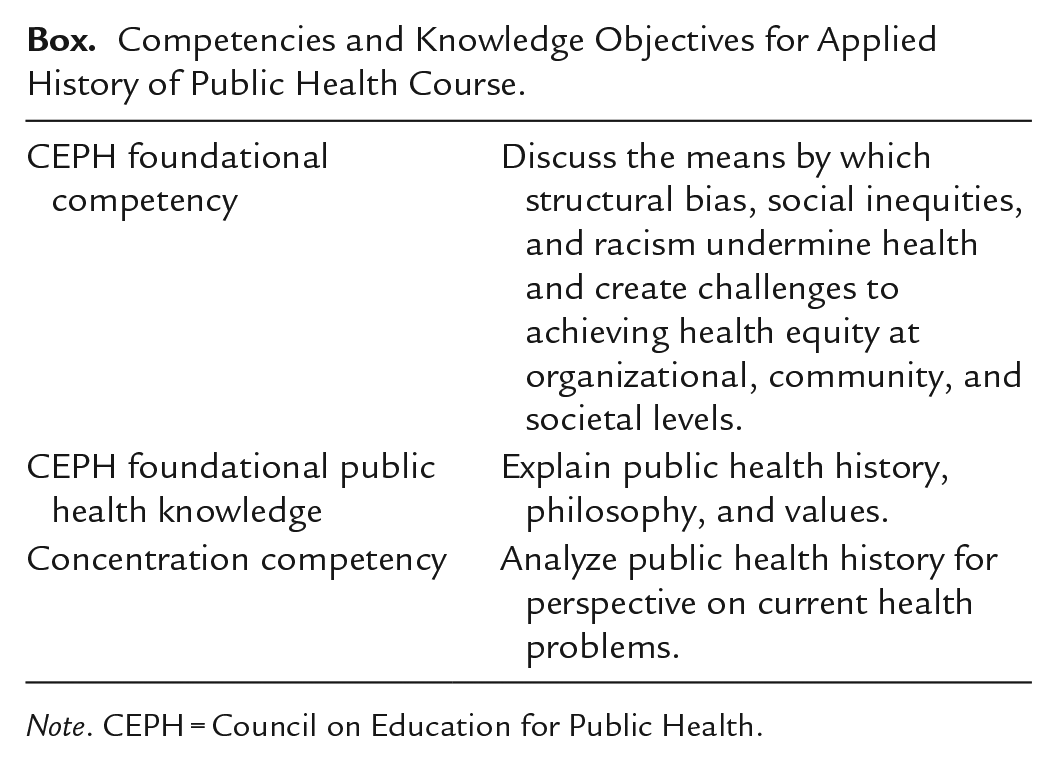
Note. CEPH = Council on Education for Public Health.
Methods
We conducted qualitative interviews with 11 current MPH students and 12 alumni in the BSHES department to assess the perspectives and value of the Applied History of Public Health course. The students for this course only come from our department. In-depth interviews allowed us to explore the value and meaning students attribute to the course’s content as well as the learning objectives and competencies. Semi-structured interviews allowed time for the interviewer to probe on specific student experiences and the impact on the participants’ overall understanding of public health and their career goals (Hennink, et al., 2011; Padgett, 2012). The Emory University IRB approved the study.
Sampling and Recruitment
We used purposive sampling to recruit a diverse range of participants that reflect the overall student demographics (race, ethnicity, and gender identity) in the BSHES department (Padgett, 2012; Table 1). Inclusion criteria included: current enrollment as an MPH student in the BSHES Department who completed the Applied History of Public Health course or a graduate of the BSHES MPH program who completed the course in the past 5 years.
Characteristics of 12 Alumni and 11 Student Interviewees.
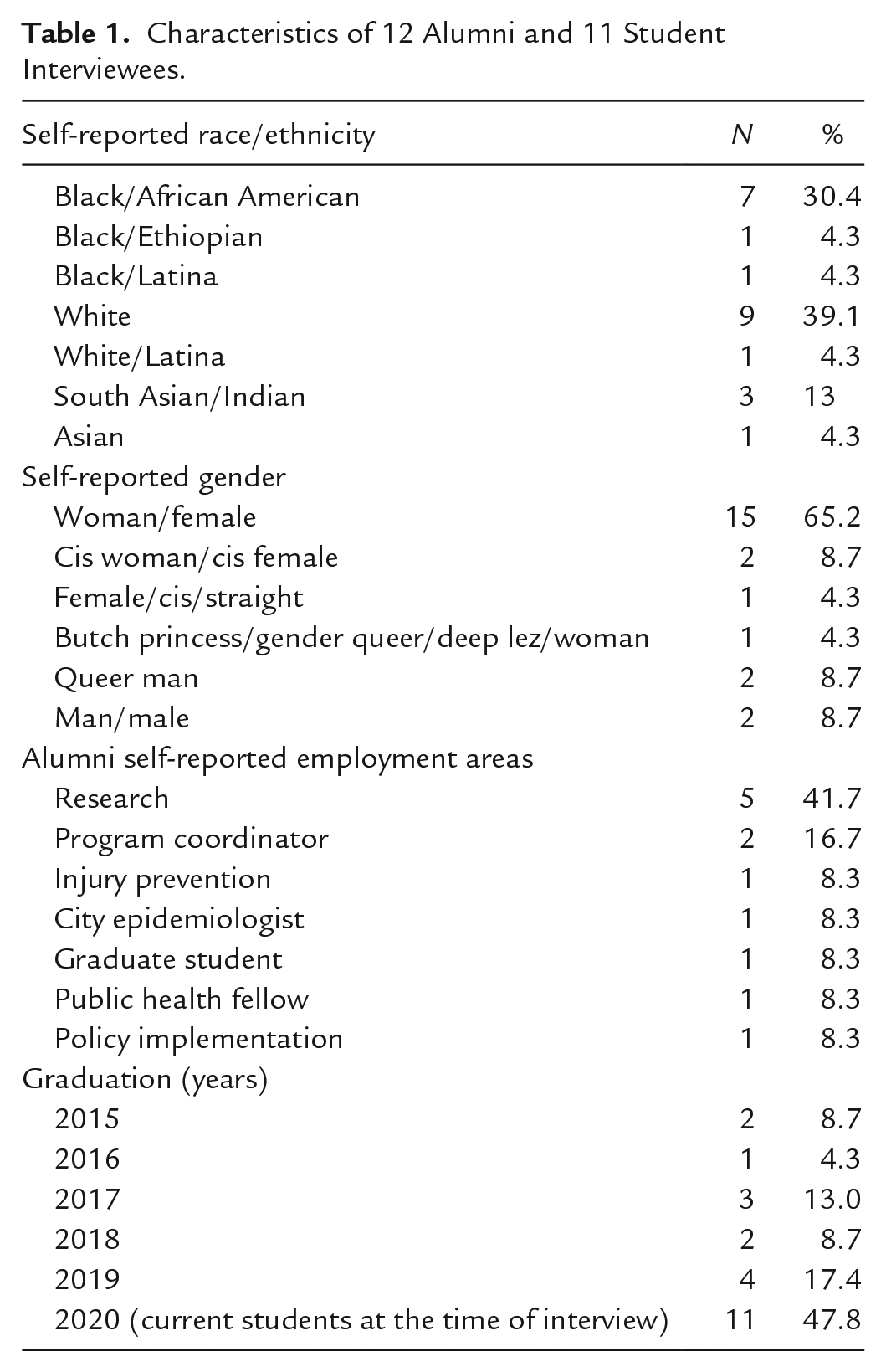
To recruit participants, a research assistant sent an email to currently enrolled students and alumni describing the study and asking if they were willing to participate in an interview about the course. The students and alumni completed a short screening form to confirm their eligibility and were contacted to schedule an in-person, Facetime, or phone interview. The research assistant conducted the interviews at a time and location convenient to the participants.
Data Collection
The interview guide was developed from topics in the literature review, student course evaluations, and course learning objectives and competencies including the CEPH foundational objective and competency described above. The guide included the following domains: (1) how the course shaped students’ views on public health, values, identity, and practice and the impact on their public health work and career; (2) students’ perceptions of their ability to discuss structural biases, inequities, and racism and health; (3) the value of the course in the BSHES MPH curriculum and the importance of history for public health education and work; and (4) pedagogy and suggestions for course improvement.
Before beginning the interview, the researcher obtained a signed informed consent form in person or by email, depending on whether the interview was in person or virtual. Interviews lasted between 25 and 70 minutes and were audio recorded. The participants did not receive incentives for participation. The audio files were transcribed by a professional transcriptionist and reviewed by a member of the research team to ensure accuracy. All data files such as audio recordings, transcripts, and datasets were password protected and kept on a secure network.
Coding and Analysis
Data were analyzed using thematic analysis which is a method for identifying, analyzing, and describing patterns or themes in the data (Braun & Clarke, 2006; Padgett, 2012). Transcripts were de-identified and entered into the qualitative software MaxQDA for data management and coding. Two researchers reviewed a subsample of transcripts to identify a list of codes and definitions for the codebook. The researchers compared coding and resolved differences by further refining the codes and definitions. The codebook was used to double code the transcripts. Researchers wrote memos on key codes and relationships between the codes. Codes were grouped together into themes that captured participants’ experiences and perspectives. All names are pseudonyms.
Results
Themes from the interviews emerged into four clusters centering on the value of learning history in an MPH curriculum. The themes included (1) the importance of history as foundational knowledge in public health and for the development of professional identities; (2) history as a means to understand race, racism, and the social determinants of health; (3) self-reflection and critical thinking and the relevance of history to health promotion, community health, and public health; and (4) the use of multiple teaching strategies to support student learning and meaningful conversations. Comparisons were made between responses of students and alumni and responses of participants of different racial/ethnic identities. No significant thematic differences were found between these subgroups.
The Importance of History as Foundational Knowledge and for the Development of Professional Identities
Students take this course in the first semester of the MPH program because it serves as an introduction and a foundation for work in behavioral, social, and health education sciences in public health and health promotion. At the beginning of the semester many participants reported having a limited definition of public health. For example, Jason, a student, commented, “I’m not sure I would entirely know what public health is if I didn’t have this historical context.” Participants said that the course broadened their ideas about the scope of public health and increased their appreciation of the social determinants of health. Lauryn, an alum, indicated the ways the course had broadened her views so that she saw the larger contexts of health. She explained:
“I think the course really laid the foundation of, ‘hold up, this is more than just disease.’ Even in the topic of talking about tuberculosis, or infant mortality rates . . . those diseases come from unequal access to medical services. Those diseases come from discrimination. Those diseases come from poor environments.”
Tatianna, a student, elaborated that this new understanding of public health showed her that “social factors are. . .a very important component of public health, it opens up the field of possibilities for what could be public health work.”
History as Important Foundational Knowledge
Many participants responded that the course provided them with important foundational public health knowledge. Hannah, an alum, said, “for me it was just the good foundation for understanding the field as someone who is sort of new-ish to it.” Isabelle, a student, described how the course added important human context and emotion that is often missing in other public health classes. She said, “It just kind of gives you this emotional perspective. It humanizes the concepts. And I think that’s what’s lacking from almost every – from a lot of public-health curricul[a] is that humanization.” She added, “I think it was important as public health officials to know this history, to know the background in order to be successful professionals.” Karen, a student, agreed saying, “We can at least start with getting everybody involved in the history because that’s so core to where we’re going and why we’re where we are now. Like, it’s foundational knowledge that everybody should have.”
History and the Development of Professional Identities
The course also helped students to understand their professional roles in public health and develop a professional public health identity, and many indicated it helped them find their place in public health and broadened their views of possible career paths. For example, Tatianna explained, “I think it’s easier to think of multiple places where I could fit into this field, whereas before [this class], I could only think of like one or two potential things I could do in public health. Now, it’s like broadened the possibilities.” Jamilla, an alum, also noted the positive impact the course had on her perceptions of her career in public health. She said,
“So, the best thing the course has done has showed me that I actually have a role. I didn’t have a strong epidemiology background, so I felt kind of weird that I might not be able to play a big part in science. Or I don’t have a strong research background, so I might not be able to impact research. But taking the class has shown me that it takes a lot of people throughout the history of public health to actually make a difference. . .”
Importance of Collaboration, Teamwork, and Multidisciplinarity in Public Health
The course helped many participants understand the importance of collaboration and teamwork in their professional roles; and several students specified that the course helped them understand how behavioral and social sciences and health promotion fit into the larger multidisciplinary institutional contexts of public health. For example, Hannah remarked that, “I think it . . . laid out how all of these disciplines relate to each other, where some of the overlap is, and then where some of the distinct features of each area of study are and how we can work together [in public health].” Some participants also mentioned that learning about the unethical and harmful practices of past public health research and programs motivated them to pursue an ethical public health practice that includes addressing racism and health inequities and pursuing more equitable health promotion.
History as a Means to Understand Race, Racism, and the Social Determinants of Health
Many of the participants responded that the course increased their understanding of and raised consciousness about the social determinants of health, health inequities and inequality, and the multiple contexts affecting health. Karen explained, “I would say the class kind of demonstrates how, one, just like our history as the United States and as the world, but like, specifically within America how our history has impacted individuals’ health within racism, sexism, classism.” Another student, Petra, stated, “I’ll be honest, it wasn’t hitting me what the main difference between equity and inequity was until I was learning more about the history of it [in this class]. . .” Many participants reported that the course helped them understand the systemic, institutional, and historical nature of racism and discrimination and their effects on health. Merlin, a student, remarked, “I think definitely, I personally, the most important [lesson] I learned was just like the importance of racism in public health . . . and I think that’s the biggest reason that the class needs to be in the curriculum.”
Racism as a Cause of Health Inequities
Students appreciated learning that racism, not race, was the cause of health inequities. As Shannon, an alum, said, “It’s not a person’s race that is determining these things. It’s the way that people react to them and act towards them that is the problem.” For those participants who already had some understanding of racism as a public health issue, some said that the course deepened their understanding of it or brought it into sharper focus. Only two students said the course did not affect their views on racism as a public health issue, but they thought it did have an effect on others. For example, Imani, an alum, said, “I’ve had my own personal experiences with race and health. So, it was for me kind of preaching to the choir, but I do think it was beneficial for some people who’ve never experienced racism and health.”
Importance of the Study of Racism in the History of Public Health
Many participants thought it was important to study the history of racism within the profession of public health because it showed how some actions taken in the name of public health or for the “greater good” were racist. This helped students consider their roles in public health practice and how they could contribute to antiracist practices. Many students said that the readings on the Tuskegee Syphilis Study were impactful because they generated a strong emotional reaction, meaningful conversation, and reinforced the importance of discussing racism as a public health issue. As Tatianna said, “One of my favorite classes. . . was when we talked about the Tuskegee experiments just because I think it’s important to have those kinds of conversations and to acknowledge that that history is there.” Kyle reported that he had not examined this topic in depth before and continued by saying,
“I think that the conversation that was had that day [about Tuskegee], it was an important conversation. I think that sort of like, some people struggled through it, including myself. But I think that it’s important to, as a group, process those feelings and process exactly what our thoughts are on that piece of information and that history.”
Self-reflection and Critical Thinking and the Relevance of History to Health Promotion, Community Health, and Public Health
Several students shared how the class material initiated important self-reflection as part of their own public health practice. Isabelle, a student, described how the class affected her personally. She said, “I felt really guilty because I didn’t know [about the history of racism and health inequities in the US], and no one’s ever told me. And then, I was just like, people don’t talk about these things. And I don’t know why people are not talking about this because this is so important.” Luci, a student, questioned how she would have responded in an unethical public health scenario. She remarked, “Would I have said something if I were involved in the Tuskegee trial? I don’t know. And I think that’s why the class is so important because it challenges us to really engage in history that’s super, super raw.” She added that “as a white student, I think [the class] really drew attention to where my privilege needed to come into this.” Some students reported that the course contributed to students challenging their own privilege and raising awareness about positionality in research and practice.
Importance of Understanding the History of Racism to Community Health Promotion
Many students reported that the course helped them understand the impact of racism when planning interventions for people of color and working with minority communities and the importance of self-reflection when undertaking this work. As Lauren said,
“I think it was a wake-up call for me. Well, being an African-American woman, I think specific that those little nuggets of race discrimination in the history of public health. Obviously, I could identify with that . . . When I do a research project. . . when I read a research project – there are questions that run through my head; there are assumptions that I check in my own mind. I think it's natural for everyone to assume things, or think a conclusion is just a conclusion, but I think the History of Public Health really helped define that there's always another layer.”
Jamilla concurred, saying, “I think it [history] can be used as a tool for health promotion. It’s where you use it as a means of reflection.”
Importance of History to Understanding Communities’ Perspectives and Experiences to Improve Health Promotion and Planning
Many participants reported that the course helped them understand the importance of health promotion and how historical contexts shape current approaches to community health. Many students argued that knowledge of history was essential for working in communities because it fostered critical thinking and reflexivity and emphasized the importance of communities’ voices and diverse perspectives. Participants reported that the course was particularly effective in teaching the importance of historical perspective to improve critical thinking and efficacy and planning in health promotion. Monica, a student, concurred saying, “I think this course really kinda laid the foundation for how. . . programs and interventions should be done right.” Alexis, an alum, added, “I think the critical analysis of how we think about health problems, how we think about working with communities was really advantageous.” Tatianna concluded that, “I don’t think you can have an effective health promotion program if you don’t understand the history of either that health topic or the population that you’re working with or the community that you’re working in.” Many participants mentioned that the course effectively raised their awareness about the importance of communities’ perspectives, voices, and priorities in research, practice, and health. Shannon, an alum, said, “the importance of actually being in a community and listening to the community is a big takeaway” from the course. Denise, a student, added, “and you can’t just go blindly into a population without knowing them first. And history is part of who you are.”
Appreciation of Diversity, Community Contexts, and Cultural Humility
Participants responded that the course inculcated appreciation of diversity and seeing public health from multiple points of view. They also emphasized that the course instilled appreciating community contexts and cultural humility as important elements in their professional identity and roles, as well as the importance of population-level perspectives. Jamila, an alum, said, “but the best thing about the class is that it ended up encompassing a lot of cultural competency and to deal with different populations that we might encounter. And that has been the most beneficial.” Petra, commenting how the course impacted her current work, said,
“So, critically thinking about the moment, evaluating it, and evaluating yourself and your privilege and what you can do to prevent something like that from happening in the future but also to remedy and mitigate whatever harms were done. So, it’s definitely that type of self-aware introspection on yourself and also on the history that’s there.”
Multiple Teaching Strategies Support Student Engagement and Meaningful Conversations
Participants viewed the multifaceted nature of the course structure as being important for engaging students, supporting their learning, and providing a “safe space” for difficult conversations. Participants noted the value of the readings and lectures for introducing each topic, the discussions for offering opportunities for critical analysis and considering multiple perspectives, and teamwork for promoting peer learning. Several participants noted that the course structure centered the students’ voices in a meaningful way. For example, Monica remembered that:
“. . .it was a very welcoming space, and I think [the professor] did a great job of giving us, the students, the platforms to speak, which was very important. . .this was one of the main classes where I felt like wow, I actually have a voice, because it’s something that affects us, especially people of color.”
Active Learning Strategies and Professional Development
Participants appreciated the small group activities and teamwork beyond simply completing assignments. Participants described that the teamwork, discussions, and presentations allowed them to practice being flexible and to gain experience collaborating and communicating with people who may or may not have similar views. They also mentioned the value of learning from each other and gaining a better understanding of people’s varying perspectives. For example, Kyle reflected on the benefits of hearing from other students:
“I think that getting perspectives from others, your classmates, and having these discussions in an open forum can be a really powerful thing. And they can point out your blind spots. . . .there’s just multiple times in class where I felt like I was able to reach an entirely new perspective on a point in an article or a point in a discussion, just based on a question that someone posed or a thought that someone had in class.”
Several participants mentioned that their presentation skills and ability to clearly articulate an argument improved as a result of the course. A few alumni mentioned how these skills were valuable in their current work as well. As Jason noted, “I think learning how to sit and listen to people that have different opinions or different understandings of the readings or the topics you’re discussing is something that is extremely valuable, especially after leaving the school.”
Importance of Inclusive Space for Difficult Conversations
The course fostered a space where most students felt comfortable sharing their opinions and talking about topics that might be uncomfortable. Luci said, “I think [the course] prompted some really uncomfortable conversations but also. . .we found out where we showed up for each other and like when we weren't getting it right how we all could still support each other in that space.” Some participants felt comfortable sharing in small groups, whereas they may not have been as comfortable talking in a large group. However, some participants noted that not everyone in the class felt comfortable sharing their ideas because the diverse mix of personalities was intimidating. A suggestion shared by a couple of participants was to have a more explicit discussion at the beginning of the course to set ground rules for having respectful and inclusive dialogue and to prompt students to reflect on who should be the ones to speak on the issues first and foremost (Table 2).
Themes on the Value of Learning History in a Master of Public Health curriculum With Example Quotes.

Note. LGBTQ = lesbian, gay, bisexual, transgender, queer; STI = sexually transmitted infection.
Discussion
In this evaluation study, participants who completed the Applied History of Public Health class reported that the class taught foundational knowledge and prompted new insights about their professional identities. Students concurred that history was an effective way to learn about race, racism, and the social determinants of health and health equity. Participants reported that the course sharpened their critical thinking skills and was useful for informing their approach to health promotion in diverse community contexts. Students and alumni responded that the multifaceted pedagogical strategies were effective for engaging students with the material, supporting learning, and creating a space for difficult conversations.
The course was effective in meeting the CEPH competency “discuss the means by which structural bias, social inequities and racism undermine health and create challenges to achieving health equity at organizational, community and societal levels” because it gave students new perspectives on the social determinants of health and how present health inequities are linked to past inequities. Many students reported a new or deepened understanding of how racism shapes health and of how societal inequalities lead to health inequities. Many also reported an increased ability to describe and analyze these relationships more effectively after taking the class. In meeting the CEPH foundational objective “explain public health history, philosophy and values,” many students shared that the course imparted the importance of studying public health history and public health values. The most common reasons for this included: that understanding the multiple historical, social, and cultural contexts of public health was important for understanding contemporary public health; that understanding that public health changes over time can help facilitate changes in the present; that understanding past successes and failures can improve current practice; and that the importance of studying social determinants of health and health inequities in historical context was vital for understanding current population health issues. Students reported that among the public health values the course imparted were inclusivity, the value of communities’ perspectives and community-based work, making vulnerable populations a priority for public health, the good for all, compassion, solidarity, social justice, activism and advocacy, and anti-racism work.
Participants valued the course in the context of the curriculum in part because many were new to the field and it allowed them to develop a professional identity and improve critical thinking which many carried forward into their careers. Training students to acknowledge the impact of racism, consider the historical roots of health inequities, and assess social and structural determinants of health is vital to preparing them to be public health professionals who can work toward health equity (Abuelezam, 2020; Bassett & Graves, 2018).
To our knowledge, this is the first evaluation of a public health history course in an MPH program and it supports the scientists and scholars who have argued that history and historical perspective are vital tools to understand the social determinants of health (Chowkwanyun, 2011; Fleming 2020; Jones et al., 2014; Krieger, 2008; Madsen 2018; Schulz & Northridge 2004). We found that history was useful as a pedagogical intervention to gain perspective on and improve health promotion especially in relation to the social determinants of health and community work as Madsen (2018) has argued. The course enabled students to develop a critical perspective on the institutions of public health and its ethical dilemmas.
Based on our findings, we recommend that MPH programs include a history of public health course which includes the history of public health institutions, concepts, practices and health equity, and/or incorporate historical perspectives in existing courses. Notably, it is crucial to develop an inclusive classroom environment and to establish community discussion norms from the beginning of class in order to support open and difficult discussions among students. The pedagogical strategies of co-learning, peer support, and active collaboration are central to generating meaningful conversations and learning, especially with regard to race, racism and health, and critical thinking.
A strength of this evaluation was the inclusion of students and alumni who represent the racial, ethnic, and gender diversity of our MPH students. A limitation is that students and alumni who chose not to participate may have had other experiences or perceptions about the course that were not captured in our data. Additionally, the evaluation was conducted on a course within a behavioral and social sciences department in one school of public health; therefore, the findings may not include nuances that would be salient in other contexts.
Conclusion
A history of public health course can be a valuable tool to teach students about the social determinants of health, health equity, and racism and health. Importantly, a history course prompts students to improve and sharpen critical thinking skills and inculcate habits of self-reflection, better analyze public health problems and the social determinants of health, and develop a professional identity. This training is increasingly important in order to better prepare students to promote health equity as future public health professionals.
Footnotes
Author Note
The Emory University IRB determined that the study “does not require IRB review because it does not meet the definition of ‘research’ with human subjects or ‘clinical investigation’ as set forth in Emory policies and procedures and federal rules if applicable.” IRB #: IRB00113127.
Declaration of Conflicting Interests
The author(s) declared no potential conflicts of interest with respect to the research, authorship, and/or publication of this article.
Funding
The author(s) received no financial support for the research, authorship, and/or publication of this article.
