



Abstract
Critical thinking is an important skill in all academic disciplines, but it can be difficult to develop assessments that adequately evaluate how critical thinking has changed over the period of a semester. In the context of health promotion, it is essential to prepare learners to appraise health information and misinformation, identify health disparities and work to address them, engage in health promotion practices that are culturally sensitive, theoretically driven, evidence-based, and acknowledge the role of social determinants of health and health behaviors. Health Behavior Theory is a fundamental subject taught in health promotion programs. While a large part of this subject matter involves the learning of health behavior theory, it presents an opportunity where critical thinking can be fostered through embodied pedagogy. Since students have had years of exposure to health information, as well as personal and observed experiences with health behavior, students come with many preconceived notions about the subject matter. In this article, we describe the use of a scaffolded experience of embodied behavior change and self-reflection, culminating in the creation of an autoethnography as a pedagogical experience which can support critical thinking in learners. We describe the development, implementation, and evaluation of the autoethnography assignment. As an embodied pedagogy, the autoethnography experience provides students with valuable insight into the difficulties of behavior change on an individual level while connecting individual experiences with social discourses that influence diverse meanings related to health behavior.
Health behavior theory is a common requirement in health promotion and community health programs at the undergraduate and graduate levels. While health behavior is an extremely embodied practice—meaning that behaviors are enacted through bodily movement and experienced through bodily sensation—theory can be presented in disembodied ways which can confound students. Furthermore, given the sheer number of theories in use, students must gain critical awareness of the uses and limitations of these theories in the face of a growing understanding of the social determinants of health and health behavior (Short & Mollborn, 2015). This paper outlines a teaching practice of incorporating (1) an embodied health behavior change for students to undertake, (2) weekly reflections on the connection to their behavior change and theories learned in class, (3) identifying and providing a critical analysis of health behavior promotion messaging weekly, and (4) a culminating autoethnography to describe their embodied process of behavior change and a description of patterns they identified in observing the messages surrounding them throughout the process. We first outline the relevant theories supporting these pedagogical practices.
Pedagogy of Autoethnography as Critical Thinking
Critical thinking is defined, taught, and evaluated in various ways across different disciplines, though generally involves a reflective thinking process to determine an action or belief (Ennis, 2015). Writing is an important tool for the development and demonstration of critical thinking generally, and the ways this is developed and evaluated varies (Barr, 2019; Ezezika & Johnston, 2022; Yancey, 2015). Autoethnography generally refers to the exploration, and often critique, of a cultural phenomenon through a reflective writing practice focused a personal experience or set of experiences (Denzin & Lincoln, 2018; Ellis et al., 2015). It is a valuable form of writing that combines reflective writing, ethnographic observation, embodied pedagogy, and critical communication, all of which provide ways for students to learn the material in personally meaningful and critical ways (Denzin & Lincoln, 2018).
Writing assignments generally can provide important measurements of critical thinking skills, especially when students are required to articulate their thoughts with supporting evidence (Carter et al., 2016, 2017; Paul & Binker, 1990). Reflective writing has been associated with improvements in critical thinking (Yeh et al., 2023). Autoethnographic writing, specifically, can support the development and assessment of critical thinking (Cook, 2014) and can reasonably be expected to do so in the following ways: via systematic analysis of their own experiences, through evaluating the cultural, historical, and societal factors that have shaped their experiences and identity, identifying connections of their personal experience to larger sociocultural patterns, and by reflecting on their own biases and assumptions while considering alternative perspectives.
Embodied Pedagogy and Critical Communication Pedagogy
Nguyen and Larson (2015) define Embodied Pedagogy as “learning that joins body and mind in a physical and mental act of knowledge construction. . . [and] entails thoughtful awareness of body, spaces, and social context.” (Nguyen & Larson, 2015). They state that there are typically three important conceptual elements: bodily and spatial awareness, unification of mind/body in learning, and the body’s role as sociocultural context (Nguyen & Larson, 2015) all of which provide learners with an embodied site of “articulation” of theory (Shahjahan, 2015). Students of behavior change theory thereby enact behavior change in such a way that allows theory to inform their experiences while undergoing health behavior change.
Relationship to the Assignments
A primary goal of introducing the embodied health behavior change with a critical appraisal of health promotion messaging was to help students connect the theories to the vague “sociocultural” context which arises in many theories and models of health behavior. Furthermore, through the experience of reflecting on their behavior change, they embody and name the constructs of the theories which are personally felt in their struggles to change. Part of the motivation for this is educational, specifically remembering the constructs of the theories through embodiment of a health behavior change process. Another source of motivation is to create intense empathy for future populations they may work with. Many students begin the class asserting that personal responsibility is the biggest determinant of health behavior participation. Facing 16 weeks of trying to change their behavior, they come to realize the socioenvironmental barriers and influences on that change. Through observing the discourse surrounding health behavior promotion (at first with approval, then with trepidation and finally with critical awareness), they begin to see and feel the weight of the ways that the modern health promotion context “restrict[s] the range of behavior by promoting and sometimes demanding certain actions and discourag[ing] or prohibit[ing] others” (Wicker, 1979). Gathering weekly data via reflective writing is essential component of building and evaluating critical thinking skills throughout the embodied experience of the semester.
Course and Assignment Description
The autoethnography assignment was added to an undergraduate health behavior theory class at the University of Illinois at Urbana-Champaign (United States) in Spring 2019. This campus serves between 33,000 and 35,000 undergraduate students in any given year and is classified as an R1 institution. Historically, this class incorporated one large research paper on a health behavior of interest. The course is an advanced writing general education (GE) requirement and a major-specific requirement for Community Health and a subset of Interdisciplinary Health Sciences students. The course objectives are: (1) You will be able to describe the role of health behavior theory in Community Health, psychology, medicine and social science; (2) You will recognize the impact of psychology, society, and the individual on health behaviors; (3) You will determine the role of race, gender, socioeconomic status, and health status on different groups’ ability to engage in health behavior; (4) You will critically evaluate behavioral health issues in modern society; (5) You will identify methodologies used in the behavioral sciences; and (6) You will demonstrate writing principles appropriate to the health field. As an advanced writing GE course, assignments needed to total 20 to 30 pages of writing with multiple drafts of the assignments required. As part of the updated writing component of the course, students complete several writing assignments on a health behavior change selected by the student: weekly reflections, annotated bibliography, literature review, health promotion handout, and the autoethnography.
Assignment Development
We chose to vary the types of writing assignments to reflect community health-specific writing (including a literature review, and a promotional handout). Authors BA and KD, who introduced this change, wanted to increase the connection of theory to an embodied experience of having students change their own health behavior while also promoting critical thinking about health behavior messaging. Therefore, we decided to incorporate autoethnography to guide students to reflect critically on their behavior change journey and notice the discourse surrounding their chosen behavior.
The newly designed set of assignments was initially implemented in two class sections of Foundations of Health Behavior in Spring 2019 at the University of Illinois Urbana-Champaign. Each class had a lecture section and several discussion sections. The ratio of students to teaching assistants (TAs) in the discussion sections was about 30:1.
Assignment Description and Implementation
The complex nature of writing autoethnography necessitated a scaffolded experience. In the first week of the semester, students learn about connections between health and behavior and identify a behavior they would like to change during the semester, a health outcome expectation associated with that behavior and then set a SMART goal (specific, measurable, action-oriented/adjustable, realistic/relevant, and time-based).
In addition to providing an experience to gain a deeper understanding of theory, the embodied behavior change involved active awareness of discourse surrounding their changes, thus examining the body’s role as a sociocultural context. Weekly, students were asked to comment on two messages related to their behavior change and what those messages made them think, feel, and do. This form of guided and embodied reflection is a means of employing Critical Communication Pedagogy which seeks to teach the “constitutive power of communication, the ways in which communication—from one’s embodied movements through the world to one’s particular word choices—function reiteratively to sediment particular experiences and understandings of the world as well as to disrupt, challenge, and alter those experiences and understandings.” (Fassett & Nainby, 2017).
Students were provided with additional questions that they could use to help them provide an analysis of their identified messages (found in Supplemental Appendix 1) thus supporting them in the development of critical thinking in their observation of behavior change messaging. While they were working on their other writing assignments, they amassed a small data set comprised of approximately 22 to 26 messages.
In week 11 (of a 16-week semester), students were taught the process of conducting a basic thematic analysis using Braun and Clark’s six-step process (Braun & Clarke, 2012). These six steps include the following. Step 1, becoming familiar with the data—students were asked to re-read all their reflections. Step 2, generating initial codes—students were asked to assign short descriptions of ideas, patterns, and concepts that stood out to them as they reviewed their reflections, and were asked to identify at least one code for each message they wrote about. Step 3, searching for themes—students wrote down all of their codes from step 3, and then started grouping similar codes together. Step 4, review themes—students reviewed all of the codes in their different groupings to begin defining the patterns of codes as a theme. Step 5, define themes—using the worksheet provided in Supplemental Appendix 2, students created a definition of each theme, listed all codes belonging to that theme and identified 1 to 2 examples from their reflections of messages that fit within each theme. Step 6, writing up—at this stage, students used their completed thematic analysis worksheet to begin writing about each theme, using messages from their reflections to exemplify the themes. A lecture was devoted to this topic and a worksheet (found in Supplemental Appendix 2) was provided to allow students to organize the themes they identified during their analysis.
Health as an unassailable good is difficult to argue with, making this assignment an uncomfortable space for students to learn how to critique and grow in their critical awareness. They start the semester by choosing a health behavior—they are excited to finally “get ripped,” “lose weight,” quit smoking, sleep more, or improve their skin by drinking enough water. We put significant effort into building excitement about their goal. Then we require them to look for messages that relate to their goal and critically analyze the underlying motivation for those messages. They start to question their earlier assumptions, “if I just have enough willpower, I can reach this goal.” While we give them tools to succeed in reaching their goals (e.g., Health Behavior Theories and evidence-based behavior change programs), we simultaneously create a space for a sort of disillusionment to happen.
After spending the first part of the semester struggling through and reflecting on the behavior change process, becoming familiar with the literature through writing a review, and identifying messages in the world around them, they begin the autoethnography. We ask them to identify themes in their messages. They are guided in this process in lecture as well as in their discussion section where they practice with their TAs, and peer-review other students’ thematic analyses. They are asked to identify at least four themes in their messages, with one theme related to race, gender, or socioeconomic status.
Students then write an autoethnography critiquing the messages in the world around them, and what those messages are trying to get them to think, feel, and do. Students also reflect on their experience with the behavior change process as well as how these messages might have shaped their values and beliefs regarding the behavior change and hindered or helped their success. Students identify bias and misleading information in the messages as well as positive encouragement.
Students are given the opportunity to turn in a second draft of the paper following a round of feedback. This comparison between drafts serves as an important marker of critical thinking growth—but more importantly, the autoethnography is in and of itself a reflection of the students’ process of coming to a critical awareness of the sociocultural milieu surrounding their chosen behavior change. If instructors/TAs notice a lack of critical thinking in the first draft of the assignment, specific feedback (often in the form of questions in the Reflection Assignment instructions found in Supplemental Appendix 1), is given.
Assessment and Iterative Implementation
Since this first semester, the assignment has been implemented in 15 sections of Health Behavior across seven additional semesters. Classes have been held as few as once per week for 2 hr and 40 min (non-writing intensive delivery of the course) and as much as four times per week for 50 min a session (one discussion section and three lecture sessions in the writing intensive delivery of the course). Students are typically sophomores or juniors when taking the class. All faculty members involved in course delivery are junior faculty members. Furthermore, Author began implementing this assignment at the University of Colorado Colorado Springs within a non-writing intensive version of this course and has done so in-person and online. This campus serves roughly 10,000 undergraduate students and is classified as an R2 institution. The comparable course at this institution was not classified as a writing intensive course and also had no discussion section as part of the course (and no teaching assistants). The assignment has therefore been implemented and evaluated under several teaching circumstances. Details about the implementation of the assignment are included in Table 1.
Implementation of Autoethnography Assignment.
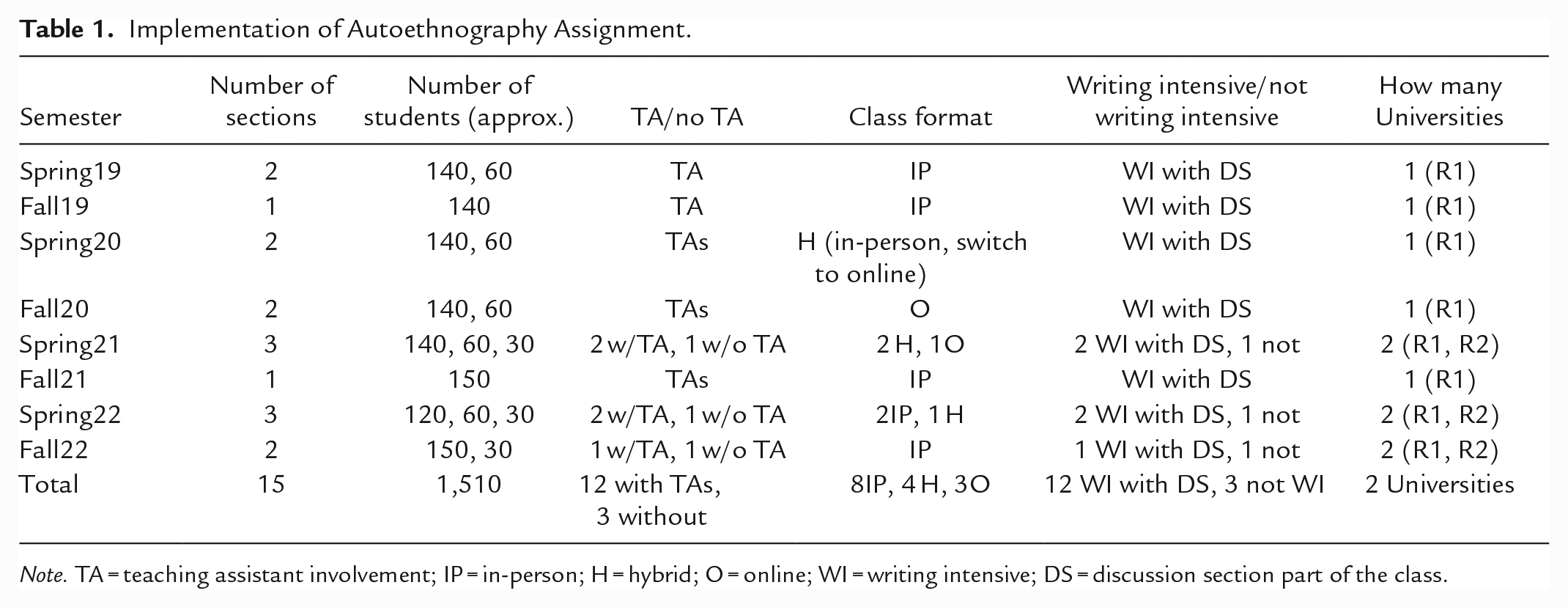
Note. TA = teaching assistant involvement; IP = in-person; H = hybrid; O = online; WI = writing intensive; DS = discussion section part of the class.
Each semester, three sources of input allowed instructors to further refine the autoethnography assignment. These were: formal and informal feedback from students (i.e., course evaluations at the end of the semester, informal early feedback in the middle of the semesters and conversations with students during class or office hours). The second source of feedback was from TAs of the class who worked intensively with students on all writing assignments. The third source was from the assignments themselves. Reviewing the assignments allowed the instructors to determine whether the assignment objectives were being met based on the content of the work produced by the students. Importantly, we looked for critical thinking growth/engagement as the semesters went on. Since students wrote weekly reflections, we could see change in engagement with the prompts and critical evaluation of the messages as the semester went by. Additionally, based on information gathered from these three sources, we made several changes over the course of the first four semesters of implementation of the new assignments.
Specifics Allow More Room for Critique
Early on, the assignment description was less proscriptive (in keeping with autoethnographic tradition allowing the author to determine the best form for writing). However, due to the lack of familiarity with autoethnography, students were frustrated by the process and requested more examples, specific requirements, and direction. TAs, likewise, wanted specifics to allow them to successfully guide students “in the right direction.” Instructors grappled with the need to allow students freedom to explore their experiences and the expectations we had of a well-reasoned critique of health behavior promotion messaging. The decision was made based on this feedback to provide a guideline of the sections of the paper (see Supplemental Appendix 1) as well as an example. Instructors wrote an example and gave descriptions and expectations for the paper sections through the new rubric. Student papers started following the structure of the example. However, the critiques of their identified themes became more robust. So, while the current assignment may stray from principles of autoethnography that allow more freedom in form, at the undergraduate level, the structure allowed students to spend much more time with their thematic analysis and identifying their critiques/finding sources to support their critiques.
Guiding the Thematic Analysis Process
Initially, the thematic analysis was introduced in a workshop (discussion section) in week 11 of the semester. Students were taught the six steps of thematic analysis by Braun and Clarke (2012; Maguire & Delahunt, 2017) and performed coding in class with the first 10 weeks of reflections that they had written. As many students of qualitative study do, our classes struggled to know what a code was, whether something could have multiple codes, how to come to a theme, and what to do if two themes were related. We introduced two main changes in response to this feedback. First, a worksheet was created (Supplemental Appendix 2. Thematic Analysis Worksheet). Students brought their first 10 weeks of reflections in as they had before (representing roughly 20 unique health promotion messages related to their behavior change and what those messages made them think, feel, and do) and learned the steps of thematic analysis as they had before. The worksheet was given to students to allow them to amass all their codes and notes into one place (side 1 of the worksheet). After they had all their codes written down, they started looking for the patterns in the codes and were instructed to try and find at least four categories or patterns that they could put their codes into (i.e., bucket themes). On side 2 of the worksheet were four columns representing the four themes they would be identifying. They were asked to name the theme, then define the theme, write in all the codes that fit within that theme, and include exemplary quotes from their reflections. After this worksheet was completed, they were ready to write about each theme for their autoethnography assignment.
This worksheet was implemented for several semesters before a second addition was made by Author CC to provide further scaffolding for the thematic analysis. Author CC collected a sample data set to analyze with the class using the “Donut Analogy.” Since this is not a qualitative methodology course, only a general overview of Thematic Analysis was given and the analogy was used as a tool to explain the coding process. This analogy used an image of donuts with various attributes (pink, vanilla, sprinkles, etc). Students were told to think of the attributes as different codes. Students were asked to group the donuts based on a range of similarities in attributes/codes (e.g., color, toppings, flavor, etc.). These groupings represented themes, which the author noted could involve some donut characteristics (codes) being grouped into more than one group (theme) depending on the characteristic being prioritized (e.g., pink frosting could be color or topping). From there, students were asked to determine how frequently each donut attribute (code) appeared to learn about the significance of each theme. This lecture and analogy were paired with the instructions for completing the thematic analysis worksheet to support students in building the skill of identifying codes and themes as well as determine significance prior to attempting to explain the significance in relation to course readings and other peer reviewed literature in the autoethnography.
Finding Sources That Critique Health is Challenging and Uncomfortable
For this assignment to truly resemble autoethnography, the connection with other literature is necessary, otherwise the paper is, instead, a piece of reflective writing. Based on our objectives as instructors to help students think critically about health behavior promotion, we required that students identify at least three sources that supported their critique of one or more of their themes. We found that identifying appropriate supporting literature for their critiques was a weakness through TA feedback, informal student feedback, and reading the final work. Additionally, students were uncomfortable critiquing health promotion materials generally.
To support the students in, what for them was uncharted territory, we introduced two example papers within the required reading of the class and noted that most students would be able to use components of at least one, if not both articles in support of their critique. These papers were Health as a Meaningful Social Practice by Crawford (2006) and Guilt, Fear, Stigma and Knowledge Gaps: Ethical Issues in Public Health Communication Interventions by Guttman and Salmon (2004). Since these articles covered a wide range of topics in relation to the critiques of health behavior promotion, they were widely applicable to the students’ work. Seeing these examples allowed students to find similar work more easily than expecting them to identify appropriate search terms related to their themes and critical inquiry. While most students used at least one of the example papers moving forward, their additional sources were of a higher quality, and more closely related to their themes than they had been in the past.
Additionally, we emphasized that not all their themes would be “bad” or worthy of critique. We focused on providing a strong critique of at least one theme rather than a weak critique of all four. As a result, students’ critical analyses improved.
Inevitably, Health Behavior Messaging Targets Different Demographic Groups Differently
Related to our desire to strengthen critical awareness and critical thinking through this assignment was our desire to uncover that health behavior messaging can carry racist, sexist, classist, and ableist undertones (not to mention those that are overtly so). In early iterations of this assignment, we could identify these trends when reading and grading students’ reflections, but the assignments were often void of critique about the ways bias and discrimination are present in health behavior promotion messages. Therefore, to meet our objectives, we introduced another requirement to the assignment. This requirement was to identify at least one theme that demonstrates the ways that the messages they identified were gendered, racialized, or targeted groups of different socioeconomic status differentially. Initially, we worried that some students would truly have nothing applicable, but this proved not to be the case.
Limitations
One limitation of this description of the Autoethnography is a lack of student work/feedback to demonstrate change in critical thinking or suggestions for assignment improvement. Future work with this assignment will involve systematic evaluation of the impact of the assignment on students’ critical thinking skills using a scholarship of teaching and learning approach.
Lessons for the Field
As instructors, our goals with this class and the embodied behavior change component were to (1) get students excited about their health behavior change, (2) get students frustrated about the messages they see and hear, (3) get students critiquing the messaging impact from a social ecological model perspective, (4) create a space where a sort of disillusionment happens, and (5) empower critical reflection arising from their transformational learning experience. As health promotion continues to attract the attention of the fitness and wellness industries, social media influencers, and other popular outlets, it is imperative that we strategically challenge students’ preconceived notions of health and behavior change in the interest of addressing health inequities. We found this assignment useful for that purpose.
Supplemental Material
sj-docx-1-php-10.1177_23733799231174247 – Supplemental material for Using Autoethnographic Writing to Teach Critical Thinking in Health Behavior Theory Courses
Supplemental material, sj-docx-1-php-10.1177_23733799231174247 for Using Autoethnographic Writing to Teach Critical Thinking in Health Behavior Theory Courses by Brynn Adamson, Kristen DiFilippo, Elizabeth Frasca and Caitlin Vitosky Clarke in Pedagogy in Health Promotion
Supplemental Material
sj-docx-2-php-10.1177_23733799231174247 – Supplemental material for Using Autoethnographic Writing to Teach Critical Thinking in Health Behavior Theory Courses
Supplemental material, sj-docx-2-php-10.1177_23733799231174247 for Using Autoethnographic Writing to Teach Critical Thinking in Health Behavior Theory Courses by Brynn Adamson, Kristen DiFilippo, Elizabeth Frasca and Caitlin Vitosky Clarke in Pedagogy in Health Promotion
Footnotes
Declaration of Conflicting Interests
The author(s) declared no potential conflicts of interest with respect to the research, authorship, and/or publication of this article.
Funding
The author(s) disclosed receipt of the following financial support for the research, authorship, and/or publication of this article: This study was supported from University of Illinois at Urbana-Champaign Provost’s Faculty Retreat Grant which aided in the development of this assignment.

References
Supplementary Material
Please find the following supplemental material available below.
For Open Access articles published under a Creative Commons License, all supplemental material carries the same license as the article it is associated with.
For non-Open Access articles published, all supplemental material carries a non-exclusive license, and permission requests for re-use of supplemental material or any part of supplemental material shall be sent directly to the copyright owner as specified in the copyright notice associated with the article.
