




Abstract
Modern public health practice includes planning, implementation, and evaluation of programs targeting the structural and social determinants of health. To prepare graduate students to engage with theory in complex, practical, and innovative ways, a new model of course delivery was created to focus on developing and applying theorizing skills to the social ecological model. Throughout the semester, students engage in collaborative learning to apply theory to real-world public health interventions focused on high-profile public health issues. Data were gleaned from three course sections (N = 80) using a pre-post study design to evaluate students’ ability to apply theory at various levels of the social ecological model and confidence to meet course objectives. The post-course survey also included questions about the helpfulness of specific course elements and asked for recommendations for improvement. Descriptive statistics were calculated and differences between pre- and post-ratings were tested with paired samples t-tests and Wilcoxon signed rank tests. Students improved in their ability to apply theory by the end of the semester (p < .001) and in their confidence in meeting all learning objectives (p < .001). Most students found that this new format of engaging with theory in complex, applied, and innovative ways by working in teams, completing in-class activities, and open poster presentations beneficial. Engaging students in a new course format led to critical reflection about various levels of influence on health and enhanced students’ ability to apply theory at multiple levels of influence. Further refinement and course development will continue to facilitate developing theorizing skills.
The multifaceted and complex issues facing public health have led to multiple calls over the decades for transforming how public health practitioners work toward health equity (Landers & Bowleg, 2022). Part of this transformation includes addressing long-standing structural factors that have hindered the ability of public health to make substantial progress. For example, structural racism, classism, and sexism along with many other complex problems affecting population health (e.g., police violence and restrictive abortion policies) require innovative solutions guided by theoretical frameworks that engage multiple levels of influence. Yet work integrating and applying theory across multiple levels of influence and expanding theoretical frameworks remains underdeveloped (Asada et al., 2018; Crawford & Lewis, 2022; McBride et al., 2021; Schölmerich & Kawachi, 2016).
Developing Theorizing Skills by Engaging With the Social Ecological Model
Theorizing provides the opportunity to integrate theory across multiple levels of influence to begin addressing structural factors influencing health outcomes. Theorizing means to critically develop an explanation of a phenomena, such as health behavior, that describes the relevant constructs and the relationships between the constructs (Goodson, 2010). To theorize means asking questions and developing logical explanations through an iterative process of review, reflection, and testing (Goodson, 2010; Kislov et al., 2019), including identifying relevant constructs, describing propositions, and designing conceptual models to faciliate testing proposed relationships (Kislov et al., 2019). Within public health, a helpful framework for the theorizing process is the social ecological model (SEM).
The SEM is foundational to transformational public health (Schölmerich & Kawachi, 2016). While different conceptualizations of the SEM exist, most highlight multiple levels of influence on individual and population health outcomes. One conceptualization identifies intrapersonal, interpersonal, organizational, community, and policy levels and interactions between the levels as influential to health outcomes (McLeroy et al., 1988). Increasingly, the public health field recognizes the inadequacy of focusing primarily on the intrapersonal and interpersonal levels of the SEM in research and practice (Asada et al., 2018; Golden et al., 2015; Komro et al., 2018; Lieberman et al., 2013). This has resulted in a call for increased attention to organizational, community, and policy-levels of influence, including the social and structural determinants of health (Asada et al., 2018; Golden et al., 2015; Komro et al., 2018; Lieberman et al., 2013).
However, a review of curricula from the top 20 schools of public health in the United States found that few courses focus on social and structural determinants of health (Komro et al., 2018). This training gap limits the profession’s impact on population health. If we are to make significant improvements in addressing health equity and intervening on structural factors that influence health, the next generation of public health professionals needs to integrate multi level thinking into their work (Magaña & Biberman, 2022), requiring innovation in how theory is taught in Master of Public Health (MPH) programs.
Challenges of Theory Related to Social and Structural Determinants of Health
Part of being able to engage in the theorizing process includes exposure to a variety of theories that cross multiple levels of influence. While the SEM is a guiding framework for many foundational theory books used in schools of public health, more attention to the structural determinants (Komro et al., 2018) and social theories of health inequality is warranted (Harvey, 2020; Komro et al., 2018). Harvey (2020) highlights the limited theory-based public health resources focused on explaining the social, political, and economic determinants of health. Previously, other authors have noted similar gaps within public health training (Golden & Earp, 2012; McLeroy et al., 1988). With the increased attention to social and structural determinants of health, additional frameworks are needed to gain clarity on hypothesized mechanisms that link levels of influence (McBride et al., 2021).
Course Development
To focus attention on applying theory at multiple levels, we tested a new model of course delivery for the foundational theory course for MPH students in the Department of Behavioral, Social, and Health Education Sciences (BSHES) at the Rollins School of Public Health, Emory University. This course aims to equip students with skills in theory exploration and application at the multiple levels of influence on population health. Competencies met by completing the course include “Explain behavioral and psychological factors that affect a population’s health” and “Apply the social-ecological framework or other theories to examine public health research studies.”
This new format was first implemented in 2018 in one of four sections of the course. An initial evaluation of the new format compared with a traditional section suggested that students in the newly designed section felt more confident to meet course objectives at the end of the semester (Walker et al., 2021). Based on these promising results, additional sections of the course implemented the same format in 2019 and a more in-depth evaluation that assessed outcomes was conducted. In this paper, we present the results of the evaluation.
Redesigning and implementing the course across multiple sections required investment and support from the department. Each section was led by two instructors and a teaching assistant, which allowed for collaboration and increased student support. While each co-instructing team developed their own method of engaging with the class, all students received substantial guidance and feedback on their work. Co-instruction included teaching teams mutually agreeing upon a lead teacher for each level of influence and dividing grading responsibilities to enable in-depth review and feedback. Teaching teams met regularly to align feedback and teaching strategies.
To prepare for the semester, all teaching teams met multiple times to discuss the course and evaluation. The instructors who previously delivered the course shared materials, including assignments and lectures. While this provided some consistency across sections, each instructional team set expectations and created learning communities for their own sections.
Before the semester, instructors identified challenging public health problems, such as suicide and opioid use prevention, along with real-world interventions related to these topics that addressed various levels of the SEM by reviewing literature and publicly available information. Once interventions were identified, instructors developed short summaries that gave context to the intervention (e.g., setting, population, and example activities) and described the overall goal. As is often the case with practice-based interventions, few details about their theoretical foundations were available (Leviton & Trujillo, 2017). Therefore, students were afforded rich opportunities for exploring the theorizing process by envisioning myriad possibilities for describing how the interventions may achieve their overall goal. By engaging with real-world interventions, students develop understanding about linking practice-based and academic public health. The assigned interventions served as a framework for each team to collaboratively think about theory and how the intervention might achieve its stated goal by developing conceptual models.
Course Format
The course was re-designed using a flipped classroom model (Hew & Lo, 2018; Howard et al., 2017) in which students prepared for class by watching short, pre-recorded lectures describing the level of influence, reading relevant literature, and engaging in their own research on theories prior to class. Class time was spent on collaborative learning tasks such as summarizing specific theories and engaging in peer review of emerging conceptual models. Through these and other activities, students worked in teams to enhance understanding, apply theory, and develop a multi level conceptual model. During several class sessions, teams completed application worksheets (described below) for each level of influence, which served to facilitate development of conceptual models (see Table 1 for an overview of the schedule and topics).
Overview of the Schedule, Topics, and Assignments for the Theory Course for Master of Public Health students.

Active Learning Model
The course is grounded in social constructivist learning theory (Palincsar, 1998), where students work independently and together to engage in problem solving. Building upon prior evaluations of the benefits of team learning (Lang et al., 2018), students individually take responsibility to prepare for team meetings, and collaboratively work to solidify understanding of theory through problem-solving and integration of knowledge. Students explained their understanding of theories to team members, which enhanced cognitive processing and comprehension (Major, 2020).
A core feature of the course revolves around collaborative learning, where students work in teams to think through real-world public health interventions. Collaborative learning, a type of active learning, encompasses a variety of pedagogical strategies that facilitate students engaging in groups to enhance understanding, develop solutions, and create deliverables (Smith & MacGregor, 1992). Discussion, reciprocal teaching, and problem-solving are all features of collaborative learning (Major, 2020).
Collaborative learning encourages student autonomy (Hill et al., 2020), and as a form of active learning has the potential to create more equitable learning outcomes (Theobald et al., 2020). In this class, collaborative learning emphasized autonomy in the learning process by giving students power to explore theories and providing support to enhance understanding. The bolstered teaching infrastructure allowed the teaching team to guide students in their decisions about which theories and constructs to select and to ask questions about how they were applying them to their interventions. Students received in-depth feedback on their work to facilitate the iterative development and refinement of the final projects. Designing teams where everyone contributes to understanding and the final project ensures each student participated in the process.
During the first-class session, students were introduced to each intervention and, depending on their preferences, were assigned to teams focused on a specific intervention for the rest of the semester. Throughout the semester, teams applied theories to the assigned real-world intervention at each level of the SEM. Weekly class sessions addressed different levels of the SEM, starting with the intrapersonal level, and building to the policy/macro-societal level. In the pre-class lectures, delivered via the online learning management platform, students learned about the fields that influenced the core theories, key concepts that are common across theories, and challenges associated with the theories at each level. Then, students were asked to find and explore specific theories most relevant to their assigned intervention.
Application Worksheets: For each level of influence, the teams completed “Application Worksheets” (Supplemental Appendix A) where they selected a relevant theory, demonstrated understanding of the theory by providing a brief description, and identified constructs of the theory. The worksheets prompted students to define the constructs, describe how the constructs apply to their assigned intervention, and explain strengths and limitations of the theory. The theories selected across the levels of influence varied by team. Examples included Self-Determination Theory, Social Cognitive Theory, Social Networking, Diffusion of Innovations, Empowerment Theory, and Intersectionality. The purpose of these worksheets was to help teams develop their final projects by identifying theories and constructs to include in their conceptual model.
Final Project: Through an iterative process, students developed a final conceptual model project that was a culmination of their work across the semester describing how their assigned intervention might achieve its intended goal at three levels of the SEM. Students used feedback on their application worksheets to inform the development of their conceptual models. During several class session, students developed draft conceptual models, engaged peers in discussion about their models, and continually refined their models. With their final multilevel conceptual models, students gave context to the intervention, identified the selected theories and their level of influence, described the connections between the constructs, and addressed the strengths and limitations of the conceptual model. By developing their conceptual models, students demonstrated their ability to theorize and connect multiple levels of influence.
At the end of the semester, students from all sections presented their conceptual models at a public poster presentation with invited public health practitioners and researchers serving as judges and providing feedback. The session was held in a shared area and was open to anyone. By engaging with experts, students learned from people currently working in public health practice. Students gained professional experience in presenting their work by discussing theoretical concepts and explaining their multilevel conceptual model. They also learned from each other by visiting other poster presentations.
To demonstrate their individual proficiency in meeting the learning objectives, students completed an independent final paper presenting their understanding of theory and its application, as well as their reflection on the development of the multi-level conceptual model.
Evaluation Questions
The purpose of this evaluation was to assess whether students improved their ability to apply theory after completing the theory course, their confidence to meet course learning objectives, and their perceptions of the helpfulness of specific course elements. The evaluation questions we sought to answer were: (1) To what extent did first year MPH students in the BSHES department improve their ability to apply theory at multiple levels of influence? (2) To what extent did first year MPH students in the BSHES department gain confidence in meeting the course learning objectives? (3) What did first year MPH students perceive as most helpful in their learning?
Methodology
Evaluation Setting and Design
All MPH students in the BSHES department are required to take the Theory Driven Research and Practice course described above during their first semester. The data for this evaluation came from three different sections of the course taught by three sets of instructors (two per section) in Fall 2019. For this year, the intervention topic selected was suicide prevention, and intervention descriptions were informed by the CDC’s Preventing Suicide: A technical package of Policy, Programs, and Practice document (Stone et al., 2017). The evaluation uses a pre-post design and draws upon a paper and pencil application activity and self-reported electronic survey data.
Data Collection Methods
The Institutional Review Board determined this evaluation met the criteria for a classroom activity and therefore, did not meet criteria for human subjects research or require full review. A graduate assistant handled data collection and management. Two faculty external to the instructional team oversaw the evaluation process. Instructors were not involved in reviewing the data, and participation in the evaluation was not associated with course grades. A final evaluation report summarizing the data was provided to instructors after the semester ended and grades were submitted.
All students enrolled in one of the three sections using the flipped design classroom were asked to complete an application activity and an electronic survey at the start of class the first day and the last day of the semester. Student IDs were used to link the pre- and post-course data collection. The application activity sought to gauge students’ ability to accurately place an intervention within various levels of the SEM and develop a justification for their placement. The pre- and post-course surveys asked students about their confidence to meet course objectives. The post-course survey also included questions about the students’ perceptions of the helpfulness of specific course elements to their learning. Students were given approximately 15 min to complete the application activity and survey.
Applying Theory Activity
During pre- and post-data collection students were provided a brief statement about 15 interventions (e.g., support groups for pain patients and fixed medicine disposal sites at law enforcement offices). After reviewing the interventions, they were asked to determine which level of the SEM they addressed. After making their placement, they were asked to write a one-to-two sentence justification for their selection. Each student submission for the applying theory activity was reviewed by a graduate assistant (N.W) and evaluated on their performance pre- and post-course. The graduate assistant was a second-year student who had previously taken the theory course and received training on qualitative research methods. The graduate assistant participated in two 1-hr, one-on-one, training sessions from one of the instructors (C.J-H) on applying the evaluation criteria. The training included practicing applying the assessment criteria together to explore possible responses for the different levels and discuss agreement on applying the criteria. Training was conducted prior to scoring both assessments. The responses were evaluated on two criteria: (1) logical placement of the interventions into each level, and (2) justification for the level placement. Scores could range from 0 to 15 points for each criterion. A total score was computed by summing the two components for a range of 0 to 30 points. Higher scores indicated more accurate placement and justification.
Survey Measures
Confidence in Meeting Course Learning Objectives: In the pre- and post-course survey, students rated their confidence in meeting seven learning objectives. Response options included “Very Confident,” “Somewhat Confident,” and “Not confident.”
Perceptions of Helpfulness of Course Elements: In the post-course survey, students rated how helpful nine different course elements were in their learning. Examples of course elements included required readings, pre-class lecture videos, working within a team, and project presentations. The response options were “Very helpful,” “Somewhat helpful,” “Not helpful at all,” and “Not Applicable.”
Additionally, students responded to an open-ended question about what most helped student learning.
Recommendations: Students were asked to provide suggestions for changes to the course with an open-ended question.
Data Analysis
Data were entered into Excel and imported into SPSS 28.0 for analysis. Frequencies were calculated. For the pre- and post-course comparison of changes on the Application Activity, data were analyzed using paired samples t-tests. For the pre- and post-course comparison of changes in confidence to meet course learning objectives, data were analyzed using Wilcoxon signed-rank test for each learning objective.
For the open-ended responses, the data were reviewed and summarized by one person (N.W.). The evaluation team discussed the summary to extract key lessons learned. Relevant quotes were noted to provide voice to the student participants.
Findings
Sample
Eighty students were enrolled across the three class sections included in this evaluation. The response rates for both sources of data collection were high. The Applying Theory Activity response rates were 99% (79/80) for the pre-assessment and 91% (73/80) for the post-assessment. Survey response rates were 99% (79/80) and 98% (78/80) for the pre- and post-survey, respectively.
Applying Theory Activity
At the start of the semester students scored well on the activity (mean total score = 19.32). By the end of the semester there was a statistically significant improvement in their total score (mean total score = 22.03; mean difference = 2.71, 95% confidence interval (CI) [−3.93, −1.49], t(72) = −4.44, p < .001). Improvement was most demonstrated in the justifications that students wrote for their selection about which level to place an intervention (Figure 1).
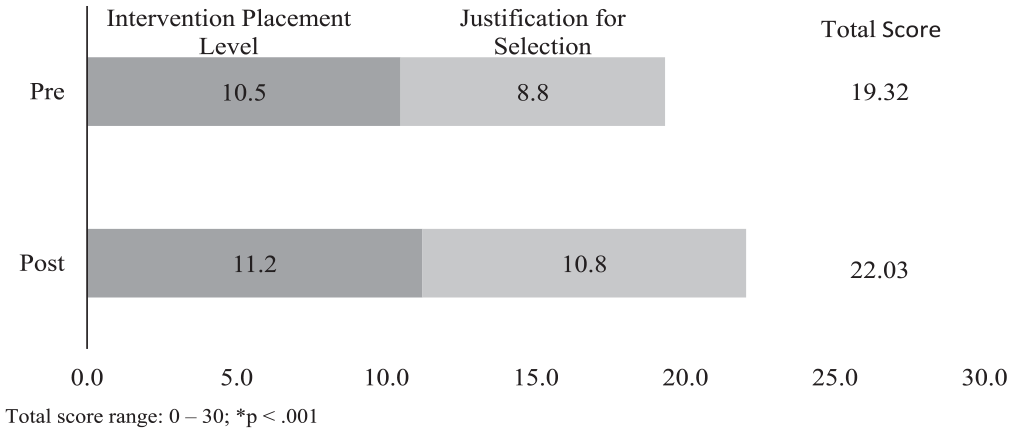
Pre- and post-course mean scores for applying theory activity, n = 73*.
Confidence in Meeting Course Learning Objectives
Many students were not confident about their ability to meet each learning objective at the start of the semester (range: 26.6%–63.3%). The learning objective with the most students selecting not confident was “compare different theories and models in terms of their utility, strengths, and weaknesses.” The learning objective with the fewest students selecting not confident was related to their ability to “discuss the value and application of theory in research and practice.” Instead for this objective, most students selected somewhat confident (63%, n = 50).
After completing the course, students reported improved confidence in their ability to meet all learning objectives (Z-scores ranged from −5.50 to −6.77, p < .001). The learning objective with the greatest amount of change was “Link theory at multiple levels of influence to current high-profile public health cases” (Z = −6.77, p = <.001) (Table 2).
MPH Student Confidence to Meet Theory Course Learning Objectives at the Beginning and End of the Semester.

Wilcoxon Signed Rank Test; statistically significant p-value < .001.
Perceptions of Helpfulness of Course Elements
Most students found the various course elements somewhat helpful or very helpful for their learning (Figure 2). The elements that were very helpful to most students included working with a team (82.1%, n = 64), in-class activities (67.9%, n = 44), project presentations (66.7%, n = 52), the final project or paper (60.3%, n = 47), and in-class lectures (56.4%, n = 44). A minority of students did not find the required readings (11.5%, n = 9) or the pre-class lecture videos (11.5%, n = 9) helpful.

Students’ perceptions of the extent to which the course components were helpful to their learning in a master’s level theory course, n = 78.
The most helpful aspects of the course, as reflected in open-ended responses from students, included the application of the material, working in teams, having examples and explanation, and the course materials (e.g., readings). Students reflected that they benefited from working in teams by discussing the content with their peers. For example, one student shared: “Time for team meetings was definitely the most helpful! I always felt like I better understood our constructs and model after we met and had a chance to discuss them.” The benefit of applying theory to real-world examples was also noted by students as helping them to learn about theory. One student noted, “Having to apply theory to our [assigned intervention] helped me learn and understand the theories a little more.”
Recommendations
In open-ended responses, students shared several suggestions to enhance their learning. Students reflected some discomfort in not knowing all of the theories. Students stated that further grounding in particular theories would have been helpful before applying a theory to the assigned intervention. They suggested providing additional foundations in theory at the beginning of the semester, additional explanation by “clarifying the context of theories and how it connects to different level[s] of influence,” and “more in-depth conversations about specific theories.” Students suggested including more detail in the pre-class lectures on specific theories and additional lecture or explanation in class.
Students wanted additional clarification of expectations for assignments and more examples of the assignments and conceptual model projects. One student wrote, “I also think it would have been good to have a clearer sense of connection between the class assignments and our final project, as I didn’t really understand what our final project was until a few weeks before.”
Discussion
This evaluation describes the benefits of a novel graduate-level course to enhance students’ ability and confidence to apply theory to real-world public health interventions. Through this course, first year MPH students learned how to apply theory at multiple levels of influence and engaged in critical thinking to justify their application. While improvements in theory application were modest, the results demonstrate that students developed foundational skills related to theory application, such as distinguishing between appropriate levels of influence, which can enable their continued growth in thinking theoretically throughout the duration of their MPH training and future work.
An added benefit to engaging in multi level theorizing includes the intentional focus on the organizational, community, and policy levels of influence, including the structural and social determinants of health. Students’ ability to critically engage with theory, as demonstrated by justifying their placement of interventions within the levels of the SEM, is important because the field of public health requires new models and new ways of engaging with theory to achieve health equity (Asada et al., 2018; Crawford & Lewis, 2022; Goodson, 2010; Harvey, 2020; Komro et al., 2018). Through their conceptual model projects, students integrated theories from multiple levels of influence and explicitly engaged with critical frameworks, like Critical Race Theory and Intersectionality (Bowleg, 2012; Ford & Airhihenbuwa, 2010). Theorizing that includes these critical theories and frameworks furthers innovative thinking by identifying and applying constructs that more explicitly conceptualize theory that operates at higher levels of the SEM and has the potential to address intractable structural and social determinants of health (Crawford & Lewis, 2022; James et al., 2022).
In addition to demonstrating knowledge gained, students reported growth in confidence in meeting the course learning objectives. The greatest gain was seen in the learning objective related to linking theories at multiple levels of influence. Considering the complexity of multi-level public health interventions (McBride et al., 2021), this is a promising outcome associated with participation in this course. Furthermore, achieving this learning objective suggests students gained theorizing skills by seeing connections between and among theories to link constructs across levels.
Students reported that the teamwork was the most helpful component for their learning. Learning in teams allowed for group-based discussions which further enhanced understanding and provided opportunities for active learning. Both the quantitative and open-ended responses reflected the value of opportunities to work in teams and collaboratively apply their knowledge. These findings correspond with research indicating the benefits of team learning (Lang et al., 2018; Major, 2020).
Course Adjustments for Future Implementation
In deploying this model across three sections and reflecting on the evaluation findings, instructors have since made course adjustments for subsequent semesters. First, in some cases, students desired more consistency across sections. In subsequent years, instructors have highlighted that while variations in course delivery exist, each section teaches students to meet the same competencies and learning objectives. Furthermore, the variations in course delivery reflect the different strengths that instructors bring to the field and the uniqueness of their ways of teaching and expertise.
Second, in-class time to engage with theory and workshop projects was an important part of the learning process. Having two instructors per section allowed for more instructor-student engagement where students could ask questions and discuss challenges. Instructors also modeled engaging in critical discussions about theory by offering different perspectives and ways of thinking about application. To maintain a sustainable infrastructure for delivering this course, the teaching team has been adjusted to one instructor and two teaching assistants. The teaching assistants provided important support and mentorship to students by asking questions and reflecting on their own experiences.
Third, instructors made several adjustments to improve the course based on students’ recommendations. Students expressed discomfort in not knowing all the theories discussed in class. By the end of the course, the goal is for students to select and apply theories to public health interventions. To meet this goal students are exposed to numerous theories, but they gain in-depth understanding of a select few that best apply to their assigned intervention. To reduce concern about not knowing all the theories, instructors have in subsequent years more clearly articulated to students the goals of the course at multiple points throughout the semester. For instance, when introducing the course to students at the start of the semester, instructors share that a goal of the course is for them to think critically about theory and improve skills related to exploring theories rather than to memorize theories.
To assist students in selecting theories, an adjustment was made in subsequent years to provide more structure to their exposure to theories by creating “theory teams” that are responsible for exploring assigned theories rather than having students identify and explore theories on their own. With this adjustment, students individually complete brief worksheets to document their understanding of their assigned theories, and then, work with their colleagues in their theory teams to enhance their understanding. The worksheets provide a mechanism for individual-level accountability and facilitate group-based discussions about assigned theories. Using a jigsaw design (Crone & Portillo, 2013), each team then has exposure to at least four theories per level of influence from which they can then select the theory that best applies to their assigned intervention. Further, additional resources and lectures about historically foundational theories, such as the Health Belief Model, Social Cognitive Theory, Diffusion of Innovations, and Fundamental Causes, have been more intensely incorporated into the course through pre-lecture materials and in-class discussions. These pre-lectures provide an example of a specific theory and provide additional exposure to theories across the levels of the SEM. These adjustments address several student recommendations, including providing opportunities to explore and discuss key theories in more depth. Additional improvements were made to address other students concerns such as balancing the reading load over the semester, clarifying assignment instructions, and revising grading rubrics to clarify expectations. More emphasis about how the assignments contribute to the iterative development of their final conceptual model is also included in the assignment details and discussed with students consistently throughout the semester.
Strengths and Limitations
Continuously refining the course and engaging in evaluation improves the learning outcomes for students. This evaluation was strengthened by having a dedicated graduate assistant to lead the data collection and management, which helped reduce bias in the evaluation results. Additionally, multiple sources of data informed conclusions. The application activity and survey with closed- and open-ended responses provided data on learning, changes in confidence, and helpfulness of course elements. Giving time in class to complete the evaluation contributed to high response rates. Additionally, since the sample included most of the students in three sections of the course, the data provide some support that the model can be used well across different instructors.
Several limitations are noted. Students may have responded to the evaluation tools differently if the assessment were anonymous rather than connected to the student IDs. The evaluation does not account for differences in instructors’ delivery of the material and learning communities that may have influenced outcomes. The lack of a comparison group limits our ability to conclude that improvements in students’ learning are due to the new course format. Exploring the components that contribute to positive learning outcomes, such as course delivery, class assignments, and/or teamwork, could inform future implementation of similar courses. Furthermore, the applying theory activity was scored by one graduate assistant. Using a second person to score the activity would have enabled assessment of inter-rater reliability. Lastly, the applying theory activity was designed to assess theory application and did not assess students’ theorizing skills. Future evaluations could incorporate assessment of final student projects, or an alternative activity, to evaluate theorizing skills.
Conclusions
Overall, participation in the course improved students’ confidence and ability to apply theory across multiple levels of the SEM. Their critical thinking in justifying their decisions about applying theory improved. Supporting students in applying theory across the SEM has potential benefits for the public health profession, where interventions increasingly need to address social and structural determinants of health resulting in complex and multi-level conceptual models. As public health moves forward, theory courses that prioritize integrating and linking levels of influence can adapt to meet the needs of emerging health issues. For instance, MPH students who are more comfortable in critically examining and integrating theoretical frameworks have an emerging foundation for contributing to achieving health equity and transforming a public health community that is committed to anti-racism in practice and research (Association of Schools and Programs of Public Health, 2021). With an approach that supports student learning and valuable opportunities for improving future versions of the course, continued evaluation and refinements will contribute to even better outcomes.
Supplemental Material
sj-docx-1-php-10.1177_23733799231186637 – Supplemental material for Enhancing Students’ Skills in Applying Theory Through Collaborative and Active Learning: A Pre-Post Evaluation of an Innovative Theory Course for Graduate Public Health Students
Supplemental material, sj-docx-1-php-10.1177_23733799231186637 for Enhancing Students’ Skills in Applying Theory Through Collaborative and Active Learning: A Pre-Post Evaluation of an Innovative Theory Course for Graduate Public Health Students by Robin E. McGee, Elizabeth Reisinger Walker, Colleen M. McBride, Eric J. Nehl, Whitney S. Rice, Nicolette E. Wise, Carla Jones-Harrell and Delia L. Lang in Pedagogy in Health Promotion
Footnotes
Declaration of Conflicting Interests
The author(s) declared no potential conflicts of interest with respect to the research, authorship, and/or publication of this article.
Funding
The authors disclosed receipt of the following financial support for the research, authorship, and/or publication of this article: Financial support from the Office of Evidence Based Learning at the Rollins School of Public Health, Emory University.

References
Supplementary Material
Please find the following supplemental material available below.
For Open Access articles published under a Creative Commons License, all supplemental material carries the same license as the article it is associated with.
For non-Open Access articles published, all supplemental material carries a non-exclusive license, and permission requests for re-use of supplemental material or any part of supplemental material shall be sent directly to the copyright owner as specified in the copyright notice associated with the article.
