




Abstract
Medical education often prioritizes technical skills over personal reflection, a critical component of professional identity formation (PIF). We designed and implemented a 45-minute ‘Finding Your North Star’ session for 130 first-year medical students during orientation. Facilitated by senior students and deans, the session included small-group discussions, guided reflection, and the creation of personalized professional purpose statements, which were printed on cards featuring student artwork. Feedback from a post-session survey (n=101) demonstrated the session’s meaningful impact with 85% of respondents reporting a deeper understanding of their purpose in medicine and over 90% finding it valuable to hear senior students’ reflections and share personal values with their peers. Students recommended more time for group interactions and hearing from a wider range of speakers, such as alumni and physicians. Such initiatives may contribute to fostering professional identity and reducing burnout, important factors for health professional resilience, and improved patient care quality. This initiative highlights the need to invest in integrating humanistic reflective activities to prepare students for the multifaceted demands of a career in medicine.
Introduction
Professional Identity Formation (PIF) in medicine is the gradual transformation that occurs as professional values, beliefs, behaviors, and roles become integrated into an individual’s existing sense of self. 1 Conceptually, PIF is a trajectory between an individual’s current identity and an evolving, aspirational identity. 2 This process is highly individualized and shaped by context, psychosocial influences, and lived experiences.
At key transition points or moments of dissonance—such as starting medical school—students may experience internal conflict between personal beliefs and the expectations of the profession. 3 If unaddressed, this misalignment can decrease one’s sense of belonging and contribute to distress and burnout.4,5 Supporting students through these transitions with reflective practices may promote resilience and reinforce motivation.6,7 Notably, effective PIF and reduced burnout may be linked to improved patient outcomes: a meta-analysis found that healthcare provider burnout is frequently associated with lower quality of care, including increased medical errors, poorer adherence to safety practices, and diminished patient experience. 8
Despite the importance of PIF, medical curricula often emphasize knowledge and technical skill acquisition while underprioritizing early, structured reflection. Therefore, guided by self-determination theory, which posits an individual’s growth is influenced by intrinsic motivation and external factors, we designed a one-time, replicable educational session to support early PIF through peer-led reflection and purpose articulation, grounded in humanistic values of meaning-making, relational presence, and moral reflection at the start of medical training.
Methods
The ‘Finding Your North Star’ session was implemented in August 2024 during an orientation session for first-year medical students in Baltimore, Maryland. Session facilitators were senior medical students and student affairs deans who were selected based on prior involvement in student mentorship and interest in medical education. Prior to the session, facilitators received a structured briefing that outlined session objectives, discussion prompts, and strategies for guiding reflective conversation. These strategies included guidance on modeling reflective vulnerability, establishing norms for respectful listening, and supporting psychological safety during personal sharing.
The 45-minute session was structured into three components: (1) introduction and framing of professional identity formation (∼10 minutes), (2) small-group guided discussion and peer reflection (∼20 minutes), and (3) individual writing of a professional purpose statement (∼15 minutes). Students were divided into small groups led by facilitators, who guided discussion using standardized prompts focused on motivations for pursuing medicine, formative experiences, and evolving professional values. After the session, students received an email invitation to complete an anonymous brief online survey with Likert-scale and open-ended questions to measure the session’s impact (Supplemental Table 1). Survey questions included: ‘What was the most meaningful component of this session?’, ‘What is one way that this session could be improved?’, and ‘Any other comments you would like to provide?’. These were selected for qualitative analysis and thematically coded by the study team using an inductive approach. Percentages for Likert-scale responses were calculated using R version 4.4.3 (2025-02-28).
Students also had an option to submit their statement of purpose in an online form to be printed onto custom North Star cards, which students could wear with their ID cards if they wished (Supplemental Figure 1).
Results
Of the 130 student participants, 101 completed the post-session survey and agreed to have their data used for the study (response rate: 77.7%), and 118 students submitted statements to be printed onto custom North Star cards.
Of these 101 survey respondents, 85% agreed or strongly agreed that the session helped them recognize their purpose for pursuing medicine. Over 90% of respondents agreed or strongly agreed that the session was relevant to their future career as a physician, helped them reflect on their purpose for becoming a physician, and helped them appreciate diverse motivations among classmates. Over 90% also valued sharing personal values with peers and hearing more senior students share their purpose (Figure 1). Percentages and corresponding n values of responses for post-session Likert-scale survey questions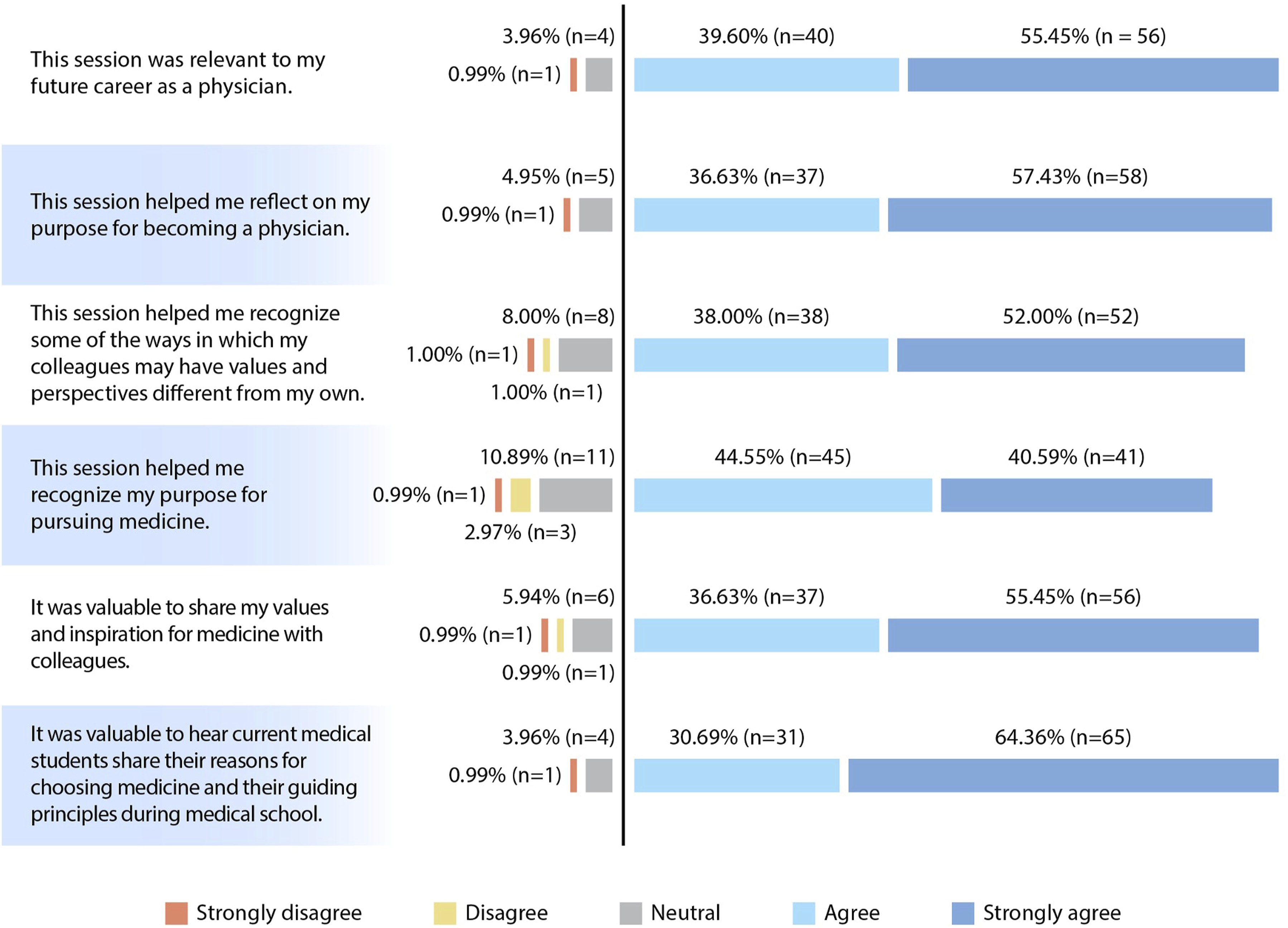
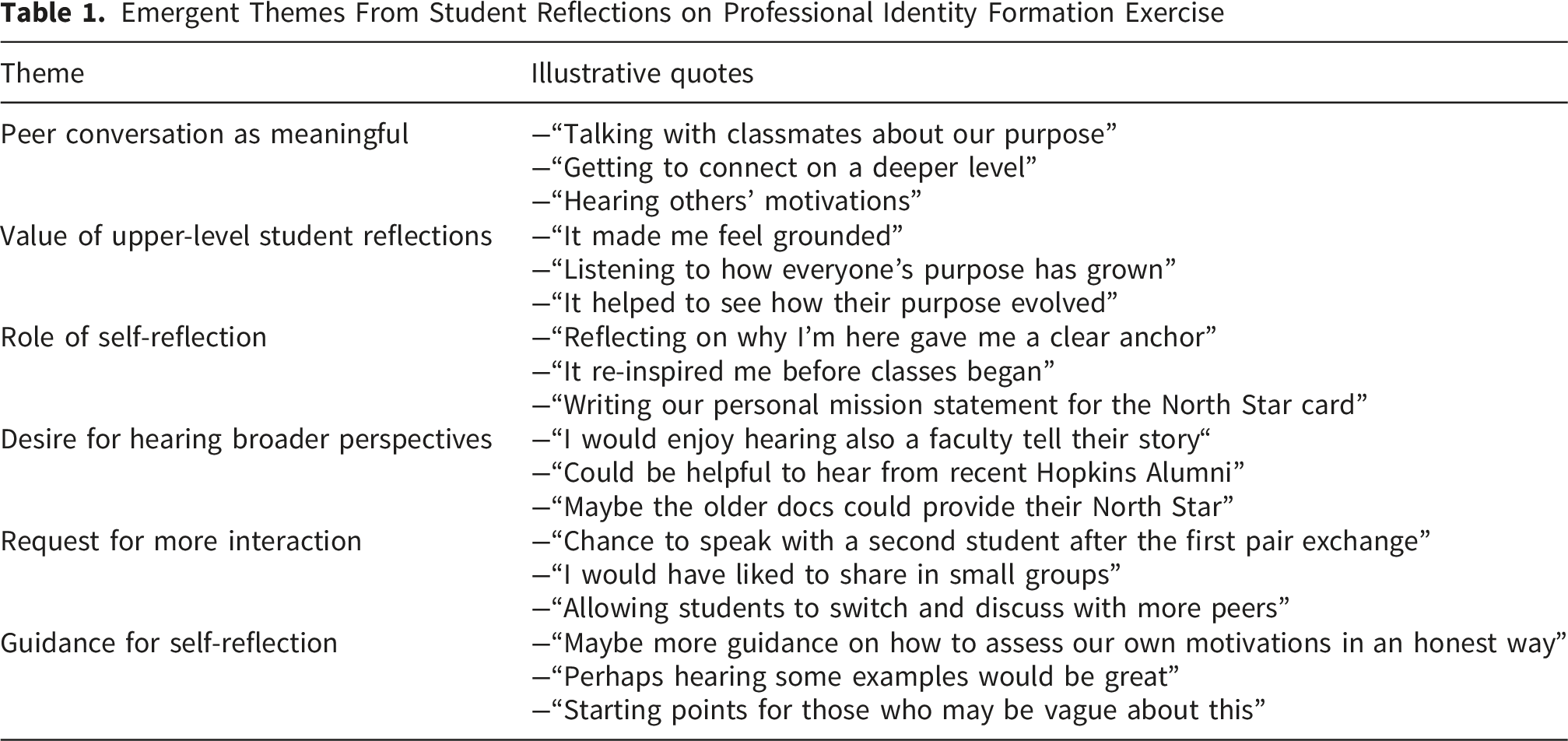
Emergent Themes From Student Reflections on Professional Identity Formation Exercise
Discussion
Our findings suggest that a brief, student-led reflection session can foster early signals of professional identity formation, peer connection, and increased self-awareness among first-year medical students. These reflections helped students reconnect with their core motivations for entering the field—an important early step in shaping how they may one day engage with patients. Such formative experiences have been encouraged by past literature, with some calling for PIF as a central goal of medical education given its long-term influence on physician behavior and values.3,6,7,9
Longitudinal mentorship also plays an important role in supporting PIF by encouraging conversations that connect personal and professional experiences. 10 As mentors share their journeys, students can reflect on similar experiences and have a more concrete foundation for recognizing their own professional purposes. Our session aimed to create a similar space for reflection through peer storytelling and guided writing, helping students explore their values in the context of their future roles as clinicians.
Reflection-driven identity development supports resilience and moral reasoning, helping students internalize professional norms and sustain empathy during training.11,12 These skills are especially critical given the well-documented association between clinician burnout and diminished patient care quality, such as increased medical errors, poorer communication, and lower patient satisfaction.8,13 Thus, interventions like ours may offer an early opportunity to support reflective capacity and professional grounding, which have been associated with resilience and patient-centered care, rather than demonstrating direct or longitudinal effects on burnout or patient outcomes.11,14 Furthermore, centering the student’s ‘why’ in early training may reinforce core humanistic commitments to dignity, meaning, and relational presence. Self-awareness and reflective capacity are integral to clinicians’ ability to recognize patient suffering, respond empathetically, and navigate complex interpersonal dynamics.14-16 As such, these reflective dialogues may help students assimilate into their new professional roles and develop the relational skills important for quality patient care delivery.
As part of the session, students could submit their written purpose statements for printing on “North Star” cards featuring original student artwork. These laminated, badge-sized cards were distributed several weeks later and designed to fit behind institutional ID cards, offering a visible, personal reminder of purpose. Of the 130 first-year students, 118 chose to have their statements printed. Given that PIF evolves across training, future evaluations will explore whether students continued to carry or reference their cards and whether the cards contributed to a sustained sense of meaning or resilience. 17
In this light, the impact of reflective, purpose-driven activities may extend well beyond the medical classroom. By encouraging students to define who they are and why they serve, initiatives like Finding Your North Star may support the development of clinicians who are more attuned to the emotional and human dimensions of medicine. As the health care system seeks solutions to burnout and depersonalization, early, intentional identity formation may represent a promising and underutilized strategy for protecting clinician integrity and promoting positive patient experiences.
Limitations
This educational innovation was conducted at a single institution with one cohort of students, which may limit generalizability. The high voluntary survey participation rate and diversity of responses are strengths, though findings may still reflect response bias. Data presented represents immediate post-session reflections, and longitudinal assessment of professional identity development, connection to patient care, and burnout will be assessed over time. While the session encouraged self-reflection, students may have experienced vulnerability in sharing personal motivations or felt pressure to align their values with perceived professional expectations. However, the peer-led format and emphasis on respectful dialogue were intended to mitigate these concerns and promote psychological safety. Finally, qualitative data coding, while reviewed by multiple authors, may carry inherent interpretation bias.
Despite these limitations, the data reveal early signals of impact and offer promising directions for future implementation. As a next step, we plan to adapt and expand this innovation for other learner populations, including medical students at later training stages and residents at our institution.
Conclusion
The ‘Finding Your North Star’ session serves as a feasible model with early signals of impact for early self-identification of core values and peer connection, with potential relevance for future efforts aimed at supporting trainee well-being and professional development. Continued study of its longitudinal effects and adaptations across settings will inform its broader applicability in medical education and further contributions to humanistic patient care.
Supplemental Material
Supplemental Material - Finding Your North Star: First Year Medical Students Reflect on Humanism and Purpose in Medicine
Supplemental Material for Finding Your North Star: First Year Medical Students Reflect on Humanism and Purpose in Medicine by Pallavi V Menon, Antalique N Tran, Valerie L Thompson, Barry Solomon and Paul O’Rourke in Journal of Patient Experience.
Supplemental Material
Supplemental Material - Finding Your North Star: First Year Medical Students Reflect on Humanism and Purpose in Medicine
Supplemental Material for Finding Your North Star: First Year Medical Students Reflect on Humanism and Purpose in Medicine by Pallavi V Menon, Antalique N Tran, Valerie L Thompson, Barry Solomon and Paul O’Rourke in Journal of Patient Experience.
Footnotes

Consent to Participate
Written informed consent was obtained from the participating medical students for their anonymized information to be published in this article.
Funding
The authors received no financial support for the research, authorship, and/or publication of this article.
Declaration of conflicting interests
The authors declared no potential conflicts of interest with respect to the research, authorship, and/or publication of this article.
Supplemental Material
Supplemental Material for this article is available online.
References
Supplementary Material
Please find the following supplemental material available below.
For Open Access articles published under a Creative Commons License, all supplemental material carries the same license as the article it is associated with.
For non-Open Access articles published, all supplemental material carries a non-exclusive license, and permission requests for re-use of supplemental material or any part of supplemental material shall be sent directly to the copyright owner as specified in the copyright notice associated with the article.
