



Abstract
Introduction
Migration from Albanian healthcare professionals to Western countries has been widespread since Albania emerged from communism in 1991. The migration of Albanian physicians and nurses has significant impacts on the country's healthcare system.
Objective
The manuscript addresses the migration intentions of Albanian healthcare professionals, including physicians and nurses focusing on their inclination to emigrate to Western countries.
Methods
This cross-sectional study included 315 participants from two municipalities, Fier and Vlore, examining various factors that impact their desire to seek employment abroad. A structured, culturally adapted questionnaire (18 items; four subscales: migration intention, social worth, teamwork climate, financial dissatisfaction) adapted from Goštautaitė et al. was used; internal consistency was high (Cronbach's α = 0.885).
Results
Results indicate a moderate-to-high level of migration intention, particularly pronounced among younger healthcare workers, those with fewer years of professional experience, and individuals working in high-stress departments such as emergency medicine and intensive care. Statistically significant associations were found between migration intention and key variables, including age (p < .01), ward of employment (p < .05), and self-reported financial dissatisfaction (p < .01). Participants citing greater dissatisfaction with income and professional growth opportunities were more likely to express a desire to emigrate. Additionally, poor teamwork climate and low perceived social worth were moderately associated with higher migration intentions, though not all associations reached statistical significance. These findings highlight a widespread perception of undervaluation and burnout, particularly in public sector facilities and among early-career professionals.
Conclusions
Financial dissatisfaction and stressful work settings were associated with higher migration intention; policy measures may mitigate these risks. Several systems have piloted targeted retention levers (remuneration, career ladders, dual practice), offering transferable options. Similar interventions could mitigate the brain drain in Albania, improving job satisfaction and financial stability for healthcare workers.
Introduction
Migration from Albanian healthcare professionals to Western countries has been widespread since Albania emerged from communism in 1991. Many scholars have discussed the migration of health professionals as a significant challenge for developing countries (Toyin-Thomas et al., 2023; Koduzi, Kongjonaj & Lazarevik, 2017). The term “migration intentions” refers to the likelihood that potential migrants will take steps to leave their home country over the next few years (Lozano, Meardi & Martín-Artiles, 2015). Globally, the 1990s saw approximately 70.5 million individuals moving to Western countries, with Germany and the United States being primary destinations (Aluttis, Bishaw & Frank, 2014).
Literature Review, Albanian Case
Data on Albania show that more than one-seventh of the population has emigrated since 1991 (Institute of Statistics, 2020) with over 900 physicians emigrating within the first 3 years of their practice (Eaton et al., 2023). Faced with such numbers, public health experts question the outlook for Albania's healthcare system (Gedeshi, King & Ceka, 2024; Tushe, 2024). The migration of Albanian physicians and nurses has significant impacts on the country's healthcare system.
Recent evidence further documents rising outflows of nurses, especially younger professionals seeking higher wages, better training, and more stable career pathways abroad (Gedeshi et al., 2024; Tushe, 2024). These data underline the urgency of examining migration pressures within Albania's health workforce. Post-communism in Albania was marked by declining professionalism, low wages, and poor working conditions in general and in the healthcare sector (Tarifa, 2008). Addressing these systemic issues could play a role in retaining healthcare professionals and even encouraging those who emigrated to return (Naum et al., 2022). Assessing these intentions allows organizations and institutions to implement strategies to retain healthcare workers and ensure healthcare needs are met (Chen et al., 2004). Neglecting to address migration intentions could result in policies that do not reflect the actual situation, potentially leading to workforce shortages and compromised healthcare services (Kruk, 2012; Sargent, 2024). Therefore, addressing healthcare professionals’ migration intentions has critical implications for healthcare workers, health managers, and policymakers responsible for supervising and developing workforce strategies for the future (Toyin-Thomas et al., 2023). Evidence from Eastern Europe and LMICs shows that perceived social worth and team functioning buffer intention, whereas financial dissatisfaction and high-stress assignments elevate it. The study therefore examined these modifiable meso-level factors alongside demographics in Albanian physicians and nurses. Despite this growing body of work, prior Albanian studies have focused primarily on macro-level push–pull forces, such as wages and system financing, and offer limited examination of meso-level workplace determinants such as teamwork climate, social worth, and ward-level differences. There is also little analysis combining demographic mooring factors with job demands and resources in a unified conceptual model. This study addresses these gaps by applying a combined Push–Pull–Mooring (PPM) and Job Demands–Resources (JD-R) framework to examine migration intentions among physicians and nurses in two major urban regions. Guided by a hybrid PPM and JD-R perspective, migration intention is conceptualized as the net result of competing pressures and buffers. In addition to demographic variables such as age, tenure, and marital status, migration decisions are shaped by mooring factors including family networks abroad, foreign-language proficiency, prior migration experience, and the licensing and recognition requirements in destination countries. These elements can either facilitate or deter migration and represent important conditioning variables within the PPM framework (Poppe et al., 2014; Walton-Roberts et al., 2017; Ibrahim et al., 2019). Job demands (e.g., workload intensity, stressful departments) and financial push–pull factors tend to elevate intention, whereas job resources (teamwork climate, perceived social worth, recognition, and development opportunities) may buffer it; mooring factors (e.g., age, tenure, marital status) condition these relationships. This lens informs our variable selection and interpretation, focusing on modifiable, workplace-level levers alongside core demographics. Accordingly, the study aimed to assess migration intentions among physicians and nurses and to identify how JD-R and mooring factors are associated with these intentions in two urban Albanian settings.
Methods
Design
The study included 315 nurses and doctors from the municipalities of Vlore and Fier in Albania, between July and December 2024, employed across various healthcare settings. These cities are known for their pivotal roles in regional healthcare and development. Vlore has a population of 104,000, a major port, and a center for tourism and economic activities with healthcare centers and the Psychiatric Hospital.
Fier city with a population of 120,000 functions as a key industrial and agricultural hub. The Memorial Hospital in Fier, a state-of-the-art facility, serves as a referral center for the broader region, providing advanced medical care to an estimated 300,000 people.
Research Questions
What are the migration intentions among Albanian health care professionals?
Does financial dissatisfaction affect the migration of health care professionals?
Does social recognition affect the migration of health care professionals?
Does teamwork climate affect the migration of health care professionals?
Which demographic and professional characteristics are significantly associated with migration intention?
Sample
The study involved 315 healthcare professionals, including nurses and doctors. Eligible participants were clinicians engaged in direct patient care; clinical-adjacent supervisory roles (e.g., nurse managers with direct oversight of care) and willing to provide informed consent for participation in the study. Participants were recruited through formal invitations distributed within selected healthcare institutions via internal announcements and direct communication by trained members of the research team. The participants voluntarily accepted to answer to the questionnaire and were assured complete anonymity.
Inclusion/Exclusion Criteria
A list of eligible healthcare professionals was randomly selected using a simple random sampling technique to ensure representation across departments and shifts. Whomever health care staff that wanted to participate was accepted.
The team excluded: (i) administrative-only, non-clinical roles; (ii) students and residents not currently employed in clinical care; (iii) retired or on-leave staff; (iv) individuals with prior permanent migration or ongoing migration contracts; and (v) questionnaires with >20% item non-response.
Variables
In this study, “migration intention” specifically refers to the intention to work abroad (emigration intention).
The study explored key factors influencing the migration intentions of healthcare professionals, focusing on four main variables:
Migration Intentions: This represented the likelihood of seeking employment abroad in the coming years, measured on a five-point Likert scale (1 = strongly disagree, 5 = strongly agree). It encompassed professional dissatisfaction, career opportunities, and the willing-ness to relocate.
Financial Dissatisfaction: Capturing perceptions of income adequacy and stability, this variable addressed concerns about salaries, economic security, and comparisons with opportunities abroad.
Social Worth: This reflected the sense of professional value and societal recognition, examining respect, appreciation, and acknowledgment received from colleagues, patients, and the community.
Teamwork Climate: Evaluating workplace collaboration and communication, this variable highlighted team dynamics, supportiveness, and the overall work environment. These variables were analyzed to reveal the interplay of economic, professional, and social influences on the decision to migrate.
Instrument Used
The questionnaire, adapted from a Lithuanian study (Goštautaitė et al., 2018), was designed to evaluate migration intentions among healthcare personnel to work abroad. The scale consisted of 18 items related to various aspects of professional activities and migration intentions on a five-point scale, from 1 (strongly disagree) to 5 (strongly agree). The questionnaire consisted of four subscales that measure: migration intentions, social worth, teamwork climate, and financial dissatisfaction.
For the 18 questions in the questionnaire, an analysis of validity, reliability, and exploratory factor analysis was conducted to determine the structure of the questionnaire. Initially, forward-backward translation process was performed as the questionnaire was in English language. The questionnaire was translated into Albanian, and both linguistic and conceptual equivalence of the items were confirmed. A back-translation process was finalized to ensure consistency between the English and Albanian versions of the scale. The original scale was translated into Albanian by translators highly proficient in both languages. A group of five bilingual experts, including a doctor, two nursing faculty lecturers, a nurse manager, and a linguist, analyzed the expressions used in the scale. Each expression was reviewed both individually and in combination, leading to the selection of the most appropriate wording for the 18 items. The backward translation from Albanian to English was conducted by two trained linguists (English teachers) with expertise in both languages. The backward-translated version and the original version of the questionnaire were compared and found to be highly consistent in meaning, with adjustments made to align with the specific characteristics of the country. Subsequently, the expert panel convened to evaluate the validity of the scale. Five experts, including nursing academicians specializing in medical nursing and nursing administration, reviewed and provided their opinions on the adequacy of meaning and content. A pilot study was conducted with 20 nurses and doctors to assess the clarity, comprehensibility, and feasibility of the questionnaire. The data collected during this pilot study were excluded from the final analysis. Based on the pilot results, minor adjustments were made to the wording of certain items to improve clarity and ensure better understanding.
Construct Validity Internal Consistency
The Albanian version of the scale yielded a four-factor structure, with factor loadings ranging from 0.631 to 0.927. The subscales were migration intentions, social worth, teamwork climate, and financial dissatisfaction. In this study, the correlation coefficients between the average item scores ranged from 0.70 to 0.91, indicating a satisfactory level of reliability. Cronbach's α calculated to assess internal consistency and uniformity, was 0.885, which is considered very high. Cronbach's α for the five-item migration intentions subscale was 0.815, for the three-item social worth subscale was 0.600, for the six-item teamwork climate subscale was 0.791, and for the four-item financial dissatisfaction subscale was 0.757. The social worth subscale demonstrated modest internal consistency (α = 0.60); consequently, results involving this construct should be interpreted with caution as they may be subject to greater measurement error. As a result, the Albanian version of the questionnaire can be regarded as having good psychometric properties, closely aligning with those of the original scale.
Data Collection
Personal information included age, gender, education level, and civil status. The professional information included the profession, the institution where participants worked, the type of employment (public or private), the ward where they were engaged, the shift they worked most frequently, and their years of work experience. Data were collected by four trained researchers through a structured questionnaire. An interview lasted approximately 13 minutes.
Bias
Several measures were implemented to ensure consistency and validity. Four trained researchers conducted face-to-face interviews with participants. These researchers underwent training to ensure uniformity in data collection procedures and to minimize interviewer bias. Additionally, all responses were anonymized, safeguarding participant confidentiality, and encouraging honest answers, thus reducing the potential for social desirability bias. Despite these measures, some limitations were recognized. The reliance on self-reported data posed a risk of recall or social desirability bias. To address this, participants were assured of confidentiality to promote truthful responses. The geographic focus on two municipalities, Vlore and Fier, may limit the generalizability of findings to the national healthcare workforce. However, efforts were made to include diverse institutions within these regions to capture a range of professional experiences.
The sample composition, predominantly nurses, could introduce an imbalance, but stratified analysis was conducted to address disparities. Overall, these strategies ensured the reliability of the findings while acknowledging the inherent challenges of a cross-sectional study design.
Sample Size
The study included 315 healthcare professionals, comprising nurses and physicians. A standard finite population sampling formula was used with the following parameters: Z = 1.96 (corresponding to a 95% confidence level), p = 0.5 (to maximize sample size underuncertainty), d = 0.05 (margin of error), and N = 820 (target population size). Applying the finite population correction yielded a minimum required sample size of 262. This sampling strategy aimed to ensure sufficient representation and enhance the generalizability of findings to the broader population of healthcare professionals in the two urban centers. Participant flow is illustrated in Figure 1.

STROBE Flow Diagram of Participant Inclusion.
Quantitative Variables
The study included several quantitative variables to analyze migration intentions among healthcare professionals. Age was measured in years and categorized into five groups: ≤29, 30–39, 40–49, 50–59, and ≥60, reflecting typical career stages in the Albanian healthcare system—namely early-career, mid-career, senior, late-career, and near-retirement phases. Similarly, work experience (tenure) was grouped into five intervals: 0–5, 6–10, 11–15, 16–20, and >20 years. These bands aligned with promotion milestones, contract renewals, and professional development thresholds, facilitating analysis of how career longevity may influence migration intentions. Migration intentions were assessed using a five-point Likert scale, ranging from 1 (strongly disagree) to 5 (strongly agree), to capture varying levels of desire to migrate. Additionally, subscale scores for financial dissatisfaction, social worth, and teamwork climate were treated as continuous variables, providing detailed insights into the specific workplace and financial factors that contributed to migration decisions. These variables formed the foundation for statistical analyses, highlighting key predictors of migration intentions.
Statistical Analysis
Data were analyzed using SPSS software (IBM SPSS Statistics for Windows, Version 21.0; IBM Corp, Armonk, NY, USA). Descriptive statistics, including frequencies, percentages, means, and standard deviations, were used to summarize the sociodemographic characteristics of the study participants and their questionnaire responses. Continuous variables (e.g., age and subscale scores) were presented as means with standard deviations, whereas categorical variables (e.g., sociodemographic and professional characteristics) were summarized using frequencies and percentages. The distribution of continuous variables was assessed using the Shapiro–Wilk test to evaluate normality. To examine the relationships between sociodemographic and professional characteristics and staff migration intentions, several inferential statistical analyses were conducted. Independent-samples t-tests compared subscale scores between two groups; one-way ANOVA with Bonferroni post-hoc tests assessed differences across multi-category variables. The overall migration intention subscale was dichotomized into two groups: agree/strongly agree and disagree/strongly disagree responses, and logistic regression was used to analyze the relationship between sociodemographic and professional factors and the migration intention score. Multicollinearity was checked (VIF<2). Logistic model fit was evaluated (Hosmer–Lemeshow, AUC with 95% CI).
Missing data: All variables had complete responses (0% missing across 315 participants); therefore, complete-case analysis was equivalent to analysis of the full sample, and no imputation was performed. For all statistical tests, a p-value of less than 0.05 was considered statistically significant.
Ethics (fut Lejen e Studimit)
Participation was voluntary; all participants provided written informed consent and could withdraw at any time. Anonymity and confidentiality were maintained throughout data collection and analysis.
Results
Sample Characteristics
The mean age of participants was 34.4 (±8.1) years; 75.2% females and 24.8% males presented in Table 1. Data completeness was 100%; no missing values were observed for study variables.
Sociodemographic Characteristics of the Participants.
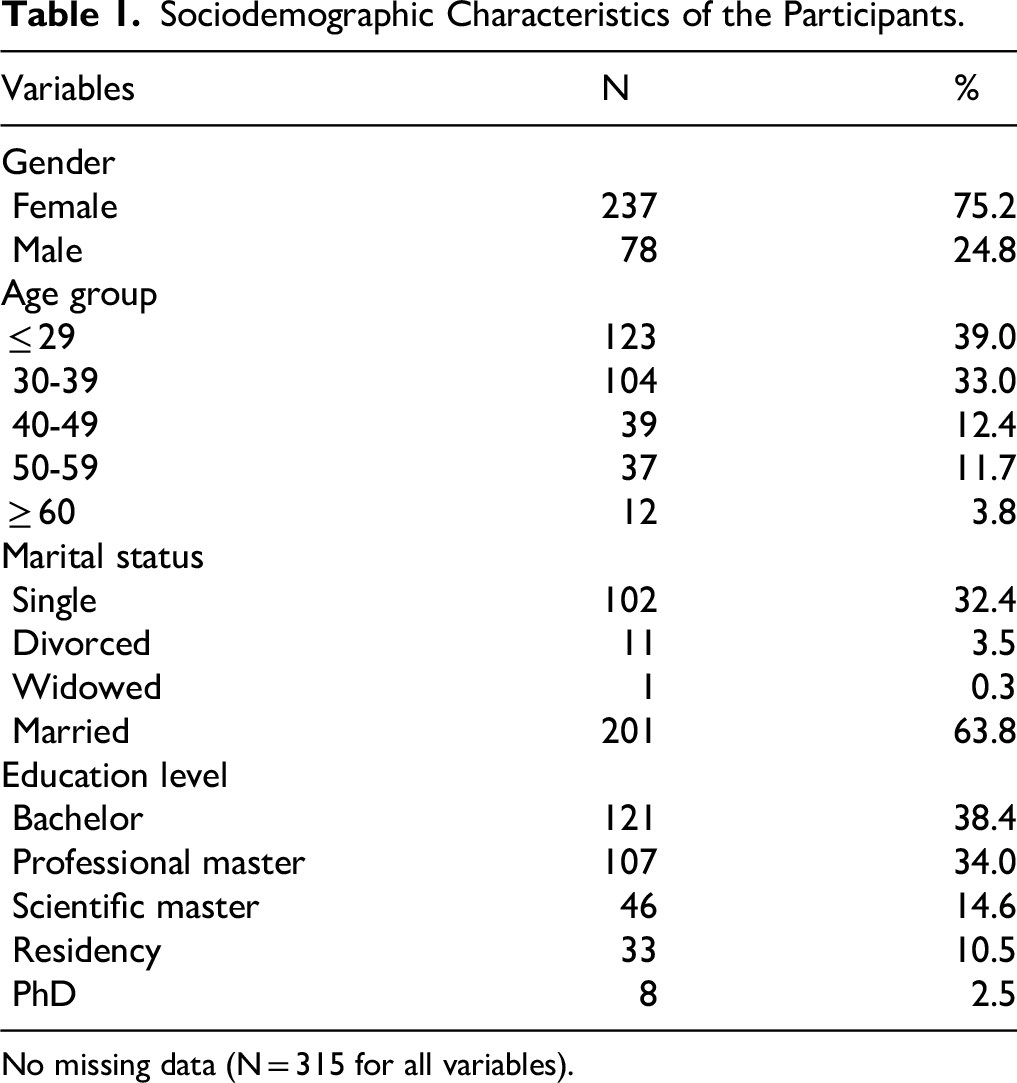
No missing data (N = 315 for all variables).
Professional characteristics of participants are shown in Table 2.
Professional Characteristics of Participants.

No missing data (N = 315 for all variables).
The mean score of subscales according to sociodemographic characteristics is shown in Table 3.
Mean Score of Subscales According to Sociodemographic Characteristics.

Note: Divorced/Widowed—Widowed (n = 1); summary stats omitted. *significant difference p < 0.05.
The migration intention score is higher among younger ages with a significant difference compared to those over 50 (F-ratio = 9.55, p < .001) and for single individuals (F-ratio = 3.33, p = .02) (Table 4). It is precisely this younger age group that views their developmental prospects and better life opportunities in migration.
Mean Score of Subscales According to Professional Characteristics.

*significant difference p < 0.05.
Personnel aged ≥60 report higher social worth values compared to other age groups (F-ratio = 4.63, p = 0.001). As for the teamwork climate, the highest score was found in the age group ≥60 years (F-ratio = 4.63, p < .01), a group that does not intend to emigrate and views the teamwork environment positively. All age groups except those ≥60 years reported being dissatisfied with their finances (F-ratio = 3.54, p < .01). The migration intention score was higher for staff working in the infectious diseases and emergency wards, with a significant difference compared to other departments (F-ratio = 2.29, p = .04), while it was lower for staff working in the “other” shift (F-ratio = 6.62, p < .01).
The social worth score was higher for staff employed in both public and private sectors (F-ratio = 4.72, p < . 01) and those with more than 16 years of experience (F-ratio = 3.38, p = .01). Additionally, staff with over 20 years of experience reported a higher score for teamwork climate (F-ratio = 4.26, p < .01).
Regarding financial dissatisfaction, the most dissatisfied staff were those working in “other” institutions (F-ratio = 2.54, p = 0.04), those employed exclusively in the private sector (F-ratio = 5.78, p = .01), and those working in “other” departments (F-ratio = 2.69, p = .02).
Overall, 193 (61.3%) (95% CI 55.6 to 66.7) of the staff intended to work abroad. Table 5 presents the adjusted odds ratios (aOR) derived from the multivariable logistic regression model, illustrating the associations between migration intention and selected demographic and workplace variables.
Regression of Subscales Social Worth, Teamwork Climate, and Financial Dissatisfaction on Migration Intention.

aORs shown as exp(β).
Staff aged 50–59 had ∼69% lower odds of migration intention (aOR = 0.31; ≈3.3-fold decrease). Working in Emergency was associated with ∼2.2-fold higher odds (aOR = 2.20). Employment at Memorial Hospital Fier (aOR = 0.52; ∼1.9-fold decrease), assignment to Pediatrics (aOR = 0.37; ∼2.7-fold decrease), and >20 years of experience (aOR = 0.23; ∼4.4-fold decrease) were protective. By subscale, higher financial dissatisfaction related to increased odds (aOR = 4.47), whereas higher social worth (aOR = 0.36) and teamwork climate (aOR = 0.58) related to decreased odds.
Discussion
This study highlights critical insights into the migration intentions of Albanian healthcare professionals, revealing several critical trends and factors. The results showed that financial dissatisfaction was the most significant predictor of migration intentions, with staff expressing concerns over low wages, lack of economic stability, and limited financial growth opportunities. Dissatisfaction was particularly pronounced among those employed exclusively in the private sector and in institutions categorized as “other.” These findings are similar to the literature from Eastern European countries like Poland and Romania, where financial dissatisfaction drives healthcare workers to migrate (Mladovsky, Rechel, Ingleby & McKee, 2012; Stancu et al., 2024). Across settings, economic strain consistently anchors migration intention. Evidence from Eastern Europe and LMICs points to salary insufficiency, income instability, and weak career ladders as primary push factors often compounded by workload and facility constraints (Poland/Romania; LMIC syntheses). Supporting our findings, a recent study in Iran likewise prioritized economic pressures (insufficient salaries, rising living costs) alongside workplace factors (poor conditions, limited advancement) as dominant drivers (Afshari et al., 2025, Leitão, Salvador, Idowu & Dako, 2024).
Interpreted through the PPM/JD-R lens, financial strain and high-demand departments operate as pushes/demands, while teamwork climate and perceived social worth function as resources that buffer intention-consistent with our adjusted estimates.
Age and marital status were also significant predictors of migration intentions. Younger healthcare workers, especially those aged ≤29, demonstrated the highest inclination to emigrate, while individuals aged ≥60 reported the lowest intentions. The ≥60 group reported the highest social worth and teamwork climate alongside the lowest migration intention, consistent with job-embeddedness and late-career stability: deeper professional networks, role seniority, and lower marginal returns from migrating may suppress intention despite systemic drawbacks. Similarly, single participants expressed stronger intentions to migrate compared to their married or divorced counterparts. These results align with studies from Nigeria and India, where younger professionals cite limited career opportunities and low salaries as primary motivators for migration (Badru et al., 2024; Walton-Roberts et al., 2017).
Staff working in high-stress departments, such as emergency and infectious disease wards, was more likely to consider migration, reflecting the impact of workplace stress. Conversely, professionals in pediatrics and those employed at the Memorial Hospital in Fier exhibited lower migration intentions, potentially indicating better working conditions or job satisfaction in these settings. The study also uncovered disparities in perceptions of social worth and teamwork climate. Older healthcare workers and those with more than 20 years of experience reported higher social worth and teamwork satisfaction, whereas younger professionals expressed dissatisfaction with these aspects, potentially contributing to their migration intentions. This pattern is consistent with global trends where early-career professionals are more likely to seek opportunities abroad (Jinah et al., 2024). Although the prevalence of migration intentions was high (61.3%), the findings highlight areas with potential for improvement. The importance of social recognition is consistent with findings in sub-Saharan Africa, where healthcare workers cite underappreciation as a key driver of migration (Poppe et al., 2014).
Personal experiences of being underappreciated and negative aspects of the healthcare sector can affect migration intentions, especially for those who lack social life and entertainment opportunities in their home country, particularly in rural areas (Apostu, Vasile, Marin & Bunduchi, 2022; Li & Sun, 2019). Additional factors include societal pressure and the potential for easier financial establishment abroad, poor public services in education, healthcare, security, and family issues can trigger migration intentions (Christensen, Hussein & Ismail, 2016; Georgieva, 2024; Mladovsky, Rechel, Ingleby & McKee, 2012; Stancu et al., 2024; Ibrahim et al., 2019).
Educational background and prior professional experience acquired in the destination country can encourage migration for work. Additionally, being proficient in English or other foreign languages can facilitate physician mobility, enabling healthcare professionals to secure employment in other countries (Poppe et al., 2014; Walton-Roberts et al., 2017). Despite the high prevalence of migration intentions, our findings suggest that work environment and economic dissatisfaction play a critical role in shaping nurses’ migration thinking. Migration intention was significantly associated with emergency department assignment, fewer years of experience, higher financial dissatisfaction, and lower perceptions of teamwork and social worth. These findings align with theoretical expectations and mirror broader regional patterns in healthcare workforce mobility. While international comparisons provide useful insight into mechanisms that influence migration, their applicability to Albania is bounded by contextual differences in salary levels, EU mobility pathways, health system financing, and recruitment regulations. Therefore, the cross-country examples below are interpreted at the level of underlying processes—such as financial dissatisfaction, workplace conditions, and professional recognition—rather than as direct one-to-one parallels in effect size or policy impact.
The Philippines, a major source country for global healthcare professionals, has seen high rates of nurse migration. Filipino nurses cite the low salary structure, lack of job security, and limited access to specialized training as reasons to seek employment in wealthier countries, particularly in North America and the Middle East (Robredo, Ong, Eala & Naguit, 2022). This aligns with findings from Albania, where younger professionals with fewer local career opportunities view migration as a pathway to professional growth and improved living conditions (World Health Organization, 2021). In Eastern European countries, including Poland, Romania, and Bulgaria, the legacy of post-communist instability has contributed to widespread healthcare migration. Poland and Romania have reported significant outflows of healthcare workers to the United Kingdom, Germany, and France, driven largely by income disparities and underfunded health sectors at home (Mladovsky, Rechel, Ingleby & McKee, 2012). The Polish government has responded by implementing retention incentives, such as salary increases and improved working conditions in public healthcare (Stancu et al., 2024), which highlights potential interventions for Albania. Similarly, Bulgaria has faced an exodus of young doctors who express frustration over bureaucratic constraints and lack of modern equipment, reflecting Albanian healthcare professionals’ dissatisfaction with workplace infrastructure (Georgieva, 2024). These factors push Bulgarian doctors to seek training and employment abroad, underscoring the need for Albania to invest in healthcare infrastructure and reduce bureaucratic barriers that impede professional development. Studies from sub-Saharan Africa further illustrate the impact of “brain drain” on healthcare systems. In Kenya, for example, over 70% of medical students expressed intentions to emigrate due to a perceived lack of appreciation and support within the healthcare system, similar to the social worth concerns reported in this Albanian study (Li & Sun, 2019). Such dissatisfaction with professional recognition, particularly among young healthcare workers, suggests a global trend where workforce retention may be improved by creating a supportive and collaborative workplace environment (Poppe et al., 2014). The case of India highlights additional non-economic motivations, such as the pursuit of work-life balance and respect for clinical autonomy, as significant factors in healthcare migration (Walton-Roberts et al., 2017). To retain healthcare professionals, many countries are exploring comprehensive policy reforms. For instance, Turkey has implemented competitive salary adjustments and offers professional development opportunities aimed at reducing migration rates among healthcare professionals (WHO, 2021). Similarly, Ghana has adopted dual-practice policies allowing public healthcare workers to engage in private practice, thus increasing income potential and professional satisfaction (Jinah et al., 2024). These examples suggest that Albania could benefit from similar policies, such as providing dual-practice options and expanding career development programs to incentivize retention.
Additionally, language barriers and cultural differences are factors that sometimes discourage migration, especially for healthcare workers from non-English-speaking countries, including Albania. However, as healthcare professionals in Albania often possess multilingual skills, they may find it easier to integrate into foreign healthcare systems (Al-Btoush & El-Bcheraoui, 2024). This can be seen as both an asset and a challenge; while language skills facilitate migration, they can also expedite workforce depletion if local job satisfaction is not addressed.
Greece and Serbia reflect the same mechanism: austerity, heavy bureaucracy, and limited advancement opportunities are linked to higher migration intentions. (Ifanti et al., 2014; Kaitelidou et al., 2014; Apostu et al., 2022). Taken together, these examples support our interpretation that, although contexts differ markedly from Albania, economic strain, career stagnation, and weak workplace recognition consistently emerge as core mechanisms shaping migration intentions across health systems.
Strengths and Limitations
This study situates its findings within regional comparisons, incorporating evidence from neighboring countries with similar healthcare challenges. The culturally adapted and validated questionnaire enhances the relevance and reliability of findings within the Albanian context. By comparing results with regional trends, the study contributes to a broader understanding of healthcare migration in Southeastern Europe.
Several limitations should be acknowledged. First, the study relied on self-reported data, which may be subject to recall bias and social desirability bias-particularly regarding migration intentions reported by public sector employees.
To mitigate these risks, the survey was conducted anonymously, used neutrally phrased items, and was administered by trained interviewers. Second, the cross-sectional design precludes causal inferences; the results are limited to observed associations and cannot establish directionality.
Third, the sampling frame included only two municipalities (Vlora and Fier), which limits the generalizability of the findings. Rural areas, the northern region of Albania, and private sector healthcare settings may have different workforce dynamics that are not captured in this study. Fourth, although migration intention is a well-established proxy, it may not fully predict actual migration behavior, which can be influenced by unforeseen personal, economic, or political factors. The social worth subscale showed modest internal consistency (α=0.60), suggesting potential measurement error; estimates involving this construct should be interpreted cautiously.
Several likely confounders (family ties abroad, foreign-language proficiency, dual citizenship, prior short-term placements, spouse employment, childcare) were not measured and qualitative data to unpack how social worth and teamwork perceptions emerge in day-to-day practice were not collected. Future studies should include these to refine estimates and also should adopt mixed-methods approaches (focus groups, interviews), including administrative data linkage or longitudinal follow-up, and expand to more diverse geographic and institutional settings.
Implications for Practice
Several actionable strategies emerge from this study to help reduce migration intentions among healthcare professionals in Albania. Priority levers include (1) targeted salary enhancements for high-stress departments such as Emergency and ICU; (2) regulated dual-practice arrangements to supplement income without incentivizing public sector attrition; (3) structured career pathways that include transparent promotion timelines, funded continuing medical education, and access to subspecialty training; (4) improved team-based practice conditions, including adequate staffing ratios, regular debriefing sessions, and clinical supervision to enhance teamwork climate; and (5) recognition programs aimed at boosting perceived social worth, such as performance-based awards or expanded clinical autonomy. These interventions warrant prospective evaluation and adaptation to the Albanian healthcare context.
Conclusions
This study highlights the complex interplay of economic, professional, and personal factors that drive migration intentions among Albanian healthcare professionals. Younger healthcare workers, particularly those in high-stress departments, such as emergency medicine, are more inclined to seek opportunities abroad, viewing migration as a pathway to a better quality of life and career advancement.
These measures, along with potential regional cooperation, may offer a sustainable approach to mitigating the brain drain among healthcare professionals and ensuring a stable workforce to meet the country's healthcare needs. Given the 75% nurse and ∼86% public sector composition and absence of rural sites, findings should not be generalized to private sector dynamics or remote regions without caution.
Footnotes
Acknowledgments
We would like to express our sincere gratitude to all the healthcare professionals who participated in this study and generously shared their time and insights. Special thanks go to the administrative staff of the healthcare institutions in Vlora and Fier for facilitating data collection.
All authors that contributed to the article are included in the list of authors.

Ethical Approval and Informed Consent Statements
All ethical guidelines as well as the Helsinki declaration were strictly followed for this study. Before data collection, the research protocol was reviewed and approved by the appropriate scientific ethics committee of University “Ismail Qemali” No. 134/9 as well as written approval to conduct the research was also obtained from local health authorities in Vlora and Fier.
Informed consent was obtained from each participant with an assurance of anonymity and confidentiality.
Participation was voluntary, with the option to withdraw at any time.
Author Contributions
Conceptualization was done by VP, EK, and AS; methodology was done by AS; software was done by VP and SQ; validation was done by LR. Formal analysis was done by LR and SQ; investigation was done by RÇ, EK, and SQ; resources was done by VP and EK; data curation was done by VP; writing—original draft preparation was done by VP and AS; writing—review and editing was done by AS and RÇ; visualization was done by VP; supervision was done by LR and AS; project administration was done by VP and LR.
Funding
The authors received no financial support for the research, authorship, and/or publication of this article.
Declaration of Conflicting Interests
The authors declared no potential conflicts of interest with respect to the research, authorship, and/or publication of this article.
Data Availability Statement
The data that support the findings of this study are available from the corresponding author upon reasonable request.