



Abstract
Introduction
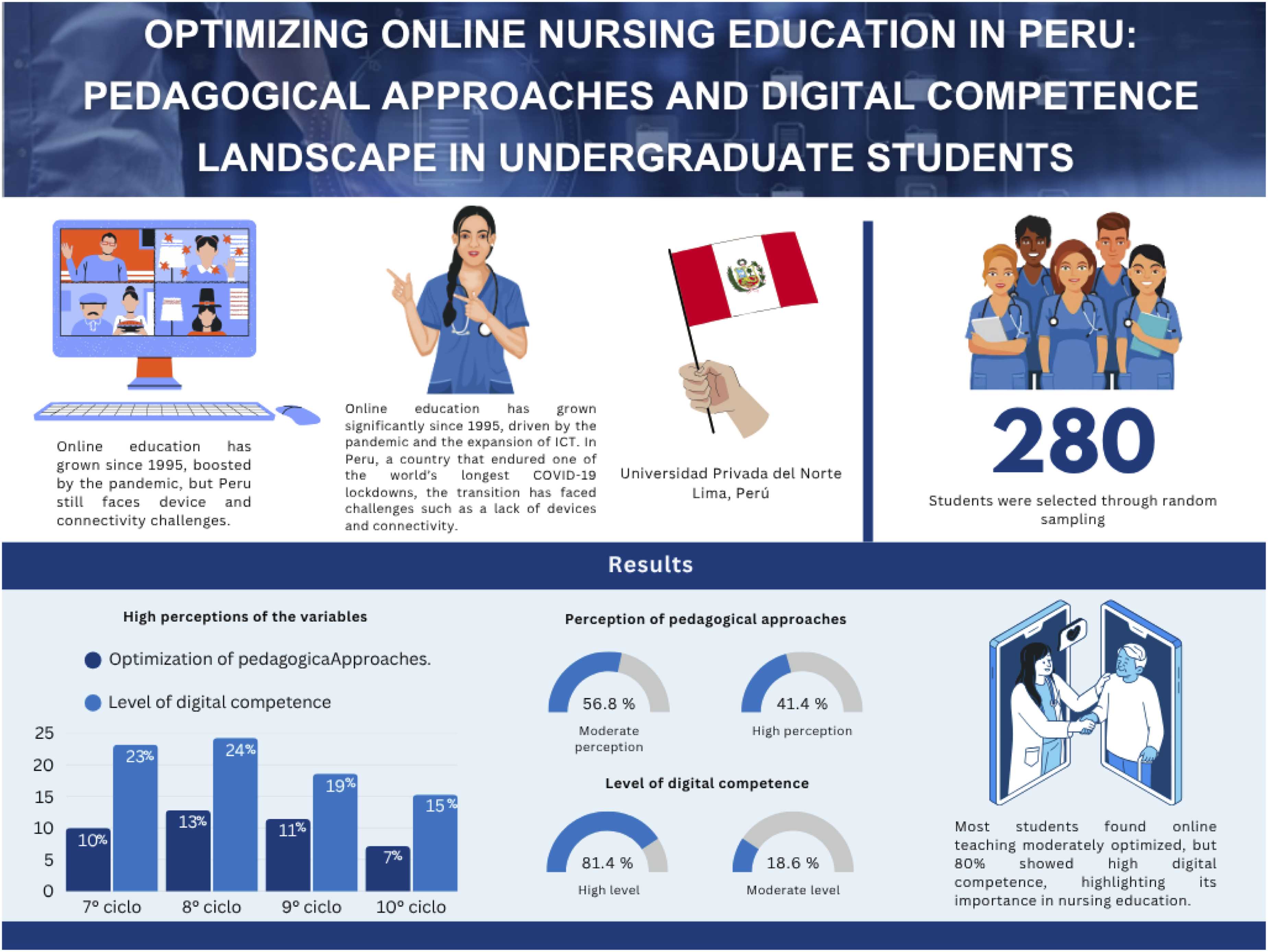
Online education has experienced significant growth, particularly accelerated by the pandemic and the expansion of Information and Communication Technologies (ICT). In Peru, a country that endured one of the world’s longest COVID-19 lockdowns, the transition has faced challenges such as a lack of devices and connectivity.
Objective
To determine the perception of the optimization of pedagogical approaches for online learning and its relationship to the level of digital competence among nursing students at a private university in Lima, Peru, in 2024.
Methods
A cross-sectional study assessed the perception of 278 nursing students at a private university via simple random sampling. An online, Likert-scale, 58-item questionnaire was used for data gathering. Both instruments demonstrated high reliability (Cronbach’s α: 0.914–0.922) and validity (Aiken’s V: 0.894–0.995). We used Mann Whitney U and one-way ANOVA with Eta-square (η2) values for comparing the variables Spearman’s Rho for association.
Results
Most participants were women aged 18–27 (73.9%). A moderate perception of pedagogical optimization prevailed (56.8%), while 81.4% exhibited high digital competence. Age significantly influenced pedagogical perception (p< 0.001) and digital competence (p= 0.006), with younger students outperforming older peers. Academic semester showed no significant impact. A strong association emerged between pedagogical perception and digital competence (Rho=0.336, p<0.001), with high-competence students exclusively reporting high pedagogical satisfaction. Also, students with high digital competence differed significantly from those with moderate/low competence (U = 6061, p < 0.001).
Conclusion
These findings highlight the interdependence of digital proficiency and effective pedagogical design in nursing education. While high digital competence is prevalent, gaps in pedagogical optimization suggest that technological integration alone is insufficient without structured teaching strategies. Addressing age-related disparities and enhancing interactive virtual learning are critical to preparing nurses for technology-driven healthcare environments.
Introduction
Online education has enabled remote access and flexible scheduling, accelerating since the mid-1990s and surging during COVID-19 school closures that affected more than 1.2 billion students in over 190 countries (UNESCO, 2020). In Latin America, ICT adoption brings opportunities and constraints tied to infrastructure, equity, and educators’ digital skills (Ministerio de Educación del Perú, 2023; Moya-Salazar, Jaime-Quispe, et al., 2022; Moya-Salazar, Sevillano-Jiménez, et al., 2022). In Peru, 81% of universities expect greater reliance on distance learning by 2030 (Moya-Salazar, Cañari, et al., 2021), yet uneven device and internet access, especially in jungle regions, exacerbates existing inequalities (Montero O'Farrill, 2019; Pachauri & Pachauri, 2023).
The pandemic also drove broader changes across the Americas, including expanded virtual teaching, improved connectivity, teacher training, mental health support, and telemedicine research integration (PAHO, 2020). These shifts urge rethinking medical and nursing education for a digitalized healthcare landscape. Online education, encompassing pedagogical, technical, and methodological dimensions, provides a framework for this transformation (Mendoza Lacma et al., 2023; UNESCO, 2022). As Gates predicted in 1996, digital tool integration is inevitable and essential for a technology-driven world (Reis, 2019); universities have already adapted their pedagogical models accordingly (Eynon, 2020).
Review of Literature
South American studies from Ecuador and Colombia show the pandemic’s dual impact: expanded access and innovation, but also challenges in technology adaptation, motivation, and the digital divide (Beingolea, 2021; Munévar García et al., 2015; UNESCO, 2024). In Peru, competency-based nursing research reveals progress alongside persistent gaps, including curricular adjustments and improved digital literacy (Franco;Coffré et al., 2021; Morales Alvarez et al., 2024; Moreira Palacios et al., 2024; Suárez, 2024; Tovar et al., 2025). U.S. studies reinforce integrating digital competence into nursing curricula; structured digital literacy training improves performance and engagement (González;Mujico, 2023), and collaborative virtual simulations enhance clinical reasoning. These findings align with Latin American data and support globally aligning digital tools with sound pedagogy.
Evaluating virtual education’s impact is critical in nursing, where students need both clinical and digital competencies for technology-driven healthcare (Denegri et al., 2014; Martínez Berruezo & Pascual Gómez, 2013; WaiCook et al., 2023). Understanding student perceptions is key to refining pedagogy, retention, and outcomes. Recent evidence from 2023 to 2025 shows that virtual reality improves knowledge, skills, and satisfaction (Liu et al., 2023); virtual simulation enhances problem solving, communication, and critical thinking (Alsharari et al., 2025); and digital health literacy should be embedded across nursing curricula (Kleib et al., 2024). Continuous faculty training is necessary for high-quality virtual instruction (Li et al., 2025).
Global online learning and MOOCs have expanded health education access but remain concentrated in English, limiting equitable access for Peruvian nurses (Sim et al., 2022; Jowsey et al., 2020; Palvia et al., 2018). During COVID-19, Peruvian universities rapidly virtualized nursing curricula under national guidance but faced limited institutional readiness and low faculty digital competence (Salazar & Salazar, 2024). Case studies note weak virtual classroom design despite continued enrollment. A 2023 cross-sectional study linked poor virtual teaching quality to lower satisfaction and performance, especially for collaborative skills (Sharif et al., 2025). Nursing informatics is only partially integrated, with about 24% of programs offering it, despite national frameworks stressing technology (Camara et al., 2018; Curioso et al., 2021).
This study focuses on nursing students in Lima, Peru, a region with one of the world’s longest COVID-19 lockdowns (Collyns, 2020; Moya-Salazar et al., 2021b), to examine specific challenges and opportunities in online education. By assessing student perceptions of pedagogical approaches and digital competence, it aims to provide actionable insights to enhance online learning and better prepare future nurses for modern healthcare.
Given the growing prevalence of online education, it is essential to understand how pedagogical approaches influence key competencies. Digital competence is critical for independent learning, academic interaction, and professional performance in virtual environments. Therefore, this study analyzed the relationship between the optimization of pedagogical approaches in online education and the level of digital competence among undergraduate nursing students.
Methods
Study Design
This cross-sectional study was conducted following the recommendations of the STROBE (von Elm et al., 2008) and CROSS (Sharma et al., 2021) guidelines and examined the perceptions of 1,000 nursing students at a private university in Lima, Peru, regarding the optimization of online pedagogical approaches and their relationship with digital competence in 2024.
Sample
The sample size was calculated using EPIDAT (Xunta de Galicia, Spain), considering a power of 80%, 95% confidence level, 5% margin of error, and a population of 1,000 nursing students eligible according to the university’s enrollment report from the year 2024. A simple random sampling method was used to select 280 nursing students from the Universidad Privada del Norte (UPN). Randomization was ensured by providing an open survey to nursing students, allowing students from all semesters to participate.
Inclusion/Exclusion Criteria
Inclusion criteria required participants to have been enrolled between 2020 and 2022, be in at least their 7th academic cycle, be aged 18–59 years, and have completed fully virtual education during the study period. Exclusions applied to foreign students, those who had repeated consecutive courses, individuals simultaneously working and studying, and those pursuing nursing as a second degree.
Variables
The study assessed two primary variables: (i) perceptions of optimized pedagogical approaches in online education and (ii) levels of digital competence. Perceptions of pedagogical optimization were measured using a survey evaluating pedagogical-didactic, technical-technological, and methodological dimensions. Items included clarity of online explanations, interactivity, use of digital tools, and course structure, rated on a 5-point ordinal scale ranging from “very low extent” to “very high extent.”
The operational definitions of the variables are as follows:
1. Pedagogical Optimization in Virtual Education
The optimization of pedagogical approaches is defined as the student’s perception of the degree of adequacy, effectiveness, and quality of the teaching strategies applied in virtual environments. This variable was evaluated using a questionnaire designed by the authors entitled “Perception of the optimization of pedagogical approaches in online education,” validated by experts (Aiken’s V = 0.995, α = 0.922).
It consists of 30 items grouped into three dimensions: • Pedagogical-didactic approaches • Technical-technological approaches • Methodological approaches
Each item was rated on a 5-point Likert scale, with the following ranges: • Low perception: 30–70 points • Moderate perception: 71–110 points • High perception: 111–150 points
2. Digital Competence
In this study, digital competence is defined as the set of skills, knowledge, and attitudes that enable students to use digital technologies effectively, critically, safely, and ethically in an educational context. This variable was assessed using the Student Digital Competence Scale (SDiCoS) questionnaire, developed by Tzafilkou et al. (2022), which was translated into Spanish and validated by experts panel (Aiken’s V = 0.984, α = 0.914). It consists of 28 items distributed across six dimensions: • Search, find, and access • Develop, apply, and modify • Communicate, collaborate, and share • Store, manage, and delete • Evaluate • Protect
Each item was rated on a 5-point Likert scale. The established ranges were: • Low competence: 28–65 points • Moderate competence: 66–102 points • High competence: 103–140 points
Instruments
The research employed two instruments. A 30-item self-designed questionnaire entitled “Percepción de la optimización de los enfoques pedagógicos en la educación en línea”was used. This questionnaire measures the degree to which students perceive the appropriate, efficient, and relevant application of different pedagogical approaches in virtual learning environments. The questionnaire was structured into three fundamental dimensions: Dimension 1: Pedagogical-Didactic Approaches, Dimension 2: Technical and Technological Approaches, and Dimension 3: Methodological Approaches, ensuring that each dimension was represented by a set of relevant questions. Thirty items were written, primarily closed, using a Likert scale to measure students’ level of agreement or perception. This questionnaire has the following cutoff points: 30–70 for low perception, 71–110 for moderate perception, and >111 for high perception.
The questionnaire was subsequently validated by an expert panel in pedagogy and online education, who evaluated its clarity, relevance, and coherence, obtaining an Aiken V index of 0.995, indicating the high validity of the instrument. A pilot test was then administered to a small group of 50 students to verify their understanding, and a reliability analysis was performed using Cronbach’s alpha coefficient, yielding a value of 0.922, indicating excellent internal consistency.
To evaluate digital competencies, the Students’ Digital Competence Scale (SDiCoS) created by Katerina Tzafilkou et al., in 2022, is used. This tool, originally in English, was translated into Spanish with a careful process to retain its content accuracy and relevance to this study context (Tzafilkou et al., 2022; Wild et al., 2005). This 28-items Likert-like questionnaire was organized into six dimensions: Search, Find, and Access; Develop, Apply, and Modify; Communicate, Collaborate, and Share; Store, Manage, and Delete; Evaluate; and protect. The cutoff points established for classifying digital competencies were as follows: 28–65 points for low digital competence, 66–102 points for moderate digital competence, and more than 103 points for high digital competence (Suppl. 1).
To validate the Spanish version, the judgment of an expert panel in digital education and technology was used, obtaining an Aiken’s V =0.984, indicating high validity in terms of clarity, relevance, and coherence. A pilot test was then administered to 100 students to verify comprehension, and a reliability analysis showed Cronbach’s α=0.914, confirming excellent internal consistency. Both questionnaires were structured, multidimensional, and previously validated by university students in Peru, showing good consistency and reliability (Leandro-Matta et al., 2026; Loconi-Samillan et al., 2026).
Data Collection and Analysis
Data were collected via an online questionnaire distributed through social media platforms, email, and WhatsApp (Meta, California, US) to ensure accessibility and maximize participation. No financial incentives were provided. The final response rate was 100%, and missing data were managed through online questionnaire quality control via double-checking. Missing data were removed.
Responses from 280 participants were compiled in Microsoft Excel (Microsoft, Redmond, US) and analyzed using SPSS v25 (IBM, Armonk, US). Descriptive statistics (mean, median, standard deviation, percentiles) were used to explore data distributions and identify outliers. Non-parametric and parametric tests were employed after the Kolmogorov-Smirnov tests. The Shapiro-Wilk test was not considered, as it is primarily recommended for small samples (n < 50), whereas the current study included a larger sample (n = 280), making the Kolmogorov-Smirnov test more appropriate for assessing normality.
Mann-Whitney U and one-way ANOVA with Eta-square (η2) values and post-hoc Bonferroni test were used for comparing the variables by age, digital competence score, and academic semester. Associations between variables were assessed using Spearman’s Rho, considering a threshold of p<0.05 and a confidence interval of 95%.
Ethical Considerations
The study adhered to the principles of the Declaration of Helsinki (World Medical Association, 2013), ensuring respect for participants’ rights and informed decision-making. Written informed consent was obtained from all participants, who were informed of the study’s risks and benefits. Guidelines from the Council for International Organizations of Medical Sciences (CIOMS) (CIOMS, 2016) were followed, emphasizing voluntary participation, privacy, and confidentiality. This study has the approval of the IRB of UPN (Letter N01565-2023-2).
Results
Baseline Characteristics of Students Included in the Study

Perception of Pedagogical Approaches and Leve Lof Digital Competence

Sub-Analysis by Age
Analysis of Perceptions of the Optimization of Pedagogical Approaches and Level of Digital Competence by Age Group. Data in N (%)

ANOVA indicated that age influenced both pedagogical perception (F = 10.506, p < 0.001) and digital competence (F = 4.214, p = 0.006), though effect sizes were moderate to low (η2 = 0.102 and η2 = 0.044, respectively).
The perception of the optimization of pedagogical approaches in virtual education was classified as high in 41.4% of students (n=116), moderate in 56.8% (n=159), and low in 1.8% (n=5). In terms of scores by dimension, the average was 35.8 points for pedagogical-didactic approaches, 36.4 for technical-technological approaches, and 36.0 for methodological approaches.
The level of digital competence was classified as high in 81.4% of students (n=228), moderate in 18.6% (n=52), and none presented a low level. Regarding the scores per dimension according to the SDiCoS scale, the average was 18.2 in “Search, find, and access,” 17.8 in “Develop, apply, and modify,” 18.4 in “Communicate, collaborate, and share,” 17.6 in “Store, manage, and delete,” 18.1 in “Evaluate,” and 18.5 in “Protect.”
Sub-Analysis by Academic Semester
Fourth-year students (seventh and eighth semesters) reported a higher moderate perception of pedagogical optimization: 67.1% (53/79) in the seventh semester and 63% (46/73) in the eighth. High perceptions were also common in this group, especially in the eighth semester (49.3%, 36/73) and to a lesser extent in the seventh (35.4%, 28/79). In terms of digital competence, there was a clear predominance of high levels: 93.2% (68/73) in the eighth semester and 82.3% (65/79) in the seventh.
Analysis of Perceptions of the Optimization of Pedagogical Approaches and Level of Digital Competence by Academic Semester. Data in N (%)

ANOVA revealed no significant differences between semesters for either variable (pedagogical perception: F = 0.239, p = 0.625; digital competence: F = 0.217, p = 0.642), with minimal effect sizes (η2 = 0.001 for both).
Association Analysis
Perception of Pedagogical Approaches and Digital Competence in Nursing Students. Data in N (%)

A significant association emerged between perceived pedagogical optimization and digital competence (Spearman’s ρ = 0.336, p < 0.001). Students with high digital competence differed significantly from those with moderate/low competence (Mann-Whitney U = 6061, p < 0.001).
Discussion
The results show a mostly positive perception of virtual teaching approaches and a high level of digital competence among students, consistent with recent studies indicating better adaptation to the virtual environment after the pandemic. These findings suggest that teaching strategies and educational technologies have been effective, yet they also highlight the need to continuously strengthen these skills in light of technological advances and new demands in the healthcare profession. Over half of nursing students perceived online pedagogical approaches as moderately optimized, while ∼80% demonstrated high digital competence. This underscores the interplay between perceived pedagogical quality and digital competence development in nursing education, a field increasingly reliant on digital tools.
The moderate perception of pedagogical optimization aligns with global studies reporting mixed reception of digital learning post-COVID-19. Students value flexibility and innovation but still perceive gaps in interactivity and course structure, echoing concerns about the loss of hands-on learning experiences (Dicheva et al., 2023; Langegård et al., 2021). Our results align with Rodríguez et al. (2022), who emphasized that pedagogical design significantly influences students’ ability to navigate digital environments. Notably, students with high digital competence exclusively reported high pedagogical satisfaction (41.4%), suggesting that digital proficiency enhances engagement with online methodologies. The strong statistical association (p < 0.001) confirms this relationship, providing new evidence from a Peruvian context on how digital readiness influences online learning in nursing education (Hinojosa Mamani et al., 2023; Rodríguez et al., 2022).
The high digital competence observed (81.4%) contrasts with Martzoukou et al. (2023), who reported persistent gaps in information literacy and digital research skills among nursing students. This discrepancy may stem from methodological differences (their use of self-perception scales focused on advanced research tasks vs. our broader academic practice competencies), cultural factors (Peruvian students’ accelerated digital adaptation during the pandemic due to rapid institutional migration to virtual environments), and curricular differences (Peruvian nursing programs may have integrated digital tools more systematically during emergency remote teaching).
This discrepancy may also reflect regional differences or the accelerated digital upskilling during Peru’s prolonged lockdowns (Collyns, 2020; Leandro & Loconi, 2025). However, the strong association between digital competence and pedagogical perception reinforces the need for curricula that integrate technical training with pedagogical innovation. Prior work shows that interactive virtual strategies are most valued by digitally competent students (Luzanía Valerio, 2007), and organized digital materials enhance learning outcomes (Torres Chávez & García Martínez, 2019).
Previous studies show both educators and students recognize the critical role of digital competence in modern education (Ryhtä et al., 2020). While educators are generally positive about digital pedagogy, they highlight the need for pedagogically sound integration of technology (Männistö et al., 2020). Students appreciate the impact of digital competence on their learning but identify areas for improvement, particularly in complex digital tasks (de Obesso et al., 2023). This study highlights the need to strengthen pedagogical and digital training in nursing education. As Levano-Francia et al. (2019) argue, integrating innovative technologies and structured virtual platforms is critical for equitable, high-quality education.
Age significantly influenced both pedagogical perception and digital competence, with younger students (18–27 years) outperforming older peers, mirroring global trends where younger cohorts, as “digital natives” adapt more readily to technology-driven education (Medeshova et al., 2025). However, minimal variation across academic semesters suggests that current curricula may not sufficiently address evolving competency needs as students’ progress, contrasting with Acevedo Gamboa et al. (2019), who reported progressive development of cognitive skills within structured virtual programs. These findings highlight the need for longitudinal, competency-based curricula tailored to students’ varying technological familiarity and age-related learning needs. Differentiated strategies by age group are recommended, with digital literacy interventions for older students focusing on basic skills, navigation, and platform use, alongside adaptive pedagogical designs using visual resources, guided tutorials, and personalized support to reduce the digital divide and ensure equitable learning.
This study contrasts with that of Tejada Molina (2023), who reported that virtual education negatively affected nursing students’ preparedness in Colombia. In contrast, the results align more closely with studies by Mamani Humpiri (2021) and Palomino (2024), which found moderate levels of satisfaction with online learning among nursing students. This suggests that perceptions of virtual education may vary significantly depending on institutional support, technological access, and instructional design. These discrepancies underscore the influence of contextual factors such as institutional support, infrastructure, and pedagogical design. For example, Bone Guaranda (2021) emphasized structured models to enhance educator performance, whereas this study highlights student-centered strategies as pivotal.
Institutional support plays a critical role in shaping students’ online learning experiences. In this context, universities that offered consistent access to digital platforms, timely IT assistance, and virtual academic advising likely contributed to students’ high levels of digital competence. Likewise, infrastructure disparities, such as reliable internet access and availability of personal devices can either facilitate or hinder meaningful engagement with online content. These contextual conditions may explain differences in perception across institutions or regions and highlight the importance of sustained investment in educational technology and support systems.
In the current context, advances in artificial intelligence (AI) represent a key opportunity to enhance both virtual education and the development of digital competence in nursing students. The progressive integration of AI-based tools—such as virtual assistants, intelligent clinical simulators, or personalized feedback systems—could strengthen online teaching approaches and significantly improve the learning experience. These findings become even more relevant when considering new technologies as allies in optimizing teaching in complex digital environments.
Strengths and Limitations
This study offers several strengths that enhance the validity and reliability of its findings. First, to the best authors knowledge this is the first Peruvian study to assess perceptions of pedagogical approaches and digital competence. Secondly, the robust quantitative design allowed for systematic data collection and objective statistical analysis. Methodological transparency was supported by a simple random sampling strategy, applied to an updated register of 1,000 nursing students provided by the university. The sample of 280 participants was calculated using Epidat 4.2 software, considering a 95% confidence level and a 5% margin of error, with proportional distribution according to academic years. Each student had the same probability of being selected, which reinforces the credibility, representativeness, and reproducibility of the study findings. Third, the use of structured questionnaires facilitated standardized data acquisition, while rigorous pilot testing prior to implementation confirmed the instrument’s reliability (Cronbach’s α: 0.914–0.922) and validity (Aiken’s V: 0.894–0.995).
However, certain limitations must be acknowledged. The cross-sectional design precludes longitudinal assessment of pedagogical or competency outcomes over time. While the sample was appropriate for the study’s scope, findings may not generalize to nursing students in public institutions, rural settings, or other geographic regions. Furthermore, the reliance on closed-ended questionnaires, though efficient, limited exploration of subjective experiences or nuanced perspectives that qualitative methods (e.g., interviews) could have captured. Further studies should adopt mixed-method approaches to balance breadth and depth, particularly in examining how sociocultural or institutional factors influence digital competence.
Another limitation of the study was self-selection bias, as participation was voluntary and the questionnaire was distributed in part through social media, institutional email, and WhatsApp groups. This approach may have favored the participation of students with greater digital access, greater familiarity with technological tools, or greater personal motivation, which could influence the reported levels of digital competence. There was also the risk of a digital divide that excludes students with less connectivity or access to devices, although this risk was reduced by supplementing the collection with face-to-face contact in classrooms and through official institutional channels. Despite these precautions, it is recommended to consider this bias when interpreting the results and applying generalizations.
Implications for Practice
The findings of this study have direct implications for nursing schools, as they reinforce the need to consolidate student-centered digital teaching models aligned with institutional objectives to train competent, critical professionals who are adaptable to technology-mediated healthcare environments. Although this study focused on student perceptions, its results suggest that strengthening digital competence and the quality of virtual pedagogical approaches can contribute to improving clinical preparedness and patient safety in real-world settings. To achieve this, it is essential to also incorporate the perspective of teachers, who are responsible for planning, executing, and evaluating virtual teaching, to promote a comprehensive and sustainable educational transformation in nursing training programs.
To effectively integrate digital and pedagogical training, nursing curricula should include dedicated digital literacy modules from the early semesters, emphasizing practical use of educational technology. Interdisciplinary workshops involving faculty from nursing, education, and IT can foster collaborative course design. Additionally, incorporating simulation-based activities and interactive virtual platforms can bridge pedagogical intent with technological application, ensuring that students are equipped not only to learn with technology but also to think critically within digital environments.
Conclusion
The findings of this research reveal critical insights into the interplay between nursing students’ perceptions of pedagogical approaches and their digital competence in a post-pandemic educational landscape. The COVID-19 pandemic has irrevocably transformed nursing education, necessitating a balance between technological integration and pedagogical rigor. This study underscores that digital competence alone is insufficient; it must be paired with optimized teaching strategies to prepare nurses for a technology-driven healthcare era. Further investigation should explore longitudinal outcomes of digital-pedagogical integration and its impact on clinical performance.
Supplemental Material
Supplemental Material - Digital Competence and Perceived Pedagogical Optimization in Online Nursing Education: A Cross-Sectional Study in Peru
Supplemental Material for Digital Competence and Perceived Pedagogical Optimization in Online Nursing Education: A Cross-Sectional Study in Peru by Maryori Loconi-Samillan, Mireya Leandro-Matta, Eliane A. Goicochea-Palomino and Jeel Moya-Salazar in Sage Open Nursing.
Footnotes
Acknowledgments
The authors thank the 280 nursing students from Lima, Peru, for their valuable participation in this research and the educational institutions that facilitated access to participants, promoting the analysis of the development of online education and digital competence in the Peruvian context.
ORCID iDs

Ethical Considerations
Ethical approval for this study was obtained from Universidad Privada del Norte (Letter N01565-2023-2).
Consent to Participate
Written informed consent was obtained from all subjects before the study.
Author Contributions
- Conceptualization: M.L-S., and M.L-M
- Methodology: M.L-S., M.L-M., and J.M-S
- Software: M.L-S., M.L-M., and J.M-S
- Data curation: M.L-S., and M.L-M
- Investigation: M.L-S., M.L-M., and J.M-S
- Validation: M.L-S., and E.A.G-P
- Formal analysis: M.L-S., M.L-M., and J.M-S
- Supervision: M.L-S., M.L-M., and E.A.G-P
- Visualization: M.L-S., M.L-M., and E.A.G-P
- Project administration: JM-S
- Resources: M.L-S., M.L-M., and J.M-S
- Writing - original draft: M.L-S., M.L-M., E.A.G-P. and J.M-S
- Writing - review & editing: M.L-S., M.L-M., and J.M-S.
Funding
The authors received no financial support for the research, authorship, and/or publication of this article.
Declaration of Conflicting Interests
The authors declared no potential conflicts of interest with respect to the research, authorship, and/or publication of this article.
Data Availability Statement
The original contributions presented in the study are included in the article/supplementary material, further inquiries can be directed to the corresponding author.
Supplemental Material
Supplemental material for this article is available online.
References
Supplementary Material
Please find the following supplemental material available below.
For Open Access articles published under a Creative Commons License, all supplemental material carries the same license as the article it is associated with.
For non-Open Access articles published, all supplemental material carries a non-exclusive license, and permission requests for re-use of supplemental material or any part of supplemental material shall be sent directly to the copyright owner as specified in the copyright notice associated with the article.
