




Abstract
Background
Interleaved learning, time management, and self-efficacy play a pivotal role nursing education. This study aimed to evaluate the effect of an interleaved learning strategy on nursing students’ time management and self-efficacy.
Methods
A quasi-experimental research design was utilized. The study was conducted at the Faculty of Nursing, Minia University. The study subjects consisted of 262 students divided equally into two equal groups: 131 students in the study group and 131 in the control group, selected using systematic random sampling. The intervention consisted of a structured 40-hour interleaved learning program delivered over five weeks using interactive teaching methods. Three tools were used for data collection: (I) Nursing Students’ Knowledge About Interleaved Learning Strategy Questionnaire, (II) Time Management Scale, and (III) General Self-Efficacy Subscale.
Results
The findings demonstrated that applying the interleaved learning strategy significantly improved nursing students’ knowledge, perception, time management, and self-efficacy compared with traditional teaching methods (p= 0.001). The magnitude of improvement was substantial, with large effect sizes observed for perception (Cohen’s d= 0.904), self-efficacy (Cohen’s d= 0.0.854) and time management (Cohen’s d=0.795), indicating a substantial improvement among the study group following the intervention.
Conclusion
Significant positive correlations were found between knowledge, perception of the interleaved learning strategy, time management, and self-efficacy. The findings indicate that interleaved learning may serve as an effective educational strategy in nursing education by enhancing both cognitive and professional competencies among nursing students.
Introduction
The goal of nursing, as a multidisciplinary applied science, is to develop competent individuals with a variety of skills (Qiao et al., 2021). One of the key responsibilities of nurse educator is to create a strong learning environment. Lecture presentations should optimize student learning and be engaging, interactive, and student-centered (Van Tryon, 2018; Bristol et al., 2019; Iqbal et al., 2024). Active learning approaches place students at the center of the learning process while promoting critical thinking and decision-making skills (Ghezzi et al., 2021). Recent studies have suggested that integrating interleaved learning strategies into nursing education may improve students’ self-efficacy (Chen & Hung, 2025; Foley et al., 2019). In contrast to blocked learning, which involves studying one subject in-depth before moving on to another, and interdisciplinary learning, which integrates knowledge from multiple disciplines to establish connections, interleaving encourages students to alternate between subjects or topics during sessions (Chen et al., 2021; Riter-Knox, 2023; Custer & Sutton, 2025).
Interleaving may enhance mastery and long -term memory. Its use is supported by research in cognitive psychology and neuroscience, as well as by evidence from health profession education. These findings suggest that interleaving can improve educational practices and assist educators in making informed instructional decisions (Van Hoof et al., 2022). Unlike blocked learning, which focuses on one subject at a time, or interdisciplinary learning, which integrates concepts across disciplines, the interleaved learning strategy requires students to alternate between different subjects or topics during study sessions (Gero et al., 2022; Yan & Sana, 2021b).
Literature Review
Research shows that interleaved learning strategy improves learning and memory retention more effectively than blocked learning (Little & Nepangue, 2025; Yan & Sana, 2021a). For instance, in internal medicine, interleaving involves alternating between oncology, hematology, and rheumatology each day, rather than studying one specialty at a time. This mixed practice (e.g., ORH on multiple days) promotes better retention than blocked practice (e.g., OOO, RRR, and HHH) because it requires learners to compare, differentiate, and integrate concepts across topics, rather than mastering each in isolation (Van Hoof et al., 2022). During challenging tasks such as broad exams or complex patient care, interleaved learning strategy helps the brain continually reconcile disparities. Although students often find interleaving more difficult than blocking, learners still gain more from it, even with little prior knowledge. This example not only demonstrates interleaving but also distributed practice, a distinct but connected learning-science approach (Van Hoof et al., 2021).
Learners can distinguish and recognize knowledge patterns across many academic areas through interleaving (Riter-Knox, 2023). Moreover, just spending additional time studying will not be enough to improve student learning. Research in cognitive psychology has demonstrated that integrating spaced and interleaved retrieval practice can enhance the efficiency of both student self-regulated learning time and classroom instruction time (Yan, Schuetze, & Rea, 2024). Self-regulated learning provides a comprehensive conceptual framework for understanding time management among college students and for guiding studies examining its relationship to academic performance. (Wolters & Brady, 2021). The self-controlled effort to use time in a subjectively efficient manner to accomplish goals is known as time management (Breternitz Rich, 2022). Furthermore, interleaved learning may positively influence students’ time management by promoting structured study habits and reducing cognitive overload (Pan et al., 2025). Moreover, integrating time management training within learning environments significantly enhanced students’ self-efficacy, engagement, and autonomous learning (Liu & Lu, 2024).
Additionally, the interleaved learning strategy introduces “desirable difficulties”, which may initially feel effortful but ultimately lead to stronger learning and greater confidence. It improves problem-solving abilities and memory retention, thereby increasing confidence in academic performance (Samani & Pan, 2021). In 1997, Albert Bandura introduced Social cognitive theory, a psychological theory that focuses on how people learn through observing others. The theory suggests that behavior is shaped by the dynamic and reciprocal interaction among personal beliefs, self-efficacy, behavior, and the environment. At the core of this theory is self-efficacy, which refers to an individual’s belief in their ability to successfully perform tasks. Bandura argued that self-efficacy is one of the most powerful determinants of motivation, resilience, and achievement (Usher & Ford, 2022).
Moreover, Self-efficacy shapes motivation, behaviour, and performance, strengthening it is essential for developing students’ skills and improving academic achievement (Zhao et al., 2024). Interleaved learning offers significant psychological benefits beyond cognitive gains, promoting self-regulated learning habits and metacognitive awareness, which are essential for deeper understanding (Carvalho & Goldstone, 2019). Research shows that interleaving improves long-term memory and cognitive flexibility, especially in complex fields such as healthcare. However, historically underused in nursing education, interleaving has been associated with improved problem-solving and transfer of learning across contexts (Samani & Pan, 2021). Modern nursing education is pivoting toward competency-based curricula that integrate simulation, mentorship, and reflective practice to directly enhance professional competence and self-efficacy. Literature highlights that fostering self-efficacy can serves as a critical mediator between educational intervention and the attainment of professional competency (Alhowaymel et al., 2025; Mani, 2025).
Additionally, recent studies highlight the significance of self-efficacy and time management for both academic achievement and career preparedness. El-Sayed et al. (2024) found that nursing students who were better at time management also had higher levels of readiness for self-directed learning, a crucial indicator of both clinical competence and academic success. According to academics’ observations of students’ work, students struggle greatly when addressing case studies that require integrating multiple topics or ideas, and the majority of them struggle to transition fluidly between ideas. Also, researchers aim to apply a new learning strategy to help students integrate multiple ideas simultaneously, thereby achieving better results. Nursing students are therefore required to demonstrate high levels of self-efficacy and time management, in addition to mastering complex clinical information, in the ever-changing landscape of healthcare education. Furthermore, this research can be significant in addressing these dual competencies by evaluating the effect of applying an interleaved learning strategy among faculty nursing students. This research contributes to the growing body of evidence supporting the effectiveness of interleaved learning strategies in enhancing nursing students’ dual competencies of time management and self-efficacy. It also aligns with global calls for adaptive learning strategies that prepare future nurses to thrive in dynamic, high-stakes environments. Despite the increasing emphasis on active learning strategies in nursing education, traditional teaching methods continue to predominate in institutional context. Nursing students often face challenges in integrating knowledge from multiple subjects, managing time effectively, and maintaining self-efficacy during clinical training. Therefore, introducing innovative strategies such as interleaved learning is essential to address these gaps and enhance students’ academic and professional competencies. Accordingly, this study aimed to evaluate the effect of an interleaved learning strategy on nursing students’ time management and self-efficacy.
Methods
Research Design
A quasi-experimental pretest-posttest control group design was utilized in this research.
The study was conducted at the Faculty of Nursing in Minia University. All fourth-year students (the first subgroup of the second term) enrolled in nursing administration clinical courses at Minia University’s Faculty of Nursing’s Nursing Administration Department, the study was conducted over a period of ten months, from September 2024 to June 2025. There were 262 students in all, split into two equal groups—131 in the study group and 131 in the control group—using systematic random sampling. The students were coded with number according to the aphetic arrangement, the student who had odd number select in the study group while the student had even number select in the control group. Participants were assigned to groups based on existing class divisions rather than full randomization, which may represent a potential source of selection bias.
Tool (1): Nursing Students’ Knowledge and Perception about Interleaved Learning Strategy Questionnaire; it is a self-administered questionnaire consisting of three parts:
Pilot Study
A pilot study was carried out before the commencement of the research. It comprises 10% of the total sample, comprising 26 nursing students: 13 from the study group and 13 from the control group. The pilot study was conducted to assess the clarity, objectivity, completeness, feasibility, adequacy, and applicability of the study tools, as well as to identify potential methodological issues and estimate the time required to complete the questionnaires. Since no major modifications were made to the study tools following the pilot study, the pilot participants were included in the final analysis. However, this inclusion may have introduced potential bias, which is acknowledged as a study limitation.
Tools: Validity and Reliability
Content validity was established through a structured multi stage process involving a panel of five expertise nursing administration and nursing education from Minia and Assuit Universities. These experts were selected based on their expertise in curriculum development, and teaching strategy. To quantify content validity, we applied the Content Validity Index (CVI) methodology, following established guidelinesزItem-Level CVI(I-CVI): Each item was rated on a 3-point scale (= Disagree, 2= Neutral, 3= Agree) for Perception of the Interleaved Learning Strategy Scale as well as Time Management Scale. Items with an I-CVI _0.78 were retained, following (Polit & Beck, 2006) standards. Scale-Level CVI (S-CVI). The average proportion of items rated as quite or highly relevant across all experts was calculated to ensure over all instrument validity (Polit and Beck,2006). Regarding the content validity results for the Perception of the Interleaved Learning Strategy Scale and the Time Management Scale, the majority of items achieved an I-CVI of 1.00, indicating excellent agreement among the experts, while the remaining items achieved and I-CVI of 0.80 indicating acceptable agreement. Overall, the I-CVI values ranged from 0.80 to 1.00, exceeding the acceptable threshold of ≥ 0.78. Furthermore, the S-CVI/Ave ranged from ≈ 0.93 to 0.95, demonstrating excellent overall content validity for both scales.
Data Collection Procedure
The nursing program at the Faculty of Nursing follows a credit-hour system. Fourth-year students are enrolled in nursing administration courses that include both theoretical and clinical components focusing on leadership, management principles, and healthcare organization. The study was conducted from September 2024 to June 2025. A pre-test was administered to both groups at the Faculty of Nursing to establish baseline data prior the intervention.
Data were collected using self-administered paper-based questionnaires distributed to students during scheduled sessions. For the study group, a booklet on interleaved learning and its application in nursing administration was developed based on an extensive literature review. The booklet included comprehensive information on interleaving, along with scenarios designed to train students to alternate topics within a single learning session, thereby improving concept discrimination, long-term retention, knowledge transfer, and problem-solving skills. The booklet was distributed at the beginning of the program. Prior to the implementation of the intervention, the teaching staff received orientation sessions on the principles and application of the interleaved learning strategy to ensure consistency in the delivery of the program.
The intervention was delivered in two available classrooms to fourth-year nursing students enrolled in Nursing Administration course, in coordination with clinical demonstrators during Tuesday sessions, which were allocated for research discussions with students at the faculty. Participants were divided into two main groups, each consisting of 131 students. The study group was further divided into six subgroups, each containing 22 students, subgroup 6, which included 21 students.
The researcher conducted the study group sessions for 8 hours every Tuesday over a period of 5 weeks (total = 40 hours), with the same students participating in the practical training sessions. In contrast, the control group received traditional teaching methods delivered by the nursing administration demonstrators. The interleaved learning strategy was implemented using various small group teaching methods, including group discussion, brainstorming, and think-pair-share activities. The researchers also used several teaching aids during the implementation of the program, including a booklet, handout, PowerPoint presentations, and a Video presentation. Both groups were assessed immediately after completion of the training program using the study tools.
Ethical Consideration
The Research Ethics Committee of the Faculty of Nursing at Minia University approved the study and issued an official letter under code (REC2024103). Informed consent was obtained from all participants at the Faculty of Nursing, Minia University. Before conducting both the pilot and main studies, participants provided written consent and expressed their willingness to participate in the study. The participants were informed about the nature and objectives of the study. They were also assured of their right to refuse participation or withdraw from the study at any time without providing any justification. Participants’ privacy was preserved throughout the data collection process, and all collected data were treated with utmost confidentiality. To ensure anonymity, each participant was assigned a numerical code rather than using names.
Statistical Analysis
Data were analyzed using the Statistical Package for the Social Science (SPSS)version 26. Both descriptive and inferential statistics were applied. Prior to data analysis, the normality of data distribution was assessed using appropriate statistical tests (e.g., Shapiro–Wilk test). Parametric tests (independent and paired t-tests) were used for variables that were normally distributed. For variables that did not meet normality assumptions, non-parametric tests (Wilcoxon signed-rank test) were applied. Chi-square test was used for categorical variables. Statistical significance was set at p < 0.05. Spearman’s correlation was used to assess the nature and strength of relationships among the study variables. Additionally calculate effect sizes on the study between before and after applying the strategy, which indicate Cohen’s d equal 0.2 mean small effect sizes, 0.5 mean medium effect sizes, and 0.8 mean large effect sizes.
Results of the Study
Among the “study” group, 84.5% are in the 22-23-year-old age group, and 55.2% are females. Regarding marital status, 95.7% are single, and 65.5% of nursing students are from rural areas. Also, 85.3% of the nursing students in the “control” group are in the age group of 22 to 23 years old, and 55.2% are females. Regarding marital status, 96.6% are single, and 67.2% of nursing students are from rural areas (S1 Table) (Figure 1). Comparison of nursing students’ knowledge of interleaved learning between both groups (n = 262)
Comparison Between Nursing Students’ Mean Scores Regarding Perception About Interleaved Learning Between Both Groups (n = 262)
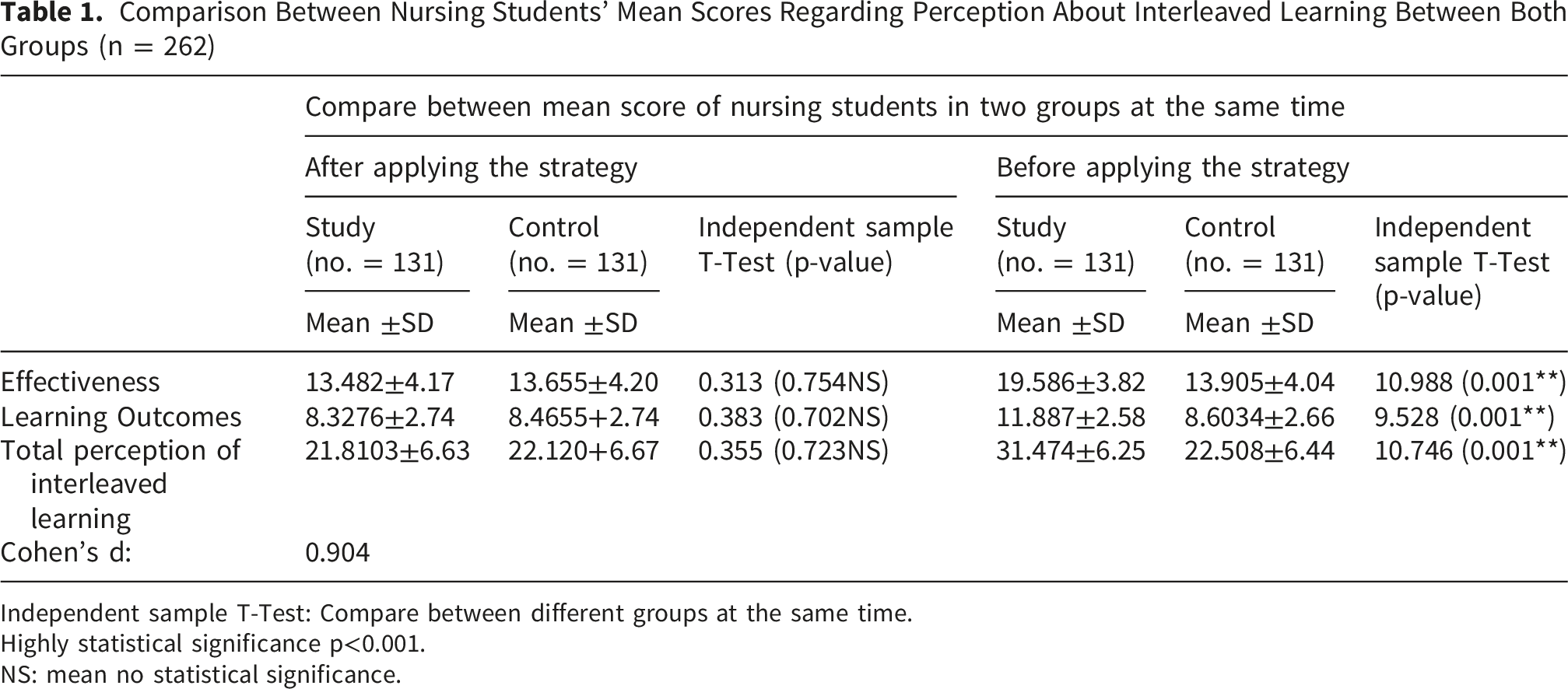
Independent sample T-Test: Compare between different groups at the same time.
Highly statistical significance p<0.001.
NS: mean no statistical significance.
Comparison Between Nursing Students’ Mean Scores Regarding Time Management Between Both Groups (n=262)

Independent sample T-Test: Compare between different groups at the same time.
Highly statistical significance p<0.001.
NS: mean no statistical significance.
Comparison Between Nursing Students’ Mean Scores Regarding Self-Efficacy Between Both Groups (n = 262)

Independent sample T-Test: Compare between different groups at the same time.
Highly statistical significance p<0.001.
NS: mean no statistical significance.
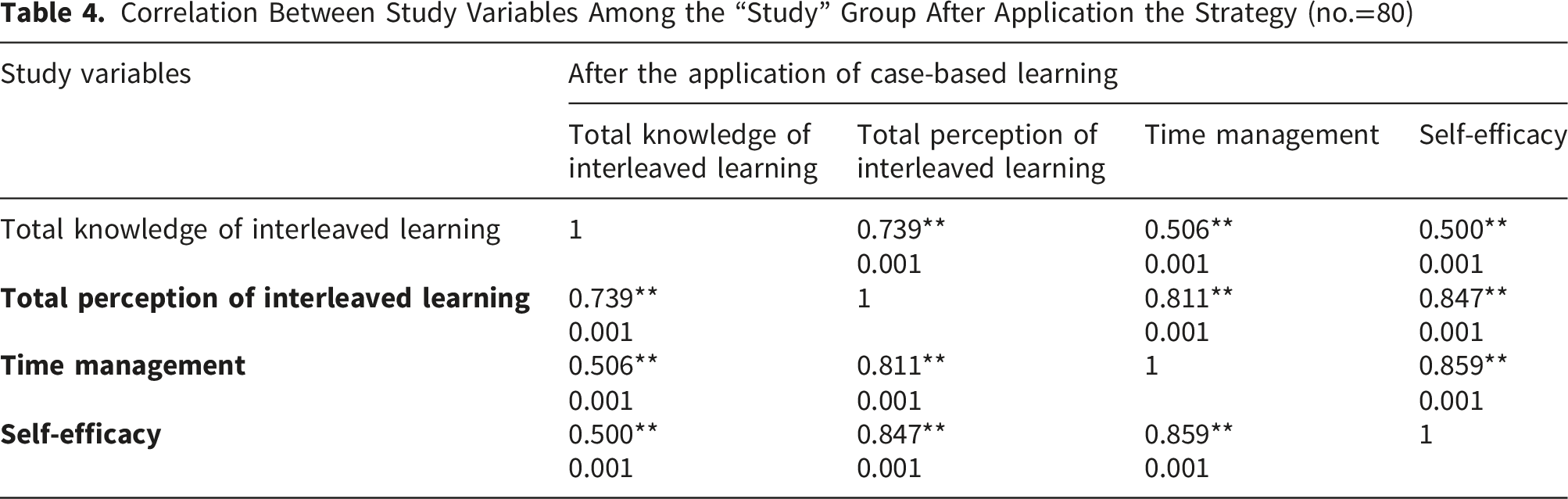
Correlation Between Study Variables Among the “Study” Group After Application the Strategy (no.=80)
Discussion
Nursing education requires innovative teaching strategies that not only enhance students’ knowledge but also strengthen essential skills such as time management, self-efficacy, and critical thinking. Traditional teaching approaches often focus on repetitive practice or massed learning, which may produce short-term gains but fail to ensure long-term retention and the ability to transfer learning into clinical practice. Recent developments in educational psychology have highlighted the value of interleaved learning, an instructional strategy that alternates between different subjects or skills rather than teaching them sequentially. This method provides students to “desirable difficulties,” which may initially seem challenging but ultimately promote deeper understanding, better retention of information, and more effective problem-solving skills (Say et al., 2025).
These findings are consistent with recent empirical studies highlighting the effectiveness of interleaved learning in enhancing both cognitive and metacognitive outcomes among nursing students. For instance, Schorn and Knowlton (2021) demonstrated that interleaved and case-based learning significantly improved students’ metacognitive awareness and academic performance. Similarly, Liu and Lu (2024) emphasized that structured learning strategies, particularly those involving task-switching and distributed practice, enhance students’ self-regulation and engagement. In addition, Lin et al. (2025) reported that effective learning strategies are closely associated with improvements in both time management and self-efficacy among nursing students. The current findings extend this body of evidence by demonstrating that interleaved learning not only improves knowledge acquisition but also strengthens essential professional competencies such as time management and self-efficacy in nursing education.
Because nursing students must balance demanding coursework with clinical training, effective learning strategies are crucial. Interleaved learning mirrors the unpredictability of actual clinical environments and has been shown to improve diagnostic accuracy, retention, and engagement (Trieu et al., 2024). It also strengthens time management and self-regulation skills by compelling them to alternate between projects. It also reinforces self-efficacy through repeated mastering experiences (Lin et al., 2025). Given these benefits, incorporating interleaved learning into nursing curricula may lead to holistic improvements in students’ knowledge, perceptions, and professional competencies, better preparing them for the complexities of modern healthcare practice.
The results showed that, after applying the strategy, the study group demonstrated a substantial improvement compared with the control group. The finding indicates that active and structured teaching methods, such as interleaving, enhance cognitive processing and long-term retention. The higher mean scores achieved by the study group support the effectiveness of interleaved learning in promoting deeper understanding, improved pattern recognition, and better knowledge. However, it was noticed that there is slightly improvement in nursing student knowledge about interleaved among the control group which might be linked to potential contamination between the study and control group. It was observed that some students from the control group were interested with the new strategy that their colleague’s study with and they share some information with them about interleaved learning. Overall, a significant increase in knowledge suggests that incorporating interleaved learning into nursing curricula could bridge gaps in traditional methods that often emphasize rote memorization over meaningful learning. Furthermore, the cognitive advantages of interleaved learning strategy can account for the improvement seen in nursing education. Students must constantly compare and retrieve prior knowledge as they switch between topics, which improves long-term memory and the ability to apply what they have learned to new contexts (Yan & Sana, 2021a). Additionally, recent research highlights that interleaving encourages deeper processing and active involvement, thereby increasing student happiness and accomplishment (Lin et al., 2025; Sadeghi et al., 2024). furthermore, Alhowaymel et al. (2025) highlighted that structured educational interventions not only improve academic performance but also enhance confidence and professional readiness among nursing students.
This is consistent with research demonstrating that structured learning methods, such as time management classes and active learning techniques, improve students’ performance and resilience (Ashrafi et al., 2021). By allowing students to switch between various assignments or ideas, interleaving improves long-term retention by fortifying memory encoding and retrieval processes (Sadeghi et al., 2024). These tactics improve overall performance in nursing education by helping students integrate theoretical understanding with real-world application (Rozenshtein et al., 2016). Additionally, the effectiveness of interleaving in difficult and professional sectors has been validated by current studies. For category learning, a crucial aspect of nursing and medical diagnoses, interleaved practice is clearly superior to blocked practice, according to a meta-analysis by Brunmair and Richter (2019). Similarly, Schorn and Knowlton (2021) found that interleaving improves learning transfer to novel contexts and long-term retention, suggesting that nursing students in the study might be more knowledgeable about interleaving and better able to apply it to other challenging subjects. Regarding perceptions, both groups had low familiarity with interleaving, with no statistically significant difference. This result is not surprising, as interleaving is still relatively new in nursing education, and many students are more familiar with traditional block-based learning methods. After implementing the strategy, the study group showed a highly significant improvement in overall perception scores. One possible explanation is that nursing students appreciated the relevance of interleaving to clinical practice, where multiple tasks and knowledge domains must be managed simultaneously. These results align with recent evidence indicating that active learning approaches, including interleaving, enhance students’ engagement and positive attitudes toward the learning process (Ylostalo, 2020). Specifically, students in the study group reported higher perceptions of interleaved learning’s effectiveness and learning outcomes than those in the control group. These results align with evidence from medical education showing that interleaved curricula improve satisfaction and long-term retention compared with traditional block curricula (Thompson & Hughes, 2023; Zeller et al., 2023). Moreover, improvements in students’ perceptions can be explained by the “desirable difficulties” principle, which holds that interleaving initially feels more demanding but ultimately enhances mastery and creates a more authentic learning experience (Yan & Sana, 2021a). Similarly, the The Royal College of Physicians (RCP) emphasizes realism and the preparation of learners for clinical unpredictability in its medical education programs; it encourages multi-strategy teaching—such as combining structured educational workshops, expert mentoring, and multidisciplinary team learning—to foster better engagement and confidence among healthcare professionals. This approach transforms traditional, passive education into active, experiential learning, which enhances the quality of education and patient care (Choudry et al., 2016).
Furthermore, Alhowaymel et al. (2025) emphasized that structured educational interventions not only enhance academic performance but also shift students’ attitudes positively toward learning methods. Also, this is consistent with research demonstrating a common disconnect between a student’s “feeling of learning” and their actual learning, a gap that can be bridged through effective instructional design (Deslauriers et al., 2019). In contrast, some earlier studies reported resistance to interleaving due to its increased cognitive demand, as learners sometimes prefer the ease of blocked practice despite its weaker long-term outcomes (Carvalho & Goldstone, 2019).
Regarding nursing students’ time management before and after the strategy’s implementation, it was initially poor in both groups, reflecting a common challenge faced by nursing students due to the heavy academic and clinical workload. After the intervention, the study group demonstrated significant improvements in general time management, task-switching and multitasking skills, and time allocation for study and practice. This result could be explained by the fact that interleaved learning encourages students to switch between tasks, set priorities, and distribute their time more efficiently, which in turn enhances their time management skills. These findings are consistent with studies that highlight the role of structured learning strategies in enhancing self-regulation and organizational skills (Lin et al., 2025). Interleaved learning may foster better time management by training students to alternate tasks, prioritize effectively, and allocate time more strategically (Pan et al., 2025). Improved time management is especially crucial in nursing education, where students must balance theoretical study, clinical practice, and self-directed learning (Sadeghi et al., 2024).
Furthermore, a systematic review by Liu (2024) confirmed a strong positive relationship between effective time management strategies and enhanced academic performance, noting that practice-based interventions yield more potent effects than knowledge-based approaches alone. This supports the efficacy of the hands-on “strategy” used in the study. Similarly, a study by Ashrafi et al. (2021) found that time management training significantly improved academic achievement and resilience among female nursing students, reinforcing the conclusion that such interventions are highly beneficial. Moreover, these findings are consistent with recent literature in nursing and health professions education. Plourde et al. (2025) and Ashrafi et al. (2021) both demonstrated that targeted time management workshops significantly improved students’ organizational skills and academic functioning and achievement. Similarly, Chust-Hernández et al. (2024) reported that structured time management interventions were associated with enhanced self-efficacy and reduced academic stress. More broadly, a 2025 study by Fu et al. confirmed that time management competencies are strongly related to self-regulatory skills, such as self-control, which, in turn, predict better academic engagement and achievement. However, the findings also contrast with some research that questions the direct impact of time management on academic outcomes. For example, a study by Temizkan Sekizler et al. (2022) found that time management skills were affected by external factors, such as social media use, but did not necessarily affect academic success.
One important explanation for these findings is the role of interleaved learning in promoting self-regulated learning. Interleaving requires students to actively plan, monitor, and evaluate their learning processes as they switch between different topics and tasks. This aligns with the principles of self-regulated learning, where learners take control of their cognitive, motivational, and behavioral processes (Wolters & Brady, 2021). Recent evidence further supports this perspective, indicating that self-regulated learning is strongly associated with effective time management and improved academic engagement (Fu et al., 2025). Furthermore, this enhanced self-regulation contributes directly to professional readiness. In real clinical settings, nurses are required to manage multiple patients, prioritize tasks, and make rapid decisions under pressure. Interleaved learning simulates these complex environments by exposing students to varied and unpredictable learning situations. As a result, students develop adaptability, critical thinking, and decision-making skills, which are essential competencies for effective nursing practice. This is supported by recent findings indicating that self-efficacy and engagement play a crucial role in developing professional competencies among nursing students (Zhou et al., 2025).
Regarding nursing students’ self-efficacy, the study group showed a remarkable increase in self-efficacy scores following the intervention. This suggests that structured educational strategies can meaningfully enhance nursing students’ confidence in their ability to manage academic and clinical demands. Enhancing self-efficacy can better prepare students to handle clinical challenges, reduce academic stress, and foster resilience, ultimately improving patient care outcomes. The educational strategy likely provided students with opportunities to succeed in manageable steps, reinforcing their confidence. This is supported by evidence that students who receive structured skills-based training report higher levels of self-efficacy and motivation (İncesu, 2024). These results align with the study of Chen et al., 2025, which found that active learning strategies and guided self-regulation training significantly enhanced nursing students’ academic self-efficacy. Similarly, Abdel Moneem Mohammad Shabana et al., 2024 reported that problem-based learning combined with mentoring improved nursing students’ clinical self-efficacy, leading to better performance during practice. In addition, Sadeghi et al. (2024) confirmed that structured educational programs not only improve time management but also increase students’ perceived competence and readiness for self-directed learning, a key element of self-efficacy.
Hung et al. (2021) confirmed that simulation-based training and clinical exposure significantly improve nursing students’ self-efficacy. A study by Momeni et al. (2025) found a direct correlation between clinical performance self-efficacy and motivation to choose a field of study, suggesting that enhancing one can positively influence the other. The observed improvement in the study, therefore, not only supports existing evidence but also provides a specific example of how a well-structured strategy can lead to measurable gains in self-efficacy, which is crucial for the transition from theory to practice. Moreover, Alhowaymel et al. (2025) reported that, by successfully engaging with interleaved tasks, students developed confidence in their ability to manage academic and clinical challenges. Similar findings have been reported in nursing education, where educational interventions significantly improved self-efficacy, satisfaction, and academic achievement. Moreover, studies confirm a strong positive correlation between self-efficacy and readiness for collaborative or interprofessional learning, further supporting the importance of building confidence through structured educational strategies (An et al., 2024).
In contrast, the study by Wolters et al. (2025) argues that short-term interventions may temporarily boost self-efficacy but do not always translate into sustained improvements unless reinforced by continuous practice and feedback. Moreover, some studies caution that interventions emphasizing performance without adequate support can increase anxiety, thereby undermining self-efficacy (Zhou et al., 2025). Similarly, Al Gharibi et al. (2021) reported that simulation boosts self-confidence but does not always translate into long-term clinical improvements. In this study, there were strong positive relations between knowledge, perception, time management, and self-efficacy. Notably, perception was strongly correlated with both time management and self-efficacy, indicating that students who valued the interleaved learning strategy were more likely to manage their time effectively and feel competent in their abilities. In addition, these findings suggest a powerful synergistic effect: a deeper understanding of a cognitive strategy leads to a more positive outlook, which, in turn, facilitates practical application and boosts students’ confidence in their learning abilities. This is consistent with Lin et al. (2025), who found that time management disposition predicted academic self-efficacy and innovative behavior. Furthermore, the significant correlation between knowledge and self-efficacy highlights the reciprocal relationship between competence and confidence, as also emphasized in Alhowaymel et al. (2025). These results support a holistic view of education, where enhancing one domain (e.g., perception) positively influences others (e.g., time management and self-efficacy).
Maruyama et al. (2024) and Onan et al. (2024) found that interleaved and case-based learning strategies improved students’ metacognitive awareness, which in turn facilitated better time management and self-efficacy. Similarly, Fu et al. (2025) reported that time management and self-control act as mediators between learning strategies and academic engagement, supporting the strong associations observed in this study. The positive link between perception of interleaved learning and both time management and self-efficacy can be explained through social cognitive theory, which suggests that students who perceive learning strategies as meaningful are more motivated to organize their time effectively and develop stronger self-belief (Waddington, 2023). This is reinforced by studies in nursing education, which show that favorable perceptions of active learning approaches are linked with higher motivation, self-efficacy, resilience, and professional readiness (Karabatak et al., 2023; İncesu, 2024). As supported by research on time management dispositions and academic outcomes (Fu et al., 2025), students who feel empowered by a learning strategy are more likely to proactively integrate it into their study schedule. The use of interleaved learning, which requires students to switch between topics, naturally calls for a methodical approach to studying time, strengthening time management skills. Accordingly, Ahmady et al. (2021) study supports earlier research that suggests efficient time management not only lowers stress but also increases students’ confidence in their capacity to succeed.
The relationship between time management and self-efficacy can be explained through social cognitive theory (Bandura, 1997), which suggests that individuals develop confidence in their abilities through successful experiences. Effective time management enables students to organize tasks, meet deadlines, and achieve academic goals, which in turn enhances their sense of competence and self-efficacy. Conversely, students with higher self-efficacy are more likely to engage in proactive time management behaviors, as they believe in their ability to control their learning outcomes. This reciprocal relationship indicates that time management and self-efficacy reinforce each other, creating a positive cycle that enhances academic performance and professional development. This finding is strongly supported by recent studies, where Lin et al. (2025) identified time management as a significant predictor of academic self-efficacy among nursing students. Similarly, El-Gazar et al. (2024) emphasized that self-efficacy is a key determinant of academic success and readiness in nursing education. Moreover, recent evidence suggests that self-efficacy enhances students’ engagement and professional competence, further strengthening this relationship (Zhou et al., 2025).
Another important finding is the strong correlation between students’ time management abilities and their understanding and perception of interleaved learning. Good time management is not standalone ability; instead, it is frequently linked to a student’s confidence in their teaching strategies. Students who feel empowered by a learning technique are more likely to proactively incorporate it into their study schedule, according to studies on time management disposition and academic outcomes (Karabatak et al., 2023). Better time management practices are reinforced by interleaved learning, which forces students to alternate between topics and demands an organized approach to study time. However, there is conflicting evidence. Although time management is linked to self-efficacy, some research indicates that it may not always be a reliable indicator of objective performance outcomes unless combined with consistent practice and feedback (Wolters et al., 2025).
The findings of this study have important implications for curriculum design in nursing education. Integrating interleaved learning into both theoretical and clinical courses can enhance students’ ability to manage complex information and improve long-term retention. Educators should consider designing learning activities that intentionally mix topics, case scenarios, and clinical skills rather than presenting content in isolated blocks. In addition, incorporating structured training on time management and self-regulated learning strategies within the curriculum can further strengthen students’ academic performance and professional competencies. Previous research has demonstrated that time management and self-efficacy are key predictors of academic success and readiness for clinical practice (El-Gazar et al., 2024; Lin et al., 2025). Curriculum planners are therefore encouraged to adopt blended instructional approaches that combine interleaving with other active learning strategies such as problem-based learning and simulation-based training to maximize educational outcomes.
Implications for Nursing Practice
Based on the study findings, interleaved learning appears to serve as an effective educational strategy in nursing education. The findings suggest the incorporating interleaved learning into nursing curricula may help bridge gaps in traditional teaching methods, which often emphasize rote memorization rather than meaningful learning. Furthermore, the cognitive benefits of interleaved learning may explain the improvement observed in nursing education. As students switch between topics, they are required to compare concepts and retrieve prior knowledge, which strengthen long-term memory and enhances their ability to apply learning in new contexts. The evidence presented in this study also provides nurses educators with a rationale for promoting active learning approaches, including interleaving, that enhance students’ engagement and foster positive attitudes toward learning. In addition, interleaved learning simulates complex environments in which nurses must manage multiple patients, prioritize tasks, and make rapid decisions under pressure. by exposing students to varied and unpredictable learning situations. As a result, students develop adaptability, critical thinking, and decision-making skills, which are essential competencies for effective nursing practice. It is recommended that interleaved learning be systematically incorporated into both theoretical and clinical nursing courses, as it may enhance task organization, prioritization of learning activities, and overall time management. Educators and clinical instructors should also be trained in the effective design and implementation of interleaved learning activities to ensure consistency and maximize their positive impact on students’ self-efficacy and learning outcomes. Combining interleaving with other active learning strategies, such as problem-based and case-based learning, may further improve knowledge retention and confidence in applying nursing concepts. Future studies should explore the long-term effects of interleaved learning on clinical performance, stress reduction, and professional readiness among nursing students across different academic years.
Strengths and Limitations
This study provide evidence regarding the effectiveness of the interleaved learning strategy in improving nursing students’ time management and self-efficacy. One of the major strengths of this study is that it is among the first studies to assess the impact of the interleaved learning on both time management and self-efficacy among nursing students within the nursing education context. Another strength is the use of a quasi-experimental pretest-posttest design, which enabled the researchers to examine changes in outcomes before and after the intervention and compare them between the study and control groups.
However, this study has several limitations. First, it was conducted in a single institution, which may limit the generalizability of the findings. Second, the use of self-reported measures may have introduced response bias. Additionally, the quasi-experimental design without full randomization may have resulted in selection bias, and the absence of long-term follow-up limited the assessment of sustained effects over time. Future studies should implement stricter control measures to minimize cross-group influence and potential contamination. Furthermore, future research should examine the long-term impact of interleaved learning on clinical performance and include multi-center studies with randomized designs to enhance the generalizability of the findings.
Conclusion
Compared with traditional teaching methods, interleaved learning significantly improved nursing students’ knowledge, perceptions, time management, and self-efficacy. The intervention group demonstrated significant improvements in time management, concept integration, and confidence in both academic and clinical performance. In addition, the positive relationship observed among knowledge, perception, time management, and self-efficacy suggest that interleaved learning may support both cognitive development and essential professional competencies. These findings highlight the potential value of interleaved learning as a long-term teaching strategy in nursing education to prepare students for the fast-paced and cognitively demanding healthcare environment. Therefore, the systematic integration of interleaved learning into both theoretical and clinical nursing courses is recommended to strengthen students’ organization, prioritization, and overall time management skills.
Supplemental Material
Supplemental Material - Effect of Interleaved Learning Strategy on Nursing Students’ Time Management and Self-Efficacy
Supplemental Material for Effect of Interleaved Learning Strategy on Nursing Students’ Time Management and Self-Efficacy by Rasha Mohamed Nagib Ali, Heba Dakrory Ali El-Said, Basma Salameh, Ola Mousa, Samar Hussien Khalaf Alah Mohamed in Sage Open Nursing
Footnotes
Acknowledgment
We thank all subjects and the nursing staff at Minia University Hospital for their participation in the study.

Ethical Considerations
The Research Ethics Committee of the Faculty of Nursing at Minia University approved the study and issued an official letter under code (REC2024103). Informed consent was obtained from all participants at the Faculty of Nursing, Minia University. Before conducting both the pilot study and the main study, Participants provided written consent and expressed willingness to participate. The participants were provided with an explanation of the study’s nature and objectives. Participants in research studies have the right to decline to participate or discontinue their involvement without justification. Subject privacy was preserved during the data collection process. The participants were assured that their data would be treated with utmost confidentiality. To ensure anonymity and privacy, each nurse was assigned a numerical identifier rather than their name.
Funding
The authors received no financial support for the research, authorship, and/or publication of this article.
Declaration of Conflicting Interests
The authors declared no potential conflicts of interest with respect to the research, authorship, and/or publication of this article.
Data Availability Statement
The data utilized to support the results of the research are accessible to the corresponding author upon request.
Supplemental Material
Supplemental material for this article is available online.
References
Supplementary Material
Please find the following supplemental material available below.
For Open Access articles published under a Creative Commons License, all supplemental material carries the same license as the article it is associated with.
For non-Open Access articles published, all supplemental material carries a non-exclusive license, and permission requests for re-use of supplemental material or any part of supplemental material shall be sent directly to the copyright owner as specified in the copyright notice associated with the article.
