




Abstract
Background
Moral disengagement is a psychological mechanism through which individuals justify ethically compromised behavior. Understanding the experiences of nursing faculty involved in moral disengagement is essential for maintaining educational integrity and ensuring the development of ethically grounded future nurses.
Objectives
The purpose of this study was to explore the lived experiences of nursing faculty regarding moral disengagement and to examine how nursing faculty experienced moral disengagement as a cognitive strategy used to rationalize compromises in both academic and clinical teaching standards.
Methods
A hermeneutic phenomenological approach, guided by van Manen’s method, was employed. Twelve (n=12) nursing faculty members from three Palestinian universities located in the West Bank participated in semi-structured interviews conducted between February and June 2025. Participants were selected through purposive sampling based on inclusion criteria of full-time employment and a minimum of two years of teaching experience. Data were analyzed using van Manen’s thematic analysis. Credibility was established through member checking, peer debriefing, and triangulation among researchers.
Results
The thematic analysis identified four overarching themes:
Conclusions
These findings highlight the complexity of moral disengagement among nursing educators within the specific context studied and the potential impact it had on nursing education quality and student development. The study calls for institutional reforms, including ethical workload audits, holistic faculty evaluation systems, and faculty ethics support programs, as well as context-sensitive professional ethics training and multilevel policy interventions in nursing education. Further research across diverse contexts is warranted to enhance transferability of these findings.
Keywords
Introduction
Moral disengagement is a cognitive process through which individuals selectively disengage their moral self-sanctions from harmful conduct, thereby allowing them to act in ways that violate their moral standards without experiencing distress (Bandura, 1999, 2016). This psychological mechanism is particularly relevant in nursing education, where faculty may experience moral distress when institutional pressures, resource limitations, and competing demands create conflicts between their ethical standards and professional realities (Bandura, 2016; Moore et al., 2012). In the context of nursing education, moral disengagement can manifest when faculty rationalize compromising teaching standards, reducing student support, or overlooking academic integrity issues due to systemic constraints (Ogunfowora et al., 2022). The politically unstable environment and resource-limited settings such as the West Bank
Bandura’s theory identifies eight mechanisms of moral disengagement: moral justification, euphemistic labeling, advantageous comparison, displacement of responsibility, diffusion of responsibility, distortion of consequences, dehumanization, and attribution of blame (Bandura, 2016). These mechanisms enable individuals to maintain a positive self-concept while engaging in ethically questionable behaviors. In educational contexts, faculty might employ moral justification by rationalizing lower standards as necessary adaptations to challenging circumstances, or use diffusion of responsibility by attributing compromised practices to systemic failures rather than individual choices (Moore et al., 2012; Ogunfowora et al., 2022).
While moral distress and moral disengagement are related concepts, they represent distinct psychological phenomena. Moral distress occurs when individuals recognize the ethically appropriate action but feel constrained from pursuing it due to institutional, hierarchical, or resource barriers (Jameton, 1984). Moral disengagement, in contrast, involves cognitive mechanisms that allow individuals to dissociate from moral standards without experiencing psychological distress (Bandura, 2016). Research suggests that sustained moral distress may lead to moral disengagement as a coping mechanism, wherein educators progressively rationalize ethical compromises to reduce psychological burden (Fida et al., 2016). Understanding this progression is crucial for developing interventions that support faculty ethical resilience.
A phenomenological approach is uniquely suited to explore this phenomenon because moral disengagement is covert, psychologically complex, and deeply embedded in the subjective lived experience of individuals. Phenomenology enables researchers to access the meaning-making processes through which faculty interpret and justify their ethical compromises, going beyond surface-level descriptions to interpretive understanding (Neubauer et al., 2019).
Review of Literature
Research on moral disengagement in higher education, particularly among nursing faculty, remains scarce and sporadic. Studies conducted in diverse international contexts have found moral disengagement to mediate relationships between educators' stress and professional withdrawal, reflecting factors like rationalization of standards and diffusion of responsibility in academic environments (Fida et al., 2016). Moral disengagement negatively influences teaching quality, represents an increase in academic shortcuts, and lowers educational standards (Ke & Li, 2025). Ethical leadership and institutional support could mitigate moral disengagement (Zhao & Xia, 2019).
Critically, existing research on moral disengagement in nursing education is predominantly quantitative and cross-sectional in design, focusing on prevalence and correlates rather than the lived meaning of these experiences for educators themselves (Fida et al., 2016; Ogunfowora et al., 2022). The phenomenological dimension, how nursing faculty subjectively interpret, justify, and navigate moral disengagement in their day-to-day teaching lives, remains theoretically underdeveloped across international literature
The present study addresses this conceptual gap within the specific structural conditions of higher education under occupation in the West Bank, Palestine, where resource constraints, institutional pressures, and political disruption compound in distinctive ways. While the setting provides a unique window into how sustained external pressures shape moral experiences, the study’s primary contribution lies in advancing phenomenological understanding of moral disengagement as a lived experience in nursing education, a contribution with relevance beyond this single context.
The Palestinian context presents unique pressures that extend beyond typical resource-limited settings. Education under occupation involves movement restrictions, disrupted academic calendars, limited access to updated resources and technology, and students who carry the psychological burden of ongoing conflict and trauma (Talebian et al., 2025). These structural conditions intersect with institutional pressures to create a distinctive ethical landscape. Faculty navigating checkpoint delays, interrupted semesters, and student trauma may find it psychologically easier to rationalize compromises, blurring the boundary between contextually adaptive responses and genuine moral disengagement. Where available, literature on education in conflict-affected or occupied territories underscores that political instability profoundly shapes the ethical consciousness of educators (Scager et al., 2017).
Recent phenomenological research has begun to illuminate moral disengagement experiences among healthcare professionals in Middle Eastern contexts. A study examining moral disengagement among intensive care and emergency department nurses in Iran identified similar patterns of rationalization and ethical compromise under institutional pressure (Talebian et al., 2025). Notably, that study also identified the ‘contagion’ phenomenon of moral disengagement, whereby normalized ethical compromises spread through organizational culture, a pattern that emerged independently in the present data. These convergent findings across different Middle Eastern healthcare settings suggest potentially shared cultural or institutional dynamics that warrant further investigation.
With regard to the significance of this research, the researchers believe that articulating these factors is essential in furthering knowledge of moral disengagement among nursing faculty working in challenging academic environments. Qualitative research, specifically phenomenological studies, is fundamental to nursing education research, as it generates knowledge about the lived experience of educators and what that means for practice (Thorne et al., 2016). By framing the importance of these findings, the researchers can create a bridge from theory to practice and generate meaningful knowledge that may help with ethical decision-making and educational quality enhancement.
Therefore, this study aimed to explore the lived experiences and meaning of moral disengagement among nursing faculty in universities located in the West Bank, Palestine.
Methods
Researcher Positionality and Reflexivity
In keeping with best practices in hermeneutic phenomenology, the reflexivity statement is presented at the outset of the Methods section to acknowledge how the researchers’ positionality shaped data collection and interpretation (van Manen, 1997).
All members of the research team are nursing faculty employed at West Bank universities, positioning them as insiders to the phenomenon under study. This insider status provided valuable contextual understanding and facilitated participant trust; however, it also required heightened reflexivity regarding potential biases and assumptions. Throughout the research process, the team maintained reflexive journals documenting their preconceptions, emotional responses to participant narratives, and evolving interpretations. The team explicitly recognized that their own experiences with institutional pressures and ethical dilemmas in West Bank nursing education shaped their sensitivity to certain themes while potentially creating blind spots regarding others. To address this, the team implemented regular peer debriefing sessions where team members challenged each other’s interpretations and questioned taken-for-granted assumptions. When analyzing data related to practices the team had experienced, they deliberately sought alternative interpretations and consulted with faculty from different institutional contexts. This reflexive stance directly influenced the analytic decisions, particularly in moderating initial interpretations that may have overemphasized systemic constraints while underestimating individual agency.
Study Design
This study utilized van Manen’s hermeneutic phenomenology, which was selected for its emphasis on interpreting lived experiences within their sociocultural contexts. Van Manen’s approach aligns with the research aims as it moves beyond mere description to interpretive understanding of how participants make meaning of moral disengagement within the complex West Bank academic environment. This method is particularly suited to exploring ethically sensitive phenomena, as it honors the contextual embeddedness of moral experiences while maintaining methodological rigor (van Manen, 1997), based on Heidegger’s inquiry of ‘being’ and the essence of being-in-the-world, with emphasis on returning to “the things themselves” through analytical examination of experience using conversational interviews. This study examined moral disengagement among nursing faculty throughout their academic and clinical teaching roles to understand their lived experiences and the meaning of daily phenomena. The purpose of phenomenological reflection is to uncover the original meaning of phenomena by interpreting lived experience, involving thematic analysis to establish essential themes (Flood, 2010; van Manen, 1997).
Study Period
Data collection for this study was conducted between February 2025 and June 2025, with the entire research process from conception to final analysis spanning from January 2024 to August 2025.
Setting and Participants
The study was conducted with nursing faculty who were selected based on established criteria, which included full-time employment status and a minimum of two years of teaching experience in academic and/or clinical settings. To ensure diverse institutional and regional representation while protecting participant anonymity, faculty were recruited from three universities located in different regions of the West Bank. These institutions are referred to in this study as University 1, University 2, and University 3.
Recruitment Process
Participants were recruited through multiple strategies. Initial contact was made through official institutional channels, with department chairs distributing recruitment flyers via email to eligible faculty members. These communications included the study purpose, participant criteria, and contact information for the research team. Interested faculty contacted researchers directly, ensuring voluntary participation free from departmental pressure. Additionally, early participants were invited to share study information with colleagues who met eligibility criteria (snowball sampling), which proved particularly effective in reaching faculty hesitant to respond to formal recruitment channels. Potential bias from professional acquaintance within the Palestinian nursing education community was managed through the primary researcher’s explicit acknowledgment of prior relationships in the reflexive journal, and through analytical peer debriefing that specifically challenged interpretations where insider familiarity may have introduced assumptions. All potential participants received detailed information about the study aims, procedures, risks, and benefits before providing informed consent.
Participant demographic information was collected using a standardized questionnaire (see Supplementary Material 5). Twelve nursing faculty members participated in this study, with representation across all three institutions. The sample included faculty with varying levels of teaching experience (ranging from 2 to 18 years), diverse academic ranks (from instructor to full professor), and balanced gender representation. All participants held at least a master’s degree in nursing, with six holding doctoral degrees. There were no exclusion criteria established other than participants self-excluding or wishing to withdraw their data, which did not occur.
Ethical Approval
This study was conducted in accordance with the ethical principles of the Declaration of Helsinki. Ethical approval was obtained from the Institutional Review Board at Ibn Sina College for Health Professions, Nablus University for Vocational and Technical Education (Approval Number: Ref: Nrs. Jan/2025/10). All participants provided written informed consent after receiving comprehensive information about the study. Participation was entirely voluntary, and participants were informed of their right to withdraw at any time without consequence. Given the sensitive nature of the topic, which involved disclosure of ethically compromised practices, additional protections were implemented: participant codes (P1–P12) were used throughout all reporting, audio recordings and transcripts were stored on encrypted, password-protected institutional servers accessible only to the research team, institutional identifiers were anonymized, and data were retained securely in accordance with institutional data governance policies. Translators were also briefed on the study’s objectives and the sensitive nature of the topic prior to undertaking translation work, to better capture nuanced meanings.
Data Generation
Data for this study was collected through semi-structured in-depth interviews conducted between February 2025 and June 2025 (duration of approximately five months), with oversight from two senior researchers. Participants were recruited from the participating institutions and were informed about ethical considerations and their rights prior to granting consent for the interview (see Supplementary Material 2 for Participant Information Sheet and Supplementary Material 3 for Informed Consent Form). All interviews were audio-recorded with participant permission. Each interview was conducted in private settings, such as faculty offices, with only the participant and researcher present to ensure confidentiality and comfort. Interviews lasted between 45 and 60 minutes. Data saturation was determined when no new themes emerged from interviews and existing themes were well-developed with rich, thick description. This was achieved after the twelfth interview, as confirmed through ongoing analysis and team discussion. Data saturation was determined analytically: following each interview, the research team reviewed emerging themes and noted the degree to which new data added conceptually novel content. From interview nine onward, no new subthemes emerged, and by interview twelve, full redundancy across all four major themes was confirmed through structured team discussion and comparison of analytical memos. This process is documented in the audit trail (Supplementary Material 6).
Translation Procedures
All interviews were conducted in the participants’ native language (Arabic) to facilitate natural expression and rapport. To prepare the data for analysis by the bilingual research team, audio recordings were transcribed verbatim in the original language by a research assistant fluent in both Arabic and English. These transcripts were then translated into English by a member of the research team proficient in both languages and familiar with nursing education terminology.
To preserve semantic meaning and contextual nuance, a rigorous forward-backward translation approach was implemented. A second bilingual nursing educator, independent from the research team and blind to the original translations, back-translated 30% (four transcripts) of the transcripts from English to Arabic. The research team then compared the back-translated versions with the original transcripts to identify any discrepancies in meaning, tone, or emphasis. Discrepancies were resolved through discussion among the bilingual team members, with consultation of a third bilingual nursing educator when consensus could not be reached. The translation validation process demonstrated strong conceptual agreement on key thematic content across the sampled transcripts; where minor discrepancies were identified, they were resolved through team consensus. This qualitative judgment of conceptual equivalence determined that the translation protocol was sufficiently robust. All team members reviewed the remaining English translations while referring to original Arabic transcripts to ensure consistency and accuracy throughout the dataset. All translators were briefed on the study’s objectives prior to undertaking translation work to better capture nuanced meanings.
Participant quotes used in this manuscript were carefully selected and translated to maintain their original intent, emotional tone, and contextual relevance while ensuring clarity for an English-speaking readership.
Interview Guide
The interviews were guided by a semi-structured interview guide (see Supplementary Material 1). The interview guide was developed based on Bandura’s moral disengagement framework and was reviewed by three qualitative research experts and two ethics specialists prior to implementation. Questions were reviewed and revised before each interview based on existing knowledge of the topic to ensure validity. The researchers initiated interviews with open-ended questions, such as “Tell me about your typical teaching day” and “What comes to your mind when I say moral disengagement? How do you behave after experiencing moral disengagement? Can you describe your feelings?” and “How do you think moral disengagement affects your interactions with students?” As interviews progressed, the researchers asked more probing follow-up questions based on participants’ earlier responses, such as “Can you provide a specific example?” “Do you mean…?” and “How…?”
The interview guide was not previously validated in published research; however, it was reviewed and refined through pilot testing with two nursing faculty members (not included in the final sample) to ensure clarity, cultural appropriateness, and alignment with research aims. Feedback from pilot interviews led to minor wording adjustments and the addition of clarifying probes. While the guide was structured around Bandura’s theoretical framework, open-ended questions were prioritized to allow participants’ lived experiences to emerge naturally, consistent with phenomenological principles. The theoretical framework served as a sensitizing lens rather than a constraining template. Nevertheless, the researchers acknowledge that a guide substantially organized around Bandura’s mechanisms may have inadvertently constrained the emergence of meanings not anticipated by the framework, and may have nudged participants toward morally coded interpretations of their experiences. This is an inherent methodological tension in theory-informed phenomenological work that readers should weigh when interpreting the findings. Future studies employing more purely inductive interview structures may yield richer or divergent experiential accounts.
Thematic Analysis
The qualitative data were analyzed by the primary researcher and two faculty advisors with experience in phenomenology. The three researchers transcribed all audio recordings without exclusion by adhering to van Manen’s phenomenological method (Dowling, 2007). The goal of analysis was to identify themes related to “moral disengagement” and describe participants’ lived experiences (see Supplementary Material 6 for coding framework and codebook). The phenomenological analysis adhered to six steps of van Manen’s method: focusing on the lived experience, investigating the experience, reflecting on the essence of themes, writing the phenomenon, maintaining connection to the lived experience, and balancing the research (Errasti-Ibarrondo et al., 2018). This systematic process identified useful and powerful themes and patterns reflecting participants’ experiences of moral disengagement in nursing education.
Detailed Example of Thematic Analysis Process
To illustrate the analytic approach, consider the development of the theme ‘Subjective Weighing of Educational Responsibilities.’ Initially, the team noted multiple instances where participants described prioritizing certain teaching duties over others. One participant stated: ‘I know I should spend more time giving detailed feedback on assignments, but when you have 60 students and limited time, you focus on what’s most critical.’ The team coded this as ‘selective prioritization.’ Similar codes emerged across transcripts (e.g., ‘choosing battles,’ ‘focusing energy where it matters most’). Through iterative reflection, the team recognized these discrete choices reflected a broader pattern of subjective moral reasoning wherein faculty developed personal hierarchies of professional obligations. The team returned to the data to explore how participants justified these hierarchies, what factors influenced their rankings, and how they experienced tensions between competing responsibilities. This deeper analysis revealed that participants were not simply managing time constraints but were engaging in active moral reasoning—weighing which professional obligations held greater ethical weight in their specific contexts. This interpretive process exemplifies van Manen’s hermeneutic approach, moving from descriptive coding to interpretive understanding of the phenomenon’s essence.
Trustworthiness
The study addressed methodological rigor and reliability through criteria defined by Lincoln and Guba (1985): credibility, dependability, confirmability, and transferability.
Credibility was established through multiple strategies: (1) prolonged engagement, the primary researcher spent 5 months in data collection, allowing deep immersion in the phenomenon; (2) member checking, three participants reviewed preliminary themes and provided feedback confirming resonance with their experiences; (3) peer debriefing, the research team met bi-weekly throughout analysis to challenge interpretations and explore alternative explanations; and (4) triangulation, multiple researchers independently coded transcripts and compared analyses to ensure interpretive consistency.
Dependability was established through maintaining a comprehensive audit trail documenting all research decisions, methodological adjustments, and analytic processes. Confirmability was enhanced through systematic documentation of the interpretive process, including reflexive journals where researchers recorded their assumptions, biases, and evolving understandings. The codebook (Supplementary Material 6) provides clear linkages between raw data, codes, and themes, allowing readers to trace the interpretive pathway.
Transferability was established through purposeful sampling across different institutions and detailed reporting of researchers’ reflections. The study provides thick description of the research context, participant characteristics, and institutional settings to enable readers to assess applicability to their own contexts.
Data collection followed COREQ guidelines (see Supplementary Material 4 for completed checklist) and was conducted by an experienced nursing educator to establish participant confidence. Coding was done collaboratively by the research team, and findings were reviewed by qualitative research and nursing education experts external to the team.
Results
Important Note on Interpretation: The findings presented in this Results section represent the lived experiences of the twelve participants in this study and should not be interpreted as universal truths or normative patterns across all nursing faculty in West Bank universities. While these experiences reflect significant challenges reported by participants, it is important to recognize that many nursing educators in Palestine maintain strong ethical standards and demonstrate remarkable professional integrity despite substantial institutional and contextual constraints.
Participant Demographics
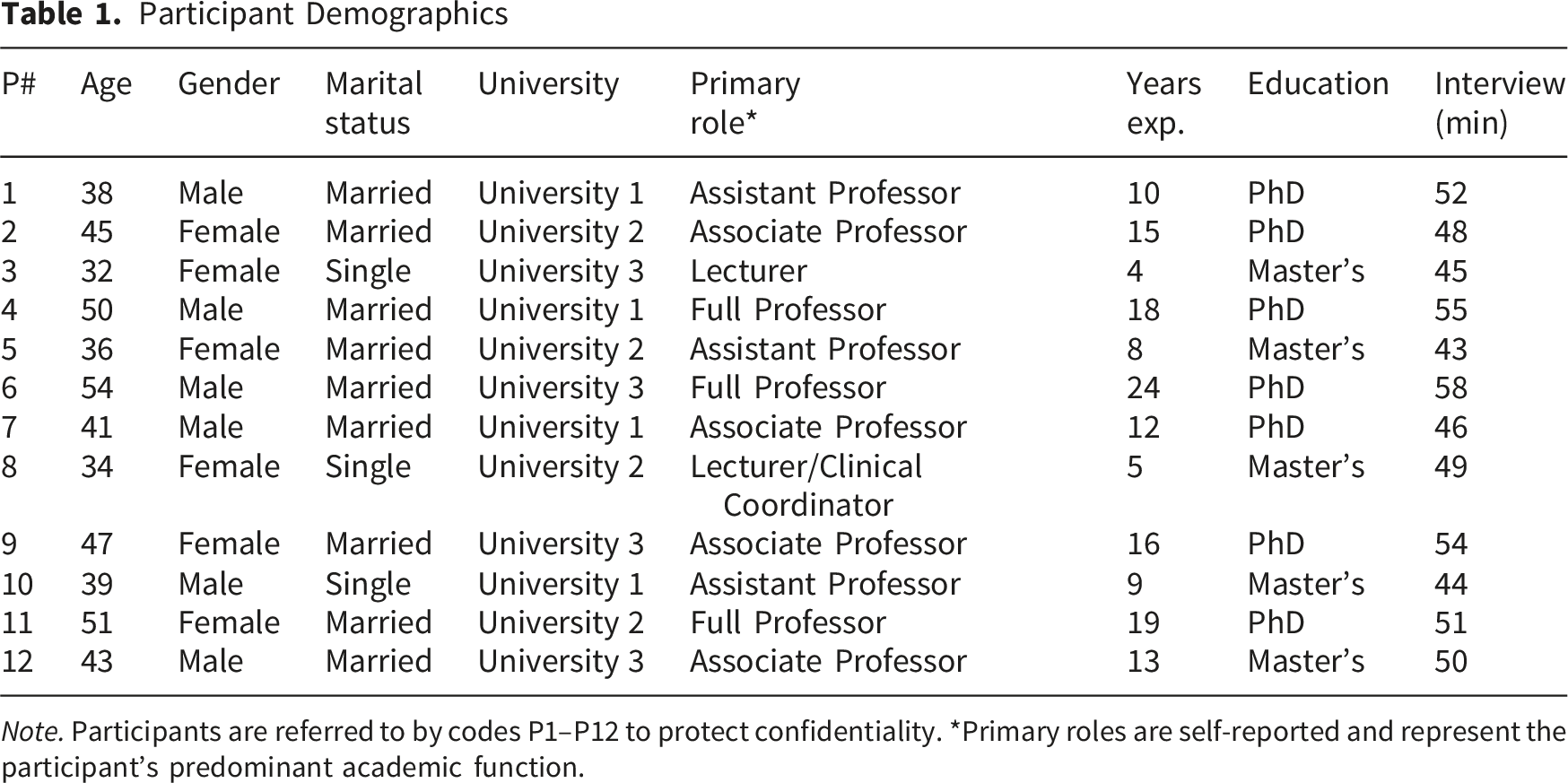
Note. Participants are referred to by codes P1–P12 to protect confidentiality. *Primary roles are self-reported and represent the participant’s predominant academic function.
Summary of Themes and Subthemes

Theme 1: Negotiating and Avoiding Responsibilities
Several participants in this study described experiences that can be likened to placing tasks on a mental scale to weigh the importance of their duties. This mental weighing encompasses three subthemes:
Deliberately Not Fulfilling Responsibilities
Some faculty reported experiencing instances where they intentionally chose not to perform certain duties while teaching or supervising students. This represents a deliberate avoidance of actions that the individual was aware of and capable of performing. One participant stated: “When supervising clinical students, I know I should follow each student individually throughout their shift, but I stay in the nursing station because I have other work to complete. I feel pressure because my workload is too much, so I compromise on the supervision quality.” (P1)
This pattern was consistent across multiple participants, suggesting that deliberate non-fulfillment of responsibilities is not experienced as an active moral failure but rather as a pragmatic accommodation to structural overload. Participants retained awareness of what they were not doing, yet the persistence of these choices across time points to a process of progressive moral distancing in which the gap between intended and enacted professional behavior becomes normalized.
Taking Shortcuts Instead of Addressing Root Issues
A subset of participants’ lived experiences illustrated their perception of major problems in the educational system, particularly the notion of applying quick fixes rather than addressing underlying issues. These faculty described how shortcuts lead to a culture of avoiding problem-solving. Additionally, these participants faced moral disengagement resulting in feelings of guilt and moral distress. “I overlook certain clinical errors. I pass them anyway because failing them means extra paperwork and family complaints. What I’m saying is difficult even for me to admit.” (P7)
Phenomenologically, what is most significant in these accounts is not simply the behavior described but the interpretive work participants performed to reconcile their actions with their professional self-concept. The phrase “what I’m saying is difficult even for me to admit” (P7) signals residual moral discomfort rather than full disengagement; yet the behavior recurred. This tension, between moral awareness and repeated compromise, reflects the progressive nature of moral disengagement described by Bandura (2016), where initial rationalizations become increasingly automatic over time.
Procrastination in Academic Duties
One experience described by some participants after mentally weighing their duties was procrastination. Procrastination in this context means deferring tasks such as grading, feedback provision, or student counseling rather than addressing them promptly—a deliberate choice. In this type of avoidance, these faculty felt the necessity to perform duties and were aware of potential negative impacts on students, yet they did not feel significant remorse. “The student submitted a research proposal that needs major revisions. I know I should provide detailed feedback immediately so they can improve, but I delay it for weeks because reviewing it thoroughly is time-consuming. I tell myself I’ll do it next week, and the student waits, losing valuable time.” (P5)
Across Theme 1, a shared experiential pattern emerged: participants consistently maintained dual awareness, knowing what professional standards required while simultaneously choosing not to meet them. This is phenomenologically distinct from ignorance or incapacity. It reflects what van Manen (1997) describes as a rift in the lived relation between knowing and doing, wherein the demands of the lifeworld systematically overtake professional commitment. Importantly, these accounts point to structural conditions, overload, under-resourcing, and administrative complexity, as the proximate triggers, even as individual agency remained present throughout.
Theme 2: Justification
Moral justification entails reinterpreting unethical actions as contributing to a socially valuable or necessary objective. Some participants rationalized their conduct, believing that despite its questionable nature, it served a higher purpose or secured positive outcomes for students or the institution.
Categorizing Students Hierarchically
Some participants expressed that they provided more attention to well-connected or privileged students while exerting less effort for those from marginalized backgrounds. These lived experiences highlighted how faculty members’ personal judgments influenced their educational decision-making and the quality of education provided to different students. “I’m more lenient with students whose families are known in the community or who have connections to university administration. I give them more opportunities to make up missed work. For students from refugee camps or with no connections, I hold them to stricter standards. I justify this by thinking the privileged students have more to lose, but I know it’s unfair.” (P2)
What makes this account phenomenologically significant is the simultaneous presence of moral awareness and moral compromise. The participant’s own framing — “I know it’s unfair” — reveals that disengagement here operates not through a suppression of moral judgment but through its subordination to social hierarchies internalized from the broader institutional context. This pattern, reported by several participants in varied forms, reflects how participants perceived broader institutional culture as reproducing structural inequalities through seemingly individual pedagogical choices.
Perceiving Educational Requirements as Futile
Some faculty demonstrated that they frequently found themselves questioning the value of certain institutional requirements or curriculum standards. This doubt stemmed from their practical experiences and observations of graduate outcomes. This belief in the futility of some requirements led to incomplete implementation. “The university requires us to use specific teaching methods and assessment rubrics that I find impractical for our context. I’ve seen these methods fail repeatedly with our students who have different learning needs. So I modify or skip these requirements because I believe they’re designed for Western contexts and don’t fit Palestinian nursing education. I convince myself I’m doing what’s best for students.” (P9)
Phenomenologically, this subtheme reveals a form of moral disengagement in which participants recast non-compliance as contextually appropriate professional judgment. Rather than experiencing deviation from institutional standards as failure, these faculty reframed it as a form of local wisdom. While such adaptive reasoning may at times reflect genuine pedagogical insight, as a consistent pattern it also functions as a mechanism for displacing accountability from the individual to the system, a dynamic consistent with Bandura’s (2016) concept of displacement of responsibility.
Overwhelming Workload and Inadequate Resources
Most participants frequently expressed concern about excessive workload and inadequate resources in their institutions. These faculty believed that insufficient support negatively impacted teaching quality and student learning, as they were required to perform multiple roles beyond their primary teaching responsibilities. “When I have 80 students in a nursing fundamentals course, there is no way to provide meaningful individual feedback. I have to cut corners: generic comments, slightly inflated grades to avoid complaints.” (P8)
Phenomenologically, workload operates in these accounts as a justificatory mechanism that displaces moral responsibility onto structural constraints. Participants did not describe themselves as choosing to compromise quality; rather, they experienced the compromise as imposed by circumstances beyond their control. This framing is significant because it reveals how moral disengagement can emerge not from active rationalization alone but from the progressive erosion of conditions necessary for ethical practice. When faculty consistently face workloads that make it impossible to meet their own professional standards, the line between “choosing' and “being forced' to compromise blurs, and moral accountability becomes increasingly difficult to locate. Notably, however, participants retained awareness of the gap between what students needed and what they could provide, a tension that persisted even as they normalized the compromise.
Inadequate Institutional Organization
Several participants believed that problematic institutional practices, such as evaluating performance primarily through student satisfaction scores or publication counts, negatively impacted educational quality. “The administration judges us mainly by student evaluations, which encourages us to be lenient with grading to keep students happy. If I fail students who deserve to fail, my evaluation scores drop and I face pressure from administration. The system rewards popularity over educational rigor, so I compromise standards to protect my position.” (P2)
In participants' accounts, this subtheme points to one of the most institutionally embedded forms of moral disengagement identified in the data: they described the evaluative architecture of the institution as actively incentivizing ethical compromise. Participants did not describe choosing leniency over integrity in a vacuum but as a calculated response to a performance measurement system they perceived to reward student satisfaction over educational rigor.
Challenging Educational Context
When expressing lived experiences of moral disengagement, some faculty referred to the unique challenges of the West Bank context. The political realities of occupation, including movement restrictions, disrupted academic calendars, and students carrying the weight of ongoing conflict, created conditions in which rationalizing compromised standards felt both unavoidable and necessary. These contextual pressures intersected with and amplified the other justification mechanisms described above. One participant described this with the statement: “Teaching in our context means constant uncertainty, movement restrictions, political tensions affecting attendance, limited resources, and students carrying trauma. These conditions make it easy to justify lowering standards because we tell ourselves students are dealing with enough already.” (P6)
This subtheme is interpretively distinct from the others in Theme 2 in that the justification draws not on institutional logic but on collective suffering. The political and humanitarian context of the West Bank functions here as a powerful moral lever: rationalizing lower standards is experienced as empathy rather than negligence. Phenomenologically, this reveals how the broader socio-political environment can become woven into the fabric of moral disengagement, rendering compromise not just acceptable but compassionate in participants’ self-understanding. This mechanism warrants particular caution in interpretation: the researchers do not suggest that contextual sensitivity is itself a form of moral failure, but rather that when contextual reasoning consistently produces lower standards, it warrants careful institutional attention.
Theme 3: The Façade: Discrepancy Between Stated and Enacted Practices
This theme captures some participants’ experiences of maintaining professional appearances while privately engaging in practices that contradicted stated standards.
Superficial Course Delivery
Some faculty described presenting course materials and documentation that did not accurately reflect actual teaching practices. “In my course syllabi and official documents, I list all the learning outcomes, teaching methods, and assessment criteria that administration wants to see. But in reality, I don’t cover all topics adequately, I don’t use all the assessment methods listed, and I simplify content significantly. During program reviews or accreditation visits, we present these documents as if we’re implementing everything fully.” (P5)
This experience captures the phenomenological essence of Theme 3: the maintenance of a professionally coherent external presentation that diverges systematically from lived practice. Rather than a single act of deception, this describes an ongoing relational performance sustained across institutional audiences, students, administrators, and accreditors. The experience is not primarily one of guilt but of role management, suggesting that the moral weight of the discrepancy has been substantially internalized and routinized.
Inaccurate Documentation and Reporting
Some participants reported that inaccurate documentation occurred through inflation of student performance, omission of academic integrity violations, or misrepresentation of teaching activities. In participants’ accounts, this behavior was experienced as a way of managing competing institutional pressures rather than as a deliberate intention to produce unprepared graduates; yet its cumulative effects on educational integrity remained a source of significant concern. “Sometimes I don’t document plagiarism cases even when I detect them, because the process is lengthy and complicated. I just give the student a lower grade instead. Or I inflate clinical evaluation scores slightly for struggling students to help them pass, knowing they might not be fully competent. I record that they met standards when they didn’t, because I don’t want to deal with the consequences of failing them.” (P7)
What distinguishes this subtheme phenomenologically is the explicit falsification of records, a form of moral disengagement where displacement of responsibility is enacted through bureaucratic process. The behavior is framed by participants as consequence-avoidance rather than as dishonesty, revealing how documentation practices can become sites of moral disengagement when the administrative system itself is perceived as punitive toward rigorous standards. It is important to note that these accounts reflect the subjective experience of some participants in specific circumstances and should not be read as characterizing the documentation practices of West Bank nursing faculty broadly.
Forced Complicity
Some participants’ lived experiences revealed that they often felt pressured to collude with administration or colleagues in practices that compromised educational integrity. These experiences highlight how institutional power dynamics can produce conditions in which faculty perceive silence as a form of self-protection rather than complicity; the ethical dimensions of this are complex and should not be reduced to individual moral failure. “Administration pressures us to pass students who should fail because the university needs enrollment numbers. When I raised concerns, I was told I'm being too rigid. Now I stay silent because speaking up threatens my job security.” (P2)
Forced complicity represents a phenomenologically distinct form of moral disengagement in that the initial motivating experience is not a personal rationalization but an externally applied pressure. Participants described their silence not as a chosen position but as an adaptive response to perceived institutional threat. This distinction matters interpretively: in participants' accounts, it points toward organizational and leadership failures as the proximate drivers of this form of disengagement, and cautions against locating moral responsibility solely at the individual faculty level.
Theme 4: The ‘Contagion’ of Moral Disengagement
This theme describes how moral disengagement may spread through academic departments and become normalized within institutional culture, based on the experiences reported by participants.
Collective Rationalization
The lived experiences of some participants revealed normalization of compromised standards through collective faculty behavior. This concept refers to following colleagues’ practices and conforming to prevailing departmental norms, despite personal ethical principles. “When I first started teaching, I was idealistic about maintaining high standards. But I quickly learned that other faculty members grade more leniently, overlook plagiarism, and don’t enforce attendance policies. If I’m the only one holding strict standards, students complain that I’m unfair compared to other instructors. Eventually, I adapted to match my colleagues’ practices because being the outlier was professionally isolating.” (P9)
This account captures the experiential mechanism through which collective rationalization functions: not through overt peer pressure but through the social cost of non-conformity. Participants described gradually abandoning higher standards not because they were instructed to but because professional belonging and collegial standing depended on alignment with prevailing practices. This process mirrors what social learning theory describes as vicarious moral disengagement, observing that ethical compromise is unpunished and indeed socially rewarded, and it points to the department rather than the individual as the primary unit of moral culture.
Peer Influence and Departmental Culture
Some faculty described how observing colleagues’ ethical compromises influenced their own behavior. The organizational culture created an environment where moral disengagement became the accepted norm rather than the exception within their specific departmental contexts. “In department meetings, faculty openly discuss workload-reduction strategies—reusing exams, minimizing feedback, approving weak theses. These shortcuts become shared knowledge, almost a survival strategy. New faculty learn quickly that this is how things are done here.” (P4)
The language of camaraderie in P4’s account — “we’re all in this together” — is phenomenologically significant: it signals that ethical compromise is not merely tolerated within departmental culture but actively constitutive of collegial identity. In the experiences participants described, this transforms what might be understood as individual moral failure into a shared survival narrative. Such reframing exemplifies Bandura’s (2016) mechanism of diffusion of responsibility operating at the collective level, as participants experienced it: no single actor owned the ethical compromise because it appeared co-produced and socially validated across the group within their specific departmental contexts.
Institutional Acceptance of Lower Standards
Some participants noted that administration in their institutions often implicitly accepted or even encouraged practices that compromised educational quality, creating an environment where moral disengagement was not only tolerated but expected. “The university leadership knows the quality issues exist, but they don’t address them because they’re focused on financial survival and political navigation. They need enrollment numbers, graduation rates, and satisfied students more than they need rigorous education. This sends a message to faculty that compromising standards is acceptable as long as problems stay hidden and metrics look good.” (P11)
Across Theme 4, in the experiences reported by participants, the data reveal a process of organizational moral disengagement that transcends any individual faculty member’s psychology. Within the specific contexts these faculty described, when institutional leadership was perceived to implicitly condone compromised standards to protect enrollment and revenue, moral disengagement ceased to be a coping strategy and was experienced as an institutional norm. As one participant stated, this perception created an environment where ethical compromise felt expected rather than exceptional (P11).
Discussion
Research on moral disengagement in nursing education has produced relevant conclusions regarding ethical dilemmas that some faculty face. This exploration revealed themes related to subjective evaluation of educational tasks, justification mechanisms for compromised standards, the gap between stated and actual practices, and the spread of certain unethical norms through academic culture in specific contexts.
Integration With Bandura’s Moral Disengagement Framework
The themes identified in this study align closely with specific mechanisms of moral disengagement articulated by Bandura (2016). The theme ‘Negotiating and Avoiding Responsibilities’ reflects moral justification, wherein participants reframed ethical compromises as necessary adaptations to challenging circumstances. The theme ‘Justification Mechanisms’ maps onto multiple Bandura mechanisms simultaneously: euphemistic labeling, advantageous comparison, and displacement of responsibility. The ‘Contagion’ theme particularly reflects diffusion of responsibility, wherein normalized patterns of compromise across the faculty community allowed individuals to feel less personally accountable for ethical lapses.
Furthermore, the analysis reveals how moral disengagement operated across individual, organizational, and structural levels. At the individual level, participants employed personal rationalizations to manage cognitive dissonance between their ethical ideals and actual practices. At the organizational level, institutional cultures that normalize compromise create environments where moral disengagement becomes a shared coping mechanism. At the structural level, broader political and economic constraints in West Bank higher education create systemic pressures that feed moral disengagement at all levels.
Convergence With Previous Research and the Contagion Phenomenon
The independent emergence of the ‘contagion’ theme in both
The theme of ‘justification’ arose from the types of ethical dilemmas faced by some faculty in trying to ensure student success within constrained resources and challenging contexts (Scager et al., 2017). Literature indicates that some nursing educators experience moral distress related to typical ethical dilemmas in academic decision-making, with similar struggles regarding balancing multiple competing demands (Palmryd et al., 2025). Additionally, institutional cultures emphasizing metrics over educational quality can cause job dissatisfaction and burnout among faculty (Halbesleben et al., 2008; Kiptulon et al., 2024).
The West Bank Context and Moral Disengagement
The political context of the West Bank is not merely background to this study, it is a constitutive force in the moral experiences of faculty. The intersection of occupation-related movement restrictions, disrupted academic continuity, and pervasive student trauma creates a distinctive ethical landscape that shapes the specific content and intensity of moral disengagement. Faculty described checkpoints delaying both students and themselves (P6), interrupted semesters due to political tensions (P6), and students whose psychological burden from the ongoing conflict made it difficult for faculty to maintain rigorous academic standards without feeling callous. These realities intersect directly with the mechanisms of moral disengagement: the challenging context provides a ready justification for compromises, while the sense of collective suffering can activate advantageous comparison and displacement of responsibility at the institutional level.
This contextual specificity has implications beyond Palestine. Educators in other conflict-affected regions, from conflict zones in Africa and the Middle East to post-disaster contexts in Asia, may encounter structurally similar pressures. The findings suggest that moral disengagement interventions in such settings must be contextually grounded, acknowledging the genuine difficulty of maintaining standard educational practices under exceptional circumstances, while simultaneously resisting the normalization of compromise.
Transferability and Contextual Specificity
While this study is grounded in the specific context of West Bank nursing education, certain findings may have transferability to other settings. The mechanisms of moral justification, diffusion of responsibility, and rationalization under resource constraints are likely relevant to nursing educators in other conflict-affected regions, developing nations with limited higher education resources, and any institutional contexts where faculty face competing demands without adequate support.
Strengths and Limitations
The phenomenological approach provides in-depth qualitative understanding of some nursing faculty’s lived experiences regarding moral disengagement. Though the study scope involved twelve participants, it addresses an important issue in nursing education ethics.
Limitations must be considered. The sample of twelve faculty from three West Bank universities, while appropriate for phenomenological inquiry, necessarily constrains the breadth of the findings. The study does not claim representativeness, and transferability to other national, cultural, or institutional contexts is limited; readers should apply the findings with caution beyond the specific setting studied. The sensitive nature of the topic may have led to under-reporting of certain experiences even with anonymity protections. Additionally, as acknowledged in the Methods section, the interview guide’s grounding in Bandura’s framework represents a methodological limitation: the theory-shaped structure of questioning may have oriented participant narratives toward predefined moral disengagement concepts, potentially limiting the emergence of alternative or unexpected meanings. Further, while participants varied across three universities, all were from West Bank institutions, which may limit transferability to other contexts. Additionally, the study captures experiences at a specific point in time and does not address how moral disengagement patterns may change over the course of faculty careers.
Implications for Nursing Education
The research indicates that moral disengagement among some nursing faculty begins with justification and can spread through academic departments. To address this phenomenon and promote ethical educational practices, the following specific interventions are recommended.
Implications for Faculty
Faculty-level interventions should prioritize building individual ethical resilience and reflective capacity. Institutions should establish Faculty Ethics Circles—regular, facilitated peer discussions where educators can confidentially explore ethical dilemmas. University deans should mandate and resource monthly Faculty Ethics Circles, facilitated by an external ethicist or senior nursing ethics educator, to create structured spaces for ethical deliberation that are insulated from institutional power dynamics. Structured mentorship programs should pair new educators with experienced ethical role models who can provide guidance on navigating institutional pressures. Trauma-informed teaching workshops are also essential, particularly in the West Bank context, to help faculty recognize and respond to student trauma while maintaining academic rigor.
Implications for Institutions
At the institutional level, ethical workload audits should be conducted regularly to review faculty assignments and ensure that teaching loads, clinical supervision ratios, and administrative responsibilities do not compel ethical compromises. Nursing department heads should annually audit faculty workload distribution, with binding guidelines capping student-to-faculty clinical supervision ratios. Holistic faculty evaluation systems must be developed to value educational quality, student competency development, and ethical practice alongside traditional metrics. Transparent academic integrity processes should simplify and standardize procedures for addressing academic dishonesty. Whistleblower protection policies must be implemented to provide clear safeguards for faculty who report ethical concerns, ensuring that moral courage is protected rather than penalized.
Implications for Policy
At the policy level, Palestinian nursing education governance bodies should develop nationally endorsed Nursing Education Ethics Guidelines that acknowledge the realities of education under occupation while maintaining core professional standards. These guidelines should be developed collaboratively with faculty from across the West Bank, contextualized to local realities, and reviewed regularly. Policy should also support resource adaptation training programs that help faculty ethically adapt international educational standards to local resource constraints. Crisis-response teaching protocols, clear institutional guidelines for maintaining educational quality during periods of heightened political tension or movement restrictions, should be established at a national level to prevent ad hoc rationalization of compromised standards.
Recommendations for Further Research
Ethical training and ethical discourse are essential components for faculty to effectively navigate the risks of moral disengagement. Future research should advance understanding of how organizational factors, culture, institutional policies, resource allocation, and political context influence moral disengagement among nursing faculty. To build on the findings of this phenomenological study, the following research directions are recommended: (1) quantitative studies examining the prevalence of moral disengagement among nursing faculty in Palestine and the broader Arab region; (2) cross-cultural comparative studies with other conflict-affected or resource-limited settings to identify both universal and context-specific factors; (3) intervention studies aimed at reducing moral disengagement and promoting ethical leadership in nursing education; (4) longitudinal studies examining how moral disengagement evolves throughout faculty careers; and (5) research exploring the impact of faculty moral disengagement on student learning outcomes and professional development.
Conclusion
The research indicates that some nursing faculty in West Bank universities experienced moral disengagement manifesting as prioritization of simpler tasks over complex educational responsibilities (Theme 1: Negotiating and Avoiding Responsibilities), rationalization of compromised standards (Theme 2: Justification), maintenance of appearances that contradicted actual practices (Theme 3: The Façade), and the normalization and spread of ethical compromise through academic culture (Theme 4: The ‘Contagion’). The unique contextual factors of the West Bank, political instability, occupation-related restrictions, resource limitations, and institutional pressures, played a constitutive role in shaping how these mechanisms manifested. However, it is essential to acknowledge that many nursing educators in West Bank universities maintain exemplary ethical standards despite facing the same systemic pressures, demonstrating that strong professional integrity can persist even in challenging contexts.
The study calls for multilevel, context-sensitive interventions: faculty ethics support programs, institutional workload reforms and holistic evaluation systems, and nationally endorsed nursing education ethics guidelines that acknowledge the realities of education under occupation. Addressing moral disengagement among nursing faculty is essential for nurturing ethically grounded future nurses, maintaining nursing education integrity, and supporting faculty well-being in challenging environments.
Supplemental Material
Supplemental Material - Lived Experiences of Moral Disengagement Among Nursing Faculty in the West Bank: A Hermeneutic Phenomenological Study
Supplemental Material for Lived Experiences of Moral Disengagement Among Nursing Faculty in the West Bank: A Hermeneutic Phenomenological Study by Mustafa Shouli, Ibrahim Aqtam, Ahmad Ayed, Lobna Harazneh, Moath Abu Ejheisheh, Ahmad Batran in Sage Open Nursing
Supplemental Material
Supplemental Material - Lived Experiences of Moral Disengagement Among Nursing Faculty in the West Bank: A Hermeneutic Phenomenological Study
Supplemental Material for Lived Experiences of Moral Disengagement Among Nursing Faculty in the West Bank: A Hermeneutic Phenomenological Study by Mustafa Shouli, Ibrahim Aqtam, Ahmad Ayed, Lobna Harazneh, Moath Abu Ejheisheh, Ahmad Batran in Sage Open Nursing
Supplemental Material
Supplemental Material - Lived Experiences of Moral Disengagement Among Nursing Faculty in the West Bank: A Hermeneutic Phenomenological Study
Supplemental Material for Lived Experiences of Moral Disengagement Among Nursing Faculty in the West Bank: A Hermeneutic Phenomenological Study by Mustafa Shouli, Ibrahim Aqtam, Ahmad Ayed, Lobna Harazneh, Moath Abu Ejheisheh, Ahmad Batran in Sage Open Nursing
Supplemental Material
Supplemental Material - Lived Experiences of Moral Disengagement Among Nursing Faculty in the West Bank: A Hermeneutic Phenomenological Study
Supplemental Material for Lived Experiences of Moral Disengagement Among Nursing Faculty in the West Bank: A Hermeneutic Phenomenological Study by Mustafa Shouli, Ibrahim Aqtam, Ahmad Ayed, Lobna Harazneh, Moath Abu Ejheisheh, Ahmad Batran in Sage Open Nursing
Supplemental Material
Supplemental Material - Lived Experiences of Moral Disengagement Among Nursing Faculty in the West Bank: A Hermeneutic Phenomenological Study
Supplemental Material for Lived Experiences of Moral Disengagement Among Nursing Faculty in the West Bank: A Hermeneutic Phenomenological Study by Mustafa Shouli, Ibrahim Aqtam, Ahmad Ayed, Lobna Harazneh, Moath Abu Ejheisheh, Ahmad Batran in Sage Open Nursing
Supplemental Material
Supplemental Material - Lived Experiences of Moral Disengagement Among Nursing Faculty in the West Bank: A Hermeneutic Phenomenological Study
Supplemental Material for Lived Experiences of Moral Disengagement Among Nursing Faculty in the West Bank: A Hermeneutic Phenomenological Study by Mustafa Shouli, Ibrahim Aqtam, Ahmad Ayed, Lobna Harazneh, Moath Abu Ejheisheh, Ahmad Batran in Sage Open Nursing
Footnotes
Acknowledgments
The authors extend their deepest gratitude to the nursing faculty members who participated in this study and to the administrations of the participating institutions for facilitating this research. Special thanks are extended to Nablus University for Vocational and Technical Education for providing funding support during this study.

Ethical Considerations
This study was conducted in accordance with the ethical principles of the Declaration of Helsinki. Ethical approval was obtained from the Institutional Review Board at Nablus University for Vocational and Technical Education (Approval Number: Nrs.Jan/2025/10).
Consent to Participate
All participants provided written informed consent after receiving comprehensive information about the study. Participation was entirely voluntary, and participants were informed of their right to withdraw at any time without consequence. Given the sensitive nature of the topic, which involved disclosure of ethically compromised practices, additional protections were implemented: participant codes (P1–P12) were used throughout all reporting, audio recordings and transcripts were stored on encrypted, password-protected institutional servers accessible only to the research team, institutional identifiers were anonymized, and data were retained securely in accordance with institutional data governance policies. Translators were also briefed on the study’s objectives and the sensitive nature of the topic prior to undertaking translation work, to better capture nuanced meanings.
Consent for Publication
All data are anonymized, and no identifiable personal details are included in the manuscript.
Author Contributions
Funding
The authors received no financial support for the research, authorship, and/or publication of this article.
Declaration of Conflicting Interests
The authors declared no potential conflicts of interest with respect to the research, authorship, and/or publication of this article.
Data Availability Statement
The datasets generated and analyzed during this study are not publicly available due to privacy and confidentiality considerations but may be made available from the corresponding author upon reasonable request and with appropriate ethical approvals.
Study Location Details
Data were collected from faculty at three universities located in different regions of the West Bank, Palestine: Palestine Ahliya University (Bethlehem), Nablus University for Vocational and Technical Education (Nablus), and Arab American University (Jenin).
Study Duration
January–August 2025.
Supplemental Material
Supplemental material for this article is available online.
References
Supplementary Material
Please find the following supplemental material available below.
For Open Access articles published under a Creative Commons License, all supplemental material carries the same license as the article it is associated with.
For non-Open Access articles published, all supplemental material carries a non-exclusive license, and permission requests for re-use of supplemental material or any part of supplemental material shall be sent directly to the copyright owner as specified in the copyright notice associated with the article.
