




Abstract
Background
Modern healthcare’s increasing complexity requires team-based nursing care, yet the psychological mechanisms of nurses’ team job crafting remain under explored. This study aims to explore the association between psychological capital and team job crafting in clinical nurses and to test the mediating effect of regulatory focus.
Methods
A cross-sectional design was employed, with 465 clinical nurses recruited from five hospitals in China. Data collection included a demographic questionnaire and three validated scales: the Psychological Capital Scale for Nurses, the Regulatory Focus Scale, and the Chinese version of the Team Job Crafting Scale. Data were analyzed using SPSS 25.0 for descriptive statistics and Amos 23.0 for structural equation modeling to examine the hypothesized path relationships.
Results
Nurses’ team job crafting averaged 3.95±0.64, with significant positive correlations to psychological capital and regulatory focus (p<0.05). The regression model (Adjusted R2=0.731) identified age, gender, length of service, higher sense of responsibility and confidence, and both promoting/defensive focus as significant predictors. Regulatory focus partially mediated the psychological capital-team job crafting (β=0.214, 95%CI [0.114,0.221]), accounting for 32.4% of the total effect.
Conclusion
Clinical nurses demonstrated moderate team job crafting levels, suggesting room for improvement. Significant predictors included older older, female, and with long work experience. Regulatory focus emerged as both a direct predictor and partial mediator (32.4%) between psychological capital and team job crafting.
Keywords
Introduction
Modern healthcare’s increasing complexity has rendered solo nursing practice uncommon, with most clinical tasks requiring coordinated team efforts (Rosengarten, 2019; Simpson-Collins et al., 2023). Nursing, as a collaborative profession, is fundamentally shaped by team job crafting—a key driver of team efficacy. By adopting a collaborative team framework that actualizes collective agency, nurses can enhance organizational flexibility and adapt to complex healthcare settings (Stahlke & Dahlke 2020). Iida et al. (2021) reported that team job crafting promotes cooperation among nurses, enhances team cohesion, improves organizational efficiency, reduces turnover intention, and increases job satisfaction and organizational commitment.
Review of Literature
With the advancement of modern medicine, multidisciplinary team collaboration has become dominant in hospital nursing, making team-based job crafting more critical than individual-level design (Goh 2020). Iida et al. (2021) defined team job crafting as “behaviors beneficial to ward nurses in designing work tasks, relationships and cognition”, which indirectly influences nursing leadership, improves team service quality, and predicts team work participation. Research has shown that team job crafting positively affects individuals, teams, and organizations, potentially stimulating team vitality and improving performance (Lee & Kim 2023; Zhou et al., 2025). In China, cultural emphasis on collectivism and team spirit further highlights the importance of studying team-level job crafting behaviors over individual ones (Hung et al., 2020). However, most studies focus on individual job design, neglecting team dynamics in healthcare settings.
Grounded in the Job Demands-Resources Model, psychological capital is a critical personal resource helping nurses navigate high-stakes clinical environments (Yuan et al., 2023b). Evidence shows that nurses’ psychological capital—comprising self-efficacy, hope, optimism, and resilience—buffers occupational stress and catalyzes positive work behaviors. A scoping review of 111 studies confirmed a consistent positive correlation between registered nurses’ psychological capital and desirable outcomes including work engagement, organizational commitment, and retention intention (Flinkman et al., 2023). A meta-analysis of 6,092 nurses demonstrated a significant inverse correlation between psychological capital and burnout (Orgambídez et al., 2025).
Beyond mitigating negative outcomes, psychological capital drives constructive workplace behaviors. Research has shown that psychological capital mediates the relationship between authentic leadership and nurses’ caring behavior (Zhang et al., 2023), influences job performance through problem-focused coping and work engagement (Chen et al., 2024), and partially mediates the relationship between work readiness and work well-being among newly graduated nurses (Ding et al., 2024). Psychological capital also moderates the pathway from emotional labor to workplace deviant behavior (Meng et al., 2024) and functions as a chain mediator between organizational commitment and perceived professional benefit (Qiu et al., 2025). Within the Job Demands-Resources Model, personal resources like psychological capital generate positive emotions that build enduring resources, fostering work engagement and proactive behaviors such as job crafting (Huang et al., 2022; Lee & Kim 2023). Iida et al. (2021) confirmed that psychological capital serves as intrinsic motivation driving nurses’ mental health, stress relief, and work efficiency. Thus, clinical nurses with higher psychological capital are more likely to engage in team-level proactive behaviors. This study hypothesized that clinical nurses’ psychological capital is positively correlated with their team job crafting.
The theory of regulatory focus, proposed by Higgins et al. (2001), refers to the ways individuals achieve work goals. Two main types exist: promoting focus (pursuing positive results, improvement, and growth) and defensive focus (focusing on negative outcomes and avoiding punishment). Promoting-focused individuals attend to development needs and ideals; defensive-focused individuals emphasize security, caution, and avoidance (Liu et al., 2020). In nursing, regulatory focus reflects task-oriented behavioral tendencies based on intrinsic motivation (Wallace & Chen 2010). Clinical nurses’ team decision-making is influenced by their work focus: promotion focus maximizes team gains, while prevention focus minimizes collective losses (Liu et al., 2022). This study speculated that regulatory focus is also related to team job crafting in clinical nurses.
Guided by the Job Demands-Resources Model and the theory of regulatory focus (Hung et al., 2020; Lee & Kim 2023), psychological capital as a personal resource not only alleviates work stress but also promotes positive behaviors. Nurses with high psychological capital tend to adopt a promotion focus (growth and ideal realization), whereas those with low psychological capital are more likely to exhibit a prevention focus (risk avoidance and status quo maintenance) (Kohnen et al., 2024). Regulatory focus theory further explains that teams dominated by promotion focus foster innovation and proactively drive team job crafting, whereas prevention-focused teams emphasize compliance and adopt a conservative stance toward change (Zhang et al., 2024). However, the specific pathways through which clinical nurses’ psychological capital influences team job crafting via regulatory focus as a motivational mediator remain unclear. Thus, this study proposed the core hypothesis: regulatory focus mediates the relationship between nurses’ psychological capital and team job crafting.
To summarize, although previous international studies have confirmed the positive role of individual-level job crafting among nurses, the mechanisms underlying team-level job crafting—particularly how nurses’ psychological capital translates into collective work redesign—have received limited empirical attention. Moreover, the mediating role of regulatory focus between psychological capital and team job crafting has not been tested in clinical nursing settings. This study fills these gaps by providing three novel contributions. First, unlike most prior research focusing on individual job crafting, this study shifts to team job crafting, which aligns with the team-based nature of modern nursing practice and collectivist culture. Second, grounded in the Job Demands-Resources model and regulatory focus theory, this study is the first to empirically examine whether regulatory focus mediates the link between psychological capital and team job crafting among clinical nurses. Third, using structural equation modeling and bootstrap methods, this study quantifies direct and indirect effects, offering new evidence on the mediating pathway. These findings will provide nursing managers with actionable insights: for nurses with low psychological capital, strengthening prevention focus through structured guidance can rebuild confidence; for those with high psychological capital, activating promotion focus can empower innovation and proactive team redesign.
To synthesize the theoretical linkages, this study propose an integrated conceptual model: psychological capital directly enhances team job crafting, and also indirectly influences it via regulatory focus. Nurses with higher psychological capital are more likely to adopt promotion focus (seeking growth) or prevention focus (ensuring safety), both of which drive distinct forms of team job crafting—proactive redesign and cautious process optimization, respectively.
Therefore, grounded in this conceptual model, the following research hypotheses were developed: Hypothesis 1. Psychological capital positively correlates with team job crafting. Hypothesis 2. Regulatory focus positively correlates with team job crafting. Hypothesis 3. Regulatory focus partially mediates between psychological capital and team job crafting.
Methods
Setting and Population
A cross-sectional study was conducted from March 1 to April 28, 2025, involving clinical nurses recruited via convenience sampling from five tertiary general hospitals in Shandong Province, China. Inclusion criteria: (1)registered nurses with a nursing professional qualification certificate; (2)engaged in clinical nursing work in this department for at least 1 year; (3)voluntarily participate in the survey and sign an informed consent form. Exclusion criteria: (1) Absence from work during the survey period; (2) Experienced major illness or life events (e.g., bereavement, divorce) within the preceding three months, as such factors may significantly impact psychological and occupational well-being.
The estimated number of participants required for this study was analysed using the G * power 3.1.9.7 programme, According to the widely accepted conventions (Faul et al., 2009), we set the effect size of 0.15, significance level of 0.05, power of 0.8, and the sample size required for the hierarchical regression analysis was 270. Allowing for a 30% dropout rate, the minimum sample size was estimated to be 386 participants. In practice, we successfully recruited and completed the survey in a total of 465 nurses, exceeding the minimum required, thereby ensuring the study was adequately powered.
Procedure
An online survey was conducted using the Wenjuanxing survey platform. On the questionnaire home page, participants were provided with an explanatory statement that outlined the research purpose, significance, and filling instructions, explicitly emphasising the voluntary nature of participation, the anonymity of responses, and the confidentiality of all collected data. An electronic informed consent form was also presented, and participants were required to provide consent before proceeding. To ensure anonymity, the platform did not collect any personally identifiable information (e.g., names, employee ID numbers, or IP addresses), and all responses were recorded without any linkage to individual participants. Data were stored on a password-protected server accessible only to the research team and were used solely for the purposes of this study. Participants were informed that they could withdraw from the survey at any time without any consequences. The research team first distributed the questionnaire link to department supervisors via dedicated WeChat groups, who then forwarded it to their respective nursing department groups. Prior to the survey, investigators contacted head nurses to facilitate communication and to provide standardised instructions on how to complete the questionnaire. All participants voluntarily agreed to take part and signed the electronic informed consent form. By completing and submitting the questionnaire, participants provided their final consent for data use.
Measurements
Data were collected using the general demographic questionnaire, psychological capital scale for nurses, team job crafting scale for nurses, and regulatory focus scale for nurses.
General Demographic Questionnaire
It included the age, gender, educational level, length of service, marital status, professional title, job position, employment mode, work department, and monthly night shift frequency.
Team Job Crafting Scale for Nurses (TJCSN)
This scale was compiled (Iida et al., 2021) to evaluate clinical nurses’ team job crafting behaviour. It included team job tasks crafting (four items) and team job cognition and relationships crafting (nine items). Using the Likert 5-point rating system and was graded from 1 (never) to 5 (very), with a total score of 13 to 65. The higher the score, the stronger the nurse team’s job crafting behavior. The researchers used the Chinese version of the TJCS-N, which was validated by Fang et al. (2024). The Cronbach’s α coefficient, split-half coefficient and test-retest coefficient were 0.945, 0.872 and 0.925, respectively, the I-CVI of the scale was from 0.778 to 1.000, and the S-CVI was 0.923. Totally two common factors were extracted by the exploratory factor analysis, the cumulative variance contributing 69.415%. The confirmatory factor analysis showed that the model had good fit. In this study, the structural validity and reliability of the scale were assessed. The internal consistency of the entire tool was 0.980.
Psychological Capital Scale for Nurses (PCSN)
This scale was developed by Yuan (Yuan et al., 2023a) to understand nurses’ psychological capital. It included six dimensions: hope (seven items), collaborative communication (six items), emotional intelligence (five items), sense of responsibility (four items), resilience (four items), confidence (four items). The items were evaluated on a 6-point scale ranging from 1 (completely inconsistent) to 6 (completely consistent), with higher scores indicating better psychological capital. In this study, the Chinese version of the scale, which was validated by Wu et al. (2025), was used. Cronbach’s α coefficient, split-half reliability, test-retest reliability and the scale level content validity index was 0.981, 0.996, 0.918, and 0.956, respectively. Exploratory factor analysis extracted 6 factors, and the cumulative variance contribution rate was 77.587%. The confirmatory factor analysis revealed that the factor structure of the scale was stable. The researchers assessed the structural validity and reliability of the scale. The overall Cronbach’s alpha coefficient of the tool was 0.983, and the Cronbach’s α coefficient for the six dimensions ranges from 0.956 to 0.968. The PCS-N scale has acceptable reliability and validity.
Regulatory Focus Scale for Nurses (RFSN)
This scale was developed for measuring nurse’s regulatory focus (Wallace & Chen, 2010). It included two dimensions: promoting focus (six items) and defensive focus (six items). The items were evaluated on a 5-point scale ranging from 1 (completely inconsistent) to 5 (completely consistent), dimension with higher scores reflecting nurses’ tendency towards regulatory focus. In this study, the Chinese version of the RFSN was used, which was validated by Xu et al. (2023). The item-content validity index (I-CVI) of RFSN ranged from 0.800 to 1.000, and the average scale-content validity index (S-CVI/Ave) was 0.917. The Cronbach’s α coefficient was 0. 962. And the Cronbach’s α coefficient of each dimension were 0. 929 and 0.970. The results of exploratory factor analysis showed that the cumulative variance contribution rate of the two common factors was 83. 259%,and the results of confirmatory factor analysis showed that all fitting indexes were within the acceptable range. In addition, this study assessed the structural validity and reliability of the scale. The internal consistency of the entire tool was 0.951, with a range of 0.893-0.972 for the subscales.
Statistical Analysis
Data were analyzed using SPSS 25.0 and AMOS 23.0. Descriptive statistics were performed for all variables. Continuous variables are presented as mean±standard deviation (SD), and categorical variables as frequency and percentage. Differences in team job crafting across demographic groups were compared using independent t-tests and one-way analysis of variance (ANOVA). Pearson correlation analysis was employed to examine bivariate relationships among nurses’ psychological capital, regulatory focus, and team job crafting. Moreover, while controlling for demographic variables, hierarchical regression analysis was conducted to examine the degree of variation in team job crafting, as a dependent variable, resulting from psychological capital and regulatory focus. AMOS 23.0 software was used to construct a structural equation model of the relationships among psychological capital, regulatory focus and team job crafting, and path analysis was performed on the association of the three variables. The bootstrap method was used to test the mediating effect of regulatory focus. The 95% confidence interval (CI) was calculated for 2000 bootstrap samples, and the values of the 95% CI that did not cross zero were considered to indicate a significant mediating effect. Given the cross-sectional design and the use of self-reported scales, the researchers performed Harman’s single-factor test to examine common method bias. All items of the three scales were entered into an unrotated principal component analysis. The first unrotated factor explained 29.2% of the total variance, which is below the 40% cutoff, indicating that common method bias did not significantly affect the results. P-values of all tests below .05 reflected statistical significance.
Results
Demographic Characteristics
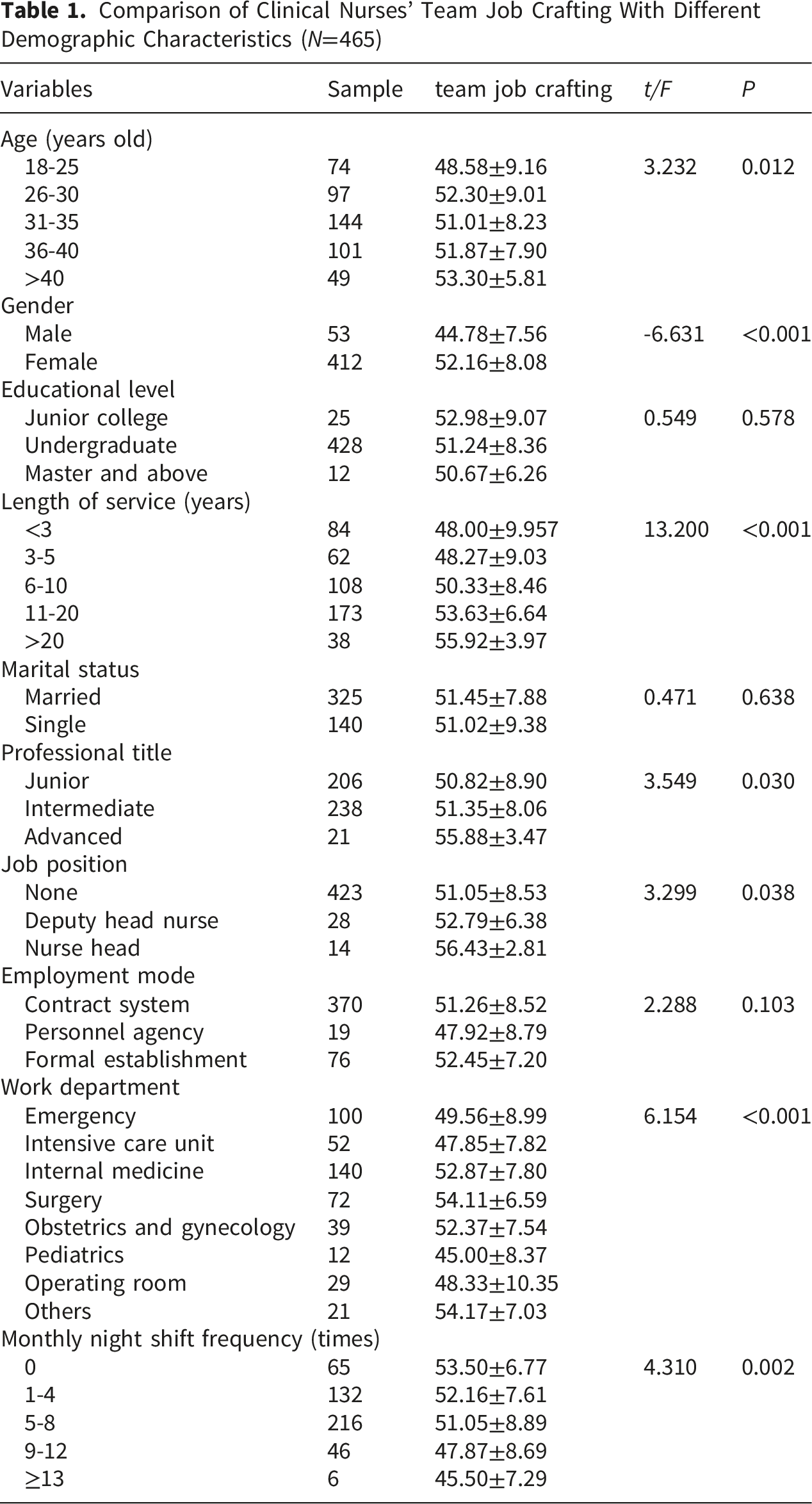
Comparison of Clinical Nurses’ Team Job Crafting With Different Demographic Characteristics (N=465)
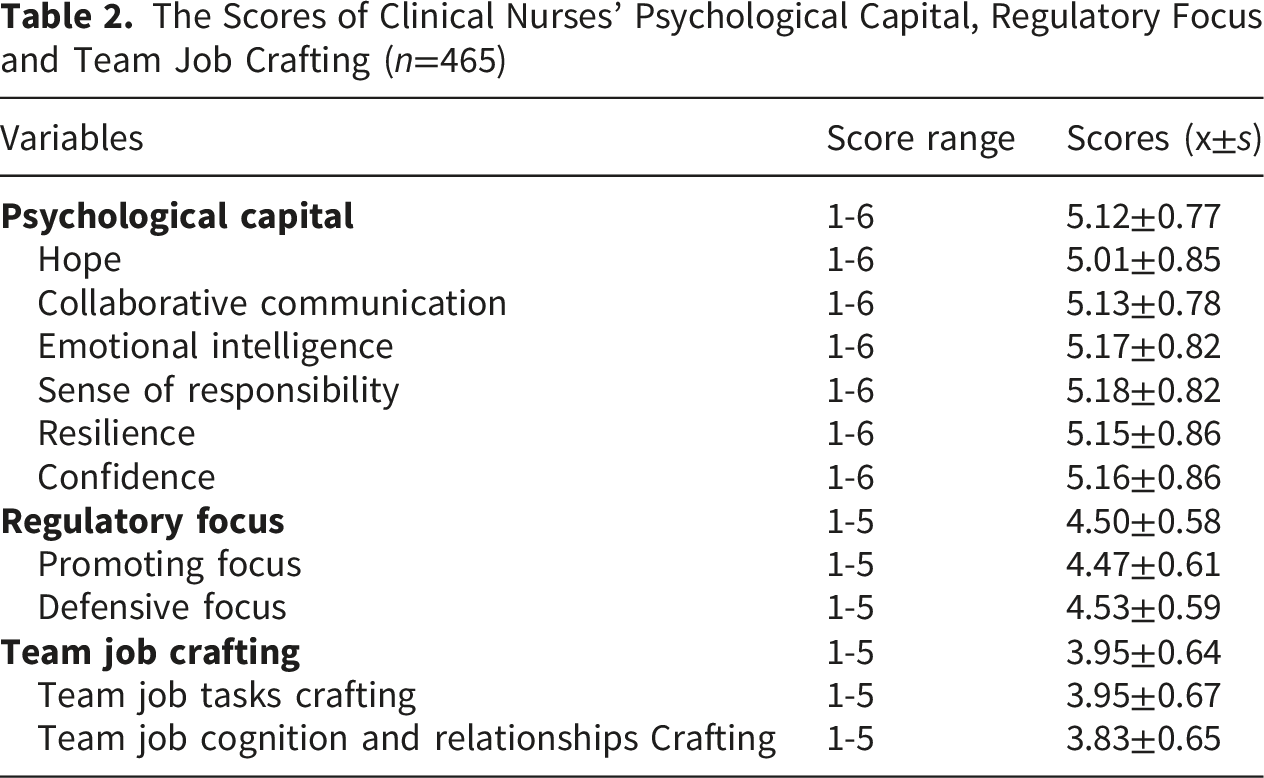
Scores of Clinical Nurses’ Psychological Capital and Regulatory Focus and Nurses’ Team Job Crafting
The Scores of Clinical Nurses’ Psychological Capital, Regulatory Focus and Team Job Crafting (n=465)
Comparison of Clinical Nurses’ Team Job Crafting With Different Demographic Characteristics
Table 1 revealed statistically significant variations in clinical nurses’ team job crafting scores across multiple demographic and occupational factors:age (F=3.232, P=0.012), gender (t=-6.631, P<0.001), length of service (F=13.200, P<0.001), professional title (F=3.549, P=0.030), job position (F=3.299, P=0.038), work department (F=6.154, P<0.001) and monthly night shift frequency (F=4.310, P=0.002).
Correlation Analysis of Clinical Nurses’ Psychological Capital, Regulatory Focus and Nurses’ Team Job Crafting
Correlations Among Psychological Capital, Regulatory Focus, and Team Job Crafting (N= 465)
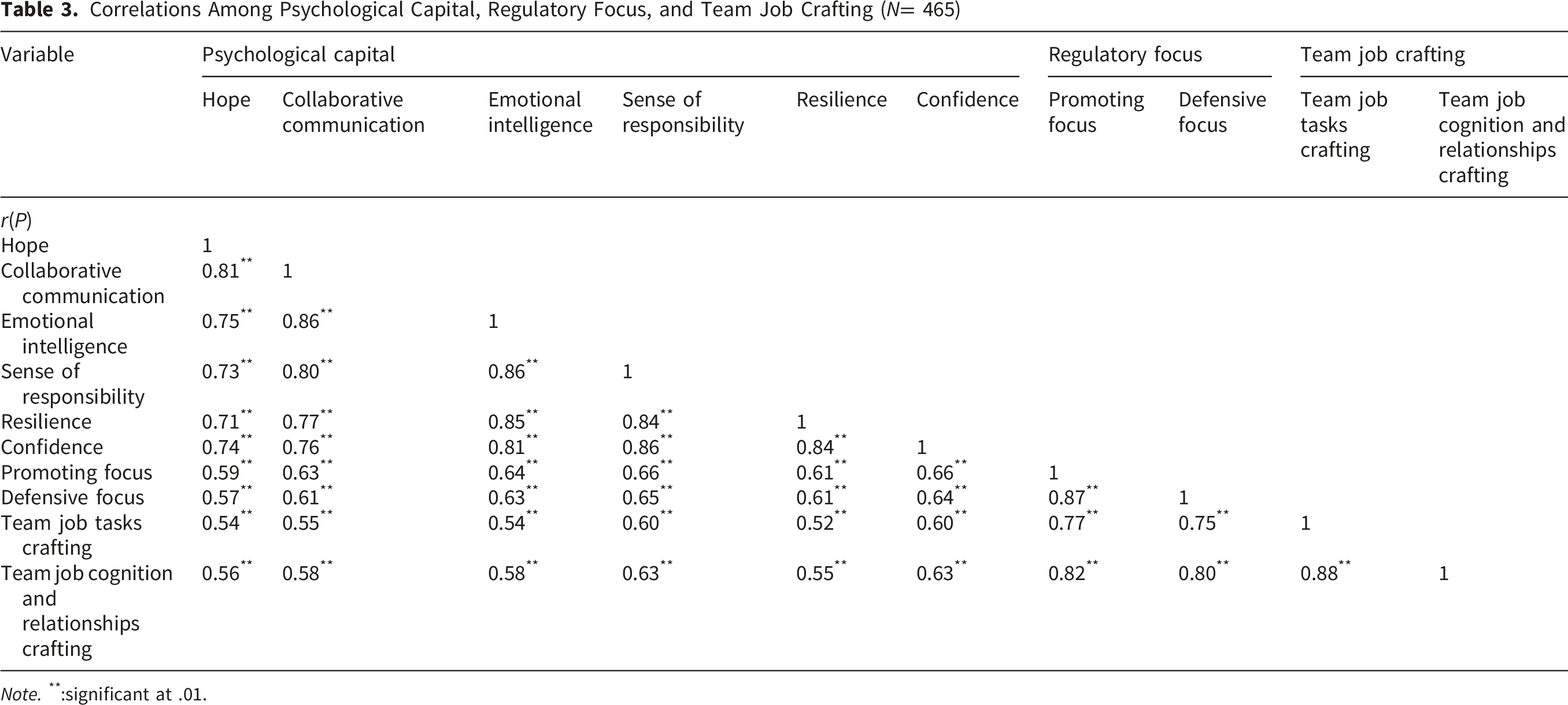
Note. **:significant at .01.
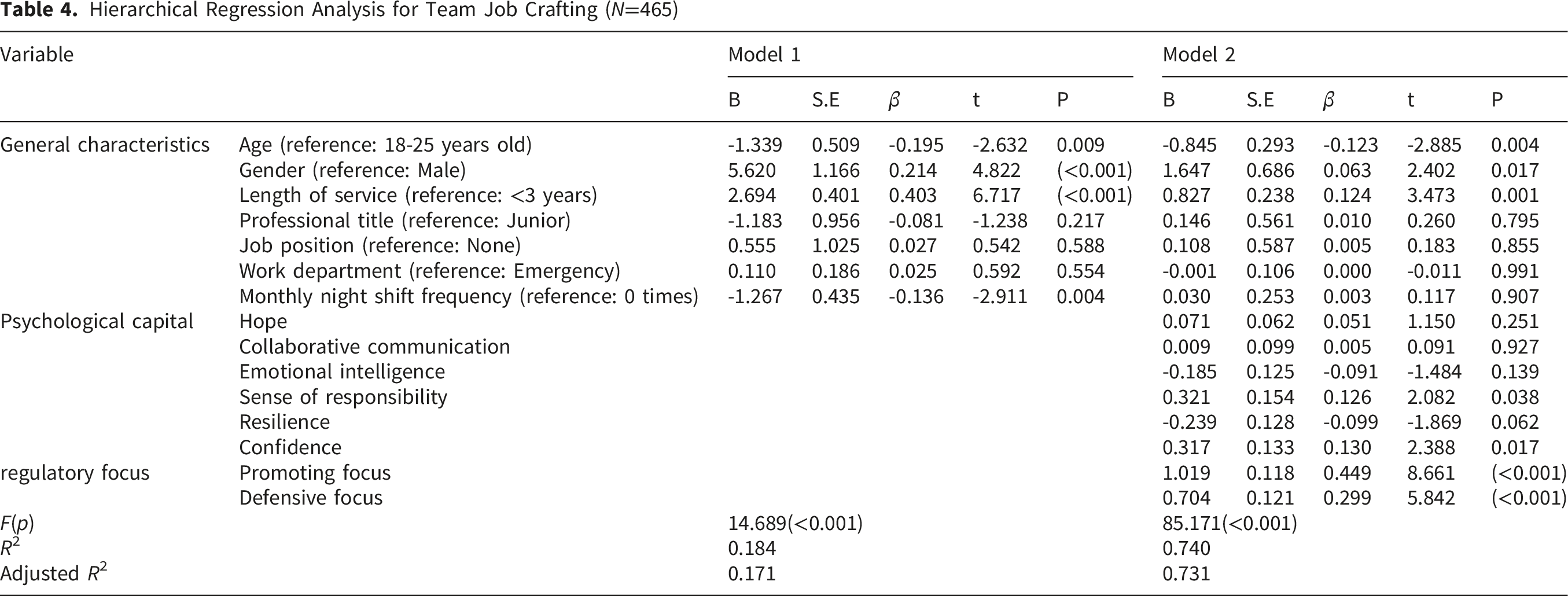
Hierarchical Regression Analysis on Factors Influencing Clinical Nurses’ Team Job Crafting
Hierarchical Regression Analysis for Team Job Crafting (N=465)
Mediation Effects of Regulatory Focus Between Psychological Capital and Team Job Crafting
The structural equation model was constructed with the total score of psychological capital as the independent variable, the total score of regulatory focus as the intermediary variable, and the total score of team job crafting as the dependent variable. The maximum likelihood method was used to estimate the parameters of the fitting degree of the model. After the initial model runs, the fitting indexes are unreasonable. The model was moderately modified according to the modified index and expected parameter change value in the output results, and the modified fitting indexes were within the acceptable range, indicating that the model has good fitting, as shown in Figure 1. The fitting indexes of the model was as follows: Chi-square/degrees of freedom (χ2/df) =2.810, Relative Fit Index (RFI) =0.978, Adjusted Goodness of Fit Index (AGFI) =0.934, Comparative Fit Index (CFI) =0.991, Normed Fit Index (NFI) =0.985, Tucker-Lewis Index (TLI) =0.986, Root Mean Square Error of Approximation (RMSEA) =0.062. Structural equation model of psychological capital, regulatory focus, and team job crafting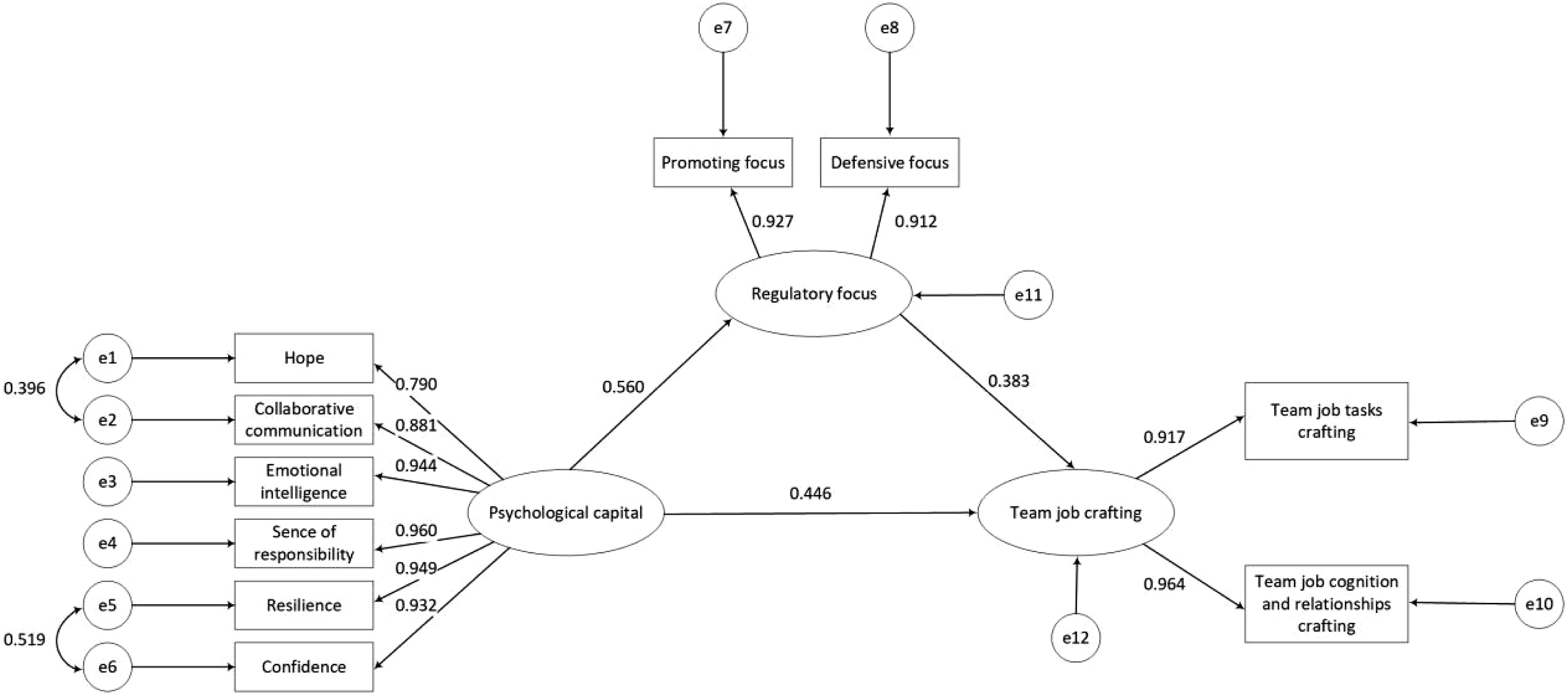
Results for the Total, Indirect, and Direct Effects of Psychological Capital on Team Job Crafting With Regulatory Focus as a Mediator (N=465)
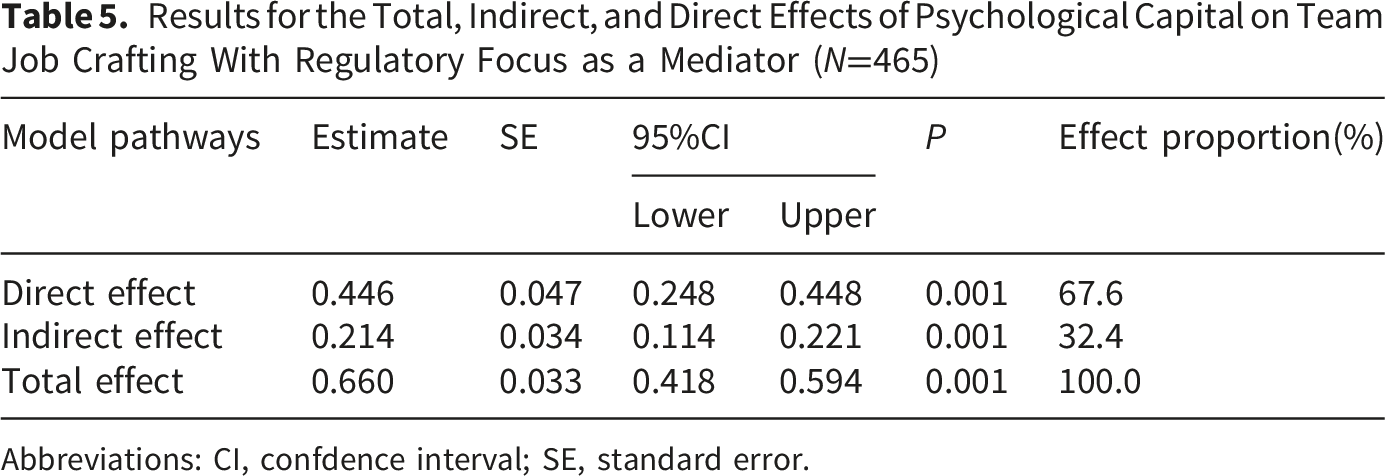
Abbreviations: CI, confdence interval; SE, standard error.
Discussion
The mean score of the nurses’ team job crafting scale was 3.95±0.64, indicating a moderately high level of engagement in collaborative work redesign behaviors, which was higher than the results reported by Iida et al. (Iida et al., 2021). This higher score may be attributable to the fact that all participants were recruited from tertiary general hospitals, where nurses typically have stronger clinical competencies, receive more rigorous training, and work in a team-oriented environment that encourages proactive work redesign. Additionally, the participating hospitals were located in economically developed regions with better healthcare resources. In contrast, Iida et al.’s sample included nurses from a wider range of hospital settings, potentially explaining the lower score in their study.
Moreover, results indicate that nurses respond to complexity by first reshaping team job tasks rather than cognition or relationships. This typically involves practical adjustments to workload, scope, or methods to fulfill objectives, followed by efforts to align team cognition and relational patterns. This trend aligns with the broader shift toward team-based care, in which collaborative decision-making and situational interaction naturally cultivate flexibility, interdependence, and collective efficacy. However, the study also reveals that dimensions related to team cognition and interpersonal relationship building scored relatively low, suggesting that teams may tend toward task-oriented, reactive coordination rather than relationship-oriented, proactive, and deep collaboration (Tuncer et al., 2025). Therefore, this study propose structured interventions centered on guided collective reflection—including regular collaborative debriefings and controlled role-rotation experiences—which can refine role understanding, deepen mutual trust, and foster a shared mental model for adaptive teamwork (Cannon-Bowers & Salas 1999).
This study indicated that older, female, and with long work experience have a higher level of team job crafting. In Liu’ study, The results for age were consistent with those of this study (Liu et al., 2020). This may be due to the clinical skills and knowledge level of junior nurses are limited, which can easily affect team work tasks and work efficiency. Moreover, younger nurses’ tendency to face the status of volatile income security and lower organizational loyalty, which makes them consider their team work efficiency as less important than their improvement of operational skills level. A survey showed that more than half of the nurses have low-level attitudes toward male nurses, male nurses have a lower sense of professional identity (Dhami et al., 2024). In China, the vast majority of nurses are female, with male nurses accounting for a very low proportion. They also face significant social biases and challenges related to professional identity (Wang, 2024). Low professional identity was not conducive to male nurses’ reflection and learning at work, which reduces the initiative and purpose of nursing work, thus hindering the positive behavior in future work and reducing the remodeling of team work. With the increase of length of service, the level of team job crafting showed an upward trend, which is consistent with the results of existing research (Iida et al., 2024). The accumulated expertise, skills, and clinical experience of long-serving nurses sharpen their observational and analytical abilities. According to Job Crafting Theory (Dutton, 2001), nurses adjust their work content and work relationships to better enhance the meaning and satisfaction of work. This progression enhances their nursing leadership, fosters collaborative relationships with physicians, patients, and colleagues, and facilitates both task- and relationship-focused remodeling within the team. Therefore, it is recommended to prioritize the cultivation of team job crafting among young nurses and male nurses. Specifically, a “Clinical Mentor Certification Program” could be designed for senior nurses, converting their expertise into standardized training modules to guide junior nurses. This approach would enhance professional belongingness and team collaboration, thereby improving team job crafting (Golfenshtein et al., 2024; Yuan et al., 2025).
The clinical nurses’ team job crafting was related to the level of sense of responsibility and self-confidence in psychological capital. High sense of responsibility makes it easier for nurses to form a positive attribution style and interpretation style, and have more perseverance and confidence in the face of work requirements, which helps to enhance the initiative, flexibility and openness in daily work and improve the level of work remodeling (Zhenfeng et al., 2025). Moreover, Nurses in a positive psychological state are more easily linked with and embedded in the organization and their job, and are more easily adaptive to and competent for their post (Han, 2023). Stelnicki & Carleton pointed out that nurses with high self-confidence level have higher nursing leadership (Stelnicki & Carleton 2021). Clinical leadership can improve the quality of nursing and patient outcomes, promote nurses’ job satisfaction and team cooperation (Guibert-Lacasa & Vázquez-Calatayud 2022). Therefore, it is recommended to utilize leadership behaviors to shape a team climate that supports the development of psychological capital, thereby enhancing nurses’ work engagement and occupational well-being, or to consolidate psychological capital by fostering a positive team identity, creating a psychologically safe and energizing environment where nurses feel empowered and motivated to engage in job crafting (Khattab et al., 2023; Tuncer Unver 2025; Wu et al., 2025).
This study found that regulatory focus had a partial mediating effect between clinical nurses’ psychological capital and team job crafting, indicating that clinical nurses’ psychological capital affects the level of team job crafting via the partial mediating effect of regulatory focus. The theory of regulatory focus points out that as a behavioral regulatory system of individuals, regulatory focus was a psychological regulatory tendency made by individuals in the process of achieving expected goals (Zhang et al., 2024). Nurses with promoting focus should keep working enthusiasm and creativity, conversely, nurses with defensive focus were committed to optimizing nursing processes and standards, the two complement each other and jointly promote the remodeling and improvement of team work performance (Li et al., 2023). The research results of Zhang et al. (Zhang et al., 2025) showed that psychological capital helps cultivate nurses’ regulatory focus tendency, which in turn affects their work potential and creativity, and promotes teamwork, and was consistent with the results of this study. The results of this study show that the clinical nurses’ team job crafting was affected by regulatory focus. According to the regulatory focus theory, the promotive focus individuals pursue growth, innovation and development, were willing to accept challenges, dare to take risks, and were more sensitive to the information of progress and achievements. Defensive focus individuals focused on safety and caution to avoid errors, which helps to improve the stability and reliability of work. The two kinds of regulatory focus were indispensable elements for the successful operation of the team in different work situations and stages. Therefore, managers should assess the psychological capital levels of nurses. For nurses exhibiting low self-efficacy and high burnout (weaker level), leaders should provide clear structural guidance and resource support, which helps activate their prevention focus—enabling them to rebuild confidence and regain control through process optimization and risk mitigation (Golfenshtein et al., 2024; Zhou et al., 2025). Conversely, for nurses with strong psychological capital levels and high motivation, leaders should empower them to lead team innovation initiatives, encouraging them to leverage their promoting focus to explore new approaches. This strategy not only reinforces their hope and self-efficacy but also energizes the entire team (Tuncer Unver et al., 2025; Wu et al., 2025).
The applicability of this study to other regions and populations warrants discussion. Our sample was drawn exclusively from five tertiary hospitals in one province, where nurses have higher competencies and more favorable resources than those in secondary hospitals. Most participants were female, limiting generalizability to male nurses, and the local collectivist culture may also influence team job crafting levels. Future research should test this mediation model in diverse healthcare settings and cultural contexts to confirm robustness and strengthen the conclusions.
Implications for Practice
This study confirm that psychological capital and regulatory focus are positively associated with team job crafting among clinical nurses, with regulatory focus acting as a partial mediator. These results have direct implications for nursing management. To enhance team job crafting, nurse managers should first assess nurses’ psychological capital levels. For nurses with low psychological capital, providing structured guidance and clear role expectations can strengthen their defensive focus, helping them regain confidence through process optimization and error reduction. For nurses with high psychological capital, activating promoting focus—by encouraging innovation, delegating leadership in team improvement projects, and recognizing proactive behaviors—can foster team-level work redesign. Additionally, targeted training programs that combine psychological capital building with regulatory focus modulation may be particularly effective. Therefore, clinical nurse leaders, educators, and hospital administrators are encouraged to integrate these insights into routine team development and continuing education to improve both team performance and nurse retention.
Strengths and Limitations
This study has several strengths. First, it employed a large sample with adequate power, exceeding the minimum required size. Second, all instruments were well-validated in the Chinese nursing population with high reliability, and common method bias was not a major concern. Third, structural equation modeling with bootstrap methods enabled robust mediation testing while controlling measurement error. Fourth, the study provides actionable evidence for nursing management by identifying psychological capital and regulatory focus as leverage points to improve team job crafting.
However, several limitations should be acknowledged. First, convenience sampling from five hospitals in one province limits generalizability; future studies should use multi-regional probability sampling. Second, the cross-sectional design precludes causal inferences; longitudinal designs or randomized trials are needed. Third, self-reported questionnaires may introduce bias, though Harman’s test indicated this was not a major concern; multi-source data collection is recommended. Fourth, demographic variables explained only 17.1% of the variance, suggesting unmeasured factors (e.g., organizational culture, leadership styles) may influence outcomes; future research should integrate these variables.
Conclusion
This study verified the effects of regulatory focus and psychological capital on clinical nurses’ team job crafting and provided valuable information for nursing management and administration to improve the work efficiency and performance of nursing team. According to the study, the level of team job crafting at clinical nurses was acceptable, but it could still be further improved. Those who were older, female, and with long work experience had a higher level of team job crafting. Both regulatory focus and psychological capital are positively correlated with team job crafting, and psychological capital influences team job crafting partially through the mediating effect of regulatory focus. This suggests that nursing managers can effectively promote nurses’ participation in team collaboration and work optimization by intervening in their psychological capital and regulatory focus.
Footnotes
Acknowledgements
The authors gratefully acknowledge the assistance of all the participants in the collection of data.

Ethical Considerations
This study was approved by the Medical Ethics Committee of Zibo Central Hospital (Approval No. 2025050). All participants provided written informed consent prior to participation. The study procedures were carried out in accordance with the ethical principles of the Declaration of Helsinki.
Consent to Participate
All participants were informed about the purpose of the study, assured of confidentiality, and advised that participation was voluntary. Respondents could withdraw at any time without consequence.
Author Contributions
Shuo Wang: Writing-original draft, Investigation, Data curation, Project administration, Resource. Jie Yuan: Writing-original draft, Investigation, Data curation, Resources. Xiaojie Fang: Writing-review & editing, Data curation, Project administration. Yulian Wei: Writing-review &editing, Investigation, Methodology, Funding acquisition. Junjie Ma: Writing-review & editing, Project administration, Resources. Xuebing Jing: Writing-review & editing, Conceptualization, Data curation, Fundirg acquisition, Supervision, Resources.
Funding
The authors disclosed receipt of the following financial support for the research, authorship, and/or publication of this article: This study was supported by the Medical and Health Science and Technology Projects of Shandong Province in 2023 (Grant Nos. 202314020641) and the Medical and Health Research Project of ZiBo in 2024 (Grant Nos. 20242001129). The funders had no role in considering the study design or in the collection, analysis, interpretation of data, writing of the report, or decision to submit the article for publication.
Declaration of Conflicting IHnterests
The authors declared no potential conflicts of interest with respect to the research, authorship, and/or publication of this article.
Data Availability Statement
The data that support the findings of this study are available from the corresponding author upon reasonable request.