



Abstract
Aim
This study aimed to explore and compare the perceptions of novice and experienced head nurses in a hospital setting regarding the meaning of their work.
Design
A qualitative comparative study was conducted face-to-face interviews.
Methods
Thirty nurse managers (15 novice, 15 experienced) from an 800-bed hospital in Israel were selected via convenience sampling and participated in semi-structured interviews during January-March 2025. Data were analyzed thematically using Braun and Clarke’s six-step method, focusing on participants’ experiences and perspectives.
Results
Four themes were identified related to the meaning of head nurses’ work: (a) leadership and influence, (b) emotional commitment and sense of mission, (c) challenges and professional success, (d) balancing a managerial role with personal needs.
Conclusion
This study revealed that novice and experienced head nurses attach different meanings to their work. Novice managers emphasized immediate impact, daily achievements, and personal development, while experienced managers focused on long-term vision, mentoring others, and sustaining a supportive unit culture. These differences suggest that leadership development should be tailored: for novice head nurses, training should strengthen confidence in decision-making, stress management, and short-term leadership skills; for experienced head nurses, support should focus on mentorship opportunities, succession planning, and strategies to maintain resilience over a prolonged career. Addressing these distinct needs can enhance effectiveness, job satisfaction, and the sustainability of nursing leadership across career stages.
Patient or Public Contribution
No patient or public contribution.
Introduction
Head nurses, also referred to as nurse managers, play a critical role in healthcare organizations as frontline leaders. They balance clinical work with leadership responsibilities, team management, and efforts to improve care quality (Erjavec & Starc, 2017; Li, 2024). However, they experience significant pressure from heavy workloads, competing demands, emotional stress, and limited resources. These factors put their well-being and job retention at risk (Cai et al., 2023). The problem is especially serious for new head nurses. Due to nursing workforce shortages, nurses are now being promoted to head nurse positions after only 1-2 years of clinical practice, often with little training or mentorship support (Metersky & Fisher, 2025).
Understanding what gives head nurses a sense of meaning in their work is important for keeping them motivated and effective. Most existing studies have looked at either new head nurses or experienced head nurses, but not both together. Little is known about how professional experience changes the way head nurses view their work, their leadership role, and what gives them satisfaction (Fu et al., 2024; Zhang et al., 2024). Without this knowledge, it is difficult to create support programs that match what head nurses need at different career stages.
This study explored how novice head nurses and experienced head nurses differ in how they perceive the meaning of their work. The study compared their perspectives on leadership, emotional commitment, and professional challenges.
Review of Literature
Nursing workforce shortages have led to rapid promotion of nurses with minimal experience into head nurse positions, often without adequate preparation (Metersky & Fisher, 2025). Understanding what gives head nurses meaning in their work is critical for motivation and retention, yet existing research examines novice or experienced managers separately without systematic comparison (Fu et al., 2024; Zhang et al., 2024).
Head nurses (hereafter referred to interchangeably as nurse managers) play a multifaceted role, combining direct patient care with managerial and strategic responsibilities. They divide their time between clinical activities, care coordination, workforce management, and quality improvement initiatives (Ningsih et al., 2024). Clinically, nurse managers ensure high-quality nursing care delivery (Zhang et al., 2024). Managerially, they lead nursing teams, conduct performance evaluations, promote professional development, provide staff training, coordinate interdisciplinary care, and enhance collaboration among healthcare professionals and patients’ families (Ahmed & EL-Shaer, 2024Ahmed & El-Shaer, 2024). They also drive quality improvement by implementing updated protocols and monitoring service quality (Ahmed & Ibrahim, 2023). While head nurses hold pivotal roles in ensuring care quality and organizational performance, they face increasing challenges including heavy workloads, role conflict, emotional demands, and limited resources that threaten their well-being and retention (Cai et al., 2023). These challenges are particularly acute for novice managers entering leadership with limited preparation.
Essential leadership competencies include communication, caring for team members, decision-making, conflict management, being visionary, and serving as a change agent (Perez-Gonzalez et al., 2024). For interprofessional collaboration, nurse managers require proficiency, mindset, empowerment skills, and transformational leadership approaches (Kamppila et al., 2026). Experiential learning enhanced by mentorship, reflective practices, and leadership modeling effectively develops clinical nursing leadership (Duprez et al., 2024).
However, novice head nurses face distinct challenges including role ambiguity, lack of structured training, insufficient mentorship, and isolation during leadership transition (Esquisábel-Soteras et al., 2026; Metersky & Fisher, 2025). Recent research identified three critical themes: bridging the readiness gap (lack of transition plans and managerial skills), fighting loneliness (isolation from absent mentorship), and challenges with clinical expertise, particularly for managers promoted within their own teams where authority negotiation becomes critical (Esquisábel-Soteras et al., 2026). Despite these challenges, targeted training can improve novice manager competencies including role awareness, capability adjustment, identity construction, and professional development (Wang et al., 2025). Novice managers benefit from formal mentorship, structured orientation, peer support, and early leadership training (Metersky & Fisher, 2025).
Understanding meaning in work is essential for enhancing job satisfaction, motivation, and retention. Meaning encompasses positive emotional experience from daily tasks, significant purpose aligned with professional values, and contribution to patient safety (Lee, 2015). Meaning evolves through professional and organizational interactions, enhanced by mentorship, team relationships, and leadership empowerment (Ahmed & EL-Shaer, 2024), and is reinforced when professional identity aligns with role values and clinical achievements directly impact patient and staff wellbeing (Franco et al., 2021).
Theoretical Framework
Social Identity Theory (Tajfel et al., 1979) provides a framework for understanding why novice and experienced head nurses may perceive meaning differently. The theory suggests people define themselves through professional roles and derive identity and self-worth from these affiliations. Professional identity evolves as individuals gain experience and integrate new role aspects. For novice head nurses, leadership identity is still forming as they shift from clinical expert to organizational leader. Meaning may come from proving capability, gaining recognition, and establishing themselves. Experienced head nurses have developed secure leadership identity. What becomes meaningful shifts toward mentoring others, shaping culture, and contributing to long-term goals. This progression from building identity to expressing it may explain differences in how groups view leadership, emotional commitment, professional challenges, and work-life balance.
Despite recognition of these developmental differences, many studies focus on novice or experienced head nurses separately, without comparing how they construct work meaning (Fu et al., 2024; Zhang et al., 2024). Without understanding how meaning-making evolves across career stages, organizations cannot design targeted interventions or leverage experiential wisdom to support leadership transitions.
Aim of the Study
To explore and compare the perceptions of novice and experienced head nurses in a hospital setting regarding the meaning of their work.
Methods
Design
This is a qualitative study using semi-structured interviews with hospital-based head nurses. This study adhered to the Consolidated Criteria for Reporting Qualitative Research (COREQ) guidelines.
Study Setting and Recruitment
Participants were recruited in January 2025 through direct personal contact initiated by the primary researcher. All head nurses in the hospital’s wards were invited to participate in the study. The primary researcher approached them individually, explaining the study’s purpose, procedures, and voluntary nature. Head nurses who were interested then contacted the researcher directly to confirm their participation. Out of the total invited, 90% agreed to take part, resulting in a sample that included both novice and more experienced head nurses. The participants were drawn from the head nurses of an 800-bed hospital in Israel. The 10% non-participation rate was attributed primarily to clinical workload demands and various personal reasons.
Sample
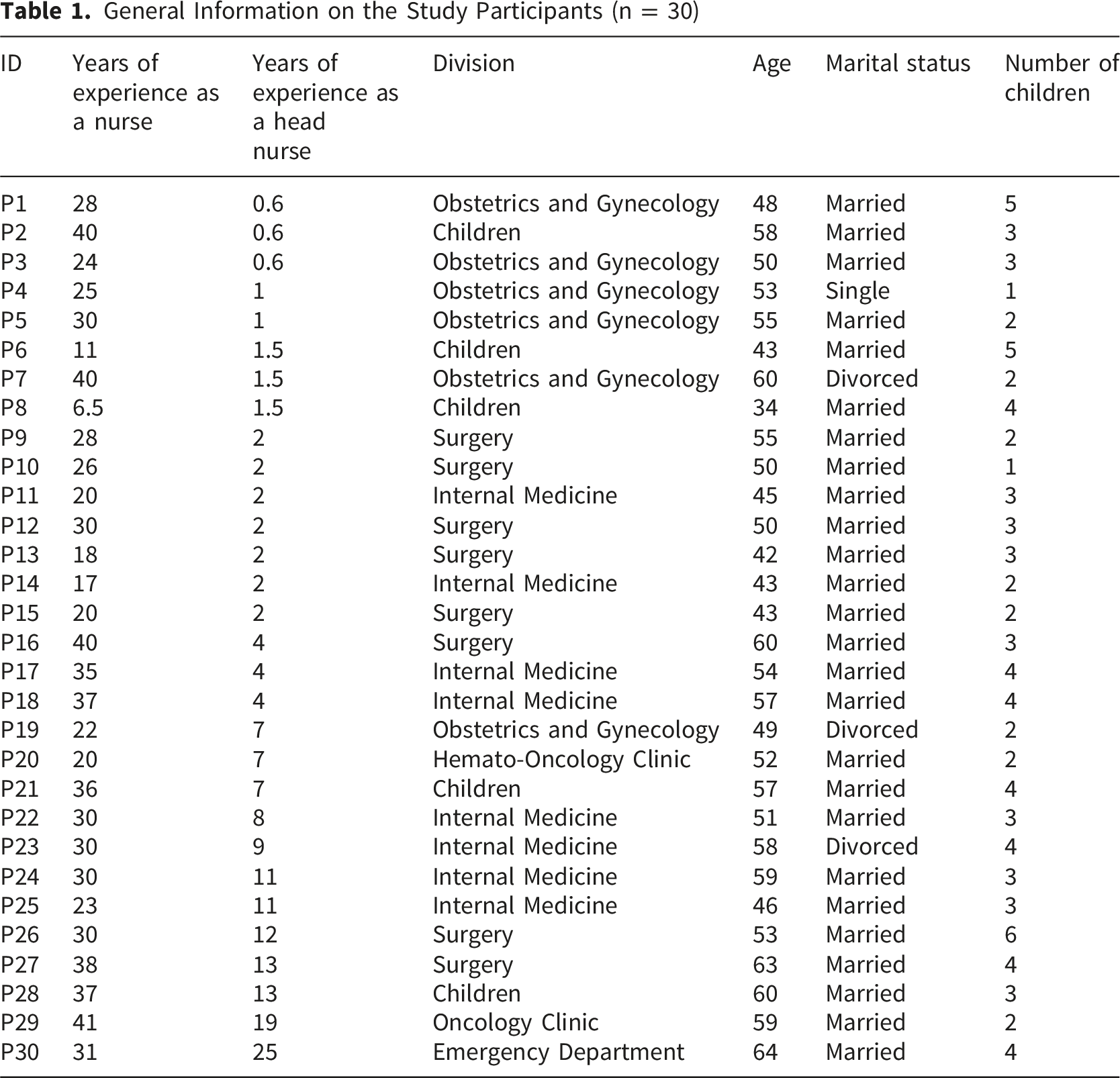
The sample consisted of 30 female nurse managers selected through convenience sampling. For this study, a novice head nurse was defined as having managerial experience of no more than 2 years, based on Benner’s (1984)novice-to-expert framework and consistent with recent research (Huang et al., 2024), while an experienced head nurse was defined as having managerial experience of more than 2 years.
Inclusion and Exclusion Criteria
Eligibility criteria included age between 22 and 64 years, a formal permanent appointment as head nurse, and working regularly in an inpatient ward.
Nurses were excluded if they temporarily filled the role of head nurse in the ward without a formal permanent appointment, or if they worked as head nurses in small outpatient clinics with fewer than eight nurses.
Data Collection
A semi-structured interview guide was developed by the research team, informed by Benner’s Novice to Expert Theory and existing literature on nursing leadership transitions (Huang et al., 2024; Zhang et al., 2024). The guide included open-ended questions designed to elicit participants’ advice and perspectives on nurse management (e.g., “What meaning do you find in your work as a head nurse?” and “How do you feel your work impacts the staff and patients?” To ensure content validity and clarity, the interview guide was reviewed by five head nurses from a small outpatient clinic (excluded from the final sample) and members of the research team. Minor refinements were made based on their feedback.
Data were collected from January to March 2025 through individual interviews with 30 head nurses, conducted by the primary researcher. No follow-up interviews or member checking were conducted; each participant was interviewed once. Convenience sampling was employed as a pragmatic and appropriate approach for this exploratory qualitative study. This method enabled efficient recruitment of participants who met specific inclusion criteria while allowing purposeful allocation to equal groups of novices (n=15) and experienced (n=15) managers, ensuring balanced representation of different experiential perspectives. In qualitative research, sampling prioritizes information richness and depth over statistical representativeness, making convenience sampling suitable for the study’s comparative aims. All participants were female, as no male nurses occupied permanent head nurse roles in the hospital at the time of data collection.
Interviews were scheduled at the beginning or end of shifts in the nursing manager’s office, ensuring privacy in a closed room. Participants received detailed study information, including objectives, recording procedures, and confidentiality measures. Oral informed consent was obtained, and all interviewees agreed to be recorded.
Interviews began with casual conversation and demographic questions to establish rapport, followed by the semi-structured interview guide (Supplementary File 1). Probing questions were used for clarification and to explore responses in greater depth. Each interview lasted 40–60 minutes, averaging 45 minutes. All interviews were audio-recorded and transcribed verbatim for analysis.
Data collection continued until thematic saturation was achieved, operationally defined as the point at which no new themes emerged from additional interviews. Saturation was reached after approximately 12-13 interviews per group (novice and experienced), with the remaining interviews confirming thematic saturation.
Recordings were transcribed using TurboScribe, an AI-powered speech-to-text tool ensuring data security. Two researchers verified and refined transcripts against the recordings, finalizing them by consensus. The last corresponding author securely stored all data on a password-protected computer in the hospital office. No repeat interviews were conducted, and transcripts were not returned to participants.
This manuscript presents a thematic analysis examining work meaning among novice and experienced head nurses in hospital settings. An additional manuscript utilizing the same interview dataset is currently in development, focusing on different research dimensions. While both papers analyze data from identical participants, each addresses unique research questions through independent application of Braun and Clarke’s (2006) thematic analysis methodology. Complete analytical independence is maintained between the studies, with no shared themes or overlapping findings.
Data Analysis
In this study, the method described by Braun and Clarke (2006) was used for identifying, analyzing, and reporting patterns (themes) within data. The process of data analysis consisted of six steps; 1) Becoming familiar with the data, 2) Generating initial codes, 3) Searching for themes, 4) Reviewing themes, 5) Defining themes and naming them, 6) Producing a report.
The data analysis process followed six systematic steps:
Ethical Considerations
Ethical approval for the study was approved following the Declaration of Helsinki by the Meir Medical Center-Kfar Saba institutional review board, where the study was conducted (Approval date: 2.01.2025, Approval No. 0045-25-MMC).
Rigor
Several steps ensured study credibility (Lincoln & Guba, 1985). A research protocol was maintained an audit trail for transparency and consistency. Interpretive notes were kept separate from descriptive narratives to prevent a priori views from influencing theme formation (Polit & Beck, 2010). Data analysis was performed independently by each author to ensure reliability and validity. Interviews were transcribed verbatim and double-checked for accuracy. Thematic analysis identified patterns and themes, refined through discussion until consensus was reached. No member checking was conducted; this limitation is acknowledged in the study’s constraints.
Reflexivity was maintained through continuous reflexive examination of their positionality as researchers and the research relationship. The first author, a female PhD-prepared nurse manager in nursing administration, and the second author, a male PhD-prepared head nurse in a small outpatient clinic, contributed distinct perspectives. Working in the same organization facilitated access and understanding but raised potential bias concerns. Participants might hesitate sharing negative experiences due to the researchers’ organizational positions, or adjust responses to perceived expectations. The researchers’ leadership views could shape data interpretation.
To address these concerns, participants were assured of confidentiality and informed that the authors were acting in a researcher capacity, not as managers. A structured interview guide ensured consistency. Throughout analysis, the researchers documented their assumptions and reactions. Two researchers coded data independently, discussing differences until agreement was reached. Analysis consciously focused on participants’ actual statements rather than the authors’ own experiences. While researchers cannot be completely neutral in interpretive studies, these steps helped maintain awareness of positional influence.
Results
General Information of the Study Participants
General Information on the Study Participants (n = 30)
Key Themes
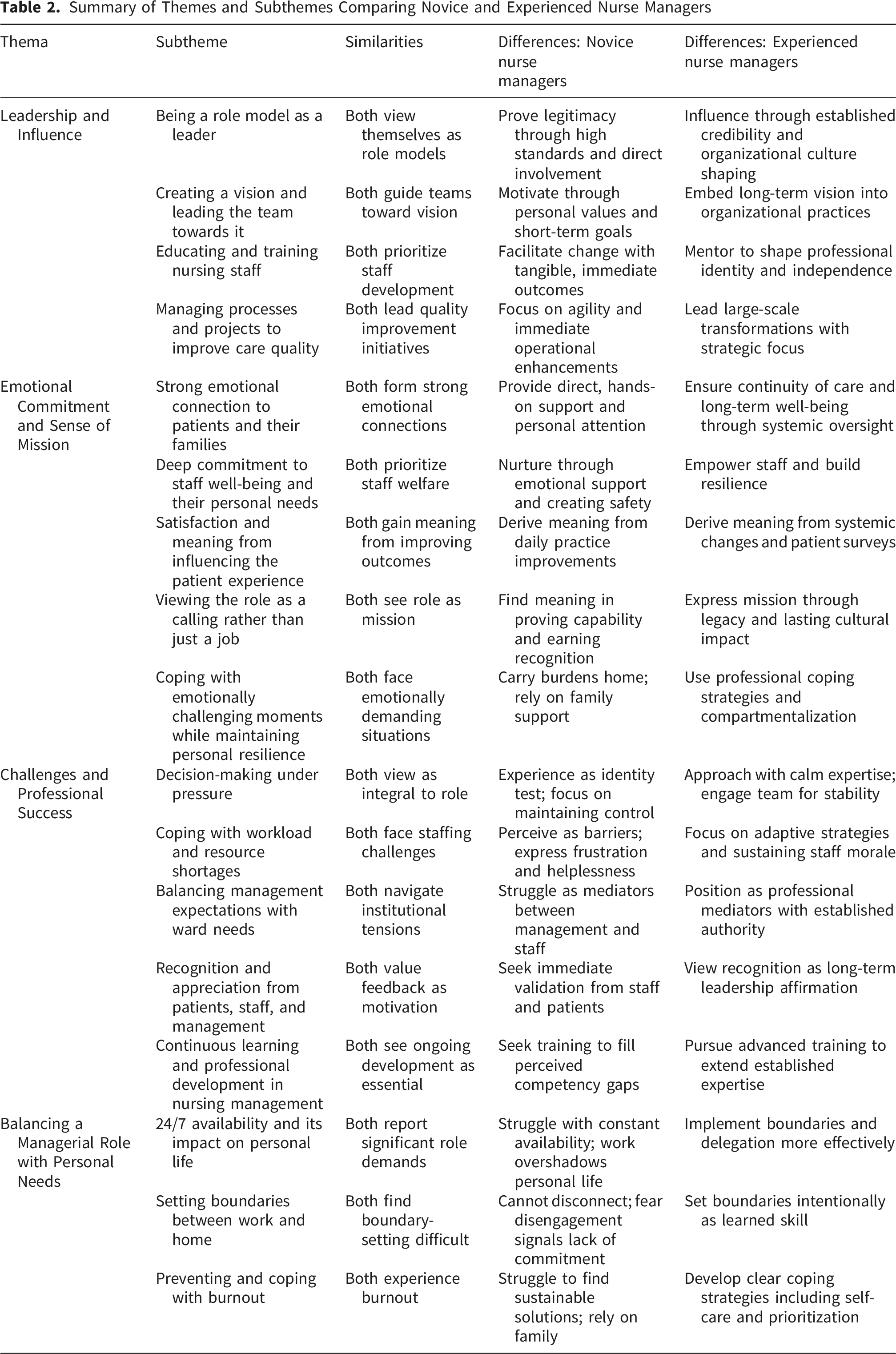
In this study, four themes and nineteen subthemes were obtained by analyzing the interview data of the interviewees. Figure 1 shows the themes and subthemes. Thematic coding of head nurses’ work experience: Leadership, challenges, and work-life balance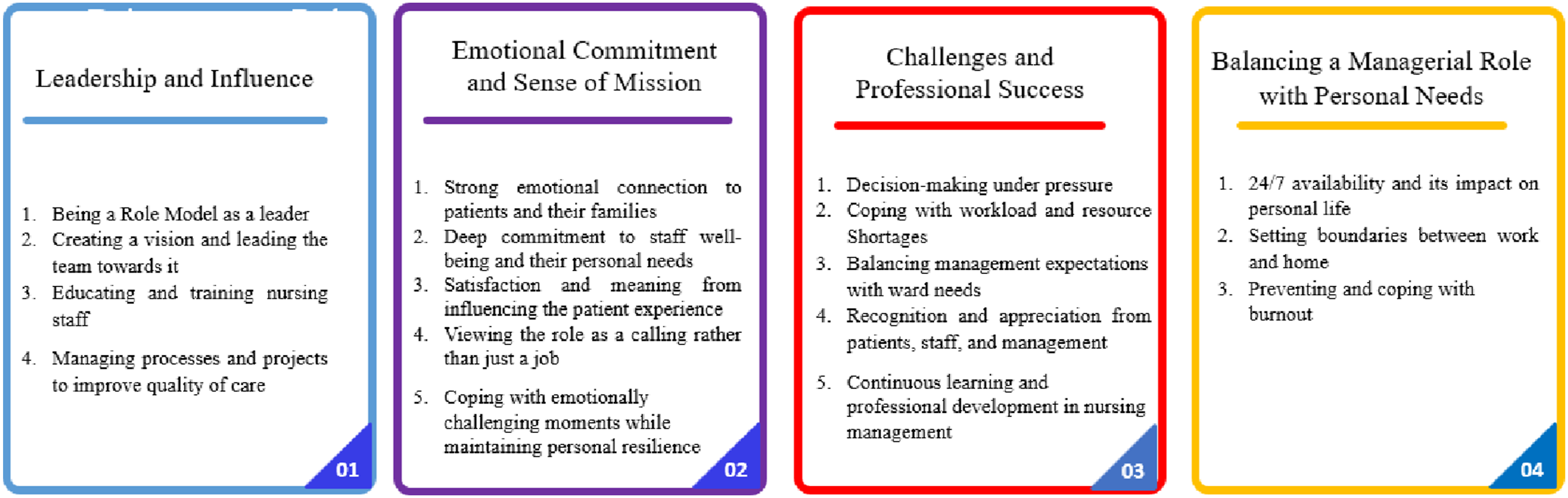
Summary of Themes and Subthemes Comparing Novice and Experienced Nurse Managers
Theme 1: Leadership and Influence
The first theme addresses leadership function, including role modeling, vision setting, staff development, and quality improvement.
Subtheme 1.1: Being a Role Model as a Leader
Both groups perceived themselves as role models. Novice managers set high standards for their teams while proving they belong in the role. “I demand from my team what I do myself” (P1).
Experienced managers perceived themselves as having a broader influence, shaping organizational culture. “The team observes what I do and adopts my approach” (P22).
Subtheme 1.2: Creating a Vision and Leading the Team Towards It
All managers discussed the need to guide teams toward a clear vision at work.
Novice managers focused on conveying their vision and instilling purpose within the team through personal values. “It’s like navigating a ship… I am there to guide the employees, the care, and everything” (P8).
Experienced managers saw themselves as pathfinders, shaping and enacting a clear vision, deriving satisfaction when their professional approach was embraced by the team. “When I see the ward aligning with my values, it gives me great satisfaction” (P19).
Subtheme 1.3: Educating and Training Nursing Staff
All managers considered education and staff training a core part of their role. Novice managers saw themselves as facilitators of change, emphasizing education as a shared developmental process focused on tangible outcomes. “Progressing and bringing something new of my own and seeing results in the ward improvements” (P7).
Experienced managers viewed themselves as shaping generations of nurses, focusing on building an independent team and embedding professional values. “I reshape the new generation, shaping the professional identity of every nurse who joins my ward “ (P22).
Subtheme 1.4: Managing Processes and Projects to Improve Care Quality
Both groups considered managing processes and projects to improve care quality an integral part of their role, actively shaping and optimizing clinical practices.
Novice managers focused on implementing changes and overcoming initial resistance. “I changed work procedures in the ward. Initially, the team resisted, but today they thank me” (P7).
Experienced managers took a broader view, leading large-scale projects with long-term impact, focusing on stability, and organizational-wide changes. “Introducing a substantial and noticeable change, like digitizing lab work—when the staff successfully adopts it, it’s rewarding” (P20).
Theme 2: Emotional Commitment and Sense of Mission
The second theme addresses emotional investment in the head nurse role, including connections to patients and families, staff well-being, viewing work as a calling, and navigating emotional challenges.
Subtheme 2.1: Strong Emotional Connection to Patients and Their Families
Both groups emphasized their deep connection with patients and their families, considering it a core aspect of their role.
Novice managers emphasized being a supportive and attentive, focusing on providing direct support and personal attention. “Being a listening ear for patients and families” (P14).
Experienced managers emphasized their broader responsibility for patient well-being, ensuring ongoing care beyond hospitalization and maintaining long-term quality of care. “I take care of patient well-being, ensuring their treatment is professional, high-quality, and safe… We must ensure continuity of care, whether in other hospitals, community care, or institutions” (P23).
Subtheme 2.2: Deep Commitment to Staff Well-Being and Their Personal Needs
Both groups emphasized the importance of staff well-being and personal relationships with employees.
Novice managers perceived their role as providing emotional support and fostering a positive, nurturing work environment, creating a sense of security. “Being a stable anchor, someone employees can turn to” (P8).
Experienced managers focused on creating a professional environment that enabled staff to grow and feel empowered, while maintaining morale in difficult circumstances. “It starts with interpersonal relationships. The stronger the connection with each team member, the better the overall impact” (P18).
Subtheme 2.3: Satisfaction and Meaning From Influencing the Patient Experience
All managers reported professional satisfaction from improving patient experiences and care quality.
Novice managers felt fulfillment from initiating improvements in daily clinical practice. “I know how to lead a team to provide high-quality, professional care. It’s about service and excellence” (P17).
Experienced managers viewed their influence through systemic changes and patient satisfaction surveys. “I influence patients through staff education and our expectations – how to communicate, how to behave. I hope they feel it” (P30).
Subtheme 2.4: Viewing the Role as a Calling Rather Than Just a Job
All managers saw their role as a mission rather than merely a position.
Novice managers described their journey of forming a managerial identity and finding deep meaning in their work. “Recognition, appreciation – ensuring the team is engaged in daily processes” (P8).
Experienced managers expressed a well-defined sense of mission and broader influence. “I develop my staff to be independent, both in practice and in thought” (P26).
Subtheme 2.5 Coping With Emotionally Challenging Moments While Maintaining Personal Resilience
All managers described facing emotionally challenging situations at work and their impact on personal resilience.
Novice managers often took emotional burdens home and sought support from their circles. “Sometimes there are difficult cases, patient complaints… I take it home, but I talk to my family, and they support me” (P10).
Experienced managers emphasized long-term resilience strategies and coping mechanisms developed over time. “When I feel overwhelmed, I step outside, breathe, reset, and return. The team doesn’t need to feel my frustration” (P29).
Theme 3: Challenges and Professional Success
The third theme reflects the tension between professional demands and achievements, including decision-making under pressure, resource scarcity, conflicting expectations, recognition, and professional development.
Subtheme 3.1: Decision-Making Under Pressure
Both groups viewed decision-making under pressure as an integral part of their role.
Novice managers viewed decision-making as a major challenge that highlights the significance of their role, emphasizing the importance of maintaining control and minimizing stress. “In moments of crisis and pressure, or when dealing with difficult families, I feel that my role becomes more significant” (P14).
Experienced managers highlighted their expertise in decision-making under pressure, focusing on engaging the team and maintaining stability. “I also achieve results through a calm approach. I manage to engage my team in tasks and motivate them toward high-quality performance” (P26).
Subtheme 3.2: Coping With Workload and Resource Shortages
All managers dealt with staffing shortages and a constant sense of workload, considering staffing and workload challenges as central to their role.
Novice managers often found their workload frustrating and felt it hindered their ability to perform effectively, seeing limited resources as barriers. “Many times, there is a staff shortage, and it’s hard for me” (P7).
Experienced managers focused on strategies to manage workload and support their staff in challenging conditions, viewing heavy demands as part of the role. “When unexpected gaps arise, and you can’t fill shifts… you build trust with the team, ask politely, and navigate between shifts” (P18).
Subtheme 3.3: Balancing Management Expectations With Ward Needs
All managers recognized the tension between hospital policies and the ward’s daily needs.
Novice managers described the difficulty of mediating between their team and hospital leadership, and emphasized the need to communicate effectively with both parties. “Sometimes an organization’s policies have a negative impact. I need to take a moment and figure out how to handle it without harming my team” (P15).
Experienced managers saw themselves as professional mediators between frontline staff and decision-makers, striving to balance organizational requirements with ward needs. “The real challenge is facing management. Sometimes their expectations don’t reflect what is happening on the ground” (P29).
Subtheme 3.4: Recognition and Appreciation From Patients, Staff, and Management
All managers viewed positive feedback as a key source of motivation in their role.
Novice managers focused on receiving feedback from their staff and patients, highlighting the sense of meaning it gives them. “First and foremost, feedback—direct feedback and patient satisfaction—is what keeps me going” (P6).
Experienced managers viewed recognition from management, staff, and patients as long-term validation of their leadership. “If I have management’s support and they listen to me, it gives me security and purpose” (P24).
Subtheme 3.5: Continuous Learning and Professional Development in Nursing Management
Both groups emphasized the need for continuous professional development, seeing it as an integral part of their career growth.
Novice managers felt that continuous learning was a daily necessity, as they were still building their managerial skills. “I’m constantly learning—on the job, from my team, from experienced managers” (P13).
Experienced managers viewed ongoing learning as natural but sought advanced training tailored to experienced leaders. “For me, professional development means high-level leadership training, strategic planning, and crisis management—something beyond the basics” (P29).
Theme 4: Balancing a Managerial Role With Personal Needs
The fourth theme captures the struggle to reconcile management demands with personal needs, including constant availability, boundary-setting challenges, and burnout prevention.
Subtheme 4.1: 24/7 Availability and Its Impact on Personal Life
Both groups reported that the role significantly impacts personal life, with demands extending far beyond regular working hours.
Novice managers experienced significant difficulty separating work from personal life and struggled with constant availability. “If I had to rate myself on balancing work and home, I’d give myself a 3” (P13).
Experienced managers acknowledged the same challenges but had developed strategies for managing balance, accepting availability as integral to the job while learned to set boundaries. “I’m available for my team 24/7, but when I’m home, I’m home. I know how to disconnect, especially on weekends” (P26).
Subtheme 4.2: Setting Boundaries Between Work and Home
All managers acknowledged the difficulty of establishing clear boundaries between professional and personal domains.
Novice managers found boundary-setting particularly difficult and struggled to refuse work demands even during personal time. “I’ve come to realize that no matter when – if something happens, they will reach out to me” (P7).
Experienced managers had learned strategies to create clearer separation, though they acknowledged this required ongoing conscious effort. “You never really put it aside, but over time, you learn how to handle it in a healthier way” (P24).
Subtheme 4.3: Preventing and Coping With Burnout
All managers experienced burnout over time.
Novice managers sought ways to cope with stress and burnout but struggled to find long-term solutions. “My family supports me, but sometimes it’s not enough” (P13).
Experienced managers had developed clear strategies for coping with burnout and understood the importance of maintaining balance. “You have to learn how to separate, take breaks, and do something for yourself to avoid burnout” (P24).
Discussion
This study revealed how novice and experienced head nurses constructed professional identity, manage emotional labor, and navigate organizational demands. While existing literature documents managerial development challenges (Esquisábel-Soteras et al., 2026; Huang et al., 2024), limited research compared how managers at different career stages experience their roles. Recent multinational research demonstrated that core head nurse responsibilities are consistent across healthcare systems (Billiau et al., 2025), suggesting this study’s findings may have relevance beyond this Israeli context, though cultural factors warrant empirical examination.
The present study demonstrated that differences between novice and experienced managers extend beyond skill acquisition to reflect fundamental shifts in professional identity formation, emotional labor demands, and organizational socialization.
Leadership and Influence
Social Identity Theory (Tajfel et al., 1979) posits that individuals with emerging identities actively construct membership through visible performance, while those with established identities exercise influence through internalized authority. This study’s findings demonstrated this in nursing leadership.
Both groups viewed themselves as role models (Yu et al., 2025), yet this reflects different processes. For novice managers, role modeling is identity construction. By setting high standards and demonstrating involvement, they prove they belong. This challenges literature suggesting novice managers primarily observe role models (Huang et al., 2024). The present findings indicate that novice managers simultaneously position themselves as models while learning, creating emotional labor that depletes cognitive resources experienced managers devote to strategic thinking.
Experienced managers exercise influence from established credibility (Foster et al., 2018). This shift reflects professional maturation whereby managers progressively internalize role expectations through practice (Wang et al., 2025). Organizational socialization facilitates this transition through repeated interactions, structured feedback, and mentorship.
This study’s findings showed novice managers emphasized short-term goals while experienced managers embed long-term vision (Al Qodri et al., 2024). Identity security determines time horizon. Novice managers need visible results to validate competence, while experienced managers pursue strategic initiatives with delayed payoffs. In education, novice managers emphasize tangible outcomes while experienced managers develop independent thinkers. Recent research confirms novice managers face role ambiguity and insufficient mentorship (Esquisábel-Soteras et al., 2026; Metersky & Fisher, 2025), intensifying the need for immediate validation.
Process management shows stark differences. Novice managers focus on immediate operational enhancements while experienced managers lead large-scale transformations (Fukuda et al., 2020). This reflects professional maturation and organizational socialization. Recent research identifies shared leadership as effective for navigating complexity (Déry et al., 2026), supporting this study’s findings that novice managers need distributed responsibility while experienced managers benefit from mentorship opportunities.
Emotional Commitment and Sense of Mission
Social Identity Theory (Tajfel et al., 1979) suggests individuals with emerging identities invest greater psychological resources in role performance. This study’s findings confirmed this. Novice managers engage in dual emotional labor, simultaneously caring while proving dedication. Experienced managers redirect emotional energy toward systemic impact.
Both groups formed strong connections with patients and families (Fu et al., 2024), but express these differently. Novice managers prioritize immediate, hands-on support, demonstrating they belong in the role through constant availability. This reflects incomplete organizational socialization. Experienced managers focus on continuity of care through systemic oversight (Demeke et al., 2024), understanding that caring can be embedded in organizational processes (Wang et al., 2025).
Staff well-being shows parallel patterns. Novice managers provide nurturing emotional support, establishing authority through caretaking. This creates substantial emotional labor. Experienced managers emphasize empowerment and resilience building. Organizational socialization determines whether managers view staff independence as threatening or desirable (Duprez et al., 2024).
Novice managers found meaning in proving they can navigate challenges (Huang et al., 2024), while experienced managers expressed mission through legacy and lasting culture (Moghaddam et al., 2019). Resilience development follows similar trajectories (Yassin et al., 2021). Given that workforce shortages place nurses into leadership earlier than expected (Metersky & Fisher, 2025), supporting novice managers’ emotional regulation becomes urgent.
Challenges and Professional Success
Social Identity Theory (Tajfel et al., 1979) predicts individuals with contested identities experience greater stress when demands threaten their ability to demonstrate competence. This study’s findings confirmed this. Novice managers interpret challenges as identity threats, while experienced managers view identical challenges as routine problems.
Decision-making under pressure affects both groups (Nametallh et al., 2022), but responses differ. Novice managers view high-pressure moments as tests of capability, creating emotional labor because each decision tests legitimacy. Training must address identity insecurity alongside decision-making skills (Huang et al., 2024). Experienced managers approach crises with calm confidence, understanding that individual decisions matter less than overall patterns (Wang et al., 2025).
Staffing shortages affect both groups (Cai et al., 2023). Novice managers perceive constraints as barriers, feeling frustrated when external factors prevent meeting expectations. This reflects identity threat. Rapid advancement into management intensifies this dynamic (Metersky & Fisher, 2025). Experienced managers focus on adaptive strategies, viewing resource management as core leadership skill.
Recognition serves different purposes (Qtait, 2023). Novice managers value immediate feedback as identity validation, while experienced managers view recognition as long-term leadership affirmation. Similarly, novice managers seek skill development to fill perceived gaps while experienced managers favor advanced training extending established expertise (Zhang et al., 2025).
Balancing Role With Personal Needs
Social Identity Theory (Tajfel et al., 1979) suggests individuals with emerging identities invest greater psychological resources in role performance, leaving fewer resources for boundary management. This study’s findings supported this.
Both groups reported significant role impact on personal life (Fu et al., 2024; Zhang et al., 2024). Novice managers experience this more intensely, struggling to set boundaries because disengagement might signal lack of commitment. Their challenges reflect ongoing identity work. This creates substantial emotional labor. Given increasing placement of inexperienced nurses into management (Metersky & Fisher, 2025), many face boundary challenges before developing sustainable approaches.
Experienced managers implement boundaries more effectively. Through experience, managers learn that consistent quality matters more than constant availability (Wang et al., 2025). Organizations socialize managers into these norms through modeling, explicit permission, and recognition of sustainable practices. Novice managers often lack exposure to these norms and fear boundary setting signals insufficient commitment.
The source of difficulty differs fundamentally. Novice managers struggle because boundary setting conflicts with identity construction. This is not poor time management but rational response to identity insecurity. Experienced managers face genuine role demands but manage through established coping strategies rather than identity-driven overcommitment.
Burnout affects both groups. Novice managers lack sustainable coping mechanisms and experience greater emotional labor from simultaneous task performance and identity construction. Experienced managers use prioritization and delegation. Research demonstrates targeted training addressing role identity can improve competencies (Wang et al., 2025), but organizational socialization into sustainable practices remains essential.
Strengths and Limitations
There is limited qualitative research exploring the role of head nurses within complex hospital environments. Moreover, existing studies often focus solely on novice head nurses, limiting a broader understanding of the role across experience levels. This study was the first qualitative exploration to compare how novice and experienced head nurses perceive the meaning of their work in a hospital setting. Its comparative approach provides valuable insights into their roles, leadership strategies, daily decision-making, and the challenges they navigate in real-world clinical practice. Additionally, the high participation rate ensured a representative sample, capturing the perspectives of both novice and experienced head nurses and supporting the credibility and transferability of the findings.
This study has some limitations. First, the study participants were from a single hospital, which may limit the generalizability of the findings to other healthcare settings with different organizational cultures, leadership structures, or patient populations. Future research should include multiple hospitals to capture a broader range of experiences and contextual factors influencing head nursing leadership. Comparative studies across different countries could identify which developmental patterns are universal versus culturally specific. Second, all participants in this study were women, reflecting the gender distribution in nursing leadership but potentially overlooking the perspectives of male nurse managers. While this accurately represents the demographic reality at the study site, where all permanent head nurse positions were held by women during the data collection period, it limits this study’s understanding of whether and how gender influences leadership experiences and the advice managers offer to novice colleagues. Further studies should consider gender diversity to explore whether leadership experiences differ based on gender. Third, using convenience sampling with voluntary participation may have led to selection bias. Head nurses who agreed to participate might have been more willing to share their experiences or more satisfied with their roles compared to those who chose not to participate. As a result, the perspectives of managers facing greater challenges or holding more critical views may be underrepresented in the findings. Fourth, both researchers hold senior nursing positions in the same hospital as participants, which may have influenced responses despite measures taken to minimize bias. Finally, self-reported perceptions may introduce biases, such as social desirability or recall issues. While these insights provide depth, the study does not assess the impact of leadership strategies on patient outcomes, team performance, or organizational effectiveness. Future research should incorporate mixed methods, including quantitative assessments, to explore differences in head nurses’ leadership styles.
Implications for Practice
Leadership development involves building professional identity, not just skills. Organizations should tailor support to career stage.
Novice managers need identity validation and stress management support. Organizations should provide early recognition, regular feedback, and acknowledgment of their authority. Experienced mentors normalize credibility-building challenges and model sustainable practices. Training should address management skills alongside anxiety and self-doubt accompanying new leadership roles. Smaller projects build confidence without overwhelming pressure. Organizational socialization is equally critical. Novice managers benefit from shadowing senior leaders, joining cross-departmental projects, and receiving guidance about institutional politics and competing demands. Organizations should set realistic expectations that building influence takes time.
Experienced managers benefit from advanced training in strategic leadership, organizational change, and mentoring. Their established credibility positions them to guide newer managers, lead large-scale improvements, and shape institutional culture. Organizations should create formal teaching, coaching, and consulting roles recognizing their long-term contributions.
Work-life balance support differs by stage. Novice managers need explicit permission to disconnect, senior manager modeling of sustainable practices, and reassurance that steady performance matters more than constant availability. Experienced managers benefit from delegation support, flexible schedules, and accumulated stress resources.
Providing developmentally appropriate support at each career stage improves effectiveness and retention.
Conclusion
This study revealed that differences between novice and experienced head nurses extend beyond skill acquisition to reflect fundamental shifts in professional identity formation. Novice managers actively construct leadership legitimacy through visible performance and immediate results, creating substantial emotional labor that constrains long-term strategic capacity. Experienced managers exercise influence through internalized authority and organizational networks developed over time, reflecting predictable developmental stages rather than individual deficits.
Understanding nursing leadership as identity formation rather than simply competency building has direct implications. Organizations must address identity validation and organizational socialization alongside skill development. Novice managers require structured mentorship, explicit recognition, and exposure to sustainable practice norms to accelerate transition from proving worth to shaping culture. Experienced managers need opportunities to leverage their influence in mentorship and transformational change.
Effective development programs must be tailored to career stage, recognizing that novice managers struggle from inherent demands of simultaneous role performance and identity construction. As workforce shortages place inexperienced nurses into leadership earlier than optimal, creating supportive conditions for identity formation becomes increasingly urgent.
Supplemental Material
Supplemental material - Understanding Work Meaning: A Qualitative Comparative Study of Novice and Experienced Head Nurses in Hospital Leadership
Supplemental material for Understanding Work Meaning: A Qualitative Comparative Study of Novice and Experienced Head Nurses in Hospital Leadership by Marina Vexler, and Ibrahim Abu Ras in Sage Open Nursing.
Supplemental Material
Supplemental material - Understanding Work Meaning: A Qualitative Comparative Study of Novice and Experienced Head Nurses in Hospital Leadership
Supplemental material for Understanding Work Meaning: A Qualitative Comparative Study of Novice and Experienced Head Nurses in Hospital Leadership by Marina Vexler, and Ibrahim Abu Ras in Sage Open Nursing.
Footnotes
Acknowledgments
This study was not supported by any grant.

Ethical Considerations
The study was approved following the Declaration of Helsinki by the Meir Medical Center-Kfar Saba institutional review board, where the study was conducted (Approval date: 2.01.2025, Approval No. 0045-25-MMC).
Author Contributions
MV was responsible for conceptualization, methodology, software, and data curation. MV conducted the semi-structured interviews and transcribed the data. Both authors (MV and IAR) performed the initial coding process and collaborated on the thematic analysis. MV wrote the original draft, and IAR contributed to review and editing. Both authors have read and approved the final version of the manuscript.
Funding
The authors received partial publication support from Meir Medical Center.
Declaration of Conflicting Interests
The authors declared no potential conflicts of interest with respect to the research, authorship, and/or publication of this article.
Data Availability Statement
Data from this study are not publicly available due to ethical considerations and the potential for identifiable content in the interviews. However, portions of anonymized data may be shared upon reasonable request, subject to ethical approval from the Research Ethical Committee, obtained through the corresponding author.
Supplemental Material
Supplemental material for this article is available online.