



Abstract
Professional coaching has been touted as a highly effective approach to helping executives and managers enhance their organizational acumen and interpersonal skills. In the past several years, a number of prestigious, top-ranked MBA programs have established one-on-one coaching programs to attract students by offering “executive treatment before the title.” Coaching, however, does not have to be the purview of larger, prestigious, resource-rich universities. We offer robust coaching services to students with limited university resources. From its modest beginnings 15 years ago, our MBA Coaching Program recently received national recognition. This article highlights the challenges and decisions that those wishing to undertake a coaching program should consider.
Coaching in the business world has become a mainstream approach to professional and leadership development. Over the past decade, attitudes toward coaching shifted as its benefits were identified, studied, and publicized (Palmer & Cavanagh, 2007). Well-known and respected management gurus like Marshall Goldsmith (Goldsmith, Lyons, & Freas, 2000) and successful executives like Oprah Winfrey and Bill Gates (Gates & Schmidt, 2013; Pierce, 2016) lauded its positive, consequential impact. Rigorous coaching certification programs were created by the International Coach Federation (ICF) and the International Association of Coaching, which are now well-recognized accrediting bodies for coach training.
Coaching entails a different relationship from mentoring (Conte, 2002). Mentoring is defined as the “relationship between an older, more experienced mentor, and a younger, less experienced protégé for the purpose of helping and developing the protégé’s career” (Ragins & Kram, 2007, p. 5). Mentoring entails a deep personal relationship with significant contact time. In contrast, coaching is akin to a counseling model. Coaching is defined as a one-on-one conversation focused on the enhancement of learning and development through increasing self-awareness and a sense of personal responsibility where the coach facilitates the self-directed learning of the coachee through questioning, active listening and appropriate challenge in a supportive and encouraging climate. (Van Niewerburgh, 2012, p. 132)
Positive reasons for coaching abound (Caplan, 2003; Goldsmith et al., 2000; Kimsey-House, Kimsey-House, Sandahl, & Whitworth, 2011; Wales, 2002). Coaching helps individuals attain the next level in their personal and professional development by
offering a sounding board and outside perspective (Sperry, 2008),
identifying and clarifying developmental needs and goals (Feldman, 2001; Feldman & Lankau, 2005),
highlighting the first steps toward a more satisfying work–life balance (Wales, 2002), and
providing an accountability partner when facing challenges and obstacles (Thorn, McLeod, & Goldsmith, 2007).
As the popularity and publicized value of coaching in the business world have risen, schools nationwide have begun offering their graduate students one-on-one coaching. It is frequently positioned as an elite, individualized offering that uses professional coaches, who help prepare graduate students for leadership roles in the workplace (Butler, Johnson, & Forbes, 2008; Wood & Gordon, 2009). How do business schools with fewer resources level the playing field for their students by offering them coaching and its many benefits?
This article outlines an MBA Coaching Program at a midsize private university in a large urban city. Our program illuminates a number of ways that a successful coaching program can be designed for any business school—even those with limited resources.
Coaching Program
Framework and Design
Our MBA curriculum has a holistic and developmental approach to teaching leadership. The MBA Coaching Program was created to support students in their efforts to achieve their development goals. We built the program on three guiding principles.
Build credibility and trust: Trust and credibility are essential elements of any effective relationship (Lewick & Bunker, 1996; Sweeney, 2010), and the coaching relationship is no different (Bluckert, 2005; Kimsey-House et al., 2011).
Foster involvement and ownership: An essential step to leadership development is a embracing the need to change (Boyatzis, 2006; Boyatzis & Akrivou, 2006; Jayashree & Jamal Hussain, 2011). Furthermore, people are more likely to reach goals that they participate in setting (Latham, Locke, & Fassina, 2002; Locke & Latham, 2002). Using the Socratic method, coaches guide self-discovery and action.
Provide ongoing coaching: Ongoing feedback and accountability are essential for intentional change to take place (Rutkowski & Steelman, 2005). Coaching is a mechanism for both (Conte, 2002; Peterson, 2006).
We chose the coaching model laid out in Co-Active Coaching (Kimsey-House et al., 2011). The model’s four cornerstone principles support the holistic leadership approach of our MBA program and is well suited for a young, professional student body. The first premise of this model, self-discovery, assumes that students are naturally creative and resourceful and that they have the answers or can find them. The second guiding principle, a holistic approach to coaching, addresses the student’s whole life, not just his or her professional issues. The third foundational rule, a coachee-driven agenda, means that the coach helps the student clarify and achieve his or her mission or goals. The fourth element, a designed alliance, requires that the student and coach work together to design a relationship that meets the student’s needs.
Coach Staffing
Recruitment
Paying professional coaches was cost prohibitive, so that option was immediately eliminated. Our choice was either to train students for peer-to-peer coaching or to recruit and train volunteers from the business community to coach students. We chose the latter. First, our business school historically has fostered partnerships with individuals, groups, and organizations in the business community in which the university resides. We felt using business professionals would facilitate connections between our students and the community. Second, many of our MBA students are part-time students with full-time professional positions. While research studies have demonstrated that peer-to-peer coaching has similar results to traditional coaching (Bolton, 1999; Bowman & McCormick, 2000; Showers & Joyce, 1996), those studies did not address a priori perceptions. We reasoned that coaching by business professionals would enhance the perceived value of the coaching process and would mitigate the concerns of students who were less predisposed to self-reflection.
Recruiting good people can be surprisingly easy, but it needs to be done continuously—even after a critical mass of coaches has been obtained. Business professionals often love the idea of assisting students, but they have busy lives and times when they are unavailable. Our Coaching Program has benefitted greatly from partnerships in the business community. Advisory boards for both the University and the College of Business have been fertile ground for recruiting people who want to be involved in a more personal way with students. Professional organizations from many different industries in our community have also been a source of volunteer coaches. One of our most beneficial partnerships has been with the local chapter of the ICF, which regularly helps recruit pro bono coaches for our program.
Training
All volunteer coaches must attend a 1-day training. Our trainers are three professors who were educated pro bono by a certified coach trainer and who work with the students and coaches throughout the year. The professors receive a small stipend per training. The training is conducted either on one Saturday for 8 hours or on 2 weeknights for 3½ hours each. Volunteers receive a certificate along with the Co-Active Coaching book on the training’s completion.
In addition to the co-active coaching framework, our training content includes information about our MBA program’s approach to leadership development and the issues that our students typically face based on their demographic profile. (The majority of our students are in their mid-20s to early 30s, 32% are international, and 50% have little to no work experience.) A variety of exercises where participants practice coaching skills are built into the training. For our business professionals, it is often an education on the differences between coaching and mentoring. We emphasize the self-discovery aspects of a coaching relationship rather than a “teaching someone the ropes” approach that is often associated with mentoring.
Coach Expectations
Coaches meet with students a minimum of three times per semester (once per month). These meetings typically last 45 to 60 minutes. The first meeting must be in person. Coaches can work with up to three students per semester; the norm is one or two students.
Maintenance of Volunteer Base
Maintaining good relations with coaches is an important part of making sure volunteers remain interested in participating. We currently have over 100 coaches, and they decide each semester whether they want to be matched with a student. We maintain contact with them in various ways, including e-mails containing general announcements and a LinkedIn group. We hold appreciation dinners each year and have students attend to give testimonials about how much their coach helped them grow and develop.
Student–Coach Preparation and Matching
Because students do not instinctively understand how to work effectively with a coach, we designed the Strategic Choices Workshop. This workshop is offered at the beginning of the semester and is required for students taking the Career Management Practicum course. As prework, students reflect on their strengths, challenges, and core purpose (see Appendix A). During the workshop, expectations regarding the coaching relationship are explained and explored. Also during the workshop, student–coach matches are made. Coaches, who attend the workshop, learn about the students when students share their “Big Why” and their developmental aims. Based on that information, coaches meet as a group to discuss and determine who would be the best person to work with a particular student.
The process is different for students for whom coaching is not a course requirement. Students first identify with whom they wish to work by reviewing a compilation of coach biographies, which are hosted on a secure Blackboard site. They then submit a written request to be coached. A program assistant provides the desired coach with information about the student. If the coach agrees to work with the student that semester, then the student is given the coach’s contact information. This process gives us more control of the process and assures privacy until the match is agreed on by both parties.
Curricular Connections
Students who take the Career Management Practicum course write three graded reflection papers about their meetings with their coach (see Appendix B). In addition, they receive feedback from their coaches on course deliverables, including resumes and mock interviews. The professional development plan, which is cocreated with the coach, is part of a graded, comprehensive career management plan. Our anecdotal evidence indicates that stronger coaching relationships are more apt to emerge when coaching is tied to coursework. The tie-in to course objectives creates an explicit focus for the relationship. Reflection papers solidify insights gained (Wenson, 2010). Moreover, reflective skills are an important component of the experiential learning process and leadership development (Inamdar & Roldan, 2013). Furthermore, we found graded assignments complement and increase the accountability component of the coaching process.
Administrative Support
Our program has a faculty member as Program Coordinator, who is given a one-course offload. She is responsible for all program activities, including recruitment and training of new coaches, volunteer coach management, and conducting Strategic Choices Workshops. She is assisted by a 20-hour per week graduate assistant, who manages the administrative details, such as the aforementioned matching process.
Student Perceptions
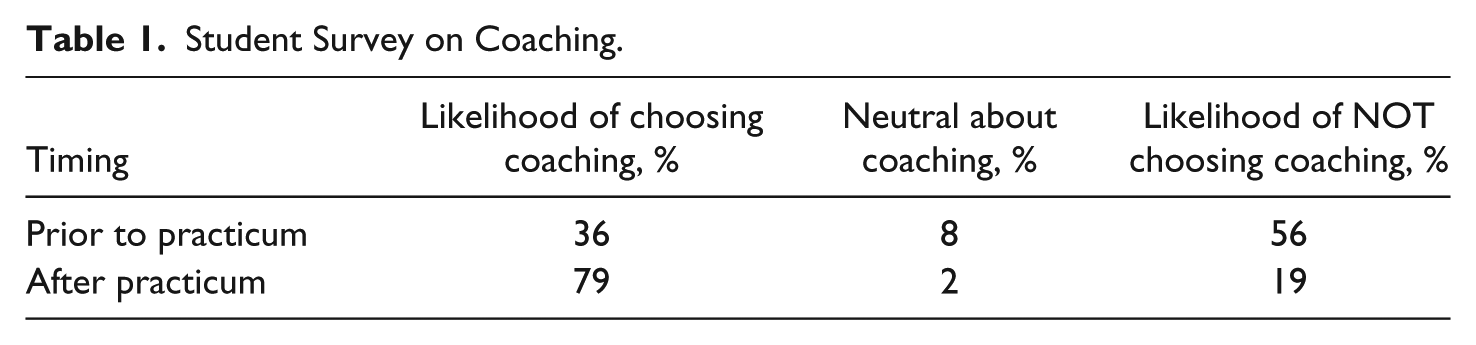
Over the past 2 years, students for whom coaching was a course requirement were asked to rate their likelihood of using a coach at the beginning of the semester. They were then asked, based on their semester-long coaching experience, to assess the program as well as to rate the likelihood that they would continue using the University’s coaching services.
As shown in Table 1, there has been a significant positive shift in student perceptions of coaching. At the beginning of the semester, about one third of our students stated that there was a strong likelihood that they would have chosen to be coached if it were not part of the course; the majority stated that there was a strong likelihood that they would not have chosen to be coached. At the end of the semester, the vast majority of students stated that coaching was of significant value and that they would continue working with a coach while attending the university. Appendix C identifies and illustrates the six major areas in which students reported greater confidence and/or increased skill levels.
Student Survey on Coaching.
Insights and Choices
Based on our experiences, we have identified several critical factors that will lead to the successful developmental coaching programs for MBA students. We began with three guiding principles. After 15 years, we believe that three additional elements are necessary to establish a context for successful MBA Coaching Program.
Define the purpose of coaching: While more mature students may be capable and motivated to set their own learning agenda, younger students may not be as able to do so. Moreover, when students first learn that they will be working with a coach, their typical expectation is that the coach is going to give them advice. In our case, the Strategic Choices Workshop clarifies coaching’s purpose and processes. After the workshop, students understand that coaching is an extension of the leadership development work they began in their previous coursework. They also learn that coaching is primarily a Socratic questioning approach to increase students’ self-awareness and ability to be self-directed.
Establish accountability mechanisms: The popular management saying “What gets measured gets done” applies to coaching. In the world of academia, grades are the measurement. Because effective coaching entails deep reflection and reflection is critical to leadership development, we strongly encourage others to include a graded reflective component. Coaching also can be linked to other gradable deliverables, such as a leadership develop plan based on the semester’s explorations and feedback/results.
Determine student participation: Each university will need to decide whether MBA coaching should be voluntary or mandatory. Our survey results suggest that many students do not see the value of coaching until after they have been coached, which might suggest that a mandatory one-semester requirement tied to a course (which forces accountability) is preferable. Resource constraints, however, are also an important factor. It is one of the reasons that we have a hybrid model.
Conclusion
Coaching has moved from relative obscurity and from inside the executive suite to a developmental mainstay across industries and managerial ranks. In educational settings, coaching can provide unique, long-term value to students in their professional and career management decisions (Coutu & Kauffman, 2009). Not only does a coaching program have an impact on current students but it also can attract future students. Students look for meaningful differences in MBA programs that distinguish one from one another (Blackburn, 2011; Sulaiman & Mohezar, 2008). Ongoing one-on-one coaching sessions with business professionals is such a differentiator.
We have made great strides toward creating a valued coaching program despite resource constraints. Ideologically, we chose a coaching approach that both suited our MBA student body’s needs and was relatively easy to teach others. Operationally, we made decisions related to participation (for both coaches and students), logistics, and administrative oversight. Adding a precoaching workshop and connecting coaching to specific course activities were two ways that we enhanced the reputation and quality of our coaching program. Recently, our program was recognized by ICF as one of the top pro bono coaching initiatives in the nation. The ICF partnership and other lessons helped us in our efforts to provide the best coaching with limited resources. Our hope is that you can too.
Footnotes
Appendix A
Appendix B
Appendix C
Declaration of Conflicting Interests
The author(s) declared no potential conflicts of interest with respect to the research, authorship, and/or publication of this article.
Funding
The author(s) received no financial support for the research, authorship, and/or publication of this article.
References
Supplementary Material
Please find the following supplemental material available below.
For Open Access articles published under a Creative Commons License, all supplemental material carries the same license as the article it is associated with.
For non-Open Access articles published, all supplemental material carries a non-exclusive license, and permission requests for re-use of supplemental material or any part of supplemental material shall be sent directly to the copyright owner as specified in the copyright notice associated with the article.
