



Abstract
We created the “Outfitting the Office” exercise to increase student engagement with health and safety concepts in introductory human resource management courses. The experiential exercise consists of two phases: (1) hazard recognition in a typical office and print room setting and (2) office design with a focus on employee health and wellness. The first phase was developed as an introductory activity to get students working together in their teams and to sensitize them to safety considerations. The second, longer, phase provides students with the opportunity to apply their readings in a decision-making scenario. In this scenario, students simulate a human resources firm that is tasked with renovating and furnishing a healthy and safe office space. Feedback from students indicates that this exercise is a fun and engaging way to learn about the health and safety factors that can affect worker comfort and enhance individual, team, and organizational productivity.
Keywords
Typical undergraduate introductory human resources (HR) courses include one lesson on health and safety, covering topics such as employers’ legal obligations to provide a safe work environment and hazard recognition (Belcourt, Bohlander, Snell, & Morris, 2017; Dessler & Chhinzer, 2017). Our experience has been that students often find the concepts to be somewhat dull and do not always see clear applicability to their future workplaces, especially if they envision themselves working in a relatively “safe” office job. We, therefore, wanted to incorporate an experiential learning exercise into our health and safety class in order to enhance student engagement with and retention of the material (Caza, Brower, & Wayne, 2015). However, we soon discovered that few health and safety exercises have been published, and those we did find were focused on nonoffice settings (e.g., Hallowell, 2011). The need for an activity that would connect health and safety concepts to many of our students’ future work contexts is what inspired us to develop our “Outfitting the Office” exercise. We have found it to be an engaging way of broadening students’ thinking about the meaning of a healthy and safe workspace.
Learning Objectives
At the end of the exercise, students will be able to do the following:
Identify hazards in an office setting and categorize hazard types
Relate the three levels of the environmental comfort model to individual, team, and organizational effectiveness
Explain the relationship between stress and performance and the effect of the workspace on this relationship
Make decisions that promote a healthy and safe work environment
Overview of the Exercise
The exercise was initially designed for undergraduate students enrolled in their first HR course. However, the concepts are sufficiently complex that the exercise is appropriate for MBA or other postgraduate students who are being initially exposed to health and safety as a HR function. It could also be incorporated into a more specialized upper-level undergraduate health and safety course, in which case, due to the survey nature of the exercise, we would suggest running it early in the semester and then elaborating on the concepts in subsequent classes.
The exercise is carried out in two phases. Prior to attending the class, students are assigned to read the health and safety chapter of their textbooks, as well as Vischer’s (2007a) article describing the environmental comfort model. Appendix A includes a summary of the health and safety content that is relevant to the exercise and how it connects to each of the phases. Familiarity with these materials is important because the class starts with the exercise rather than a lecture. We chose this approach because it helps deepen students’ understanding of the material and promotes student attentiveness (Costello & Brunner, 2016).
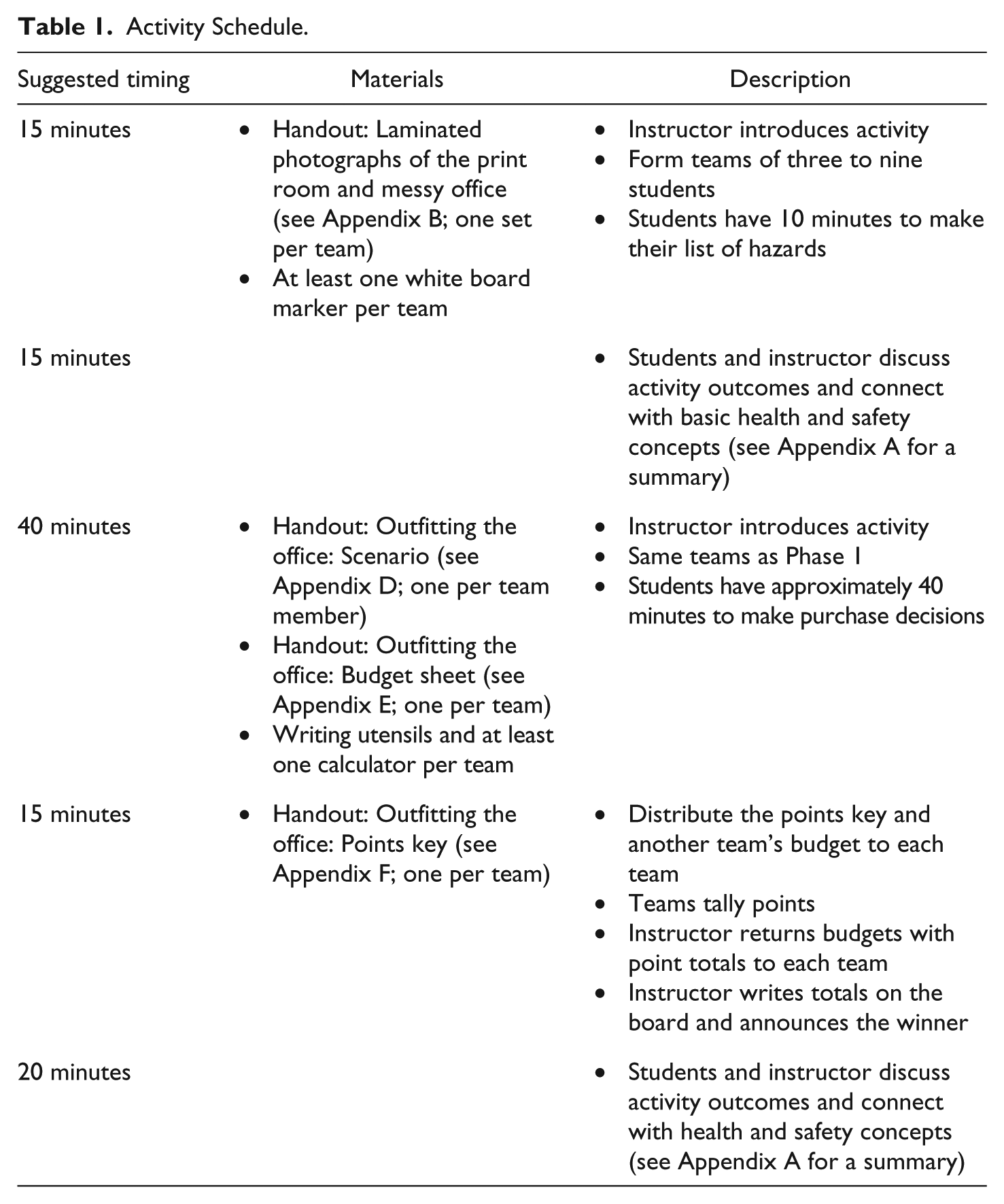
The first phase of the exercise is designed to familiarize students with basic health and safety concepts by providing them with a chance to identify hazards in an office setting. The second phase is more complex and involves a scenario where students are asked to outfit an office with a limited budget and extensive choices about how to spend their funds. Their decisions are then rated by the extent to which they address workers’ comfort according to Vischer’s (2007a) model and other research about workplace design for employee wellness. Table 1 includes timelines for both phases.
Activity Schedule.
Assigning Students to Teams
In the courses where we have run the exercise, students are already assigned to semester-long teams of seven to nine students for their term projects. We do not believe that it is necessary for students to have worked together previously, and instructors could form teams of between three and seven students for the purpose of the exercise alone. If the latter approach is taken, we suggest that smaller teams are preferable because students will need time to get to know one another, and social loafing is minimized in smaller groups (Hoegl, 2005). In this case, we would also suggest that it is especially important to do Phase 1, so that students have a low-stakes way of orienting themselves to the team.
Phase 1: Messy Office and Print Room
Materials
Provide each team with laminated color photographs of the messy office and print room (see Appendix B; also available with the online version of the article). We encourage instructors to set up similar scenarios in their own offices to create unique photographs. Students were amused that the photos were of their instructor’s office, which contributed to the positive atmosphere in the class (some students even dropped by office hours over the following weeks to see if it was really that messy).
Conducting the Exercise
As soon as students arrive, we inform them that there will be no lecture and that they will instead be doing an experiential health and safety exercise. We ask students to form their teams, and we provide them with copies of the photos. We tell them that they have 10 minutes to identify all of the visible and invisible hazards in the photos. Afterwards, we provide each team with a marker and ask them to write some of the hazards they found on the whiteboard at the front of the room.
Debriefing
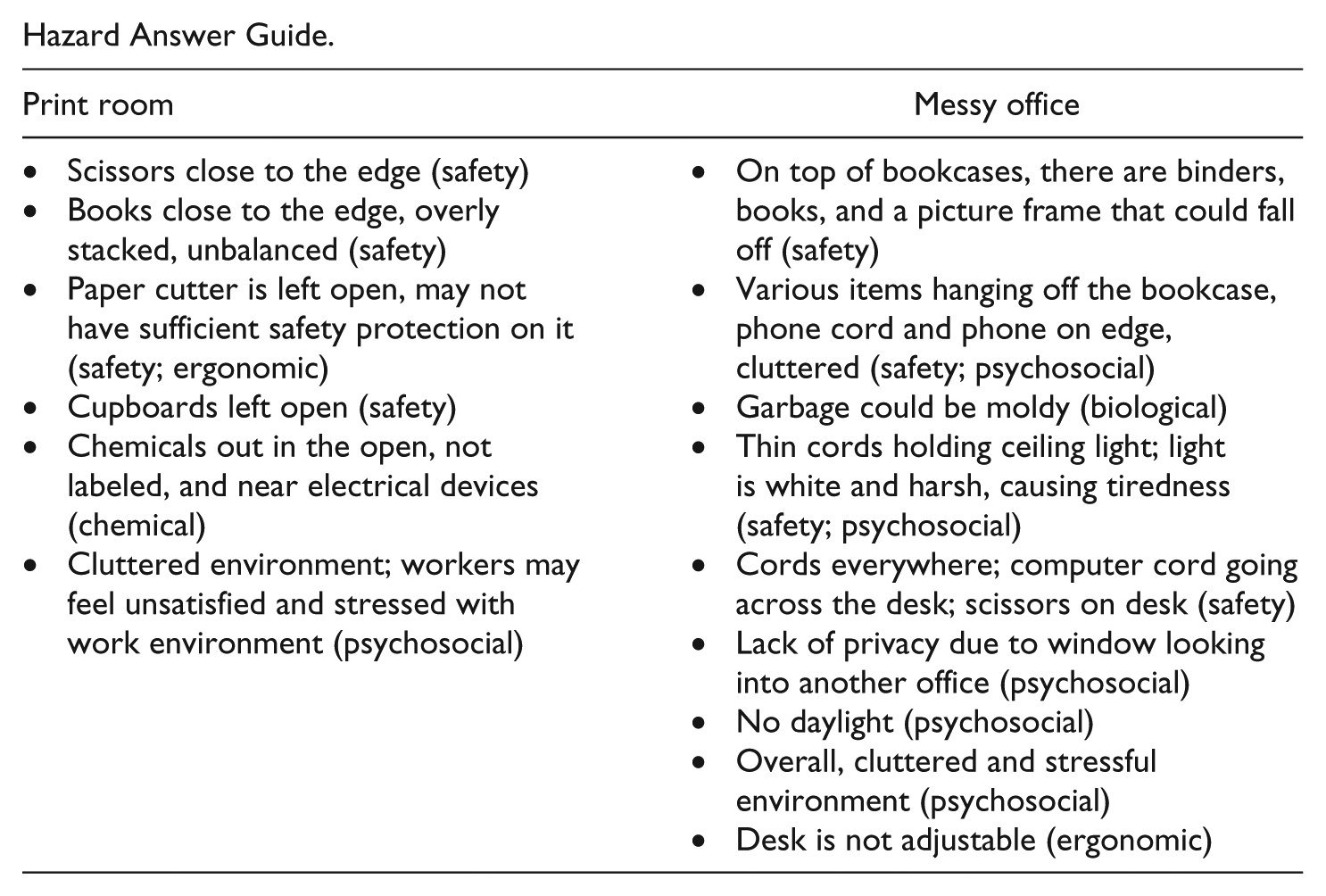
The main purpose of this phase is to prepare students for the more challenging Phase 2 activity and to introduce them to the various types of hazards (see Appendix A for a summary). We share the hazard categories with students after they have made their lists on the board and ask them to determine the appropriate category for each of the hazards identified. Appendix C contains a list of the hazards in the photos. We then introduce several other discussion questions (included in Table 2) to encourage students to think critically about workplace hazards. We deliberately end by focusing on less visible threats to health in the photos and how they might be connected to employee stress, such as the poor lighting in the office and the view into a neighboring office rather than to the outdoors. The discussion of less visible threats helps sensitize students to the comfort issues that become the focus of Phase 2.
Questions to Guide the Debrief.

Phase 2: Office Design
Materials
Distribute two handouts to each team: (1) a scenario handout for every team member (see Appendix D) and (2) one budget sheet per team for students to record their budget allocation decisions (see Appendix E). Each team also needs writing utensils and at least one calculator. After students complete their budget allocations, provide one copy of the point allocation key (see Appendix F) to each team. Appendixes D, E, and F are also available in the online version of the article.
Conducting the Exercise
When students read their scenario handout, they learn that they are board members of an HR firm that is tasked with making purchasing decisions for a recently acquired office space. The available budget is $165,000. We chose this number because it restricts students’ spending enough that it creates dilemmas for them to discuss and resolve in their teams but also ensures that through application of their readings, they will be able to create a physically, functionally, and psychologically comfortable workspace. For example, the decision to spend money on window renovations would address workers’ psychological comfort, as exposure to natural light is associated with increased job satisfaction, productivity, and commitment (Brennan, Chugh, & Kline, 2002). We inform students that they will be assigned points based on their budget allocations according to the extent to which they meet the requirements specified in the scenario and address the environmental comfort model. For example, in the points key, ergonomic furniture earns more points than nonergonomic furniture, and students can earn points by choosing items such as plants that make the workplace more pleasant for employees. Because students have ample realistic options about how to spend their funds, there are multiple possible “winning” scenarios in which the physical, functional, and psychological aspects of environmental comfort are well addressed. We also provide a nominal incentive of 2 bonus marks on another assignment to the team that earns the most points. These bonus marks do not make a significant difference to students’ overall grades, but the incentive encourages a competitive atmosphere that increases student engagement and learning (Hannah & Venkatachary, 2010).
Provide students with approximately 40 minutes to complete their budgets. Once finished, rotate the budgets between the teams, provide each team with a points key (see Appendix F), and ask them to “grade” another team’s allocations. We keep an eye on the teams to make sure that everyone is grading one another correctly and encourage teams to check the grading of their budget when it is returned to them. While we recognize that this method creates some risks of students making mistakes in grading one another’s allocations, we have found that the grading process is important for students’ learning. The points key contains explanations for how choices about the different office items are likely to affect physical, functional, and psychological comfort. The energy in the room increases when students look at one another’s decisions and assess their own decisions against the key. Once grading is complete, the instructor writes each team’s final point allocation on the board, which leads to gasps and cheers as students see how their team’s performance compares. Once all of the points are recorded on the board, we proceed to the debriefing.
Debriefing
The debrief period is an opportunity for students to reflect on their decisions, consider alternatives, and discover new ideas. Therefore, it is paramount that the students lead the discussion and that the instructor take on a facilitative and supportive role (Chavez & Poirier, 2007; Meyers & Jones, 1993). The debriefing questions used for Phase 2 are included in Table 2. Our goal in this phase is to help students assess their decisions in relation to the research around office design and wellness. At a minimum, we encourage students to address the comfort issues outlined in Table 3 and supplement their thinking with findings from the research.
Comfort Issues to Address in the Debriefing Phase.

Student Feedback and Instructor Observations
In all of the courses where we have run the exercise, students seem to quickly engage with and enjoy doing the activity. We gathered feedback about the exercise from students in two course sections. There were a total of 62 respondents: 35 from one section and 27 from the other. In addition to many positive comments provided by students, 91% perceived the classroom environment to be lively and active, and 97% agreed or strongly agreed that the exercise provided the necessary environment for student engagement.
We have also made some observations that may be helpful to instructors who are considering incorporating the exercise into their courses. First, while the options for furniture and décor may seem numerous at first, undergraduate students are able to grapple with the complexity of these decisions very well. We have not experienced any teams being disqualified as a result of their decisions, and only rarely have teams lost points for not meeting the minimum furniture requirements. Second, we have been surprised to see that members who tend to be quieter in the team’s discussions take on more of an active role in this exercise. We believe this increase in participation is attributable in part to the calculations component and attention to detail needed for the exercise, which allows students with more math- and accounting-based strengths to shine. We have observed that these students gleefully produce their calculators to employ skills that are not usually the focus of HR courses but become valuable to the team in this exercise. Thus, even within large teams of seven to nine students, this exercise promotes more equal team member participation than in other team cases we have used in our HR courses.
Conclusion
Since designing the “Outfitting the Office” exercise, we have gone from dreading the health and safety lesson in introductory HR courses to looking forward to it. This exercise has allowed us to introduce students to health and safety concepts that are clearly applicable to their future work lives. Students have expressed that being able to participate in this exercise has not only piqued their interest in health and safety but also inspired them to want to learn more about HR.
Supplemental Material
Appendix_B – Supplemental material for Outfitting the Office: An Experiential Health and Safety Exercise
Supplemental material, Appendix_B for Outfitting the Office: An Experiential Health and Safety Exercise by Kirsten M. Robertson, Hayley Chase and Arianna Castonguay in Management Teaching Review
Supplemental Material
Appendix_D – Supplemental material for Outfitting the Office: An Experiential Health and Safety Exercise
Supplemental material, Appendix_D for Outfitting the Office: An Experiential Health and Safety Exercise by Kirsten M. Robertson, Hayley Chase and Arianna Castonguay in Management Teaching Review
Supplemental Material
Appendix_E – Supplemental material for Outfitting the Office: An Experiential Health and Safety Exercise
Supplemental material, Appendix_E for Outfitting the Office: An Experiential Health and Safety Exercise by Kirsten M. Robertson, Hayley Chase and Arianna Castonguay in Management Teaching Review
Supplemental Material
Appendix_F – Supplemental material for Outfitting the Office: An Experiential Health and Safety Exercise
Supplemental material, Appendix_F for Outfitting the Office: An Experiential Health and Safety Exercise by Kirsten M. Robertson, Hayley Chase and Arianna Castonguay in Management Teaching Review
Footnotes
Appendix A
Summary of Instructional Content.

| Relevant instructional content | How exercise addresses content |
|---|---|
| Identifying and categorizing workplace hazards (Learning Objective 1) Hazards are defined as “any source of potential adverse health effect, damage, or harm on something or someone under certain conditions at work” (Kelloway, Francis, & Gatien, 2014, p. 82). Sources of hazards include the following (Kelloway et al., 2014; Occupational Safety and Health Administration, 2018): a. Safety: Caused by unsafe conditions related to machinery, tools, spills, or causes of tripping b. Biological: Caused by biological materials (i.e., mold, bacteria, viruses) c. Chemical: Caused by single or combined chemical agents and resulting reactions d. Ergonomic: Caused by design of workstations and equipment e. Physical: Caused by poorly managed or controlled energy sources (e.g., noise, temperature) f. Psychosocial: Caused by stressors in the social environment or individual psychological factors Employers are legally required to provide a hazard-free workspace, follow applicable health and safety legislation (which varies by country and jurisdiction), train supervisors about potential hazards and how to recognize them, keep records of workplace injuries or illnesses that may occur, and report any such injuries or illnesses to the regional Workers’ Compensation Board (Belcourt et al., 2017). |
Phase 1: Examining the photographs is similar to a “walk-through survey,” where a safety professional walks through and notes hazards (Kelloway et al., 2014). During the debrief phase, the instructor guides students about how to correctly categorize hazards. Phase 2: Options for renovations, furniture, and décor relate primarily to ergonomic, physical, and psychosocial safety hazards. |
| The environmental comfort model and individual, team, and organizational effectiveness (Learning Objective 2) The environmental comfort model suggests that worker satisfaction and well-being are determined by three levels of comfort (Vischer, 2007a): a. Physical: A safe, clean, and accessible workplace; if not satisfied, the habitability threshold will not be met and cannot be compensated for through the other two comfort levels b. Functional: Workspace factors that enable the completion of tasks and activities, such as appropriate lighting, ergonomic furniture, and appropriately designed rooms c. Psychological: Workers’ intrapersonal sense of belongingness and autonomy The three levels of effectiveness are individual task performance, collaborative teamwork, and overall organizational effectiveness. Individual task performance is affected by functional comfort (e.g., ability to read and do computer work) and psychological comfort (e.g., adjustability, territoriality, and participation in decision making). Collaborative teamwork is affected by functional comfort (e.g., shared meeting space and whiteboards for team collaboration) and psychological comfort (e.g., team decisions around territory and making changes to the workspace). Organizational effectiveness is directly affected by functional comfort (e.g., reflection of corporate values and value placed on employees) and psychological comfort (e.g., workspace design is responsive to business processes). Functional and psychological comforts also indirectly influence organizational effectiveness through factors such as absenteeism, health insurance premiums, and turnover. |
Phase 1: In the photos, safety, biological, and chemical hazards are relevant to physical comfort; ergonomic hazards are relevant to functional comfort; and psychosocial hazards are relevant to psychological comfort. Instructors can make these connections during the debrief discussion. Phase 2: Student groups whose budget allocation choices promote functional and psychological comfort are awarded more points; decisions that prevent the habitability threshold from being met result in disqualification (e.g., not addressing ventilation) or negative points (e.g., not addressing lighting). |
| Relationship between stress and performance and how the physical environment affects this relationship (Learning Objective 3) Stress is an individual’s intrapersonal response (generally negative) to external events (or stressors). Stress can be acute (highly intense, but short and infrequently experienced), chronic (of varying intensity and duration, but encountered frequently), daily (low intensity, short, and encountered infrequently), or catastrophic (rare and of varying duration, but highly intense) (Kelloway et al., 2014). Persistent stress can lead to four types of strain, which have negative consequences for individuals and their workplace performance: a. Psychological: Affective and cognitive disruptions, often resulting in difficulty concentrating and making errors b. Physical: Illness and compromised immune system, which can lead to absenteeism c. Behavioral: development of nervous habits, reduced workplace involvement, or increased consumption of substances such as alcohol and psychotherapeutic drugs d. Organizational: higher absenteeism, turnover, and likelihood of accidents, as well as lower performance and quality of workplace relationships Aspects of the workplace environment can contribute to, or help reduce, strain and stress. Functionally uncomfortable workspaces, for example, increase worker stress (Vischer, 2007a), whereas increased exposure to natural light (Leather et al., 1998) and incorporation of biophilic design principles can offset stress (Borthwick et al., 2009; Browning, Ryan, & Clancy, 2014). |
Phase 1: Psychosocial hazards can be connected to workplace stress and strain during the debrief discussion. Phase 2: Decisions that promote functional and psychological comfort can reduce workplace stress and strain for employees. Information provided in the points allocation key (Appendix F) helps students to make these connections. Questions suggested for the Phase 2 debrief allow instructors to elaborate on models of stress and their relevance to the workplace environment. |
Appendix B
Appendix C
Hazard Answer Guide.
| Print room | Messy office |
|---|---|
| • Scissors close to the edge (safety) • Books close to the edge, overly stacked, unbalanced (safety) • Paper cutter is left open, may not have sufficient safety protection on it (safety; ergonomic) • Cupboards left open (safety) • Chemicals out in the open, not labeled, and near electrical devices (chemical) • Cluttered environment; workers may feel unsatisfied and stressed with work environment (psychosocial) |
• On top of bookcases, there are binders, books, and a picture frame that could fall off (safety) • Various items hanging off the bookcase, phone cord and phone on edge, cluttered (safety; psychosocial) • Garbage could be moldy (biological) • Thin cords holding ceiling light; light is white and harsh, causing tiredness (safety; psychosocial) • Cords everywhere; computer cord going across the desk; scissors on desk (safety) • Lack of privacy due to window looking into another office (psychosocial) • No daylight (psychosocial) • Overall, cluttered and stressful environment (psychosocial) • Desk is not adjustable (ergonomic) |
Appendix D
Appendix E
Appendix F
Declaration of Conflicting Interests
The authors declared no potential conflicts of interest with respect to the research, authorship, and/or publication of this article.
Funding
The authors received no financial support for the research, authorship, and/or publication of this article.

Notes
References
Supplementary Material
Please find the following supplemental material available below.
For Open Access articles published under a Creative Commons License, all supplemental material carries the same license as the article it is associated with.
For non-Open Access articles published, all supplemental material carries a non-exclusive license, and permission requests for re-use of supplemental material or any part of supplemental material shall be sent directly to the copyright owner as specified in the copyright notice associated with the article.
