



Abstract
Organizational behavior (OB) students often have difficulty understanding how individual-, group-, and organization-level OB concepts interact to influence employee behavior in the workplace. As a result, students may disengage from the class. Yet the simple prompt of asking students “How do you get promoted?” serves as an effective engagement trigger that helps students link course objectives to valued outcomes. The purpose of this article is to describe a highly interactive, in-class exercise and demonstrate how it can increase in-class participation, help students visualize and appreciate what OB represents, and provide students with a conceptual roadmap for the semester. Due to the learning objectives and format of this exercise, it is intended for undergraduate OB students in a traditional, face-to-face classroom.
Keywords
In my experience, when teaching Organizational Behavior (OB), three of the most difficult challenges at the start of the semester are facilitating in-class participation, helping students understand the basics of what OB represents, and preparing students for what is ahead in a densely packed semester. To overcome these challenges, I use an exercise known as “How to Get Promoted 101” at the beginning of the semester to introduce my students to everything OB has to offer.
After initial introductions and icebreakers, I ask my students, “How do you get promoted?” It is a simple question with an extremely complex answer, and yet it primes students to see how everything they will learn this semester fits together. As explained below, I write all student responses on the board and relate each one to a course concept. Students then have a sense of what OB entails and the value it can provide. I can also use this exercise during the semester to help students discover the characteristics associated with nearly any OB concept. As an added bonus, I often repeat this exercise at the end of the semester to help students review for a final exam or paper.
Because of the quick-paced, interactive nature of this exercise, as well as its focus on introducing students to OB concepts, it is intended for a traditional classroom and for undergraduate students who are studying OB for the first time. However, the exercise is suitable for all teachers regardless of their career stage. It can keep even the most seasoned teachers on their toes due to the spontaneity and variety of student responses.
Theoretical Foundation
This exercise is rooted in two forms of learning—visual and discovery. Visual learning is based on the premise that teachers should provide students with a unique and active way of seeing and understanding the material (Robson, 2016). Along these lines, this exercise is essentially a form of “collaborative concept-mapping” whereby the teacher and students “co-create” the visual material and chart student learnings for the semester (Robson, 2016; Vince & Warren, 2012).
The exercise also encourages discovery learning, which proposes that student learning is contingent on active involvement and direct guidance from the teacher (Clark, 2009; Druckman & Ebner, 2018). Specifically, this theory of learning claims that students are more likely to be involved when they have some familiarity with the topic and it piques their curiosity (Bruner, 1961; Whitehead, 1929). Since my students typically associate promotions with many powerful external motivators, such as status, money, and security, this exercise functions as an “engagement trigger.” It features a provocative question that grabs students’ attention due to its importance to their lives (Bain, 2004; Borton, 1970; Chase, Germundsen, Brownstein, & Distad, 2001; Crane, 2017; Nilson, 2010; Sousa, 2011). Thus, the exercise facilitates class participation and promotes an active learning environment (Auster & Wylie, 2006; Bonwell & Eison, 1991; Klionsky, 1999).
Learning Objectives
Based on my experiences, students often have difficulty understanding the different levels of analysis used in OB (i.e., individual, group, and organizational). This exercise enables students to recognize these levels and how they can interact to have a profound influence on an individual’s decision making, behavior, and, ultimately, career progression. Repeating this exercise during the semester also allows students to visualize OB concepts, such as the Big Five personality traits. Similarly, using the exercise at the end of the semester provides students with a visual depiction of all they have learned.
Finally, students may fail to see the relevancy of how these wide-ranging OB concepts apply to their own lives. This exercise helps students discover how all of the OB concepts covered during the semester relate to an extremely relevant and motivating objective: how to get promoted.
Therefore, by the end of the exercise, students will be able to do the following:
Recognize the three levels of analysis in OB
Visualize complex OB concepts
Discover how OB-related concepts apply to earning a promotion.
Exercise Overview
Logistics
Depending on the topic, this exercise typically takes about 20 to 30 minutes. The only materials necessary are a large dry-erase board and marker. The exercise is appropriate for any size class, although I personally have used it for class sizes of 10 to 35 students.
Instructions
During the first week of class, after I explain what OB represents, I ask the class: “How do you get promoted?” This question is intentionally open-ended and encourages students to think both practically (“work harder!”) and creatively (“blackmail your boss!”). Most answers, even the more creative ones, can usually be steered back into an OB concept. Therefore, nearly all answers will fall under one of the three levels of analysis—Individual, Group/Others, or the Organization (see Table 1).
Cheat Sheet of Select Organizational Behavior Concepts, Organized by Column (i.e., Level of Analysis).
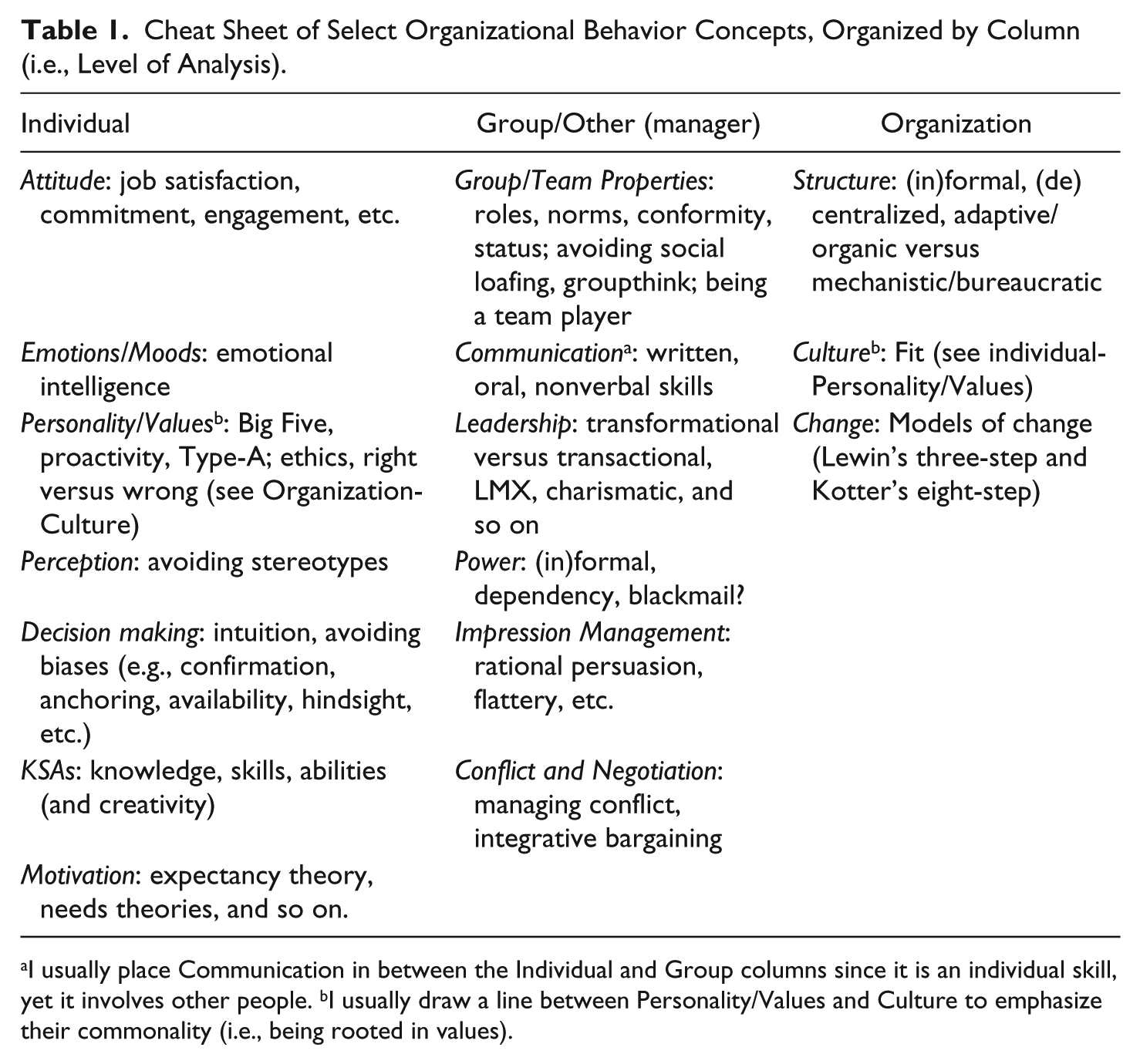
I usually place Communication in between the Individual and Group columns since it is an individual skill, yet it involves other people. bI usually draw a line between Personality/Values and Culture to emphasize their commonality (i.e., being rooted in values).
In my experience, a sufficient number of students are usually willing to participate by shouting out answers. However, one could just as easily give students a chance to write their responses first before asking the entire class to participate. In either case, as students provide their answers, I write them on the board, making sure to separate them into three distinct columns, with answers related to Individuals on the left, Groups (e.g., interacting with others) in the middle, and the Organization on the right. But the trick is I DO NOT fill in the column headers! By leaving the columns unnamed and not telling the students what I am doing, it at first appears that there is no rhyme or reason to where their answers are ending up on the board.
Most answers tend to revolve around some type of knowledge, skill, or ability, in which case, I add it to the Individual column on the left. Sometimes, students may need a little push, so I prompt them to think of ways to get promoted based on general OB concepts. For instance, I often ask questions such as, “Do you think that flattering your boss, or being in control of your emotions will help you get promoted?”
However, some student responses may be too vague or will not appear to align with a specific OB theory/concept. If that is the case, I ask the student to explain the situation he or she is imagining, which usually leads to something I can identify as an OB concept. For example, if a student says “work harder,” I will ask, “What do you mean? How would working harder lead to a promotion?” This clarification typically connects to a range of OB-related concepts, such as conscientiousness or commitment.
After filling in the columns a bit, I ask the students to guess what the entries in the left-side column each have in common. I then draw a line at the top of each column to serve as blank column headers and wait for the students to identify that the left side is for Individuals and the middle is for Groups. However, I find that since students struggle with recognizing the impact that an organization’s structure or culture has on individual behavior, the right side of the board is often blank when I draw a line for the Organization column header. Nonetheless, once students have identified the other two column headers, they tend to figure it out quickly and guess “the company/organization.”
To help fill in the column, I then ask, “Who believes that they are more likely to be promoted if they work for an organization that values employee autonomy?” Once all column headers are filled in, I encourage students to keep providing answers to the original question until time is up. At that time, I fill in the remaining concepts that the class was unable to identify before letting students take pictures of the completed board (see Figure 1).
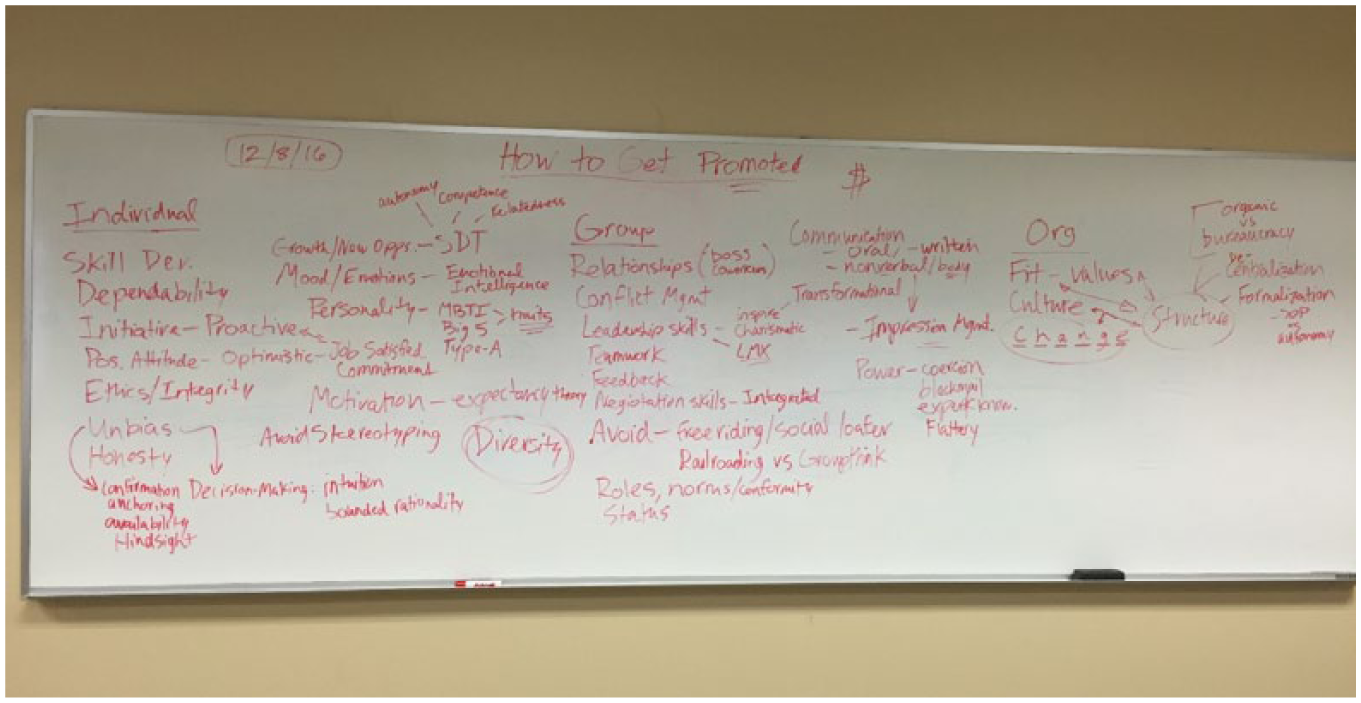
Image of “How to Get Promoted”—A completed board at the end of the semester.
The beauty of this exercise is that it allows students to generate organic responses associated with OB concepts that have distinct, preexisting categories, and to see how the course material relates back to getting promoted. For example, teachers can use this exercise to introduce students to Individual-level concepts such as the Big Five. For this concept, one can ask students to describe some personality traits that they think may be related to higher job performance and the chance for a promotion. One can then classify student responses into the five traits/categories, thereby helping students learn about the characteristics associated with each trait and how to distinguish between them.
As for the Group-level, if the teacher asks, “What type of power do you have at work? Which can you use to get promoted?”, the exercise enables students to learn about French and Raven’s (1959) five forms of power. When discussing the Organization-level, one can use the exercise to help students appreciate the varied distinctions between mechanistic and organic structures. Finally, during the last class of the semester, I repeat the entire exercise by once again asking, “How do you get promoted?” In my experience, it is much more fun and lively at the end of the course because students have a better understanding of OB and appreciate how it can help them achieve their goals.
Debriefing Guidelines
During the first week of class, after the exercise is complete, I tell the students that all the concepts on the board represent a roadmap for the entire semester; that it constitutes all that they will learn in OB. Of course, one can customize the content of each column shown in Table 1 to meet the specific needs of the class, in case one chooses to focus on specific concepts and omit others. In either case, I then ask the students to reference their syllabus (and/or textbook) and see that, like on the board, the course is divided into three sections—one for each level of analysis. This approach often helps students, especially the visual learners, recognize how concepts within each level of analysis interact to influence their behavior and chances for a promotion. To maximize engagement, I typically conclude with a bold statement, such as, “At least one of these topics will resonate with you and likely change how you view yourself and the world.”
During the semester, debrief questions should be catered to the specific OB topic. For example, when using this exercise for the Big Five, I conclude by focusing on the “Big One” (i.e., conscientiousness) and its positive relationship with job performance (Barrick & Mount, 1991). As for power in Groups, I suggest that informal power tends to be more effective than formal power at influencing others and potentially earning a promotion. To help students learn about mechanistic and organic structures for Organizations, I often mention person-organization fit, which usually generates a quality discussion in which students explore the (dis)advantages associated with each type of structure, such as working at an automobile manufacturer or a tech start-up.
During the last week of class, after we finish the exercise, I step back and show the students how much they have learned. They are usually quite impressed by how far they have come. I then explain that the important takeaway is that each of these concepts can serve a specific and tangible purpose, which can help the students as they navigate through their current jobs and future careers. Finally, I emphasize that although each of these concepts may not necessarily lead to or guarantee a promotion, one is far more likely to obtain a promotion when one is aware of, and can correctly apply these concepts in the workplace.
Conclusion
Asking questions is an effective engagement trigger that, when properly implemented, can facilitate student participation and set a positive tone for the semester (Crane, 2017). This exercise not only engages students but also encourages them to appreciate how various individual, group, and organizational factors influence their own behaviors and chances for promotion. This exercise is simple yet effective and caters to a wide variety of learning styles, especially visual learners. Furthermore, one can tailor the concepts within each column to the topics one plans to cover, making it a highly flexible exercise that is appropriate for all traditional, early undergraduate OB courses.
Footnotes
Declaration of Conflicting Interests
The author declared no potential conflicts of interest with respect to the research, authorship, and/or publication of this article.
Funding
The author received no financial support for the research, authorship, and/or publication of this article.