



Abstract
Employee empowerment yields positive outcomes for employees, managers, and organizations. Yet, too many employees feel disempowered at work, and managers, while wanting to empower employees, often do not know how. Contributing to this state of affairs is the lack of published, high-fidelity exercises explicitly designed to instruct students on how empowerment “feels,” how empowerment “works,” and how to practically empower others. In this article, we outline a 90-minute face-to-face classroom exercise that integrates the structural and psychological empowerment perspectives enabling students to “feel” empowerment or disempowerment and see the productivity and quality benefits of an empowered workforce, and teaches students how to empower others at work. While participating in the exercise, students simulate working in an airplane manufacturing organization, working either in an empowered work environment or a traditional hierarchical work environment. The exercise provides instructors with an important classroom tool to instruct students about the importance of empowerment, trust, and performance in organizational life.
In October 2017, General Motors (GM) settled dozens of lawsuits stemming from a faulty ignition switch. Despite issuing a recall of more than 2-million vehicles, the faulty ignition switch ended up taking the lives of more than 120 people. While the faulty mechanisms were troubling and the repairs essential, internal investigators discovered the foundational reason for the debacle was a lack of employee empowerment (Gavett, 2014). GM’s internal investigators determined that individual employees knew about the problem but did not feel empowered to raise the issue to higher levels in the organization. To remedy the situation, GM instituted an employee empowerment initiative to encourage employees to speak up (Burris et al., 2021).
In this article, we introduce a face-to-face classroom exercise that provides an empowering experience for students, demonstrates ways that managers can foster both structural and psychological empowerment, and demonstrates important outcomes that can result from empowerment initiatives. A careful review of the management teaching literature identified several empowerment-type exercises that exist in the literature with notable strengths; there is also room for refinement and expansion. For example, Bolman and Deal (1979) introduced an exercise that demonstrates the complications that can result from interactions among groups with high and low power. Three additional classroom exercises generate empowerment-like feelings among students by varying work tasks consistent with Hackman and Oldham’s (1980) Job Characteristics Model (Donovan & Fluegge-Woolf, 2015; Fornaciari & Dean, 2005; Smrt & Nelson, 2012). Two additional exercises we identified in the literature illustrate the effects of employee empowerment by varying simple production processes (Eylon & Herman, 1999; Kern, 2000). In the exercise presented here, we combine the best elements of these previously published exercises: (1) an exercise that can be completed in a single class session and (2) students role-play as workers in a manufacturing organization. Moreover, our exercise can be distinguished from these previously published exercises. The activity explicitly: (1) illustrates both structural and psychological empowerment; (2) simulates a high-fidelity manufacturing operation requiring several interdependent production steps with different workgroups; and (3) demonstrates how and why employee empowerment leads to both superior product quality and quantity.
The Empowering Flight Exercise and accompanying discussion require approximately 90 minutes to complete, though instructors could complete the exercise in a typical 60-minute class session and conduct the lecture–discussion in a subsequent class session. The exercise, described below, is intended for upper-level undergraduate and graduate students studying human resources, management, organizational behavior, or other topics related to employee relations. We have successfully run the exercise with a diverse set of students on campuses in the southern and western parts of the United States and in Korea. In what follows, we provide a theoretical foundation for the exercise and a general description of how to run and debrief it.
Theoretical Foundation
As evidenced in GM’s ignition tragedy, organizations are increasingly dependent upon the knowledge, energy, and creativity of employees at every level to promote safety, learning, and innovation (Grant & Parker, 2009). Yet employees only contribute meaningfully to their organizations when they feel empowered to do so (Spreitzer, 1995). Employee empowerment can be broadly defined as “a motivational construct manifested in four cognitions: meaning, competence, self-determination, and impact” (Spreitzer, 1995, p. 1444). Empowerment is an “active, rather than a passive, orientation to a work role” (Spreitzer, 1995, p. 1444) and promotes greater job satisfaction, organizational commitment, and less strain for employees (Aryee & Chen, 2006; Avolio et al., 2004; Spreitzer et al., 1997), while also fostering greater quality and productivity for organizations (Wallace et al., 2011).
As research on empowerment has grown over several decades, two distinct perspectives of empowerment have emerged: psychological empowerment and structural empowerment (Eylon & Bamberger, 2000; Spreitzer, 1995). The psychological perspective of empowerment explores empowerment from a more micro level focusing on employees’ psychological experience when they are given more responsibility and authority at work (Spreitzer, 2008). From this psychological perspective, scholars view the feelings of empowerment as a motivating force experienced by individual employees that positively affect the employee work experience as well as organizational outcomes.
On the other hand, the structural empowerment perspective grew out of earlier research on job design and job characteristics, which focused on the motivational outcomes emanating from upper management’s sharing of responsibility and authority with front line employees (Hackman & Oldham, 1980). As one group of scholars noted, “structural empowerment is primarily concerned with organizational conditions . . . whereby power, decision-making, and formal control over resources are shared” (Maynard et al., 2012, p. 1234).
While these two theoretical perspectives about empowerment present different views of the construct, some scholars have suggested the possibility that the “true nature of empowerment can be better understood . . . by focusing on the effects of various empowering practices on the psychological state of the individual employee” (Menon, 2001, p. 158). In this way, structural empowerment and psychological empowerment, although different, can also be complementary to one another (Spreitzer, 2008). The exercise presented here places students into either structurally empowered or disempowered work organizations, creates feelings of empowerment or disempowerment, and results in positive organizational outcomes for the structurally and psychologically empowered teams.
Learning Objectives
The exercise is designed to help students:
Develop knowledge about structural and psychological employee empowerment.
Comprehend the different ways leaders can empower employees and the complexities of empowerment initiatives.
Practice and reflect upon both structural and psychological ways to empower employees.
Analyze, synthesize, and evaluate the way structural and psychological empowerment can benefit individuals and organizations.
Exercise Overview
The Empowering Flight Exercise is a face-to-face classroom activity that requires classes to be randomly divided into two teams assigned to two separate, nearby rooms. Each team is assigned a specific empowerment style that will shape their experience in the exercise. The first team, called the Red Team, is managed with an empowerment enhancing work system and a manager adhering to a philosophy that values employees and their suggestions for improvement. The other team, called the Blue Team, is managed with a traditional hierarchical work system and a manager adhering to a philosophy that workers are hired hands to be directed and not consulted on improving performance. In this way, we generate both structural and psychological empowerment in the Red Team while creating structural and psychological disempowerment in the Blue Team. Each team will manufacture paper airplanes according to defined specifications, using materials “purchased” from the exercise moderator and submit the completed planes for inspection to the moderator for compliance with specifications and “purchase.” The goal of each team is to maximize their team’s profit (i.e., revenue from the sales of the properly constructed planes minus the cost of the paper raw materials).
In what follows, we provide a general description of how to conduct the exercise. The list of materials needed for the exercise can be found in Appendix A. The set of instructions for the Red (empowered) Team can be found in Appendix B while the set of instructions for the manager of the Blue (disempowered) Team can be found in Appendix C. Due to space limitations, the complete set of materials required for the exercise, including a slide deck to supplement the post-exercise debrief and discussion can be found in the journal’s supplemental materials. The slide deck includes video clips of students participating in both the Red and Blue Teams, allowing the instructor to show students how the teams differed under the different work systems. Blueprints for the paper airplane to be manufactured can be found in Appendix D. See Appendix E for an inventory of all the supplemental materials.
Conducting the Exercise
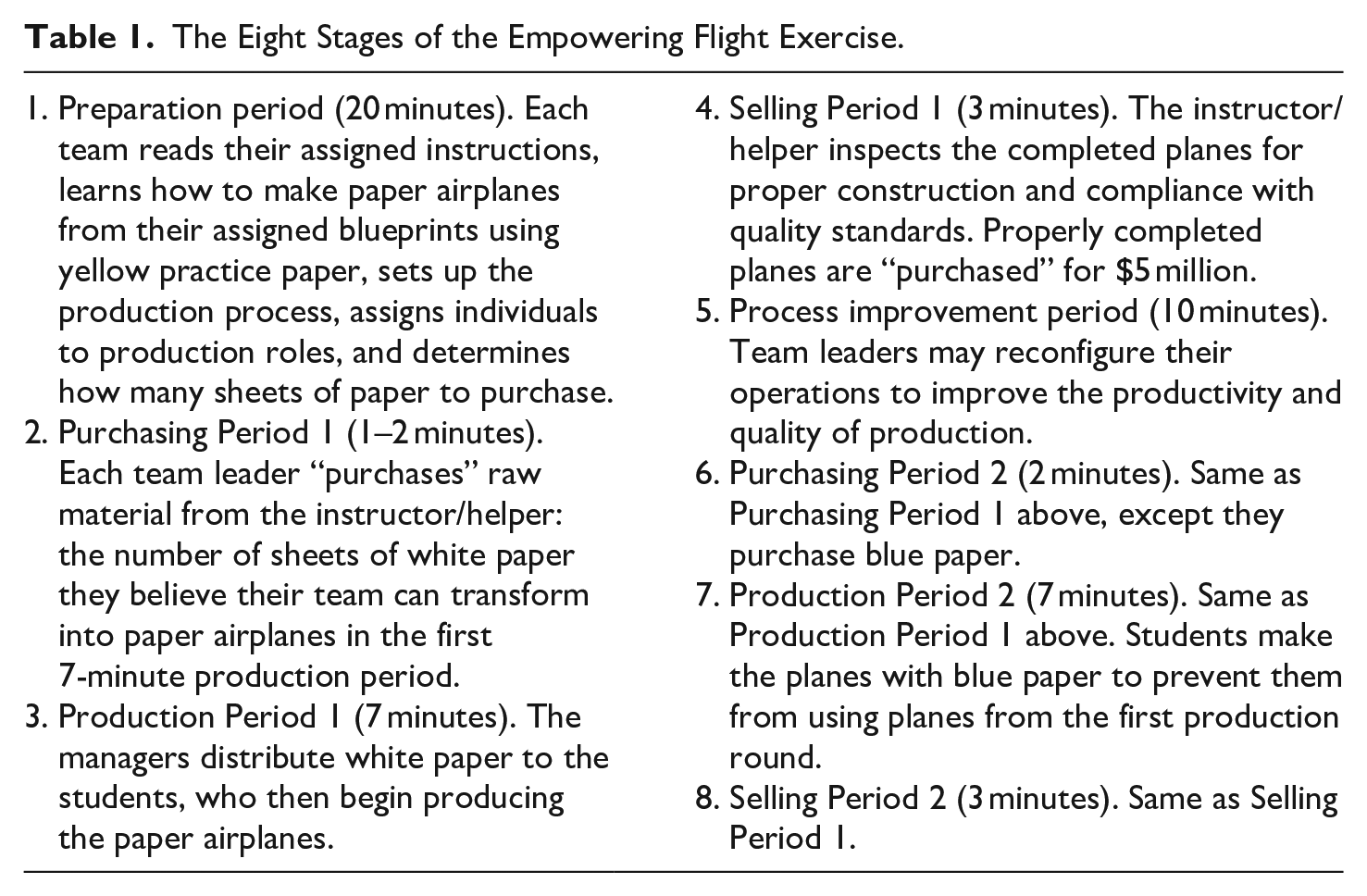
After dividing the class into Red and Blue Teams, explain to students that they will participate in a team manufacturing exercise. The actual exercise takes approximately 55 minutes to complete and consists of eight stages, beginning with a preparation period, as outlined in Table 1.
The Eight Stages of the Empowering Flight Exercise.
Debriefing the Exercise
After both teams have completed the exercise, collect the accounting sheets from the students playing the accountant’s role for each team. Reading from these sheets, reveal to the class the respective performance of each team. In nearly every experience with the exercise, we have found that the Red Team dramatically outperformed the Blue Team. One of the highlights for the students is learning that this disparity is due to the (previously unknown) differences in philosophies of the leaders and the different work systems. First, read the results for the Blue Team’s (disempowered) first production period (number sheets of paper purchased, number of planes successfully made, profit), then the second production period (again, number sheets of paper purchased, number of planes successfully made, profit for the period) then overall profit or loss across both sessions for the Blue Team. Read the same information in the same order for the Red Team (high empowerment team). The discrepancy in production and profit numbers between the two teams provides a great foundation to facilitate a class discussion about empowerment. The instructor should explain that the exercise was not a competition but a role-play.
As students reflect upon their experiences in the exercise, it is helpful for instructors to be prepared to ask thought-provoking questions to generate discussion, such as:
What prevented the low empowerment team from being more productive and profitable?
Would members of the low empowerment team choose to work with their team on a different project in the future? Why or why not?
What made the empowered team so productive and profitable?
These questions enable instructors to probe the different experiences team members had on the respective teams.
Instructors can ask students to discuss how the team members worked together to accomplish the tasks, how it felt to be on the team, how motivated team members were, and what team members’ perceptions were of their leader. Typically, members on the Red (empowered) Team will discuss the excitement and positive emotion they experienced on their team and that they appreciated their leader, while members of the low empowerment Blue Team will reveal the opposite emotions and leader perceptions. Ask the students if they would be willing to conduct another round of production with their respective teams. Often, empowered team members are eager to do so while low empowerment team members have no interest.
Next, move to a discussion of the differences between the two teams. Discuss the different managerial philosophies employed in the two teams, the differences in information sharing and knowledge transfer, and the differences in how the work processes were structured. The differences are illustrated in the slide deck found in the journal’s supplemental materials section. Embedded in the slide deck are also video clips of students, participating in the exercise, from both teams that highlight the differences in the work systems and management philosophies. These video clips can help provide students assigned to the disempowered team an opportunity to see what it would have felt like to be assigned to the empowered team and vice versa. Finally, discuss how empowerment works (psychological outcomes and information sharing outcomes), business outcomes of empowerment, how to empower a workforce, and the potential problems and challenges with empowerment.
Conclusion
Empowerment is an important aspect of organizational learning and performance, underscored by the widespread empowerment initiatives that organizations have carried out. Indeed, empowerment yields important outcomes for individuals, organizations, and society at large. However, due to the division that exists in empowerment research and the lack of experiential learning exercises that teach empowerment, managers’ efforts to empower their workforce are often unsuccessful. In developing the Empowering Flight Exercise, we provide an exercise that integrates the structural and psychological empowerment perspectives, allows students to “feel” empowerment or disempowerment, reveals the productivity and quality benefits of an empowered workforce, and models for students how to empower employees at work by the way team leaders interact with and lead team members in planning and production during the exercise.
Supplemental Material
sj-pdf-1-mtr-10.1177_23792981211039199 – Supplemental material for Empowering Flight Exercise: Teaching Students the Design, Underlying Processes, and Organizational Outcomes of Empowering Work Systems
Supplemental material, sj-pdf-1-mtr-10.1177_23792981211039199 for Empowering Flight Exercise: Teaching Students the Design, Underlying Processes, and Organizational Outcomes of Empowering Work Systems by Timothy M. Gardner and Alexander C. Romney in Management Teaching Review
Supplemental Material
sj-pdf-10-mtr-10.1177_23792981211039199 – Supplemental material for Empowering Flight Exercise: Teaching Students the Design, Underlying Processes, and Organizational Outcomes of Empowering Work Systems
Supplemental material, sj-pdf-10-mtr-10.1177_23792981211039199 for Empowering Flight Exercise: Teaching Students the Design, Underlying Processes, and Organizational Outcomes of Empowering Work Systems by Timothy M. Gardner and Alexander C. Romney in Management Teaching Review
Supplemental Material
sj-pdf-11-mtr-10.1177_23792981211039199 – Supplemental material for Empowering Flight Exercise: Teaching Students the Design, Underlying Processes, and Organizational Outcomes of Empowering Work Systems
Supplemental material, sj-pdf-11-mtr-10.1177_23792981211039199 for Empowering Flight Exercise: Teaching Students the Design, Underlying Processes, and Organizational Outcomes of Empowering Work Systems by Timothy M. Gardner and Alexander C. Romney in Management Teaching Review
Supplemental Material
sj-pdf-2-mtr-10.1177_23792981211039199 – Supplemental material for Empowering Flight Exercise: Teaching Students the Design, Underlying Processes, and Organizational Outcomes of Empowering Work Systems
Supplemental material, sj-pdf-2-mtr-10.1177_23792981211039199 for Empowering Flight Exercise: Teaching Students the Design, Underlying Processes, and Organizational Outcomes of Empowering Work Systems by Timothy M. Gardner and Alexander C. Romney in Management Teaching Review
Supplemental Material
sj-pdf-3-mtr-10.1177_23792981211039199 – Supplemental material for Empowering Flight Exercise: Teaching Students the Design, Underlying Processes, and Organizational Outcomes of Empowering Work Systems
Supplemental material, sj-pdf-3-mtr-10.1177_23792981211039199 for Empowering Flight Exercise: Teaching Students the Design, Underlying Processes, and Organizational Outcomes of Empowering Work Systems by Timothy M. Gardner and Alexander C. Romney in Management Teaching Review
Supplemental Material
sj-pdf-4-mtr-10.1177_23792981211039199 – Supplemental material for Empowering Flight Exercise: Teaching Students the Design, Underlying Processes, and Organizational Outcomes of Empowering Work Systems
Supplemental material, sj-pdf-4-mtr-10.1177_23792981211039199 for Empowering Flight Exercise: Teaching Students the Design, Underlying Processes, and Organizational Outcomes of Empowering Work Systems by Timothy M. Gardner and Alexander C. Romney in Management Teaching Review
Supplemental Material
sj-pdf-5-mtr-10.1177_23792981211039199 – Supplemental material for Empowering Flight Exercise: Teaching Students the Design, Underlying Processes, and Organizational Outcomes of Empowering Work Systems
Supplemental material, sj-pdf-5-mtr-10.1177_23792981211039199 for Empowering Flight Exercise: Teaching Students the Design, Underlying Processes, and Organizational Outcomes of Empowering Work Systems by Timothy M. Gardner and Alexander C. Romney in Management Teaching Review
Supplemental Material
sj-pdf-6-mtr-10.1177_23792981211039199 – Supplemental material for Empowering Flight Exercise: Teaching Students the Design, Underlying Processes, and Organizational Outcomes of Empowering Work Systems
Supplemental material, sj-pdf-6-mtr-10.1177_23792981211039199 for Empowering Flight Exercise: Teaching Students the Design, Underlying Processes, and Organizational Outcomes of Empowering Work Systems by Timothy M. Gardner and Alexander C. Romney in Management Teaching Review
Supplemental Material
sj-pdf-7-mtr-10.1177_23792981211039199 – Supplemental material for Empowering Flight Exercise: Teaching Students the Design, Underlying Processes, and Organizational Outcomes of Empowering Work Systems
Supplemental material, sj-pdf-7-mtr-10.1177_23792981211039199 for Empowering Flight Exercise: Teaching Students the Design, Underlying Processes, and Organizational Outcomes of Empowering Work Systems by Timothy M. Gardner and Alexander C. Romney in Management Teaching Review
Supplemental Material
sj-pdf-8-mtr-10.1177_23792981211039199 – Supplemental material for Empowering Flight Exercise: Teaching Students the Design, Underlying Processes, and Organizational Outcomes of Empowering Work Systems
Supplemental material, sj-pdf-8-mtr-10.1177_23792981211039199 for Empowering Flight Exercise: Teaching Students the Design, Underlying Processes, and Organizational Outcomes of Empowering Work Systems by Timothy M. Gardner and Alexander C. Romney in Management Teaching Review
Supplemental Material
sj-pdf-9-mtr-10.1177_23792981211039199 – Supplemental material for Empowering Flight Exercise: Teaching Students the Design, Underlying Processes, and Organizational Outcomes of Empowering Work Systems
Supplemental material, sj-pdf-9-mtr-10.1177_23792981211039199 for Empowering Flight Exercise: Teaching Students the Design, Underlying Processes, and Organizational Outcomes of Empowering Work Systems by Timothy M. Gardner and Alexander C. Romney in Management Teaching Review
Supplemental Material
sj-zip-12-mtr-10.1177_23792981211039199 – Supplemental material for Empowering Flight Exercise: Teaching Students the Design, Underlying Processes, and Organizational Outcomes of Empowering Work Systems
Supplemental material, sj-zip-12-mtr-10.1177_23792981211039199 for Empowering Flight Exercise: Teaching Students the Design, Underlying Processes, and Organizational Outcomes of Empowering Work Systems by Timothy M. Gardner and Alexander C. Romney in Management Teaching Review
Footnotes
Appendix A: List of Materials Required for the Empowering Flight Exercise
Appendix B: Red Team Manager Instructions
Appendix C: Blue Team Manager Instructions
Appendix D: Plane Manufacturing Instructions
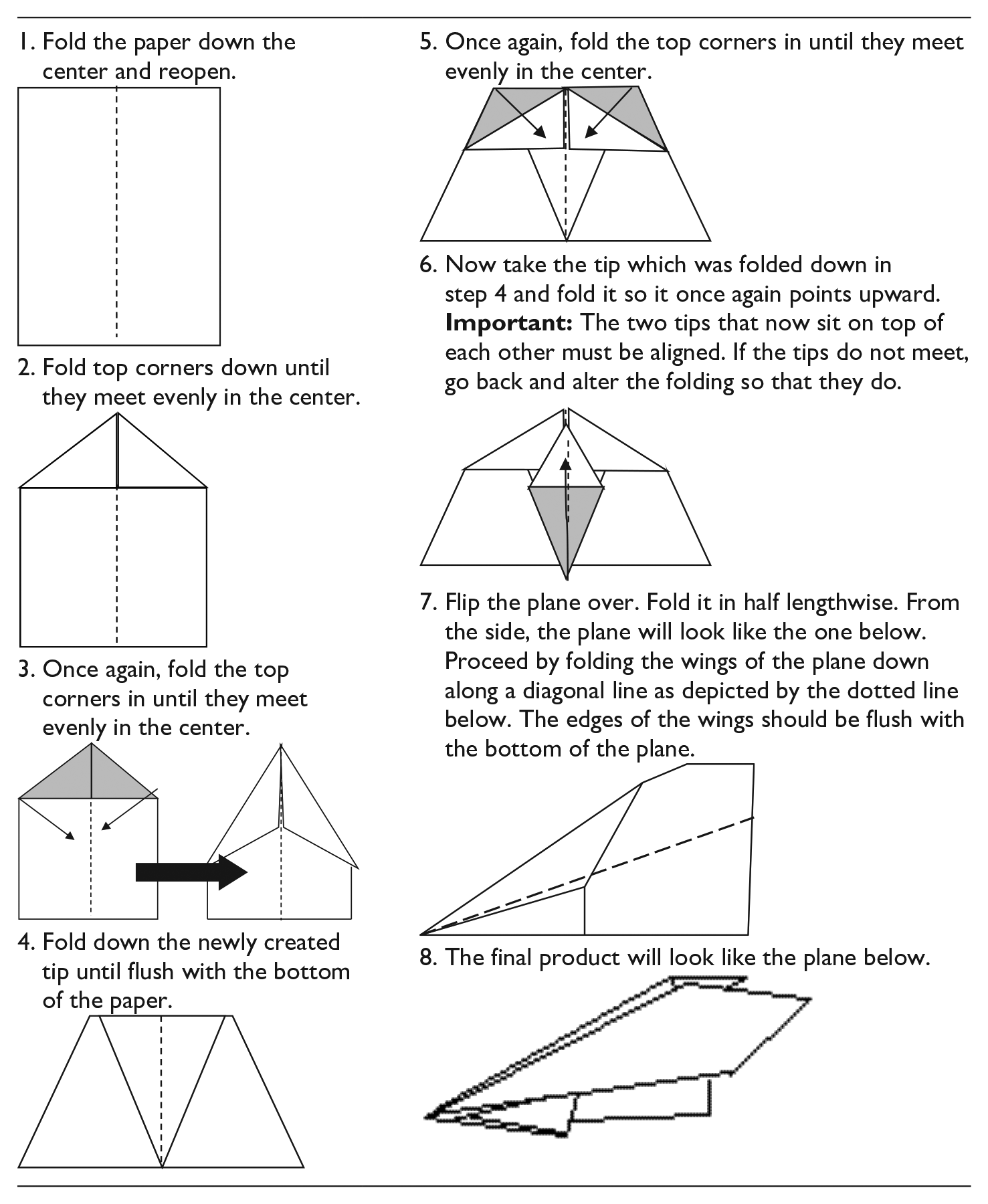
| 1. Fold the paper down the center and reopen. 2. Fold top corners down until they meet evenly in the center. 3. Once again, fold the top corners in until they meet evenly in the center. 4. Fold down the newly created tip until flush with the bottom of the paper. |
5. Once again, fold the top corners in until they meet evenly in the center. 6. Now take the tip which was folded down in step 4 and fold it so it once again points upward. 7. Flip the plane over. Fold it in half lengthwise. From the side, the plane will look like the one below. Proceed by folding the wings of the plane down along a diagonal line as depicted by the dotted line below. The edges of the wings should be flush with the bottom of the plane. 8. The final product will look like the plane below. |
Appendix E: Inventory of Supplementary Materials
The instructions provided in this article are a sample of the full set of instructions and materials the instructor will need to run the Empowering Flight Exercise. The full set of materials can be found on the supplementary materials web page provided by Management Teaching Review. Below is an inventory of the items that can be found on this page.
Declaration of Conflicting Interests
The authors declared no potential conflicts of interest with respect to the research, authorship, and/or publication of this article.
Funding
The authors received no financial support for the research, authorship, and/or publication of this article.

References
Supplementary Material
Please find the following supplemental material available below.
For Open Access articles published under a Creative Commons License, all supplemental material carries the same license as the article it is associated with.
For non-Open Access articles published, all supplemental material carries a non-exclusive license, and permission requests for re-use of supplemental material or any part of supplemental material shall be sent directly to the copyright owner as specified in the copyright notice associated with the article.
