




Abstract
As educators, we seek engaging ways to demonstrate how crucial leadership is to advancing organizational success. This exercise uniquely emphasizes how much leaders may learn from their predecessors in the same role. Participants explore leadership by researching two former Bishops of Rome—John Paul II and Benedict XVI—and the incumbent pontiff, Francis. Participants investigate the personal traits, biographies, and accomplishments of each pope to understand each leader’s style and effectiveness and make recommendations to Pope Francis using this situational data of his predecessors. In doing so, the exercise creates a perspective for how participants might enhance their own leadership skills within their own professional organizations. Variations for other organizational contexts where leadership is essential are included as well as variations for online delivery modes.
Keywords
Educators continually seek to present leadership concepts that resonate with students and contribute to their development as future leaders. We offer here an exercise where students’ reflections about leadership are paramount. The activity’s uniqueness is its focus on leaders in the same organization and how the study and reflection of predecessors may be valuable to a new leader. This leader set is in some ways incidental yet provides an interesting storyline. Leaders, of course, should never be captive to their predecessors’ agendas or approaches. On the other hand, new leaders may arrogantly reject leadership lessons of their predecessor(s) to their own peril. A leader desiring to enhance their organization’s success ideally would take counsel from various sources, including the lessons they can learn from their predecessors. We feature in this exercise Pope Francis as a current leader who might gain valuable leadership advice by reflecting upon his predecessors’ legacies.
Exploring the leadership styles, accomplishments, and disappointments of Pope John Paul II (Karol Wojtyla), Pope Benedict XVI (Joseph Ratzinger), and Pope Francis (Jorge Bergoglio) illustrates many leadership themes. Popes have executive leadership responsibility which can reveal leadership excellence or missteps. Popes oversee a complex and international organization—one that must be relevant to myriad stakeholders. The modern Roman Catholic Church cannot afford to be static. It has survived rather well for 2,000 years notwithstanding the occasional schism, scandal, and fluctuations in Church attendance. In business, “built to last” enterprises seldom endure longer than a hundred years.
Distinguished from leaders in other fields, popes are unique—being elected for life. How they are perceived and the initiatives they advance have a profound effect on the Church as a social institution. Popes also start out with built-in “followers,” having been elected by their peers, the College of Cardinals. This does not mean that internal stakeholder groups necessarily are willing “followers,” nor does it imply that each cardinal is an ardent supporter of a newly elected pope. But popes begin their leadership responsibilities with considerable goodwill, which is not always the case when “new management” is brought on board in a business setting or when there is a leadership change in government. Yet popes are not representative of all leaders, being all men, belonging to the same religious faith, and having taken vows of celibacy.
“Three Popes: Lessons in Leadership” deals with challenges two popes faced and Pope Francis is facing in leading the Church—an organization trying to maintain relevance in a fast-changing world characterized by globalization, 24/7 news coverage, divergent social viewpoints, and an array of new communication avenues. Those challenges have included how the Vatican should exert influence in matters like:
regime change, human rights, eradication of poverty, terrorism, immigration/refugees, climate change;
social controversies such as same-sex marriage, capital punishment, euthanasia;
the role of women in the Church; and
sexual abuse of minors by priests and cover-ups by bishops.
While the Church remains relevant to large swaths of the world population, its sustainability can be threatened if its lifetime-elected leader lacks leadership skills perceived as appropriate for the concerns of his tenure. We believe leaders can benefit by reflecting upon situations and leadership approaches of their predecessors although new leaders do not always build upon a predecessor’s legacy or seek guidance or inspiration from past leaders. New leaders often pursue different agendas or leadership approaches. But if they care to, the lessons of history can be compelling and informative to a leader’s own legacy.
Through an assignment hypothetically commissioned by Pope Francis, participants evaluate three popes’ effectiveness as leaders of the Church to better understand how their life stories/“roots,” the historical context within which they operated, their communication and leadership styles, and even how the selection of their names presaged what each of them viewed as their leadership priorities.
While developed for graduate students studying leadership at a Catholic university, we see no reason the exercise cannot be used at a secular university. Non-Catholics seem to perceive the Pope as an international leader—similar to how an American president is perceived outside the United States.
Learning Objectives
By engaging in this exercise, participants will be able to:
compare and contrast recent popes’ leadership styles and effectiveness—within the historical context of each pope’s tenure;
provide leadership recommendations to Pope Francis based on what he might learn from his predecessors; and
reflect how they might enhance their own leadership skills after studying these leaders and related leadership concepts.
Overview of the Exercise
In “Three Popes,” participants assume the role of a lay group of men and women called People to Pope. Facilitators are provided supporting materials including a description of the exercise logistics/materials needed (Appendix A) and step-by-step instructions for running the exercise (Appendix B). Participants are given instructions (Appendix C) to act as advisors to Pope Francis to better understand how to navigate, connect with, and advance his mission with the Church bureaucracy, the laity, and non-Catholics. Teams are formed to study Pope Francis and one of his two predecessors, either Pope John Paul II or Pope Benedict XVI, and prepare a presentation that includes the leadership lessons that may be valuable to Pope Francis. Using the “Papal Archives” as a suggested starting point, participants are encouraged to compile information on each pope—assembling data on personal attributes, professional style/effectiveness, historical context, and examples of each pope’s leadership style through quotes and actions. A glossary of unique terms used by the Church is available in Appendix C, and a suggested template for collecting this data is provided in Appendix D. The facilitator is provided with an extensive list of debriefing questions (Appendix E). Appendices C and D are also available as online supplemental materials for use as handouts.
The experiential aspect of the exercise is analyzing the data, consulting with teammates, and making recommendations to the theoretical client, Pope Francis. As a catalyst for what could be a large research effort, the authors have identified many traditional and online research sources the facilitator may choose to share with participants for leadership and papal biographical sources. These research suggestions are available as online supplemental materials, specifically Supplementals 5 and 6. While we strongly believe teams should conduct independent research, providing concrete starting points via suggested resources may ensure more baselined continuity in the approach to the exercise.
This exercise involves in-class time (for initial team discussions, presentation of team advice to Pope Francis, and class debriefing) and outside class time (for team research and preparation). Please reference Appendix B, which describes time estimates for the steps of the exercise. In-class time can be limited to 70 or 90 minutes, with the majority of other team work done outside of class.
Variations
There are two variations described for this exercise—the first relates to changing the leaders under study, and the second discusses adaptations if the exercise must be conducted fully online. For either of these variations, the exercise can easily be adapted to meet the exercise’s learning objectives.
Different Leaders Sets
The exercise might be conducted with minimal revision focusing on United States presidents or other national leaders, leaders in a particularly large complex organization (such as Apple, Disney, or General Electric), or leaders in a particular industry (such as the automotive industry). The only requirement would be that information about the leaders be publicly available.
Appendices F through H include full teaching and student materials to evaluate two pivotal U.S. presidents, President Franklin Roosevelt and President Abraham Lincoln, whose relevance in terms of leadership may be helpful to President Joe Biden. Like these two past presidents, President Joe Biden also is leading through times of national and global change, transition, and upheaval. Appendices F and G are also available as online supplemental materials for use as handouts. Research suggestions for these three presidents are available as an online supplemental material, specifically Supplemental 7.
An interesting set of public servants—besides the United States presidents—might be the current Prime Minister of Great Britain, Boris Johnson, and some of his predecessors: Theresa May, David Cameron, Gordon Brown, Tony Blair, John Mayer, and Margaret Thatcher. An interesting set of business leaders might be the current General Electric CEO Larry Culp and some of his predecessors: John Flannery, Jeffrey Immelt, and Jack Welch.
Online Delivery
This exercise was designed primarily for in-class use, but it is adaptable to either a synchronous or an asynchronous online class; in fact, one of the authors used it in a synchronous online class at the beginning of the pandemic without any problems arising. Please refer to Appendix I, Variations for Online Delivery, which describes how adaptations to a synchronous or asynchronous online course might be made.
Debriefing
We feel the flow of the debriefing is important, moving from participants’ reactions to the exercise itself to what they learned from the exercise that they might want to apply on their own leadership journey. Topics such as a leader’s communication style, authenticity, emotional intelligence, personality, charisma and cultural background naturally arise in these discussions. Included in the aforementioned Appendix E is an extensive list of debriefing questions and commentary. The commentary consists of typical student answers, common mistakes, and material students often miss. The debriefing questions are organized into six categories:
Reflections on the exercise
Challenges doing the research on popes and connecting it to leadership concepts
Organizational culture
Leadership concepts and papal behavior
Leadership lessons, and
“Take-aways” from the exercise for your own leadership journey.
Conclusion
By researching in-depth the last three popes and presenting their leadership approaches, participants should come away with reflections on leadership effectiveness and the degree to which a new leader can learn from a predecessor’s strengths or shortcomings. The debriefing itself is crucial in this regard. Not only should certain leadership theories/concepts (such as charisma, authenticity, servant leadership, and transactional vs. transformational leadership) become more vivid, but participants should become increasingly aware that leadership excellence often begets enterprise success. The exercise is designed to motivate participants to enhance their leadership skills through all means possible—including learning from their predecessors—in order that they may be instrumental in advancing their own organization’s success.
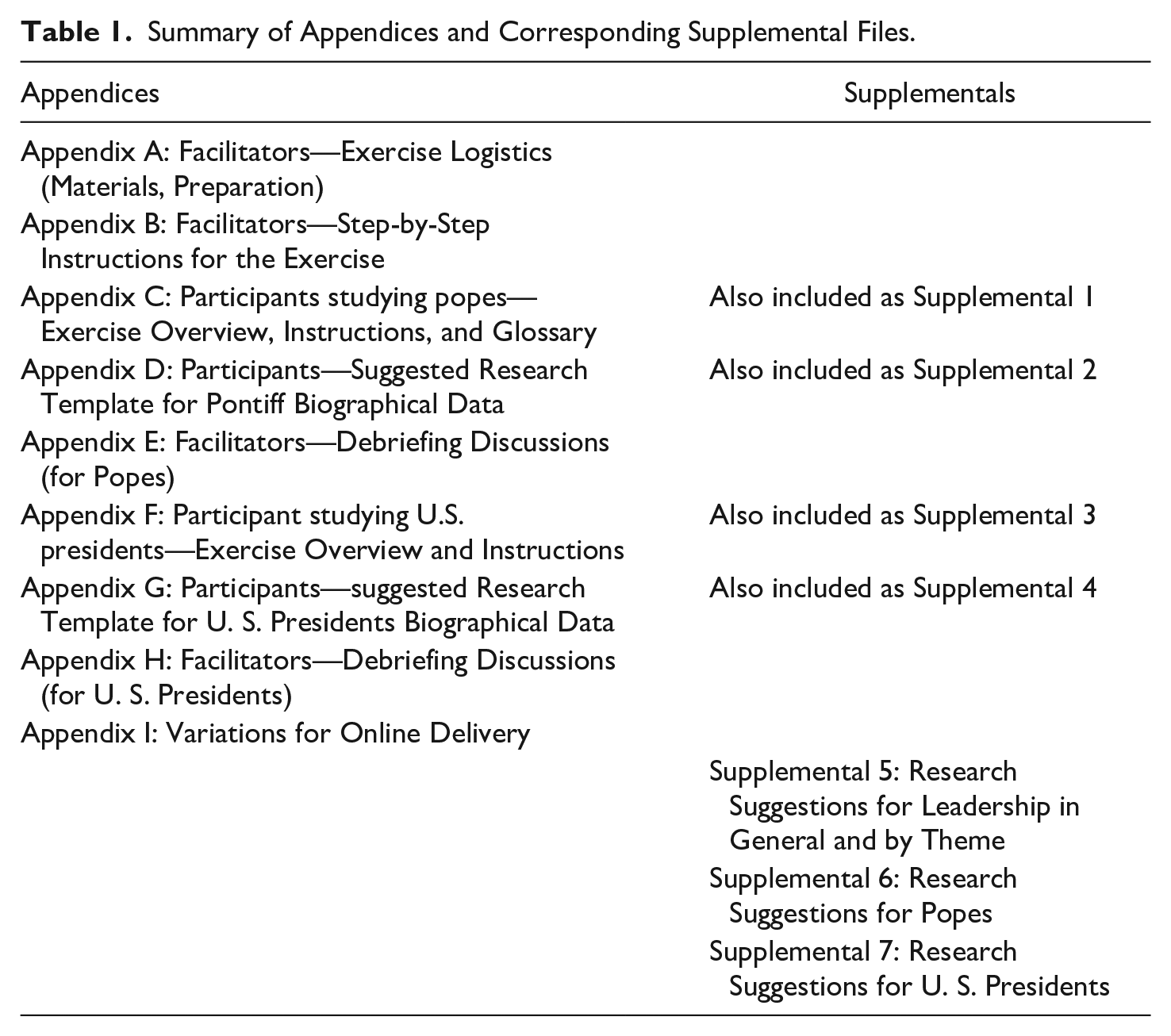
Table 1 summarizes the list of appendices as well as the online supplemental information. The supplemental information may facilitate the dissemination of instructional handouts or serve as research suggestions for studying leadership, the popes, or the U. S. presidents.
Summary of Appendices and Corresponding Supplemental Files.
Supplemental Material
sj-docx-1-mtr-10.1177_23792981221107357 – Supplemental material for Three Popes: Lessons in Leadership—The Powerful Learnings of Predecessors in Developing One’s Leadership Style and Approach
Supplemental material, sj-docx-1-mtr-10.1177_23792981221107357 for Three Popes: Lessons in Leadership—The Powerful Learnings of Predecessors in Developing One’s Leadership Style and Approach by Valerie Labun Christian and Mary Garlington Trefry in Management Teaching Review
Footnotes
Appendix A: Facilitators—Exercise Logistics (Materials,Preparation)
Appendix B: Facilitators—Step-by-Step Instructions for the Exercise
This exercise was designed for MBA courses in which the majority of the participant research and preparation takes place outside of class. Facilitators can decide, however, how to balance the in-class and outside-of-class work as best for their particular courses. Table B1 shows recommended time estimates for each of the stages of the exercise.
Appendix C: Participants Studying Popes—Exercise Overview,Instructions,and Glossary
Recently you were selected by Pope Francis to join a lay group of men and women called People to Pope. This recognition is richly deserved. The program calls upon distinguished leaders from all faiths and all walks of life to assist the pontiff in his mission to revitalize the Church for the future. While Pope Francis admires all his predecessors, he would like you to focus your attention on the two most recent pontiffs, Pope John Paul II and Pope Benedict XVI, whose relevance in terms of leadership effectiveness/ineffectiveness may be beneficial to him.
His direct request is: “Reflecting upon the leadership approaches of my two predecessors, what leadership advice would you give me? More specifically, what aspect(s)—if any—of their leadership should I try to emulate more? Why? If none, why not?”
The last three popes combined tenures as Bishop of Rome began in 1978 with the historic naming of the first Polish pope and the first non-Italian pope in more than 400 years, Pope John Paul II; continued in 2005 with Pope Benedict XVI, the first pope to resign (in 2013) since Pope Gregory XII in 1415 and the first to do so on his own initiative since Pope Celestine V in 1294; and continues now with Pope Francis, the first Jesuit pope, the first non-European pope, and the first South American pope.
As you know, over the past several decades, the Church has been pummeled by world events, scandal, and general disaffection. And while the Church’s influence and membership have grown in Latin America and Africa, its influence has declined in Europe and the United States.
Therefore, Pope Francis is soliciting advice from the People to Pope program to complement the advice he’s being given from the Curia, which may or may not have its own agenda. At the end of these instructions, refer to Table C1, a glossary of terms commonly used by the Church.
You are being placed in one of several teams to present your ideas of leadership to Pope Francis. You should view this as a unique opportunity to study the relationship between a predecessor’s leadership style and one’s own leadership style and effectiveness. In doing so, you—as an incoming leader—can better evaluate how studying the legacies of your predecessors may enhance your own leadership effectiveness.
Appendix D
Participants—Suggested Research Template for Pontiff Biographical Data.

| Personal attributes | Professional style and effectiveness |
|---|---|
| Personality Traits, Education, Talents | Symbols/Images—including the symbolism of the name taken |
| Background, Culture | Message and Goals |
| Issues Faced in Life (Early Life Influences, Personal Struggles) | Leadership Style |
| Times He Lived In | Common Nouns Used to Describe Him |
| Common Adjectives Used to Describe Him | |
| Big Events/Issues Faced in His Pontificate | |
| In His Own Words—regarding the role of the pope |
|
| His Mission for the Church |
Appendix E: Facilitators—Debriefing Discussions (for Popes)
Facilitators will want to conduct debriefing discussions in ways that are consistent with the learning objectives of their particular courses. There could be several different areas on which to focus.
Appendix F: Participants Studying U.S. Presidents—Exercise Overview and Instructions
Recently you were selected by President Joe Biden to join a group of esteemed colleagues called People to President. This recognition is richly deserved. The program calls upon distinguished leaders from many walks of life to assist the new president in his mission to “Build-Back-Better” and restore the United States’ prestige on the world stage. While President Biden admires several of his predecessor presidents, he would like you to focus your attention on
His direct request is: Reflecting upon the leadership approaches of two of my predecessors, Abraham Lincoln and Franklin Delano Roosevelt, what leadership advice would you give me? More specifically, what aspect(s)—if any—of their leadership should I try to emulate more? Why? If none, why not?
As you know, over the past several decades, the country has faced its share of challenges: 9/11, the Great Recession, the rise of emerging economies like China and India, scandals, grass-roots political movements, climate-induced disasters, the COVID-19 pandemic, and last, but not least, a bellicose Russia creating global disorder due to its invasion into Ukraine. These challenges have been aggravated by increasing economic and political divisions within the citizenry. And while the United States’ influence remains high, its influence has declined with some of the country’s previously-staunch Western allies.
Therefore, Joe Biden is soliciting advice from the People to President program to complement the advice he’s being given from his own Cabinet and Congressional leaders, but some of his staunchest supporters may not fully share in the ideas/policies of the Biden-Harris administration.
You are being placed in one of several teams to present your ideas to President Biden. He is inviting you to the Oval Office to remind him of the leadership lessons of these two presidential predecessors who rose to the same pinnacle of power as he now holds. You should view this as a unique opportunity to study the relationship between a predecessor’s leadership style and one’s own leadership style and effectiveness. In doing so, you—as an incoming leader—can better evaluate how studying the legacies of your predecessors may enhance your own leadership effectiveness.
Appendix G
Participants—Suggested Research Template for U. S. Presidents Biographical Data.

| Personal attributes | Professional style and effectiveness |
|---|---|
| Personality Traits, Education, Talents | Symbols/Images |
| Background, Culture, Party Affiliation, Experience in Elected Office (local, state, national) | Message and Goals |
| Issues Faced in Life (Early Life Influences, Personal Struggles) | Leadership Style |
| Times He Lived In | Common Nouns Used to Describe Him |
| Common Adjectives Used to Describe Him | |
| Big Events/Issues Faced in His Presidency | |
| In His Own Words [Franklin D. Roosevelt]—regarding tenacity and overcoming what life throws at you “…the only thing we have to fear is fear itself…” (Roosevelt, 1933)“When you reach the end of a rope, tie a knot in it and hang on.” (Franklin, n.d.) |
Appendix H: Facilitators—Debriefing Discussions (for U.S. Presidents)
Facilitators will want to conduct debriefing discussions in ways that are consistent with the learning objectives of their particular courses. There could be several different areas on which to focus.
Appendix I: Variations for Online Delivery
As mentioned in Variations, this exercise was designed primarily for in-class use but is adaptable to either a synchronous or an asynchronous online class. Please refer to Appendix B for the stages of the exercise that might need to be handled somewhat differently in an online environment.
In an asynchronous online course, which would be more challenging, the facilitator could provide a narrated lecture for Stage 1 (introduction and team assignments), post the instructions and support materials to their course management system (e.g., Blackboard), instruct participants to arrange times to meet for Stage 3 (teams meet, share, and develop advice) and Stage 4 (team time to develop presentation materials), have them narrate and post their presentations to the course management system, and then use a discussion board or survey to conduct the debriefing.
In a synchronous online course, Stage 1 (introduction and team assignments) would be done in-class virtually, referring to instructions and support materials already posted. Stage 3 (teams meet, share, and develop advice) might be best conducted as an in-class Zoom meeting using breakout rooms where the facilitator can join in to answer questions and assure progress. Ideally, Stage 5 would be synchronous team presentations, and Stage 6 would be a synchronous debriefing, possibly followed up with a discussion board or survey if the learning from the debriefing deserves more attention.
Acknowledgements
The authors want to express their gratitude to two individuals who provided extremely constructive feedback on this experiential exercise. We are particularly grateful to Dr. Joe Seltzer, MTR Associate Editor—Experiential Exercises, for his generous support and thoughtful suggestions. Also, we are thankful to Dr. Jane Schmidt-Wilk, MTR Editor, for her valuable recommendations that gave the exercise more focus and will broaden its appeal to educators.
Declaration of Conflicting Interests
The authors declared no potential conflicts of interest with respect to the research, authorship, and/or publication of this article.
Funding
The authors received no financial support for the research, authorship, and/or publication of this article.

References
Supplementary Material
Please find the following supplemental material available below.
For Open Access articles published under a Creative Commons License, all supplemental material carries the same license as the article it is associated with.
For non-Open Access articles published, all supplemental material carries a non-exclusive license, and permission requests for re-use of supplemental material or any part of supplemental material shall be sent directly to the copyright owner as specified in the copyright notice associated with the article.
