



Abstract
This study explores texts used in four 7th-11th grade teachers’ history/social studies lessons and these teachers’ perspectives about the texts. Specifically, data from interview and observation field notes were analyzed to determine (a) the number, types, and modes of texts teachers used in their lessons and (b) teachers’ perspectives on the what, why, and how of their text selections and uses in their lessons. The data demonstrated a relation between the number, types, and modes of texts teachers used in their lessons and the focus of teachers’ explanations about text selection and uses. The results of this study suggest that the teachers’ textual decisions in their lessons may relate to their reasoning about syntactic structures of the discipline of history. In particular, the extent to which and how teachers framed literacy as an integrated tool to engage students in historical inquiry varied among teachers. This variation was related to the number, types, and modes of texts they used in their lessons.
In history/social studies, discipline-based literacy practices entail interpretation of past and current events through close analysis and synthesis of multiple sources (Monte-Sano, 2008; Wineburg, 2001). Documents from the time period under study and documents written about the event/time period are examined and used as evidence to develop grounded arguments. Considering the central role of texts in history, teachers’ decisions about texts are some of the most important decisions they have to make. Decisions might range from selecting and sequencing a variety of sources that coherently paint a picture of events, to determining how students will make meaning from the texts’ language and content. Such decisions are multifaceted and involve complex considerations of subject-matter content, practices, and student learning in relation to the affordances and limits of sources.
Although current educational reform encourages teachers to foster students’ text analysis and interpretation, little is known about history/social studies teachers’ perspectives on their selection and uses of texts for these practices. Analysis of teachers’ text selections and their reasoning about the texts they use in their instruction can deepen researchers’ and teacher educators’ understandings of how to support educators’ historical epistemologies and textual decisions. This article is a multiple case study exploring four history/social studies teachers’ text selections and their explanations of why and how the texts were used in lessons. Specifically, the following research questions guided the study: What texts did teachers use in their history/social studies lessons? What are teachers’ perspectives on the what, why, and how of their text selections and uses in their lessons?
Review of Literature
Substantive and Syntactic Structures of History
Inquiry in middle and high school classrooms is shaped by the rules and norms of the relevant discipline. Each discipline has a range of established methods for asking and answering questions (Chinn & Malhotra, 2002; Shanahan & Shanahan, 2008). Shulman (1986) credits Joseph Schwab in his description of disciplines as comprising both substantive and syntactic structures. Substantive structures include the content or the organization of interconnected concepts and principles. A discipline’s syntax involves the “set of rules” in the domain and what consists of “breaking the rules” (Shulman, 1986). Knowing what counts as a valid, answerable question; an appropriate set of methods to seek answers; and warranted ways of communicating results are all elements that make up the syntactic structure of disciplines (Shulman, 1986). Engaging in disciplinary inquiry is employing agreed-upon methods for constructing knowledge; it is an active interplay between the discipline’s substance and syntax. As Hillocks (2010) elucidates, “the process of working through an argument is the process of inquiry” (p. 26).
History is “evidence-based interpretation in which inquiry is central” (Monte-Sano, 2008, p. 1046). The substance of history includes knowing details about significant historical actors and events as well as explaining phenomenological relationships and categorizing information in meaningful ways. For example, historical content knowledge entails knowing the details surrounding Rosa Parks’ refusal to give up her bus seat from a legal, social, political, and ideological perspective. The syntax of history is continual reinterpretation of the past (Rouet, Britt, Mason, & Perfetti, 1996). It is questioning accounts and arguing for different or more nuanced stories. For example: On December 1, 1955, was Parks a tired, old woman who had reached her breaking point with giving up her seat to white folks and complying with abusive bus drivers? Or was she a strategic civil rights activist working in collaboration with others, intending to stir up commotion in anticipation of an impending bus boycott?
Historical inquiry is engaging in disciplinary literacy practices, or “doing” history (Lee, 2005). This type of learning in a classroom necessitates an iterative interrelationship between helping students develop a “deep foundation of factual knowledge” (Lee, 2005, p. 80) and honing historical habits of mind. Central to this inquiry is analyzing texts—interrogating competing narratives and thinking critically about evidence across multiple sources (e.g., Monte-Sano, 2008; Nokes, Dole, & Hacker, 2007).
Teachers who aim to foster historical inquiry in their classrooms need to scaffold students’ learning of the substantive and syntactic structures of history. In classrooms, historical inquiry involves decoding and comprehending documents of all kinds, closely reading and making inferences within and across sources, and constructing arguments based on those inferences. History teachers need to be adept at organizing a combination of sources and at carefully considering the substantive merit each text offers as well as how their students will engage in disciplinary ways within and across sources.
Multiple Sources
Fostering historical inquiry in classrooms requires the use of multiple sources. Some research suggests that engaging with multiple texts encourages historical practices, even when such literacies are not the explicit focus of instruction. For example, VanSledright and Kelly (1998) found signs of fifth graders’ emerging critical thinking and evaluation of the reliability of sources when they engaged in research about a historical topic using multiple sources. The authors proposed that, “knowing the historical ‘what’ and knowing the historical ‘how’ and ‘why’ develop simultaneously” (VanSledright & Kelly, 1998, p. 260). In other words, inquiry with multiple sources supports the development of substantive and syntactic structures of the discipline. Nokes, Dole, and Hacker (2007) conducted a quasi-experimental study examining four conditions, comparing type of text (traditional textbook versus multiple sources) and type of instruction (content versus heuristic focused). The principal finding of the study was the importance of using multiple sources. The researchers reported that “across all conditions, students who read multiple texts learned more than students who read single texts” (Nokes et al., 2007, p. 502).
Not surprisingly, however, the most common source used in middle and high school history classrooms is the textbook (Nokes et al., 2007; Paxton, 1997). Some research points to the limits of using textbooks to learn history (e.g., Paxton, 1997; Wiley & Voss, 1999). The most obvious adverse feature of history textbooks is the lack of authorial voice (Paxton, 1997). Students tend to read textbooks passively, deeming them as trustworthy sources with which to extract facts rather than to question or read critically (Paxton, 1997). Assuming students should engage in disciplinary practices such as comparing evidence across sources, using textbooks as the main source of information is not conducive to doing history.
Removing textbooks completely from the curriculum, however, is not necessarily the answer. Instead, as Moje (2010) advises, teachers should strategically think about how texts, including textbooks, can be juxtaposed to produce dissonance about events and people, pushing students to think critically about varying perspectives on the same topic.
Integrated Literacy Practices
The literacy practices utilized in analyzing varying perspectives and competing narratives make up the syntax of the discipline and cannot be separated from knowing the substance of the discipline. However, literacy in content-area classrooms is often thought of as disconnected from learning content and approached as teaching a set of discrete skills to “improve reading or writing of content-area texts” (Moje, Sutherland, Solomon, & Vanderkerko, 2010, p. 5). When engaging students in authentic disciplinary inquiry, however, literacy serves as a tool used to reconstruct content knowledge of the domain (Moje et al., 2010).
In history, analyzing multiple sources to develop evidence-based claims encompasses a host of literacy practices and a wealth of background knowledge. Although the literacies employed when doing history can be engaging and empowering for students, they also have the potential to pose a myriad of challenges. For instance, textbooks can include confusing organization and can place “extensive prior domain knowledge demands on readers” (Moje, 2010, p. 55–56). Primary sources can contain antiquated language that is foreign to students, syntax that is difficult to untangle, and vocabulary and concepts that are obscure and unfamiliar. Thus, making meaning from these varied sources can require an integration of literacies, such as engaging one’s schema of various genres and text structures, synthesizing key ideas across several accounts, and noticing authors’ word choice and inferring their purpose and perspective as relates to the historical context.
Saul and Dieckman (2005) note the importance of matching a text’s vocabulary and structure to the reader’s ability at times. But the authors also suggest the most “sensible approach is to use a variety of text types” (p. 508) to meet the “multiplicity of needs” (p. 511) when making instructional decisions. Likewise, Moje (2010) asserts avoiding certain texts is not the answer. Instead, disciplinary teachers need to analyze sources to “decide whether texts need to be scaffolded in terms of vocabulary, prior knowledge, and discourse” (p. 60) to move students toward independent meaning making of complex texts. In history, the ultimate goal of this meaning making is constructing evidence-based interpretations.
Little is known about the what, why, and how of teachers’ decisions about disciplinary texts, especially in history. The current study provides a starting point for building understanding about history/social studies teachers’ textual decisions and their reasoning about these decisions vis-à-vis the substantive and syntactic structures of the discipline.
Method
Participants
The collection of data for this study occurred in the context of a larger project focused on supporting evidence-based argumentation and multiple text use in middle and high school history, science, and language arts classrooms (Goldman et al., 2016). For the first phase of the larger project, a purposeful sample of 34 history, science, and language arts teachers was selected. Participants were teachers who reported using literacy practices in their disciplinary instruction and who were highly regarded by researchers and administrators as “effective and engaging” teachers (Litman et al., 2017, p. 89). To inform future interventions for the project, analysis of the larger study described learning opportunities teachers provided in their classroom instruction to support students’ text-based argumentation (Litman et al., 2017).
The current study utilized interview and observation data from the four history teachers from schools in a large, Midwestern city or in suburban districts near the same city. This study focused on teachers’ textual decisions and their perspectives about these decisions in their history/social studies lessons. Participants included two males and two females, and the number of years teaching ranged from 3 to 11 (see Table 1). Kari and Brent (all participant names are pseudonyms) were in two different schools in the same urban district; Lance and Julianne were in two different schools in the same suburban district. Julianne was observed twice in two grade levels and subject areas, allowing for a comparative analysis between teachers and a within-case analysis of one teacher. Thus, there were a total of five lessons observed across the four teachers.
Teacher Participant Demographics.

Data Collection
Each teacher was observed teaching one lesson across two consecutive days in one classroom. Prior to the observed lesson, teachers completed a preobservation questionnaire about their planned lessons via e-mail. The questionnaire included questions about the texts teachers intended to use for their lesson as well as other questions about the lesson and their teaching context. For each observation, lessons were videotaped, and two researchers took field notes. Observers also collected artifacts of the lesson (e.g., texts, graphic organizers, and student work). After the second day’s observation, semistructured interviews were conducted in person or over the phone. Teacher participants were asked to reflect on their lesson, provide insight into choices about texts and activities, explain how routines have been established in the classroom (such as routines for reading texts), and describe how the lesson fit in to the broader curriculum of the class. These interviews were audiotaped and transcribed and averaged about 24 minutes each.
The primary sources of analysis for the current study include five written preinterview questionnaires from the four participant teachers, five audiotaped and transcribed postinterviews, and 10 individual observation field notes (one set across two days for each of the five observed lessons). Artifacts such as texts and student work samples were used for triangulation purposes and to contextualize the lessons.
Data Analysis
The first phase of data analysis involved identifying sources used in each teacher’s lesson. Sources used refer to texts that students engaged with on some level during the observation, such as previewing, reading, and discussing. Texts were catalogued from the postinterview data. Then field notes and preinterview questionnaires were checked for sources used in the lesson but not mentioned in the postinterview.
Texts were catalogued along two predetermined dimensions. Texts were coded for source type: primary source (written during the time period under study), secondary source (document that interprets or analyzes primary sources), or tertiary source (e.g., textbook and encyclopedia). Texts were also coded for mode of sensory or cognitive input: written text, visual representation (i.e., image/photo), audio, and audio/visual (i.e., video). Categories were refined and operationalized through constant comparative methods (Corbin & Strauss, 2007) to determine consistency in coding.
Using grounded theory methods (Corbin & Strauss, 2007), pre- and postobservational interview data were coded for the second phase of analysis. Teachers’ explanations were coded for each indexed source. Explanations included teachers’ reasons for selecting and using texts. Explanations also included teachers’ beliefs and concerns about issues related to texts, such as how sources lend themselves to specific learning goals or how texts contain relevant history content. Teachers’ nontextual comments, or statements not directly related to the selection or use of texts, were also coded and tracked separately. These nontextual explanations were used to obtain a more complete picture of participants’ conceptions of the lesson.
Six explanation code categories emerged from analysis. Forty-four total textual explanations spanned those six coded categories. Many statements were coded for more than one category simultaneously. Table 2 provides a description and example of each code category. Code categories were examined for emerging themes and patterns among the teachers’ explanations. Teachers’ explanations were then characterized in terms of the focus of their talk, such as the extent to which their explanations focused on literacy and/or history issues.
Explanation Code Categories.

The third and final phase of analysis entailed looking across the texts identified in the lessons and comparing them to themes found in the interview data to determine if any further patterns emerged about the relation between the texts used and teachers’ explanations about them.
Results
This section first describes a pattern of the number, types, and modes of texts teachers used in their lessons. The section then describes the focus of teachers’ explanations about text selection and use in relation to that pattern.
Sources Used in Lessons
Results indicate teachers either used (a) one to three tertiary sources or (b) multiple source types and modes in their lessons (see Figure 1). Two teachers—Brent and Kari—used one to three tertiary sources in their lessons. Brent used one written tertiary source across the two days of instruction. His lesson about women’s suffrage centered on asking and answering questions from one expository trade book. Kari taught two different topics in two days to her seventh-grade students—the French Revolution and U.S. political parties. Across both days and topics, she used three tertiary sources, two of which were written and one video.
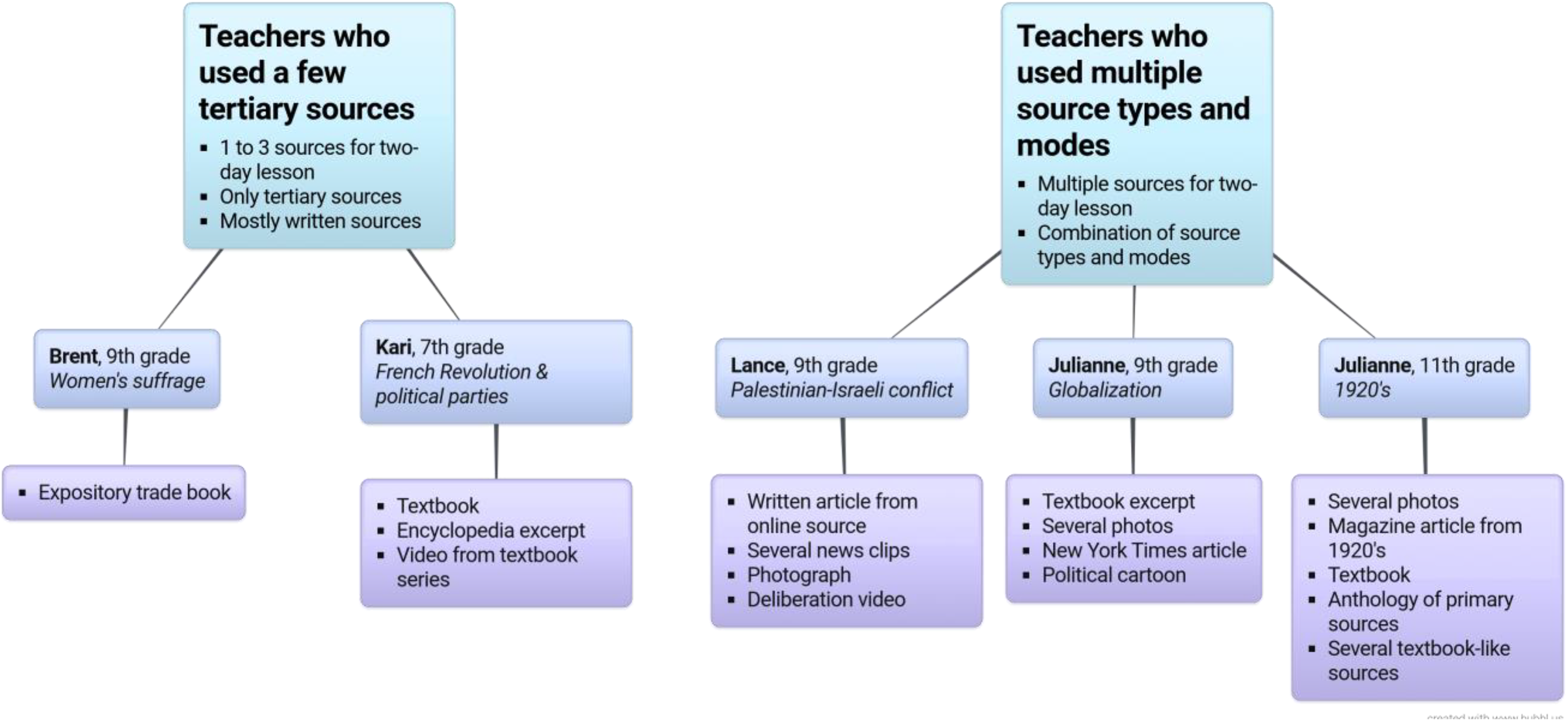
Patterns of teacher text use.
The other two teachers—Lance and Julianne—used multiple source types and modes in their lessons. Five of the six sources used in Lance’s two-day lesson were visual or audio/visual modes and one was a written text. Four of the six texts were primary sources and two were secondary. His lesson about the Palestinian–Israeli conflict included one photo and three news clips with raw footage of the conflict. The news clips were considered primary sources because they represented viewpoints of participants involved in the event at the time of the conflict. A fourth video was a deliberation between two people in a U.S. news clip. This video was considered a secondary source because the deliberators’ perspectives were further removed from the event and likely depended on primary sources (such as those like the first set of videos) to make their claims. The lesson also included one written secondary source about the conflict the teacher revised from a website.
In Julianne’s ninth-grade lesson about globalization, she used 15 sources, 13 of which were primary, one was secondary, and one was tertiary. Of the 15 sources, 13 were visual representations and two were written texts. Julianne used a series of 12 photos that were considered primary sources because they comprised original pictures of places and artifacts (i.e., a rotary phone, a local restaurant, and a KFC in China). The lesson also included a visual, which was a primary source political cartoon; a written, tertiary textbook; and a written, secondary New York Times article.
In Julianne’s 11th-grade lesson about the 1920s, the two-day lesson included 19 sources, 13 of which were primary and six were tertiary. Primary sources included audio, visual, and written sources: a magazine article excerpt read aloud to students, written by a woman from the time period (audio); four photos projected on the large screen (visual); and an anthology of primary sources (written). Tertiary sources were all written texts, which included the students’ textbook and several “textbook-like” sources.
Teachers’ Explanations About Text Selection and Use
What follows are descriptions of foci for each teacher’s explanations vis-à-vis the above described patterns about source use across teachers’ lessons. Most quotes included are from postinterview transcripts and are therefore not labeled; excerpts from teachers’ preinterview questionnaires are indicated as such.
Brent: Helping students become independent readers
Brent, who used one tertiary source in his lesson, had explanations characterized as literacy focused. Brent’s talk centered on supporting students’ literacy needs and the instructional strategies he used to support students’ reading, both in the observed lesson and for the overall class. For example, Brent commented that “a certain number of kids really can’t read the material on their own” and described how he scaffolds students’ engagement with texts to help them become better general readers. He explained that “the focus of the class is to teach independent reading” so when students “run into things that seem to be challenging they don’t give up on it.” The class he taught was an English and history class guided by the Reading Apprenticeship framework (Greenleaf, Schoenbach, Cziko, & Mueller, 2001). He identified several examples of reading strategies he worked on with his students throughout the year, such as: “I have [students] identify their roadblocks, what might be confusing to them, their connections and their questions.” “We teach [students] how to connect with texts, like how there are three different types of connections—text to world, text to self, and text to text.” “We also work on getting the gist, getting the main idea, chunking sentences, chunking words, paragraphs, anything that is long or confusing we break it up.”
Kari: Literacy instructional strategies to support comprehension of content
Kari, who used three tertiary sources in her lesson, had explanations characterized as blended-literacy focused. Her talk centered on literacy issues in relation to two other code categories—pedagogical issues and the historical content of her lesson. Kari talked about specific literacy strategies she taught or tasks she led in service of students understanding the content of texts. For example, she stated that she guided students in writing “Cornell Notes,” where students included “main ideas and questions on the left, answers and details on the right,” and “at the end [students] write a summary.” Kari also explained how students throughout the year have worked on “looking for root words and applying knowledge of root words to the actual word” and that they practice doing it “in context a lot to make meaning of text.” For the observed lesson, Kari expressed surprise that her students didn’t use their “ability to figure out what ‘foreign policy’ would mean from knowing the words ‘foreign’ and ‘policy’” during a pre-reading vocabulary activity.
Kari also talked about differentiating instruction for her students by providing leveled texts to support their comprehension of the content. She explained how the text for day two of the lesson, the encyclopedia excerpt, was “really nice because that resource is leveled” which “helped me differentiate the texts, as I had my groups leveled based on their reading level.” She commented that she was disappointed though, because she “thought it would be more engaging and interesting,” but that even her “highest students” didn’t “pull out the main idea” from the text. Kari did mention, however, that the video on day one was a good “visual engagement” for students because “short videos like that” help students “get a visual of the topic of the French Revolution and what was going on.”
Thus, Kari’s explanations focused on literacy strategies and pedagogical supports aimed at helping students comprehend the content of the texts. She made one comment about a discipline-specific practice, considering perspectives in history, when she explained the importance of students understanding one section of the textbook about the French Revolution. She stated, “the idea of perspective, that concept of the different countries’ perspectives are really key in social studies.” She explained that she had students take notes using “thought bubbles” as a way for students to “process the idea of the perspective and what the countries’ perspectives were during French Revolution, a way to engage [students] in a [visual] format that’s not just written.” However, Kari did not talk about, nor was she asked about, students discussing or writing their interpretations of what various country’s perspectives meant or reasons for these perspectives. (Such discussions were also not observed in the taught lesson.)
Lance: Summarizing texts to develop evidence-based arguments
Lance, who used multiple source types and modes in his lesson, also had explanations characterized as blended-literacy focused. However, Lance’s explanations reflected a greater focus on engaging students in discipline-specific practices than Kari’s. Lance’s comments were dominated by talk of honing general literacy skills with texts, such as summarizing and determining the main idea, in service of students building evidence-based arguments, a key historical practice.
Lance’s observed lesson involved students viewing visual and audio–visual (video) sources and preparing for a final oral deliberation about the Palestinian–Israeli conflict in small groups using the teacher-adapted written source. Specifically, students addressed the question, “Should the Palestinians have the ability to establish a Palestinian state?” (teacher PowerPoint slide). Lance explained the ultimate goal for the overall unit was to help students move away from “opinion” to using “facts, actual evidence” in their arguments. Lance described various texts he used throughout the unit prior to and in the observed lesson. He emphasized repeatedly, in different ways, the importance of students summarizing and finding the main ideas of these texts to draw evidence for their arguments about the topic.
For instance, Lance explained that prior to the observed lesson students read a “picture-based timeline” where they “pull[ed] out images and main ideas” and determined “not complete summaries, but more main ideas.” He described a documentary the students had watched where “they summarized each character and what was going on with each character.” For the written text in the observed lesson, Lance explained that he and the students “spent two days going through those readings, annotating, summarizing each paragraph, sort of making connections from what we already knew into that reading.” He explained the “whole goal” of the unit was for students to “summarize each one of those pieces of texts, take out the main ideas from those pieces of texts and use them for their argument.”
Developing evidence-based arguments from multiple sources is the essence of disciplinary inquiry in history. In reflecting on students’ oral deliberation, however, Lance expressed disappointment that students weren’t using evidence as much as he would have liked. For instance, he commented, “I really wish [students] would have taken evidence from the text, you know specific dates, you know ‘look this is what happened here, you know in 1993 and we tried to do this but it wasn’t effective.’” It is unclear how many of the texts the students engaged with prior to the observed lesson would be categorized as primary sources or written texts, but the observed lesson and Lance’s interview comments suggest the majority of sources were audio/visual rather than written texts. Furthermore, Lance described the main, written source students used to construct their arguments—the teacher-adapted written text—as “definitely a lower level reading.” Lance had revised the source he obtained online because he thought it was “too easy to pull evidence from,” and it was biased toward one side of the argument. Lance stated that if he used the article again he would “tweak it a little more maybe to provide more argumentation for the ‘give the Palestinians a state’ side.” Lance’s emphasis on summarizing sources and students having to draw mainly from one “easy” secondary written source may be related to the lack of evidence in students’ oral arguments.
Julianne: Analyzing multiple sources to develop evidence-based interpretations
Julianne, who also used multiple source types and modes, had explanations characterized as history focused for both her 9th-grade and 11th-grade lessons. Julianne’s talk emphasized students gaining a clear understanding of texts’ content and engaging in historical practices—analyzing multiple sources in order to address an overarching inquiry/focus for the unit. For example, in her preobservation questionnaire for her ninth-grade lesson, Julianne explained students would engage in “analyses of slides, an article, and a political cartoon” to “gain a better understanding of the global economy.” Similarly, her preobservation questionnaire for her 11th-grade lesson stated, “students will analyze multiple sources” in order to “create a cohesive set of historical facts and evidence that support claims into four areas of inquiry for the 1920s.”
Similar to Lance, Julianne emphasized the importance of students developing evidence-based arguments via engagement with multiple sources. However, Julianne’s explanations moved away from a focus on merely summarizing the key idea of texts to an emphasis on questioning and analyzing sources to determine the reliability of information to construct valid interpretations. For instance, she explained: What I have found in their writing is that students in general just pick whatever evidence they can remember rather than looking at an argument and deciding which piece of evidence is the best evidence to prove what [they’re] trying to argue. So, the catch phrase that my colleague and I came up with is “all evidence is not created equal.” So, in certain instances there’s better arguments to support a cause, you know to support your argument. And that’s truly the motivation behind the [unit].
Julianne’s 11th-grade lesson entailed students preparing for an oral deliberation of an overarching question about the 1920s. As noted in the observation field notes, students worked in small groups, with each student analyzing multiple sources along one of four dimensions of focus for the inquiry: economic, legislative, cultural, and race/ethnicity. Students compiled evidence and used a T-chart to investigate both sides of the argument for their dimension. Julianne explained in her postinterview that during the oral deliberation that followed the observed lesson, she “challenged a couple of students on their thinking because it was evident that they were not choosing the best evidence to support what they were trying to claim.”
Julianne explained that she supported students’ evidence-based interpretations through various scaffolds, such as providing graphic organizers and reinforcing routines for scrutinizing texts. For instance, she explained that she helps students “really dig in to a piece” and “not take it at face value” by encouraging “HOTS questions, or higher order thinking questions.” She elaborated that “the idea is ‘what questions are you asking of this document?’ And if you’re only asking ‘what,’ that’s not nearly enough.” This explanation reflects Julianne’s focus on students gaining deep understanding of texts from an inquiry stance. Julianne also described how she does read alouds and think alouds with students to “model what a good historian…what a person thinks while they’re reading the text” from a historical perspective.
While Julianne’s explanations were focused on history content and disciplinary practices, she did not disregard the importance of supporting students’ general literacies and comprehension of texts. Julianne provided a few explanations about considering the challenges of texts in relation to students’ strengths and needs. For instance, when describing her process of selecting and using texts for her ninth-grade globalization class, Julianne stated, “I always take into account vocabulary.” She explained that “If I see certain words I will rewrite the article” or “I will challenge [students]” by keeping the vocabulary intact. Julianne also explained that “the length [of the text] is something I take into consideration, especially when selecting primary sources…really the readability of it.”
Discussion
The results of this study suggest that the four teachers’ textual decisions in their lessons may relate to their reasoning about syntactic structures of the discipline. In particular, the extent to which and how teachers framed literacy as an integrated tool to engage students in historical inquiry (Moje et al., 2010) varied among teachers. This variation was related to the number, types, and modes of texts they used in their lessons.
The two teachers who used one to three tertiary sources in their lessons framed literacy as a set of skills to help students read and comprehend texts. Brent, who used one written tertiary text, focused his explanations on honing literacy skills to help his students become better general readers, without discussion of how such literacies can help students become good readers and reasoners of history texts. Brent did comment, however, that he felt “much more pleased” about his second day of the lesson because his class was “a lot more involved and focused,” as opposed to day one that represented the “status quo” of his classroom. He explained that on day two, the class “used student-generated questions” of the text, which “sparked pretty good discussion.” This one seemingly small change in his instruction, having students ask questions of the text, reflects a move in the direction of disciplinary inquiry and seemed to positively effect students’ engagement.
Kari, who used three tertiary sources in her lesson, framed literacy as a tool to access the substantive structures of the discipline (Shulman, 1986). When she mentioned a practice that could be deemed disciplinary, considering perspectives, Kari focused on students representing what the text stated about various countries’ perspectives. This focus seemed to privilege students comprehending the content of the discipline more so than the syntax of the discipline (Donovan & Smolkin, 2001), which in this case could mean exploring and constructing interpretations of various perspectives. Kari reported frustration with her students’ lack of comprehension and motivation with the texts in her lesson. Perhaps Kari’s concerns were related to her focus on helping students extract meaning from tertiary sources, which are usually absent an authorial voice with which students can ask questions and engage in conversation (Paxton, 1997).
The two teachers who used multiple types and modes of sources framed literacy as a tool for engaging in disciplinary practices—constructing evidence-based arguments. Lance expressed disappointment that students did not use more textual evidence in their final oral deliberations. Would the students’ arguments perhaps have been stronger with more and more complex written texts from which to draw evidence? Without more than one article that the teacher described as “easy” to read and “pull out” evidence, perhaps the students were limited in their resources for constructing evidence-based interpretations of the conflict. Some studies suggest effortful reading can actually facilitate meaning making (Wiley & Voss, 1999) and that if students have prior topical knowledge they actually learn more from less coherent texts because reading activates the construction of inferential links (Paxton, 1999).
Julianne also emphasized students constructing evidence-based arguments from multiple sources. However, different from Lance, Julianne focused on supporting students’ analysis of sources using various approaches and scaffolds. Julianne framed literacy as a means to understand and question the validity of texts to determine the most convincing evidence in addressing an overarching inquiry. Like Lance’s lesson, Julianne’s 11th-grade lesson culminated in an oral deliberation. In preparation, students read a variety of written primary and tertiary sources (in addition to audio and audio/visual sources), from which students could examine textual evidence to inform their final arguments. Julianne reported that students were able to “rank their evidence” before the deliberation, but that during their oral arguments, students were a little “gun shy.” Julianne reasoned that students are “institutionalized in history to believe there really is only one right answer” and therefore weren’t “confident” when there was ambiguity. Thus, Julianne emphasized the syntactic structures of the discipline. She seemed purposeful in her selection and use of texts to apprentice students into engaging in authentic reasoning and discourse of the discipline. Julianne did not elaborate, however, on whether and/or how she helped students become more confident in their arguments and more comfortable with the ambiguity of historical interpretation.
A few factors may be related to the difference in Julianne’s history-focused explanations and her related framing of literacy as a tool to engage students in historical inquiry as compared to the other teachers. First, Julianne is the only participant who was observed teaching a class with a true history label—U.S. History. Each of the other teachers was observed teaching social studies, global studies, and an English/history class. Second, Julianne is also the only teacher with a degree in history and she has taught the longest (11 years). Finally, Julianne’s history class is the oldest grade level of all the observations and the course was an advanced placement class. However, given the fact that Julianne was also observed teaching a ninth-grade global studies lesson and the explanations in her interview for that lesson were also history-centered, the age and skill level may not be a factor.
Reasoning about decisions can be difficult to articulate during one interview and challenging to elicit and identify in research. It is not possible in this study to know the extent to which the teachers considered and scaffolded students’ disciplinary practices in other lessons across the school-year. The results of this study are limited in that they are based on a small sample of participants over a short period of time. However, the findings of this study do provide an intriguing story of four teachers’ text selections and their explanations about the texts they used in a two-day lesson. Considering the fundamental role of texts in history/social studies, a more complete picture of teachers’ textual decisions is needed. This study provides a starting point for understanding the what, why, and how of history/social studies teachers’ text selections and uses in their lessons. Additional research is needed to explore what goes in to teachers’ text selections and uses to support students’ engagement in the substantive and syntactic structures of the discipline, such as integrating literacy as a tool for historical inquiry.
Footnotes
Declaration of Conflicting Interests
The author(s) declared no potential conflicts of interest with respect to the research, authorship, and/or publication of this article.
Funding
The author(s) disclosed receipt of the following financial support for the research, authorship, and/or publication of this article: The research was supported by the Institute of Education Sciences, USA