



Abstract
Speculative fiction is a powerful medium to explore possible futures, inviting literacy researchers and educators to consider the value of futures thinking as a tool for eliciting learners’ hopeful narratives about equitable, sustainable futures for their communities. Yet, when asked to imagine the future, adults and youth alike often envision dystopian stories and fail to consider the interdependencies between technological innovations and the social, economic, and environmental contexts they shape. Moreover, current pedagogic strategies for thinking about the future encourage globalized perspectives rather than stories localized in learners’ lived contexts. Using design-based research methods and informed by ecological theories that assume learners exercise agency through their actions that bring together past, present, and future, our team developed conjectures about how futures thinking might support learners’ agency in relation to sustainability activism and environmental justice. Data analyzed to test our conjectures were 18 solar futures narratives written by adult and youth participants in a solar energy research program. Findings show promise for writing practices that foster sustainability and climate change learning.
Speculation in many forms can make reality more malleable (e.g., Dunne & Raby, 2013). Speculative fiction, for example, invites writers to unsettle experience by coupling what is and what could be. That is, speculative fiction invites writers to imagine and reason with possible, plausible, or probable alternatives, often about the future. As a genre, it is widely known through the oft-dystopian lens of science fiction. For example, cyberpunk (e.g., Gibson, 2000) considers the unintended consequences of new technologies. In this view, the work of good speculative fiction is not to anticipate a future where, by way of illustration, cars provide personal transportation but rather to explore a future where cars create traffic jams (Pohl, 1968) or, more recently, not to anticipate a future with self-driving cars but rather to explore one where fewer auto accidents reduce organ donations. As a nondystopian contrast, solarpunk (e.g., Howard, 2018; Robinson, 2017) also imagines complex interdependencies of sociotechnical systems, often with hopeful futures perspectives. Finally, climate fiction (i.e., cli-fi), in its speculative form, can be characterized according to a typology of dystopian or utopian themes related to humanity’s imagined response to climate change challenges (Milner & Bergmann, 2020). Adults and youth alike navigate these genres while also actively engaging with, and sometimes leading, efforts to shape our shared global future. This study reports on efforts to develop and sequence futures thinking activities as a means of supporting speculative fiction writing that situates and envisions nondystopian, possible futures in the writer’s local, everyday world.
People of all ages are leading climate change and ecosystem sustainability activism, challenging unsustainable practices and environmental injustices (Drehobl & Ross, 2016; Sunrise Movement, 2021; Zraick, 2019). In doing so, they exhibit future perspectives that stretch beyond imagining possible future selves to also imagining possible future social and technological systems for themselves, their communities, and world ecologies. One important climate change issue is energy transitions. Given that current fossil fuel–based systems are unsustainable in the long term, renewable energy innovations—and solar energy innovations specifically—are an important part of developing solutions for a global future. Innovative energy systems are more than their novel technologies; indeed, they are inextricably linked with the social configurations and practices that support them. Moreover, transforming energy systems in response to climate change requires visions of a future that go beyond technical and material-based problem-solving to include the role of powerful, political ideas and pluralistic agency as social drivers of change (Gillard et al., 2016). Nonetheless, even individuals with high investment and expertise in renewable energy often fail to consider technological innovations in relation to their sociotechnical, sociopolitical, and social–ecological demands as well as their unintended effects on local and global aspects of the energy–water–food–poverty–equity nexus (Araujo, 2017).
Impending energy transitions present an opportunity to creatively rethink how we provide energy to communities so that it creates social and economic value rather than being a drain on resources, particularly for families in the lowest income brackets. The energy transition also creates opportunities to reimagine civic-oriented literacy education: How can we teach toward a literate citizenry empowered to envision and create sustainable energy solutions for local communities? Addressing the energy–poverty nexus and making a successful energy transformation require helping citizens imagine how they can participate in shaping a new energy future. Most importantly, it requires empowering communities to find their voice and ultimately take ownership and control over how they acquire and consume energy. We contend that literacy teachers might contribute to this empowerment by engaging learners in writing speculative fiction that invites ways of reimagining existing systems and exploring alternative future realities (Zittoun & Gillespie, 2016).
Futures thinking about sociotechnical energy transitions can be optimistic or pessimistic, with pessimism leading to a hopelessness that tends to shift agency (Ojala, 2012). While literacy educators should foster a constructively critical lens toward climate change learning (Beach et al., 2020), few studies in the humanities consider the counterbalancing role of constructive hope (e.g., Siegner & Stapert, 2020). Speculative fiction may provide a hopeful framework. That is, speculative fiction can couple reasoning and imagination, organizing interplay that may be fundamental, first, to fostering generative activities through both a psychological and emotional sense of being and, second, to fostering individual well-being (Pendleton-Jullian & Brown, 2018). Saler (2012), for example, argued that Sir Arthur Conan Doyle counterbalanced impoverished modernist discourse by recruiting imagination in service to reasoning and, further, enchantment (p. 22). Speculative fiction like Sherlock Holmes grounds reason and imagination in relation to acting in and experiencing possible worlds, echoing pragmatist philosophy’s “metaphysical standpoint in which the ontological modalities of actuality and potentiality are integrated into the very idea of an ‘event’ or ‘situation’” (Alexander, 2013, p. 326). In this sense, writing speculative fiction can combine reasoning and imagining about hopeful, potential future events that, pragmatically speaking, can seem as consequential as actual events.
Organizing futures thinking activities in relation to hopeful speculative fiction falls under the purview of literacy learning that cultivates “the human imagination and its capacity to understand the experience of others, comprehend[ing] complex problems in human terms, and creat[ing] alternative visions of the future” (Beach et al., 2017, p. vii). Yet, despite the potential of futures thinking and speculative fiction to evoke productive and hopeful futures, the review of literature below suggests three challenges for doing so. Namely, (a) people tend to envision the future with collapse markers, (b) many struggle to consider the interdependencies between technical and sociotechnical systems, and (c) current strategies for eliciting futures narratives for learning purposes tend toward global, generalized features when localized futures are potentially more powerful in continuing this thinking. Aiming to design a process to support adults and youth in envisioning productive, located speculative fiction, we guided participants through a series of activities that address these challenges.
Using design-based research methods, our interdisciplinary team of educational and sustainability scholars developed and tested an instructional process based on theoretical conjectures about how writing futures narratives supports learners’ agency by interlinking temporal and spatially located narratives, imagining possible futures for their local communities while increasing awareness of past and present local and global energy systems and energy challenges. Our endeavors were informed by ecological theories asserting that learners exercise agency as they negotiate the temporal interplay between their own past, present, and future actions (Emirbayer & Mische, 1998). Agency results from linking habitual actions from the past with a learner’s propensity to pursue change to present structural conditions and with imaginative actions that create identity and narrative into the future. Here, specifically, this study tested conjectures about how futures thinking constrains and enables learners’ agency in relation to sustainability activism and environmental justice through their construction of located futures narratives. The specific questions that guided our research are as follows:
Literature Review
Futures Thinking
Because we were interested in fostering hopeful solar world building that might foster agency for present and future actions, our processes drew more from the pragmatic optimism of solarpunk writing genres than from more dystopian speculative fiction genres. Thus, we turned to futures thinking perspectives in our design of processes to support participants’ narrative creation. Futures thinking has been described as a set of interdisciplinary theories and methods designed to help people engage in “the rigorous art of imagining” (Miller, 2003). Processes to elicit thinking about the future are used across a broad array of contexts including the arts, business, and research regarding the processes of imagining, projecting, and depicting futures (Henchley, 1978; Hunt et al., 2012; see Eschrich & Miller, 2019, for example). Futures thinking processes are designed to help individuals and groups disrupt the bounds of their conceptions by interrogating their own beliefs, thereby revealing assumptions about what we believe is and is not possible as the future unfolds (Ogilvy, 2006). Such processes are predicated on the assumption that the future emerges from ongoing interactions between the world and ourselves.
Nonetheless, previous studies of futures thinking processes show that youth and adults alike often express fatalistic attitudes toward the future. Moreover, this dystopian orientation persists even when individuals hold positive views toward technology and the potential for technology to yield positive outcomes for humanity (Cook, 2016; Threadgold, 2012). By way of example, in a study with 380 Australian high schoolers participating in surveys and focus groups, Threadgold (2012) found that “virtually all the focus group participants expressed quite apocalyptic views of the future in terms of climate change, peak oil, politics and terrorism and war” (p. 6). Among Cook’s (2016) sample of 28 Australian young adults, participants expressed pessimistic views of the future and a sense of disempowerment about their personal responsibility to these futures. Collapse events—developments in environment or politics that lead to a disestablishment of the present world order—are commonly projected by participants in futures thinking studies, even when not prompted. While in Cook (2016) and Threadgold (2012) these events were mostly expressed in negative ways, the expectation of collapse events is not inherently negative. Work by Angheloiu and her colleagues paints a more mixed picture of such events. Graduate students and professional designers tended to envision collapse events as stepping-stones along the way to sustainable futures (Angheloiu et al., 2017). However, when asked to think about their hopes and fears for future generations, youth frequently envisaged collapse event markers such as a Third World War and nuclear holocaust (Angheloiu et al., 2020).
Storytelling and Environmental Education
While futures thinking research often finds orientations toward collapse futures, parallel work in storytelling through participatory videos in climate change education shows how these pessimistic visions of the future need not be the only futures envisioned by young people (Haynes & Tanner, 2015; Littrell et al., 2020). Aligning with shifts away from climate change education as simply dispensing information to emphasize working toward action (Walsh & Cordero, 2019), these projects have participants create short films to communicate information about climate change and its consequences to their local communities. While these short films in some cases explore the potential negative consequences of climate change, they do so in a way that provides opportunities for young people to take action and responsibility in ensuring these futures do not come to pass. Although drawing from a different tradition than futures narrative work, these projects show the potential for storytelling to be used as a tool for developing agency over the future and climate change.
Theoretical Framework
Located Futures
Useful to our work are critiques by Sandford (2013) and Holfelder (2019) of views of the future in education. Sandford (2013) argued that in education, visions of the future are often based on economic activity rather than the social systems of a community. As a result, the systemic view of the future is “empty,” and possible futures are able to be arbitrarily exchanged for one another depending on the economic needs of the present. Holfelder (2019) argued that mainstream educational systems are set up with the underlying assumption that the future is unshapable, seeking to prepare learners to react to futures as opposed to shaping them. Both scholars argued for reenvisioning the future as open and shapable through agentive actions. Such calls are resonant with place-based pedagogies and sustainability education perspectives that assert, “to engender critical global literacies, we must first seek to understand our local world” (Azano, 2019, p. 108).
To reorient views of the future toward a more optimistic and agentive view of open, shapable futures, Sandford (2013) maintained that visions of the future in education must be located, explicitly recognizing place and belonging. By locating futures in a particular space, the development of the future becomes less arbitrary and more informed by context: by paying attention to what might come to pass in a particular location, it becomes possible to recognise the difference between this and the futures that will happen elsewhere, offering an opportunity to counter the general and homogenous quality of orthodox global futures, and connecting those who currently inhabit that place with those who are yet to do so. (Sandford, 2013, p. 121)
In our own design described here, we worked to have participants’ narratives take place in these located futures rather than in global dislocated contexts. Our presumption is that locating futures will foster an agentive orientation toward the future. Moreover, we contend that many who engage in such thinking will remain optimistic about the future, while remaining pragmatic about the changes individuals and our society will need to make to ensure that future.
Writing Futures Narratives
One particular thread of futures thinking is the construction of scenarios and narratives to explore the possibilities of the future. Futures narratives can be constructed for any number of purposes. Based on our understanding from the literature, we divide them into four categories according to their intended purpose: artistic, descriptive, developmental, and aspirational; of course, the purposes among them are not mutually exclusive. Artistic futures narratives are constructed primarily for the art of storytelling, for example, the film Blade Runner or the game series Fallout; indeed, any work of speculative fiction that focuses on the future would fall under this category, while primarily works of entertainment, like all art, often have deeper purposes (Pendleton-Jullian & Brown, 2018). Descriptive futures narratives are generated in studies in which researchers seek to see what kinds of futures people construct. These studies solicit futures narratives from a community or group without other associated activities (cf. Cook, 2016; Sools et al., 2015). When constructing futures narratives for developmental or aspirational purposes, the narratives are meant to have a particular use for the generators (cf. Angheloiu et al., 2017). When made for developmental purposes, futures narratives are constructed as part of a planning process for a particular initiative undertaken by a business or unit of government (cf. Rogers & Hunt, 2019). Finally, futures narratives are generated for aspirational purposes when they are created as part of a process meant to support participants’ abilities to think about and affect change to the actual future (cf. Angheloiu et al., 2020). Such was the case in the current study, as our goal for the participants was to foster participants’ hopeful, agentive, and sociotechnical perspectives on their own and their communities’ possible solar futures.
No matter what purpose they are written for, futures narratives tend to fall into types or genres. Dator’s (2009) four generic futures model is well-known and often applied to narratives generated for developmental and aspirational purposes. Dator described these generic futures by drawing on a wealth of experience coordinating developmental futures thinking workshops. They include the following: continued growth, where present patterns continue into the future; collapse, where a disaster leads to “backward” changes in society; discipline, where society reorients itself around a particular creed or philosophy; and transformation, where technological and scientific innovations (e.g., artificial intelligence, space transport) radically change society (the last two types are most likely to be seen in solarpunk genres).
When narratives are created for aspirational or developmental purposes, they are typically constructed as part of a multistep futures envisioning process. Dator (2009) suggested a six-step model: (1) appreciating the past, (2) understanding the present, (3) forecasting aspects of the futures, (4) experiencing alternative futures, (5) envisioning the futures, and (6) creating the futures (pp. 2–3). While Dator envisioned these steps as a linear process, some futures thinking work subverts this expectation. For example, consider the order of activities in Angheloiu et al.’s (2020) study with youth. Their first activity asked youth to think about the fears and hopes of prior, present, and future generations; this reflects the first three of Dator’s steps. The next activity involved creating narratives for what 2050 might be like—jumping straight to envisioning the futures without having experienced alternative futures. This experience of alternative futures came next when participants were provided with scenarios for 2050 and asked to create artifacts from that future. In the current study as well, we characterize the activities designed to inform participants’ futures narratives in terms of Dator’s steps but not following their proposed sequence.
Method
Context and Design
This study unfolded in the context of a summer engineering research program organized around team-based solar cell research projects with a national engineering research center. In relation to these collaborative efforts, synergistic activities included a speaker series, field trips, and hands-on activities that together provided deeper understanding of solar cell manufacturing and wide-ranging solar energy solutions they created. This study concentrated on a fourth set of synergistic activities: a series of five futures thinking workshops described in Table 1. The purpose of these futures thinking activities, set within the overarching program, was to support participants in coupling reasoning with imagination to foster agency related to envisioning the integration of solar energy innovation in their own community by localizing a future and considering sociotechnical aspects of solar power. Table 1 describes the activities in the order that participants engaged with them, linking each to the components of Dator’s (2009) futures visioning process.
Sequence of Futures Thinking Activities.
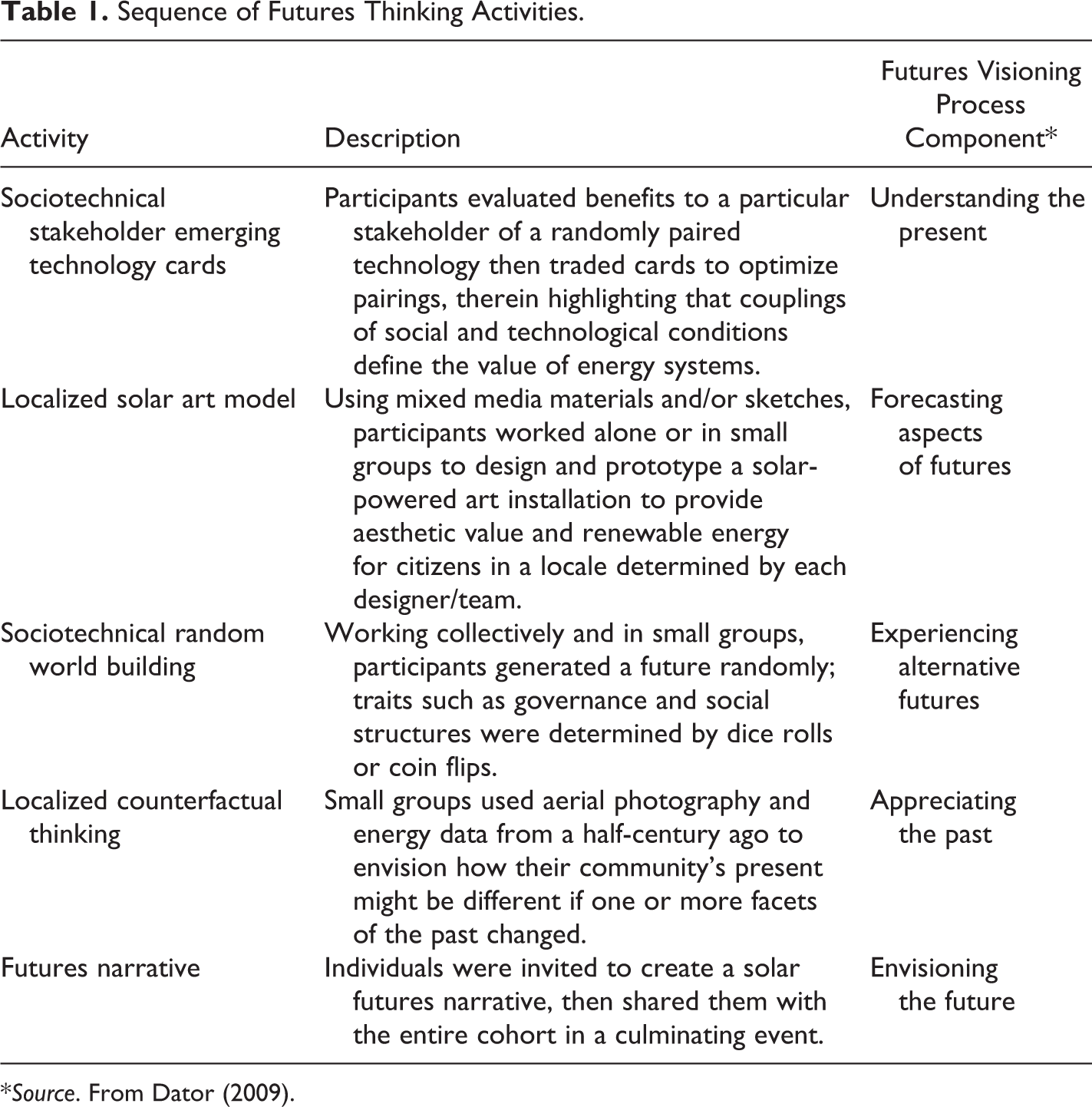
*Source. From Dator (2009).
The first four activities served as complementary components of a futures thinking process adapted from Dator’s (2009) sequence; however, in order to explore our research questions, we highlight how and why these activities uniquely organized futures thinking. In relation to RQ1, the first four activities departed from Dator’s original past–present–future ordering of components. For example, whereas Dator ordered “appreciating the past” first, our localized counterfactual thinking activity positioned it fourth in our pedagogical sequence (see Table 1). This departure challenged participants to engage with the chordal resonance of past, present, and future as interdependent and interpenetrating rather than sequentially following one from another (Emirbayer & Mische, 1998). In relation to RQ2, two sociotechnical activities concentrated on the coupling of social and technical conditions in energy systems in order to promote participants’ understanding of solar energy transitions that foster agency and energy activism. In relation to RQ3, two localized activities framed futures thinking in specific relation to the everyday worlds of the participants to situate futures thinking locally (Sandford, 2013). Together, these activities set the stage for the final activity.
The fifth and culminating futures thinking activity invited participants to create and share futures narratives, the focal data for this article. The writing prompt challenged participants not only to develop a futures narrative (RQ1) but also to draw from the previous futures thinking activities: You can use any of the characters, technologies, or worlds we’ve imagined already—or you can imagine new ones for this assignment.
The prompt also invited participants to consider the sociotechnical integration of human societies and energy systems in terms of story elements and, in turn, to focus their account on explaining the who, what, where, and why of the systems they integrated (RQ2): What are the technologies we choose to design? What is their purpose? Who could benefit most from existing technologies or technologies yet to be created? Who is adversely affected?…. Where will we build the technological systems?…. How do we work together to make visions into reality?…. How might those futures have come to be?
Finally, the prompt challenged each writer to develop a localized narrative (RQ3): Your story needs to be rooted in the lives and the communities you care about. How would these future conditions affect your school, your neighborhood, your family and friends?
Participants were given a period of 1 week to work on their narratives before sharing them with the entire cohort of participants and facilitators in a culminating event. This final activity, enacted in a read-around fashion, was framed as an opportunity to celebrate the acts of imagination and knowledge integration by each writer and the collective.
Participants
The summer solar energy research program that was the site for this study intentionally recruited youth and adult participants to establish a cross-age cohort. The cohort included three middle school youth, six high school youth, and four teachers from K–12 schools, all from the same local, metropolitan area. It also included six undergraduate engineering students from across the United States. Nine of the 19 participants identified as female. Thirteen identified as Latino/Latina, two each as Native American, Black, and White, respectively.
Data Generation and Analysis
The data generated for this study are 18 futures narratives written as part of the culminating futures thinking activity, 17 solo-authored text-based narratives, and one coauthored by a pair of high schoolers. Several submissions included additional features: one middle school youth and two undergraduate participants incorporated visual images, one middle school youth created a video-based narrative with audio narration and images, and one teacher submitted a lesson plan that incorporated the narrative.
In order to answer the first research question, theory-driven coding derived from Dator (2009) served to characterize each narrative in terms of one of four generic types of futures thinking described in our theoretical framework—continued growth, collapse, discipline, and transformational. These generic types illuminate whether and in what ways the futures thinking activities supported a hopeful, preferred, agentive perspective on the futures. Narratives were classified as continued growth narratives if they told stories of futures relatively consistent with present conditions and technologies. Collapse narratives were those where a major disaster (most often war or climate change) completely destroyed the current world order. Narratives were categorized as discipline narratives if they described a future with social structures oriented toward an overarching philosophy. Finally, futures were described as transformational if technological developments ushered in a restructuring of society.
To address the second question, the research team conducted directed content analysis (Hsieh & Shannon, 2005) of the participants’ narratives to characterize whether and how writers incorporated technical and social aspects of solar energy systems innovation. Our analyses generated and operationalized the following five codes: solar power present, solar power function specified, solar power located in a specific physical setting, sociotechnical implications of solar power and overall global conditions considered (i.e., sustainability issues and/or climate change), and technical innovation in the use of solar power present. For the third question, we again conducted content analysis to characterize whether and how writers located narratives in a particular context by coding each narrative as local (focused on a single community), global (focused on the world as a whole), or mixed (elements of local and global).
For each of the analyses, the second author (Bernier) reviewed each narrative closely, generating short summaries of the narratives and analytical notes in relation to the research questions. Then, these summaries and notes were discussed and negotiated within the research team to begin to identify what categories and codes would be appropriate for addressing the research questions. We negotiated our definitions and operationalization of codes by collaboratively coding the first two narratives, consulting the literature frequently, and drawing on Jordan’s significant experience in solar energy engineering education. Once identified, Bernier returned to the narratives and applied the codes to each one. Final coding was agreed to through discussion between the first and second authors. Both authors read through the narratives a final time, discussing each one for which there were discrepancies, co-reading, and exchanging interpretations until reaching consensus. Creating tables and graphs to aid our interpretation, the entire team then collectively reviewed the set of data to confirm the results.
Findings
Types of Narratives
To answer RQ1, we first summarize the frequency of each generic type of futures narrative. Our analyses suggest that the futures thinking activities in this study did not constrain writers to a narrow set of possible futures. Narratives resonated with each generic type, demonstrating that the writers as a whole envisioned multiple, fundamentally different futures.
Foremost, nine of 18 narratives reflect Dator’s (2009) collapse generic type. For example, Narrative 10 described a new ice age occurring 70 years in the future, putting humanity at threat of extinction. On the one hand, the disproportionately large number of collapse narratives affirm the following anecdotal reflection offered by Dator (2009): “for most of my experience as a futurist, people have not wanted to consider collapse [but] collapse has almost become the new ‘official’ view of the future for some people” (p. 9). On the other hand, younger participants generated a disproportionately smaller number of these collapse narratives. Specifically, only two of eight middle and high school youth wrote collapse narratives, while seven of 10 undergraduates and teachers did. These findings counter previous investigations in which all youth envisioned a collapse event (Angheloiu et al., 2020) and 15% to 25% of adult participants did (Angheloiu et al., 2017). This seems significant, given that apocalyptic views of the future dominate in many studies of futures thinking and that collapse event markers in youths’ narratives tend to be more devastating and final than in adults’ narratives.
Of the remaining narratives, five were classified as transformational, and three were classified as continued growth. Narrative 17, as a transformational narrative, describes the creation of a Dyson sphere leading to a postscarcity society on earth: All who live to see such ultimate harnessing of the sun will receive life changing benefits. Because of the near endless supply of energy available by use of this structure, scarcity is effectively nonexistent to the remaining humans.
On the continued growth side, Narrative 12 describes a 2035 where the transition away from fossil fuels and toward renewable energy is still ongoing and the subject of political debate. Meanwhile, only one narrative was described as a discipline type; Narrative 6 describes an island with two societies at war with diametrically opposed structures and philosophies including an accompanying watercolor depicting the geography of the island societies.
It is also important to recognize that categorizing diverse speculations on the future into four types inevitably obscures rich variations in creative expression. We therefore highlight three narratives with features that differentiated them beyond the generic types. Narrative 3 was distinct by the way it was constructed—as a collaborative two-part narrative from two high school participants. Their narrative depicts a future where the Tesla corporation is responsible for the deployment of solar panels in space and as a result has extensive influence on U.S. energy. Each writer wrote from a different perspective—one from the perspective of a Tesla employee and one from the perspective of an “average Joe” frustrated with the lack of government regulation of the corporation. Narrative 8 was the only video narrative. The writer constructed their narrative using drawings, small animations, and a voiceover to describe a transformational future where extraterrestrial life forms are instrumental in resolving issues of pollution and climate change. Finally, Narrative 12 took the unique format of a lesson plan. The writer, one of the teacher participants, created a partially complete continued growth narrative and guiding discussion questions to go along with it. The writer created this lesson to help their own students consider the possible future impacts of societies’ failing to fully explore policies to fight climate change.
Sociotechnical Emphasis
The presence and description of solar energy system elements in participants’ narratives were mixed and not as high or as elaborated as we might have hoped. In three narratives—Narrative 6, 12, and 13—solar technology is not mentioned at all, although Narratives 12 and 13 do refer to renewable energy. In their description of solar technologies, two-thirds of the narratives identify a location where structural elements would be installed (e.g., rooftops, space), slightly less than the proportion that explains cutting-edge solar technology. Among the narratives in which solar technology is present, it was rare for participants to consider sociotechnical implications of their solar innovations. Only one-third of the narratives explicitly incorporate social, economic, and/or environmental implications in their storylines. Many writers did not specify a particular function for the energy generated—or for whom, with what social, economic, and environmental impacts for particular individuals or communities. The transformational potential of renewable technologies to mitigate climate change plays a focal role in the majority of the narratives (11 of 18) and is present but not central to the unfolding story in two additional narratives.
Although most of the futures narratives describe solar energy technologies as a positive future element, few discuss sociocultural or technological innovation in a fundamental way, though with notable exceptions across all participant types. In most narratives, the solar technology present is equivalent to current-day solar technology and does not have a key impact in shaping social, economic, or environmental aspects of the future the writer constructed. For example, Narrative 1 mentions the use of solar panels in the community but does not suggest any difference between these panels and present-day solar panels in use, nor means by which solar power affects the community. Rhetorically, many writers attempted to provoke narrative emergence through foils (e.g., gremlins and humans collaborate to decrease global warming) rather than through incorporating knowledge related to technical and sociocultural innovations. On the other hand, several narratives do contain expansive discussion of solar power and associated sociotechnical systems. This knowledge integration was completely fulfilled across each coding category for one middle school, one high school, one teacher, and one undergraduate participant. Examples of narratives with more extensive solar technology integration include Narrative 4—where a Dyson sphere around the sun powers the human transition from Earth to Mars: The government then worked on power for the people who are going to Mars. They decided to use a two-prong approach. They first sent up thousands of solar panels that powered the colony for years. Then the solar panels would use their laser propulsion to push themselves to the sun. A locking system will then interlink all the panels creating a Dyson sphere. The sphere will be cooled by using super frozen hydrogen, which it will collect from the sun and from canisters sent by the planets. They [sic] with the help of gravity it will super pressurize it causing it to freeze.
Locating Futures
Finally, to address the third research question, our analysis considered where writers located their futures narratives. Eight narratives envision a future in the writer’s local community, seven envision a global future, and three mix local and global aspects. Consistent with localized emphasis of our futures thinking activities (Table 1), a plurality of participants therefore situated their futures narratives by recognizing place and belonging (e.g., Sandford, 2013). These narratives were strongly tied to their writers’ community contexts. Narrative 18, for example, focuses on the impact of a national catastrophe on South Dakota: However, the oil fields in North Dakota have run out, cutting of [sic] the Midwest’s direct supply to energy. The lack of energy has gotten so bad that South Dakota cannot operate their planting and harvesting equipment due to not enough fuel…A group of South Dakotans, the Future Betterment Initiative (FBI for short), has started an initiative to install solar panels on top of all planting and harvesting equipment with large enough surface area to do so as well as have all livestock with large enough surface area wear solar saddles while out grazing.
The piece attends to issues central to South Dakotans, such as reliance on North Dakotan oil resources, effects on farming, and challenges with implementing solar power in a state with less exposure to sunshine. The remaining 10 narratives focus on global issues or mixed global issues with some degree of localization.
In spite of having pedagogically designed for localization in two activities and providing activity directions to focus futures narratives specifically on the communities and people the writer cares about, the writers of seven narratives developed an exclusively global vision that either did not mention a specific community or mentioned it only briefly. For example, Narrative 17 mentions “this student’s community” without naming the community or the unique ways it was affected by global events in the narrative. Three mixed narratives include some focus on a local community but are not entirely locally focused. In these instances, even when a narrative starts out identifying a localized context, it rapidly moves to generalizing the storyline. For example, the writer of Narrative 16 included some discussion about how a post–World War III society looked in Phoenix but spent most of the narrative speaking more globally.
Narrative 11 exemplifies transformational speculative fiction, exhibiting both sociocultural and technological innovation and localized in the writer’s community context. Set 30 years into the future, the indigenous community of this writer has gone solar, installing solar light posts to illuminate the governmental streets, attracting the public to use them for walking or jogging at night, and giving rise to outdoor sports courts lit by solar energy. It used to take 2 weeks by horse and wagon to travel 300 miles, then it became 4 hours roundtrip for people that had a vehicle. Now, anyone can watch live Native Basketball Association (NBA) games, visit relatives that live hours away, or take classes at Dine University because the Navajo and Hopi are using a Solar Transit system that operates 24-7.
This narrative situates energy transitions to a cultural context of importance to its writer: an indigenous community historically and presently burdened with energy injustice and inequity. It conveys a strong orientation to the powerful potential of solar energy to transform community involvement in activities like sports and education by envisioning a combination of, first, scaling-out technologies already installed in the community (solar lighting) and, second, innovations beyond past or present possibility (a long-distance solar-powered train).
Discussion
In this study, we examined a futures thinking framework through which literacy educators might inspire and enable the authoring of nondystopian, hopeful, speculative fiction. We recognize that genres of speculative fiction like cli-fi, cyberpunk, and solarpunk already thrive because they invite writers and readers alike to actively engage with the possible futures they all share. As a variation of speculative fiction, we further situated futures thinking in the local, everyday worlds that prospective writers shared while sharpening their focus on complex sociotechnical systems associated with energy transitions.
Our conjectures about the futures thinking framework described here are twofold. First, by locating futures thinking in writers’ immediate surroundings and, second, by concentrating futures thinking in relation to sociotechnical energy systems, we conjectured that writers might couple reasoning and imagination toward nondystopian, possible futures. We hoped this framing would encourage learners to adopt a view of the future as open and shapable and, in so doing, foster agency for participating in acts of imagination and action to help bring about desirable visions of an as-yet-unwritten future (Bennet et al., 2016). Such visions act as “seeds” that can disrupt dystopian trajectories by nurturing commitments and choices that offer promising possibilities for positive relationships among coupled social, ecological, and technological systems. Literacy education can position provocative agendas like this as productive humanities spaces to guide sustainability and climate change learning (Beach et al., 2020; Siegnar & Stapert, 2020).
Against the backdrop of these design intentions, first, dystopian-like collapse narratives remained the most common narrative type in our sample. It is noteworthy, however, that younger participants generated collapse narratives less often than older participants, which departs from findings reported elsewhere (e.g., Angheloiu et al., 2020) and supports our conjectures. Our small sample precludes statistical testing, but the fact that differences emerged justifies further research into how and why our approach yielded these findings. Second, most narratives incorporated aspects of sociotechnical systems, though not at a level of sophistication we hoped. This may reflect wider emphasis on solar energy research within the program in which these activities occurred. Third, a narrow majority of participants crafted partially or fully localized narratives, suggesting a possible lever for fostering agency in regard to shaping renewable energy futures.
As part of a design-based study, the enactment of the activities as much as the outcomes reported here can inform ongoing refinements to futures thinking programs and theories. Future research can analyze data specific to each futures thinking activity that potentially shapes narratives like these (see Table 1). Interrogating how each activity organizes an opportunity to explore alternatives and imagine possibilities can, in turn, illuminate how participants subsequently did and did not draw on these experiences when writing their narratives. Specifically, analyzing how each activity is a situation in which resources, tasks, and participants simultaneously shape the experience contributes to a holistic account of the sequential influences of preceding activities on succeeding ones. Such complementary analyses guide design iterations. With a view to these possibilities, we reflect on our design conjectures and elaborate on several potential areas of revision.
In light of our findings, an important point of reflection is how this design study instrumentalized imagination at the intersections of near-term solar energy research and long-term speculative fiction about energy transitions. To this end, our futures thinking activities organized workshop-like situations as a mechanism for the play of imagination (Pendleton-Jullian & Brown, 2018). We conjecture that an interplay of imagined possibilities across these activities is consequential because it challenges participants to exercise agency temporally. Participants worked to (re)imagine the past, present, and future while also seeking resonance among them (Emirbayer & Mische, 1998). Our findings thus support the idea that speculative fiction invites writers to make sense of present-moment experiences in relation to past and future positions.
Further, we conjecture that futures thinking activities can be consequential for learning because they are generative. By design, the futures thinking activities in this study organized and, to varying degrees, orchestrated multiple ambiguities that challenge learners to hold in tension multiple meanings, values, and perspectives while working on solutions for complex problems (Pendleton-Jullian & Brown, 2018). These ambiguities include time: contingencies from the past, complexities of the present, and uncertainties about the future. The futures thinking activities also orchestrated the ambiguity of relations: the interdependencies between people and innovations in sociotechnical systems. Further, they orchestrated the ambiguity of multiscale energy transitions that simultaneously influence the places we inhabit and directly experience from one moment to the next and the more elusive scales when the place is bounded regionally, nationally, and globally. Generative and consequential forms of nondystopian speculative fiction like those explored here not only story possible futures but also invite learners to actively shape rather than passively react to an emerging future (Holfelder, 2019). This study demonstrates that some participants engaged each of these multiple ambiguities while all narratives navigated at least one. Future inquiry into the relationship between futures thinking activities and speculative fiction writing can further illuminate how situational mechanisms like the activities we developed invite the play of imagination necessary for envisioning just and sustainable futures. In relation to this reflection on our design conjectures, we now discuss future iterations of our futures thinking framework.
One identified potential area for program revision is in our instantiation of the experiencing alternative futures (Dator, 2009) step. In our program, we used an activity wherein traits of the future were determined randomly. The futures that were generated through this random process included a mix of traits reflecting ideas from each of Dator’s four generic futures. However, because the activity was random, there was no opportunity for facilitators to purposefully introduce particular visions of the future. Randomness may have been good for introducing participants to futures that may otherwise seem impossible, but at the same time, the lack of purposefulness of the futures may have meant that this expansion of potential futures was unproductive for coupling reasoning with imagination. Revising our approach to experiencing alternative futures to be more purposeful could be done in multiple ways. Dator (2009) suggested using the four generic futures framework at this stage, having participants envision at least one future of each type. The axes of the uncertainty model (Hunt et al., 2012) is another alternative structured way to conduct this exercise. These approaches could be modified to include random elements, or the randomness of our initial design could be discarded entirely. Co-locating any of these approaches with instructions calling for localizing narratives in one’s own community might provide opportunities for creating contrasting cases of localized futures—as suggested by Sandford (2013).
Another potential area for revision is in the pedagogy related to the futures narrative activity itself. As noted in our literature review, collapse markers are common among the visions of the future generated by futures thinking participants, and this is not without reason. At the same time, engagement with dystopic futures, while heightening awareness of climate issues and environmental injustice, can simultaneously invoke negative emotions that demobilize action and agency (cf. Schneider-Mayerson, 2018). A revised narrative activity might combine elements from Henchley’s (1978) possible, plausible, probable, and preferred futures framework with Dator’s (2009) continued growth, collapse, discipline, and transformational framework. By way of illustration, participants would have multiple rounds of narrative generation, first creating short possible narratives of each of Dator’s generic futures, then iteratively refining these narratives to be plausible and then probable. Finally, facilitators would invite participants to expand on these to create preferred narratives. Through this experience, participants could voice their own concerns by creating and iterating on collapse narratives, then build on this process in crafting a narrative for a hoped-for future.
In closing, speculative fiction about energy transitions, such as the activities reported here, contributes to an urgent need for a global learning agenda that must unfold on an unprecedented scale and with an unprecedented scope (Araujo, 2017). Given the transformational changes expected for national and global energy systems in the coming decades, visions of continued, incremental growth will not mitigate climate change, energy inequities, or environmental injustices. Moreover, while dystopian visions tend to dominate discussions of the future of our shared biosphere, “extrapolations of current, maladaptive trends into a bleak future run the risk of becoming self-fulfilling, because people base their actions on what they believe about society and their future” (Bennet et al., 2016, p. 441). Yet, there is much evidence for hope in that the future is not fixed or determined; rather, it is yet to be written. Literacy educators can extend invitations to author speculative fiction through futures thinking activities that begin to envision more ambitious and transformative possible futures that expand people’s capacity to choose the futures they individually and collectively desire and to shape trajectories toward those desired futures.
Footnotes
Authors’ Note
Any opinions, findings, and conclusions or recommendations expressed in this material are those of the authors and do not necessarily reflect those of NSF or DOE.
Declaration of Conflicting Interests
The author(s) declared no potential conflicts of interest with respect to the research, authorship, and/or publication of this article.
Funding
The author(s) disclosed receipt of the following financial support for the research, authorship, and/or publication of this article: This material is based upon work supported in part by the National Science Foundation under award No. 1560031 and by the Engineering Research Center Program of the National Science Foundation and the Office of Energy Efficiency and Renewable Energy of the Department of Energy under NSF Cooperative Agreement No. EEC-1041895.
