



Abstract
This article explores the concept of literacy futurisms as guided by the 2019–2021 Scholars of Color Transitioning into Academic Research Institutions cohort, who conceptualize themselves as part of an emergent literacy research collective. Drawing on the knowledges of our ancestors and children, we offer dimensions of a framework-in-the-making (grounded on intersectionality, translanguaging, decoloniality, ancestral, play, and collectivity) for reenvisioning and reclaiming the future(s) of literacy research. We invite readers to engage in multimodal play as co-conspirators in reclaiming literacy research.
What if literacy research was a way toward collective healing and justice?
We 1 begin this article with a provocation by Professor Marcelle Haddix, past president of the Literacy Research Association (LRA), who presented her presidential address at a time when racial injustice was once again at the forefront of national consciousness and when various LRA members were resisting the prevailing racist norms of the organization itself. To illustrate, weeks before the 2018 conference, the LRA board disinvited Professors Sandy Grande, Carmen Kynard, and Leigh Patel, “women of color who employ radical and critical scholarship,” from a featured panel session organized by Haddix, who served as Program Chair at the time (Grande et al., 2018). This disinvitation resulted when the professors refused to sign a revised contract created because of alleged bylaw violations within the original contract that they had already signed. In their open letter to the board, they proclaimed that “We are not mollified by the explanation of a just-discovered bylaw as we are quite familiar with how the dismissals and erasures of whiteness happen” (Grande et al., 2018). Dissatisfaction with LRA’s treatment of the professors, and other scholars of Color 2 who had served the organization, is what led Professor Haddix and many other LRA members to question the utility and goals of literacy research. We write, in this article, for the first time as a collective entity, initially brought together as Fellows of LRA’s Scholars of Color Transitioning into Academic Research Institutions (STAR) Mentoring Program. We are united in a shared vision of what literacy research—in theory, method, and practice—could become.
In the pages that follow, we outline this vision, which we conceptualize through the term literacy futurisms, explicitly named by our STAR sister Bianca Nightengale-Lee. We begin by contextualizing the article followed by our approach to theorizing literacy and defining literacy futurisms. We then describe the following key concepts that underpin literacy futurisms: ancestral/collectivism, intersectionality, translanguaging, play/imagination, and decoloniality. By drawing on the knowledges and wisdom of our elders, ancestors, children, participants, and peers, we offer our own provocations, both inspired by and in response to Professor Haddix’s call, which invites literacy scholars and educators to (re)envision a future where collective healing and justice are centered in all the work we do. We then conclude with a found poem generated from our collective words and processes and a stance in continuing our commitments toward literacy futurisms.
Grounding and Context
Building on the literacy scholarship and legacy of our elders, we root our work in established concepts such as collectivism (e.g., Campano et al., 2020), intersectionality (e.g., Crenshaw, 1991), translanguaging (e.g., García & Wei, 2014), imagination (e.g., Anzaldúa, 2015), and decoloniality (e.g., Mignolo, 2011). We engage in historical and ongoing theory building, enacting a justice-focused collective that follows the examples of collectives who came before us, to offer aspects of our embodied scholarship, collectively theorizing “in the flesh” (Moraga & Anzaldúa, 2015).
We, the members of LRA’s 2019–2021 STAR cohort, are a collective-in-the-making. Scholars seeking to participate in the STAR program must engage in an application process, after which only a small number of individuals (eight, in our case) are selected to receive material support, including funds to support travel to the LRA conference, a research stipend, and even our daily nourishment during the LRA conference. In addition to these components, we have understood the most vital pieces of the program to be mentorship from senior scholars as well as our own lateral mentorship with and of one another. In December 2019, the STARs physically and symbolically aligned, when we were brought together to share our personal and professional commitments. While we are still in the process of naming our emerging collective, it is with excitement that we share some of the collective magic we have been generating.
Supported by conversations with senior scholars across the annual conference, we celebrated the differences and recognized the commonalities across our research. We left LRA 2019 moved by Professor Marcelle Haddix’s (2020) question in her presidential address tied to disrupting dominant practices. Among these practices were discourses centered on the analogy of offering scholars of Color “a seat at the table,” within the existing power hierarchies of LRA. Dr. Haddix complicated notions of tables as meeting places as she questioned: “Who and what is excluded, included? And as a literacy research community, who are we becoming and who do we want to be?” Committed to taking up these provocations and remembering the 2018 plights of Professors Grande, Kynard, and Patel, we drew on our shared experiences, contemporary social practices, and multimodal technologies to initiate and sustain ongoing connections and communication before, during, and beyond the conference meeting.
Over the course of the subsequent year, we developed virtual gathering practices that mirrored the pláticas (Abril-Gonzalez & Pérez, 2021; Fierros & Delgado Bernal, 2016; González, 1998) that several of us grew up with, typically at a kitchen table or sobremesa (Ramírez, 2020). Pláticas (i.e., familiar and intimate gatherings/discussions) have their roots in Latinx homes, in which our intellectual sensibilities and knowledge come not only from schooling but also emerge out of experiences of coming together in our homes and communities with abuelitos and elders (Fierros & Delgado Bernal, 2016; Moreno, 1999). Beyond our pláticas, which occurred in real time on video conferencing platforms, we also engaged in what Domingo (2014) referred to as digital tambayan, a term that draws on the Tagalog concept for “hanging out,” across multiple online and mobile communication platforms. As a collective-in-the-making, our intimate pláticas and tambayan became spaces for theorization, as we continually made sense of our lifework in literacy research through our own experiences (Soto et al., 2009).
Collectively Theorizing Literacy
Our literacy theorizing is grounded in the New Literacy Studies (e.g., Heath & Street, 2008; Lewis et al., 2001; Luke & Freebody, 1999) that have framed literacy as an ideological sociocultural practice rather than a primarily cognitive skill set. Extending this foundation, which has historically framed literacy events and literacy practices as individual achievements, we draw on scholarship that has identified the ways that literacy practices can also be coalitional (Campano et al., 2016) and communal (Rusoja, 2017), not just something we do but something that we do together (Domingo, 2014; Mills et al., 2016).
Drawing on each of our varied philosophical commitments as scholars of Color, we collectively frame literacy as a living, breathing, dynamic, and embodied practice that cannot be shackled by the narrow strictures of white supremacy, coloniality, racism, or linguistic privilege. Literacy research has always been a contested space used to shut out, surveil, and silence Black and Brown bodies, at once a site of imperialism, coloniality, resistance, transformation, revitalization, and liberation (Freire & Macedo, 1987). In the last few years alone, our fellow literacy scholars of Color have highlighted concerns with the “centuries-long harm emerging from and perpetuated by English education onto racially and linguistically minoritized US communities” (de los Ríos et al., 2019, p. 2) and the role that LRA has played in maintaining colonial ways of being through practices such as town halls that make claims about democratic rule while excluding who the late poet and activist, June Jordan, has referred to as silent minorities (Toliver et al., 2019).
Yet, spaces of hope reside within groups like The Black Girls’ Literacies Collective (Haddix et al., 2018) who, following in the footsteps of radical collectives like the Combahee River Collective, reclaim spaces to “[center] the identities, lived experiences, and literacy practices of Black girls” (Price-Dennis et al., 2017, p. 4). Another example is the research team of Campano et al. (2016), who inquire with multilingual families to explore “how people can cooperate across social and institutional boundaries toward a vision of educational justice” (p. 44). These examples of collectives—groups of individuals acting in solidarity for literacy justice, in the face of imperialist and colonial claims to “science” and rigor in educational research—inspire this work.
Rather than focusing on traditional notions of agency which reinforce meritocracy and a kind of hyperindividualization, we are inspired by the discussion of collectivity put forth by Campano et al. (2020). That is, we argue for the interdependence of collectives and communities such as ours. As a group, we have experienced systemic oppression along multiple dimensions but are aware that “both generating knowledge and bringing about change is ultimately dependent on our abilities to take one another’s varied and intersectional experiences seriously and to engage in joint work” (p. 3). In other words, we refute notions of hyperindividualization, in that we cannot be severed from our ancestors, our families, or communities. We instead imagine hypercollectivity, placing emphasis on communities coming together in solidarity. We not only empathize with each other’s individual and community struggles, but we also uplift each other’s triumphs, inciting and shifting toward systemic love, systemic joy, systemic hope, and systemic humanity. The inclusion of hyper denotes a heightened level of awareness and intentionality to commune in intergenerational solidarity with people from varying backgrounds, thus generating a unique collective knowledge and wisdom.
As STAR Fellows, we share a collective love, joy, hope, and humanity for literacy by honoring the experiences and knowledges of those who have come before us. We seek collaboration in a continued redefining of educational literacy within the contexts of a more colorful existence. Through this process, we broaden the scope of what literacy is; what it means to use literacy as members of a leading organization in literacy research and theory (i.e., LRA); and who is allowed access to it. As we reach back to hold the hands of our ancestors and look forward to reenvision futures for our children, we believe in our collective magic, imbued in the individual notions that we embody. We are everything we hope academia to be: collective, not competitive, and drawn together from a place of love, joy, hope, and humanity. Now, we welcome you, readers, to open your minds, hearts, and spirits as we collectively reclaim potential futures of literacy research together.
Defining Literacy Futurisms
Much like our Afro-Indigenous ancestors, we believe that survival requires reorganization, evolution, and transformation. To survive in a broken world, literacy research must move toward a vision of healing, reconciliation, and justice to reckon with the complexities, traumas, and contradictions of its past, preserve its present, and, ultimately, sustain its future. Keeping in line with Haddix’s (2020) challenge, we examine our ideas of community to explore a conceptual framework that we refer to as literacy futurisms (Nightengale-Lee, 2021).
Undergirded by Afrofuturism (Carrington, 2016; Womack, 2013), “…an aesthetic and an activist movement in the arts…[interrogating] the intersections between speculative fiction, futurism, and African Diaspora culture” (Thomas, 2019, p. 9), literacy futurisms interrogate our past and imagine our futures to enhance the conditions of our present as people of Color. In essence, literacy futurisms envision multiple futures, presents, and pasts in which the literacies of minoritized communities are centered. In reworking the past to imagine new presents and futures, we also reconstruct how literate identities come to be. This orientation to literacy research attaches literacy knowledges to qualities of being fully and complexly human for individuals whose literacies have been historically marginalized, perceived as nonliterate, and therefore, not yet fully human.
Further, literacy futurisms question the technologies and apparatuses that have been constructed by dominant groups to “remediate” or “intervene” on the literacy practices of our communities. Instead, we focus on the aesthetic practices of minoritized communities which include oral histories, intergenerational knowledge, and cultural ecologies that have complex literacy knowledges that are unrecognizable to the mainstream (i.e., white, cisgender, able-bodied, English-speaking). We draw on the historied, embodied, and relational knowledges of our elders, ancestors, and children. In this article, we share our vision of literacy futurisms as a constellation of ideas grounded by elements from five interrelated concepts including ancestral/collectivism, intersectionality, translanguaging, play/imagination, and decoloniality.
As racialized members of society, the discourses we draw upon to engage our understandings of the community include the material and affective (Haddix, 2020), as they unfold in our own personal and professional encounters. We recognize the ways our individual scholarship is grounded and woven within our communal and collective histories, through lived experiences, legacies of struggle, and in our relationships with/to literacy. As Moraga and Anzaldúa (2015) articulated, the ways in which we make sense of the world collectively are theories in the flesh that speak to and from the “physical realities of our lives” which “fuse to create a politic born out of necessity” (p. 23). They are also theories aiming to build a tomorrow “through transforming today,” knowing “different tomorrows are possible” (Freire, 2007, p. 55), seeking to detach from colonial discourses which shackle us to Eurocentric notions of literate acceptability, moving toward those that more accurately reflect the cultures, colors, and contours of marginalized communities.
Mapping Literacy Futurisms: Five Key Concepts
Our framing of literary futurisms arises from the knowledges of our individual, familial, and communal experiences, commitments, and inquiries. Overall, while our process for developing this framework was iterative, nonlinear, and rooted in relationality, we offer some approaches to our process. We are mindful not to flatten our lived experiences into a procedural series of “steps” that can be extracted from the particular contexts we have been living through. Rejecting the dominant colonizing narrative that knowledge building must be separated from lived, subjective experiences, we instead center our processes of becoming a collective as essential to understanding our shared conceptual provocations.
We began our process by looking across our varied literacy research and inquiry projects including, but not limited to, those presented at our initial conference gathering. Over time, we deepened our relationships through practices of virtual platicas and digital tambayan, generating artifacts from our conversations: video recordings, transcripts, SMS threads, and image galleries. We engaged in reflective conversation, shared storytelling, and resource sharing, while guided by an ethic of consensus building. Finally, we began to write and rewrite, in reflective prose, poetry, stream-of-consciousness journaling, and occasionally, in scholarly prose. In these iterative, relational, and creative processes, we developed the framing illustrated in Figure 1. These separate, yet related, concepts are elaborated in the following sections.
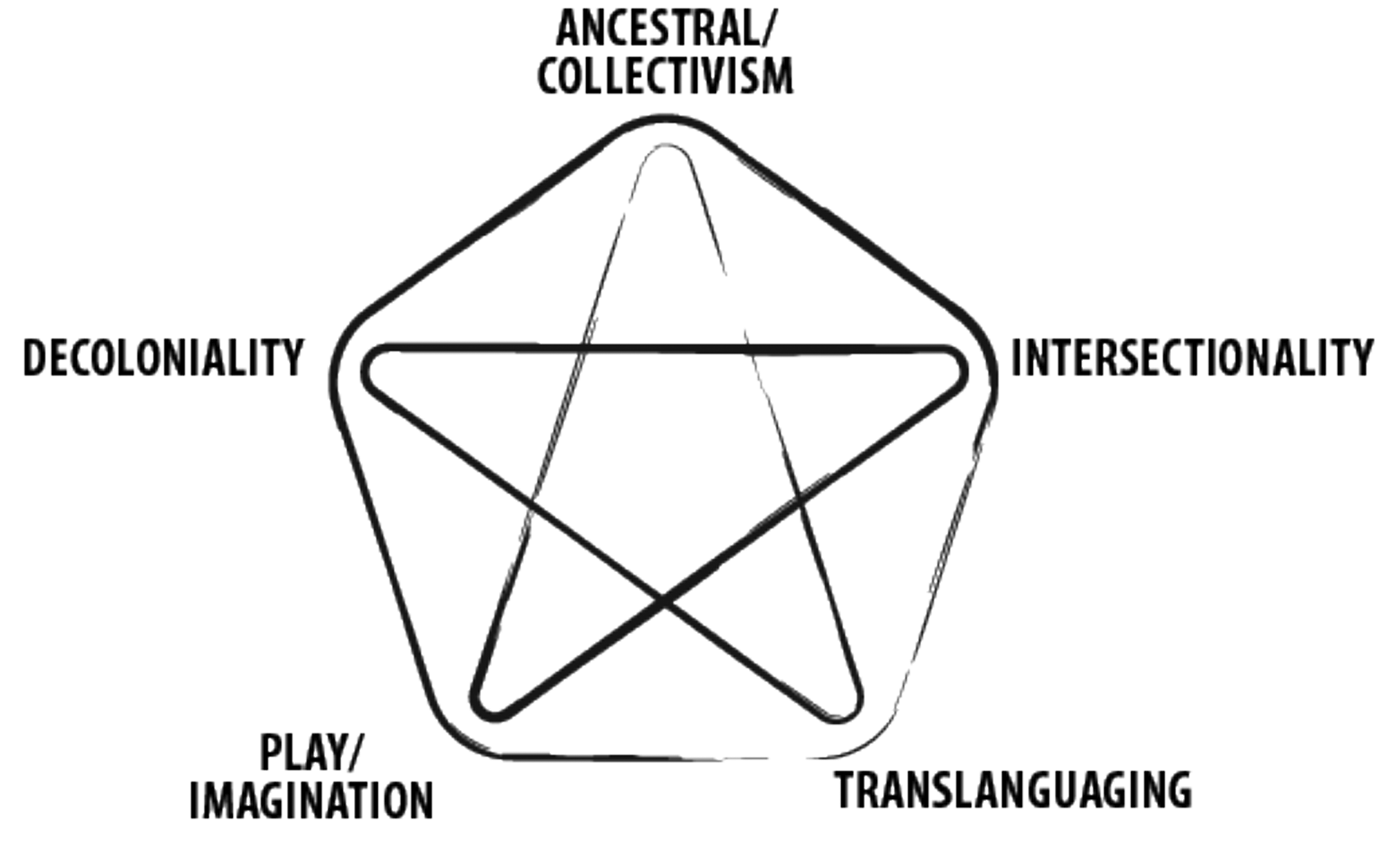
Literacy futurisms framework.
Literacy Futurisms Rooted in Ancestral/Collectivism
We begin our explanation of a literacy futurisms framework with a reminder of our invitation to engage literacy through an ancestral and collectivist lens (e.g., Campano et al., 2020). As a literacy collective-in-the-making, we are beginning to conceptualize collectivism as meaning-making practices enacted when people engage collaboratively around multimodal texts in ways that are rooted in ancestral/collectivism, communal and intergenerational knowledge, and action. In our beginning thinking, we are also drawn to a growing body of scholarship that has been exploring how many contemporary literacy practices beyond schooling involve collaborative reading and writing—from composing fan fiction (e.g., Black, 2006) to digital storytelling (Aguilera & Lopez, 2020) to computer programming (Vee, 2013). Such an ancestral/collectivist framing challenges dominant ideologies of literacy as institutionally defined and recognized through practices of individualistic evaluation, measurement, comparison, and sorting (Serafini, 2001).
Co-envisioning the ancestral dimension of literacy futurisms requires centering scholarship that takes an intergenerational approach to conceptualizing literacy (e.g., Flores et al., 2020; Gadsden, 1992, 2004), especially literacy practices that have often been overlooked, rejected, or ignored when they do not fit institutional definitions (Haas, 2007). Additionally, we align with Pugh et al. (2019) in our understanding of ancestral in that such practices emerge within Indigenous communities and other groups that center relationality as core to their epistemologies and are embedded in intergenerational knowledge passed down by elders, traditional knowledge keepers, and sustainers of culture. While literacy research in this area continues to evolve and we work together on related projects that define collective and ancestral, members of our collective have already offered attempts to center this ancestral and collective framing (Aguilera, 2021; Nightengale-Lee & Clayton-Taylor, 2020).
For example, in our STAR sister Bianca’s research on critical hip-hop literacies, she and her colleague have highlighted how this multifaceted artistic and communicational form has connected past and present practitioners to movements of social critique, identity formation, and community mobilization (Nightengale-Lee & Clayton-Taylor, 2020). Another STAR sister, Paty, draws from nepantlera border artists’ concepts (Anzaldúa, 2015), conceptualizing liminal spaces where borders meet. Nepantlera border artists galvanize metaphors and imagery to reimagine and heal the painful individual and collective wounds from the past. By working with one student, Paty shows how she embodies her lineage through metaphors of her blood representing her ancestry (Abril-Gonzalez, 2020). Our STAR brother Earl’s research contends with the framing of literacies as simultaneously material, cognitive, and sociocultural phenomena. In a recent research project focusing on the digital literacy practices of first-generation college students, Earl learned the many ways participants navigating online learning platforms enacted agency through strategic engagements with resources well beyond the institutionally sanctioned software platform (Aguilera, 2021). At the same time, he learned about how their literacy practices were constrained by procedural, institutional, and social structures. Participants had little influence or control over these structures, which informed how the students would be evaluated and coded as learners. Considering the perspectives presented, we invite your reflection on the following provocation: If literacy has historically been framed as an individual endeavor, in what ways might ancestral and collectivist framings help us rethink the literacies we observe in our everyday lifework?
Literacy Futurisms Informed by Intersectionality
As emerging scholars of Color, our knowledge about the ways oppressions work in our lives, in our world, and within the field of literacy is fully shaped by our differing identities and experiences as people of Color. We understand intersectionality to be the overlapping of a person’s or group’s multiple oppressed identities within a location-bound sociopolitical context (Collins, 2000; Crenshaw, 1991; Lorde, 1984). Each of us holds privileges and oppressions that are quite different from one another’s. Thus, as a collective, we learn from, believe, and center each other’s experiences of oppression. We stand in reverence of each other’s ways of knowing, which come from our lived experiences as people who are differently racialized, gendered, abled, classed, and so on by society. This stance comes from understanding that our lived experiences of oppression give us unique insights into how “society operate[s] to sustain matrices of power” (Moya, 2002, p. 479). For this reason, we hold epistemic privilege (Campano, 2007) that must inform the changing of oppressive structures, systems, and policies.
Due to the ways in which systematic oppressions function, literacy research can erase the intersectional experiences and understandings of literacy among communities of Color. This leaves us wondering then what an intersectional understanding of literacy might look like and how we, as literacy scholars of Color, might (re)imagine what it means to be literate such that our communities are positioned as epistemologically privileged instead of as victims (i.e., illiterate, struggling, or limited), as has historically been—and continues to be—the case. We call upon literacy scholars to grapple with how intersectionality (Collins, 2000; Crenshaw, 1991; Lorde, 1984) relates to epistemic privilege (Campano, 2007) in the context of their work. By employing intersectionality, we draw on epistemic privilege to (re)imagine literacy in our work.
Our STAR sister Rebecca’s (forthcoming) ethnographic case study centered on the ways in which one multiply marginalized young woman navigated a new sociopolitical reality that was shaped by her linguistic, cultural, racial, ethnic, and religious identity as well as her documentation status. Through practitioner inquiry (Cochran-Smith & Lytle, 2009), our STAR sister Alicia found that undocumented Latinx immigrants organized by centering the heterogeneity of their communities and by analyzing the different ways they are othered, their own internalized oppressions, and their (re)production of their oppressions (Rusoja, 2017). Additionally, embedded throughout our STAR sister Tiffany’s various lines of research are her own experiences and subjectivities as a Black woman with “outsider within” status, who self-identifies as a Black feminist pedagogue (Nyachae, 2016, 2018). She trusts and draws upon her standpoint to understand schooling phenomena. Finally, our STAR sister Bianca’s work considers the overlapping tenets of criticality and intersectionality (Nightengale-Lee, 2020) to support preservice teachers in becoming aware of their privileged and oppressed social positionalities to elicit deeper understandings of the self and of students of Color.
In our collective, we think intersectionally, attending to each other’s epistemic privilege, and for this reason, we view ourselves as self- and communally empowered by our identities, instead of victims of our positions as oppressed peoples. At this point in your reading, please consider the following provocation: How does your work (re)imagine literacy in ways that recognize the intersectional identities and related epistemic privilege of oppressed peoples?
Literacy Futurisms as a Space for Translanguaging
Anzaldúa (1987) describes us, translingual beings of Color, as “…your linguistic nightmare, your linguistic aberration” (p. 58) in that our languaging practices do not fit the standards established and perpetuated by white settler colonialism. Many of us, translinguals, were socialized and conditioned to view ourselves, our families, and our languages (e.g., Spanglish, Black language, Vietnamese) as fractured. We internalized these negative perspectives, which sometimes translates to perpetuating linguistic terrorism on others and an oppressive maintenance of linguistic hierarchies (Anzaldúa, 1987). Moving away from operationalizing language as a mechanism for appeasing “white listening subjects” (Flores & Rosa, 2015), García (2009) revived translanguaging theory, which pays tribute to Anzaldúa, among other Chicanx scholars, and communities of Color who have been silenced or deemed as broken. Similarly, our collective believes our translanguaging practices do not need to be fixed. Moreover, translanguaging offers the possibilities of embracing our culture, which heals and humanizes the language practices of our communities.
Translanguaging, for us, is a fluid and dynamic way of being and doing language for and by racialized bi(multi)lingual, multidialectal people and/or communities (Linares, 2020; Nuñez, 2018). This is the way we make sense of and interact with the conflicting world(s) around us that fail to recognize our linguistic practices, identities, and histories. We translanguage as we read and are read as racialized beings across contexts. We do it for sobrevivencia (Galván, 2006), comunidad (España & Herrera, 2020), and those who came before us and whose tongues were cut out (Anzaldúa, 1987). Our translanguaging is not for the “white listening subject” (Flores & Rosa, 2015), and it is not to be cut up, prepackaged, and sold back to our bilingual communities. Further, translanguaging, for us, is not prescriptive, and it is not to be operationalized because it stems from our lived experiences as marginalized beings. It is for our whole selves.
We connect this concept to our own histories. We recognize that where and how we position ourselves as researchers is inextricably linked to our own literacy pasts and to one another. Our commitments are to position our communities as producers and holders of knowledge and as complex linguistic beings (Baker-Bell, 2020; Delgado Bernal, 1998). For example, our STAR sister Idalia highlights the creative translanguaging and transmodal practices by Spanish-speaking, madres Mexicanas who worked every day to support their children’s bilingualism and biliteracy (Nuñez, 2019). To illustrate further, our STAR sister Rebecca has highlighted the complexities of the translingual and transborder literacy practices of multilingual Indigenous youths navigating new cultural and linguistic landscapes (Linares, 2020). Across our work, we seek to listen and learn from others’ voices, testimonios, literacy practices, and language(s) to guide our understanding of what literacy should be for students.
As we move forward, we envision translanguaging as a way of reimagining and rewriting our futures in this world and the futures of generations to come. Siguiendo los pasos de nuestros antepasados, esto es para un mejor futuro sin arrancar nuestras lenguas. We invite you to reflect on the following provocation: Consider your own linguistic identity and unpack your understanding of translanguaging. What role has translanguaging had in your past, present, and future work as a literacy researcher?
Literacy Futurisms through Play and Imagination
Literacy owes much to play and imagination. As a precursor to literacy development, play is a standard (Genishi & Dyson, 2012, 2014) rather than an activity. Play acts as a manifestation of our right to imagine new worlds for ourselves and others; it is, in fact, where we “learn that ideas can transform the mundane, the seemingly set world” (Genishi & Dyson, 2014, p. 231). In schools, play happens in moments of recess and transition, as well as in the arts, activities that are all increasingly displaced by the interminable “race to the top” (Genishi & Dyson, 2012). A consequence of white supremacist, neoliberal practices, and policies in PK–16 educational institutions is in the diminished resources and time for play and flights of the imagination (Vasudevan, 2015; Yoon & Templeton, 2019). More often now, play is leveraged primarily for the purposes of learning outcomes (Genishi & Dyson, 2012). We wish to delink play and imagination from neoliberal discourses of innovation and the production of capitalist goods and services. All of this is to say that we reject the white supremacist, capitalist capture of play, and imagination (Gaztambide-Fernández, 2013).
Borrowing from the Nap Ministry’s Tricia Hersey, white supremacy and capitalism have stolen our ability to rest and therefore to dream and daydream (Young, 2020), to imagine, and to play. Our collective positions play and the imaginative as fundamental to finding our way out from under the crushing weight of white supremacy, imperialism, and settler colonialism. Our research is collectively rooted in notions of play and the imagination that allow for individuals to not only try on other ways of being and becoming (Vasudevan, 2015; Yoon, 2021) but also to build just worlds together (Greene, 1995). Communities of Color engage in play as resistance (da Silva Iddings & McCafferty, 2007; Yoon, 2021) and to accompany one another in and through the world (Vasudevan, 2015). Although play is often relegated to the realm of childhood, Vasudevan’s (2015) research on the laughter (i.e., joy) of youth of Color urges us to curb our assumptions about the playfulness of youth (e.g., as delinquent). Noticing play and imagination, both in the classroom and in research, is integral to humanizing communities.
As researchers and educators, we are responsible for cultivating childhood and youth spaces “for laughter [and play] to take root and be central to the authoring—of selves, of texts, of relationships” (Vasudevan, 2015, p. 7). The young children in our STAR sister Tran’s research use photographs that they make to play with and center their own narratives of themselves rather than to be framed by adults and others (Templeton, 2021). Our STAR sister Paty’s case study shows how a bilingual Latinx youth, Valeria, deploys art and imagination through poetry, which becomes a conduit for empathy. She not only plays with her poetry over time to empathize with others, which is commonly understood in today’s contemporary discourse, but her creative prose opens empathy for herself (Abril-Gonzalez, 2020). Our STAR brother Earl examines young people’s discourse as they design games that respond to ecological crises and highlights how young people imagine a world in which games are not concerned with competition and individual effort—as they typically are in the United States (Aguilera, 2021). Livable futures demand reimagining meritocratic, white supremacist assumptions (such as the imperative for competition within play AND literacy achievement) that have been imposed on communities of Color. Instead, in literacy futurisms, the self encompasses the other.
To be committed to the future of literacy as one that centers communities of Color, we must integrate play and imagination into our personal and professional lives. We ask you now to think about the following provocation: “Given our conditions of existing within a white supremacist, imperialist, and settler colonial society, how can you play with your own literacy research to further the roles of play and imagination within it?”
Literacy Futurisms as a Decolonial Commitment
As emerging scholars of Color, our work is shaped by our relationships with each other and with the land. As settlers on Turtle Island (also known as Abya Yala), each of us, and us together, are implicated in the ongoing violence of settler colonialism. The Combahee River Collective and the Black Girls Literacies Collective function as what Dr. Bettina Love (2019) calls our “North Stars.” Similarly, we are guided by the activist scholarship and feminist movement work of people of Color and global south giants on whose shoulders we stand and whose work together envisions decolonial research, theorizing, and action.
We understand decolonial literacy research as research that prefigures decolonization (Walia, 2013) and delinks from Eurocentric thinking, practices, and structures by engaging in epistemic disobedience and border thinking (Mignolo, 2011) visioning through decolonial logics. Rather than remaining individualistic and commodified, for example, decolonial literacy research can be a collective, pluriversal, and futuristic processes. We aim to be accountable to the deep ways educational institutions have been, and continue to be, tools of colonization that norm colonial logics, relationships, and structures generation after generation. We commit ourselves to take action to unlearn and resist the logics of coloniality.
For example, the scholarship of our STAR sister Tran dismantles the child as a colonized construct, othered by Western developmental theories that construct the child (Templeton & Moffett, 2019). In her research, our STAR sister Idalia approaches the Brown body as a holder and producer of critical knowledge necessary to challenge marginalizing positionings experienced in everyday life (Nuñez, 2021). Additionally, our STAR sister Alicia utilizes practitioner inquiry (Cochran-Smith & Lytle, 2009) in her research as a methodology to resist coloniality in research and shows fellow Latinx immigrants refusing research(ers) and challenging the colonial logics (such as anti-Black racism) of our own activism. We attend to Walia’s (2013) call and learn about and challenge each other in our complicities and contradictions within asymmetric relations of power and oppression, as we unlearn colonial strategies that foster competition and division among each other…actively become[ing] good ancestors to future generations. (p. 275)
We do not claim to know exactly how to collectively theorize each other’s and our own identities, communities, and experiences. We are making the road by walking together. We are trusting each other as we go, learning from our differently intermeshed identities and their accompanying intermeshed oppressions (Lugones, 2014), willing to do deeply discomforted personal work, together. In our final provocation, we invite you to ask these questions, posed by Linda Tuhiwai Smith (2012), of your current and future literacy scholarship: “Whose research is it? Who owns it? Whose interests does it serve? Who will benefit from it? Who has designed its questions and framed its scope? Who will carry it out? Who will write it up? How will its results be disseminated?” (p. 10).
Closing Thoughts
Coming together has been a profound gathering of intellectual brilliance. As we began getting to know each other and becoming friends and a STAR family, we understood the similarities and connections in our lived experiences and commitments. As we gathered, we noticed the many ways our work aligned and that the knowledge from our communities, including our families and ancestors, assembled into collective magic. We lift up and embrace Dr. Nightengale-Lee’s manifestation of literacy futurisms, by recognizing how our lived experiences have informed our literacy and academic trajectories, the theories we draw from, and the work we are committed to doing. As scholars of Color before us have legitimized ancestral/collectivist co-constructed knowledge (Delgado Bernal, 1998), we continue in this endeavor, elaborated through a co-construction of magic. The STAR mentoring program brought us together, and we are honored to cocreate a collective space for drawing from what informs our collective way of conceptualizing the future of literacy research. We acknowledge that what we have learned and what we are learning stem from our past and are inspired by scholars paving the way, especially as we are seeing ourselves reflected more and more in the academy and at LRA. Now, as we reflect on our ancestors, we simultaneously recognize we are the ancestors of future generations. We know that what we do together now matters greatly as it unsettles typical hierarchies and individualized performances by instead working together. We are collectively imagining a new tomorrow. The found poem below comes from our various conversations capturing the power and spirit of our collective magic.
Collective Magic
Footnotes
Authors’ Note
All the authors of this article, founding members of this collective, contributed equally to its conceptualization and writing and are therefore listed in alphabetical order: Patricia Abril-Gonzalez (University of Texas, Austin), Earl Aguilera (California State University, Fresno), Rebecca E. Linares (University of Colorado Boulder), Bianca Nightengale-Lee (Florida Atlantic University), Idalia Nuñez (University of Illinois Urbana–Champaign), Tiffany M. Nyachae (Pennsylvania State University), Alicia Rusoja (Saint Mary’s College of California), and Tran Templeton (University of North Texas).
Acknowledgments
We want to thank the LRA STAR Fellowship for their organization and support. Thank-you to our STAR mentors for their mentorship and radical care: Patricia Baquedano-Lopez, Ana Christina da Silva Iddings, Mileidis “Millie” Gort, Latrise Johnson, Danny Martinez, Carmen Martínez-Roldán, Carmen Medina, P. Zitlali Morales, and Jennifer Dandridge Turner.
Declaration of Conflicting Interests
The author(s) declared no potential conflicts of interest with respect to the research, authorship, and/or publication of this article.
Funding
The author(s) received no financial support for the research, authorship, and/or publication of this article.