



Abstract
Deficit mindsets of multilingual writers must be upended. Yet, little research has been done to explore how to prepare bilingual teachers with strength-based orientations, especially in approaches to assessment. Using a holistic biliteracy lens, this qualitative case study explored how Transliteracy observation shaped teachers’ understanding of biliterate writing development in K-5 dual language settings. Findings showed that teachers learned that writing is multifaceted and observable, influenced by oral language, and reflective of one linguistic repertoire. Participants gained a deeper understanding of biliteracy development and their students’ capabilities, supporting an asset-based orientation that challenged monolingual norms. Implications for teacher preparation are shared.
Keywords
English learners represent the fastest growing student population in United States (U.S.) public schools, recently surpassing five million students (NCES, 2022). These students, who we call multilinguals, bring knowledge of two or more languages to their literacy learning. Despite their linguistic capabilities, multilinguals are often asked to demonstrate writing abilities through normed assessments that happen only in one language, framing them in relation to their gaps instead of their bilingual brilliance. “One language” approaches to assessment disregard the dynamic nature of bilingualism, offering teachers an incomplete picture of students’ capabilities (Escamilla et al., 2018) and contributing to deficit mindsets among teachers of multilingual youth (Butvilofsky et al., 2017). This issue is compounded by a growing trend of legislation that dictates which assessments states can use to measure literacy achievement (Schwartz, 2022).
Some multilinguals have access to bilingual education, like dual language program models, in which students from different linguistic backgrounds are brought together with the aim of bilingualism and biliteracy for all. These programs offer unique opportunities for multilingual writing development by providing literacy instruction in two languages. However, in their implementation, instruction in each language can be rigidly separated by time and content area (Howard et al., 2018), resulting in teaching and learning practices that were designed for monolinguals. Without space to understand the unique ways in which multilinguals learn to read and write, teachers minimize their literate potential. One way to address this issue is by re-examining approaches to assessment; teachers who learn to assess from a strengths-based perspective may develop the knowledge to notice what writers can do, making them more effective teachers (Ascenzi-Moreno, 2018; Briceño & Zoeller, 2022). However, there is insufficient research on how to prepare bilingual teachers with formative assessment approaches.
This study's purpose was to examine an alternate approach to writing assessment using holistic observation. We asked, How does formative holistic biliteracy assessment shape teachers’ understanding of biliterate writing development? Through an innovative approach we call Transliteracy, we explored how holistic observation and pedagogy support teachers’ understanding of biliteracy development in K-5 Spanish/English dual language settings. The paper begins with a review of research to support our argument, organized into three themes: (a) holistic biliteracy theory conceptualized through Transliteracy, (b) research findings on writing development among multilinguals, and (c) an examination of bilingual writing assessment approaches. We then share research methodology and findings that explain how Transliteracy observation developed participants’ knowledge of writing and student capabilities. We call for teacher preparation that challenges traditional deficit views of multilingual learners by engaging new ways of looking at students.
To recognize speakers of two or more languages, we have selected the term multilinguals (Martínez, 2018). We acknowledge the term bilingual is commonly used, and we maintain it when referring to concepts in literature (e.g., bilingual education), citing research studies, and sharing participants’ descriptions of themselves or their students.
Translanguaging, Holistic Biliteracy, and Transliteracy
Scholars have used the term translanguaging to explain how multilinguals fluidly and flexibly draw from a single reservoir of linguistic knowledge to communicate ideas (Garcia & Wei, 2014). This dynamic use of language reflects the fact that the majority of U.S. Spanish/English bilinguals are exposed to two languages in and out of school contexts from a young age, learning languages simultaneously and using them interchangeably (Escamilla et al., 2014). A dynamic lens on bilingualism is not new. Hornberger (1989) framed biliteracy as a continuum of interrelated points reflecting contexts, individual development, and media, offering a way to understand biliteracy development through a trajectory that is flexible and not static. Others have demonstrated the interplay between literacy practices across two named languages (Gutiérrez et al., 2001; Reyes, 1992), calling for approaches that move away from a traditional first/second language binary and instead pose literacy practices as interrelated.
Despite research support for a dynamic view, many dual language programs separate literacy into two named languages, enacting “parallel monolingualism” (Fitz, 2006) in which instruction and assessment apply one-language approaches as if students were monolingual. To combat this language dichotomy, Escamilla et al. (2014) designed a holistic biliteracy framework in which literacy instruction in each language is intentionally paired to support a student's biliteracy trajectory. The term holistic conveys the idea that the approach must transcend what multilinguals can do in one or the other language, and instead consider the totality of their language and literacy repertoires (Hopewell et al., 2016).
This study is grounded in a theoretical framework of holistic biliteracy, recognizing that knowledge across languages is reciprocal—what a child learns in either language influences learning in the other (Soltero-González & Butvilofsky, 2016). We define holistic biliteracy assessment, then, as an approach that takes into account how students draw upon knowledge from both languages for literacy learning. This approach contrasts assessment approaches that measure skills in isolation, that overlook cultural and linguistic influences, or that consider one language separate from the other.
One caution of cross-linguistic pedagogy is that, without clear parameters, the minoritized language can be dominated by English, the language of power (Ballinger et al., 2017). So, the field of dual language education calls for translanguaging practices that are deliberate and not haphazard (García et al., 2017). Escamilla and colleagues’ holistic biliteracy framework presented us an opportunity to conceptualize a clearly delineated translanguaging process, based on student strengths. We designed an observation and teaching cycle we call Transliteracy (Briceño & Zoeller, 2022; Williams, 1994). Originally used in Welsh/English bilingual education, the term Transliteracy referred to a practice involving the strategic use of language for input (reading or listening) and output (speaking or writing) to support language and literacy development (Baker, 2003). Decades later, we revive the term Transliteracy to describe a carefully designed cycle of instruction, illustrated in Figure 1. Stages include observation of literacy behaviors in two languages, a holistic analysis of strengths, and a prompting model to teach use of a competency from one language to the other.
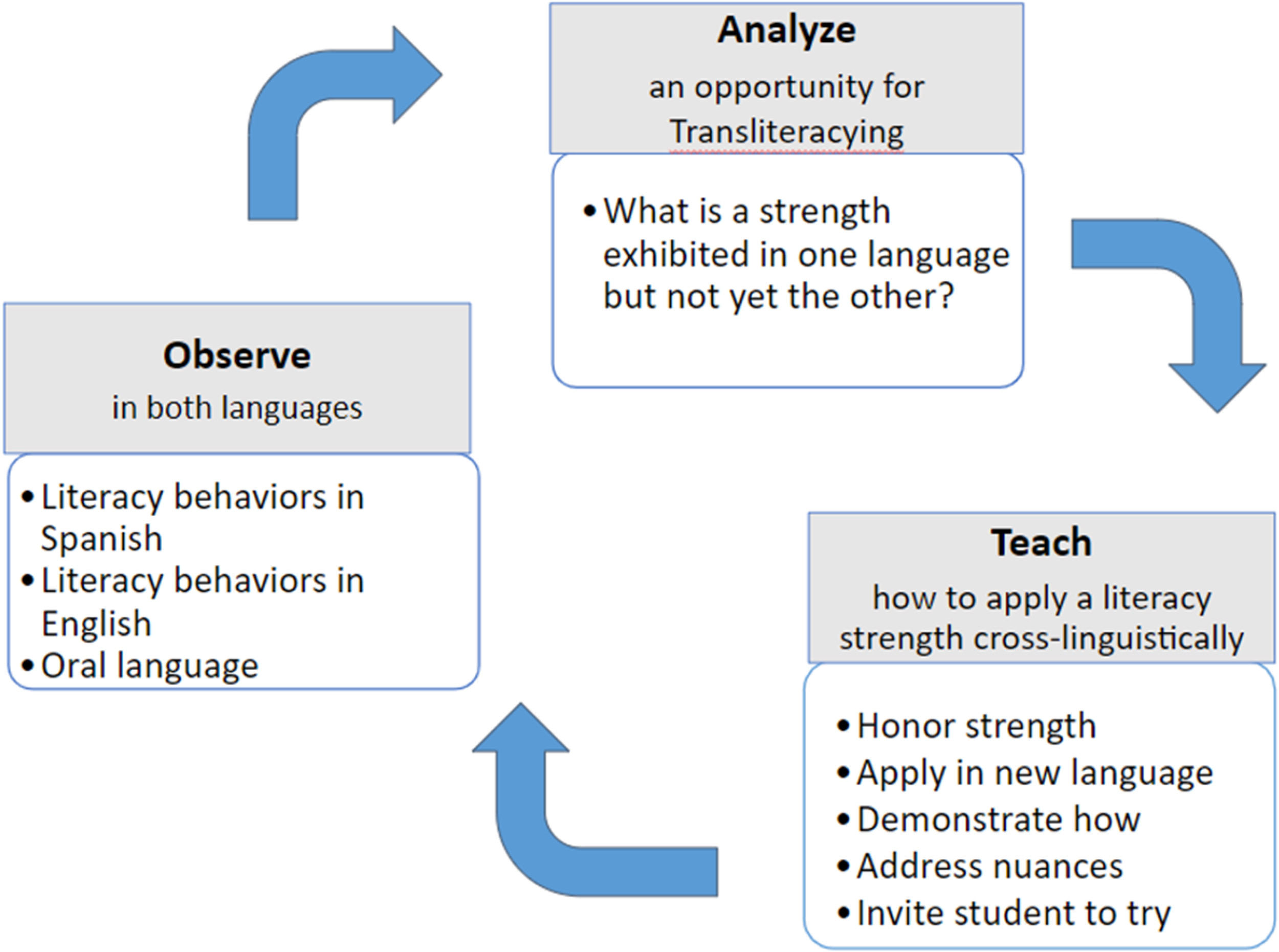
A Transliteracy Cycle.
As depicted in Figure 1, Transliteracy deliberately integrates languages, and shares theoretical underpinnings with others’ use of the term (Stornaiuolo et al., 2017) framing literacy as multimodal and interactive. We view Transliteracy as a type of instructional design situated within a broader translanguaging pedagogy. The approach shares the goals of other strategies developed for cross-linguistic teaching (e.g., “the bridge,” Beeman & Urow, 2012) and assessment (Escamilla et al., 2014), but is unique in its purpose to unveil strengths as the focal point for biliteracy teaching. Transliteracy has been found to contribute to teacher knowledge of biliteracy, developing their pedagogical and ideological clarity and supporting their integration of language as system, practice, and identity (Zoeller & Briceño, 2022). We build upon findings connecting holistic biliteracy approaches with strength-based ideologies to examine writing assessment among K-5 dual language educators.
What do We Know About Multilinguals’ Writing Development?
Though the importance of writing to academic achievement is well-documented in research literature, much of the focus has been on children who are monolingual students, overlooking the unique ways in which multilinguals use linguistic resources to develop as writers (Williams & Lowrance-Faulhaber, 2018). Multilinguals make use of what they know from their oral language to plan their texts, monitor the writing process, and evaluate their work (Gort, 2012). They also use communication to support their encoding of text, by, for example, talking with peers to negotiate spelling, meaning, or language forms (Soltero-González, 2009).
Multilinguals use knowledge from both languages to compose, encode, and process text. Cross-linguistic transfer occurs in spelling when a writer uses a letter from one language to represent a sound in the other language or applies language-specific rules like adding the “silent e” to a word in Spanish (Gort, 2006). Research shows how multilingual writers use syntactic transfer, applying structures from one language to the other language; this transfer is also demonstrated in punctuation and word choice (Soltero-González et al., 2012). Even in cases where literacy instruction is separated by language or provided in only one language, as in the case of this study, multilinguals have been found to apply knowledge of written language cross-linguistically and bidirectionally (Gort, 2006, 2012).
Multilinguals’ writing development is distinct from their monolingual peers, and this “special form of literacy” (Bauer & Gort, 2012, p.2) calls for preparing teachers with a new lens on pedagogy and assessment. Musanti and Rodríguez (2017) found how teacher preparation supported pre-service bilingual teachers in creatively leveraging their own linguistic repertoires for producing meaningful writing. Bilingual teachers are supported in examining their own linguistic identities and use these to shape translanguaging pedagogy they enact with students (Sánchez & España, 2019). In literacy teacher education, teachers in bilingual settings and English-medium settings apply translanguaging in their field placements through intentionally designed lesson plans, creating bilingual books, and using languages dynamically and interchangeably in everyday interactions with students (Machado & Gonzales, 2020). These studies illustrate how teachers can be supported to develop knowledge of pedagogy that disrupts dominant monolingual views and point to the potential of preparing teachers to apply a multilingual stance to assessment.
What are Approaches to Assessment of Multilingual Writers?
Writing assessment illustrates broader literacy development, as readers and writers draw upon common foundations of knowledge in content, metaknowledge, linguistic features, and connections between phonology and orthography (Shanahan, 2006). Despite the potential for writing assessment to reveal literate understanding, assessment focus tends to prioritize reading (Butvilofsky et al., 2021), with increasing emphasis on monitoring progress of foundational skills (Schwartz, 2022). In many early literacy settings, as in the context of this study, school districts mandate skill-based writing tasks that address knowledge of phonemic awareness, phonics, fluency, and spelling. These skills are monitored through curriculum-based measures claiming to offer valid and reliable data results in a short amount of time (Fuchs et al., 1990), often used to sort children into categories of proficiency, flag for intervention, and in some cases remediate if benchmarks are not met (Illuminate Education, 2020).
One concern of using curriculum-based measures to assess multilinguals is that most are available only in English. English-only assessments have been found to underestimate the abilities of the multilingual learner if results are compared with monolingual peers or if the tool does not allow for language influences on performance (Butvilofsky et al., 2021). Even when curriculum-based measures offer a Spanish counterpart, as in the Dynamic Indicators of Basic Early Literacy Skills Next (Indicadores Dinámicos del Éxito en la Lectura) and AIMSweb (Medidas Incrementales de Destrezas Esenciales), some argue that valid and reliable data for multilinguals require modifications, like ensuring that results are analyzed in conjunction with language skills assessment in both languages (Brown & Sanford, 2011).
In dual language education, equitable assessment outcomes call for new research and assessment approaches that consider student performance holistically (Howard et al., 2018; Téllez & Mosqueda, 2015), and some examples illustrate how. An analysis of multilinguals learning to read in English revealed over half of student miscues were language-related errors, showing how assessment design captures the interaction of language and literacy processing (Briceño & Klein, 2019). In dual language programs, cross-language observation in writing revealed students’ knowledge about language and knowledge about literacy from their home language (Zoeller & Briceño, 2023). These approaches offer a new frame for understanding student capabilities; when considered holistically, writing outcomes among fourth and fifth grade emerging bilinguals surpassed outcomes of monolingual counterparts (Escamilla et al., 2018).
Methods
This research stems from a larger self-study examining teacher perceptions of a Transliteracy approach, involving 32 bilingual teachers in two teacher preparation programs (Briceño & Zoeller, 2022). We draw from that study to specifically examine how holistic biliteracy assessment shapes teachers’ understanding of biliteracy development. We selected five cases of practicing K-5 bilingual teachers from one teacher preparation program. Participants employed cross-linguistic Transliteracy observation with multilingual students in their dual language education settings. We applied multiple case study design (Stake, 2013) to examine how teachers’ experience using holistic assessment with their students supported their understanding of how multilinguals develop writing in two languages.
Context and Participants
This study occurred within a bounded context (Merriam, 1998) at a small liberal arts college in the midwest during a semester-long course, Biliteracy Development, of which Emily was the instructor and Yesenia was a former student. Conducted in Spanish and English, the course was part of a graduate level teacher preparation program leading to a bilingual teacher license endorsement. A population of 22 teachers participated in the course; course assignments, described below, served as a data source. Following the course and after grades were submitted, we recruited participants, applying purposive sampling (Merriam, 2009) to the population and selecting five illustrative cases. Table 1 shares the demographic information of the participants and their focal students.
Participants.
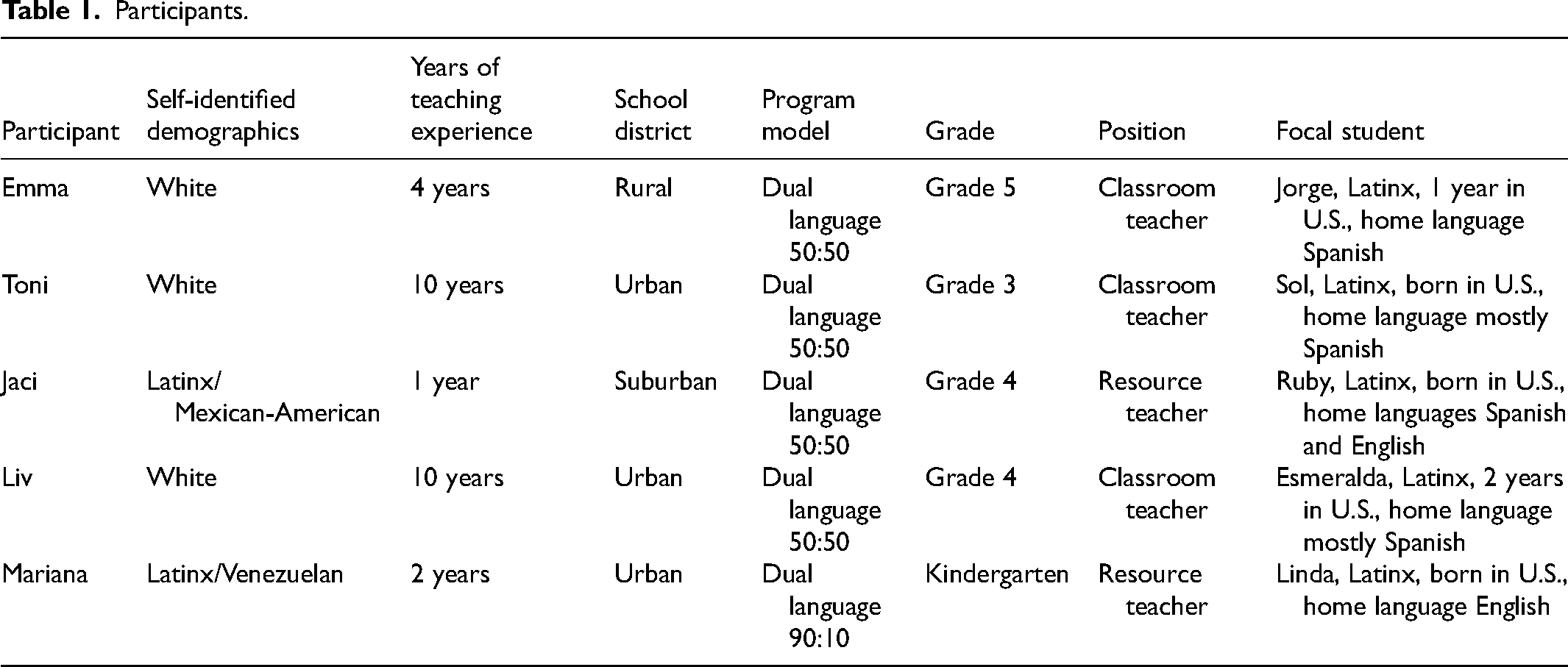
As illustrated in Table 1, the participants were five in-service bilingual teachers; all were proficient in Spanish and English. In their teaching positions, participants planned and delivered writing instruction; three teachers were classroom teachers and two were bilingual resource teachers who provided small group support. All five teachers taught in Spanish/English dual language environments, in which literacy instruction was provided in both languages, with Spanish allocated as half (50:50) or most (90:10) of instructional time. Models that were 50:50 allocated a daily English literacy block and a daily Spanish literacy block, separated by time of day. All focal students were bilingual but students represented diverse language backgrounds, with home languages of English, Spanish, or both.
In their Biliteracy Development course, participants carried out two cycles of a Transliteracy approach with a focal student in their teaching context. Teachers obtained writing samples in both languages, observed literacy behaviors, identified strengths, and designed cross-linguistic instruction to leverage competencies across languages. The Transliteracy Observation Framework (Appendix A, adapted from Escamilla et al., 2014) presents the assessment tool they used for observing and analyzing the holistic multilingualism of student writing. Teachers received instructor guidance and support throughout the cycles.
Data Sources and Analysis
To explore the phenomenon comprehensively, we utilized multiple data sources (Baxter & Jack, 2008). Data included assignments that participants applied with their focal students: the Transliteracy Observation Framework (OF) and an informal oral language analysis, along with written reflections. Data also included semistructured interviews of 40 to 60 minutes conducted within three weeks of course completion. Interview questions invited teachers to expand upon what they noticed in their students’ writing, probing for connections to student language and identity. Questions also addressed their developing knowledge of pedagogy and application in context (e.g., How does Transliteracy align or not align with assessment approaches in your school?; Has this experience led to any shifts in your teaching?). Triangulation of these data provided a comprehensive picture of participants’ emerging understanding of biliteracy development.
Data analysis was iterative. OFs were first analyzed deductively, using codes for biliteracy (e.g., Butvilofsky et al., 2021) such as spelling, sentence structure, and writing discourse; features within these aspects of biliteracy were also coded (e.g., discourse included main idea, details, transitions, coherence, rhetorical structures, and genre). We developed a table noting these examples in both Spanish and English, as well as teacher noticings of cross-linguistic writing behaviors. To analyze teacher beliefs and behaviors, we applied codes for culturally and linguistically responsive teaching (Kibler et al., 2021), such as critical reflection and learning about student assets. Interviews were coded using the same coding system. A second round of inductive coding (Merriam, 2009) collapsed these codes into broader categories such as knowledge about language and knowledge about writing, deepening the connection between teacher observations and their developing understanding. Each author was the first coder for half the data and the second coder for the other half. Both authors coded all the data, discussing any differences that arose until conclusions were reached. We used journal and memo writing to capture researcher reactions and perceptions and separate them from the data analysis process.
We realize our research is impacted by our positionalities. We authors are female and bilingual. Emily developed Spanish as a second language and served as a bilingual teacher and reading specialist before becoming a university professor where she met Yesenia. Born and raised in Mexico, Yesenia brings perspective from her own cultural and linguistic experiences to her current position as a dual language teacher. Together, we strive to be antiracist educators who combat reductionist practices for multilingual youth.
Findings
Findings from this study show how holistic observation deepened teacher understanding of biliteracy development. When teachers noticed how multilingual writers used their full linguistic reservoir, they developed a strength-based lens and were more able to identify how to instruct using students’ linguistic assets. Their new learning reflected three themes: (a) writing is multifaceted and observable, (b) writing is influenced by language, and (c) writing reflects cross-linguistic knowledge. After illustrating each theme, we show how these themes contributed to teachers’ development of strength-based orientations and supported them in interrogating monolingual norms in their school contexts.
Writing Behaviors are Multifaceted and Observable Across Disciplines
Through close observation of student writing samples, teachers were able to notice new behaviors and competencies in students, including discourse, sentences, phrases, words, spelling, and conventions. Emma, a fifth-grade teacher, reported, “I learned that there is a lot more to writing than just writing. There are so many components to being able to write well.” Emma's quote illustrates how her concept of literacy broadened by recognizing writing's multiple dimensions. Participants learned how assessment could integrate these aspects of writing instead of measuring them in isolation. Mariana, a kindergarten teacher, focused on observing her student's phonics abilities through a writing sample—an approach that differed from skills-based assessment she was accustomed to. She shared “he podido observar cuan satisfechos se sienten los estudiantes al ver sus propias palabras representadas en forma impresa.” [I have been able to observe how satisfied students are when they see their own words represented in print.] For Mariana, a writing sample fostered student engagement and provided a meaningful context through which she could teach foundational skills. Holistic observation fostered teachers’ ability to view student writing through a new lens, as described by Jaci: “It makes me more aware of what I should be looking for during my observations of bilingual students.”
Participants shared how holistic observation differed from the school-mandated writing assessment that focused primarily on spelling and served as a tool for planning upcoming instruction and to better understand their writers. Liv described how she used assessment with her fourth-grade writers, reporting: Part of my decision making is knowing what skills my kids already have, and then knowing where to go from there…if we could look at kids as a whole, then we might actually get more beneficial data on how to support our kids.
Teachers reported how observing student writing behaviors supported them in thinking about writing demands across disciplines. In her role as a support teacher, Jaci used Transliteracy observation to understand her focal student's use of “academic language” during science class; she shared how she sought to observe her students’ “ways of using language of observing, questioning, hypothesizing, experimenting, interpreting data, and making conclusions.” Similarly, Liv reflected on how observing her student's opinion writing illuminated the language her student would need to argue – making claims, offering reasons, and linking with connectors. She shared, “I can take what I learned about genre in reading and writing to leverage her writing skills by focusing on language features.” In the cases of Jaci and Liv, analysis of student writing developed new understanding of not only multiple facets of writing, but how these aspects apply to functions within particular disciplines and genres.
Writing Behaviors Reflect Oral Language Development
In interviews and in work samples, teachers shared how they used insights from oral language observations to make sense of student writing. Toni, a third-grade teacher, used the assignment as an opportunity for team collaboration and reported on shifts in her team's approach to data analysis, explaining, We're getting really good at ‘Okay, is it language? So maybe that was the issue…Well, maybe it wasn’t that, so let's go to the next thing’… I feel like we're more efficient at figuring out where a kid is at and what the next step should be.
Kindergarten teacher Mariana, in her second year of teaching in the U.S., worked with Linda, an emergent writer receiving literacy instruction in Spanish. With a focus of foundational skills, Mariana sought to understand Linda's strategies for solving new words in writing and reflected first on her oral language: Cuando Linda se comunica en español, generalmente dice palabras en inglés por no conocerlas en español. Entiende el español más de lo que puede producir en palabras. [When Linda communicates in Spanish, she generally says words in English for words she doesn’t know in Spanish. She understands Spanish more than she can produce in words.]
Writing Behaviors Show Cross-Linguistic Knowledge
Teachers observed students’ cross-linguistic behaviors, noticing how they drew upon their entire linguistic repertoire to compose and transcribe written text, and how this reflected strategy and resourcefulness. Emma worked with fifth-grade student Jorge, a newcomer from Mexico with 1 year of schooling in the U.S. Jorge wrote about his experiences learning a language, composing a response in both languages, depicted in Table 2. These samples were analyzed holistically to unveil bilingual competencies.
Jorge's Writing Samples.
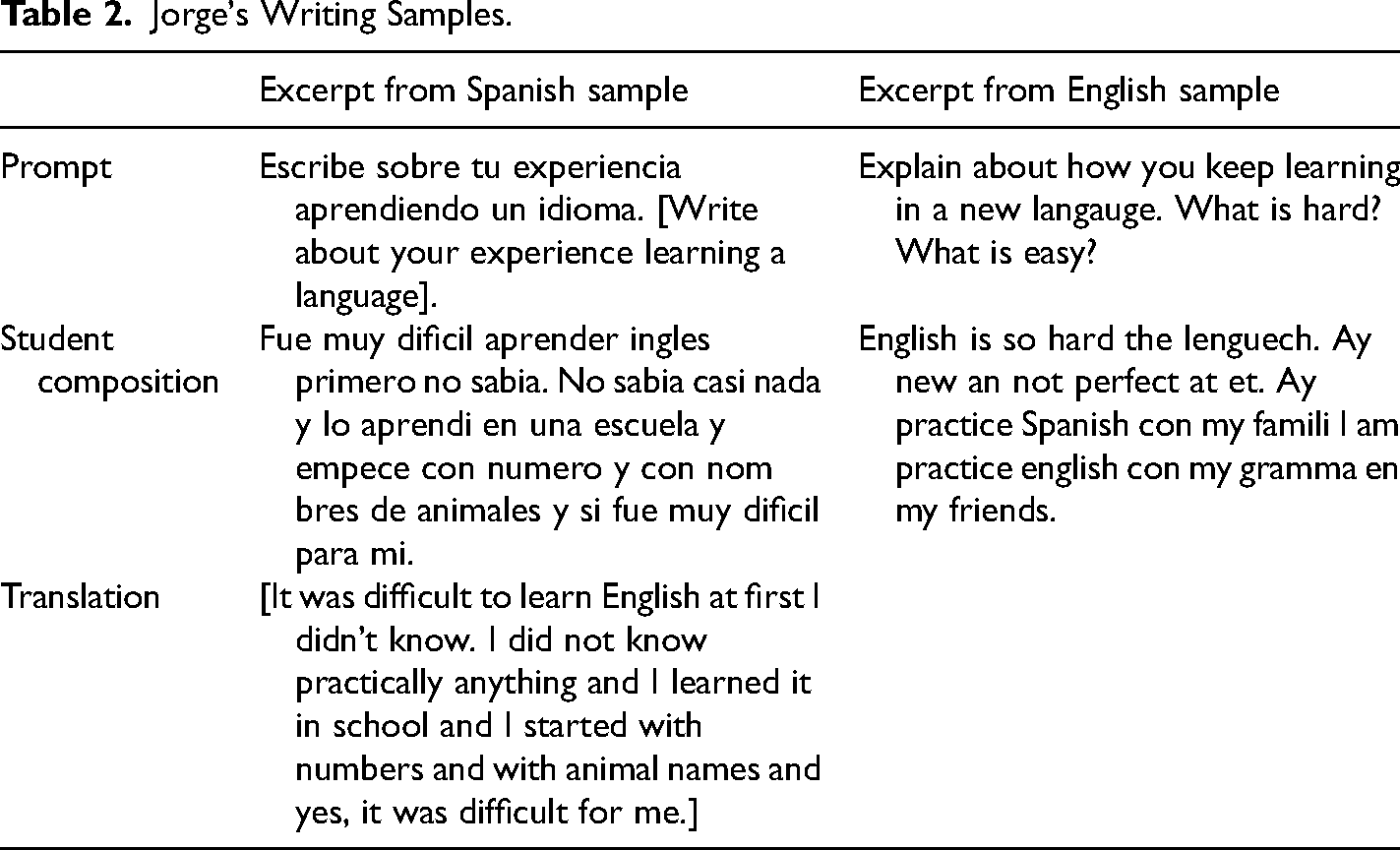
Emma noticed, first, that Jorge had ideas about his experiences learning English, and he was able to effectively communicate his message to his audience. Further analysis revealed that although Jorge's control of syntax was still emerging, he was capable of writing complex sentence structures, even in English. She also noticed how Jorge applied knowledge of letters and words cross-linguistically, recording Spanish graphemes to represent sounds in English words, as in “et” for “it” and “famili” for “family”, and using whole words from Spanish in English composition (e.g., “Ay” for “I”; “con” for “with”). Emma recognized how Jorge's approximations were not haphazard errors, but reflections of his linguistic knowledge from Spanish. In this way, observation supported her to understand and honor her student's multilingualism as a source of support rather than a hindrance; thus, providing a springboard for focused instruction.
Strength-Based Orientation
Taken together, teacher noticings about writing components, language, and cross-linguistic transfer contributed to new knowledge about biliteracy development. This, in turn, shaped their perceptions of students’ capabilities. Figure 2 illustrates the interactions among our findings.
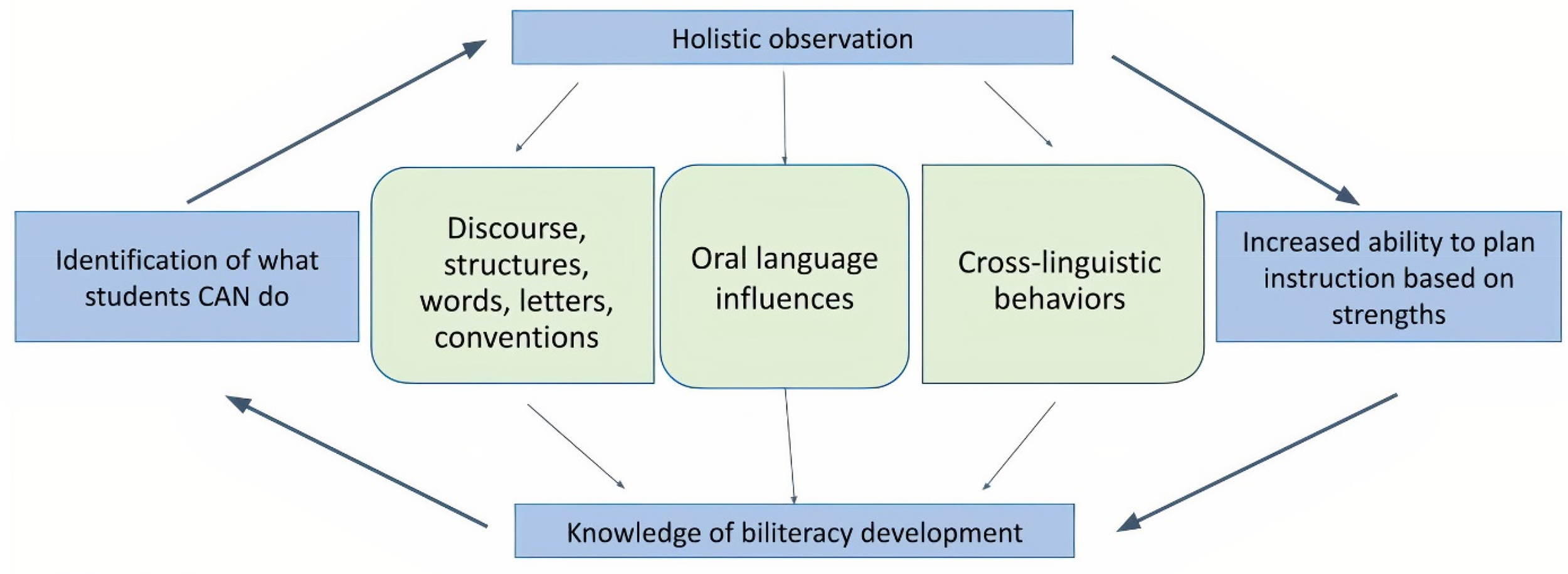
Fostering Asset-based Orientation.
As illustrated in Figure 2, holistic observation supported teachers to recognize multiple aspects of writing development rather than focusing solely on mechanics. Through observation, teachers analyzed language-influenced writing behaviors, gaining a deeper understanding of the role of oral language in writing development. Identifying and interpreting cross-linguistic writing behaviors led them to realize strengths that were formerly veiled and to honor dynamic bilingualism.
Holistic observation supported teachers to identify multilingual capabilities, and participants contrasted this approach to those in their school settings. Liv reported: What I liked about Transliteracy is that it focuses on the student's strengths. A lot of times our English Learner (EL) students are seen as just the ones who aren't meeting benchmarks, and even in the best data conversations, there's not always a lot of strengths brought up about our EL students. So something I like about this Transliteracy model is, it's all focused on strengths… it's focused on ‘you already have this in one language and we're going to capitalize on that and help you figure out how you can do it in another language.’
Using assessment to plan instruction based on assets seemed to evoke meaning and joy in participants. Mariana, a transnational teacher from Venezuela, reflected on insights gleaned from using observation to plan a Transliteracy phonics lesson: Es fantástico poder pensar de manera distinta al momento de planificar, así como considerar la cantidad de recursos valiosos y disponibles que hay para esto. Estoy disfrutando plenamente el proceso de instruirme para enseñar un segundo idioma. [It's fantastic to be able to think about a distinct way, from the planning stage, the amount of valuable resources available to them. I am fully enjoying the process of learning myself how to teach a second language.]
Challenging Monolingual Norms
Teachers compared a holistic assessment with those used in their contexts, developing critical consciousness of one-language approaches. Liv contrasted Transliteracy assessment with her school's implementation of assessments in accordance to “science of reading”: The main challenge that I have identified so far is that all of the assessments that they have or talk about are monolingual. And it is somewhat of a problem that all of the assessments are also in English only…but even if we had Spanish assessments and standardized assessments, we're still looking at students as in parallel monolingualism instead of holistic biliteracy, and science of reading doesn't at all touch on how to analyze assessments in English and Spanish to figure out how students are doing as literate people… So when I think about assessing kids in only English or Spanish, we might have more of a deficit mindset.
For others, Transliteracy raised awareness and critique of monolingual systems and structures. Jaci considered her next steps in practice, and, realizing limitations in her school's language separation model, explained: One thing that I continue to reflect on is… how can I support language development in the two-way immersion programs where the languages are separated based on subjects…utilizing both languages (English and Spanish) interchangeably or as needed to help our bilingual learners?
Discussion
Findings from this study illustrate how a Transliteracy approach to writing assessment developed teachers’ knowledge of biliteracy development, leading to strength-based pedagogy. When participants were asked to conduct holistic observation—a departure from their school-adopted approaches—they noticed new things in their multilingual students’ writing. Teachers broadened their definition of writing and realized the role of oral language in how their students composed and transcribed ideas. Also, by comparing samples across languages, teachers recognized cross-linguistic influences, which revealed student strengths that were otherwise overlooked. Teachers’ new understanding of multilingual writing development shaped asset-based dispositions, supporting them in questioning and critiquing traditional assessment approaches in their contexts.
In an era of high-stakes literacy assessment and accountability, multilingual youth deserve equitable measures to reflect what they know and can do. We join scholars across areas of education arguing for assessments that give institutional weight to more complex, and therefore more accurate, depictions of young writers and their unique strengths and challenges—intellectually, socially, culturally, and linguistically (Dutro et al., 2013; Dyson, 2006). As argued by Williams and Lowrance-Faulhaber (2018), “If language is the principal tool students bring to the learning process (Vygotsky, 1978), then educators must not only welcome the oral language(s) of young bilingual children but also support their simultaneous or emerging bilingualism” (p. 67). For equitable assessment of multilingual writers, we must challenge the status quo, and we can do this by replacing monolingual approaches with multilingual ones.
To carry out this equity imperative, teachers need preparation. We argue for bilingual teacher education that provides opportunities for assessment and instruction like Transliteracy that build on linguistic assets of multilinguals. We respond to the call for “extraordinary pedagogies” that reflect robust understandings of bilingualism (Palmer & Martinez, 2013), especially in dual language settings who aim for high literacy achievement in both languages. Insights from this study can also apply to promoting the value of multilingualism among educators in English-medium classes, which is critical since most multilingual students do not have access to bilingual education (García & Kleifgen, 2020) but nevertheless deserve access to culturally and linguistically sustaining pedagogies.
This study addresses the gap in research literature on measuring young multilingual children's growth as writers (Williams & Lowrance-Faulhaber, 2018). However, limitations include its small sample size and self-reported data in absence of classroom observations or student achievement outcomes. Though teacher perceptions do not provide complete data, they offer a foundation on which future research can build. Our data revealed tensions surrounding a holistic approach, including rigid language separation, district-mandated assessment, and limited time for collaborative data analysis among colleagues. So, more research is needed to examine writing assessment in context and how policy and leadership can support bilingual teachers to employ holistic assessment. We find this future scholarship critical given the rise of dual language education programs and increasing legislative mandates on early literacy assessment, primarily from a monolingual English viewpoint.
In pursuit of equity, solidarity, and social justice, deficit norms for multilinguals must be upended. Teachers in this study illustrated how the lens we apply to assessment practices with multilingual writers can unveil their brilliance. In the words of Liv, “The most antiracist thing we can do is to give our kids rich academic experiences and accelerate their learning, and I do feel like Transliteracy can do that because we're helping them connect the pieces of the puzzle.” We call for teacher preparation that fosters awareness and appreciation for multilingual writers by utilizing assessment that honors and not ignores their entire linguistic repertoire. Though we cannot control all factors that influence the literacy development of multilinguals, we can shift the way in which we choose to understand.
Footnotes
Declaration of Conflicting Interests
The author(s) declared no potential conflicts of interest with respect to the research, authorship, and/or publication of this article.
Funding
The author(s) received no financial support for the research, authorship, and/or publication of this article.

Author Biographies
Appendix A
Transliteracy Observation Framework for Writing