



Abstract
Abstract
Even though Buddhism probably had some emancipatory potential for the downtrodden from its inception in the sixth century BCE, this potential gradually declined in its establishment as an ideology of the ruling dynasties largely upheld by the religious practices of the masses in ancient and medieval Ceylon. The nineteenth century Buddhist revival in Ceylon under the leadership of Anagarika Dharmapala did contain some anti-colonial tendencies, but this new form of Sinhala Buddhism subsequently became an ideology of the Sinhala ruling classes in independent Sri Lanka. Against this background, the Navayana Buddhism invented by Dr Ambedkar built on the emancipatory potential of Buddhism by converting it into a moral foundation for the Dalit struggle against untouchability and inherited social disadvantages. This article explores the ambivalent and contradictory dynamics in the hegemonic and transformative tendencies in Buddhism within the larger South Asian context.
In his lifelong struggle (1891–1956) against untouchability, Dr Babasaheb Bhimrao Ambedkar deployed politics and constitutional measures to combat the caste system. 2
An earlier version of this article was presented in the International Conference on the Life and Works of Dr B.R. Ambedkar, Central University of Karnataka, 18–19 July 2016.
Thus Dr Ambedkar spent 21 long years after renouncing Hinduism in order to identify the path of salvation for him and his Dalit followers. During this intervening period, he explored all possible pathways including Hindu Reform Movement, Sikhism, Islam, Christianity, Marxism and Buddhism. Based on analysis of Dr Ambedkar’s own writings and reflections by some recent commentators, the article will explore why he opted for Buddhism which seemingly had no firm foundation in India at the time. His understanding of Buddhism was largely based on reading of Buddhist texts, most of which had been translated into English by this time, largely through the intervention of orientalist scholarship. Dr Ambedkar supplemented this textual understanding with brief visits to surrounding countries, namely, Ceylon, Burma and Nepal, for participation in Buddhist events and conventions. For instance, in May 1950 he visited Colombo and participated in the first conference of the World Fellowship of Buddhists. This may have enabled him to witness the impact of Buddhist revival in Ceylon and its ideological overtones including Buddhist contestations of Christianity and Western values. On the other hand, his continued exchanges with Mahabodhi Society made him realise the current plight of the Buddhist heritage in India. In a public meeting on 29 September 1950, he publicly declared that he would devote the rest of his life for revival of Buddhism in India.
As a social analyst and a social reformer, Dr Ambedkar’s unique contribution lied in the fact that he identified and deployed Buddhism as a means to challenge untouchability, collectively mobilise Dalits against the Brahmanic supremacy and as a platform to fight for social justice. His was certainly a novel reinterpretation of Buddhism comparable to other reinterpretations of Buddhism by social activists in the region. 3
Comparable examples from Sri Lanka would be Anagarika Dharmapala’s effort at Buddhist revival in early part of the twentieth century and Dr A.T. Ariyaratna’s move to mobilise Buddhist ideals for social development purposes through his Sarvodaya Shramadana Movement initiated in 1958.
Even though Dr Ambedkar renounced Hinduism on 13 October 1935, he spent 21 long years before his actual conversion to Buddhism. Before renouncing Hinduism, he explored the possibility of reforming Hinduism in a way that would facilitate the political liberation of Dalits and, when it failed, he explored conversion to other religions. Interestingly, he carefully reviewed each option before making the final move towards establishing a moral foundation for the Dalit struggle.
Hindu Reform
Dr Ambedkar first tried Hindu reform as a means of liberating the Dalits. In order to remove castist orientation in Hinduism, he proposed a Hindu code that involves de-recognising of Shastric texts like Mansmruti as the moral foundation of Hinduism and subjecting Hinduism to state controls including certification of Hindu priests by the state. It also included the effort to enable the Dalits to enter all Hindu shrines without any inhibition. This reform agenda was flatly turned down by the Hindu leadership aborting Dr Ambedkar’s plans.
Even though ascetic ideal was identified by Khare (1984) as an alternative religious pathway in Indic culture acceptable to Dalits that did not involve the acceptance of the religious supremacy of the Brahmins, Ambedkar did not explore this option as it did not promote equality between Dalits and higher castes as such and it involved renunciation as the path of liberation which left secular life unaffected. It appears that Ambedkar’s objective was to root out caste discrimination in civil society and secular life rather than purely in respect of salvation. Further, the ascetic ideal would not generate a separate identity of Dalits that, in turn, would enable them to fight injustices against them within the Hindu society.
In his well-known essay ‘Annihilation of Caste’ (1936) Ambedkar identified several weaknesses of the Hinduism from the angle of nation building.
Each caste not only dines among itself and marries among itself, but each caste prescribes its own distinctive dress. What other explanation can there be for the innumerable styles of dresses worn by the men and women of India, which so amuses the tourists? Indeed the ideal Hindu must be like a rat living in his own hole, refusing to have any contact with others. There is an utter lack among the Hindus of what the sociologists call ‘consciousness of kind’. There is no Hindu consciousness of kind. In every Hindu, the consciousness that exists is the consciousness of his caste. That is the reason why the Hindus cannot be said to form a society or a nation. The effect of caste on the ethics of the Hindus is simply deplorable. Caste has killed public spirit. Caste has destroyed the sense of public charity. Caste has made public opinion impossible. A Hindu’s public is his caste. His responsibility is only to his caste. His loyalty is restricted only to his caste. Virtue has become caste-ridden and morality has become caste bound. There is no sympathy for the deserving. There is no appreciation of the meritorious. There is no charity to the needy. Suffering as such calls for no response. There is charity, but it begins with the caste and ends with the caste. There is sympathy, but not for men of other castes.
Thus in Dr Ambedkar’s view Hinduism is not only oppressive for the Dalits, it is essentially unreformable and inimical to nation building. He did not see it as morally defensible on any ground.
Conversion to Islam
Dr Ambedkar clearly considered depressed classes’ conversion to Islam as a possibility but ruled it out apparently due to his commitment to Indian nationalism. Clearly he did not want the Dalit struggle to undermine the Indian national struggle as evident from the following passage:
[…] what the consequences of conversion will be to the country as a whole is well worth bearing in mind. Conversion to Islam or Christianity will denationalize the Depressed Classes. If they go to Islam, the number of Muslims will be doubled […] and the danger of Muslim domination also becomes real. If they go to Christianity. […] it will strengthen the hold of Britain on the country. (quoted in Ramteke 1983: 127)
While some Dalits may have been actually converted to Islam as a means of escaping higher caste oppression as reported by some authors (Despande 2008; Schirrmacher 2013), Dr Ambedkar did not like this practice for the simple reason that it would upset the demographic balance in favour of the Muslims that he thought would harm the interests of all other Indians. Thus his Dalit struggle was framed within a nationalist framework, which in turn was informed by civil and political rights rather than by nativistic Hindu ideals. This, however, did not mean that he rejected the moral foundation of society in his political struggles. Rather he was searching for an alternative moral foundation to Brahmanism that upheld the caste system.
Conversion to Sikhism
Dr Ambedkar was attracted to the doctrine of a casteless society advocated by Sikhism. Reportedly, in 1936, he approached Sikh leaders to explore the possibility of a mass conversion of Dalits to Sikhism. It did not work out because of the position taken by the upper caste Sikh leadership that such a large-scale conversion of Dalits to Sikhism would undermine the power and authority of this upper caste Sikh leadership. Thus he discovered a contradiction between Sikh ideology of a casteless society and Sikh practice.
Conversion to Christianity
For opportunistic as well as political reasons, conversion to Christianity would have been an effective means of escaping caste discrimination and mobilising the Dalits outside the fold of Hinduism. This was indeed a pathway followed by many underprivileged layers in society in accessing education and salaried employment in South India and parts of British Ceylon in particular (Despande 2008; Mosse 1986, 1996, 2012). Dr Ambedkar did not pursue this path in spite of its obvious attractions because of its implications for Indian nation in general and Dalit identity in particular. He felt that a conversion to Christianity would denationalise the Dalits as people with no indigenous roots in Indian society and, would further entrench the colonial rule and domination in India. This clearly shows that in rejecting conversion to Christianity he took a political as well as a moral stand against colonialism and western domination.
Marxist Mobilisation?
As a political scientist, Dr Ambedkar was well versed in Marxism. In ‘Buddha or Karl Marx?’, a speech delivered before delegates in the World Conference on Buddhism held in Kathmandu in November 1956, he made a comparison between the two doctrines and argued that Buddhism is more relevant to the cause of the Dalits because of strategic reasons and Ambedkar’s refusal to take up violence as a means of social change as advocated in Marxist philosophy. In his view, the polarisation of society as a dominant and dominated social class as promulgated by Karl Marx had limited relevance for understanding caste dynamics in Hindu society or mobilising the social underdogs in society against the caste system (Ambedkar 1956, 1957).
To excite the proletariat to bring about an economic revolution, Karl Marx told them: ‘You have nothing to lose except your chains.’ But the artful way in which the social and religious rights are distributed among the different castes, whereby some have more and some have less, makes the slogan of Karl Marx quite useless to excite the Hindus against the caste system. Castes form a graded system of sovereignties, high and low, which are jealous of their status and which know that if a general dissolution came, some of them stand to lose more of their prestige and power than others do. You cannot, therefore, have a general mobilisation of the Hindus (to use a military expression) for an attack on the caste system (Ambedkar 1936).
Influenced largely by Buddhism, Dr Ambedkar cultivated a strong faith in ahimsa and the non-violent approach to social change. Although he did not rule out the need for violence to deal with issues such as crime, he did not accept the Marxist doctrine of revolutionary violence as the only viable and effective means of bringing about social justice and structural change in the society.
Conversion to Buddhism
His decision to convert to Buddhism along with 500,000 of his Dalit followers was motivated by a number of factors. First, he was convinced that of all the religions he studied, Buddhism was more in line with his personal ideals of equality, liberty and fraternity, which he adopted from French revolution.
I would not be surprised if some of you have grown weary listening to this tiresome tale of the sad effects which caste has produced. There is nothing new in it. I will therefore turn to the constructive side of the problem. What is your ideal society if you do not want caste, is a question that is bound to be asked from you. If you ask me, my ideal would be a society based on liberty, equality and fraternity. And why not? (Ambedkar 1936).
Second, he identified Buddhism as an Indic religion that could not only provide a moral foundation for his Dalit struggle, but also counter a possible backlash from the Hindu extremists by branding his campaign as an anti-national mobilisation triggered by external influences.
On the contrary, he interpreted Buddhism as an Indic cultural resource that served to de-legitimise caste and discredit the notion of untouchability. He described Buddhism as ‘part and parcel of Bharatiya culture’ (quoted in Blackburn 1993: 10).
Third, he found that the revival of Buddhism already taking place in surrounding countries, including Ceylon and Burma, that also resulted in the formation of the Mahabodhi Society of India for the rediscovery of Buddhist legacy and heritage in India as a conducive environment for evolving a neo-Buddhist framework as a rallying point for Dalits in India.
Percentage Distribution of Scheduled Castes and Scheduled Tribes by Religion, 2007
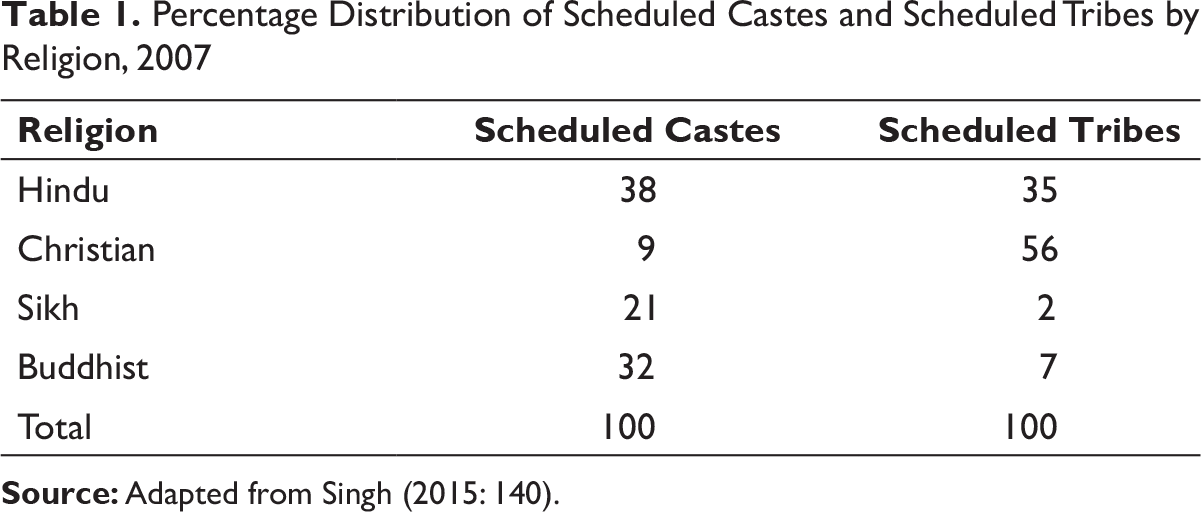
As evident from Table 1, as of 2007, the conversion of scheduled castes to Buddhism was significant but by no means universal with Hindu Dalits outnumbering Buddhist Dalits and significant proportions of Dalits remaining Sikhs and Christians. In contrast, among the scheduled tribes, Christians were the largest group, followed by Hindus, Buddhists and Sikhs. This shows that the impact of Dr Ambedkar’s campaign for mass conversion of Dalits to Buddhism has been variable regionally with greater success in Madhya Pradesh and some nearby states and limited success in regions dominated by the upper castes. This, in turn, suggests that contrary to what Dr Ambedkar expected, the Dalit conversion to Buddhism was less than complete. As Burra (1997) pointed out it may have had the opposite effect to what was intended in that it had the effect of splitting the Dalit struggle by their diverse religious affiliations.
Reinterpretation of Buddhism
Neo-Buddhism invented by Dr Ambedkar involved a reinterpretation of Buddhism in a number of novel ways. First, he identified Dalits as original Buddhists who were forcibly absorbed into Hindu fold by treating them as impure and untouchable. This, in turn, was considered an outcome of a long drawn out religious conflict between Hinduism and Buddhism, where Buddhism contested the inequality promulgated by Hinduism and a Hindu revival responded by castigating the Buddhists as untouchables within the Hindu fold. Thus, according to Ambedkar, the effort to convert the Dalits back to Buddhism was merely going back to an earlier state of affairs where they enjoyed dignity, moral integrity and political and social rights as well as fraternity as a tribal group with a common kinship bond among its members and an absence of hierarchy vis-à-vis other groups in society. This involved a reworking of the history of both Buddhism and Dalit identities. This simultaneously provided a moral foundation for the Dalit struggle and a historical counterpoint to and a rejection of untouchability as an imposition by the Brahmanic forces encountering the Buddhist onslaught at a particular juncture in history. As elaborated by Blackburn (1993), in Ambedkar’s ideology of Dalit history and identity, Buddhism and kinship were two related aspects highlighting the moral foundation for Dalit struggle as well as their shared history and common destiny.
From the point of view of the group, kinship calls for a feeling that one is the first and foremost a member of the group and not merely an individual. From the point of view of the individual, the advantages of his kinship with the group are no less and no different than those which accrue to a member of the family. Kinship makes the community take responsibility for vindicating the wrong done to a member. It is kinship which generates generosity and invokes its moral indignation which is necessary to redress a wrong. Kinship with another community is the best insurance which the untouchable can effect against Hindu tyranny and Hindu oppression (Ambedkar 1989 quoted in Blackburn 1993: 8).
This is an ideal vision of kinship that promotes a broader sense of generosity and mutual concern among members of a broadly defined group as against actual kinship ties limited by caste that defines parochial loyalties, responsibilities and entitlements.
Second, he describes the ideal form of Buddhism he wanted to propagate as ‘Navayana Buddhism’ (neoBuddhism). He clearly saw Navayana Buddhism as distinct from both historical and contemporary forms of Buddhism at the time of his conversion. Like Anagarika Dharmapala before him and social activists like A.T. Ariyaratne after him, he wanted Buddhist monks to take on constructive social action in the mold of Christian priests.
Third, the Buddhist concept of karma was reinterpreted to mean a group responsibility for future action rather than an individual’s moral responsibility for his or her past action that would justify the status quo and ‘sap the spirit of revolt’ completely in ways that prevented collective activism with a view to promote the interests of Dalits within a social order where they are kept at the bottom. Thus Navayana Buddhism was expected to problematise the existing social order rather than to legitimise it as in Hinduism and certain forms of contemporary Buddhism (Ambedkar 1946, 1948, 1979, 1987a, 1987b, 1989).
Fourth, Dr Ambedkar reinterpreted dukkha (suffering) and nibbhana (salvation) to mean not only personal suffering due to the very nature of human existence and the individual effort to escape the cycle of suffering, but also group suffering caused by inequality and the collective effort to eliminate this root cause of suffering. This reinterpretation of Buddhism gave a religious meaning and moral justification to the Dalit struggle and, thereby, provided a religious motivation for collective action against inequality (Ambedkar 1957).
Finally, this reinterpretation of Buddhism by one of the foremost social activists, who campaigned against the caste system, indicates why contemporary forms of Buddhism in Theravada countries like Sri Lanka as well as earlier efforts at Buddhist revival have failed to problematise social inequality.
Buddhism and Caste in Sri Lanka
Buddhism has an ambivalent relationship with caste in Sri Lanka (Gombrich 1971; Gombrich and Obeyesekere 1988; Silva et al. 2009). On one hand, the Buddhist sermons such as Wasala Sutta and Jataka stories narrating the previous lives of Buddha are full of moral condemnation of caste privileges and sarcastic invectives targeting the Brahmins, in particular. On the other hand, Buddhist institutions and belief system in Sri Lanka operate on the basis of caste on a number of fronts. Karma ideology, for instance, serves to explain and even legitimise caste, class and gender inequalities in society. The male monastic order is largely structured according to caste and female monastic order (meheni sasna) remains structurally marginalised from precolonial times. Moreover, religious rituals in Buddhism and related deity cults involve a display of caste order with high ranking officials drawn from higher castes receiving public obeisance from lower castes, representing hereditary caste services like drumming, dancing and mahout services as part of elephant parades and torch bearers and flag carriers. Furthermore, some of the caste services provide for merit making as in drumming and dancing in temples, alms giving and pirith ceremonies and in institutionalised begging from higher castes permitted for the lowest Rodi caste in Sinhala society.
Even though the performative public display of hereditary caste services is increasingly unpopular with younger generations in the respective caste groups, the nationalist reinterpretation and identification of some of the art forms and cultural expressions during the past several decades have served to reinforce the cultural value of Kandyan dance, Kandyan arts and crafts and temple paintings directly or indirectly associated with caste services (Pieris 1956; Reed 2010; Silva 1982). The convergence between Hinduism and Buddhism has been both historical and contemporary as reflected in Hindu Buddha and Buddhist Vishnu (Holt 2004) and the emergence of popular Bhakti religiosity across South Asia (Gombrich and Obeyesekere 1988).
The leaders of Buddhist revival in Sri Lanka such as Anagarika Dharmapala sought to mobilise Buddhism in their struggle against Christian domination and imposition of western values in a colonised society. Nevertheless, the nineteenth century Buddhist revival in Ceylon asserted Sinhala Buddhist identity and sought to revitalise perceived cultural legacy of 2500 years of Sinhala Buddhist civilisation rather than eliminating structural inequalities in society in the form of caste, class and gender disparities (Gombrich and Obeyesekere 1988; Seneviratne 1999). This may be seen as a fundamental difference between Dr Ambedkar’s social movement and previous and subsequent Buddhist reform movements elsewhere in the region. Ambedkar was not attracted to Buddhism because of its ascetic ideal that would establish a brotherhood of ascetics who escaped the caste system in their struggle for spiritual liberation, but rather due to what he identified as the potential of Buddhism to root out caste altogether.
While both Dharmapala and Ambedkar were Buddhist activists with the former perhaps influencing the latter in drawing attention to the need for revival of Buddhism in India, for Dharmapala, the future of Buddhism in Sri Lanka depended heavily on the vicissitudes of the Sinhalese, identified as the saviours of Buddhism in Sri Lanka. Firmly inspired by the Mahawamsa discourse, Dharmapala saw Buddhism as the moral foundation of Sinhala society and saw a common destiny for Theravada Buddhism and Sinhala race. While we may agree with Steven Kemper’s (2015) characterisation that Dharmapala was a universalist abroad and a parochial nationalist in Sri Lanka, nevertheless the fact remains that his effort at Buddhist revival eventually contributed to the development of Sinhala Buddhism as an ethnocentric hegemonic ideology of the Sinhala elite and the Sri Lankan state evolved since 1956. In its effort to create a common identity and ‘a deep horizontal comradeship’ (Anderson 1982) among all Sinhala Buddhists, the Sinhala Buddhist nationalism served to conceal rather than address or counter social inequality within Sinhala society whether in the form of caste, class or gender inequalities.
In contrast, for Ambedkar, Navayana Buddhism provided a platform for rebellion against the caste system upheld by the Hindu orthodoxy. While Ambedkar too was keen to win independence of the Indian nation and wanted to ensure that Dalits will not be ‘denationalised’ by conversion to Islam or Christianity, neo-Buddhism was identified and deployed as a liberating doctrine whereby the Dalits fight for their rights and claim their due place in Indian society. Even though the Sinhala-Buddhist inspired 1956 political change in Sri Lanka did seek to open up opportunities for the downtrodden through the Paddy Lands Act, switch from English to Swabhasha as the official language of the state, and by nationalisation of certain private enterprises, the Sinhala nationalist politics and development policies of the state informed by this ideology increasing took a hegemonic turn vis-à-vis ethnic minorities and social hierarchy in general.
Ethnicisation of Caste ?
Buddhicisation of the Dalit movement under the leadership of Dr Ambedkar can be approached as an effort at ethnicisation of caste as defined by Reddy (2005), Guha (2013) and others. A radicalised reinterpretation of Buddhism has served as a basis for a new identity formation among previously discreet and disjointed Dalit groups and a moral foundation for asserting their distinctive identity as well as rights vis-à-vis so-called forward castes in society. In this instance, hierarchy has been rejected on the grounds of democracy, human rights and equality as well as on moral grounds derived from a reinterpreted Buddhism. This has given a cultural and a distinctly non-violent but militant foundation to the Dalit struggle.
There is, however, a clear difference between the Buddhicised Dalit movement and the other forms of nationalist ethnicisation in South Asia. For instance, both the Sinhala Buddhist nationalist movement and the Tamil nationalist response in Sri Lanka sought to foster ‘a deep horizontal comradeship’ (Anderson 1982) across caste, class and gender divisions in Sinhala and Tamil societies, respectively, concealing and deemphasising inequality in the name of unified ethnic identities and/ or privileging ethnicity over all other identities be they caste, gender, social class or occupation. This is where horizontal inequalities get lost in the national struggles, as was evident in LTTE and JVP movements in Sri Lanka. Dr Ambedkar was careful not to make his Dalit struggle anti-national. Even more importantly he was determined that the national struggle should not undermine, overwhelm or hijack the struggle against inequality. He mobilised Buddhism to keep these various struggles alive and complementary within a broad democratic agenda. While the risk of Navayana Buddhism moving in the same direction as previous forms of Buddhism to accommodate and even legitimise social inequality cannot be ruled out entirely, as of now it calls for social justice and liberation of the subalterns.