




Abstract

In this article, my focus is on normalisation of sexism that feeds a culture in which women victims are often blamed when the crimes are committed against them, or they are posited as dehumanised objects for male pleasures. I also emphasise the potential of sexist jokes for the othering and exclusion of women from virtual social spaces through silencing women and denying their right to freely express themselves online.
Due to such a high level of women’s participation, the virtual social spaces can potentially offer some of the key features of a ‘public sphere’ in a more inclusive manner than as originally conceived by Habermas (1989). Though it is highly contested whether the Internet is a public sphere (Dean 2003), I argue here that it has, nonetheless, served as one during the COVID-19 period, mainly due to the disappearance of usual public sphere. This is partly why it requires careful consideration to assess how online sexism affects women’s online participation as well as their everyday life.
Jokes, Sexism and Social Distancing
Sex and gender have been an essential element in jokes and laughter for ages. Yet, social researchers have so far largely overlooked the social function of sexist jokes as something ‘not serious enough’, apart from a few researchers and theorists who have provided some insights on jokes more generally (Critchley 2002; Fine 1983; Kuipers 2015; Pullen and Rhodes 2013; Reay 2015), and sexism and jokes in particular (Butler 2015; Fraser 2013). Though ‘sexism’ is a relatively new term for describing social reality, studies on sexism are not new: the prejudice, stereotyping or discrimination on the basis of sex and gender have been a key concern of feminist theorists and activists for several decades (De Beauvoir 1949; Friedan 1963; Millett 1971; Rubin 1975). Historical research on sexism has dedicated more on the ‘serious’ issue of gender roles, the foundation of inequality between men and women (Millett 1971; Renzetti and Curran 1992), and largely ignored the ‘unserious’ issue of sexist representation in jokes. Nonetheless, to better understand the role of sexist jokes, it is crucial to examine the processes of reproducing sexist stereotypes, narratives, imagery and interactions, which serve to reinforce masculine consciousness.
Scholars have long emphasised the social function of jokes as a simultaneously uniting and divisive social activity (Fine 1976; Meyer 2000). As a form of social communication, jokes decrease social distance (Coser 1959) and play an important role in uniting interlocutors (Coser 1959; Fine 1976; Meyer 2000). While jokes aid in social affiliation and group formation, they can similarly be used to target ‘others’. The kinds of humour that are shared socially and the participants who find it ‘funny’ define who the ‘others’ are. Hence, jokes also function socially and politically to divide groups, particularly in generating and reinforcing social boundaries, social distance and inequalities (Billig 2005; Meyer 2000). Those laughing at an ‘out-group’ foster greater social affiliation and decreased social distance with their ‘in-group’, while simultaneously creating and/or increasing social distance against their target (Pérez 2017). Similarly, sexist jokes targeting gender ‘other(s)’ help reinforce and reproduce a masculine world view.
This social power enables sexist jokes to reinforce the power imbalance between men and women in society. Critchley (2002) argues that most humour ‘simply seeks to reinforce consensus and in no way seeks to criticise the established order or change the situation in which we find ourselves… simply toys with existing social hierarchies in a charming but quite benign fashion… much humour seeks to confirm the status quo either by denigrating a certain sector of society, as in sexist humour, or by laughing at the alleged stupidity of a social outsider’. Thus, jokes can play a ‘socially normative role’ (Butler, 2015: 43) by ridiculing an individual’s identity or behaviour. Due to the historic and continued inequities and discrimination against women, the jokes in which men ridicule women are more consequential, socially and politically, than those in which women ridicule men.
Some researchers in the field have explored the intersection between gender and power online (Foster 2015; Herring 2008). The technological developments have transformed the way people share jokes, and new forms have emerged, such as Internet memes. The Internet became a setting for circulating sexist and racist jokes early on as the anonymity it provided encouraged the circulation of the ideologies of hate. The content of such jokes is presented as a source of humour and fun rather than overt sexism. However, the ascendency of social media has greatly removed anonymity of its users, but they are openly willing to make sexist jokes. It signals a normalisation and acceptance of sexism online much more widely than in offline realities. Part of the mass appeal of sexist and racist jokes has been for their ability to offend, as Billig (2005) observes: ‘those who make racist or sexist jokes often claim to be rebelling against the demands of “political correctness”, placing themselves on the naughty, contestive, powerless side’. In the context of sexist jokes, this challenge to ‘political correctness’ is rather a direct process of reasserting masculine sentiments and ideologies.
Laughing at Women’s Body and Self in Jokes
Since the first case of COVID-19 was traced in China, there was a huge explosion of offensive jokes and memes, whose contents were often racist, sexist, xenophobic, et cetera.. The jokes facilitating adaptation to the new situation of lockdown did not help men to reorient their expectations towards accepting their new role in an altered situation but were largely about the women’s body. Early on, the South Asian users of social media remained partly preoccupied with how (mostly middle class) women would come out sexier from the lockdown, as Figure 1 illustrates, since they would have to do all the household chores on their own in absence of any helping hands, who had to go as a precautionary measure to protect the family from the virus. The meme suggests that the hard domestic works would serve to reduce body fat, making her look slimmer/sexier. Such jokes, shared widely and received much attention, act upon masculine pleasure and simultaneously discourage men from sharing or participating in housework through essentially associating housework with women.

This meme brings attention to body shaming, another key theme of sexist jokes. Negative body talk and shaming of women for how they look are ways of imposing patriarchal bodily control over women. Different women have different body shapes. Imposing such a standard whose sole purpose is to appeal to men’s desire is demeaning and dehumanising for women. It also makes them feel insecure about their own body shapes. Though jokes about body shapes are predominantly offensive for women, a large many people find them funny because they exhibit their superiority. This meme is an instance of how society depicts fat women who do not fit the social standards of beauty. This depiction is offensive not only to women but also to fat people.
The pandemic worsened the existing sexist inequalities all over the world. For instance, the Malaysian government decided that women needed a crash course on ‘pandemic manners’, sparking a sexism row. The government issued online posters, telling women how to maintain happiness in the house. One poster advised women to refrain from being ‘sarcastic’ if they needed husband’s help with household chores. The government also suggested women should dress up and wear make-up while working from home. Similarly, the mayor of Japan’s Osaka city said that women should not be allowed to go to the grocer’s during the pandemic as they take longer and ‘dawdle’. When public officials openly say things like these, it reveals how deeply ingrained stereotypical gender roles are. In different circumstances, representing Ugandan cases, Mwiine (2020) explores new visions into men’s lives, actions, interactions and negotiations between and among men, women and children and emerging social practices and media representations associated with men during the COVID-19 pandemic, what she has termed as ‘lockdown masculinities’. One of the revealing examples of lockdown masculinities is masculine jokes related to domestic work and women.
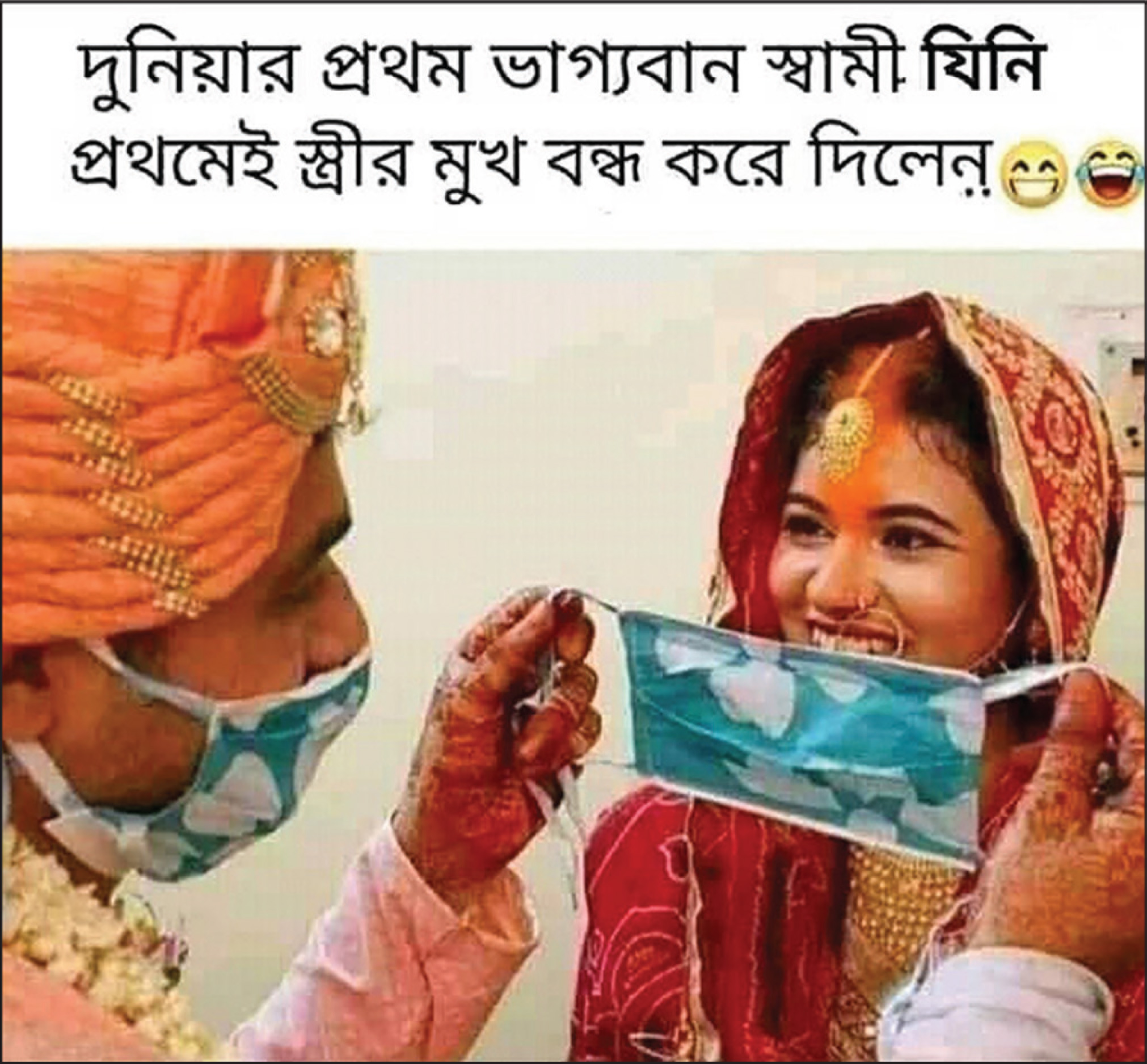
Since the declaration of general holidays in Bangladesh, a number of jokes in the form of memes, cartoons and videos have been shared widely, where men’s possible ‘sufferings’ while staying at home for an uncertain period and how they might adjust with that situation were the core issues. Some memes were addressed to women: ‘please behave well with men so that they can stay at home’, suggesting that men cannot stay home for long as they are tortured by women. The use of mask has been one of the recurring motifs in such ‘jokes’, for example, the text caption overlaid in Figure 2 reads: ‘The world’s first fortunate husband who shuts his wife’s mouth immediately after marriage’. This meme forges the idea that the mask can shut the women who are constantly nagging, and that the women do not really say anything serious or significant.
The laughability and unserious nature of jokes make them more ‘likeable’ than to be rejected: when a lot many people ‘like’ masculine jokes, reiterating patriarchal ideology instead of gender equality in the household, it further embeds existing societal perceptions of gender relations and makes confronting that ideology even harder. Digital reproduction makes it more complicated as its production, circulation and consumption, as well as reactions to it are instantaneous and transitory (Groys 2016). While challenging sexism where it occurs is usually an effective way of fighting it, it is not so effective online, as the feelings of fear, anger, shame, shock or panic that the ‘real-life’ experience of sexism generates may differ greatly online, largely due to the fact that in digital space, anonymity of the perpetrator and the victim is almost impossible, and likewise, the response also differs—standing up or shouting back is often different online than in our lived experience. Many stop short of responding to sexism and sexual harassment because of the fear of being ridiculed had they spoken up. Sexist imagery, narratives and interactions serve to normalise physical violence and contaminate offline relationships. Though online sexism is not isolated events but a part of wider biases against women, both online and offline, its implications for women could be much larger compared to offline due to the historical juncture of its development and saturation we are at now.
Footnotes
The author declared no potential conflicts of interest with respect to the research, authorship and/or publication of this article.
Funding
The author received no financial support for the research, authorship and/or publication of this article.