



Abstract
Abstract
While the local buzz and global pipeline approach has provided a useful platform for understanding knowledge creation and diffusion in the creative industries, little attention has been paid to the complex dynamics of knowledge flows through time and space. This article examines how the dynamics of local buzz and global pipelines supported Hallyu (translated into English as the ‘Korean Wave’, which refers to the increased popularity of South Korean cultural goods outside of Korea) by analysing the Korean film and TV industry. It is argued that changes in extra-local knowledge linkages offer opportunities for the expansion of the industry, both in domestic and international markets. The main findings indicate that not only did the dynamics of local buzz and global pipelines reconfigure Hallyu but also public support policies, private sector’s exertion and increased demand in the global market promoted Hallyu.
Introduction
For a long time, several theoretical concepts in economic geography have stressed the importance of agglomerative forces for fostering innovation and competitiveness, such as clusters (Porter, 1998a), industrial districts (Asheim, 1996; Markusen, 1996), regional innovation systems (Asheim & Isaksen, 2002; Cooke, 2001) and learning regions (Florida, 1995). However, as economic globalization moves on, these territorial innovation models (Moulaert & Sekia, 2003) have been criticized, inter alia, for neglecting extra-regional links (Hassink & Klaerding, 2012). Consequently, different concepts have been developed that may compensate for this shortcoming, such as local buzz and global pipelines or localized interactions and extra-local linkages (Bathelt, Malmberg, & Maskell, 2004).
A few studies have investigated local buzz and global pipelines in creative industries (Balland, De Vann, & Boschma, 2013; Bathelt, 2005; Bathelt & Gräf, 2008; Lorenzen & Mudambi, 2013; Vang & Chaminade, 2007). However, most of them have focused on developed economy industrial landscapes of Anglo-American countries and not on the creative industries in their Asian counterparts, such as South Korea (hereafter Korea), Taiwan or Singapore. In addition, only a few studies employed an evolutionary and historically informed perspective on local buzz and global pipelines. It thus remains unclear how the complex dynamics of knowledge flows change over time and how they encourage the development of creative industries (Berg & Hassink, 2014) in particular contexts.
The major objective of this study is, therefore, to analyse how the local–global linkages of the Korean film and TV industry supported Hallyu. It tackles the question of how diverse actors and factors are involved in the Hallyu phenomenon that operates in a ‘wave’-like way: lifting other related industries with it like a rising tide. In pursuing this objective, the article has three main aims. The first is to shed light on the historical narrative of local buzz and global pipelines in the film and TV industry. The second is to examine how the internal and external dynamics of knowledge flows support an incremental upgrading of creative industries in the global economy over time. The third is to contribute to the empirical literature on local–global linkages in the film and TV industry in a non-Anglophone context.
The context of my research is the film and TV industry in Korea. Recently, the popularity of Korean cultural goods—including movies, TV programmes, pop songs and computer games—has increased significantly around the world. This phenomenon is referred to as the Hallyu (translated into English as the Korean Wave) phenomenon (Ryoo, 2009). The boom started with the export of Korean television dramas to China in 1997. The export revenue of Korean films increased almost 65-fold between 1995 and 2010, and the export of Korean dramas has been on a rising curve from US$105 million in 2008 to US$107 million in 2009 and US$133 million in 2010 (Kwon & Kim, 2014). Hallyu has changed the perception of the Korean government towards the film and TV industry from censorship and political control to its incorporation as a fundamental element of national economic development. In addition, private sector firms entered multiple sectors of the film and TV industries, and started to produce high-quality products targeting both domestic audiences and foreign audiences. Moreover, Asian consumers in China, Hong Kong, Japan, Taiwan and Vietnam showed a high level of demand for Korean TV dramas.
Given the actions of both the public and private sector, and increased demand of global audiences, Hallyu is, in this context, neither a random accident nor a government construct. Rather, the Hallyu phenomena should be understood as a ‘wave’ 1
‘Waves’ generally occur by local wind, currents, ocean floor and tides on the free surface of oceans.
The rest of the article and the main arguments are structured as follows: The next section presents a brief review of the literature on local buzz–global pipelines and Hallyu. The following section describes the research setting. The section ‘Methods and Data’ addresses some methodological considerations. The changes in local buzz and global pipelines in the Korean film and TV industry, and their impact on Hallyu are detailed in this section. The next section discusses major reflections on the empirical findings. The next section concludes that in addition to the dynamics of local buzz and global pipelines, various other factors promoted and supported the phenomenon Hallyu; it also discusses implications for further research.
Theoretical Frameworks: Local Buzz and Global Pipelines
Buzz Creation
In the knowledge-based economy, the processes of creating, (re)combining, circulating and sharing new and existing knowledge are recognized as key contributors for generating competitiveness and economic growth in a region (Asheim & Gertler, 2005). These processes are especially encouraged within industry clusters (Bathelt, 2005, p. 107; Porter, 1990, 2000). Clusters capture the notion of dynamic interrelated networks of industrial activities at the regional scale on the whole and highlight the benefits of co-location in many ways, whereas networks represent strategic cooperation in the form of knowledge exchange between firms and other actors that may, but need not, develop these links at the local level (Visser, 2009, p. 190). Co-location and face-to-face contacts (Asheim, Coenen, & Vang, 2007; Bathelt & Turi, 2011) within a cluster give rise to a particular information and communication ecology, which is denoted as ‘industrial atmosphere’ (Marshall, 1927), ‘noise’ (Grabher, 2002a, 2002b), ‘local broadcasting’ (Owen-Smith & Powell, 2004) or ‘local buzz’ (Bathelt, 2005, 2007; Bathelt et al., 2004; Storper & Venables, 2004). These ideas can be summarized using the notion of ‘buzz’ which comprises specific information gained from intended and unexpected learning processes or accidental meetings, including continuous updates on this information, the application of the same interpretative strategy and mutual understanding of new knowledge and technologies, and shared cultural traditions and propensities within a particular technology field, which stimulate the establishment of diverse institutional arrangements, such as conventions. Actors constantly contribute to and benefit from the diffusion of buzz just by ‘being there’ (Bathelt, 2005, p. 109). More recently, however, scholars have started to claim that ‘being there’ does not mean ‘being connected’. Bell and Giuliani’s (2007) work on three wine clusters in Italy and Chile, for instance, highlights the idea that knowledge is diffused in clusters on a wide range of relational proximities, rather than firms’ geographical proximity.
External Linkages and Knowledge Flows
While numerous cluster-related studies overemphasized ‘localized interactions’ (e.g., Grabher & Powell, 2004; Saxenian, 1994; Scott, 1988) and neglected the significance of external linkages, an increasing number of studies have begun to highlight strong linkages with external markets and global knowledge flows as keys to a cluster’s economic performance (e.g., Amin & Cohendet, 2004; Bresnahan, Gambardella, & Saxenian, 2001; Coe, Dicken, & Hess, 2008; Grabher, 2002b; Hudson, 2005; Maskell, 2014; Maskell et al., 2006; Owen-Smith & Powell, 2004; Scott, 2002; Visser, 2009).
Visser (2009) explicitly distinguished between the concept of a cluster and a network, emphasizing the importance of knowledge interactions beyond the cluster level. In particular, Visser emphasized the quality of institutional conditions as crucial when the network extends beyond the local level (Visser, 2009, p. 189). Knowledge transfer through external linkages is a necessary means to enrich existing knowledge pools. For instance, conceptualized as global pipelines (Bathelt et al., 2004), deliberately established connections with external players contribute to the locally available knowledge in industrial clusters. Bathelt et al. (2004) argued that pipelines are designed and maintained by organizations to maximize the effectiveness of resource transfer across different spatial levels by creating strategic coalitions or common ownership. Communication processes in global pipelines are subject to great uncertainty and are naturally reliant on channels. The resulting interactions through pipelines rely heavily on the degree of trust that exists between the firms. Unlike buzz, the establishment of global pipelines with new partners requires investment and (human) resources.
The local buzz and global pipeline approach could provide a useful account of the dynamics of knowledge creation, accumulation, agglomeration and circulation; however, they have also been increasingly criticized for their limitations. First, physical proximity is neither a sufficient nor a necessary condition for collaborative knowledge creation (Boschma, 2005). Other factors, such as unwillingness of knowledge workers to move or the city image showed much stronger effects on knowledge sharing and collaboration (Breschi & Lissoni, 2009). Second, the local buzz and global pipeline approach focuses mainly on linkages of spatial clusters, ignoring the interaction of actors who are not permanently co-located (Grabher & Ibert, 2014). Third, it does not include any notion of an upper limit to the benefits of spatial clustering: Too much local buzz may induce information overload and too strong global pipelines could dominate the local milieu (Bathelt et al., 2004).
Nonetheless, a few studies in economic geography and international business have employed the buzz-pipelines perspective to analyse the dynamics of creative industries. For instance, Lorenzen and Mudambi (2013) emphasized the crucial role of the decentralized network structure of the Bollywood film cluster. Balland et al. (2013) analysed the dynamics of network formation of the video game industry from 1987 to 2007 and discovered that video game firms tend to prefer to partner across short distances. Vang and Chaminade (2007) discussed the importance of local–global linkages for the development of indigenous production in cultural clusters by analysing the interplay between the indigenous film production cluster in Toronto, Canada and Hollywood’s runaway productions. Bathelt (2005) pointed out the lack of a reflexive mechanism of local and trans-local interaction as the reason why the Leipzig media industry cluster has stagnated in recent years, after a decade of substantial growth. Bathelt and Gräf (2008) analysed the impact of advertising and the Kirch Group crisis on the Munich film and TV cluster. While the authors stressed that internal and external knowledge flows in creative industries play an important role, two questions have been left unanswered: (a) how do local buzz and global pipelines evolve over time?; and (b) how do they support an incremental upgrading of creative industries? Since an evolutionary approach provides an enhanced understanding of the e-processes and mechanisms in the underlying industrial dynamics (Boschma & Martin, 2007), I attempt to explain the changes of local–global linkages of the film and TV industry in Korea from an evolutionary perspective.
Research Setting
A Short History of the Korean Film and TV Industry
Research on the history of the film and television industry is particularly challenging, as film and television are ‘multi-faceted and connected to a whole set of contested issues’ (Corner, 2003, p. 273). It is obvious that there are many interrelated factors which have affected the development of the industry, and analysing all of these factors is beyond the scope of this study. Particularly, the Korean film and television industry has long been under the influence of society, politics, policies and government regulations. Moreover, the history of the Korean film and broadcasting industry has been disrupted by many tragic events, such as Japanese colonization and the Korean War.
With a structural approach, the post-war Korean film industry can be divided into two main periods: from the late 1950s to the early 1990s and from the mid-1990s to the present. During the first period, Korean cinema was barely sustained by some producers and regional distributors, who had divided the country into six major regions. At the end of this period, filmmaking was liberalized and direct distribution from Hollywood began. The second period of the Korean film industry started with the liberalization of production and the opening of the film market in 1995, when domestic distributors began nationwide direct distribution. This is the time when chaebols (large conglomerates such as Samsung, CJ Entertainment and Lotte Cinema) started to enter the film industry. Chaebols invested in Korean films and expanded through vertical integration with investments, production, distribution and exhibition. The success of Korean films after 2000 increased after the abolition of censorship and the transition to free competition in the marketplace. Today, the Korean cinema’s share of the box office exceeds 50 per cent of the total, and exports to overseas markets are increasing dramatically (Korean Film Council, 2014).
The history of the Korean broadcasting industry can be divided into two main periods: a period of strong government intervention (1961–1992), and a profit-oriented period (1992–present). During the first period, the central government was the most influential factor and the Korean broadcasting industry was limited to public broadcasting stations. The concept of a commercial broadcasting industry was extremely limited. During the second period, the Korean broadcasting industry became diversified and more profit oriented under the influence of the global broadcasting marketization trend and the development of media technology. Accordingly, the competition in dramas amongst the main broadcasting systems intensified from the early 1990s onwards. After the financial crisis in 1997, the broadcasting industry needed to become more profit oriented, rather than being enthusiastic followers of government decisions and beneficiaries of government support. Hence, government intervention in the Korean broadcasting industry was significantly weakened, although it did not vanish completely. With commercialization and technical development, total sales in the Korean broadcasting industry rose from USUS$5.5 million in 1995 to USUS$14.6 billion by the end of 2010 (Jeon, 2013, p. 63).
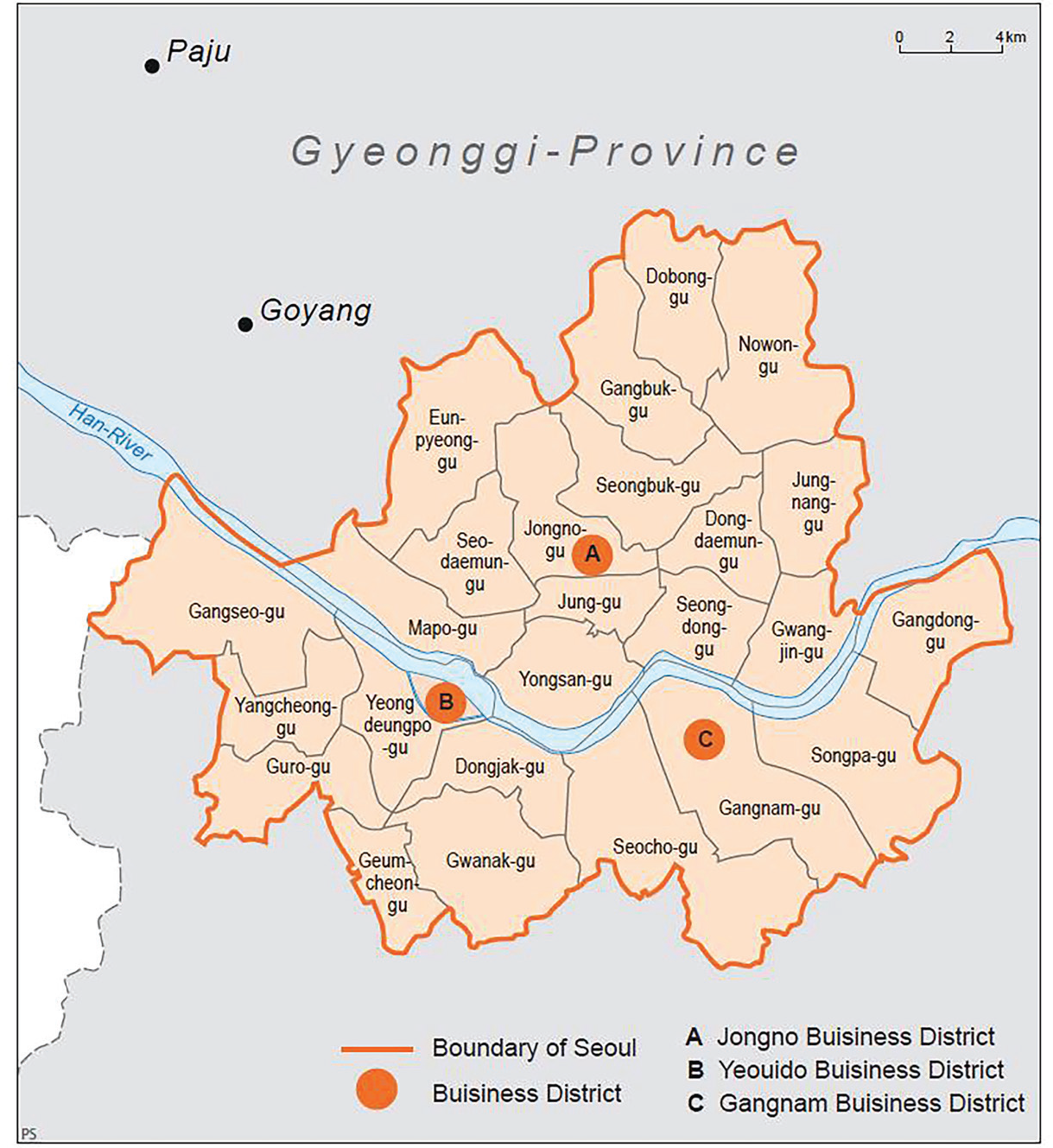
The film and TV industries are concentrated in Seoul, namel, in Gangnam Business District (GBD) and Yeouido Business District (YBD). GBD is the centre of the film production companies; YBD is the centre of the central broadcasting systems. Goyang specializes in Aqua Studios and Paju city in film post-production (Figure 1).
What Is Hallyu?
Korean drama series “What is Love All About?” was produced in the year 1991 in Korea, exported to China and aired in 1997. Therefore, the year of 1997 is the time of the broadcasting in China. The export revenue of Korean films increased almost 65-fold between 1995 and 2010. In addition, total export revenue of Hallyu products recorded a 553 per cent growth, from USUS$658 million in 2001 to USUS$4.3 billion in 2011. At least in terms of exports and the scale of the Korean film and broadcasting industry, Hallyu has been well under way since the beginning of the new millennium (Kwon & Kim, 2014, p. 423).
After the Asian financial crisis in the late 1990s, the Korean broadcasting industry recognized the need to diversify its business range, which relied heavily on advertising revenue. Meanwhile, TV programme exports seem to have emerged, as the organizational structure of TV production has gradually changed from the three major in-house producers (Korean Broadcasting System [KBS], MBC and SBS) towards many individual independent producers. Demand is increasing from neighbouring countries (China, Japan and Taiwan) for cheaper but high-quality television programmes (Jeon, 2013).
In 1997, the Korean drama What Is Love All About? was broadcasted on China Central Television (CCTV) and became a huge hit, with a 4.3 per cent rating. Consequently, Chinese journalists coined the term ‘Hallyu’ to describe the sudden influx of Korean cultural products. Since the Hallyu phenomenon started unintentionally and emerged outside of the Korean domestic market, some might argue that Hallyu is a ‘random event’ or ‘historical event’ happening beyond ex ante knowledge and the industry situation (Arthur, 1989). Some might claim that Hallyu is a ‘chance event’ (Porter, 1998b, p. 124) occurring largely outside of the power of firms or industry, creating discontinuities due to altered conditions in the industry resulting from oil shocks, war or financial crisis. Some might see Hallyu as ‘random or chance events, or historical accidents’ (Marin, 2010) of industrial structure.
Nevertheless, the rapid growth of Korean creative industries cannot be fully explained without promotion from the public and private sectors. On the one hand, public agencies formulated and implemented creative industry promotion policy. The Kim Young-Sam government (1993–1997) was a radical departure, as it eradicated the strict censorship faced by Korean film industries. Moreover, his administration permitted the entry of chaebols into creative industries. Subsequently, the Kim Dae-Jung government (1998–2003) provided the ‘informatization promotion programme’ in the late 1990s, which fostered the digitalization of film and TV production. The Roh Moo-Hyun government (2003–2008) substantially promoted the integrated development of the creative industries, in conjunction with the electronic, information and communication technology (ICT) industries (Kwon & Kim, 2014; Ministry of Culture, Sports and Tourism of the Republic of Korea, 1999, 2002a, 2002b, 2003, 2004, 2007). On the other hand, the proactive response of chaebols’ to maximize benefits in the context of domestic and international changes tended to produce competitive film and TV series by the end of the 1990s. Several chaebols started to invest and take part in production media industries and ICT (Shim, 2002). For instance, various chaebols set up joint ventures with domestic capital, including Samsung, Hyundai and CJ Entertainment, for co-production, distribution and exhibition (Ryoo, 2009).
Given the Korean government’s interventionist dynamic policy and the private sector’s proactive engagement, the Hallyu phenomenon is, in this context, neither a random accident nor a government construct. Rather, the Hallyu phenomena should be understood as a ‘wave’ that gathered momentum over time as the industry structure, and policy support mechanisms reacted to supply growing external demand and recognition of Korean cultural content, starting at first with TV content and subsequently with film and music. Hallyu is thus a multi-layered and multi-directional phenomenon encompassing diverse content, producers, consumers, politics and economics. The government’s approach to creative industries changed from censorship and political control to viewing them as a fundamental component of national economic development. This shift in the Korean government’s perspective on creative industries was reflected in the implementation of government policies, from the establishment of industry infrastructure and support for developing skills and knowledge in the workforce to supporting the expansion of firms into global markets. Private sector firms in the film and TV industries increased capital in the sector. Large enterprises, such as chaebols, have responded proactively by maximizing benefits in the context of domestic and international market changes. Not only major chaebols but also venture capital firms entered the film and TV sectors of the creative industries, and expanded their financing of cultural products. In addition, the private sector has started to produce high-quality products targeting both domestic audiences and foreign audiences (Ryoo, 2009). Moreover, Asian consumers in China, Hong Kong, Japan, Taiwan and Vietnam showed a high level of demand for Korean TV dramas (see, e.g., Yang, 2012).
Acknowledging Hallyu as a ‘wave’ of Korean cultural product in the global market allows us to enhance our understanding of local buzz and global pipelines in a broad sense, including changes to the industrial milieu and their impacts.
In summary, the suggestion here is that Hallyu should be seen as a ‘wave’ of Korean cultural products in the global economy; a ‘wave’ that has, over the last 20 years or so, gathered pace and momentum. Yet it is unclear whether it is a ‘wave’ that has peaked or one that continues to grow and spread. After an explanation of the methods used for this research study, I will investigate how diverse factors are involved in the emergence and development of Hallyu phenomenon, and I will explicitly focus on the forces of the dynamics of local buzz–global pipelines in the Korean film and TV industry as Hallyu evolves over time.
Methods and Data
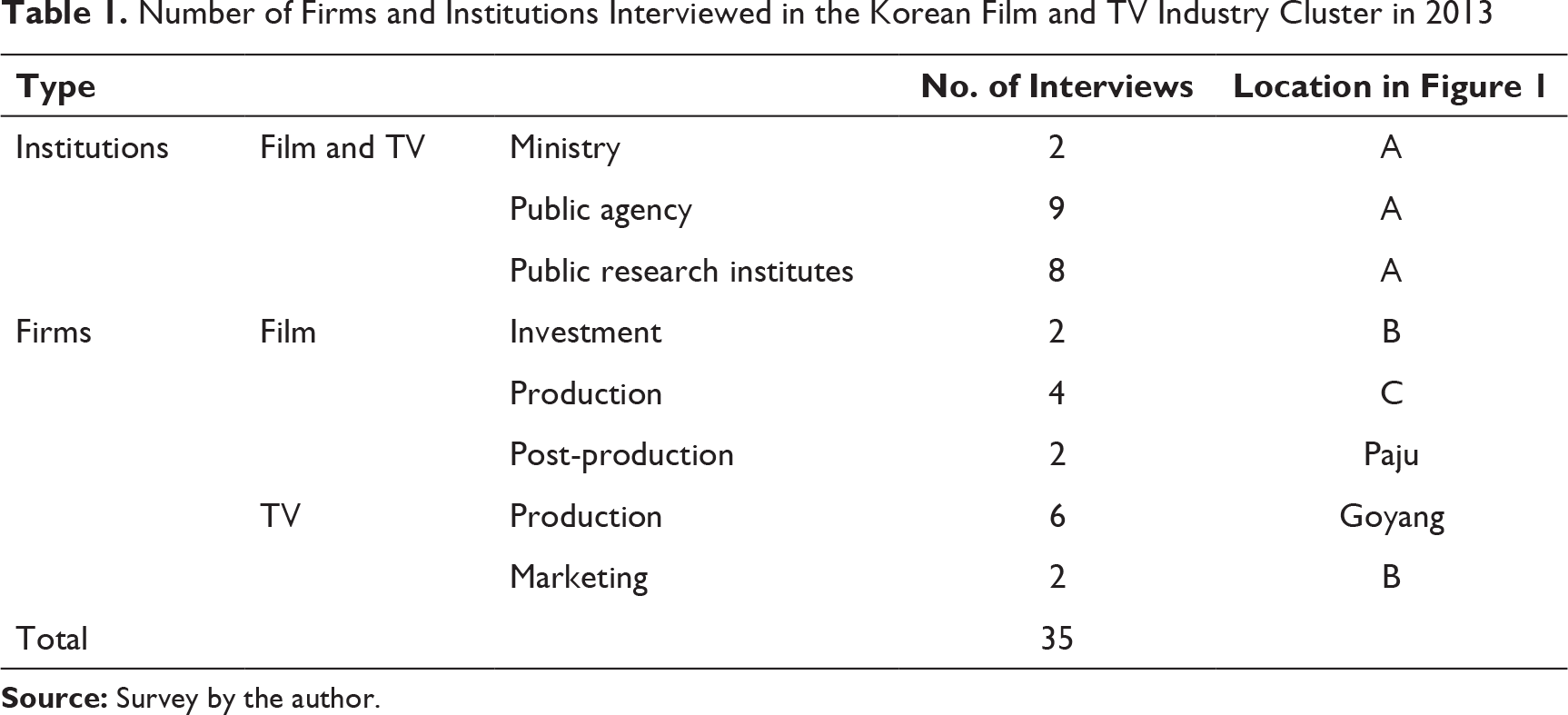
In order to investigate how local buzz and global pipelines of the Korean film and TV industry organized and supported Hallyu, this study relied on qualitative methods and observations. A qualitative approach helps to explain in depth highly contextualized phenomena while demonstrating the potential for answering the ‘why’ and ‘how’ questions of a social phenomenon. I, thus, conducted semi-structured interviews in order to attain qualitative data from respondents (Baxter & Jack, 2008; Vargas-Silva, 2012). A detailed description of the interviewees is given in Table 1.
Number of Firms and Institutions Interviewed in the Korean Film and TV Industry Cluster in 2013
The interviews were recorded and transcribed, except for a couple of cases in which the interviewee did not agree to have his/her interview recorded. In these situations, I tried to take systematic notes and completed them after the interview was over. The recorded interviews were all transcribed, managed and analysed using NVivo, and translated into English. All quotes from interviews in the article are translated from Korean, if not stated otherwise. The interviews took about 60 minutes on an average. Interview questions were categorized into seven sections: (a) general information on the organizations, (b) localization of firms, (c) linkage with related firms, partners and actors, (d) endogenous/exogenous factors that lead to change in networks, (e) the influence of Hallyu and policy intervention, (f) access to the global market and (g) future outlook. It is important to note that the interview protocol did not specifically ask questions about local buzz and global pipelines. Interview questions were open-ended, which allowed for significant prompting and focusing (Alony, Whymark, & Jones, 2007). They varied slightly with each interview according to the direction the interview went, and the information that was provided. It was also intended that the questions would change over time as the data accumulated in each categories. In January 2014, I followed up these interviews with 6 interviewees, including a film director, two producers, technician, policy-maker and industry expert. In February 2015, I conducted two additional phone interviews with film experts for updates. At that time, I focused on recent changes related to the relocation of the film institution and updated government policy. Observation was also an important part of the process during the empirical studies. I attended a Hallyu conference and informal meetings with sound engineers, post-production coordinator, costume designers, photographers, set decorator and script writers. Throughout the research period, I kept a research diary in which I documented my most important observations. Newspaper articles were used sporadically as a supplementary source of information, too.
Empirical Insights
This section analyses the changes in the local buzz and global pipelines in the Korean film and TV industry as Hallyu progresses. As aforementioned, Hallyu started with the export of Korean television dramas to China in 1997 and since then the Korean film and TV industry developed a new path with a focus on the global targeting of both domestic audiences and foreign audiences. Therefore, this section analyses the local buzz and global pipelines of the industry ‘before’ and ‘after’ the beginning of Hallyu.
Before the Beginning of Hallyu
Local Buzz
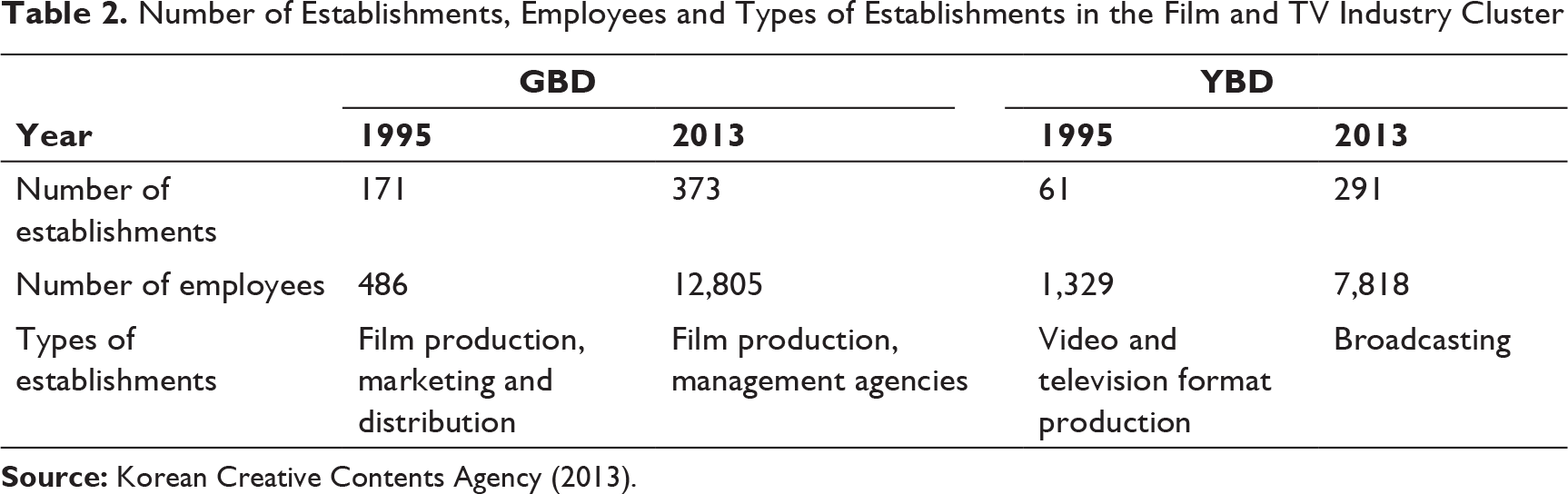
Number of Establishments, Employees and Types of Establishments in the Film and TV Industry Cluster
The area of Chungmuro (A Figure 1) was the centre of the Korean film industry until the mid-1990s. Major film companies had offices in Chungmuro, close to the movie theatres. In 1986, a total of 130 companies were located in Chungmuro, but this reduced to 27 companies in 1996 and 13 companies in 2000 due to high rents in the area (Choo, 2007, p. 246).
Until the beginning of the 1990s, Chungmuro had an exclusive network based on personal connections—such as school ties, origins and university alumni meetings. Dongguk University and Seoul Institute of Arts both had strong alumni ties, thanks to their own resource pool and informal meetings. (Senior film producer A, male, 26 years of experience.) Chungmuro had an exclusive and closed network. Many film producers isolated themselves from society and built a unique network structure based on regionalism, school relations and kinship. (Film producer B, male, 23 years of experience)
The three main broadcasting systems—KBS, MBC and SBS—are located in YBD (B of Figure 1). With KBS and MBC at the centre, there were 61 companies with 1,329 employees in 1994 and 72 companies with 5,194 employees in 1996 (Kang, 1996).
YBD symbolizes the history of the Korean broadcasting system. Before and after the Hallyu phenomenon, KBS is still the centre of the TV production cluster. (Korean Broadcasting System producer C, male, 25 years of experience)
There was also an exclusive network based on personal connections. For instance, personal connections were one of the most important tools for recruiting. In 1996, three major broadcasters (MBC, KBS and SBS) recruited a total of 92 producing directors: A total of 24 new producing directors were recruited through open-call position jobs, while the other 68 joined through a personal connection (Kang, 1996; Ministry of Culture and Tourism, 2006).
In sum, local buzz on the Korean film and TV industry before the beginning of Hallyu was exclusive and based on personal connections such as school ties and university alumni meetings.
Global Pipelines
Before Hallyu started, the external relationships of the Korean film and TV industry were limited and insignificant. Until the mid-1990s, Korean cinema was regarded as a national cinema at many international film festivals, and Hollywood films dominated the Korean domestic film market. In the early 1990s, Korean film and TV exports primarily supplied products to Korean emigrants overseas, mainly in the United States, Japan and Russia (Jeon, 2013, p. 187). Co-productions or external cluster relationships were rare. The first joint film following Korea’s independence was An Exotic Garden (1957), produced by Korea Entertainment Corporation and Hong Kong’s Shaw Brothers. A handful of joint production films were made up to the mid-1990s, but in reality, they simply changed the director’s name to a Korean name, even if the entire movie was directed by a foreign director (Korean Film Archive, 1998).
I can only remember one nominal co-production project [An Exotic Garden] before Hallyu. We called it a cooperative production, but in fact, it was mainly led by Hong Kong-based production companies. (Professor and film director D, male, 31 years of experience)
A few documentaries were produced in the 1990s by the co-production system between KBS and East Asian countries. KBS was involved in eight co-production projects with NHK (Nippon Hoso Kyokai; Japan Broadcasting Corporation) (Japan). In 1994, KBS and NHK jointly produced documentary series such as Teachers in the World (1993), Life: The Eternal Mystery (1994) and Great Poet Yoon Dong-Joo (1995). From 1994 to 1998, MBC had five co-productions and SBS had two co-productions (Korean Broadcasting Institute, 2007). In general, global buzz on the Korean film and TV industry before the beginning of Hallyu was tenuous, despite some international recognition and collaborations in the mid-1990s.
In the early 1990s, Asian countries have been undergoing major changes in media policies, structures and operations in favour of deregulation, privatization and commercialization (Hong & Hsu, 1999). Consequently, the previously tightly controlled television market in China has loosened their television programming import policies. For instance, since the early 1970s, imported programmes have occupied less than 1 per cent of total broadcasting hours on the CCTV in China. In the late 1990s, the percentage rose to 20 per cent or 30 per cent in different regions of China (Shim, 2008). In 1992 and 1993, three popular MBC drama series, Jealousy (1992), Eyes of Dawn (1991–1992) and What Is Love All About? (1991–1992) were consecutively exported to CCTV in China. Among these dramas, What Is Love All About?, broadcast on CCTV in 1997, garnered considerable viewing figures, averaging 4.1 per cent, which was the second highest viewing record among all foreign programmes broadcasted by CCTV in 1997 (Jeon, 2013, p. 190). The popularity of What Is Love All About? in China might also be explained by the cultural affinity between Korea and China: The focus of Korean TV dramas on family lives and their depiction of social relationships were based largely on Confucian values and ideology (Ryoo, 2009).
After the Beginning of Hallyu
Local Buzz
Once Hallyu was on a roll, GBD became a centre of Korean film production. In 2011, there were 373 cinema business companies with 12,805 employees in GBD, including production, investment and distribution firms. In 2013, a total of 701 film production companies in Seoul and 53.3 per cent of productions were located in GDB (Choo, 2007; Hwang, 2009; Kwon, 2011, p. 116; Korean Film Council, 2004, 2005, 2006; Yoon, 2002).
Because of increased rent in Chungmuro, film producers started to move to GBD in the mid-1990s. At that time, rent in GBD was lower than in Chungmuro and GBD provided sufficient workspaces and parking lots. I think that’s the main reason why many film directors and actors settled down in GBD. (Film producer E, male, 33 years of experience)
This film industry trend could be explained by the uniqueness of GDB, which is well known as the centre of education, business and shopping in Seoul. Major companies in the IT, manufacturing and pharmaceutical fields are located in this area. Major film investors/distributors such as CJ Entertainment, Showbox and Lotte Cinema were established in GBD in 1996. Major film production companies such as ShinCine, Taewon and Kang Je Gyu Film arrived in GBD in 1999. Management companies, for example, Namoo Actors and BH Entertainment, were founded in GBD in 2004.
GBD is like Hollywood in the USA. GBD provides a rich atmosphere that attracts many film producers. In addition, as PSY’s ‘Gangnam Style’ became so famous, people know there is a place called Gangnam in Korea. (Film agency manager F, male, 8 years of experience)
GBD became a new centre of the film industry after the emergence of Hallyu, although its network is still exclusive. One interviewee confirmed that GBD still provides exclusive networks amongst film producers, for instance, informal meetings to discuss new projects, face-to-face contacts and a shared resource pool. Most film productions are one-off projects; and consequently, information flows are brisk for production crews. As a result, with GBD as a centre, film production companies built an exclusive network in which information flows are only open to GBD ‘insiders’. These exclusive interactions among individuals reinforce the cluster dynamics of the film industry in Korea by intensifying localized knowledge transfer.
The broadcasting industry has remained in YBD since Hallyu began. In 2011, there were 538 TV production companies in Seoul, 291 of which are based in YBD. About 7,818 employees worked in the broadcasting sector in YBD out of 27,203 total employees in Seoul (Hwang, 2009; Kwon, 2011, p. 73). In addition, the survey confirmed that an exclusive network based on personal connections is still dominant in YBD.
One interviewee pointed out that most producers are afraid of revealing new ideas to the public, due to the risk that others may copy them, which has actually been a frequent occurrence in the past two decades. Furthermore, interviewees acknowledge that there is excessive competition for staff due to a number of structural problems in the TV industry—such as working conditions and imbalanced information flows. It indicates a series of boundaries to local interaction: secrecy, extreme time constraints, short production runs and poor working conditions.
Drama production crews receive scripts just before shooting each episode. This is the reality for most Korean drama productions. Production crews have no choice but to keep shooting, no matter how absurd the script is. (Senior actor G, male, 46 years of experience in broadcasting, interview with Dong-a IlBo 30 September 2013) Since we must complete drama production within a limited time frame, both the cast and crew are obligated to work under high pressure. Overtime and night working hours are no longer an option. (Art director of TV drama series H, male, 6 years of experience) Poor working conditions and time pressure tire the brain and are enormous problems in YBD. To secure sufficient staff, producers are hesitant to discuss their next project with colleagues. (Production director I, male, 13 years of experience)
The buzz in GBD and YBD has remained exclusive in nature. This reveals that innovation-related knowledge is exchanged unevenly and selectively, despite the presence of widespread business interactions (see, e.g., Bell & Giuliani, 2007, p. 163).
Due to the shortage of systematic data before the advent of Hallyu, it is hard to analyse the impact of Hallyu on local buzz, but many interviewees confirmed that there were few changes in buzz patterns in the last decade. In short, the impact of Hallyu on local buzz in Korean film and TV production is insignificant, as local buzz continued forging exclusive networks (Table 2).
Global Pipelines
Once Hallyu started, the film and TV industry went through different development processes. The Korean TV industry focused on TV drama production targeting the three main Asian markets of Japan, China and Taiwan, while the Korean film industry diversified its pipeline channels by expanding co-production, entering new markets and gaining international recognition at several film festivals.
On the one hand, the Korean broadcasting industry began to focus on exporting Korean drama series to Asian markets. Between 1993 and 1995, KBS and MBC tried to find a strategy for concentrating overseas market sales in neighbouring Asian countries to make up for the limited domestic market. Thanks to the successful entry of MBC drama series What Is Love All About? into the Chinese broadcasting market, KBS’s exports exceeded USUS$1 million in 1996 and reached approximately USUS$3 million by 2000. In 2003, the KBS drama Winter Sonata featured on the Japanese terrestrial station, NHK, enjoying enormous popularity among female Japanese audiences. This success changed the negative bias against Koreans held by Japanese people based on their memories of Japan’s colonization of Korea from 1910 to 1945 (Mori, 2008, p. 128). According to the KOCCA, exports of Korean dramas are on a rising curve from USUS$105 million in 2008 to USUS$107 million in 2009 and USUS$133 million in 2010.
The tight plots and strong characters have made Korean TV drama series popular both at home and abroad. Along with Hallyu, the overall quality of Korean TV programs has improved. The importance of scriptwriters and producers has become more recognized. (KOCCA researcher J, male, PhD in media studies, 13 years of experience)
Moreover, the initiative in drama production has gradually moved from the three large in-house producers (KBS, MBC and SBS) towards many individual independent producers due to vertical integration of the broadcasting stations after the financial crisis in 2008.
Hallyu is well underway, at least in terms of exports of Korean broadcasting programmes to East Asian countries; however, it has not been strong enough to diversify the global pipeline channels of the Korean broadcasting industry. For instance, the three large TV production companies still dominate both private and government-driven co-production of broadcasting content. Furthermore, the major partners are still East Asian countries—Japan (62%), China (12%) and Taiwan (11%; Korea Creative Contents Agency, 2013)—and joint productions were primarily carried out with Asian countries, including China, Mongolia, Vietnam, Indonesia and the Philippines. The programmes produced through international joint production projects were shown on 188 channels worldwide, including the Korean stations EBS and Arirang TV (Kwon, 2011). One interviewee criticized Korean companies’ short-term investment strategies, which may fail to induce overseas partners to participate in co-production with Korean companies (Table 2).
On the other hand, the Hallyu phenomenon not only triggered the export of Korean films but also boosted the expansion of global pipelines by diversifying the network channels (Table 2). It intensified both the private and public sectors of the film industry. Korean film productions actively entered the global market, and the public agencies provided a number of support policies for them. The period from the late 1990s through the mid-2000s is considered a renaissance for Korean cinema, as the industry began to gain international recognition. The first international film competitions held in Korea were also established in this period. In 1996, the Busan International Film Festival (BIFF), the first international film festival in Korea, was established to introduce and support new directors and movies, with particular attention given to Asian cinema. At the beginning of the new millennium, American distributors such as Warner Brothers, MGM and Dreamworks started purchasing the rights to remake successful Korean films. Moreover, some Korean actors began to enter Hollywood.
Lee Byung-Hun is one of the few actors to have found a place in Hollywood—because of his proficiency in English, although for the moment, his roles seem limited to stereotypical Asian characters. (Entertainment agency manager K, male, 9 years of experience)
As Korean films and Korean artists gained international recognition, overseas film producers actively reached out to Korea to produce joint productions. The KOFIC supported 33 Korean–foreign joint productions in 2012. In addition, three acclaimed Korean directors made their Hollywood debuts in 2013: Park Chan-Wook with Stoker, Kim-Ji Woon with The Last Stand and Bong Joon-Ho with Snowpiercer (Korean Film Council, 2005, 2014). Furthermore, Korean film production companies launched joint ventures with foreign partners in order to facilitate knowledge exchange and cooperation among film workers. For instance, Korea’s Next Entertainment World (NEW) and China’s Huace Film&TV launched a joint venture to produce films in Korean and Chinese languages. The joint venture called ‘Huace & NEW’ produced its first three projects: The Witch, Beauty Inside and The Phone. The two companies will co-invest and co-produce these films equally. Also, they will have 50–50 share of revenues. Kim Hyeong-Cheol, director of NEW’s Korean film division, added that the joint venture is ‘an important step in its globalization strategy’ (Yonhap News Agency, 6 October 2015). The strengthening and extension of chaebols’s networks is analogous to the Chinese commercial media enterprises which successfully adopted the social and institutional dynamic shift during the 1990s. For instance, Star TV, founded in 1991, sharpened their focus on Chinese audiences, and expanded and reconfigured their media services by globalizing their strategies such as establishing transnational movie studios and video distribution platforms to meet the burgeoning demand (Curtin, 2007, pp. 2–5).
The empirical results portray the changes of local buzz and global pipelines of the film and TV industry as Hallyu progresses. The broadcasting industry stimulated strategic cooperation with East Asian media partners by focusing on TV drama series production. The film industry actively entered the global market by promoting joint productions and joint ventures with the strategic partners. Diverse reactions not only reveal strategic networking capabilities but they also confirm the externally oriented knowledge circulation and exchange of and by the industry.
Discussion
Juxtaposition of Local Buzz and Global Pipelines in the Film and TV Industry
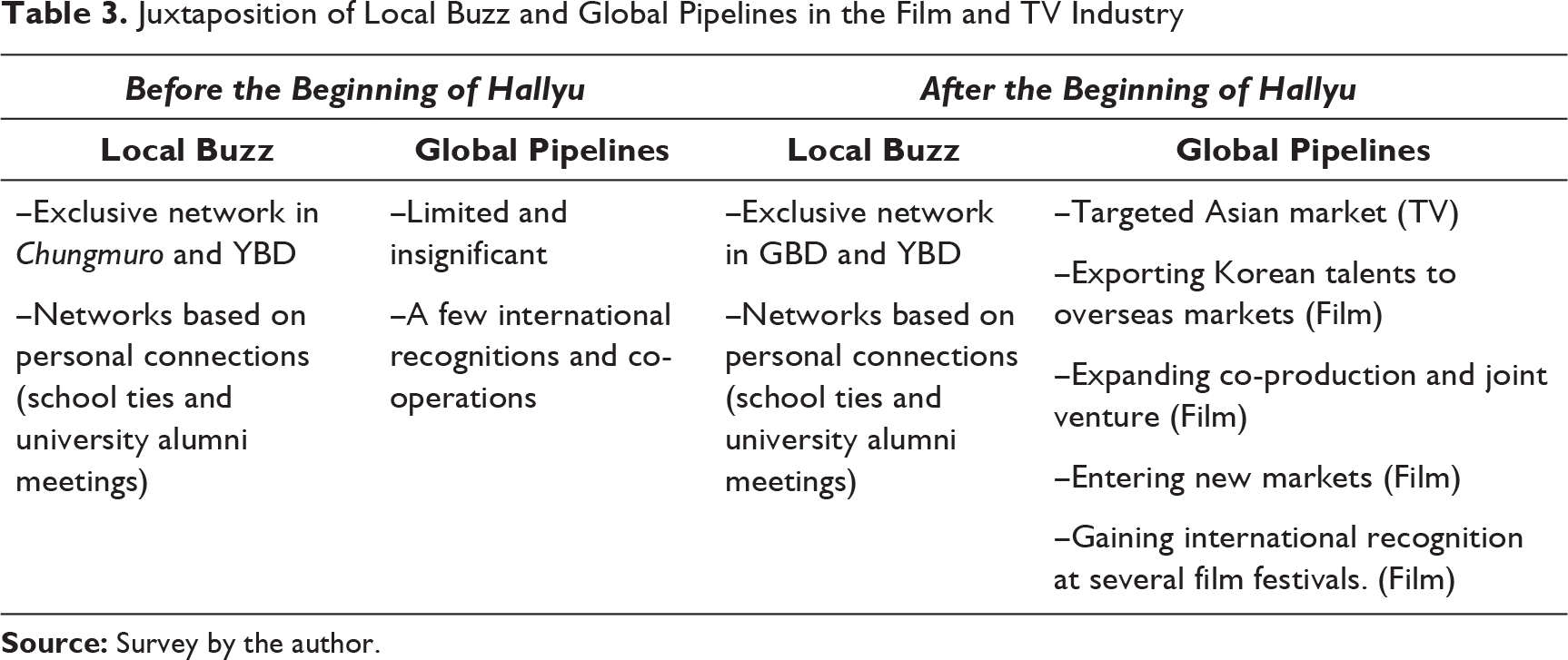
The local buzz remained an exclusive form while global pipelines extended external knowledge flows through diversifying channels. Minor alterations to local buzz may be reflected in the attributes of film and TV programme production: the project-based work and creativity of the final products (De Vann, Boschma & Frenken, 2013; Lorenzen & Mudambi, 2013). De Vaan et al. (2013) found that the increased number of fellow competitors in the same location can lead to negative externalities in the case of project-based creative industries. Some of the informants also pointed out that there is only limited interaction with co-located competitors for sharing new/creative ideas due to the risk of copying those ideas. In addition, this empirical study of Hallyu problematized an additional examination of power and politics in Korean society. It pointed out that the geopolitical aspects associated with these global pipelines are in line with the government’s support policy on creative industries, the consolidation of power within the exclusive network, the conglomerate-oriented industry structure and poor labour conditions—such as temporary employment, overtime working hours and nepotistic access to knowledge—in the film and TV industry that could give rise to the precariousness of the creative class in the long run.
Another important finding is that the changes in global pipelines of the film and TV industry experienced different processes. The TV industry’s global linkages were concentrated on the Asian markets, whereas those of the Korean film industry set up pipelines by entering diverse new markets, building co-production partnerships, joint ventures and exporting Korean talent to Hollywood. An explanation for this finding might be found in the fact that the broadcasting industry is still under the control of the central government, whereas the chaebols strengthen their market leadership in the film market. However, one interviewee expressed concern about this chaebol-oriented system, which endangers the film industry by encroaching on the diversity and creativity of Korean cinema.
Limitations
I see this study as an explorative and early attempt to analyse the impact of local–global linkages on an incremental economic transformation. In that respect, there are a number of countervailing forces and limitations. First, the empirical study of the Korean film and TV industry confirms that the dynamic local buzz and global pipelines promoted the development of Hallyu by diversifying knowledge flows. However, the Hallyu phenomenon entails bi-causality—in other words, Hallyu triggered the growth of the industry on the one hand, while the industry benefits from the Hallyu phenomenon on the other hand. The argument here is that Hallyu cannot be fully grasped or understood unless full consideration is given to the institutional setting and contexts (Martin, 2010). In addition to the dynamics of local buzz and global pipelines, recent studies argued that diverse factors are related to the emergence and development of Hallyu: (a) the success of Hallyu cannot be completely explained without an understanding of Korean government initiatives to develop the industry. In fact, since the late 1990s, the Korean government has aggressively promoted the development of film and TV production technology and supported a skilled workforce for global expansion; (b) technological advancements—such as digitalization and 3D technology—in the film and TV industry have also changed the industrial configuration; (c) growth of cable and satellite television networks and the development of media technologies increased audiences’ demand for entertainment programmes in East Asian countries including Japan, Taiwan and China; and (d) the reduction of the screen quota should be included as an environmental factor that has impacted the performance of the Korean film industry in the past decade (e.g., Kwon & Kim, 2014; Yang, 2012).
Second, there is a lack of data on local buzz before the beginning of Hallyu. The reliability or quality of local knowledge flows is hard to measure and evaluate. A lack of statistical data on the film and TV industry could be another explanation. A number of government-funded organizations, including the Korea Creative Content Agency (KOCCA, established in 2001), Korea Broadcasting Institute (KBI, established in 1999) and Korean Film Commission (KOFIC, established in 1999) were established to effectively support the growth of the film and TV industry. However, their databases do not provide data on interactions or collaborations within the industry.
Concluding Observations
Since the territorial innovation models have been criticized among economists and geographers for neglecting extra-regional links, the concepts of local buzz–global pipelines stressing extra-local knowledge flows have come into vogue (Bathelt et al., 2004; Grabher, 2002b; Owen-Smith & Powell, 2004). Arguably, the co-existence of a high level of local buzz and various pipelines leads to a more dynamic cluster (Bathelt et al., 2004). However, the evolution of buzz–pipelines has received relatively little attention in the extant literature on economic geography, despite the wide reach of the path dependence concept (in a non-trivial sense, history matters; Arthur, 1989, 1994) and an evolutionary approach (Marin, 2010). Recent buzz–pipeline analyses have begun to include creative industries in the global economy (Balland et al., 2013; Bathelt & Gräf, 2008; Lorenzen & Mudambi, 2013).
However, the extant literature still explains little about the dynamics of the buzz–pipelines of creative industries over time. A study of changes in local–global linkages that integrates both an evolutionary perspective and the concept of local buzz–global pipelines were thus warranted; and in so doing, this study provides a historic and more evolutionary view. By highlighting the importance of exogenous knowledge and local structures in the guise of institutions and relations among local agents, this study emphasizes the mechanisms of evolution (variation (global pipelines and interest induced changes to film, TV and broadcasting), selection (government interventions and pro-active private sector strategies) and retention (local buzz) of local–global linkages) in the Korean context showing how the Korean film and TV industry evolves over time in the global economy. This article posits that the changes of local–global linkages of the Korean film and TV industry induced the emergence and development of Hallyu. It also claims that Hallyu entails bi-causality, it thus should be acknowledged as a multi-layered and multi-directional phenomenon encompassing diverse sectors and contents. Hallyu started outside of Korea with a successful entry into the Chinese broadcasting market that ignited Korean TV and film exports; however, this success cannot be seen as an extraordinary event or a shock, since diverse actors, factors and sectors of the Korean creative industry also played crucial roles in the growth of Hallyu. In other words, the growth of the Hallyu cannot be fully explained without including the changes of the local–global linkages of the industry, promotion from the central government and private firms, and increased demand in the global market. This article argues that to understand whether and how a creative industry evolves over time, we must investigate the institutional settings and milieu of localized interactions and extra-local linkages.
The main finding of the article is that changes in local–global linkages can appear in different structural forms. On the one hand, the Korean TV industry case study indicates less change in local buzz; on the other hand, the Korean film industry case illustrates the diversification of global pipeline channels. Taking the changes of local–global linkages into account allows us to understand how diversification of extra-local knowledge linkages offers opportunities for innovation and the expansion of the creative industry, both in domestic and international markets. Furthermore, this study also makes us consider how growing success in on the global market place rapidly progresses ‘wave’-like, in the sense of a rising tide that lifts other related industries with it.
Future Research: Challenges and Opportunities
A number of challenges are associated with future research on this subject. There is a need to better understand how we identify a ‘wave’ in industrial settings when it occurs, develops and reaches a peak. For instance, defining a time point regarding the peak of Hallyu remains a controversial issue (for an overview see Marinescu, 2014). Future research could elaborate on geopolitical aspects of Korean society, such as the consolidation of power within the exclusive networks, the conglomerate-oriented industry structure and poor labour conditions. Finally, we know relatively little about the processes of the Hallyu effect lifting other related creative industries with it. In my view, this work is particularly important in the future for challenging and/or broadening the explanatory power of the economic geography paradigm.
Acknowledgements
The research for this article was partially conducted at the Department of Social and Economic Geography, Uppsala University, Sweden. The project was in parts funded by the Swedish Research Council (Vetenskapsrådet) and the author wishes to thank the Vetenskapsråde, and colleagues at Uppsala University for their support.