



Abstract
Abstract
Shanghai Energy Corporation—SHEnergy Group, a major Chinese enterprise in energy provision and the development of continuous improvements in energy conservation within urban development, is undertaking a major initiative in establishing the Shanghai International Energy Innovation Centre (SIEIC). Within the programme, study visits to London and Cambridge in the UK led to a decision to seek close collaboration with established and mature centres of excellence in technology transfer and the support of new company development and scale up, providing the rapid transfer of methodology and process and in addition to establishing longer term connections and relationships enabling the identification, curation, funding and eventual adoption of promising new technology from Cambridgexf and other UK and Western centres by SIEIC—in ways bringing benefits to all parties.
The initial research study commissioned by SHEnergy and carried out by Cambridge Worldwide Associates (CWA) and Business Global Technology Accelerator, supported by five Cambridge-based organisations expert in aspects of innovation, design and development of technology and the commercialisation of research as well as in the support and promotion of emerging ‘Cleantech’ companies, identified and ranked the observed key factors in successful identification, selection and nurturing/support of projects and technology companies. The resulting catalogue of ‘key success factors’ and detailed information collected on aspects of innovation centre management processes and education will support SHEnergy and SIEIC in startup and rapid progress towards successful innovation centre operation while building connections early for cross-border knowledge and technology exchange—with SIEIC as the centre point of activity.
This short, practically oriented and highly focused study provides key information to SHEnergy and SIEC in areas requiring priority focus in establishing a functioning and successful Energy Innovation Centre in important areas including:
Management, management structure and human resources Operating systems and processes Latest approaches to innovation, design and product development Metrics, measures and establishment of key performance indicators (KPIs)
In addition to providing significant detailed information to SHEnergy Group which will accelerate, enhance and enable efficient start-up and scale up of SIEIC, the study provides insights for other organisations in East and West contemplating cross-border collaborations and endorses the value of an open innovation mindset and practices to achieve effective international collaborations.
Background, Purpose and Rationale of the Study
Innovation centres, accelerators and science parks have become an integral part of processes focused on the transformation of knowledge and technology and of R&D into products, services and economic and social value. Centres of excellence in processes of ‘valorisation’ of R&D and technology have become established in numbers of locations. The evolution of entrepreneurial ecosystems has become a major subject of international interest and study and the prospects of accelerated processes in developing geographical locations through collaboration with more mature and established centres, which also have access to innovative new technology, has become a particular focus for key centres in China seeking not only rapid progress in the creation of new enterprises based on innovative technology but also access and connections with other international locations of special note in key technology areas so as to foster international knowledge and technology transfer into newly established innovation centres in China. International collaborations which can support the rapid transfer not only of new technology, but the established processes of innovation and technology management to Chinese centres, is seen as highly attractive. Shanghai Energy Corporation—SHEnergy Group is a world leader in energy provision and attendant services and it as part of future development foresees the importance of being at the leading edge of new technology acquisition and development in pursuit of remaining a leader in energy and extending its activities more comprehensively towards engagement in effective urban planning and support of the ‘smart cities’ movement.
Following extensive overseas visits and exploration, SHEnergy management embarked in 2017 on the planning and construction of a major state-of-the-art’ Energy Innovation Centre in Shanghai. As part of this development process, strong alliances have been formed through Business Global Technology Accelerator (BGTA) and Cambridge Worldwide Associates (CWA) with leading innovation centres in Cambridge in particular, and work is advanced on establishing firm partnerships for collaboration in not only identifying energy-related technology of interest to SHEnergy but also connecting with key Cambridge centres in ways that accelerate and enhance the effectiveness of those employed operating the Shanghai International Energy Innovation Centre (SIEIC), leveraging expertise and accumulated knowledge and experience.
The rationale for this study is based on observed experience that many schemes to effect successful international knowledge and technology transfer fail. The study is focused on identifying those key factors and elements incorporated in proven and successful innovation centre management which can be adopted or transferred, subject to necessary cultural adjustment, and to other characteristics found in effective entrepreneurial ecosystems proven to have supported and enhanced the role of innovation centres. The study aims to identify those key success factors, which if shared will lead to a successful long-term collaborative engagement between partners.
Participating Partners
In addition to SHEnergy Group, CWA and BGTA, participation is acknowledged from:
St John’s Innovation Centre Cambridge: the first established centre of its kind in UK. Future Business Centre (FBC) Cambridge: one of three such centres founded by Allia Ltd—A leading organisation operating in innovation for ‘Impact’. Trinity Science Park Cambridge (Europe’s first Science Park founded in 1970): The Bradfield Innovation Centre. Cambridge Cleantech Ltd: an industry association focused on the support of enterprises working on Clean Technology, Sustainable Energy and related subjects. It has an international membership of more than 300 companies and is based at the FBC Cambridge. Cambridge Design Partnership (CDP) Ltd: A highly innovative and successful company with extensive expertise and experience in creative product design and development strongly focused on innovation.
Partners listed are long-time associates of Cambridge Worldwide Associates (CWA) and its management and amongst the group of recognised leading organisations in their fields of interest. All have been previously introduced to SHEnergy management.
Process and Methodology
The participating partners received and completed a survey questionnaire. There were three specific questionnaire formats. All covered three principle areas of organisation and activity of the participants:
Management structure and business model Operations and positioning in the business/general community Human resource, training and educational issues.
There were three variants of the questionnaire:
One specifically for the three participating innovation centres. One designed to capture key information about Cambridge Cleantech—a focused cluster-based industry organisation. One designed to bring forth key information on identity, purpose and operation of CDP, a company focused on innovation, product design and development operating a specific commercial approach to new product development for companies across sectoral boundaries.
The questionnaires were returned completed to CWA/BTGA and the results studied, analysed and summarised to identify key factors to enable conclusions and recommendations to be made to both SHEnergy Group/SIEIC and participating partners concerning successful process introduction and operation of SIEIC and means whereby open innovation approaches to longer-term cross-border technology and knowledge transfer can be effected with benefit all parties and locations.
Following initial study and analysis by CWA/BGTA, summary findings were returned to survey participants for comment, correction and further inputs as appropriate prior to final consolidation of the report. The detailed questionnaire responses will be made available to SHEnergy group in due course with full approval of the participants once the report is finalised and published.
Summary of Key Findings
These are presented in three specific sections:
Innovation Centres Cambridge Cleantech—Industry Cluster Association CDP—a leading supplier of innovation and contract R&D services globally in energy, healthcare and consumer sectors
Innovation Centres
The key aspects of management structure and business model are as follows:
All innovation centres are commercially focused—for profit. All have relatively flat management structures facilitating ease of delegation and uncomplicated decision making. All express aims and objectives clearly internally and externally through all the usual media. For example, at FBC—of which there are now three separate operating units in different locations:
FBCs are focussed on resourcing impact ventures to start, grow, become sustainable and scale. Impact Ventures are ones which focus on improving people’s lives (either directly where they live or on the planet around them). We work with businesses that understand and who are addressing challenges covered by UN Sustainable development Goals.
Business models vary and are in all cases flexible based upon short-term leases and contracts suitable to enable early stage companies with limited resources to afford space and services and not be encumbered by long leases but able to grow (or reduce size temporarily) in line with business development and market conditions. Some centres are primarily rental based in offering space and services, with wide ranges of rental options form ‘hot desks by the day’ to dedicated office spaces form 1–100 people (the upper number only is some cases)—but all with ‘easy in-out terms’. All centres offer meeting room facilities and cafeteria services. All centres offer office space and some workshops and, in some cases, ‘make-place’ or ‘fab-lab’ facilities. None of the centres participating in this study currently include ‘wet labs’ for bioscience companies—although other centres in Cambridge do. In one centre—FBC, some profits are diverted to fund-limited offers of free business support and incubator programmes for very early stage enterprises. One centre emphasises a ‘membership model’ concept and approach admitting companies only if a clear and genuine dedication to contribution to community purpose in the centre is demonstrated. Management structures include senior and experienced leaders as CEO or managing director and experienced executives in management of facilities, finance, marketing and business development and enterprise support.
Key Success Factors that management identified in differentiating the centres for success included:
Understanding of the local ecosystem and strong presence in the local business and educational communities. Focus on optimisation of capital assets. Deep understanding of clients/customers’ needs and challenges. Empowerment of centre managers to drive and be decision making in delivery. Clear focus and understanding of the stages of development and respective stage needs of companies admitted to the centre. In some cases, the preferred entry point is very early stage, in another ‘late start-up and scale-up’. This is important in having available support staff with appropriate experience and expertise.
All Centres have identified key performance indicators (KPIs). Named in the survey were:
Occupancy rates (number one in all cases) Profitability—as net income Revenue per sq. metre Gross rental income Property expenditure Cash at bank Cafeteria performance Conferencing income and occupancy Consulting income

In addition, centres reported that more detailed KPIs were in place to track performance of functional teams in marketing, finance and facilities.
Where KPIs are reported regularly, they are shown compared to a budget or plan and are reviewed regularly at executive and board levels.
The most mature centre—founded in 1987—St John’s Innovation Centre reports that occupancy has been 98 per centplus for the past five years and overall performance has been strong with costs well controlled and income streams positive.
Those centres surveyed seek to charge commercial rates.
Figure 1 (with author approval from Dee et al., 2015) is illustrative of types of income streams available within the overall context of innovation centre and science park operations and is helpful in relation to the reported performance and KPI information in this report.
Operational Issues Within the Start-up Community—Selection and Recruitment of Tenants/Members—Curation and Management of Candidate Companies
Of established centres participating, one was able to share information on a portfolio of current and some former tenant companies. These cover a broad spectrum of company types and sectors. A total of 73 companies were named, and web addresses provided as current. A total of 60 past tenants were also identified. St John’s Innovation Centre can name amongst former tenant’s companies which have eventually exceeded US$ I billion in value. Several former tenant companies have become world leaders. Concerning other aspects of candidate company identification and selection/recruitment:
All centres seek to be connected to sources of information leading to introduction of new tenants/occupants through:
Close association with the existing Cambridge Cluster Active membership of Cambridge Network Ltd Very close connections with Universities, research institutes and student enterprise societies and with student and other entrepreneur business plan competitions Attractive events like ‘Start-Up Weekends’—open house events enabling entrepreneurs to present Marketing through local, national and international media and through active and attractive website content In Cambridge, there is a very strong and active cross-referral situation within a very close and creative entrepreneurial and ‘technology smart’ environment
Selection Criteria and Admission of Companies
Common features mentioned by all centres and other points:
A clear and structured application process in which the applicant declares requested business, financial and personal information. Centre criteria vary depending upon the overall mission and purpose of the centre, for example, FBC seeks tenants who are ‘able to demonstrate impact on people, planet or place’. St John’s Innovation Centre is essentially ‘sector agnostic’. Selection criteria are stringent and FBC and SJIC have perpetual waiting lists of aspiring entrants. Centres conduct interviews as part of the application and acceptance processed and take third party references as appropriate. St John’s Innovation Centre, in addition to regular physical occupancy, operates a highly successful ‘Star Service’ enabling appropriate companies located outside the region or the country—anywhere in the world—to enjoy named membership at various escalating levels of service related to a price structure, providing Cambridge postal e-mail and telephone address and facilities use. More than 320 companies now subscribe. Some do so as a preliminary or first step towards entering the UK from overseas—as part of a ‘soft-landing’
Services to Companies—Company Curation and Development Including Internationalisation
The participating centres in the survey highlighted the key importance of:
Provision of Educational Programmes examples being: ∘ Understanding and establishing the business model ∘ Defining value propositions ∘ Customer discovery ∘ Understanding business finance and fund raising—including pitching the business ∘ Lean start-up methodology ∘ Marketing ∘ Inter-personal skills and team building ∘ Going international Mentoring and maintaining mentor panels is a key feature in all centre responses. Individual company mentoring and understanding specific advice and coaching on expansion, growth and international development for tenant companies is subject to dedicated coaching in Cambridge Innovation Centres and in some measure, this is done by utilising connections with external resources and experts from the business, business schools and university communities. One centre reports specific coaching modules available to include: ∘ Enhancing business capacity and capability for scaling ∘ Value proposition design—creating products and services customers want ∘ Bringing new products to market and innovation road mapping ∘ Market segmentation, business model generation, strengthening supply chains, strategic marketing and internationalisation At FBC, provision of structured approaches to start-up, accelerator and incubator programmes is considered part of the corporate mission. Details are at www.seriousimpact.co.uk. FBCs also provide open opportunities for outside service providers to deliver approved educational programmes to tenants. ‘A main focus is to add value to our tenants’ businesses’ Paul Hughes—Director Allia Ltd.
Connections with China: Opportunities for and Chinese Connections and Questions to Centres on Preparation of Tenant Companies for Chinese Market Entry
In Cambridge, Trinity Science Park and the Bradfield Innovation Centre on the Park have a venture in place with Tsinghua University—TUS—in which TUS is investing £200 million primarily in the establishment of a new Bioscience Innovation Hub with wet lab facilities. A TUS team is now resident at the Bradfield Centre Trinity Science Park. Neither St John’s Innovation Centre or FBC has a focused or structured programme at present related to specific preparation of tenant companies related to China. Few companies from Cambridge have developed businesses in China within the spectrum of the Cambridge Cluster as a whole, and the numerous interventions of Chinese universities, corporations and government delegations are seen, as reported by survey participants, except Trinity Science Park, historically and in the main, confusing, distracting and time consuming. The survey confirms that with some notable exceptions opportunities to enable Cambridge companies to exploit real opportunities in China are not receiving focused attention. In a later part of this report, a different perspective and different stage of cross-continental progress will be described relating to Cambridge Cleantech Ltd, and the survey and the connections which have been established involving SIEIC will be discussed as prospects of constructive and structured approaches to collaboration are discussed.
Alumni Programmes and Tracking Former Tenants and Occupants
While all centres confirm interest in tracking former occupants, some have longer established histories than others. At FBC, an active alumni programme is run jointly by the workspace director and the business support team. The business support team has the task of connecting early stage businesses with alumni who are prepared to give time for support of newer companies. FBC also holds a quarterly event that brings together founders who are alumni to discuss common issues faced by CEOPs and those establishing new businesses.
Informal connections endure in many instances due to the collegiate nature of life in community-based innovation centres.
Human Resource Issues and Policies Relating to the Organisations and Staffing of Innovation Centres
The survey invited participating centres to provide comments on experience, qualification and skills requirements, recruitment, training and continuous professional development (CPD) of centre staff. Human resource (HR) policies in all cases follow proper and appropriate legal and general requirements and staff are properly contracted in all normal ways. Specific information indicated some key principles for successful innovation centre management:
At FBC Front of House, staff focuses on visitors and events, and general day-to-day operations are recruited from customer service backgrounds. Business support staff has a range of entrepreneurial backgrounds with business experience. Mentors, advisors and coaches are selected for specific transferable knowledge. Outside resources are used in some areas of training. St John’s Innovation Centre employs consultants and advisors all with business backgrounds and not with technical experience. In most innovation centres, technology companies come with technology experts and can relate to outside technology experts if technical knowledge and information are needed. The innovation centre role is seen much more focused on business, personal and financial development. Advisors at SJIC help particularly with strategy, planning, investment, grants, recruitment and internationalisation and are recruited to have suitable expertise and experienced. Respondents all reported that staff programmes of CPD are in place and all staff have a personal training and development plan. Centres are members of UKSPA—UK science parks associations and management attends the conferences run by this and other organisations. SJIC is a member of the European Business Network and the MD attends its Annual Conference. In all cases, members of the teams are exposed to current up-to-date courses and seminars considered appropriate. Staff excellence, motivation and fulfilment are part of the corporate missions of participating innovation centres.
Cambridge Cleantech: Industry Cluster Association
Key Aspects of Management Structure and Business Model
The vision of Cambridge Cleantech Ltd is—‘To establish Cambridge and the Region as the Leading International Cleantech Cluster’.
The aim is ‘to maximise the business opportunities and global competitiveness of our members’ and objective is, ‘We will do this by supporting our members in four key areas of business support: Cleantech Fact File—World Class member Services, Global Ambition Realised, Leadership in Cleantech’.
These headline statements are supported in more detail in the Cambridge Cleantech submission and can be made available.
The business model is of a member organisation a company limited by guarantee—not for profit social enterprise. Principal sources of funding are membership fees at founder, associate and member levels, grant funding, events and consultancy.
Management Structure
The company started in in 2011 with two employees and now has five full-time equivalents, that is, CEO, international manager, projects manager, office manage, bookkeeper, conference and events manager.
Key features of success are identified as restricting staff numbers to available income and employ only staff with a strong desire and drive to work in Cleantech and are passionate about environmental issues—and who are also qualified—fit for purpose—and able to share duties in a small and close team environment. (Martin Garratt, CEO, Cambridge Cleantech Ltd)
KPIs are defined in two parts:
Measuring the performance of the Cluster—which is undertaken every two years to provide an indication of the health of the overall Cleantech Cluster. The measures used are:
(a) Number of Cleantech companies using the CCL definition
(b) Number of people employed in the sector
(c) Turnover/revenues in the sector
(d) GDP—as far as can be measured—in the sector
Current information from CCL indicates that by these measures, the cluster is performing well against these metrics. There has been a slowdown in formation and development of renewable energy companies, but an expansion in the low carbon and environmental sub sectors.
Measuring the performance of Cambridge Cleantech—an annual review using the metrics:
(a) Number of members
(b) Financial income and cash flow
(c) Number of government grants secured
(d) Amount of sponsorship secured
(e) Number of staff and completion of performance contracts
(f) Number of events and numbers of attendees at events
(g) Event feedback forms (qualitative)
(h) Number of companies supported in business development
(i) Numbers of companies supported with access to new finance
(j) PR coverage (qualitative)
(k) Member feedback summaries (qualitative)
Latest information indicates satisfactory performance against these metrics and continuous growth since inception in 2011. Membership grew from 35 companies in 2011 to 348 companies in 2017.
Membership Criteria and Selection: Attracting and Retaining Members
To gain membership, companies must be either a Cleantech Company as defined by the UK Government Low carbon Goods and Services definition or be a professional service company providing services in the sector. Membership criteria are applied as stringently as possible:
The attraction and recruitment of new members is achieved through:
Introductions and referrals
Calls to potential members following media coverage
Events—new attendees and follow up
Media coverage
Funding opportunities
Maintaining members is a key team objective. Communication processes employed to effect this include:
E-shot newsletters
Events
Feedback form analysis and actions
One-on-one meetings
Telephone calling
Members surveys
Business support activities are extensive and critical and include:
Special interest group (SIG) events based on sector topics—examples being smart cities, waste management, water management
Access to finance—Cleantech investment and pitching days with investors
Contract opportunities—‘meet the buyers’ events—international connectivity and contract alerts
Support for international engagement and expansion—introductions to partner or potential partner organisations in overseas locations
Growth company support on business expansion—special advisory services from KPMG
Generic business support for marketing, finance and accountancy and other professional services
Challenges and Support for Members Seeking to do Business with and in China
CCL is very active in assisting member companies find opportunities for doing business in China and with international Chinese organisations. There is great interest from visiting Chinese business, government and academic groups in CCL. The challenges for members seeking to work in China include:
The need for trusted local partners
Understanding Chinese business approaches and culture
Language and translation services
Discovering and understanding Chinese market opportunities
Cambridge Cleantech has developed and continues to develop and provide a range of services for members seeking business opportunities in China. These include:
Asia Special Interest Group events and newsletters
Competitions for free places on Missions to China—help from CCL to gain access to and enter competitions and make bids. Includes DIT delegations.
Cambridge Cleantech has access for members to Wujin Green Building Zone—space available to members
Soft-landing support for companies exploring China from the UK through service agreement with Lingang Eco Town
Support of Cambridge Cleantech members who are Chinese and provide support to members
Cambridge Cleantech proposes serious discussion and exploration with SHEnergy Group concerning collaboration on SIEIC development covering possibilities of partnerships investment and joint activities and offers willingness to support the establishment by SIEIC of Shanghai Cleantech—using appropriate elements of the Cambridge Cleantech model towards a future goal of:
A thriving Cleantech Cluster in Shanghai created and supported by the Shanghai Cleantech Network The SIEIC to include a Cleantech Incubator in Shanghai with innovative Cleantech companies made China ready in the UK and enabled soft-landing in China with SIEIC—thus providing a stream of tenants to SIEIC Two-way communications and missions between Cleantech companies from China and the UK to exchange a transfer knowledge and ideas An Annual Cambridge—Shanghai Conference on Cleantech and smart cities
Cambridge Cleantech Ltd and CWA are suggesting as part of the input to this survey and research report:
A consultancy agreement involving CWA/BGTA/Cambridge Cleantech to support the establishment of Shanghai Cleantech A partnership arrangement enabling: ∘ A continuously updated information system highlighting Cleantech opportunities in both centres ∘ Two—way Cleantech missions ∘ Soft-landing business support services ∘ Introductions and ‘meet the buyer’ events—cross-continental ∘ Access to enlarged financial resources/funds ∘ Mentor support ∘ Office/location space for visiting companies in both directions
An additional note from Cambridge Cleantech Ltd in the survey report submitted by Cambridge Cleantech informs that CCL is presently in discussion with parties establishing Oxfordshire Greentech—a contract to support and manage its set up. Such a Cambridge–Oxford partnership could be extended into agreements and partnerships in due course with SIEIC.
The creative inputs from Cambridge Cleantech are speculative but included since this research report is intended as a preliminary and information and ideas paper to enable substantial longer-term partnership arrangements between the parties concerned—including BGTA and SIEIC.
Human Resource Policies and Management Education and Training Issues at Cambridge Cleantech
The CEO of Cambridge Cleantech identifies ‘cluster management’ as ‘a people related employment need’. Interpersonal skills and passion for the cause are more important than technical skills. The diversity of companies enjoying membership is broad. CCL plans the HR team to be ‘fit for purpose and strongly relating to and understanding of members needs and interests.
Concerning staff development, each staff member has a performance contract and a personal development plan which is reviewed annual with the direct manager to whom the staff member reports. Training needs are identified in the personal development plan and attended to accordingly.
Cambridge Design Partnership: A Leading Supplier of Innovation and Contract R&D Services Globally in Energy, Health Care and Consumer Sectors
Key Aspects of Management Structure and Business Model
CDP aims to be the leading supplier of innovation and R&D services—globally in the energy, healthcare and consumer sectors. The long-term vision is to significantly improve customers’ and patients’ lives through new product innovation. CDP is established with a facility in California in addition to the main base in Cambridge.
The CDP business model is to provide outsourced innovation expertise. CDP supports clients through the complete innovation process, working with client’s in-house resources and delivering a complete service where no resources exist. The CDP R&D Centre in Cambridge is fully equipped to do this, incorporating (Figure 2):
Physics Mechanical engineering Electronic and electrical engineering Software development
The business model is essentially ‘fees for service’. Clients are billed for the hours of work spent on their projects.
CDP provides clients with an integrated, holistic product development capability. The disciplines of consumer research, design, science, technology, engineering and manufacture are all integrated to translate opportunities into launched products as quickly and effectively as possible. By possessing a full range of capabilities, CDP can effectively translate insights into concepts and concepts into products.
Management structure at CDP is uncomplicated—it is a limited company run by ten partners/directors who each oversee a section of the business. CDP is a multi-project company, running around 50–80 projects at any one time. Projects are run by project leaders each of whom is the client point of contact for a project.
CDP explains the success factors of the organisation and model to be the flat management structure where rules are minimised, and trust maximised to empower staff to think differently and creatively, work autonomously and collaboratively. CDP rewards team performance primarily, not individual performance—which approach promotes internal collaboration. Progress is tracked at a market sector and client level, giving these teams both the responsibility and the autonomy for success.
KPIs and metrics at CDP are based upon the principle that financial success and ongoing growth are prerequisites to the continued health and prosperity of the company and its people.
Key measures include the following:
Fees revenue and profit—the main drivers for the business. Revenue for 2017–2018 was US$18 million. Growth targets, set as ‘ambitious’, not less than 20 per cent annually. In 2018, CDP won the Cambridge News Business Excellence Award for growth rate being more than 35 per cent in 2016–2017. Project cost against budget is a second key metric measuring ability to deliver projects to plan. It is currently running at 105 per cent success rate. Staff utilisation is closely measure and a key metric. Information is confidential within CDP. Product quality data is carefully measure and recorded. CDP as a competitive consultancy measures the percentage of projects won from the number bid for. Information is commercially confidential.
Operations and Positioning in the Business Community: Approach to Projects
To demonstrate the holistic project approach adopted by CDP, three case studies of real projects are described in the following section of the report.
Challenge: a connected, smart meter and energy use monitor to differentiate the energy use of individual appliances in the home (deaggregation).
Approach: we designed a system that used AI to differentiate between appliances by monitoring the voltage and current signature of the home mains supply. In addition, a clip-on device was developed to measure not only mains power but derive system power from the connection as well—eliminating the need for batteries.
Benefit: the patented energy monitor can be installed without isolating the electricity supply to a property, and with no need for a qualified electrician. Once fitted, it monitors how much energy is used by ‘each electrical appliance’ in the house, by analysing mains waveforms at a single point. It does not rely on any sensors or socket adaptors around the home, allowing it to also monitor fixed installations such as ceiling lights and water and storage heaters. This data also provides many opportunities for additional data-based services.
Challenge: good quality paint is only half the story when it comes to decorating. In Europe, DIY markets the decorating experience that is often spoilt by equipment that is difficult to use—and even more difficult to clean. We set out to change that.
Approach: a 12-month programme of consumer research, design and technology development created a ground-breaking powered roller that not only paints quickly and efficiently without dripping but also cleans itself thoroughly after every use. An Asian partner was selected to carry out manufacturing, with CDP engineers working in China to monitor tooling, quality planning and an extensive verification and reliability testing programme.
Benefit: the paint pod helped consolidate the market-leading position of the Dulux brand. It generated nearly £10 million in device and paint sales by making decorating easy, fast and clean, and boasts a dozen patented innovations.
Challenge: to develop an innovative face mask from consumer’s functional and emotional needs to address pollution in big cities in Asia. It should target premium markets and support the demands of a busy, on-the-go lifestyle in densely populated, and increasingly polluted cities.
Approach: CDP carried out research for innovation with target consumers in China to understand consumer attitudes, the existing competitive landscape and to develop a needs-specification which would underpin a successful product. Using this information, visual design concepts and models were created, and new technology was developed in our laboratory to tackle some of the greatest needs and complaints with existing masks. A proof of concept technology demonstrator with an associated smartphone app’ was created and tested.
Benefit: intellectual property, design solutions and technology principles were generated for the client allowing them to secure funding to take the product to market. The product is currently pre-launch.
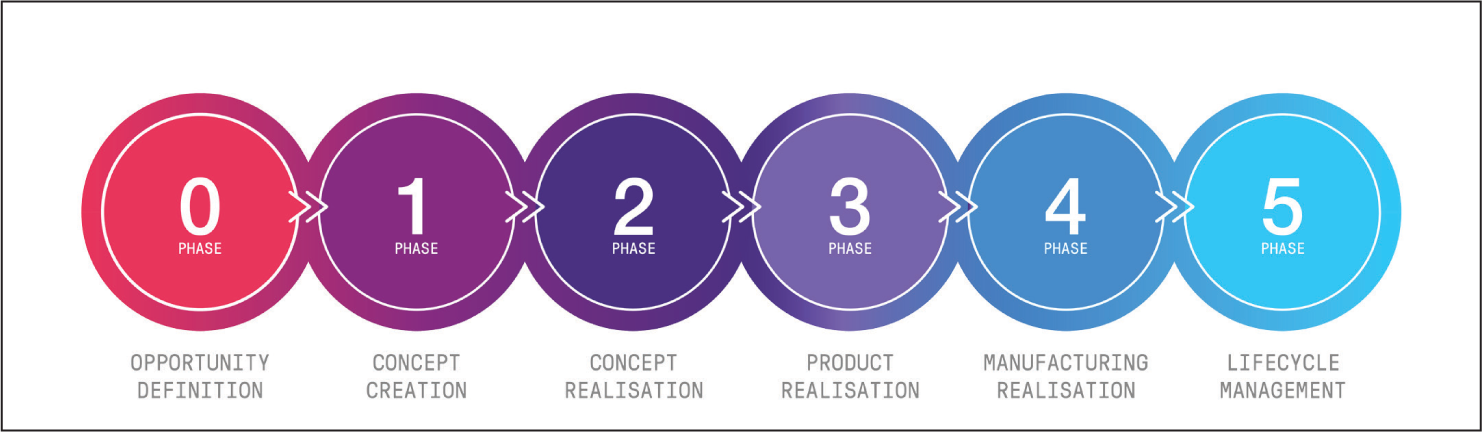
CDP undertakes fast-track, customer-focused innovation programmes, using its proven ‘Potential Realised™’ framework to optimise the return on clients’ investment in innovation.
Potential Realised is our customer-centred, holistic innovation approach that brings together creative consumer research and design with technology and manufacturing innovation, to create breakthrough new products.
It first maximises innovation potential through an evidence-based, iterative concept-optimisation process. Then it develops the technology and implements a production-ready design for manufacture, delivered as quickly and as economically as possible.
The six innovation phases within Potential Realised are illustrated above. We have produced a booklet that explains our methodology that can be provided on request.
We believe that Potential Realised delivers:
An increased return on investment in innovation by maximising likelihood of product success and minimising development costs. It fast tracks time to market by ensuring project uncertainties are managed effectively and all capabilities are under one roof and confidential. It provides a project management approach that in our experience of over 1,000 projects is most likely to deliver success.
How Does CDP support the Cambridge Ecosystem?
CDP provides services to clients in the region and cluster to achieve innovation and entrepreneurial goals and is a noted creator of jobs and employment in the region. CDP employees, partners and alumni are amongst key active members of the Cambridge growth-based ecosystem.
CDP has a presence in China—specific relationships relating to product development and special technical services. To the knowledge of the authors of this report, few if any services of the holistic nature provided by CDP can be found extant in China. This indicates prospects of serious collaboration between Universities, Government and free-standing organisations at the start of an exciting new era. Within which all can gain.
CDP has expanded successfully internationally so far and is established in the USA as well as Europe—but more is needed. CDP has developed products for the Chinese market (see face mask example). CDP works with Chinese innovators and technology providers. CDP believes there to be an emerging demand in China for the deep and broad product innovation expertise of which they are capable as Chinese companies transition from OEM business models to ODM models—by creating their own IP, new products and brands to sell domestically and for export. In the past, there has been an inescapable disparity between the cost base operated and what the Chinese market had required. The gap is quickly narrowing making this and ideal time for CDP to address the Chinese market.
CDP sees an excellent opportunity working with BGTA for CDP to use its expertise to help companies aiming to enter the Chinese market to be more effective through SIEIC. The provision of CDP innovation, design and development resources to China through a SIEIC channel could be of special mutual benefit.
Drawing Conclusions: Implications for Successful Longer-term Collaborations and Recommendations
The research we have conducted has sought to throw new light on how much discussed cross-border and -continental collaboration might be achieved between UK innovation centres of excellence and new initiatives in China. The study has been conducted not to enable the publication of academic papers—although these may indeed result—because the study has been deep. There may be lessons for many in what has been reported. That was the intent.
A reminder of the context within which this research has been commissioned is likely to be helpful before outcomes are assessed:
SHEnergy selected the Cambridge Entrepreneurial Ecosystem with its demonstrated ‘joined-up’ cluster of technology companies and support structure, including strength in ‘clean technology’ and ‘smart city’ abilities in which innovation centres have played a key role, as a model offering state-of-the-art knowledge and experience and willingness to partner in development of SIEIC. Cambridge cluster companies and innovation centre partners themselves face challenges in seeking entry to China’s huge and growing market which SHEnergy can assist with understanding and access. The engagement of BGTA as a unique bridge-building organisation expert and connected in both China and UK and staffed by Chinese and Western staff engaged in cross-border technology, and knowledge transfer has enabled the development of the valuable information in this report and can be a key factor in curation of the innovation system and processes at SIEIC in Shanghai while assisting the UK innovation partners deal with the challenges of China. The focus of the work has been inspired by the prospect of China–UK International trade and development. Cross-border and -continental activity is only possible through connections like those inspired and implemented by BGTA—an independent global accelerator with special connections in and with China.
Amongst the significant conclusions, we can draw from this focused and intensive survey:
The SHEnergy International Energy Innovation Centre project is ‘timely’. The time is right. The market need is clear, and China’s government’s focus on sustainable energy and environmental protection is highly supportive. Partnerships with a variety of specialised Cambridge- and London-based organisations can be appropriately co-ordinated by BGTA—to enable local groups and SHEnergy to leverage resources to bring rapid progress to development of SIEIC and innovation ecosystem in Shanghai through technology, knowledge and process exchange—but the real value of the connections will be realised only if longer-term contractual relationships of mutual value and trust can be established and sustained. Open innovation and cross-continental exchanges of knowledge, science and technology can result in positive benefits for all parties and locations if time is taken to align objectives and develop relationships of mutual trust and confidence. Preliminary research and preparation as conducted in this funded project can be a valuable precursor of action and prepare parties in the UK and China for substantive long-term relationships. Specific prospects and proposals for further action are clearly expressed. The design and development model and approach of one survey participant—CDP may be considered of special interest as SIEIC is launched and becomes established as a technology supporter and provider in Shanghai. The very real prospect of ‘Shanghai Cleantech’ as a partner organisation to Cambridge Cleantech providing significant value in Shanghai is recommended for serious exploration and could support the aims of SHEnergy in its leadership mission in sustainable energy programmes and support of Smart Cities.
Collaboration in technology and information exchange is also likely to lead to cross-border/joint funding of the international support of start-up, scale-up and growth of more successful technology-based companies. In our model, these will be primarily the UK-generated companies originally, but the process can be developed to be reciprocal. The prospect of Chinese investment in the UK operations or joint China–UK investment, aimed at identifying and curating innovative technology companies and making them ‘China Ready’, is a very real prospect if effective UK-based preparation and acceleration can be demonstrated.
Responses from the UK innovation centres in the study, concerning connections with and clarity of purpose with Chinese entities and partners or prospective partners—with one exception—are clearly sub-optimal and opportunities exist through prospective long-term contractual arrangements co-ordinated by a focused and resourced China–UK Accelerator like BGTA, working with established and funded Chinese partners like SIEIC/SHEnergy to bring coherence to bear in the establishment of truly practical and effective, mutually profitable cross-continental business arrangements.
Additional case study notes and a teaching guide for lecturers will follow in the next issue of JEIEE.
Declaration of Conflicting Interests
The authors declared no potential conflicts of interest with respect to the research, authorship and/or publication of this article.
Funding
The authors received no financial support for the research, authorship and/or publication of this article.