



Abstract
Abstract
Declining entrepreneurship as indicated by low total early-stage entrepreneurial activity (TEA) and high business failure is unacceptable in any economy. This predicament is indicative of South Africa’s business environment as well as the entrepreneurial disposition of firms operating within it. However, the factors precipitating entrepreneurial behaviour among small firms are yet to be fully comprehended and the environment as a motivation for entrepreneurship among these firms is yet to be examined thoroughly. Furthermore, research focus on the antecedents of entrepreneurial orientation (EO) is limited, even as EO has been considered as an aggregated construct repeatedly with inadequate attention directed at its independent constituents. In response to these concerns, this study investigates the relationships between environmental hostility (EH) and the individual components of EO among small businesses in South Africa. Using a quantitative methodological approach, the study conducts a survey, and analyses data obtained through random sampling. Through exploratory factor analysis (EFA) and partial least square structural equation modelling (PLS-SEM), it is discovered that only four components of EO are statistically recognisable, contrary to five as widely acknowledged in literature. Positive associations were also revealed between EH and each of these dimensions to varying degrees. These findings underline the necessity for entrepreneurial action along the lines of risk-taking, proactive-innovativeness, competitive aggressiveness and autonomy among small businesses in South Africa, given the hostile environment of her small business sector.
Keywords
Introduction
Extant literature recognises the potential of entrepreneurship in advancing economic development. Small businesses in particular are known to be drivers of economic expansion and mechanisms for job creation. (Acs, Estin, Mickiewicz, & Szerb, 2018; Li & Rama, 2015). To realise this potential, the environment in which small businesses operate should stimulate entrepreneurial efforts and is critical to their overall output. However, the South African business environment has been typified by limited resources, lack of competitiveness and sluggish growth in recent years (Statistics South Africa, 2019). In spite of this, the small business sector continues to play a significant role in the economy, as it accounts for approximately 91 per cent of all formal business entities. In addition, it contributes between 51 and 57 per cent to GDP, and small firms provide about 60 per cent of total employment (Fatoki, 2018).
Despite the remarkable contribution of this sector, the failure rate of these businesses is alarming, as 70 per cent to 80 per cent of SMEs in South Africa fail within the first 5 years of creation (Asah, Fatoki, & Rungani, 2015). Inevitably, the performance of SMEs, measured by revenue and profitability, remains unimpressive. South Africa’s small businesses are confronted by a plethora of challenges such as limited accessibility to finance from formal lending institutions, high levels of uncertainty and intense competition (Ayandibu & Hougton, 2017, p. 136). These challenges, among others, characterise the business environment, and it is possible that these trends, regardless of their origins, engender an inimical business environment, which could constrain entrepreneurial initiatives and small business growth. It could be associated with the relatively poor performance of the small business sector and declining entrepreneurial activity. Indeed, entrepreneurial activity levels in South Africa have dropped considerably since the year 2015 (Herrington, Kew, & Mwanga, 2017, p. 6). This is unsettling, given the Global Entrepreneurship Monitor South Africa Report of 2016/2017, which shows that the country has one of the lowest total entrepreneurial activity (TEA) rates among efficiency-driven economies. This reality could be the basis of the call made by Nieuwenhuizen (2014, p. 12) for the creation of a more enabling environment aimed at raising South Africa’s level of entrepreneurship. Irrespective of concerted efforts made to develop small business in South Africa, it has been observed that, the entrepreneurial behaviour of small firms has been sluggish and remains largely driven by necessity (Geitlinger, 2016).
On a conceptual level, how and to what extent the environment influences the entrepreneurial inclination of small businesses remains elusive. Precisely, the relationship between perceived hostility in the small business environment and the distinctive elements of firm-level entrepreneurial action is yet to be explored deeply and expounded adequately. Moreover, this study departs from a conviction that an examination of the role of the environment in the entrepreneurial orientation (EO) of small businesses may provide valuable insights that would enable a better understanding of the antecedents of firm-level EO.
Furthermore, this study seeks to address the gap in literature arising from the preponderance of studies propagating EO from a unidimensional perspective (see Madsen, 2007; Moreno & Casillas, 2008; Lotz & van der Merwe, 2013), while scant attention is paid to the elucidation of its components. Researchers appear inclined to study EO as a composite construct and this has limited the understanding of the distinct dimensions that make up the construct. As fallout of this, the relationships between environmental hostility (EH) and the individual dimensions of EO are yet to be fully investigated in the context of small businesses, particularly in an emerging economy like South Africa. It is against this background that this empirical study resolves to explicate the relationships between EH and the distinct components of EO in South Africa’s small business sector.
The Small Business Sector in South Africa
Within the market economy, small businesses are initiators and facilitators of economic development and an important sector of the economy. Due to their basic characteristics such as private property, entrepreneurial attributes, flexibility and adaptability, as well as their sensitivity to the environment, small enterprises provide a unique contribution to the economy (Spremo & Micic, 2015, p. 63).
The exact size of the small business sector is not known in South Africa, because of the large number of businesses that operate in the informal sector (FinMark Trust, 2010, p. 7) and the discrepancy in the number of small businesses registered for Value Added Tax (VAT) (Tustin, 2015, p. 81). However, it has been reported that there are 2 251 821 SMMEs in South Africa, of which 667 433 are ‘formal’ and 1 497 860 ‘informal’ (Bureau for Economic Research, 2016, p. 1). Furthermore, approximately 98 per cent of small firms are micro and very small enterprises, while only 2.4 per cent are small and medium firms (Makina, Fanta, Mutsonziwa, Khumalo, & Maposa, 2015, p. 11). The geographic distribution reveals that Gauteng Province houses the highest concentration of small business owners, and they are largely found in retailing. According to the World Economic Forum (2017), small businesses contribute 36 per cent to South Africa’s GDP. The crucial role of small businesses to South Africa’s economic growth has also been observed by Herrington, Kew, and Kew (2015, p. 10), who clearly state that micro, small and medium enterprises (MSMEs) are the ‘secondary’ economy within the nation’s entrepreneurial ecosystem, as they play a significant role within the broader business environment and can be directly associated with large firms, as they contribute towards national economic growth. Categories of small businesses are described as the interlink between the primary sectors that drives the economy and household units that benefit from these enterprises through employment and income generation. Nieman and Nieuwenhuizen (2014, p. 24) and Booyens (2011, p. 67) and the Bureau for Economic Research (2016, p. 6) have indicated why small businesses have become a subject of focus in policymaking in South Africa. They argue that the labour-absorptive capacity of small businesses could be higher than that of other categories; therefore, it is a more effective avenue for income generation and poverty alleviation. In addition, the average capital cost of jobs created by small businesses is lower than in larger businesses. Moreover, small firms allow for more competitive markets and compared with larger businesses, they adapt more rapidly to changing preference and trends. Considering the current economic situation in SA and bearing in mind the laid out National Development Plan (NDP), the need for an aggressive economic growth strategy further justifies the essential role of small businesses. A major objective of this plan is to reduce unemployment to 6 per cent by 2030 and in order to achieve that goal, 11 million additional jobs need to be generated, and this would require a GDP growth of 5.4 per cent annually. Notably, small enterprises are essential not only for GDP and job growth, but critical to fostering entrepreneurship development in the country. Therefore, an examination of the entrepreneurial behaviour of small business in relation to the environment, as intended in this article, is pertinent.
State of Entrepreneurship in South Africa
An objective appraisal of entrepreneurship in South Africa, as conducted by the Global Entrepreneurship Monitor (GEM) annually, tracks the intensity of entrepreneurial activities across multiple phases and assesses the characteristics, motivations and ambitions of entrepreneurs. TEA is considered a central indicator of the GEM study as it measures the percentage of the adult population that are in the process of starting a business (nascent phase) or who have just started (new phase) a business. With a TEA score of 6.9%, South Africa is ranked as 51st in a pool of 64 countries and in addition, the country’s established business ownership rate, which indicates the percentage of the adult population that are owners of firms that have been in operation for more than 42 months, is only 2.5 per cent (Herrington, Kew, & Mwanga, 2017). As a matter of concern, these figures indicate low and uncompetitive levels of entrepreneurship in South Africa. It portrays the country as lagging behind others in terms of entrepreneurial intensity. Furthermore, the entrepreneurial employee activity (EEA), an indicator which describes the development of new activities for an individual’s main employer, such as developing or launching new goods or services, or setting up a new business unit, a new establishment or subsidiary, a rate of 0.7 per cent is reported. With South Africa ranking low at 54th position, this corroborates the uncompetitive level of entrepreneurship in the country. This inadequacy of drive for entrepreneurship has been explained through various antecedences such as the personal characteristics of the entrepreneur (Obeng, Robson, & Haugh, 2014), the orientation of the market and availability of social networks (Gedajlovic, Honig, Moore, Payne, & Wright, 2013). However, the role of the environment has been advanced as a precursor to the entrepreneurial intensity (Otache & Mahmood, 2015) but is yet to be fully investigated. The nature of the business environment in South Africa may provide an explanation for the declining state of entrepreneurial intensity within this particular context and enhance the understanding of how factors external to small businesses can induce entrepreneurial action.
Hostility and the South African Small Business Environment
According to Anderson, Kreiser, Kuratko, Hornsby, and Eshima (2015, p. 1586), hostile environments are characterised by precarious industry settings, intense competition, an overwhelming business climate and relative lack of exploitable opportunities. Inevitably, this presents an unfavourable environmental condition typified by scarce resources and opportunities (Rosenbusch, Rauch, & Bausch, 2013). Bratnicka (2014, p. 61) elaborates that this general lack of opportunities and resources is often due to severe regulatory restrictions, shortage of labour or raw material and decreasing markets that influence the extent to which the environment hinders sustained organisational stability and growth. In hostile environments, largely because of the scarcity of resources, there is increased rivalry within the industry. Occasionally, this leads to a lower demand for an organisation’s products or services which endanger survival of the firm and unfavourable change, which negatively affects an organisation’s goals and mission.
It is well documented that the environment within which small firms operate in South Africa is challenging, and an eclectic mix of studies on the subject have identified constraints within the business environment with implications on small business development. Evidently, issues relating to market (Fatoki & Garwe, 2010) and finance (Herrington et al., 2015, p. 28) are predominant among small firms in South Africa, as they are often found in saturated markets where competition is high (Bureau for Enterprise Research, 2016). This gives rise to inadequate demand and low profits (Herrington et al., 2017). In addition, small businesses are limited by accessibility to credit facilities. Financial institutions are often unwilling to fund start-ups because their business ideas are yet to be tested. Hence, it not uncommon for business owners to be rejected due to lack of collateral. Moreover, should credit be granted, it is at high interest and on short-term basis, which impacts the profitability of the small ventures. These trends create a highly competitive environment, which makes it difficult for small firms to thrive.
Entrepreneurial Orientation
The concept of EO provides a useful framework in explaining the mind-set of firms engaged in new ventures and for researching the intensity of their entrepreneurial activity (Lumpkin & Dess, 2001, p. 432). In their seminal piece on EO, Miller and Friesen (1982, p. 10) contend that conservative firms decide to innovate only when constrained by a threatening environment, whereas entrepreneurial firms innovate regularly while taking on considerable risk. Miller (1983) argues that the extent to which a firm is entrepreneurial is determined by a composite weighting of three components—innovativeness, risk-taking and proactiveness—which must co-vary. Perhaps the consideration of EO as a unidimensional construct can be attributed to this argument.
Instructively, Lumpkin and Dess (1996) expanded the EO construct by asserting that the components of competitive aggressiveness and autonomy are also part of EO and that all EO components need not necessarily co-vary for firm-level entrepreneurial behaviour to be displayed. This position advances the idea that each EO component, individually, is reflective of some form of entrepreneurial action. On the basis of this, the notion of EO as a multidimensional construct becomes tenable. This is an opinion that has been reinforced by Hughes and Morgan (2007) as well as Pearce, Fritz, and Davis (2010) who consider EO as a multidimensional construct comprising of five dimensions and distinct variables. Accordingly, the five dimensions of EO are autonomy, innovativeness, proactiveness, competitive aggressiveness and risk-taking (Dess & Lumpkin, 2005).
Autonomy describes the independence required to conceptualise and realise a business idea, which is a critical aspect of entrepreneurial endeavours. Innovativeness relates to the extent to which an organisation is willing to chart new courses of processes, products or services, possibly to distinguish itself or its outputs with novelty, in comparison to competitors. The EO component of proactiveness is concerned with visionary thinking and action that allows businesses to anticipate emerging opportunities and latch on to them before these windows close or are recognised by their competitors. Competitive aggressiveness relates to a concerted effort to combat rivals and emerging threats in a way that allows the organisation to maintain or grow its share of the market. The outcomes of entrepreneurial actions are often attended by uncertainty and so the EO component of risk-taking focuses on the inclination of a firm to explore opportunities by making substantial resource commitments without being discouraged by the unpredictability of the future.
Consistent with the multidimensional view of EO, this article projects that autonomy, innovativeness, proactiveness, competitive aggressiveness and risk-taking are distinct consequences of the business environment. Within the context of small businesses in an emerging economy such as South Africa, it is therefore plausible that EH could play a role in instigating the entrepreneurial actions that make up the EO construct.
Since hostile environments are characterised by intense competition which is often price-based (Kuratko, Hornsby, & Covin, 2014, p. 28), businesses that lack the capability to respond entrepreneurially to such rivalry are likely to lose competitiveness and ultimately collapse. Contrarily, studies show that organisations that exhibit entrepreneurial behaviour can perform better in hostile environments (Covin & Slevin, 1989) as they are able to identify scarce emerging opportunities and, as the first movers, exploit them well before other businesses recognise the gaps (Casillas, Moreno, & Babero, 2010).
Environmental Hostility and the Components of Entrepreneurial Orientation
Miller and Friesen (1983, p. 229) contend that since resources are scarce and profit margins slim in hostile environments, businesses must pay attention to resource conservation and selective pursuit of economically competitive strategies rather than pursuing novel ideas in the course of being innovative. In their respective studies, Khan and Manopichetwattana (1989) as well as Wolff and Pett (2006) also found that EH has a negative effect on innovation in small firms. Kreiser and Davis (2010, p. 43) opine that it is likely that firms operating in munificent (non-hostile) environments will also be more innovative in their strategic orientation than firms operating in hostile environments. Zahra (1996) found that munificent environments acted to encourage research and development spending within firms, since firms operating in hostile environments may be reluctant to invest heavily in developing new technologies because hostility erodes profit margins and reduces the resources available for innovation. Resource conservation in hostile environments implies a cautious approach to innovation (Miller & Friesen, 1983, p. 775). Rosenbusch et al. (2013, p. 636) stress that for a firm to perform well in hostile environments, it may be required to implement a strategic orientation characterised by low experimentation. Accordingly, innovativeness may be an inefficient response to hostility but a legitimate strategic orientation in non-hostile environments. For example, a firm that engages in a product innovation strategy under the condition of intense price-based competition may fail because the innovation does not meet demand, and the firm suffers from an unwillingness of customers to value innovations with a price premium (Zahra & Bogner, 2000, p. 165). In contrast though, Li and Atuahene-Gima (2001) found that the turbulence in hostile environments creates new market opportunities, promotes innovation and necessitates unlearning of routines for flexibility to embrace innovation. Though there is disharmony in literature as to how EH could affect innovativeness, the predominant position seems to be that the relationship would be an inverse one. Ceding to this predominant position, the study proposes that in the South African context:
Covin and Slevin (1989, p. 77) hold the viewpoint that an entrepreneurial strategic posture may be particularly beneficial to small firms in a hostile environment. Since the hostile environment is characterised by fewer opportunities and more competitiveness than a munificent environment, it is likely that surviving firms have displayed proactive efforts associated with entrepreneurial firms rather than passive and reactive actions of conservative firms. This is possibly why Miller (1983, p. 775) argues that the more hostile an environment is, the more proactive firms tend to be. However, Miller and Friesen (1983, p. 223) posit that proactiveness can be hazardous when conditions become more demanding. The resource conservation perspective observed in hostile environments is instructive. Leaning on this perspective, Lumpkin and Dess (2001, p. 436) assert that in a hostile environment, there is increased pressure on the firm, which forces firms to be more oriented towards conserving limited financial resources. Such conservativism is antithetical to the important role of experimentation and discovery inherent in proactiveness (Lumpkin & Dess, 2001, p. 437). Although the aforementioned authors hypothesised that proactive behaviour would be related negatively to performance in hostile environments but found that proactiveness led to increased levels of performance in such environments, their argument could not be supported. However, this finding is consistent with the view held by subsequent studies (Kreiser, Marino, & Weaver, 2002; Bogatyreva, Beliaeva, Shirokova, & Puffer, 2017, p. 344). Thus, it is plausible to expect that hostile environments will act to increase the level of proactive behaviour to a larger extent among small firms. Against this backdrop, it is hypothesised that:
The relationship between EH and risk-taking is unclear (Kreiser, Anderson, Marino, & Kuratko, 2013, p. 1; Martin & Rialp, 2013, p. 71; Miles, Arnold, & Thompson, 1993, p. 13). While extremely munificent environments may not provide firms with an impetus to take risks, it is reasonable to contend that excessively hostile environments would discourage organisations from taking risks (Goll & Rasheed, 1997, p. 585). Goll and Rasheed (1997, p. 585) opine that the lack of resources in hostile environments would lead firms to avoid excessive risk-taking and pay greater attention to the conservation of resources. According to Kreiser et al. (2013, p. 2), this perspective has been informed largely by the concept of threat-rigidity, which argues that organisations will respond to threatening situations by lessening their emphasis on risk-taking. At the same time, munificent environments will act to discourage organisational risk-taking since organisations in such environments can employ typically more conservative strategies and still remain profitable (Covin & Covin, 1990, p. 38; Covin & Slevin, 1989, p. 77). Considering the non-significance of the relationship between EH and EO, as found by Rosenbusch et al. (2013, p. 646), other researchers have theorised that a non-linear relationship may exist between the two (Kreiser et al., 2013, p. 1). There is credible evidence that the relationship between EH and risk-taking is curvilinear in nature, such that extreme levels of hostility discourage businesses from taking risks while risk-taking behaviour is evident in conditions with moderate hostility. Cognisant of the position of previous studies and mindful of the contextual nature of relationships in the business environment, within the specific context of South Africa, this study opts to hypothesise that:
Businesses, which are typified by limited resources, lack the capacity to survive inaccurate managerial decisions (Brends, Jelinek, Reymen, & Stultiens, 2014, p. 616). The costs associated with such decisions are often greater in hostile environments. Furthermore, competitor responses to aggressive action are generally less predictable than their responses to passive action (Oliveira, 2015, p. 156). Thus, a firm’s viability may be secured best by adopting more passive competitive postures within hostile conditions. However, empirical evidence suggests that competitive aggressiveness may be related positively to EH. Given the paucity of product-market opportunities and the need to defend industry position vigorously in hostile environments, small firms often realise their goals only through aggressive stances (Covin & Covin, 1990, p. 38; Covin & Slevin, 1989, p. 81; Khedhaouria, Gurau, & Torres, 2015, p. 490). Although reluctant to assume the challenges associated with competitive aggressiveness in hostile environments, they may not be able to survive otherwise. Consistent with this argument, Covin and Slevin (1989, p. 81) found that small firms in hostile environments generally performed best when they demonstrated a high level of competitive aggressiveness. Lumpkin and Dess (2001, p. 437) opine that the discipline required to compete successfully in a hostile environment would be consistent with a competitively aggressive posture and their hypothesis, which postulates a positive relationship between the two, was found to be supported. These positions influence this study to hypothesise that:
Coulthard (2007, p. 29) identified autonomy as a vital factor in improving the performance of a business across different industries. Kusumawardhani, McCarthy, and Perera (2009), Covin, Green, and Slevin (2006) and Rauch, Wiklund, Lumpkin, and Dess (2009) have argued that when employees are given the leverage of independence in decision-making, they will be sensitised to act entrepreneurially and thus will help to enhance the performance of the business. Lumpkin and Dess (1996, p. 140) described autonomy as the ability and the will to be self-directed in the pursuit of opportunities and emphasised it as a key dimension of entrepreneurial action. These actions may be necessary in order to gain a competitive advantage in the precarious setting of a hostile environment.
Since hostility is typified by lack of resources which could include human resources, the autonomy of individuals and teams may be birthed under such circumstances. This would afford these individuals and teams the opportunity to act to combat the prevalent hostility. Indeed, the fast-paced turbulence that may be characteristic of hostile environments may encourage organisations to empower their employees to take expedited actions that could contribute to continued organisational operations rather than confront the ramifications of delays arising from bureaucratic decision processes. Though cognisant of the position of other researchers as presented in this section, this argument encourages the study to contend that:
Research Methodology
An ex post facto research design has been considered for this study as it entails events that have occurred already and present conditions (Leedy & Ormrod, 2015). As regards ontology, this study adopts an objectivistic position, as firm-level phenomena (such as EO and the EH) are considered independent of other social actors. Considering its epistemological stance, this study holds a positivistic perspective because it is of the view that only observable phenomena provide credible data and generate facts.
Consequently, this has informed a quantitative methodological approach, which is not uncommon in EO research. Moreover, seminal studies on the construct have largely done the same (see Rauch et al., 2009; Wales et al., 2013; Wales, 2016) and this affords a logical basis for comparison. Fundamentally, the research pathway that this study has followed aligns with a deductive reasoning process, which according to Cooper and Schindler (2014) is largely conclusive, and leverages off the precursory reasons provided. The fact that the study focuses on the construct of EH that could play an explanatory role in foretelling the distinct nature of EO in small businesses means that it is essentially a causal explanatory study.
The execution of the study entailed an online survey of small, medium and micro enterprises (SMMEs) across South Africa. A simple random probability sampling technique was utilised to identify and select respondents. With the use of self-administered questionnaires, data were collected in a cross-sectional manner. In measuring the dimensions of EO, the Hughes and Morgan (2007) scale was utilised, while EH was measured using Slevin and Covin’s (1997) scale. Both the EO and EH measurements were based on seven-point Likert scale items with measures ranging from ‘strongly disagree’ to ‘strongly agree’. Responses were extracted from returned questionnaires and coded. Subsequently, descriptive and inferential statistical techniques were utilised for purposes of analysis of the collected data.
Data Analysis, Results and Discussion
Frequency measurements of the sample characteristics of the small businesses that participated in this study, based on the categories of economic sector, phase of business operation and total annual turnover are presented in Table 1. The table reveals that there were more non-service-based businesses (57.4%) in comparison to service-based businesses (42.6%) and this was surprising, given that service-based businesses often require relatively lower amounts of start-up capital. It was therefore expected that small businesses who participated in the study would be more from the service-based cohorts, but this was not the case.
Sample Characteristics (n = 1031)
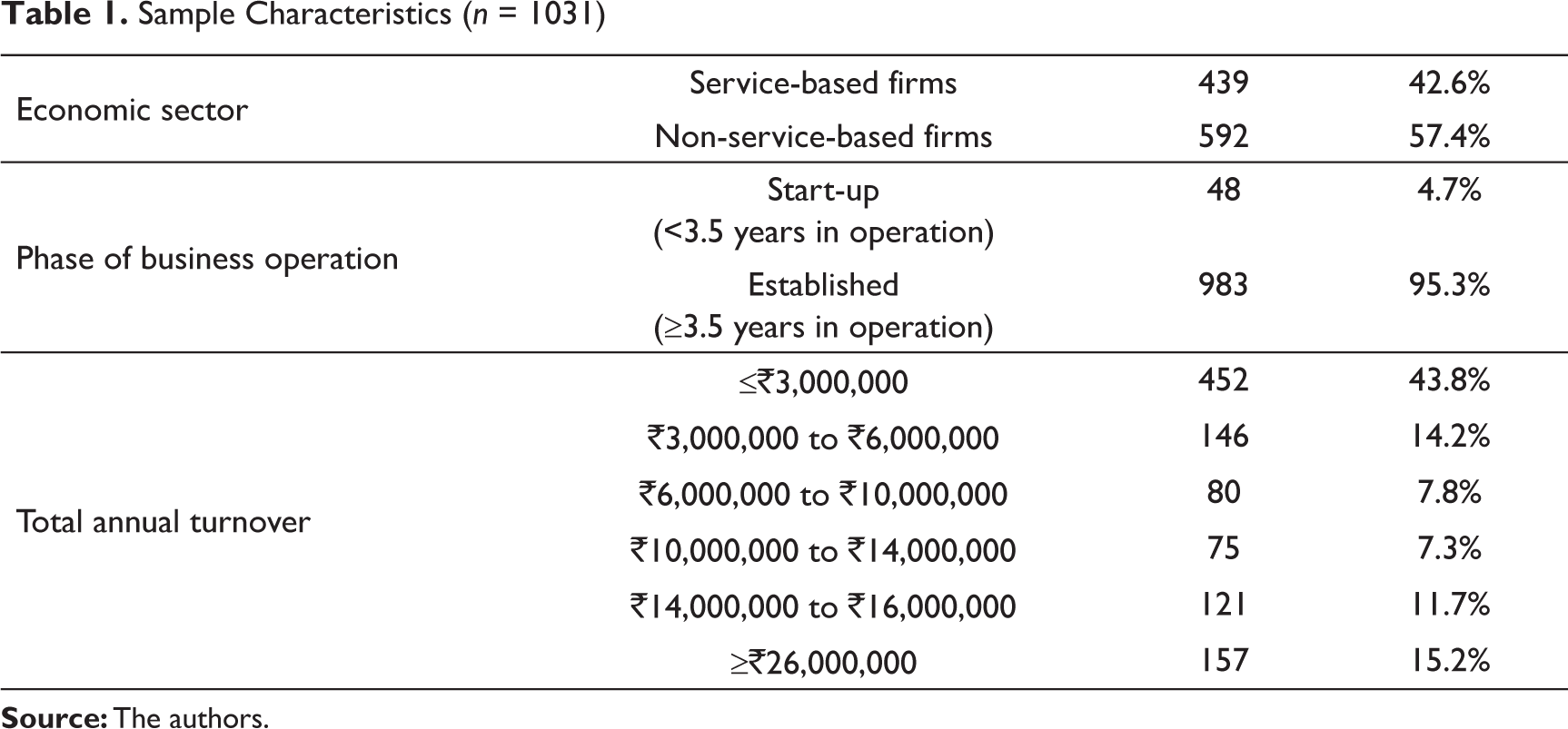
It can be observed that established businesses, those that have been in operation for at least 3.5 years, were predominantly represented in the sample. Implicitly, the sample consists largely of businesses that have stemmed the tide of the liability-of-newness which often overwhelms start-up ventures and may therefore be better informed about the business environment. Furthermore, these businesses very often have transited into the growth phase, which is somewhat a reflection of prior entrepreneurial action (Singer, Amorós, & Arreola, 2015, p. 23) and possibly embody an effective EO. Characteristic of the small business environment in South Africa, 452 (43.8%) businesses in the study’s valid sample had a total annual turnover under ₹3,000,000.
As part of the statistical analysis, the measurement model of the study was evaluated. Construct validity of the measurement instrument was assessed through exploratory factor analysis (EFA). The items measuring the dimensions of EO and EH were analysed using principal component analysis (PCA) and Varimax rotation. Table 2 shows the rotated component matrix. Kaiser–Meyer–Olkin (KMO) test for sampling adequacy and Bartlett’s test of sphericity, which assesses the suitability of the data for factor analysis, were conducted. The KMO and Bartlett’s test values returned by the analysis are 0.919 and 11,170.793, respectively. These values are statistically significant, given that the applicable associated p-value was 0.000 and this implies the suitability of the data for the purpose of EFA.
The data collection instrument consisted of 24 items for measurement of EO dimensions (Autonomy, items A1–A6; Innovativeness, items I1–I3; Proactiveness, items P1–P3; Competitive aggressiveness, items C1–C3; Risk-taking, items R1–R3) as well as EH (items EH1–EH6).
EFA for EO and EH Items: Rotated Component Matrix

Although Lumpkin and Dess (1996, p. 140) as well as Hughes and Morgan (2007, p. 659) propose five components of EO, results of the EFA undertaken in this study showed that the ‘innovativeness’ and ‘proactiveness’ components loaded together as a single factor. Since innovativeness and proactiveness loaded as one factor (Factor 2 in Table 2), this hybrid factor will subsequently be referred to as ‘proactive-innovativeness’ (P-I). This follows the precedence of Neneh and van Zyl (2017) as well as Matachba-Hove and Goliath (2016) who examined the components of EO among SMEs in South Africa and found a similar result.
Consequently, it is appropriate to restate the research hypotheses related to proactiveness (
Structural Equation Modelling Results
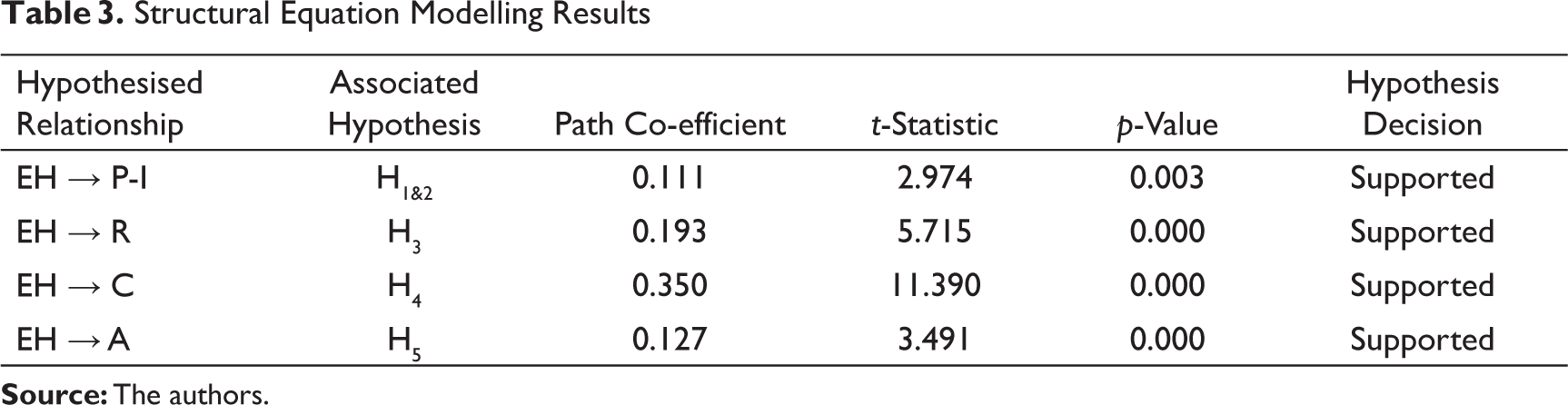
The study utilised structural equation modelling (SEM) to interrogate the existence (or lack of it) of a relationship between EH and the individual EO components. The results of the analysis are presented in Table 3. It is on the basis of these results that the study either submits that a hypothesised relationship is supported or otherwise. Examining the association between EH and P-I, the analysis yielded a path coefficient of 0.111, tstatistic of 2.974 at a pvalue of 0.003. These findings indicated a statistically significant relationship between EH and PI in the positive direction. Apparently, the hypothesis linking EH to P-I (
Furthermore, the output of SEM analysis provides evidence of a statistically significant and positive relationship between EH and competitive aggressiveness. This deduction is premised on the results of a path co-efficient of 0.350, tstatistic of 11.390 and pvalue of 0.000 associated with EH and C. Hence, the hypothesis linking EH to competitive aggressiveness (
Conclusion
Evidently, the businesses that have been considered in this study are largely established small businesses that have tarried long enough in business and have some understanding of firm-level entrepreneurial behaviour as well as their immediate environment. Against this backdrop, EH demonstrates that it is a valid antecedent of entrepreneurial action among small businesses in South Africa. Since the relationships hypothesised between EH and P-I, R, C and A were statistically significant in the positive direction, it implies that increased EH can be related to higher display of all the components of firm-level EO of small businesses in South Africa. The findings of this study are consistent with the stance of some earlier entrepreneurship theorists (Covin & Slevin, 1989; Miller, 1983: Miller & Friesen, 1982), who aver that the more hostile the environment is the more firms will strive to be entrepreneurial. Moreover, Covin and Slevin’s (1991) model, which presents entrepreneurship to firm-level behaviour, indicates a strong association between EH and entrepreneurial posture. They argue in favour of the inseparability of the external environment from the entrepreneurial process and assert that the external environment has a strong, if not deterministic, influence on entrepreneurial action. Notably, in the context of this study, the identified relationships between EH and EO components exist to varying degrees. Based on the values of path co-efficient, competitive aggressiveness indicated the strongest relationship with EH followed by risk-taking. This may not be surprising as these entrepreneurial actions can be viewed as direct consequences of a highly competitive small business environment. Within such an environment, businesses can ill-afford risk-averse behaviour, hence an intense effort to outperform one another and maintain their share of the market.
Interestingly, Rosenbusch et al.’s (2013) meta-analysis of the role of EO on the different variables of the task environment and performance revealed a negative and statistically insignificant relationship between hostility and EO in contrast to other environmental variables (such as munificence, dynamism and complexity) where these relationships were positive. In justifying this lack of relationship, Rosenbusch et al. (2013, p. 649) argue that not all firms align themselves with a hostile environment.
However, consistent with the findings of this study, previous empirical studies (Casillas et al., 2010; Martin & Rialp, 2013; McGee, Khavul, Harrison, & Perez-Nordtvest, 2012) have shown that within a hostile environment, entrepreneurial firms perform better than less entrepreneurial (or non-entrepreneurial) firms. Moreno and Casillas (2008) found that in a hostile environment, strategies of expansion through new products and markets give rise to higher growth rates. With respect to family-owned firms, Lumpkin et al. (2001) found that firm growth was positively and statistically related to innovativeness, risk-taking and proactiveness as well as hostility, an environmental condition which implicitly afforded such entrepreneurial actions. Additionally, Covin and Covin (1990) observed that high-performing firms often exhibit a competitively aggressive orientation to EH. Lumpkin and Dess’s (2001) study also shows that in a hostile environment, firms become more competitively aggressive as they develop a higher propensity to directly and intensely challenge their competitors. These studies attest to the positive relationships between EH and the dimensions of EO as observed in this study. Consequently, it becomes reasonable to assert that EH fosters different entrepreneurial actions as expressed by the individual components of EO.
Essentially, the findings of the study bear useful implications for policymakers and practitioners in the small business arena. It is important to consider the fact, as revealed in this study, that innovativeness and proactiveness go hand in hand, and as noted by Anderson et al. (2015, p. 1583), they are a primary feature of entrepreneurial behaviour. As small enterprises seek to develop new products, more effective business models and processes, they must act in anticipation of future demand from prospective customers and seek to take market opportunities ahead of their competitors. Such actions are a tacit expression of P-I and should benefit the small business. In addition, since it is apparent that the environment bears an association with entrepreneurial actions, the creation of an enabling environment that would allow for small business to thrive must remain the focus of government and policymakers in South Africa. Such an environment must encourage P-I, competitive aggressiveness, risk-taking and autonomy. This way, South Africa would have paved the way for improved entrepreneurial actions.
Limitations of the Study and Recommendations for Future Research
Since this is a cross-sectional study, as data were collected at a specific point in time, the study acknowledges this limitation and recommends that a longitudinal approach be considered for future studies. Moreover, it is ex post facto study based on the fact that the events had taken place Therefore, the validity of this approach is largely dependent on the ability of respondents to recall past events and appropriate them correctly. The environment was examined based on a single variable (hostility) in this study. To further illuminate the relationship between EO and the environment, future studies could consider the intertwined role of environmental dynamism, EH and environmental complexity instead of examining them individually. In addition, these studies can investigate the roles of selected moderation and mediation variables in the relationship between the environment and the components of EO. The finding that the component of proactiveness was indistinguishable from that of innovativeness could be further investigated to corroborate or refute the findings of this study, as it concerns these two constituents of EO.
Footnotes
Declaration of Conflicting Interests
The authors declared no potential conflicts of interest with respect to the research, authorship and/or publication of this article.
Funding
The authors received no financial support for the research, authorship and/or publication of this article.
