




Abstract
This conceptual and exploratory article aims to present a rationale for the engagement of citizens with the process and practice of, and research on new civic forms of entrepreneurship. We argue that this form of citizen engagement could enable a better alignment of entrepreneurial initiatives with economic, social and community priorities, and to address issues of global significance of local interest in uncertain environments. To this end, we posit that engaging citizens in the entrepreneurial process could facilitate agency at the collective level of people with their rights, duties and responsibilities, to identify, participate in and govern with existing institutions, in meaningful economic and social activity in defined spatial environments. Our normative understanding of entrepreneurial process involves the creation of business, social and public enterprises, the formation of which is led by entrepreneurs. Entrepreneurs are of course citizens of specific nation states, but their endeavours do not necessarily warrant the participation of the wider community of citizens in the entrepreneurial process beyond their receiving function as users of goods and services. We consider whether pro-active engagement in a variety of ways, as nurtured in the practice of Citizen Science or Citizen Economics projects, could strengthen the profile and substance of entrepreneurship to resolve critical economic, social and environmental concerns of our times.
We use the concept of the ‘commons’ and collective efficacy to argue for an understanding of entrepreneurship and innovation as a social good. We argue that Citizen Entrepreneurship (CE) is able to create new forms of collective organisation and governance, and derive economic and social value by addressing local issues arising from wide-spread phenomena such as climate change, ecological and environmental challenges, inequality, social polarisation, populism, migration and the gradual erosion of democratic institutions. To do so, citizens need to develop capabilities for engagement in the entrepreneurship process, especially when traditional public and market institutions fail to satisfy their existential needs. Indeed, active engagement could lead to the achievement of capabilities for well-being and fulfilling lives which go beyond the acquisition of skills and competencies necessary to pursue a vocation or a career. We refer to and interpret three examples of collective entrepreneurial activity in different urban environments in European countries as models of CE highlighting what we see as a growing trend in the entrepreneurial substance of the ‘urban commons’. We work towards the creation of a conceptual model with which to develop an understanding of a unique formulation of entrepreneurship.
Keywords
Introduction
Citizen Engagement
Are citizens important for economic and social development? In any democratic society, this question may sound superfluous. We are likely to take for granted the rights, duties and responsibilities of the citizen with a default assumption that carrying a passport, voting at an election or even being able to protest, defines citizenship. The benefits (rights) that accrue from citizenship rights are buttressed by the requirements (duties) and expectations (responsibilities). However, citizenship understood merely as a mechanism of governance or as an instrument of democracy may be insufficient for determining its meaning or scope. The nurturing and sustenance of democracy may depend on the knowledge, skills, civic intelligence and moral integrity of all its citizens, as Vincent Ostrom (1997) argued. Add to that the idea of self-governance and the collective efficacy of ‘the commons’ representing citizenship in action, as developed by Elinor Ostrom (2005, 2014), and the ability to achieve ‘capabilities’ with which to fulfil individual and collectives hope, aspiration and well-being (Sen, 1993) that informs the Human Development Index of the United Nations, and we begin to consider a more nuanced, value-driven and potentially efficacious appreciation of citizenship.
In our fractured social and economic environments—made worse by the growing institutional sclerosis over issues that affect our lives so fundamentally—surface symptoms, systemic limits and structural disconnects straddle questions, inter-alia, of the environment, unequal wealth creation access and accumulation, and access to finance (Scharmer & Kaufer, 2013). Furthermore, as Tims (2015) noticed, phenomena such as the growing strength of private capital in relation to public one (resulting in privatisation of public spaces and appropriation of commons), or what Sekera (2017) points to as the neglect of and the appropriation of public goods for private custodianship and gain, coupled with ineffective legal regulations, declining faith in the mechanisms of traditional democracy, or ‘marketisation’ of interpersonal relations and commercialisation of public life, all cause a depletion of the urban commons. The disconnect and the social imbalance could perhaps be reset by self-governance based on a coherent set of beliefs and crucially through the direct or indirect and competent engagement of citizens.
Citizen engagement is not a new phenomenon. Early work by Robert Chambers (1994), looks at how Participatory Rural Appraisal (PRA) entails the use of different approaches and methods to allow local people to share, augment, analyse and replicate their understanding of the essential conditions of their lives and physical circumstances, so that they can better plan for multiple eventualities. Applications range from natural resources management, agriculture, poverty and social programs, and health and food security. Various approaches and methods can be found in activist-oriented participatory research, anthropological field research with citizens, ecosystem analysis and different forms of appraisal. While traditional field research is often ‘imposed’ on a community with data collection being typically done by outsiders, PRA uses a shared platform owned by local people who learn and use, a myriad of methods including ‘inter-alia mapping and modelling methods, transect walks, matrix scoring, seasonal calendars, trend and change analysis, well-being and wealth ranking and grouping, and analytical diagramming’ (Chambers, 1994, p. 953).
Other writers such as Cernea (1985) identified relevant sociological variables to articulate and inspire issues of gathering and acting on citizen feedback. The tide of indifferent academic interventions and recommendations has given way to the increasing demand by citizens and civil society for a more pronounced voice in public decision-making. Governments have to some extent respond with both overtures and actions that reflect the needs of citizens emanating from the unravelling of the ‘disconnects’ referred to above. Demand and supply have acquired a new found legitimacy and urgency of action not least because the rise of innovations in digital and mobile technology—including open and crowd sourcing, open data, virtual reality, 3-D printing and artificial intelligence—has provided citizens with unprecedented opportunities to engage policymakers and private producers, both at the local and the international levels.
In proposing a theory of prosocial behaviour, Bénabou and Tirole (2006) claim behaviour that is not always in line with individual utility, but in line with social well-being and community priorities, is strongly embedded in economic processes. Individual prosocial or antisocial behaviour is based usually on the heterogeneous mix of three types of motivations: intrinsic, extrinsic, and reputational (Bénabou & Tirole, 2006) with concerns for both social reputation and self-respect.
We can witness a rising tide in this form of engagement attracting institutional interest when citizen engagement became a strategic priority for the World Bank in 2013, with a corporate goal of achieving 100 per cent beneficiary feedback by 2018 in all World Bank group operations with clearly identifiable beneficiaries. The bank learnt key lessons from this exercise including, inter-alia: (a) The need to go beyond citizen engagement and rethink the very model of governance; (b) The understanding that engaging citizens can improve the delivery and quality of public services; (c) The realisation that empowering citizens to simply make their voices heard is not enough and (d) A recognition of global diversity in the new consciousness that made it advisable to rethink existing the limitations of approaches from North America and Europe being replicable or transferable to lower-middle income countries and even upper-middle income countries (World Economic Forum, 2016). The Organisation for Economic Cooperation and Development (OECD), one of the largest public policy think tanks in the world, is a partner for civil society and citizens behind various movements and organisations, aiming to respond to the needs of their citizens by thinking about the route to collective intelligence particularly where technology plays a key role. This has led to the creation of the OECD’s ‘Better Life Index’ which focuses on citizen engagement around people’s quality of life. The creation of this Index was inspired by ‘Civic Tech’ an idea developed in the USA, which connects a wide number of citizens, allowing them to access information, and create a space for dialogue and sharing opinions, harnessing collective intelligence ensuring better citizen participation in democracy.
The form of citizen engagement referred to above harbours the distinctiveness of a top-down approach, with either government or a large organisation acting as the sponsor-catalyst using its vast resources to drive an agenda. Power and politics have an inexorable history of usurping the interests of the citizen especially when that power vests in essential political authority or manifests in terms of corporate benevolence. There is an argument that putting these social issues into the agenda of World Bank or OECD is a practice of ‘de-politicising’ the issues raised ‘traditionally’ by radical left movements’; a way to ‘socialise capitalism’ and making these issues more acceptable for a wider public (see Bianchi, 2018).
The role of the catalyst is crucial for any form of citizen engagement and our early forays into observing different CE projects reinforce this catalytic function. However, when we bring entrepreneurship into the equation, we are exploring the prospect of citizens not just participating or engaging with an initiative but taking responsibility for forming new organisational arrangements through their involvement. That suggests a level of civic competence and a motivation for contributing to or making decisions which brings citizens to the forefront of new organisational development without compromising the role of institutions and private entrepreneurs.
Citizen Engagement as Entrepreneurial Action
One way of fostering that civic competence and a better sense of self-governance is through entrepreneurship, but not as entrepreneurship as usual, as in a relentless tide of new venture creation and innovation for the sustenance of the holy grail of accelerated economic growth. Perhaps entrepreneurship in its broader Schumpeterian sense of prevalence and application across multiple economic and social functions needs what Tirole (2017) invests in the purpose of economics for the common good. If we wish to upgrade entrepreneurship to something more than the growth rate of start-ups by the few and embed it in a wider pool of social and economic activities, we might need to overcome the constraints of orthodoxy. We need to stretch our critical appreciation of entrepreneurship to a form of engagement that combines the innovative strength of producers and users with engagement in the creative dynamics of people as citizens. Our canon of knowledge on entrepreneurship fails to respect the collective wisdom of citizens who are also producers, users, parents, partners, children and crucially, the collective set of individuals who have a sense of purpose in their societies. What is produced, marketed and sold in the name of entrepreneurship is dependent on the absorption of goods, services, ideas and information by all citizens. However, entrepreneurial culture or framework conditions rarely embrace the role of citizens as pro-active participants in the entrepreneurship development process. So how could we create a new culture of CE?
CE means the involvement of citizens, as users, producers and collective governance gatekeepers, in the private, social and public entrepreneurship process (Mitra, 2019). This heterodox interpretation of entrepreneurship has become popular in recent studies on the urban citizens’ engagement in improving towns and cities as a living environment. Not being trained as planners, yet facing various environmental, social and public space bottlenecks, people become creative and entrepreneurial sometimes individually, more often within small communities. When traditional local government institutions do not meet their needs, citizens take matters into their own hands, practicing so-called do-it-yourself urbanism (Finn, 2014, p.395).
The formation and growth of an average business or social enterprise requires a definitive and efficacious act of establishing a new organisation and its nurture, to buy and sell goods and services for purely business and/or social objectives. The citizen’s involvement is at best transactional as a recipient of those goods and services. However, the emergence and presence of enterprises has, inevitably, an impact on the lives of people beyond the transactional market-based exchange. There are questions about the impact of the enterprises in the local environment, their use of the labour market, the security of the enterprises against crime and the earning of social legitimacy coupled with the necessary valorisation of local social capital. These larger questions, in both clement and trying circumstances, draw the attention of the citizens to the gains or the fallout from the actions of the enterprise. Businesses respond with corporate social responsibility (CSR) and social enterprises fill the void in the community often arising from public, market or systemic failure. These actions remain within the province of the single enterprise taking such action. Citizens remain passive or vocal beneficiaries while all the evidence points to the entrenched limitations of reach of both CSR and social enterprise activity (Claydon, 2011; Fooks et al., 2013; Mersland et al., 2019; Utting & Marques, 2010) to respond to the larger questions because of their meta-level significance. At the meta-level, the pragmatic engagement of citizens with ecosystem stakeholders could attempt to find better answers through innovative approaches to citizen-engaged actions and organisations.
CE meets the enterprises and the institutions (governments, universities and other power brokers) at the cusp of economic, public or social provision and its communal receipt, where the meta-level significance of larger questions of the environment, labour market skills, the improvement of people’s habitat or solutions to crime, come into play. CE promotes the idea of proactive engagement of citizens, in the private, social and public forms of new venture creation and growth made possible by productive social and economic projects. CE offers new ways of using technology, harnessing a common pool of financial, social and human capital, to address people’s aspirations and needs. It could act as a meaningful antidote to decreasing levels of trust in institutions, businesses and governance processes in most countries around the world, enabling a realistic form of Aristotelian ‘eunoia’ or goodwill, ‘arete’ or virtuousness and objective transparency, and critical judgment or ‘phronesis’, all of which are essential for effective governance. (Wynn, 2017).
Crucially, CE does not mean being evangelical about all citizens developing enterprise formation capabilities. Rather, it is about greater awareness, meaningful contact with entrepreneurial activities in society and engagement with entrepreneurs about choices for skills development and labour supply, valorisation of financial and human resources, implications for the environment and local problem solving. Citizen engagement in entrepreneurial initiatives often find best expressions in smart city projects such as the one in Copenhagen, Denmark regarded as the ‘smartest city’ by the EasyPark Group (Copenhagen Capacity, 2018), in socially constructed programmes such as the Glasgow project on crime reduction initiated by a number of stakeholders with local families, victims and perpetrators of crime, or in the capacity development of rural artisans, performing artists and musicians through rural development initiatives in West Bengal, India by Banglanatak dot com (Bhattacharya, 2020; Mitra, 2019).
Our purpose here is to reflect on the prospect of citizen engagement in varied entrepreneurial processes and work towards a broad conceptual framework with which to explore the idea of CE. The rest of the article develops first our approach to the development of a conceptual framework where we introduce seemingly disparate concepts which lend themselves for conceptual connectivity. This is followed by an overview of the underpinning literature where we study the possible connectivity of the conceptual currents to formulate an early conceptual model of CE. The third part of the article then draws on early observations from initiatives that involve citizens in two European cities against the backdrop of the conceptual model of CE. Based on these observations and our initial conceptualisation we identify three prospective research questions for future research, before making our concluding points and suggesting some implications for future research, scholarship and local entrepreneurship and economic development.
Towards a Conceptual Framework for CE
In time honoured fashion, our objective is to suggest a set of broad explanations that could fit and elucidate observable facts especially in circumstances where the underlying cause may not have been discovered or defined. To assume that CE is a phenomenon would be adopting too positivist a perspective before examining facts, figures and dynamics. Neither is there any attempt to develop constructs but to find ways and means of telling a story, to rely on what Eisenhardt and Graebner (2007) refer to as inductive theory building. Paraphrasing Eisenhardt’s comments in Gehman et al.’s essay (2017), we walk through an open door without preconceptions of what relationships may obtain, but with some tools to prevent us losing our way, guessing at best about constructs but remaining sufficiently open minded to explore the possible application of different concepts with which to make early observations and interpretations of what CE could look like.
Combinatorial Concepts
We use a combinatorial approach to construct an essential framework for CE based on an idea or an assumption of an extended form of entrepreneurship and innovation as a social good. Schumpeter (1927, 1930, 1931) as a public intellectual in the late 1920s and early 1930s offers unique insights into the social roots of the entrepreneur, the worker and the economy. We use these insights to advance our arguments about the social fabric of entrepreneurship and how it nurtures a sense of collective efficacy for citizens to be engaged with entrepreneurship. Successful innovation needs to be diffused and absorbed in society, and whatever its economic benefits might be, its ultimate value tends lie in its capacity to generate social change.
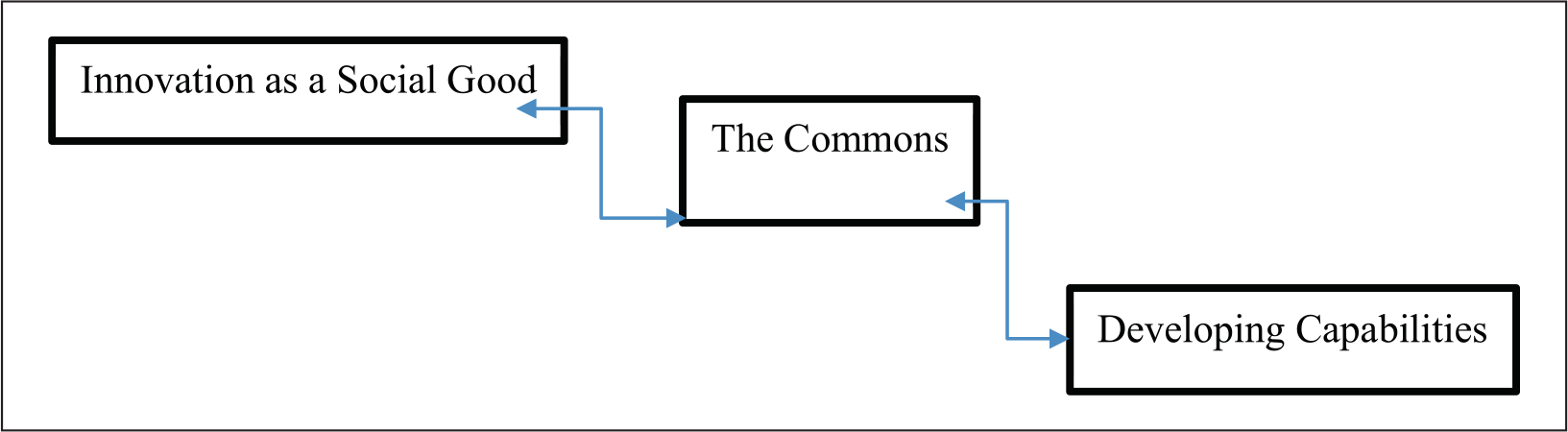
We reinforce the idea of entrepreneurship and innovation as a social good by drawing on Elinor Ostrom’s (1965, 2014) concept of the ‘commons’ where citizens are guided by a notion of collective self-efficacy to achieve collective governance over the production, use, distribution and effective understanding of goods and services that affect their lives. We consider this form of collective efficacy as the basis of achieving what Amartya Sen (1993, 1997, 2008) refers to as capabilities set for citizens to fulfil their aspirations and well-being in society through knowledge, skills, civic engagement and moral integrity. The framework facilitates entrepreneurship as a putative social movement of people where citizens can become directly engaged with the formation, development and growth stages of enterprises while addressing economic, social and cultural disconnects that thwart their sustainability. The foundations for the framework as described above are shown in Figure 1:
We borrow from well-established new practices particularly in Citizen Economics and Citizen Science where citizen knowledge and insight, and local experimentation enhances expert application to develop instruments of creative resolution of issues that matter at both the local and the meta-levels.
Secondary data and the anecdotal evidence that we have seen so far point to the entrepreneurial citizen engagement in urban areas. The Scottish city of Glasgow’s knife crime project managed through the Violence Reduction Unit (http://www.svru.co.uk/), the PlatzProjekt in Hanover, Germany (https://platzprojekt.de), or the Spolecznie Zaangazowani (Socially Engaged) project in Lodz, Poland (https://spoleczniezaangazowani.pl/), are all good examples of urban-centred citizen engagement. However, other examples from across the world such as the Art for Life project in West Bengal, India (https://en.unesco.org/events/show-art-life-rural-art-west-bengal), shows that citizen engagement in entrepreneurial projects cuts across both rural and urban lines. We limit our focus in this article to reflections on the urban setting in Europe.
Insights from the Combinatorial Literature
A Schumpeterian Perspective
At a time of another great recession and between 1925 and 1932 at a time of much controversy in Germany, Schumpeter wrote a major series of articles for The German Economist covering four topics—tax levels and public budgets, wages and unemployment, business booms and the underlying nature of capitalist society. Economists and entrepreneurship researchers tend to concentrate attention on the first three missing the importance of, for example, Schumpeter’s 1930 essay, ‘Change in the World Economy’, his 1932 article, ‘Enduring Crisis, and his 1927 piece, ‘The Function of Entrepreneurs and the Interest of the Worker’(published in a labour magazine). In the first essay he dismisses the idea of limits to technological progress, asserting instead the value of fresh opportunities and new innovations interacting with old ones to produce accelerated progress. In the second he argues about novel ways of doing things that could be incorporated within the organism of the existing economy (McCraw, 2007). What matters is the long-term interest of entrepreneurship and innovation, and in that longer term the interests of entrepreneurs and workers are identical because the motivation for high earnings for entrepreneurs is a function of the translation of innovations into actual production, raising the standard of living of all. Jobs resulting from successful innovations and the creation of new firms are a social gain for both the firms and society.
Schumpeter did not elaborate on how the interests of entrepreneurs and workers could be valorised. We propose that CE could be platform on which these interests can be brough together for the common good. As firms evolve and small entrepreneurial firms become large establishments the entrepreneurial function alters, a different type of entrepreneur emerges, one who is dependent on the innovative suggestions of specialists to create new products, generates new processes, amends business models and forms new types of organisations. Extending this idea, as society evolves, changing needs offer opportunities for alternative forms of organisations to meet economic and social needs at the wider societal level.
Social Embedding and Proximity
The possibility of entrepreneurial activity occurring in any environment necessitates an appreciation of the social embedding (Granovetter 1985, 2017) as evinced in the importance of social networks enabling the harnessing of social capital which is further enhanced by cultural, political, religious, and wider institutional influences on entrepreneurship, and the underpinning themes of trust and legitimacy. Social and institutional embeddedness also forms a base for linking the entrepreneurial process with the concept of proximity which dates back to the Marshallian concept of industrial districts (Marshall, 1920). Other than market and price mechanisms of coordination of collective action, this school also appreciates reciprocity and proximity which takes a form of a geographical, cognitive, social and institutional character (Boschma, 2005; Rallet and Torre, 2005; Sokołowicz, 2015).
Social embeddedness may have three dimensions: relational, structural and evolutionary (temporal) (Granovetter, 2017, pp. 17–19). Its complexity (and therefore limited predictability) underlines the importance attributed to trust in social and economic relations. Although it may have different sources (rational calculation, personal relationships, membership in groups and networks, institutions and standards), trust is important in entrepreneurial processes and it very often needs proximity to manifest effectively.
Multiple and Hybrid Forms of Enterprise
Despite the advances in a kind of social theoretical formulation of entrepreneurship, research and policy has tended to rely on linear, formulistic and conditional conceptions of economic growth as evinced in small firm growth, employment and knowledge creation (Acs & Audretsch, 2006). Comparable entrepreneurial function is performed by those who provide public goods and services (public sector entrepreneurship), which recognizes the role of the state in being pro-active wealth creators. Mazzucato (2015) has argued that government investment in, for example, technology, medicine and energy, has driven wealth creation by sharing risks with the private sector. Where both market prospecting by private enterprise and state intervention at times of market failure, have bypassed social and community problems, the Third Sector, in the form of social enterprises, has created alternative forms of self-sufficiency to address such social needs (Nicholls, 2010). New technology and especially digitalisation have made possible a form of open or even ‘free’ innovation (von Hippel 2017), which connects producers with users as part of a new ‘sharing economy’. At a social level we find high-impact capital from a variety of sources with wide reach and for previously hidden forms of activity, or the monetisation of personal assets, time and other resources. These include crowd-based networks (as opposed to centralised institutions and hierarchies), the blurring of lines between personal and professional activities, and the dramatic change underway in the nature of employment under the broad banner of ‘flexible labour’, resulting in an obfuscation of formal or full-time and casual labour. CE is not restricted to any specific form of entrepreneurial engagement. However, in recognising multiple and hybrid forms of enterprise development, CE offers opportunities for citizens to make choices and consider a direct or indirect agency function.
The Entrepreneurial Urban Commons
Perceiving entrepreneurship from our broad and combinatorial perspective could mean considering its place and purpose as belonging to the whole society and not just to its economy. If we understand entrepreneurship as ‘acting differently’ and if we mean CE as a domain of public realm, referring to the concept of urban commons can cognitively broaden our understanding of entrepreneurship. The latter concept refers to goods which are used by many actors simultaneously. This collective character of the commons could cause problems because of overexploitation or free rider dilemma. However, urban commons include a wide range of urban goods: from parks, squares, streets, gardens and other public spaces, through a range of services offered in the city, such as public transport, water supply, health care and energy infrastructure, to scarce and hardly measurable urban resources such as the atmosphere of life in the city, the culture of functioning of various communities and subcultures of urban environments or urban identity.
The Bologna Regulation is an interesting enactment of the urban commons based on the notion of the city as a common. Referred to as the ‘Bologna Regulation on Public Collaboration for Urban Commons’ (De Nictolis, 2014) it was adopted by the city towards the end of 2014. It provides opportunity to explore different collaborative approaches to the management of certain types of urban space and property (including both public and private property) for a period of one year. The regulation is one product of ‘The City as a Commons’ project supported by Fondazione del Monte di Bologna e Ravenna (www.fondazionedelmonte.it) but is an idea that is also being taken up by other Italian towns and cities.
The way in which urban commons is defined is not entirely clear. Regulation seems to be more about creating new or alternative collaborative (and co-management) arrangements between city administrators, ‘active’ citizens and private property owners for managing certain kinds of space within the urban area. The definition from the Bologna Regulation defines urban commons as the mix of tangible, intangible and digital goods that citizens and the local administration recognise to be functional to the individual and collective well-being through participative and deliberative procedures. While working for them, citizens share responsibility with the local administration for the care and regeneration of the commons to improve the collective capacity for enjoyment of the commons.
The collective character of urban commons implies their three important characteristics: (a) Large number of users, (b) Diversity of the needs of commons’ users (related to the allocation of different values of commons by different city users) and (c) The necessary means of cooperation and integration of many groups of city users in order to produce and consume common resources, optimally (Parker & Johansson, 2012; Kip, 2015) or at least satisfactorily.
The above-mentioned characteristics underpin processes that result in the emergence of new approaches to commons management, sharing, protection and development, especially when there is systemic or market failure. Traditional government agencies often find it difficult to offer sustainable solutions to problems associated with the provision of physical and financial resources to keep public spaces, urban greenery, public transport infrastructure, community and cultural centres at a satisfactory level. Creeping privatisation of the urban commons as an alternative to the public deficit sometimes ends up in the tragedy of many urban commons as a result of weakly or poorly regulated space. In these circumstances, more and more urban citizens take joint initiatives to deliver these goods ‘themselves’, creating cooperative and collaborative structures of governance. Among such structures, referred to by Foster and Iaione (2015) as the ‘commons institutions’, we can point to, for example, community gardeners, business improvement districts (BIDs) and community improvement districts (CIDs), neighbourhood park groups and park conservancies, and neighbourhood foot patrols. Such an approach to govern the urban commons demands, however, new democratic design principles, such as horizontal subsidiarity, collaboration and polycentrism. These principles call for the reorientation of public authorities away from a monopoly position over the use and management of common assets and toward a shared, collaborative governance approach. In consequence, the role of the public authority becomes that of coordinator and mediator in co-design processes, while the citizens become proactive actors of urban change. Active citizenship means that urban inhabitants are participating not only passively in the public life of the city, but also in co-creating the city, mobilising and using available resources and opportunities. In this sense, city officials and staff are tasked to assist, collaborate, and provide technical guidance (data, legal advice, communication strategy, design strategies, sustainability models, etc.) to enable themselves to manage, mediate and coordinate the ecosystem. The collaborative agenda delivers an entrepreneurial urban ecosystem, in which the citizens play a key role. Scientific, technical and social innovations help to foster the creation and use of new knowledge.
A caveat about the limitations of the idea of the urban commons stems from the possibility of citizen engagement in entrepreneurial processes in emerging economies, mainly in Asia and Africa. There, large rural populations and their needs often provide for the best platforms to develop CE initiatives. As the ‘Art for Life’ project in West Bengal shows, harnessing and nurturing the wealth of neglected talent in traditional forms of music, dance, weaving and street theatre in relatively poor rural districts can generate opportunities for both enhanced artistic work and a means of creating new forms of collaborative enterprise (Bhattacharya 2020).
Creating Knowledge and Capabilities for Citizen Engagement
Systemic or market failure might generate a reaction for citizen intervention. It may also take the form of pro-active action to nurture and garner the benefits of economic, cultural, personal and social value creation. Realising the benefits of a CE centred ‘commons’ suggests that citizens require a capability set. There is always a need for a process for generating knowledge somewhere and that knowledge must be embodied in some sort of socially useful technology for it be absorbed and replicated in any way and in any place. Absorption, valorisation and replication of knowledge and technology must retain some sort of public and social goods dimension in terms of being widely available to be of maximum social benefit, and there must be some ability on the part of recipients or users to adapt the technology to their conditions and needs (Dalrymple, 2003). Making this happen is the knowledge, skills, civic intelligence and moral integrity of all its citizens (Ostrom, 1997) coupled with the idea of self-governance, well-being and the collective efficacy of ‘the commons’ representing citizenship in action (Ostrom, 1965, 2014) How are these skills to be developed and how can such knowledge serve the well-being of people to determine its social good outcome?
Adopting and adapting Sen’s capabilities approach (1993, 1997, 2008) allows us to connect the knowledge creation prospect with people’s aspirations and sense of well-being, what Sen refers to ‘functionings’. These ‘functionings’ could include autonomy, self-acceptance, growth and purpose in personal life to positive relationships and positive feelings of happiness. The achievement of the ‘functionings’ could lead to the well-being of people, which is more than the sum total of skills, competencies, formal or informal education. Although Sen focuses on individuals as the agents of social activity, the individuality he works with is social individuality (Bagchi 1998). Citizens may acquire a wide set of skills and qualifications but may not have either access to or the space with which to either use their skills sets in the way they want or transform any such use to achieving well-being. In interpreting the capabilities approach, Foster and Handy (2009) refer to three sets of capabilities—the individual’s own capabilities, the socially created ones of status or legitimacy and network embedding, and the external capabilities to function that depend on direct human and institutional relationships. Failure to achieve them could engender negative outcomes of personal stress and anxiety or collective ones of social ennui (Gopinath & Mitra, 2017). Achieving them enables the formation of an evaluative space within which to grasp substantive freedoms—the capabilities to choose a life one has reason to value (Sen, 1999, p. 74).
In entrepreneurial terms these ‘functionings could be translated as creating and growing one’s own enterprise to achieve autonomy through to deriving benefits from that enterprise as a consumer or co-producing goods and services as a user-producer (von Hippel, 2017). Emergent entrepreneurial identities of citizens using crowd-based platforms for ideas and resource generation enabled especially by new digital technologies (McAfee & Brynjolfsson, 2017) are a feature of our times. If we add to that the prospect of combining individual enterprise creation with crowd-based structures for their input to meta-level issues addressing disconnects in our economic and social lives, we could create new social or civic identities for entrepreneurship development. These new identities are a manifestation of collective efficacy, which draw from a ‘commons based’ soft infrastructure, the resources necessary to achieve those ‘functionings’. The outcome is the formation of a capabilities set which is an aggregation of the individual’s own capabilities, the socially created ones of status and network or social embedding and the external capabilities or the abilities to function that depend on human or social relationships. Citizens with their individual capabilities sets connect with each other to create a collective evaluative space where convergent ideas, technologies and methods are available to address and examine systemic, and other disconnects, form new collective organisational capacity and achieve collective well-being.
The Urban Context
Extended, combinatorial entrepreneurship has begun to surface, significantly in urban environments. Cities are hotspots for sustainable futures: globally, over 50 per cent of the population lives in urban areas, with problems regarding carrying capacity and social justice. But cities also provide space for experimenting with alternative futures. A core challenge is social polarisation (Swyngedouw et al., 2002) emerging from the certain trends of globalisation and market liberalisation inspired urban policymakers to compete for capital, creative class and technology. Investigating five cases of European cities, Moulaert et al. (2001, p. 100) identified ‘a shift from (local) social to (local) economic policy, a “new” elite coalition formation favouring private sector agents and “new” forms of state entrepreneurialism that include large-scale urban development projects and city marketing’. Technology-driven and business-dominated policies often endorsed in theory and followed in practice, lead to increased polarisation of citizens. Nearly 20 years on, we face urgent problems related to the dominance of the market logic and to a lack of a sustainability logic driving creativity, opportunity identification, resource mobilisation and venture creation or development. Social innovation initiatives are caught in the friction between economic and social values and are subject to the usual efficiency paradigm. While‚ sustainable cities’ is one of the 17 Sustainable Development Goals (SDG) of the United Nations, studies of urban social innovation show a variety of approaches and successes (Mieg & Topfer, 2013; Mouleart et al., 2005; Murray et al., 2010). CE turns this idea of purely state-led or free market, corporate led reorganisation of the urban industrial space into the reality of a citizen-led or citizen inclusive recreation of an urban commons space.
Antecedents of Citizen Economics and Citizen Science
We borrow from well-established new practices particularly in Citizen Economics and Citizen Science where citizen knowledge and insight, and local experimentation enhance expert application to develop instruments of creative resolution of issues that matter at both the local and meta-levels.
Public recognition of the primary importance of the economy as an issue for citizens has emerged for reasons which we have identified above. But citizens appear to have little agency and authority, resulting in a democratic deficit in economic policy and decision-making. The Royal Society of Arts (RSA, 2016) in the United Kingdom and its Citizens Economics Council point to economic literacy, transparency, democratic accountability and creativity (as in finding novel resolutions of problems) as the four deficiencies which block answers to questions about:
Understanding the goals of an economy. Who should the economy serve? What are the trade-offs we must make in deciding between different priorities? Can policy be derived from evidence alone? What about values, assumptions, and judgements plus the application of evidence-based social science?
The capability for answering these questions and exploring citizens’ values can be achieved through deliberation and debate but crucially through empowerment, collaboration, and by engaging, receiving and informing citizens.
Some examples of emergent models of deliberative dialogue between citizens and decision-makers in policy in UK include the ‘NHS Citizen’, a deliberative engagement process that has involved citizens in a conversation about the strategic direction of the National Health Service (NHS) or the Sciencewise project, an embedded government-funded public engagement programme which has delivered 54 dialogues in partnership with 32 government departments and agencies over a period of 12 years. (RSA, 2016).
In well-established projects on ornithology, conservation of residential ecosystems and other scientific research projects, Citizen Science engages a dispersed network of volunteers to assist in professional research using methodologies developed collaboratively with professional researchers through crowd sourcing and other means (Cooper et al., 2007; Dickenson & Bonney, 2012; Wynn, 2017). Our conceptualisation embraces the Citizen Science construct of volunteer involvement in entrepreneurship research but introduces an activist dimension in economic and social project development initiatives.
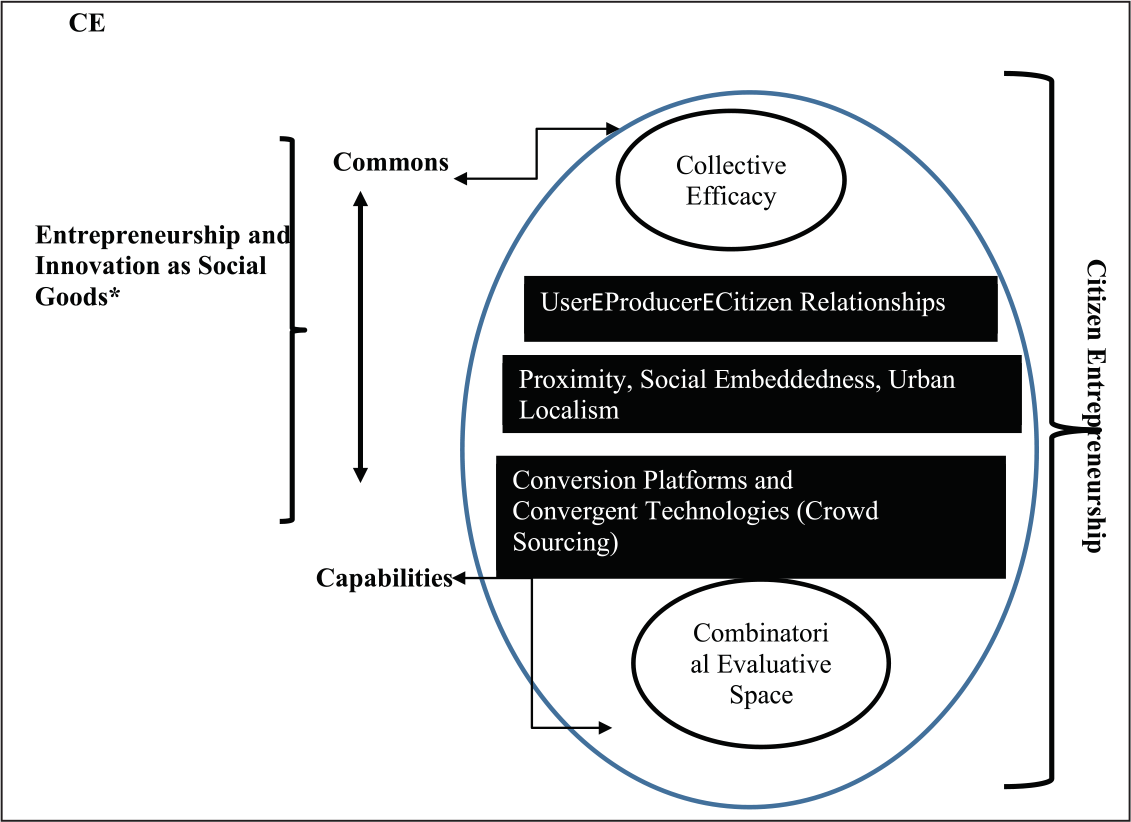
Citizens in CE projects are engaged users, producers and providers, equipped with an entrepreneurial capability set of knowledge, competencies, civic intelligence and integrity in polycentric settings. Their collective minds set and efficacy for engaging with entrepreneurship in various guises best manifest themselves in the realisation of scalable projects that can harness diverse interests and capabilities. Region-wide or urban projects that accommodate individual and collective interest to solve problems and generate new organisational arrangements are often the most appropriate vehicles making CE work.
We build an exploratory model of CE that encompasses multiple local actors, activists, local governments, consultants and organisations. Our work should contribute to an in-depth understanding of the mechanisms and the potential of CE. We propose a transformative agenda for entrepreneurship and innovation for economic and social change in Europe and elsewhere that involves engagement with communities of citizens and shared knowledge creation (Weisenfeld & Hauerwaas, 2018). Figure 2 provides for a diagrammatic configuration of our conceptualisation.
Early observations and Prospective Research Questions
We refer to two initiatives which we interpret as CE projects. 1
The information for the two projects has been drawn from respective websites for the project and from informal discussions with the project managers.
The Nature and Scope of CE
The PLATZProjekt (or the PLACEProject) is an urban experimental field to try out peoples´ ideas for different ways of working, sharing and organising in the German city of Hanover. It explores ‘prefigurative entrepreneuring’, enacting people’s visions through the practice of entrepreneurship, which deviates from mainstream notions of entrepreneurship. PLACEproject is a container village providing space for experimentation, for active and participatory bottom up development. The project’s multiplier effect spawned many more projects, became known in the city and beyond via media reports, and has been designated as one of several exceptional, exemplary projects for future urban development in Europe. Since 2014, different social and cultural projects test and realise their ideas of alternative living and working models. Some examples are a Café, a mini-sized eco-hiking hotel, a sewing studio, an inclusive refugee-project, a massage box, a clothes-swapping shop and a DIY-beer brewery.
Socially Engaged (pl. Społecznie Zaangażowani) is the non-profit organisation with the aim to induce social engagement of and for local communities of the Stare Polesie borough in Lodz, Poland. The founders and leaders of Socially Engaged are a couple, Agnieszka and Szymon, who live in the Stare Polesie with their rich professional experience as social activists and in managing NGOs. The diversity of projects is notable, ranging from ecological ones (e.g., protecting urban greenery), through the education of youths in need, to cultural ones. The binding factor is the borough of Stare Polesie. During the first three years, ‘Socially Engaged’ existed as an informal group of people with common goals and shared values. The founders’ understanding of entrepreneurship is broad as they define it as a purposeful human activity, connected with fulfilling needs of life in the borough. They also mention that it is their role to add an entrepreneurial element to all the ideas and projects which are brought to and realised through their project. The ideas for actions are given by life and situations they encounter when interacting with citizens, and further catalysed by the city.
These early sketches of what could be described as CE type activities prompt us to ask our first, prospective research question:
RQ 1: What evidence can we find about the nature and scope of CE in different urban environments?
Collective Endeavour, Collective Efficacy and Developing Capabilities for Citizen Engagement
Beyond sheltering the individual projects, PLACEproject explores structure-and community building and alternative forms of using open spaces. The project is thus seen as an enrichment for the whole city in terms of new entrepreneurial forms of economic, cultural and social offerings. Gaining funding gave some temporary stability to the process of collective endeavour. It also enabled institutional recognition (Barinaga, 2017). From the beginning, the cultural attitudes supported diversity, communality and experimentation, forming part of an evaluative space for the cultivation of citizen entrepreneurial capabilities. A form of holistic involvement was another method of inculcating an entrepreneurial capability set where people felt they could be informed participants in achieving their ‘functionings’; alongside fulfilling their collective goals.
With reference to the Socially Engaged project in Lodz, Poland the association has established the Old Polesie Joint Cooperative as well as a community centre run only by the activists. The place is attended by approximately 200 children and youth from the surrounding area, and on a smaller scale, by adults. It also serves as a venue for meetings and small cultural events, as well as a place of contact with the association’s board of directors, which is increasingly perceived as an ‘intermediary’ between the office and the citizens in the day-to-day business of the neighbourhood ‘Socially Engaged’ works to foster and strengthen the local identity of all businesses and social initiatives in the district. Among other products, they published tourist guides and created an urban field game, ‘Discover Old Polesie’ (included in the regional education programme at the local primary school). The social activists are perceived as reliable partners in the dialogue with the authorities and it has been possible to develop a certain model of cooperation with the municipality. Being a kind of broker, the association has the capacity to gather opinions about the real needs of the inhabitants and local businesspeople, as part of an urban commons. Although the activists concentrate primarily on urban greenery and the quality of public spaces alongside accessibility of public services around the main square, they also advocate the inclusion in the urban debate the issue of creating a large socio-cultural centre in the borough. Activists present a long-term vision of economic and social development of the Old Polesie that could be triggered by a creation of a centre with open spaces for both cultural and business activities. This demonstrates an acute awareness of the fact that civic action cannot take place without an entrepreneurial approach and cooperation with the business community.
These initial observations of collective endeavour, collective efficacy and capability development lead us to our second, prospective research question:
RQ 2: What constitutes collective efficacy or collective endeavour and how do citizens develop capabilities to engage entrepreneurially to ubiquitous solve socio-economic problems of global significance but of local import?
Our two examples of CE in practice are realised in urban environments. The developments would be in keeping with the rapid concentration of livelihoods in cities, often because of higher levels of availability of financial and technological resources. However, our cases reveal a greater interest among their people for a form of social networked based capability development to address local concerns of global significance—the choice of sustainable habitats, the ecological imperative, mobilisation of local art and cultural resources alongside the need to stem urban decay. This choice is predicated upon the need to articulate a new vision for social legitimacy that reinvents the agenda for life, work and play. We find that in each of these environments collective endeavour enables stakeholders to figure out catalysts for transformation. To explore this urban commons factor further we could consider a third research question.
RQ 3: Is CE activity essentially urban in character? If so, what are the peculiar urban characteristics of CE?
Concluding Observations and Implications
A New Passage to Scholarship and Research Opportunity
Unlike the usual discourse on stakeholders which revolves round the role of formal institutions in particular ecosystems, we find the early involvement of citizens in all aspects of shaping their ecosystem—from envisioning, to addressing surface symptoms, to testing systemic limits and structural disconnects (Scharmer and Kaufer, 2013). This focus on catalysts for change and an engaged citizens’ platform provides for the evaluative commons space in which to develop novel capabilities for achieving individual and collective ‘functionings’ (Sen, 1993, 2008). The individual’s own capabilities, the social ones of status and network embedding and the ability to function on the basis of strong human relationships (Foster & Handy, 2009) allow for the realisation of collective capabilities. Critically, they empower citizens to act not just as participatory observers of change but as emergent, entrepreneurial designers of their social and working lives.
Our conceptual framework and research questions underscore the development of an epistemological objectivity, and a virtuousness, the Aristotelian ‘arete’ that stretches beyond non-technical critiques of current institution provision because they mobilise resources for their own to form new collective institutions. Through direct involvement our citizen entrepreneurs are less dependent on just primary sources of knowledge, developing a capacity for expertise in critical judgment (Aristotelian ‘phronesis) acquired through association and collaboration with a range of different talents, ideas, creativity and scientific expertise.
Another unique capability afforded by networked and direct participation is what Aristotle referred to as ‘eunoia’ or goodwill among and with fellow citizens. In being involved in identifying problems and mobilising a collective efficacy for finding solutions, they come close to a form of methodological transparency, cognitive and social legitimacy, akin to ones shared by scientific, technological and entrepreneurial communities of interest.
Through new forms of collective engagement and organisation, we can see the prospect of extending the domain of entrepreneurship research beyond ‘the scholarly examination of how, by whom, and with what effects, opportunities to create future goods and services are discovered, evaluated, and exploited’ (Shane & Venkatraman, 2000; Venkataraman, 1997), to the scholarly examination of how and with what effects opportunities to create future organisations for social good are discovered, evaluated and exploited through the collective agency of citizens. Critically, our study opens possibilities for a new, epistemological approach to engaging with entrepreneurship, its meaning, functionality and value. The unfolding of agency across different economic and social actors, and through new forms of user-producer-citizen relationships, should attract new arenas for entrepreneurship research, and help with the locating of entrepreneurship at the centre of social and economic policymaking.
Informing Local and Regional Development
Our study brings the citizen into the heart of local and regional development, thereby enhancing the understanding of institutional frames, local needs, necessities and opportunities. By identifying the key factors for employing CE as a driver for urban transition, our research sets in motion a citizen-based entrepreneurship research and development platform that could accommodate different forms of research of plural value to the society in which it takes place. We find that through CE, citizens become engaged in addressing local problems and making use of local opportunities. Where CE involves citizens from idea creation through to implementation stages of both commercial and citizen-based activities and where such projects are not restricted to individuals or groups of experts concerned with enterprise or social innovation, it reduces the tensions between private, public and social enterprise and the differentiated values they generate. We find that where the citizens, exercise collective efficacy as users, consumers, producers and voters, they can engage with the formation, development and growth stages of the enterprises together with the state in acts of collective governance. This results in the avoidance of a fixation on entrepreneurship as a vehicle for growth and the cultivation of the practice of entrepreneurship as economic and social development.
Building on our conceptual framework and by carrying out empirical work we hope to inform research and policy development all over Europe and elsewhere to try and help counter the uncertainties of fragile institutional environments.
Footnotes
Declaration of Conflicting Interests
The authors declared no potential conflicts of interest with respect to the research, authorship and/or publication of this article.
Funding
The authors received no financial support for the research, authorship and/or publication of this article.