




Abstract
This study aims to explain the determinants of entrepreneurship among Indian individuals. The researchers have examined the role of social (legitimacy) and personal (personality, competency and financial resources) factors related to an individual’s new venture creation in India. This study utilises the data set of 3,403 Indian respondents from the latest available individual-level data collected by the Global Entrepreneurship Monitor. Binary logistic regression has been employed to test the study’s proposed hypotheses. The results indicate that constructs related to financial resources, entrepreneurial personality and entrepreneurial competencies significantly predict the individual’s decision to start a new venture. However, in contrast to many previous studies, factors related to social legitimacy (social status and professional attraction) were not significant in determining the start-up decision. Policy implications have been discussed.
Introduction
The role of entrepreneurship in economic development is evident as it fuels the growth, innovation and wealth creation in an economy (Ahmad & Xavier, 2014; Carree & Thurik, 2003; Shepherd et al., 2020). High levels of entrepreneurship have provided most developed countries with an edge in the global marketplace. That is why nascent entrepreneurs are supported at various levels by countries, governments and academic institutions.
Even though understanding and promoting entrepreneurship can be a boon for developing countries, most studies investigating entrepreneurial behaviour have been conducted in the western contexts. For example, Audretsch (2002, Canada), Cetindamar et al. (2012, Turkey), Kolvereid & Isaksen (2006, Norway), Linan & Chen (2009, Spain), Obschonka (2010, Germany), do Paço et al. (2012, Portugal) and Shinnar et al. (2011, USA). Researchers advocate that more research should be conducted across several regions and countries to have a broad and in-depth understanding of conditions, characteristics, motivations for firm creation in various contexts (Thomas & Mueller, 2000).
In many studies conducted in India, the scope has been much narrower. For instance, studies by Arafat and Saleem (2017) and Arafat et al. (2019) focused on women entrepreneurship. These studies found that women are now more empowered to do business, receive more family support and show more confidence in doing business than they would have been doing in the past (Arafat et al., 2020a). However, the author also hinted that women entrepreneurship is challenging, mainly due to a lack of training and male dominance in society. Many studies have focused solely on scientists (STEM), claiming that scientists of young age and higher levels of human capital are more likely to initiate new ventures (Arafat et al., 2022). Hussain et al. (2022) and Arafat et al. (2021a) focused on university students. Studies on students limit the generalisation. Some other studies have also measured the influence of intellectual capital on start-up behaviour (Arafat et al., 2020c; Khan et al., 2019a, 2020).
Some other researchers have examined the link between market orientation and performance in India. It appears that much research on this area is diverse and eclectic; therefore, it lacks the pursuance of a more extensive study. Specifically, from the Indian (or non-western) context, there is inadequate literature to help generalise what factors influence business start-ups for adults in India. Therefore, the present study is an attempt to address this gap. In this study, the researchers explore the factors that influence the individuals’ perceptions about starting a new business. In this study, we examine the start-up behaviour from the lens of institutional theory (social legitimacy) and trait theories (entrepreneurial personality). Understanding the importance of social legitimacy in entrepreneurial behaviour in emerging economies, particularly in collectivist societies, can bring insights to entrepreneurial researchers and policymakers. Studying entrepreneurship from this aspect has been scarce in the entrepreneurship literature.
Global Entrepreneurship Monitor (GEM) has defined start-up intention as a ‘nascent entrepreneur’. As observable in many studies based on the GEM data, start-up creation should not be solely investigated with demographic factors. Researchers studying the entrepreneurship process using the GEM data should consider incorporating the socio-psychological aspects. Incorporating such elements can bring a more intricate and better understanding of the subject (Arafat et al., 2020b; Arafat et al., 2020d; Audretsch, 2002). The present study provides insight into the role of demographic variables and applies the social and psychological variables from the GEM data.
The effect of personality and competencies does not work in isolation. Hence, this study adds social, personal and attitudinal attributes and demographic variables to the analysis. Our methodology is in line with earlier researchers (Arafat et al., 2019; Arenius & Minniti, 2005; Bakar et al., 2017; Pindado & Sánchez, 2017), where a combination of demographic and perception related variables has been studied to understand the entrepreneurial behaviour. Two variables, entrepreneurial personality and entrepreneurial competencies, associated with perception are adapted from Tsai et al. (2016) and Arafat et al. (2022).
Theoretical Background and Hypotheses
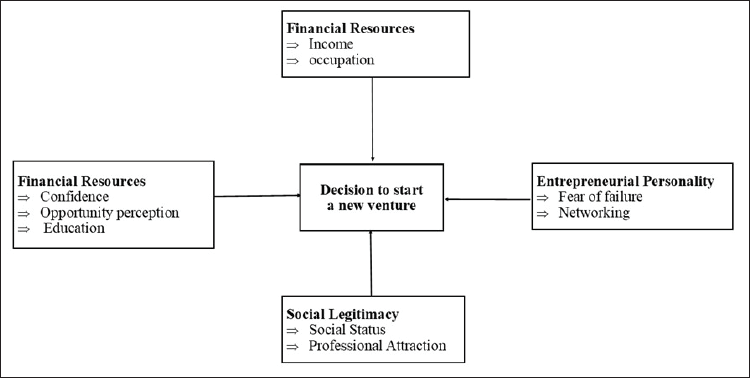
In this study, we follow the work of previous authors (such as Bakar et al., 2017) by amalgamating various theoretical underpinnings, considering several facets to explain the factors motivating start-up creation. Therefore, the present theoretical framework extends previous models based on GEM data and overcome their limitations. Besides, the factors affecting the decision to create a new venture have been categorised in the following groups: ‘financial resources’, ‘social legitimacy’, ‘entrepreneurial personality’ and ‘entrepreneurial competencies’. Figure 1 shows the proposed research framework.
Proposed Model of the Study.
Financial Resources
Personal savings remain an essential funding source for entrepreneurial ventures (Bygrave, 2003). Literature suggests that entrepreneurs avoid financial responsibility like credit loans (Kim et al., 2006). That is why their primary funding sources revolve around family, friends and personal savings. This study investigates the financial indicators: household income and working status.
Household Income
Household Portfolio Theory suggests that household wealth and income can determine the investment potential in risky assets (Gollier, 2002; Guiso et al., 2003). Individuals with high net wealth and personal income have a higher disposable income and do not depend on others to fund their businesses. Such individuals are more confident in creating a new venture (Evans & Leighton, 1989). The high-income level also acts as s cushion, protecting from (Kim et al., 2006). Therefore, individuals with high net wealth and disposable income are more likely to diversify their investments (Maula et al., 2005). Individuals with high net worth and disposable income can invest in many investment avenues; therefore, they can mitigate the risks by building a diversified portfolio of entrepreneurial investments (Maula et al., 2005). Individuals with a high net-worth also possess the capacity to assume a level of risk while investing, and entrepreneurship is considered a risky investment; it can be construed that individuals with high net wealth and disposable income are highly anticipated to start a new business (Arafat et al., 2021b). Hence, the following hypothesis is presented:
H1: Household income level positively influences the propensity to start a new venture.
Working Status
Research suggests that individuals already engaged in some employment have a high chance of starting a new venture (Arafat & Saleem, 2017; Arenius & Minniti, 2005). In most cases, individuals launch a new business as a part-time venture when they are still employed, and as the business grows, they leave their jobs and start working as full-time entrepreneurs. The main reasons behind this phenomenon are the self-financing capability and expertise possessed by individuals from their previous employment.
Entrepreneurship can be necessity driven or opportunity driven (Reynolds et al., 2003). About one-third of entrepreneurs in the world belong to the need-based category, in which new start-ups are launched mainly due to the absence of other opportunities (Reynolds et al., 2002). The rest two-thirds of the entrepreneurs belong to the motivation-based category in which opportunities and motivation play more prominent roles (Hassan et al., 2021; Reynolds et al., 2002). On one hand, India is an emerging and rapidly growing economy. India also has a vast consumer base with many untapped opportunities.
As the job market in India is shrinking and the employment rate is going down, start-ups can contribute to sustainable economic development in India. Employed individuals are considering self-employment and entrepreneurship as better options. Further, employed individuals understand the market better than those not employed. Hence, the following hypothesis is presented:
H2: Present employment status has a positive relationship with the propensity to start a new venture.
Social Legitimacy
Suchman (1995, p. 574) has defined legitimacy as ‘a generalised perception or assumption that the actions of an entity are desirable, proper, or appropriate within some socially constructed system of norms, values, beliefs, and definition’. Establishing legitimacy is regarded as an essential liability of newness for start-ups. Legitimacy may have many types and may be accomplished in several ways (Bitektine, 2011). For instance, literature on institutional theory has indicated that companies are required to fit in or be acceptable in terms of the legal, social and economic environment to become more legitimate (DiMaggio & Powell, 1983). The theory of planned behaviour (TPB) (Ajzen, 1991) maintains that social norms determine the attitude and intention related to starting a venture. Individuals, who perceive that other people will encourage entrepreneurship, would exhibit a higher chance of engaging in entrepreneurship-related activities. Generally, socially acceptable actions are admired, and unconventional, unpopular things are discouraged or abhorred. Therefore, individuals tend to avoid unconventional, disliked, or taboo activities in society. Individuals tend to follow socially desirable behaviour. Such behaviour is more prominent in collectivists’ cultures like India (Arafat et al., 2020a; Markus & Kitayama, 2010; Oyserman & Lee, 2008). In the context of entrepreneurship, individuals who find entrepreneurship as attractive and socially desirable or something that carries prestige are more likely to start a career in entrepreneurship (Ahmad et al., 2014; Begley & Tan, 2001; Khan et al., 2019b). Hence, the following hypotheses are presented:
H3: The perception of entrepreneurship as an attractive profession has a positive relationship with the propensity to start a new venture. H4: Perception of high social status and prestige in successful entrepreneurs has a positive relationship with the propensity to start a new venture.
Entrepreneurial Personality
Not all start-ups are successful, and many fail in the first six months of their operation. Fear of failure is a big psychological hurdle in front of entrepreneurs. Researchers claim that ‘fear of failure’ has an unfavourable relation with business start-up behaviour (e.g., Arenius & Minniti, 2005; Stuetzer et al., 2014; Tsai et al., 2016) which may be due to information asymmetry about the process of new venture creation. Among many other factors, knowledge of successful entrepreneurs helps reduce the ambiguity related to information (Wyrwich et al., 2016). Those in contact with some already established entrepreneurs tend to develop a positive attitude towards entrepreneurship.
It has been confirmed that role models can motivate individuals in becoming entrepreneurs (Arenius & Minniti, 2005). Knowing and having entrepreneurial role models can be helpful in the following two possible ways (Sorenson & Audia, 2000): (a) It helps them arrange necessary resources and activities by imitating the role models. (b) It also helps develop motivation in aspiring entrepreneurs. Baron (2000) has suggested that having role models may induce competence or self-efficiency in aspiring entrepreneurs.
Fear of Failure
According to the TPB, those individuals who perceive a higher level of ‘fear of failure’ in starting a business have a low level of perceived behavioural control (PBC) over launching entrepreneurial ventures. The low level of PBC is related to a negative attitude towards entrepreneurship (Gilmore et al., 2004). Therefore, reducing the fear of failure may increase the perceived control over behaviour and develop a positive attitude towards entrepreneurship (Gilmore et al., 2004). Risk is an inherent aspect of entrepreneurship, and any business requires some level of it (Schumpeter, 1934). Entrepreneurs should possess some level of risk tolerance. In the classical decision theory, risk refers to the uncertainty in the outcome and the probability of the subjective value attached to the outcomes determines the level of the risk (March & Shapira, 1987). Entrepreneurs are the risk-takers. Risk-taking and facing uncertainty are two crucial aspects that differentiate entrepreneurs from non-entrepreneurs (Entrialgo et al., 2000; Thomas & Mueller, 2000). Some studies postulate that entrepreneurs and non-entrepreneurs are not statistically different (Babb & Babb, 1992; Palich & Bagby, 1995). While in some other studies, entrepreneurial activity has been related to risk-taking ability (Begley, 1995). Literature related to entrepreneurship indicates that entrepreneurs have a higher risk-taking ability than others (Cromie, 2000; Thomas & Mueller, 2000). Though ‘fear of failure’ may vary from one country to another, the effect of the variable within a single country is expected to remain the same. Hence, the following hypothesis is presented:
H5: Fear of failure has a negative relationship with the propensity to start a new venture.
Knowledge of Other Entrepreneurs
An individual’s knowledge about other active entrepreneurs can develop a positive attitude towards the business start-up behaviour (Anderson, 2008; Hoang & Antoncic, 2003). Many researchers have concluded that entrepreneurs utilise the knowledge from other entrepreneurs to exploit new possibilities (Aaboen et al., 2013; Smeltzer et al., 1991). The role theory also suggests that knowing other entrepreneurs may facilitate entrepreneurship (Veciana, 2007). Fornahl (2003, p. 50) emphasised the significance of role models in the following argument: ‘development and the related likelihood of discovering entrepreneurial opportunities and increasing the willingness to start a new firm are strongly influenced by positive examples, so-called role models’. According to Baron and Shane (2008), being a part of a network may help gain superior information, support and many resources available within the network. Therefore, building and engaging with networks may provide better results than working in isolation (Hoang & Antoncic, 2003; Saleem et al., 2021b). Hence, the following hypothesis is presented:
H6: Knowing other entrepreneurs (networking) has a positive relationship with the propensity to start a new venture.
Entrepreneurial Competencies
Along with many other factors associated with entrepreneurship, competencies (or efficacies) have remained a determining force in entrepreneurship (Arenius & Minniti, 2005). However, the conceptualisation of competencies has been different in various studies (e.g., Camelo-Ordaz et al., 2016; McGee et al., 2009; Urban, 2012). Some studies have conceptualised competency as the confidence in one’s skills (Ballout, 2009), while in some other studies, it has been conceptualised as the perception of opportunities (Urban, 2012). In both cases, competency influences entrepreneurship behaviour. In our research, competency has been operationalised in both ways: (a) ‘confidence in one’s skills’ and (b) ‘perception of opportunities’. Further, education has also been considered as a part of entrepreneurial competency.
Perception of Opportunities
Ajzen (1991), in the theory of planned behaviour, postulates that attitude is positively related to intention and behaviour. Kahneman (2003) construe behaviour as the result of a subjective and objective evaluation of the stimuli. The entrepreneurial activity is associated with the perusal of entrepreneurial opportunity in creating a new venture (Hassan et al., 2020; Starr & Bygrave, 1991). In this process of the venture-creation, the entrepreneur employs both objective and subjective judgment of the situation. Entrepreneurs have a knack for identifying the opportunities that others may fail to recognise (Kirzner, 1985; Schumpeter, 1942). In the Indian context, we also expect that this relationship shall sustain. Hence, the following hypothesis is presented:
H7: Perception of business opportunities has a positive relationship with the propensity to start a new venture.
Confidence in One’s Skills
It is maintained in the literature that individuals confident in their expertise are more likely to engage in entrepreneurial activities. For Entrepreneurs, managing a business requires engaging in various tasks like acquiring capital, managing human and non-human resources, developing strategies for profit and growth and so on (Baron & Shane, 2008). Thus, the task of entrepreneurship has many dimensions and requires a skillset consisting of a wide variety of skills in the entrepreneur (Lazear, 2004). An entrepreneur has to play various roles in starting and managing a business venture ‘such as (that of a) manager, accountant, salesperson, (and) chief engineer’ (Lazear, 2004, 2005). These specific skills may instil confidence in individuals to initiate a new business (Denoble et al., 1999). Despite the critical role of these factors, we do not know much about how it works in the Indian context. Hence, the following hypothesis is presented:
H8: Confidence in one’s skills positively correlates with the propensity to start a new venture.
Educational Level
Education helps individuals identify the opportunities and equip themselves with knowledge and skillsets to create a new venture. However, the role of education has not been much explored in entrepreneurial venture creation. Previous studies suggest that higher education increases self-employment chances (Sexton, 1994). Arenius and De Clercq (2005) established that entrepreneurial opportunity perception and higher education are positively related. Literature indicates that the impact of education on entrepreneurial intention has been mixed (Arenius & Minniti, 2005; Davidsson & Honig, 2003). Some studies have found a positive relationship, while others indicated a negative relationship between education and entrepreneurial activity. For example, Bates (1990) found that highly educated individuals have a higher probability of becoming entrepreneurs, while Storey (1994) established a negative relationship between education and entrepreneurship. This contradiction may happen while ignoring the difference between ‘necessity-based’ entrepreneurship and ‘opportunity-based’ business creation. This study proposes that the level of education would be positively related to entrepreneurial activity. This relationship is particularly relevant to the Indian context, where entrepreneurship is mostly opportunity driven. Hence, the following hypothesis is presented:
H9: A higher level of education has a positive relationship with the propensity to start a new venture.
Methodology
Data
In this study, we have extracted the individual-level data of India from the ‘Adult Population Survey’ (APS) of the “Global Entrepreneurship Monitor’ (GEM, 2015). The GEM collects data from individuals (APS) and experts (National Expert Survey). The former data set is related to individual-level entrepreneurial activities, for example, motivation, intention, attitude and behaviour, and the latter is related to national entrepreneurial framework conditions, for example, government policy, funding, education and competition. The data set consists of more than 2,000 responses per country from 100 countries. The data were collected using a stratified representative sampling method. This data set has several variables on diverse aspects of entrepreneurship (Reynolds et al., 2005). The GEM data set is an authority on global entrepreneurship-related information; hence, it enables robust cross-national entrepreneurship research.
Researchers are showing an increased interest in exploring the GEM data sets (Arafat et al., 2019; Arenius & Minniti, 2005; Autio et al., 2013; Bakar et al., 2017; Cetindamar et al., 2012; Davidsson & Honig, 2003; Khan et al., 2019a; Langowitz & Minniti, 2007; Tsai et al., 2016). The objective of our study is to examine the impact of social legitimacy on the intention to create new ventures (Khan et al., 2021), and the data provided by the GEM APS is in congruence with the objective of our study; hence, we have used the APS part of GEM.
Measures
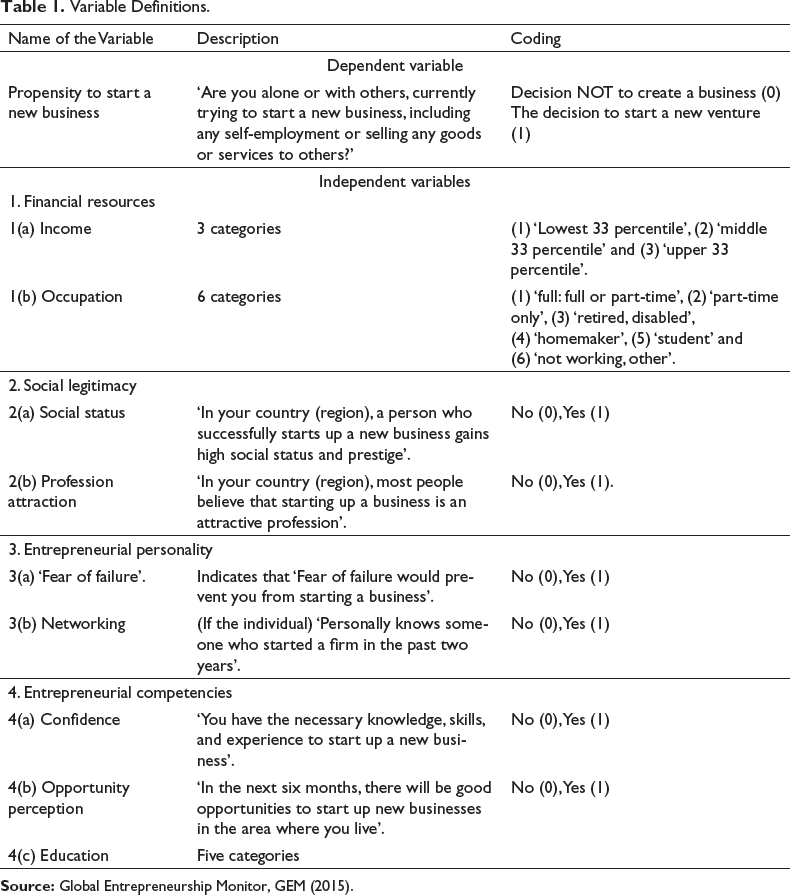
Variable Definitions.
Data Analysis
Specification and Verification
Based on the characteristics of the research objectives as well as the availability, relevance and characteristics of data utilised in the present study, where the majority of independent variables and dependent variables are measured on a binary scale (yes/no), the analysis of choice for the study is the binary logistic regression analysis. The acceptability (model fit) has been examined using the ‘likelihood ratio test’, an omnibus test similar to the F-test in ANOVA. We have used SPSS software to analyse the data.
Results
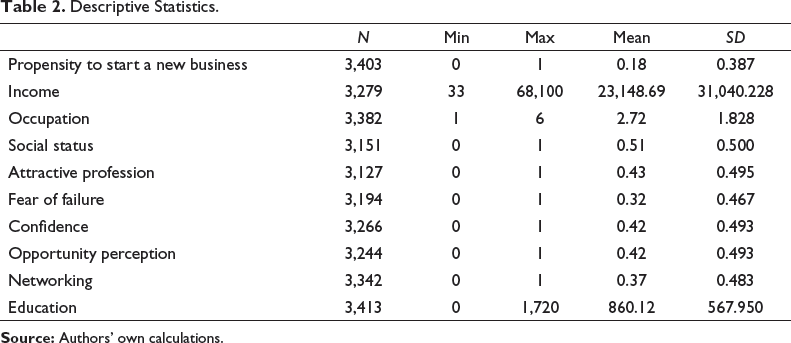
The descriptive analysis results show that 18% of Indians are taking some ‘decision to start a new business’, 51% see “Social status’ in entrepreneurship as a career, 43% of respondents consider entrepreneurship as an attractive profession.
Descriptive Statistics.
Correlation
Correlations.
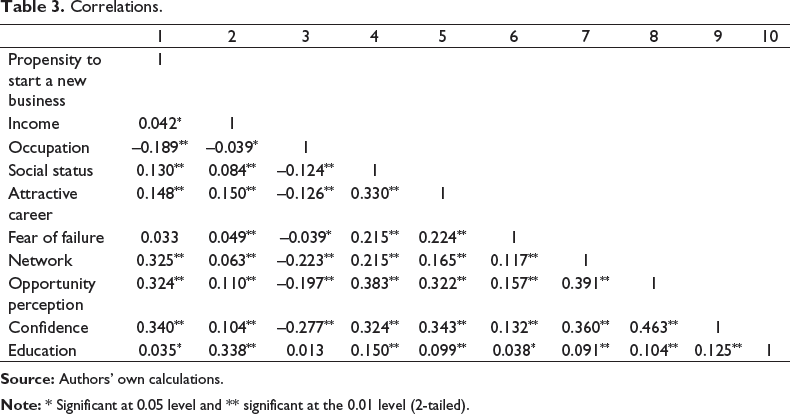
Table 4 shows statistics related to the omnibus test. The value of the omnibus test is less than 0.05, which tests the null hypothesis that every coefficient in the equation is zero vis-à-vis the alternate hypothesis that the minimum of one coefficient, if not all, is nonzero. The result of the present study indicates that the null hypothesis was not accepted at the 1% significance level. Hence, fit of the model is acceptable.
Omnibus Tests of Model Coefficients.

Further, we have also employed ‘Hosmer and Lemeshow’s goodness-of-fit test’ (Warner, 2012), which measures the observed and predicted probabilities reaching an equal point, so that if the fit is good, the predicted probability will be closely related as Y = 1 in the explained variable. The model fit is accepted if chi-square is not significant (p > .05). As mentioned in Table 5, the model has an acceptable fit (p > .05). The Cox and Snell R2 and the Nagelkerke R2 values suggest the level of variation in the dependent variable explained by all the independent variables. These statistics are termed pseudo-R2 statistics and are similar to the R2 of the linear regression. Table 6 shows that only 11.4% and 19.5% of the variability is explained by independent variables, respectively.
Hosmer and Lemeshow Test.

Model Fit Statistics.

Logistic Regression
A total of nine hypotheses have been presented in the study, which depicts the effects of various factors towards the start-up intention in the Indian context. As our outcome variable has two values (Yes and No), we have employed a ‘binomial logistic regression’ model to test the hypotheses. The ‘binomial logistic regression’ predicts the odds of an event’s incidence (starting a business = 1). Before we tested the hypotheses with logistic regression, a correlation analysis was conducted to check the interrelationship among variables (Table 3). The correlation value among variables is less than 0.6, which indicates a low chance of multicollinearity.
Hypotheses Testing: Binary Logistic Regression.

Discussion
Understanding the phenomenon of business start-ups in India is an intricate process. The study reveals that only six among nine hypotheses were accepted. Overall, the study shows that new venture creation in India is more likely for high earning groups. Further, ‘fear of failure’ is negatively related to new venture creation decisions, while having connections with the existing entrepreneurs, having a better perception of entrepreneurial opportunities and having a high level of confidence and education also affect the decision to start a new venture.
Social Legitimacy
The coefficients of the two variables related to the social legitimacy (‘attractive profession’ and ‘social status’) are not significant; therefore, in the Indian context, ‘social legitimacy’ does not seem to increase the chances of starting entrepreneurship. This result suggests that a high-status appeal of the entrepreneurial profession does not correspond with the decision to start a new venture in Indian individuals. Researchers investigating this relationship have found mixed results. Although studies are in line with the above results (Autio et al., 2013; Krueger et al., 2000), most of the studies have contrasting findings (Kolvereid & Isaksen, 2006; Kolvereid, 1996; Tkachev & Kolvereid, 1999). In contrast with our study, Guzmán-Alfonso & Guzmán-Cuevas (2012), in Latin America, who also used individual-level GEM data, observed an opposite relationship between social legitimacy and venture creation decisions. Therefore, the present study offers insights for future researchers to investigate this contrasting situation.
Fear of Failure
The findings show that ‘fear of failure’ has a negative relationship with the new venture creation intent of Indians. This result means that those with a ‘fear of failure’ are less likely to create their venture. This result corroborates available literature (Arafat & Saleem, 2017; Bakar et al., 2017). A study by Weber and Milliman (1997) contended that the high ‘fear of failure’ variable diminishes the motivation for entrepreneurship by enhancing the risk perception associated with starting a business. One could deduce that the people, in general, are being averse or cautious about the idea of entrepreneurship. The ‘fear of failure’ is an intriguing concept for researchers and policymakers seeking insights for developing strategies for start-ups creation. Elliot and McGregor (2001) asserted that ‘fear of failure’ is not just the opposite of expectation of success. Beyond economic significance, failure in entrepreneurship can also have societal importance. Policymakers should not consider ‘fear of failure’ a natural obstacle as it is not something that cannot be remedied.
Entrepreneurial Network
The results indicate that acquaintance with other entrepreneurs (networking) is positively and significantly related to the propensity to create a new venture. The positive influence of ‘knowing other entrepreneurs’ may be explained by the availability of role models in the network and the visibility of opportunities in the networks (Singh, 2000). Entrepreneurs acquire variety of resources from their network, such as information availability (Burt, 1992), advice (Christensen & Klyver, 2006) and social legitimacy (Shane & Cable, 2002). Krueger et al. (2000) have contended that the availability of resources and rich information via social networks may also positively impact self-efficacy and the perceived feasibility of venture creation. Therefore, our findings are relevant to entrepreneurship literature (Arenius & Minniti, 2005; Davidsson & Honig, 2003; Langowitz & Minniti, 2007).
Entrepreneurial Competencies
Our study shows that Indians’ entrepreneurial confidence (particularly entrepreneurial self-efficacy) increases their likelihood of starting a new venture. This relationship is also consistent with past literature (Arafat et al., 2019; Arafat & Saleem, 2017; Tsai et al., 2016). The results also indicate that recognising entrepreneurial opportunities and education increases the likelihood of new venture initiation. These results also corroborate previous results (Arafat et al., 2019; Honjo, 2015; Linan et al., 2011; Roy et al., 2017; Tsai et al., 2016). Starting a business is not easy in India because only those with entrepreneurial competencies are likely to start their ventures (Arafat et al., 2019; Linan & Chen, 2009). However, a longitudinal study conducted by Kolvereid and Isaksen (2006) in Sweden shows that entrepreneurial competencies have nothing to do with new venture creation.
Conclusions and Future Research
Implication
The findings show that the opportunity perception is a significant motivation for new venture creation. Now, it is implied for policymakers to propagate entrepreneurial awareness that will help identify prospects related to entrepreneurship (Kirzner, 1985; Saleem et al., 2021a). Prospective entrepreneurs need to be encouraged and well-informed of the advantages of start-ups. Specific policies can be designed to boost the aptitude to identify prospects of entrepreneurship. The personality factor and networking (knowing entrepreneurs personally), positively related to the start-up intent, draws implications for various stakeholders.
The present study’s findings also indicate that individuals who are confident about their knowledge and skills have a better prospect of becoming an entrepreneur. This result implies that policymakers should initiate training campaigns to nurture knowledge and skills, which may help boost entrepreneurship orientation and launch new start-ups. For instance, skill development centres in rural and urban areas may be opened to motivate individuals to create their start-ups.
Education was positively and significantly related to entrepreneurial propensity. This finding suggests that the level of education affects start-up behaviour. Education helps develop skills and confidence and a better understanding of entrepreneurship, which may translate into the creation of business start-ups. Therefore, the government should foster a system of formal education to increase the probability of the students becoming entrepreneurs (Hussain et al., 2022).
Policy institutions should provide a platform to potential entrepreneurs who may take advantage of such an environment. Motivational talks from successful entrepreneurs should be facilitated and be open to access for people on a mass level. This study offers significant contributions to the entrepreneurship literature. It utilises high-quality representative (at the national level) data. This study helps us extend earlier work by covering several facets of entrepreneurship and refocusing the attention towards the heterogeneity in different countries. Second, we have investigated the country (India) specific entrepreneurship behaviour, which is entirely different from other countries. This distinction helps us better assess aspects of new venture creation by understanding the role of entrepreneurial personality, competencies and social legitimacy.
Limitations
This study also has some limitations particularly applicable to the GEM database. The variables employed in the study have a limited set of questions. Since the data used in the study is dichotomous (yes/no format), other popular statistical procedures could not be applied. Thus, the binary nature of our variables should be treated as an important limitation of the study. However, along with all such limitations with the GEM data, it should be regarded as a promising source to identify and understand entrepreneurial behaviour. Finally, this research has utilised the data of a single country. Future studies may conduct comparative studies with multi-country data sets.
Future Research Scope
From the theory-building perspective, a good understanding of social legitimacy and its implication on entrepreneurial behaviour is important in the entrepreneurship literature. However, from the policymakers’ outlook, we recommend that the aspects related to entrepreneurial training, like developing a business plan, production process and funding, should also be studied. Based on the study, we advocate the macro-level creation of business networks, which may provide sustainable support to the members by providing access to valuable resources helpful to the emerging businesses, like easy finance, low-cost rent, assistance in product and market development.
This research suggests that stakeholders should accommodate two important facets at various levels. One factor is how to nurture entrepreneurial personality, which can help nascent entrepreneurs make decisions related to starting a new venture and develop their confidence in knowledge and skills.
