



Abstract
The present environmental complexity resulting from technological advancements has made it critical for firms to promote innovation in their activities, products, services and outputs. Innovation is a solution to everyday management problems to successfully adapt to workplace challenges and unanticipated occurrences, the invention of new ideas to improve the workflow and the advancement of novel products and services. However, for a firm to be innovative, it is essential to be led by an entrepreneurial lead. Therefore, we aim to examine the impact of entrepreneurial leader(ship) (EL) on employees’ innovative work behaviour (IWB) with moderating role of Islamic Work Ethics (IWE), with a theoretical lens of Social Cognition and Resource-Based view. To achieve these objectives a self-administered survey questionnaire was circulated among managers, owners and employees of small and medium enterprises (SMEs) in Islamabad. The Partial Least Squares Structural Equation Modelling (PLS-SEM) model was applied for hypotheses testing. The results of SEM demonstrate that EL significantly influences the IWB of employees in SMEs. Similarly, IWE also shows a significant effect on the employees’ IWB. However, an insignificant effect for IWE as a moderator between EL and IWB is observed. Overall, the findings of this research contribute to the existing body of knowledge by conceptualising a theoretical and practical model of entrepreneurial leadership predicting employees’ IWB in SMEs.
Introduction
In todays’ era for any firm to survive and grow, being innovative in their practices has become the mandatory condition. Innovation assumes a key role in attaining competitive edge in the dynamic business environment (Afsar et al., 2018; Smith & Tushman, 2005) marked with constantly changing technologies (Akram et al., 2017). Along with the organisation, employees’ capabilities, creative thinking and enacting the new ideas have a significant influence on business innovation (Mytelka & Smith, 2002). Innovative work behaviours (IWB) of employees are related to and affected factors like culture of the organisational (Woodman et al., 1993) and managers’ approach towards innovation (Damanpour & Aravind, 2012).
Leadership is one of those several factors that significantly impact the behavioural outcomes of workers. Leaders through the provision of resources and good working environment, positivity influence employees’ motivation to head on the challenges of innovation (Akram et al., 2017; Bagheri et al., 2020; Dunne et al., 2016; Fischer et al., 2017; Strobl et al., 2020). The existing scholarship is vocal about the impact of entrepreneurial leadership (EL) in the creation and adoption of IWB. For the current research EL has been defined as an approach to leading people in way that promote and endows innovation and opportunity recognition for achieving entrepreneurial goals of organisations (Leitch & Volery, 2017; Renko et al., 2015).
Recently the notion of Islamic Work Ethics (IWE) gained popularity in relation to several outcomes including organisational change, job commitment, involvement, employee turnover and organisational citizenship behaviour (Khalil & Abu-Saad, 2009; Mohamed et al., 2010; Murtaza et al., 2016). IWE represents ethical behaviour of an individual—defined as assurance, honesty and devotion to a specific assignment to complete it effectively and efficiently. People with ethical behaviour, not only value work hard but are found to be highly motivated to achieve organisational goals (Schneider, 1990). IWE has its roots in the Quran and Hadith (Ali & Al-Owaihan, 2008). The Quran endorses impartiality and rational distribution of wealth, laziness is considered being undesirable, emphasising leaning. IWE consider work commitment as an asset and stresses team work and cooperation at work place (Derwish, 2000 as seen in Abbasi et al., 2011). IWE demonstrates hard work and creativeness essential for personal accomplishment. IWE is a general concept and cannot be reduced to certain individuals, groups or particular occupations (Khan et al., 2015). Most interesting feature of IWE is the ethos of appealing for virtuous and discouraging erroneous doings. Hence, everyone in the group cooperates with others by enacting moral values and ethics, resulting in success of the organisation and betterment of the employees (Javed et al., 2020). Research studies suggest a strong influence of IWE on several outcomes including organisational change, job fulfilment, involvement in the job, turnover intention and civic virtue (Khalil & Abu-Saad, 2009; Mohamed et al., 2010; Murtaza et al., 2016). Above discussion shows that ethical behaviour must be considered while exploring IWB and adaptive performance. However, many questions in the work ethic literature are unanswered when any religious dimension of workplace ethic is considered. A thorough investigation of protestant’s work-ethics or any other religion specific work-ethics including the IWE necessitates the examination of the relationship of these variables with IWB and adaptive performance. Henceforth, we aim to examine these unanswered questions. For the current research the moderating role of IWE is being considered to analyze the impact of EL on IWB of the employees in small and medium enterprises (SMEs).
In both industrialised and developing countries, SMEs have been considered the primary source of job creation, economic development and wealth (Akhtar et al., 2015). Small and medium-sized businesses (SMEs) account for more than 90% of all businesses globally, employing over 70% of the workforce and contributing roughly 60% of GDP (Ayyagari et al., 2011). Economy of Pakistan is highly dominated by SMEs, which account for about 93% of all businesses and employ roughly 80% of the non-agricultural workforce (Malik & Nilakant, 2011). Nevertheless, SMEs account for just 30% of Pakistan’s GDP, which appears to be negligible (Subhan et al., 2014). This is even due to the government of Pakistan’s efforts to boost growth and increase the effectiveness of the SME sector through a variety of policies, initiatives and support programmed (Hafeez et al., 2012). Because SMEs make up the majority of the manufacturing sphere mostly in developed and emerging countries, it is far more essential to research their behaviour and implement methods that help them in achieving development and higher performance in order to ensure long economic progress (Jabeen et al., 2014).
When accepted and implemented, creativity and innovation are significant strategic orientations that contribute to increased organisational efficiency and long-term sustainability. Organisation ability of innovation towards customers’ needs and requirement makes it more efficient, competitive and profitable (McEvily et al., 2004). Sandvik and Sandvik (2003) found that innovation is a powerful competitive tool that is often viewed as a strong core value of competence and success. As a result, this empirical study focuses on precedents of SMEs’ innovation, since they constitute the world’s economic development.
EL has a significant role in shaping the employees’ attitude towards innovation in their work in the dynamic and ever-evolving environment of small firms that greatly emphasis creativity and innovation (Bagheri, 2017; Lydon & Swiercz, 2002). However, less is known about how leaders with an entrepreneurial mindset have an impact on the innovative behaviour of the employees (Akbari et al., 2020; Bagheri & Akbari, 2018; Cai et al., 2018; Newman et al., 2018). Damperat et al. (2016) and Newman et al. (2018) suggest that individual employees’ creative self-efficacy (CSE) and work-group creativity (Gong et al., 2009) can be used to nurture innovative behaviour, however, the above studies were conducted in large organisations, which are not much concerned about innovation development (Newman et al., 2018).
We build on social cognitive theory proposed by Bandura (1997) and resource-based view of firms developed by Grant (1996) to analyse the role of EL in relation to the IWBs of the employees. As mentioned, IWE has a positive role in shaping the IWB, we believe that the duo works better when led by an entrepreneurial mindset.
We contribute to the scholarships on innovation management, IWE and EL by adding to the antecedents of workplace creativity and innovation (Elrehail et al., 2018; Mumford et al., 2002) through presenting EL as the sources that enhance employees’ innovative work behaviour. Second, it contributes to the studies on the influence of EL on IWB in small firms (Bagheri, 2017; Leitch et al., 2013). Third, it extends the line of inquiry on antecedents through which the entrepreneurial leaders can influence employee’s IWB (Akbari et al., 2020; Bagheri & Akbari, 2018; Bagheri et al., 2020; Newman et al., 2018). In particular, we contribute through empirical evidence to the presence of EL and attitude towards innovation in small and medium firms in the context of Pakistan, as a developing economy (Bagheri et al., 2020).
Literature Review
Employees have been the significant assets in the SME sector for assuring a variety of services that are critical to the firms’ growth and performance (Raut et al., 2020). SME’s allocate money to keep risk and cost balanced so that they can expand their operations in the long run (Srisathan et al., 2020), which help them accomplish considerable business expansion, competitiveness and a long-term credibility (Ferreira & Franco, 2019). Personnel that are actively involved in providing efficient services contributing to productivity and performance of SMEs. As a result, efficient human resource practices increase the productivity of SMEs, leading to high economic growth.
According to the most recent studies conducted by Chang et al. (2021) and Duradoni and Di Fabio (2019) that employees play an essential part in the firms’ creative and innovative initiatives, as they evaluate ideas since they are formed and transform them onto inventive outcomes. SMEs may research approaches to engage in employee training to stimulate their innovative behaviour to gain competitive edge over its competitors. By definition innovative behaviour is employee’s behavioural patterns involved in the development and integration of innovative thinking, adoption of technological development for organisational goals and performance improvement for substantial growth in competitive marketplace (Chang et al., 2021) (Table 1).
Operational Definitions.

Employees’ creative endeavour, according to Knezović and Drkić (2020), may help SMEs become more effective by introducing novelty, assimilation and improved firm-based resources. Employees’ inventive attitude is important and necessary for SMEs to succeed (Blanchard, 2017). Innovative behaviour is represented through the invention of novel ideas and subsequently the implementation of those to new goods, processes and services (Lecat et al., 2018). Resultantly, to accomplish considerable development, SMEs must commit adequate resources and help to the invention and application of innovative concepts (Van Hootegem et al., 2019).
Entrepreneurial Leadership
The leadership ability of the top management determines the performance of a company; among them one is EL. EL, as per Alvarez and Barney (2004), is a form of leadership that contains efforts directed at founding a venture at the individual scale, activities designed at ensuing innovative ideas at the organisational level, and activities intended at taking benefit of the prevalent marketing opportunities (Altuntas, 2014, p. 11). EL develops the ability to deal with problems that arise in the business world. This leadership style enables leaders to successfully manage their company and address challenges as the organisation passes through various levels of growth and improvement (Chen, 2007) by being able to allocate resources, resolves conflicts, and nurtures critical thinking to achieve organisational objectives. Furthermore, this leadership method enables leaders to effectively manage organisations and resolve difficulties in a unique and robust manner through inventive policies. The term ‘entrepreneurial leadership’ denotes to a leadership’s position as an entrepreneur. To put it another way, EL refers to the leader who is willing to take risk, exploit opportunities, be imaginative, efficient, dynamic and strategic.
EL plays a significant role in enhancing firm’s productivity through creating and fostering innovative workplace environment by exploring and exploiting opportunities (Rae, 2017). In today’s dynamic business world, EL is regarded useful since it encourages innovation and identifies possibilities (Fontana & Musa, 2017) by adopting a mindset and strategic approach that allows information to be integrated into new operations, processes and commodities (Gupta & Batra, 2016). To guarantee that the process of innovation is handled properly, it is critical to foster the development of EL at various different levels of business (Fontana & Musa, 2017). EL is said to be effective in SMEs because it can handle with a rapidly changing business environment since its focus is on opportunity and innovation. It may also persuade followers to see possibilities and employ innovative ways. The goal is to encourage creative thinking and improve organisational effectiveness.
Innovative Work Behaviour
The employee IWB has been described as ‘a powerful driving force for the survival, competitiveness and continuous improvement of firms particularly SMEs’ (Bagheri, 2017, p. 160). However, this concept of IWB has several different connotations like West and Farr (1989), defined it as employee’s behaviour directed at the production, presentation or use of ideas, procedures, products or techniques that are new to the firm and provide significant benefits to that firm. Scott and Bruce (1994) see it as an employee’s ability to produce and apply innovative and profitable new ideas within the organisation. While Saeed et al. (2018) defined it as the intentional initiation (inside a job description, team or organisation) of new and innovative ideas about products, services and work procedures, including the set of behaviours required to develop, initiate and incorporate these ideas, which is essential to organisational innovation and sustainable competitive advantage for various businesses.
The conception, development, adoption and application of novel and beneficial ideas that are presented in any organisation for the significance of their organisational effectiveness are commonly classified as innovation (Rosenbusch et al., 2011). In any business, innovation usually entails a broad perspective of not just larger ideologies that bring significant change to current processes but also modest and incremental difficulties in ordinary labour (Amabile, 2004; Weinberger et al., 2018). Low-level innovation manifests itself in everyday inventive conduct as a result of original ideas (Weinberger et al., 2018). As a result, creative behaviour encompasses not only the generation of unique ideas that exercise creativity but also the implementation of those ideas in organisations (Scott & Bruce, 1994). Previous research has revealed that leadership in top management demonstrate an important role in inspiring and empowering employees and groups to innovate, as well as creating an inspiring and conducive environment that stimulates the business’s innovation process (Fontana & Musa, 2017; Kang et al., 2015).
According to Axtell et al. (2000), IWB may be discovered through gradual improvements as well as when drastic change occurs that affects the entire business. It is important to remember that significant change can only be achieved by people that work in a research and development environment. Employees, on the other hand, are concerned with gradual change in practically every aspect of the firm (Dörner, 2012). Exploring new technology, bringing novel work practices and other resources to effectively execute valuable ideas are all part of IWB (Dörner, 2012). IWB happens as a non-routine duty at work, and hence is a discretionary additional role behaviour that goes beyond the job description’s criteria (Katz & Kahn, 1978).
Entrepreneurial Leadership and Innovative Work Behaviour
EL creates a favourable environment in the workplace by granting autonomy to employees, which encourages them to participate in the investigation and utilisation of opportunities. Furthermore, through autonomy, entrepreneurial leaders assist their team fellows’ creative capacities to uncover and exploit fresh ideas (Huang et al., 2014), which leads to boosting employees’ innovative behaviour. The importance of creativity in the organisation cannot be overstated since it creates good outcomes that ensure firms’ success (Carmeli et al., 2014). Employee creativity articles suggest that if leaders exhibit assistance and demonstrate encouraging conduct, employees will be more innovative and effective (Makri & Scandura, 2010). Employees that are willing to take chances are more creative (Duan et al., 2018).
Amabile (2004) believes that three aspects, namely competence, fresh ideas and internal motivation, are necessary to improve and grow creative thinking of employees. Internal motivation is essential for promoting and expanding creativity since skill alone does not work; without internal motivation, and creative effort cannot be sustained (Zhou & Shalley, 2011). All of the employees lack the ability to think creatively. Some employees have a higher degree of creativity, while others have a lesser level of inventiveness. Every person has the ability and abilities to generate new ideas and advance the organisation’s development (Fairbank & Williams, 2001).
Individuals believe that when they have a significant amount of internal motivation, they demonstrate creative thinking and behaviour (Shalley, 1991). Employees, according to Amabile et al. (1990), are willing to take a risk in order to uncover innovative thinking and engaging resources and perspectives. So, under the supervision of EL, such innovative conduct will contribute to the overall success of the company.
Entrepreneurial leaders have a variety of effects on innovation and opportunity recognition, predominantly in SMEs (Renko et al., 2015). First, they are crucial in building an exciting entrepreneurial vision for the company (Chen, 2007; Karol, 2015) as well as generating new solutions to resolve challenges and make a progress in the performance of the company (Fontana & Musa, 2017). In reality, important qualities of a successful entrepreneur is the capability of creative thinking (Chen, 2007; Surie & Ashley, 2008). To improve their outcome and efficiency, the leaders additionally use EL qualities (innovativeness, risk-taking and proactivity) (Karol, 2015). Second, entrepreneurs fulfil their dream by identifying and prompting the capabilities of individuals and groups of employees, boosting their self-efficacy, encouraging to develop novel ideas and shape their attitudes, thoughts and conduct to put the new ideas into action (Fontana & Musa, 2017; Kang et al., 2015; Karol, 2015; Renko et al., 2015). Third, entrepreneurial leaders create an atmosphere that encourages employees to take chances and innovate and persevere in the presence of obstacles (Karol, 2015). Also, they configure the processes in a way that are necessary for their company’s long-term innovation development (Leitch & Volery, 2017; Surie & Ashley, 2008). The previous studies has primarily focused on large companies, with findings that may or may not be appropriate to the highly demanding and uncertain environment of SMEs (Leitch & Volery, 2017). As a result, the following hypotheses about the impact of EL on employee creativity and opportunity recognition behaviour in SMEs are evaluated in this study. Based on this argument following hypothesis have been proposed:
H1: EL significantly influences IWB of employee within SMEs.
Moderating Role of Islamic Work Ethics
Religion has the power to influence and shape the culture and morals of people and organisations (Tayeb, 1997). Islamic perspective in management paradigm is gaining currency (Kazmi, 2003). Islamic values are harmonious with individuals’ desire for success and contentment. Islamic values comprising honesty, proficiency, straightforwardness, tolerance, ability to put oneself under scrutiny, keeping their words and moderation are widespread in every sphere of life. These values are not reliant on societal norms and practices which tend to be dynamic and situational and vary with the social standards of acceptance (Javed et al., 2020). Generally, the religious beliefs are seen to have an effect on the understanding of ethics, and it is thought that people depict their beliefs and thoughts through their understanding and portrayal of ethics in routine life (Quddus et al., 2009).
The IWE emphasize work hard and smart. It equally stresses the creative and innovative work resulting in happiness and accomplishment (Kumar & Rose, 2012). IWE has been investigated in various organisations and managers in the public sector found to be scoring high on IWE as compared to the private sector (Ali & Al-Owaihan, 2008). Previous studies investigated the role of IWE dedication, change management, employee job-satisfaction and turnover intentions (Haroon et al., 2012; Mohamed et al., 2010), and performance of the firm and ability to innovate (Abbasi et al., 2011). IWE shapes employee’s perspectives towards organisational change (Yousef, 2000); and enhances innovation competence (Kumar & Rose, 2012); however, less is known about the relationship of IWE and employees’ IWB. Researchers propose that employees with IWE work with concentration, persistency, devotion, achievement, creativity and ability to innovate (Ali & Al-Owaihan, 2008; Kumar & Rose, 2012; Yousef, 2001); thus, IWE is seen to be positively related to employees’ IWB. Based on the above, IWE should be taken into account to explore the relationship of EL and IWB moderated by IWE.
Schematic Diagram
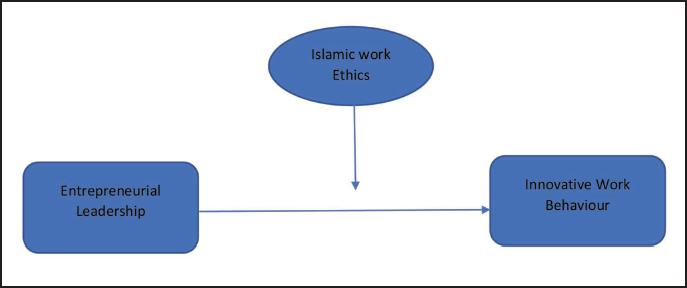
H2: IWE has a significant relationship with IWB.
H2a: IWE moderate the relationship between EL and IWB.
Methodology
Sampling and Data Collection
The study employs the hypothetical deductive technique and quantitative methodology, which is assumed to be effective in delivering reliable results for generalising to a large population. To investigate the relationship between EL and IWB moderated by IWE data was collected from SMEs in Islamabad. Since the purpose of the present study is to investigates the impact of EL on IWB of employee within the SMEs sector of Islamabad, Pakistan. Therefore, all the employees of SMEs are considered as the target population. However, the total number of employees working in different SMEs in Islamabad is unknown; therefore, we follow Hair et al. (2019) and Memon et al. (2020) recommendation of sample size for using Partial Least Squares Structural Equation Modelling (PLS-SEM) as 250 or above for accurate estimation using PLS-SEM. A total of 350 questionnaires were distributed among the employees of different SMEs in Islamabad. Employees responded to the questionnaires based on their willingness to engage.
Instruments
An 8-item scale was adopted from Renko et al. (2015) to measure EL. A sample items includes ‘Our immediate manager often comes up with radical improvement ideas for the products/services we are selling’. For IWB Janssen’s (2000) 9-items scale with α = 0.95 was adopted. The scale measures the degree to which an employee involves in IWBs, with 1 = ‘never’ and 5 = ‘always’. A sample item includes ‘Creating new ideas for difficult issues, searching out new work methods, techniques or instrument’. To understand the role of IWE 17-item scale developed by Ali (1992) was adopted. A sample item includes ‘Life has no meaning without work’ is a sample item of this scale. The α of this scale was 0.91.
Data Analysis and Results
Demographics
Demographics suggests that majority of the respondents (71.4%) are males, which is not a surprise due to the lower labour force participation of women in Pakistan. Majority of the respondents (42.7%) has their graduate degree, with a work experience of 1–13 years (Table 2).
Demographics of the Respondents.

Measurement Model Assessment
The hypothesised model was examined using SPSS version 21 and Smart PLS 3.2.2. The PLS-SEM consists of two stages; in the first, the focus was on the measurement model (internal consistency, convergent validity and discriminant validity) while the second was on the structural model (Hair et al., 2017; Ramayah et al., 2018).
Internal Consistency Reliability
The internal consistency reliability (CR) measured through CR (Richter et al., 2016) calculates the degree to which the items exhibit the underlying constructs. The acceptable value of CR is greater than 0.708. The results show that all the constructs have an acceptable CR value—entrepreneurial leader (0.909), innovative behaviour (0.905) and IWE (0.931), hence suggesting internal consistency reliability (Table 3).
Internal Consistency Reliability and Convergent Validity.

Convergent Validity
Convergent validity mirrors ‘the extent to which a measure correlates positively with an alternative measure of the same construct’ (Hair et al., 2014, p. 102). This can be calculated by examining the outer loading of the variables and their average variance extracted (AVE) (Risher & Hair, 2017). The acceptable value of AVE for the existence of construct validity is equal or greater than 0.50. As shown in Table 3, the AVE values for all the constructs are greater than 0.50—confirming the CV of the measurement model.
Discriminant Validity
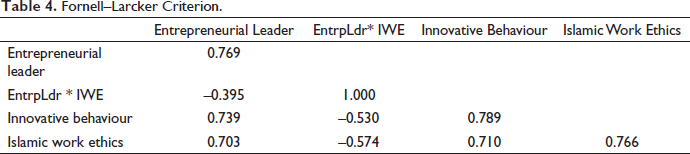
DV represents ‘the extent to which a construct is truly distinct from the other constructs by empirical standards’ (Hair et al., 2014, p. 104). The current study uses Fornell–Larcker criterion and heterotrait-monotrait (HTMT) ratio to assess the DV (Henseler et al., 2015). In Table 4, the diagonal value indicates the square root of AVE, which is greater than their correspondence latent variable. Thus, showing the presence of discriminant validity. Similarly, the HTMT ratio indicates that values of all the latent variable and construct should not be greater than 0.90. According to statistics presented in Table 5, all the values are less than 0.90, hence indicating the presence of discriminant validity.
Fornell–Larcker Criterion.
Heterotrait-Monotrait (HTMT) Ratio.

The Structural Model
The structural model represents the assessment and testing of the causal relationships between the variables. Hypotheses testing was conducting using T statistic and the p value obtained through 500 bootstrapping of PLS-SEM. Table 6 shows the coefficient value and significant value of the model. According to statistics, the coefficient value of EL predicting IWB is significant (coefficient = 0.376; p = .000), indicating that EL has a significant effect on innovative behaviour. Hence, it provide the evidence for accepting the alternative hypothesis. The statistic IWE predicting IWB is significant (coefficient = 0.543; p = .000), suggesting that IWE has a significant effect on innovative behaviour, hence H2 is accepted. Similarly, Islamic Worth Ethics and EL predicting IWB is insignificant (coefficient = –0.032; p = .18); indicating this interaction term has an insignificant effect on innovative behaviour. Hence, H2a could not be accepted and concludes that there is no significant moderate role of IWE on the relationship of EL on IWB.
Structural Equation Model.
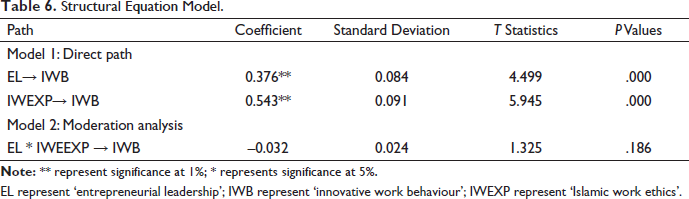
EL represent ‘entrepreneurial leadership’; IWB represent ‘innovative work behaviour’; IWEXP represent ‘Islamic work ethics’.
Discussion
The study aimed at examining causal relationship of entrepreneurial leader(ship) and IWB of employees in SMEs in Islamabad. Extant research acknowledges the importance of leadership style and its impact on employee work behaviour. However, there is a dearth of literature on the impact of ‘EL’ and IWB, particularly in SMEs in Pakistani context. We also acknowledge the fact that context and boundary conditions play a role when studying the relationship, hence we wish to examine the way IWE moderating the relationship between EL and IWB.
H1 of the study demonstrates a positive and significant effect of EL on IWB, which is supported by findings obtained through PLS-SEM. This finding is consistent with the majority of previous studies (such as Miao et al., 2018; Newman et al., 2018). According to the EL research, entrepreneurial leaders, in addition to producing innovative ideas, empower and motivate their subordinates to demonstrate their talents in disassociating complicated situations and accomplishing difficult tasks using IWB (Cai et al., 2021).
The study adds to our understanding of the favourable influence of leadership style on employee behaviour, such as IWB (Cheong et al., 2016). Previous studies recommend using a supportive leadership style to encourage good behaviour, such as IWB (Chen et al., 2016). Current findings show that an entrepreneurial leader inspires subordinates for exploration and exploitation (Newman et al., 2018) by building confidence in workers to exploit opportunities and try new ideas, resulting in innovative behaviour at work (Strauss et al., 2017). Entrepreneurial leaders enable their subordinates with considerable flexibility to explore at the workplace (Yang et al., 2019), which promotes workers’ IWB. The sense of exchange generated because of an entrepreneurial leader (Newman et al., 2018; Yang et al., 2019) also inspires individuals to perform aggressively and produce creative initiatives for supporting the business’s success.
H2 of the study indicates that there is a positive impact of IWE on innovative behaviour. According to the study’s findings, IWE has a favourable influence on IWB, which implies it improves the innovative behaviour of employees in SMEs in Islamabad. The hypothesis results (B = .543, t = 5.945) show that there is a strong positive link. As per the primary elements of IWE, the respondents of the current research believe that sitting idle and wasting time by engaging in unproductive activities is not appropriate. Islam is a comprehensive code of conduct, which guides in every domain of life—indeed its work ethics are applicable to all facets of life including organisational administration (Abuznaid, 2009). The results are consistent with the previous studies arguing that IWE upturns employees’ approach towards change (Yousef, 2000) helping them embrace the change (Ali, 1992, Wahab et al., 1996).
H2a states that IWE moderates the relationship between EL and IWB. However, this hypothesis is not accepted since the present study’s findings are insignificant. Prior research has shown that IWE boost employees’ IWB, but after collecting data from various people in SMEs firms in Islamabad and analysing it, no moderating effect on EL and IWB was found. As a result, H2a is hereby rejected. This can be attributed to the fact that in Pakistan the cultural norms are strongly prevalent and the cultural norms overshadow IWE.
Based on social cognitive theory and resource-based view of firms, results suggested that leaders with an entrepreneurial mindset can develop the innovation and creativity capabilities of their employees at work by altering their perspective of their individual and team-level abilities to create new ideas. Similarly, Islamic belief of ethics keep them persistent to stay strong in the challenging environment and implement the idea because sitting idle and not being engaged in any productive activity is not advocated by Islam.
Conclusion
The current study intends to examine a domain of EL and its effect on employees IWB, which is a highly desired and necessary area in the present day. The primary goal of this research is to determine the impact of EL on employees’ IWB in SMEs in Islamabad. Furthermore, this study has examined the role of IWE as a moderator between the associations of EL and IWB.
For this purpose, data for hypotheses testing was obtained with a self-administered survey questionnaire in different SMEs in Islamabad. A total of 350 questionnaires have been distributed among the managers, owners and employees of SMEs; however, 248 questionnaires have been returned filled and used for data analysis. This makes the response rate equal to 70.85% that seem acceptable for further analysis.
The PLS-SEM model was applied on the data for hypothesis testing. The measurement model shows that all the variables have an acceptable level of factor loading, reliability and validity. Further, the results of SEM demonstrate that EL has a significant effect on employees IWB in SMEs. Similarly, IWE also shows a significant effect on the employees’ IWB. However, an insignificant effect for IWE as a moderator between the association of EL and IWB is observed in the data analysis.
Implications of the Study
The results propose that leadership in an entrepreneurial style has a strong impact on both creativity and innovation, also concluded by Hughes et al. (2018). Entrepreneurial leaders, based on particular executive functions, create a potential atmosphere that supports and inspire their people to abandon established ways of thinking, develop ground-breaking thoughts, and find creative solutions to workplace challenges. We address a recent call for investigating the role of leadership style in altering employee’s attitude towards creativity and innovation as two separate concepts, as suggested by Lee et al. (2019). The current research introduces EL as an antecedent with the ability to positively influence employees’ perceptions about their individual- and team-level creativity and ability to come up with innovative ideas. EL is also seen to be positively influencing the endeavours and attitudes in selecting and implementing the most appropriate idea (Cai et al., 2018 & Hughes et al., 2018). Finally, this research come-up with evidence on the moderating role of IWE between the style of being led and IWB.
Footnotes
Declaration of Conflicting Interests
The authors declared no potential conflicts of interest with respect to the research, authorship and/or publication of this article.
Funding
The authors received no financial support for the research, authorship and/or publication of this article.
