



Abstract
Devbans are the parts of forest territory that have been traditionally conserved in reverence to the local deities in various parts of Himachal Pradesh. Today, they stand at the intersection of tradition and modernity. This paper endeavours to study the political ecology of a Devban in the contemporary times by looking at the power dynamics between various stakeholders with respect to their relative decision making power in the realm of managing the Devban of Parashar Rishi Devta. It further looks at howcertain political and administrative factors can contribute towards the growth or even decline of any Devban. The study argues that in the contemporary times when the capitalist doctrines have infiltrated every sphere of the social institutions including the religion, Devbans have a greater probability of survival when both the state and the community have shared conservatory idealsand powers to preserve them.
Introduction
As one embarks on the journey to explore the hilly terrains of the Western Himachal Pradesh, one is bound to come across various processions of people walking down the hill roads carrying their local deity’s palanquin on their shoulders while playing drums and trumpets. These processions take place whenever the local deities or Devi/Devtas, as they are locally called, desire to visit some place. Local deities in the Western Himalayas are treated as super humans having the divine powers that the lesser mortals are devoid of. The locals perform all the rituals necessary to keep the Devta happy, as they never want to bring out the divine wrath of the Devta. Devtas just like humans are perceived to have desires, feelings and emotions. Similar to humans, Devtas own the patch of land as well that is seen as their private property. These patches of land often surround the temple or the abode of the Devta. These patches of lands are usually rich in biodiversity and vary in size depending on the social significance and the ranking of the Devta in the hierarchical system of Devtas (Thakur, 2002). These patches of land are termed as sacred forests or sacred groves. Sacred groves are governed by a set of rules that decide who can access the sacred groves and for what purpose. In the long run, these taboos play a crucial role in perpetuating the existence and biodiversity of the sacred groves.
Back in times, when there werenot any statutory institutions to protect forest areas such as National Forest Reserves, sacred groves like Devbans played a keypart in keeping the environmental biodiversity unharmed. Sacred groves contain sizeable repositories of forest biodiversity and are responsible for protection of many plant species of conservation significance (Malhotra et al., 2001). They are held as one of the best specimens of traditional biodiversity management practices. They can be at variance in terms of size from some square meters to many hectares (ibid.). On the surface they are just a material thing like any other part of land, but traditionally and socially they are entwined with faith in local gods, rites and taboos. Sacred groves are an unmatched social body that integrates different religious, traditional, preservation and management ideas and practices. Sacred groves are denoted as the segments of a widespread setting, comprising vegetation and other forms of natural life that are well preserved by the locals as they intensely believe that doing so in a symbol of an essential relationship that they have with the divine or with nature (Hughes & Chandran, 1998). In a way, sacred groves bridge the gap between the present-day civilisation and the historical civilisation with regard to natural and social heritage (Gadgil & Vartak, 1976). In the middle of this uninterrupted advancement of society, it is essential to comprehend the various elements that have encouraged the continued existence of sacred groves. The sacred groves have mainly become important in current times because of the crisis in environmental domain caused by deforestation. Even the global bodies like the UN and WWF have come together and voiced their support to protect the traditionally conserved ecological sites.
International organisations such as United Nations Educational, Scientific and Cultural Organization (UNESCO), World Wildlife Fund (WWF) and International Union for Conservation of Nature (IUCN) have shown great interest in protecting the sacred environmental sites. Internationally, there has been expanded concentrate on customary normal asset administration and protection frameworks in the current circumstances. There is a wide acknowledgment that biological reasonability displays cooperative relationship between biological systems and the social frameworks. The Convention on Biological Diversity (CBD), which took place at the United Nations Conference on Environment and Development (UNCED) in 1992, was the main global measure that suggested procedures and guidelines for the utilisation and preservation of traditional learning, identified with the maintenance and feasible utilisation of biodiversity. Sacred groves are long-established institutions that are a result of the amalgamation of cultural and sound environmental practices. Even though these institutions are considered traditional in nature, they have not been able to stay away from the effect of changing religious outlook, changes in economic systems, technological advancement and also ever growing environmental consciousness. The institution of sacred groves is a classic example of both ecology and culture as continuously evolving and adapting. Amidst this continuous evolution it is necessary to understand the various factors that have promoted the survival of sacred groves. Thus, it becomes vital to delve into socio-political and economic factors that lead to their decline or factors that lead to their preservation.
By concentrating on the power hierarchies that exist between various stakeholders such as between the state and its subjects, the Forest Department and the locals, the dominant caste groups and the lower caste groups or, the males and the females, the researcher has tried to unravel the dynamics of community participation around the Devban of Parashar Rishi Devta. This study endeavoured to study the various socio-economic and political factors that contribute to the continued existence or demise of sacred groves in Mandi district of Himachal Pradesh. It also tried to understand the power dynamics involved in the management of Devbans with special reference to gender, caste and the state vs the community. It also aims to unravel the role of ‘sacredness’ and the extent of community acceptance and participation in this, often perceived as ‘ideal’ model of community forestry and conservation.
Methodology: Approaches and Site
Qualitative approach was chosen to conduct this study. This approach was used for the study to develop rich and thick accounts that can enable a researcher to comprehend the complex concepts like sacredness and community participation that facilitates to achieve the key objectives of the study (Denscombe, 2007). Qualitative research approach was perceived to be fundamentally essential to understand the multiple factors that impact the existence of Devbans in the region. In-depth interviews and non-participant observation methods were used for the collection of primary data. In total, 30 in-depth interviews were conducted. Recruiting respondents from multiple facets of the community life and living was done to increase the representativeness of the sample. The field visits for this study were conducted during the period from 1 September 2017 to 13 February 2018.
The site chosen for the study was Mandi district of Himachal Pradesh. Once the Princely State of Mandi, Mandi came under indirect British control in 1846 and was ruled by its traditional rulers (Rajas from Sen Dynasty) until 1947. After the abolition of the princely rule, Mandi and the neighbouring state Suket were transformed into an administrative district with Mandi Town, the former capital, as district headquarters. Mandi had an area of ca. 1200 square miles. Historically, the mountainous landscape of the study area have had a crucial role in boosting the development of small, fragmented socio political entities (locally termed as Thakurais) in the region.
Mandi district has numerous sacred forests, yet there is almost negligible work done on the sacred groves in this region. The study included a Devban, the Devban of Parashar Rishi Devta which was selected by applying purposive sampling technique. Both Primary (respondents from various facets of community life such as Devta committee members, local villagers and government officials from the Forest Department) and Secondary (government records, news articles, literature, archival documents, etc.) sources of data collection were used. Political ecology theoretical framework provided a lens to the researcher to look at the power dynamics that exist between different segments of the society over the management of the Devban.
Sacred Groves in India: A Cursory Glance
List of the Local Names for Sacred Groves in Different States.
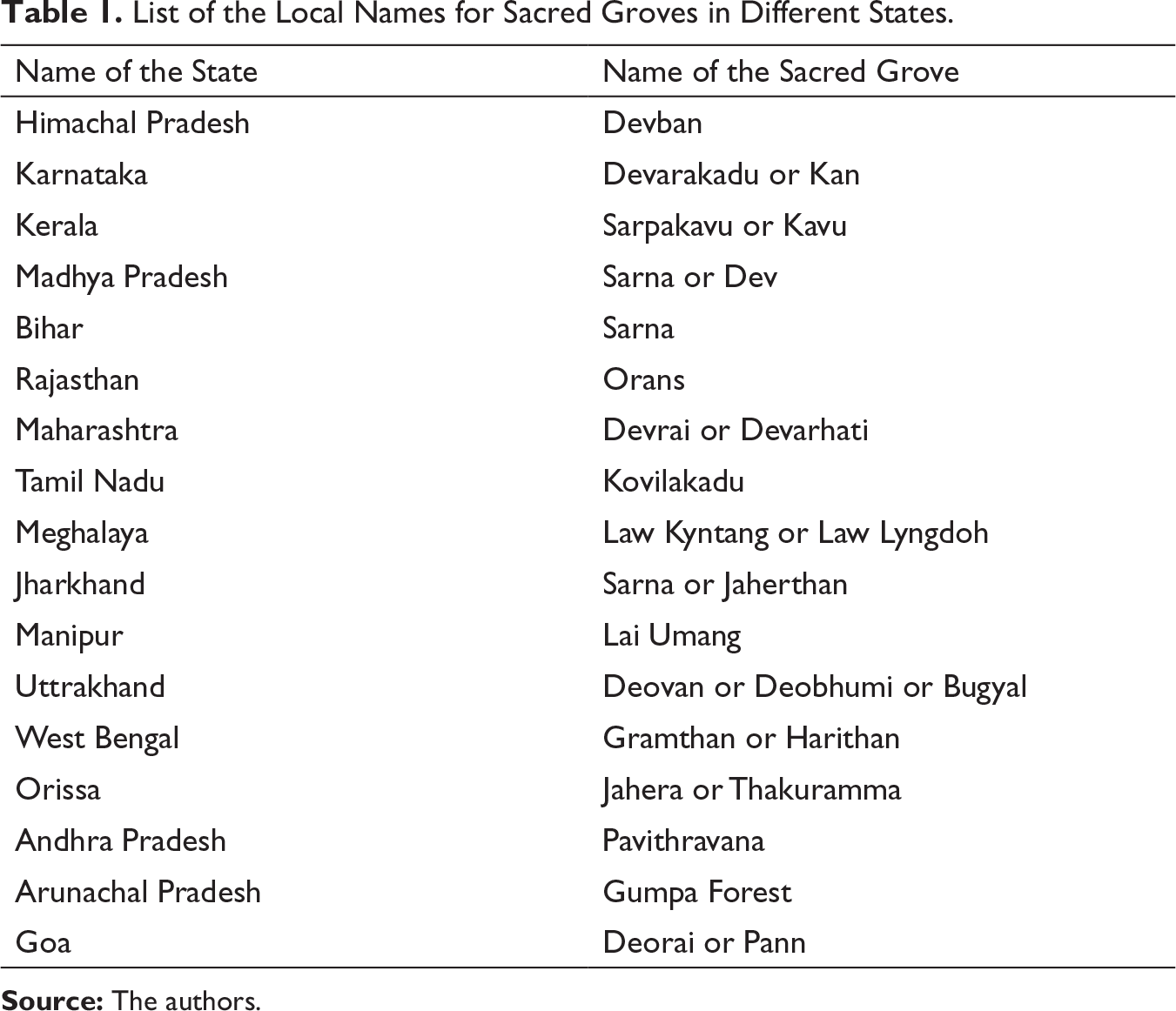
Source: The authors.
Devbans are the patches of wilderness in the Western part of Himachal Pradesh that are viewed and worshipped as sacred and as a property of local deities. Their whole administration is controlled by a Devta Committee that typically encompasses a set of dominant caste men of the villages nearby the Devban. Devbans can be located in several parts of the Himachal Pradesh ranging from the Western parts (Kullu, Shimla, Mandi, etc.) to the Eastern parts (Una, Kangra, etc.). Devbans are the assets of local deities and each local deity has been allocated a particular space in the village. The local deities are perceived as living bodies that come with their own paraphernalia such as ornaments, a temple/house to live in, piece of land that is their personal estate (i.e., sacred grove), etc. What is distinctive about the Devtas is that they are seen to be very much animated as they all have an oracle (locally known as gur), who communicates for them and conveys their demand to the local community. It is this very feature of the Devtas as ‘corporal entities’ and their association with Devbans in Himalayas that makes these Devbans stand apart from rest of the sacred groves found throughout the country.
Contextualising the Devtas of Himachal Pradesh
Durkheim (1915) defines religion as the domain of the ‘sacred’. The sacred acquires an acuteness of definition by being contrasted to the profane. Religion is a set of beliefs and practices relative to sacred things, that is to say, things set apart and forbidden, beliefs and practices which unite into one single moral community (Madan, 1991). Rituals play a vital role in polarising the sacred from the profane. Rituals are very crucial in legitimising and ascertaining the existence of these local deities. It’s through rituals that the Devtas exist and exercise their authority over the various aspects of life in a region. In the earlier times, societies in the region operated on the belief systems that were in sync with the geographical surroundings in which they existed. Though they were physically separated they were not exactly isolated from each other owing to the overarching monarchy that placed all these socio-political entities in a hierarchical order in relation to each other and to the theocratic state. Over the years the Sanskritic ideology has penetrated these socio political entities and in doing so it has transformed both itself and the local cults that thrived there (Singh, 2006). According to Conzelmann (2006), the setting up of Madho Rao in the mid-17th century as the ruler of Mandi State marked a significant milestone in the history of the region. The adoption of the cult of Krishna (mainstream Hindu deity) was warmly upheld by the cultured dwellers of the capital of Mandi State as it made them feel more Brahmanised, that is, educated and sophisticated in comparison to the village dwellers who lived in far off places. Strategically, this move had a great impact in connecting the cultured urban society to the village dwelling population as it made Madho Rao the divine ruler who was more acceptable by the locals who believed in a theocratic nature of governance and were ruled by their own Devi/Devtas. Ranks and privileges of Devi/Devtas were fixed in relation to Madho Rao, the divine king of the kingdom of Mandi. The Devi/Devtas continue to rule the lives of the local people and also impact the activities of the state (for instance, the ancient practice of Devtas gathering for Shivratri fair at Mandi continues till date and now the organising party is the ‘secular state’ itself). Thus, it can be seen that the ‘religious’ local Devtas are a very much part of the ‘secular’ political system.
The hierarchy can be witnessed during the fair by locating some of the rituals or symbolic acts per se:
All Devtas are inferior to Madho Rao, hence they all bow in front of him; When two Devtas of equal status meet each other they both bow to each other; In case the Devtas aren’t of equal status, then the one having the lower status will bow in front of the one having the higher status; and Local goddesses,that is, Devis can be distinguished from the Devtas as they carry a silver umbrella on their heads also, their heads are covered with dupatta.
The ranking among the local gods can be seen as based on the existing folklores and their impact in legitimising the power of deities in fulfilling the wishes of the people. According to the locals in the earlier times, the Shivaratri fair was a sort of trade fair, but over the years it has got transformed into a more cultural affair that incorporates, sports, dancing, singing, exhibitions, etc. Thus, it’s important to note that how something economic and political in the disguise of tradition has in fact turned into something more cultural and political. It also plays an essential role in showcasing and asserting the power of the local deities among the locals. The institution of Devtas is an integral part of the functioning of socio-political life in these regions. From maintaining caste hierarchy to interfering in the matters regarding the developmental projects to managing the Devbans, these Devtas have a great deal of control over local socio-political milieu (Thakur, 2002).
According to Mary Douglas (1970), the term ritual has been perceived as something hollow or mechanical that signifies ‘empty conformity’ in a modern secular world. She states that rituals are far more than that, they are the symbols that play vital function in the maintenance of order in any society. There are mainly two salient features of the institutions of Devta that help in legitimising their presence and control over the region through rituals: Anthropomorphising the Devtas and Localising the Devtas. Anthropomorphising essentially means that these deities are conferred with the humanly characteristics by the inhabitants of the region. Localising of Devtas also has three sub-constituents: particular jurisdiction, native of the locale and paternalistic administration.
People approach Devtas mainly on two occasions:sacred events (birth, marriage, etc.) or in case they are anxious about something.It is the second type of occasions that can be explained by using the Confidence type theory set forth by Malinowski according to which religion has psychological implication in the lives of its followers. It in fact helps one to endure the situations of emotional stress by opening up escapes from such situations and such impasses as it offer no empirical way out except by ritual and belief into the domain of supernatural (Malinowski& Redfield, 1954). Devtas are an integral part of social life in the region. The institution of Devta plays multiple social roles from being the ‘wish granter’ to the ‘maintainer of the order and status quo’ in the region.
Decoding Structures and Functions Around the Devban: Religion, State and Community
In a span of less than two centuries, the political economy of rural Mandi has changed from feudal-subsistence to colonial, to capitalist with a democratic political regime. During this period the valued form of Devta property has also changed from being collective to a purely ritual one leaving local deities as naabalig owners of the property. However, all these changes have not undermined Devta and its associated institutions. Rather they retain local significance and in some cases, like the Parashar Rishi Devta’s Devban, their significance has increased in recent past. On interviewing the officials at the District Forest Officer’s office, the locals of community and the members of the Devta committee, the researcher gained insights into the complex structural and functional arrangements that revolve around the Devban of Parashar Rishi Devta.
On asking about the relevance of the Devban in their lives and if any changes have occurred after the government took over the Devban, one of the male participants in his late forties casually remarked,
The Devan of Parashar rishi is filled with the Deodar trees. The government has taken it over. But it doesn’t really matter you know, because nobody ever dares to steel anything from the Devta’s Devban. And also the government does do the needful to protect the forest. But let me assure you nobody ever steels anything from the Devban. The Devban is safe, because nobody wants to face his (Parashar Rishi Devta’s) wrath, his anger is very ruthless.
There are various taboos which govern the activities that take place in the premises of the Devban. Anthropologists like Malinowski and Redfield (1954) and Bascom (1953) have attributed many social roles to these taboos. Taboos play a major role in differentiating the sacred from the profane. Taboos can be seen as a set of well accepted social rules that have been transmitted orally. They are usually mythological in nature. These social rules control the way humans behave in a particular social setting. In case of sacred groves, they have a vital role in accrediting sacredness to these otherwise ordinary forest patches and regulating the behaviour of locals by generating consensus through fear. Hence, it can be said that the fear of facing the wrath of deity results into actions that helps in keeping sacred groves preserved. In the recent years, owing to the influence of western education and migration, there is a weakening of believe in the practices related to taboos (Negi, 2010). This change might have played a role in increasing the influence of economic factors on the survival of sacred groves.
In many anthropological works, it has been found that there is a significant amount of association between folklores and the social context in which they exist (Bascom, 1953). For instance, in Malinowski’s Magic, Science and Religion (1954), Myths or folklores are considered as ‘charters’ that hold the society together by justifying institutional behaviour. For instance, in the folklore where there is a mention of a single Deodar tree being used for the construction of the temple of Prashar Rishi, there are some underlying messages that might have played a vital role in the conservation of the sacred grove of Parashar Rishi. In this folklore, a Deodar tree was used for the construction of the temple (the abode of the Devta). Usage of Deodar tree in the construction of this sacred site in a way also makes Deodar tree sacred in nature and grants it a position different from the other profane plant/tree species in the habitat. It is no coincidence that the sacred grove of Prashar Rishi and many other sacred groves in the Himalayas are also filled with Deodar trees that are very much revered by the habitants of the region as the property of their deity Prashar Rishi.
According to the District Forest Officer’s office,
From the legal point of view, there is not much difference between the way in which we the government officials are supposed to look at a normal forest region anda sacred forest region. They both are same thing as far as the legal state of the property is concerned. Though the government officials like us who are mostly locals (the State Service officials) do realise the importance of sacred groves and are very much familiar and respectful of the values that the locals ascribe to them. The local community has taken up a ‘self-enforced’ role in the protection of the sacred groves. The local communities and the forest department have a symbiotic relationship as far as the sacred groves are concerned. Whereby there are conflicts in the case of other ‘non-sacred’ forests.
In a study on two Devbans in Kullu, Sudha Vasan and Sanjay Kumar (2006) found that the Devban that was located on private property was harvested while the one that was situated on the government land stayed unharmed. Thus, it can be seen that how government policies can also become an efficacious tool for ensuring the protection of the sacred groves in light of ever-increasing capitalist values among people.
The Devta Committee of the Prashar Rishi Devta comprises 30 members. Majority of the members are from Rajput community. The membership of the committee is completely hereditary in nature. Mr Jeevan Thakur the pujari of the temple is from the seventh generation of his family. According to him, the interaction between the Devta Committee is limited to the need for wood for the activities related to the Devta’s temple. According to Jeevan Thakur, the government in fact takes good care of the Devban, and the shift in the power on sacred grove from Devta committee to the government has not impacted the biodiversity conservation in the region. Government protects the sacred groves while at the same time fulfilling the timber requirement of the community members through timber distribution system.
Timber distribution is done in the name of Prashar Rishi Devta, and he is seen as a minor or ‘nabaalig’ whose matters are taken care by the representatives from the Devta Committee. In pre-colonial times in Himachal Pradesh wastelands belonged to kings. On the other hand, sacred groves were one such category of forests that did not belong to the king. In medieval India, presents to deities and religious institutions by the monarchs were an essential element of feudal Hindu statecraft and such gifts were signifiers of independence, sovereignty and overlordship (Vasan & Kumar, 2006).
In the case of Parashar Rishi Devta’s Devban, we can see that the conflict between the state and the Devta/Devta Committee doesnot exist as far as the protection of the Devban is concerned. But this doesnot happen in all the cases. For instance, a hydel project could not take place in Kinnaur region because the local Devta did not approve of the project (Villagers in Himachal Pradesh block hydel project, 2015). The reason behind this could be the fact that Gram Panchayats in Tribal regions such as Kinnaur have more autonomy than the Panchayats in Mandi. As a result the Devta in Kinnaur could also have more say in the matter in comparison to the Devta in Mandi. Thus, it may be possible that the seemingly conflict less relationship between Devta and the State authorities in Mandi is actually a result of not enough power/autonomy vested in the local communities.
Determinants of Exclusion and Inclusion: Caste and Gender
There is an interesting relation between the caste, gender and the management of sacred groves. Caste along with gender remains a vital factor to be investigated while looking at the social aspect of sacred groves. This does not mean that there are same caste relations in almost all the sacred groves. Rather sacred groves have different caste dynamics depending on the region that they exist in. For instance, in Kerala, some of the sacred groves, locally known as Kavu are managed by the people from lower castes (Tarabout, 2015) while in Himachal Pradesh, the management of the Devban is done by the members of the dominant caste Rajput community (Vasan, 2002). Though even in the former case the dominant caste people have given sanction to the lower caste people to manage the Devbans. So, in both the cases from the north and the south of the Indian subcontinent, the dominance of dominant caste can be seen, the dominance being more explicit in the case of the north.
Caste hierarchies are reflected in the constitution of Devta Committee. Except for the instrumentalists who are men from the lower caste, all the other members of the committee are dominant caste men. Men of the most powerful households within the village often hold the key positions on the Devta committee. Only the men from the dominant castes have the right to carry the palanquin of the Devta on their shoulders. Lower castes are prohibited from touching the Devta idol but they lead the Devta processions since they play specialised musical instruments. Thus, it can be seen that how the nature of one’s participation in the maintenance of the Devban is determined by his or her caste identity. In the similar manner, women also do not emerge in the forefront when it comes to the decision making with regard to the Devban. The Devta Committee is completely dominated by the male members of Rajput community. Even priest or pujari as they are locally addressed is from Rajput community. According to a popular folklore, at the beginning the Pujari was from Brahman community, but he committed some huge mistake that made the King so angry that he removed the Brahman from the position of pujari and declared that now onwards only a member of the Rajput community could become the pujari of the Parashar Rishi Devta. This folklore can be seen as an assertion of the power by a particular group of people to legitimise their status quo.
As far as the access to Devban is concerned there is no taboo that forbids the people from any caste or gender to enter the Devban. But there is a clear demarcation in terms of division of labour when it comes to the Devta or the Devban. The sacred practices (such as performing rituals related to the worshipping of the Devta or staying in close proximity to the Devta) associated with the Devta and the Devta committee are done by the members of dominant castes. While the profane practices such as playing drums (done by lower caste people locally called chamars as the drums played by them are made with leather [chamda] and leather is concerned as a profane object) or cutting trees for the Devta (done by a community locally called as Brahmas) are done by the members of the lower castes. There are certain practices that clearly resonate the social hierarchies that are present in the society.
The perception of Devban varies as far as men and women are concerned. While women associated sacred groves with divinity and spirituality, for men, sacred groves denoted the power of the Devta and something that is essential in the perpetuation of the reverence towards the Devta by the people. To women, the Devban was a space that does not have evil spirits and was completely sacred. It was also important to them as it provided them with jadi booti (medicinal herbs) in case of ill health. While men can access the Devban anytime, the women were prohibited from entering the grove during their menstruation cycle. One of the female respondents aged 45 years mentioned that
The Devban is a really peaceful site, there is something very divine about. When I am sitting there, it feels like that I am sitting with Devta. There are rule that prohibit all the women to enter the main temple of the Devta, which is only accessible to the Thakur men. But here in this Devban I feel closest to the Devta. I feel really calm and peaceful whenever I come here. But I just cannot step into the Devban when I am menstruating, Devta will get angry at me then. Also, you know Devban is one place where no one cuts the trees unless it is for the Devta. Other forests might perish, but the Devban continues to flourish because the locals worship it.
As far as the role of women is concerned in the maintenance of the temple and the Devban, they are engaged in cleaning temple premises and for cooking food for the people who cut wood for the Devta from the Devban. Also, the cleaning of the temple is always done by dominant caste women, while when the food has to be cooked for the men who cut the wood for the Devta, it’s always prepared by the women from their own caste, that is, the Brahma caste.
Ecofeminists like Vandana Shiva (1988) have argued that, as reflected in the religious and cultural actions, women’s closeness to nature is different from, and more than, men’s: there are essential and engrained differences between the sexes. She puts forth the concept of prakriti, the feminine principle associated with nature. According to her the main reason towards the ecological degradation is the wearing away of the traditional knowledge base of the communities in the male-dominated capitalist world. Bina Agarwal (1992), on other hand, counters the oversimplified and romanticised ideas that put women and femininity close to nature. She believes that drawing such parallels supports and justifies the exploitation of both women and nature. According to her, the women are placed close to religion or spirituality and used as tools to perpetuate the male-dominated narrative.For Agarwal, this conventional approach of ecofeminism is tricky because it treats women as a unitary category, irrespective of class, ethnicity, location and any other factor while also deeming them as the sole protectors of ecology while shunning men of their responsibility. In the case of Parashar Rishi’s Devban, religious belief among women can be seen as supporting the mainstream dominant caste patriarchal ideology while at the same time also playing a crucial role in the perpetuation of reverence towards the Devta and the Devban. This paradox is complex in nature but must be taken into consideration while drafting any kind of policy to protect and preserve the Devbans.
The relationship that people from different caste and gender groups share with the Devban throws light on the interrelationship between two factors that are crucial to the discussion on political ecology,that is, power relations and property relations. It can be seen from the Discussion section of the paper that gender and caste identities play a major role in determining the extent to which an individual can get access or can involve in the management of the Devban.
Discussion
Conservation of sacred groves can have a positive long-term impact on the discourse of environmental conservation in India as they have in many ways stood the test of time. They are important as they have scientific, economic, social and spiritual significance. Land reforms and changing outlook towards religious beliefs have the capacity to pose a threat to the protection of sacred groves. Under such circumstances it becomes important to find out about the various ways that can promote their survival and strengthen this institution. Their adaptation to the continuous changes have also ensured that they are able to stand the trial of changing times in Mandi district.
The vital argument that arises from the findings of the study is that in the contemporary context it is important that we look at sacred groves beyond the notion of ‘sacredness’ and recognise that sacred groves have also evolved with the ongoing changes in social, economic and political structures. However, this doesnot mean that sacredness or religion doesnot hold any importance. Of course it does, as it is the foundation on which a lot of traditional practices with regard to sacred groves are premised. What becomes important to understand here is that religion does not exist in vacuum, it exists in a particular context and is part of a bigger structural set up. Thus, it is imperative to connect the dots between various sub-structures (such as Devtas, Devta committee, caste relations, gender relations, property relations) leading towards the main structural set up (Brahaminical/Mainstream Hindu/Nature of Economic and Political arrangement) to reach any sound conclusion about the nature and existence of sacred groves in the region. At the same time, we also need to ensure that more and more sections of society should be able to take part in the activities relating to the preservation of the Devbans.
Taking into account the socio-cultural fabric of the region in which the sacred groves are located also becomes vital in developing an understanding about sacred groves, as one must refrain from putting all sacred groves under one umbrella. There are variations in terms of geography, plant species, area covered by sacred grove, ritual and practices, etc. In case of Parashar Rishi Devta’s Devban, it was found that it is the geographical location of the Devban in the hills and the hegemonic dominance of dominant caste Rajput community (disseminated through Devta committee, folklores, religious sermons, caste/gender-based division of labour, etc.) that has ensured reverence towards sacred grove in the region despite the fact that it has been converted into a Demarcated Protected Forest and is not the private property of the Devta anymore. It is interesting to see how the institution of Devta can be both inclusive as well as exclusive in nature at the same time.
It has been seen that since sacred groves are not untouched by the impact of the capitalist influences, it has made them more vulnerable than ever. To combat this situation of vulnerability of sacred groves, efficient cures need to be kept in place. The cures should be such that they provide a sense of ownership to the locals while bestowing the ecological responsibility on their shoulders. Governmental as well as non-governmental organisation have a potential to play an important role in this particular domain. It goes without saying that it is only when the community and the state share conservatory values and powers with regard to the Devbans, then only the conducive circumstances for the survival and flourishing of the Devbanswill emerge.
