




Abstract
This article critically examines the dynamics of state power and political leadership in connection to the regional disparities of Odisha in a historical and present context, using both historical and empirical data. It finds a pattern of highly dominant, discriminatory and exclusionary politics and leadership. That resulted in regular and frequent control of state power by ‘Brahmin–Karan–Khandayat’ of the eastern region in collaboration with the upper-caste feudal and landlord rulers of the western region. Thus it is argued that the eastern regional upper castes dominated state power derived maximum advantage over the western region in the creation, distribution and utilisation of state resources. On the other hand, the western region has remained under the control of upper-caste feudalists and landlords while by sharing the power with their eastern partners for self-gain but did not do much for the progressive transformation in the redistribution of resources.
Introduction
All development is political and not managerial or administrative in the conceived technical sense (Leftwich, 1984, 2000, 2004). That is the process of development in human societies involves the organisation, mobilisation, combination, use and distribution of resources in new ways. That leads to inevitable disputes among individuals and groups or their combination on how such resources are to be used because of the calculation of gain and loss as a result of different configurations. It is applicable in all the spheres from the grass-roots to national level in both developed and developing societies. However, the difference is that in a developed society changes come through institutionalised ways with more of a consensual mode of democratic politics. On the other hand in developing societies with a high level of inequalities, a change threatens the interest of some directly which otherwise may be necessary for the promotion of development, like land reform. Therefore both politics and state is central in the process of mobilisation, direction and deployment of resources in a new way that does not happen on its own.
Politics of development and regional disparities between the eastern and western regions of Odisha portray one of the accounts of India’s uneven development in contemporary time—over the rapid growth of one privileged class doing well but the other most underprivileged sections continue to live with deprivation and precarious living (Drèze & Sen, 2013). It is reflected in terms of income poverty and other human development dimensions like health, and education between the regions and various social groups (De Haan & Dubey, 2005; Government of Orissa, 2004). The state has registered a high growth rate in the last one-decade with above the rate of the national average in industrial and agricultural sectors (Government of Odisha, 2019). 1 Its average per capita income has increased and highest among some of the lower-income states. 2 The monthly per capita consumption expenditure (MPCE) among the bottom 30% population in rural Odisha shows a positive trend (Government of Odisha, 2019). Moreover, still a large population lives in poverty (World Bank, 2016) and the progress has become polarised between the regions and various castes and tribes. A sizable population of the western and southern regions live with limited choices and opportunities in terms of human development.
In this context, the article addresses the question of unequal distribution of state power and the dominant political culture which are shaping regional disparities between the eastern and western regions in Odisha. The objective of the article is to critically examine state power in both pre- and post-independent Odisha that influence the creation, utilisation and distribution of resources. In this process, it has used a descriptive and analytical approach in the historical and present context comprising both historical and empirical field-based primary data.
Regional Disparities, State Power and Ruling Castes
The spatial dimension of inequality is the growing concern for policy interest in recent times in China, Mexico, Russia, India, South Africa and many developing and transition economic countries (Kanbur & Venables, 2005). Economic discipline has occupied a dominant space in this field but the explanation 3 does not satisfy their assumption because geographical features can affect the distribution of economic activity and spatial well-being. Again for geographers, regional disparities could be the result of unequal distributions of physical endowments but this also does not satisfy because the natural features do not impact the distribution of well-being, especially ‘infrastructure and public services’ (Kanbur & Venables, 2005).
So it has to be beyond the discipline of economy and geography with a multidisciplinary approach towards the phenomenon. According to Shah & Guru (2003), ‘low level of a geographical capital and social-political marginalization’ is the reason for backwardness in both western-southern and central-eastern regions in India. Again, Shah (2010) suggests having four categories of backward regions—like ‘remote, low potential or marginal, less favoured, and weakly integrated’. This includes the factors of topographical, socio-cultural, political and governance but in combined perspectives without any segregation. Similarly, Kurian (2000) suggests the backwardness of various states is due to ‘scarcity of water’, ‘particular living style of the inhabitants—mostly the tribal’—and ‘the neglect of ruling elites’. However, he further believes that the constraint of resources may be a major issue but the role of the state and the ruling elites of the respective state are important in balanced development.
In this respect, Kohli (2010) stresses the limited success of the redistribution system in BIMARU 4 states which are rooted in both society and politics. Therein the Brahminical domination in state power continues or has not been challenged very recently but the social characteristics have not changed. On the other hand in the southern states, the Brahmanical domination in state power was challenged in the early twentieth century and the power was transferred to the hand of backward classes. Thereby the transformative changes in policy and a good investment in education and human development take the states out of poverty and backwardness but it is the opposite in BIMARU states (Kohli, 2010).
That is similar in Odisha where Bailey (1958), reveals that even after changes from traditional caste society to a democratic society, village authority did not change. The same Oriya dominant castes were appointed in various positions in the democratic society. That is further highlighted by De Haan and Dubey (2005) attributing ‘entitlement failure’ and ‘social discrimination and deprivation in access to education, economy, and the markets, arising out of exploitative social and economic processes’ for the regional disparities in Odisha. That has historical and colonial roots due to the ‘continued dominance of traditional elites, extremely heterogeneous population, limited development of decentralisation, low level of political awareness among poor people, and the role played by NGOs, civil society’ (De Haan, 2004). Again the same factors were highlighted by Currie (2000) in the case of persistent poverty and hunger death in Kalahandi. 5 According to him, the faulty distribution systems of the political system are responsible for the socio-economic problems because there was enough deposited food grain in the district yet there was hunger death. Mohanty (2014), also emphasised upper-caste patriarchal dominance in the state power creating a ‘crisis in democracy’ that did little to reduce the regional disparities between eastern and mainland Odisha.
However, in the pre-British rule, domination in state power was operated based on a militaristic basis. Kings were ruling in alliance with local chiefs and zamindars. It appears that the attacks of rivals, the rise of a new king and their deals with the intermediaries of zamindars were there till the British rule. The decline of the old kingdom and the rise of new state power at the macro level did not destroy the stability of the political authority at the local level (Frankel & Rao, 1989). Moreover, even if there were no uniform patterns of dominance in state power, caste and religion still play a major role in capturing modern political institutions vis-à-vis the state power (Chatterjee, 2010). The earlier domination of caste and religion appeared on ‘building the coalition and consensus making’. They use the state power through the electoral system for consensus making with the coalition of other dominant classes like capitalists and other traditional landed elites. However instead of a clear-cut division of dominance in state and society, there are various institutions and processes in the state which are selectively used by corporate capitalists and urban middle classes (Chatterjee, 2010). Similarly, in Odisha, Pati (2012) argues that the long history of colonisation by Mughal, Marathas and then, the British has ‘polarised the social stratification and consolidated exploitation, power, and the dominance of the upper castes like Brahmins, Karanas and the Khandayats. On the other hand, the women, Adivasis, lower castes and outcastes are increasingly marginalised’.
Methodology
The article has embraced a descriptive and analytical approach within the perspectives of the politics of development looking into the multidimensional interaction of people and power in the creation, distribution and utilisation of resources. Moreover, in the political analysis of development, Leftwich (2004) finds three broader analytical themes of inter-connected and inter-dependent sphere—‘people, power and resources’ which are dependent on each other in the society, institutions or groups. But this article is confined to the thematic analysis of power concerning regional disparities. It has conceptualised the regional disparities as the disparities in sharing and control of state power between the regions and social groups. Hence, making it imperative for the analysis of the structure of power and decision making which influence the production and distribution of resources. It includes the issues of the nature of power distribution in the society like who regularly and frequently access the power (Leftwich, 1984).
Therefore the analysis has been done on various successive governments, on the position of chief ministers and the pattern of political leadership based on geography (the eastern and western region, see Figure 1) and caste groups like the Brahmins, Karans, Khandayats, Kshatrias (the dominant castes) and Scheduled Castes, Tribes and Other Backward Castes (SCs, STs, OBCs). The power dynamics have been problematised in both the historical and present context of two eras of pre-independence (1936–1952) and post-independence (1952–2020). In doing so, the article has used historical and contemporary data and substantiated it with some of the empirical data collected from interviewing key persons.

Overview of Regional Disparities in Odisha
The state has a total population of more than four crores constituting 3.47% of India’s total population (2011 census) possessing a total 4.7% of India’s landmass (Government of Odisha, 2016). It further has a diverse population of 62 tribes, constituting 22.8% of the total population and 93 types of scheduled castes groups constituting 17.1% of the total population respectively while 13 tribal groups are particularly vulnerable tribal groups (Government of India, 2013). The southern and western hilly regions are mostly dominated by the population of scheduled tribes and scheduled castes while the eastern plain is dominated by non-SC/ST caste groups. The present state was constituted in the year 1936 which has finally evolved as the separate state of Odisha on a linguistic basis. Before that parts of its eastern region were under the Bengal–Bihar Province, the western region was under the Central province and the southern region was under the Madras Province.
The general notion of regional discrimination in politics and the distribution of public infrastructure have led to multiple resistance and movements at various times. The demand for the creation of a separate Koshal state, 6 and the establishment of various institutions like a High Court bench in southern and western regions time and again are some of its manifestations (Dixit, 2013). The politics and power of the state have remained dominated by Brahmin–Karan-dominant castes (Mohanty, 2014). Almost all the chief ministers in the past belonged to the upper castes with some exceptions from the eastern region; otherwise, power has been shifting between Brahmin and Karan castes irrespective of whether it is the Congress, Janta Dal or Biju Janata Dal government.
There was a Committee for the Constitution of Separate Development Board in 1991 and Regional Imbalance Committee of 2004 constituted by the state assembly to look into the matter of regional disparities in the state. There is a separate development council called the Western Odisha Development Council (WODC) and an ongoing long-term action plan for KBK 7 districts—the Biju KBK programme—for the removal of regional backwardness and to bring overall development.
The Committee for the Constitution of a Separate Development Board in 1991 and the Establishment of Western Odisha Development Council
The committee for the constitution of a separate development board in Odisha was constituted in 1991 under the chairmanship of then minister Prafulla Chandra Ghadai to consider the question of the separate development board and identification of backward region to be included under the board (Government of Orissa, 1994). In this process, the committee used 11 basic indicators within the sectors of the population, agriculture, income, literacy and some of infrastructure like primary schools, drinking water, village road connectivity, village electrification and health care facilities. It was found that out of a total of 314 blocks, 145 were somewhat in developed conditions while 169 were under the backward category. Further, not a single block from the eight districts of Balangir, Deogarh, Gajapati, Kalahandi, Koraput, Nuapada, Nabarangpur and Rayagada from western and southern Odisha was in the developed category (Government of Orissa, 1994).
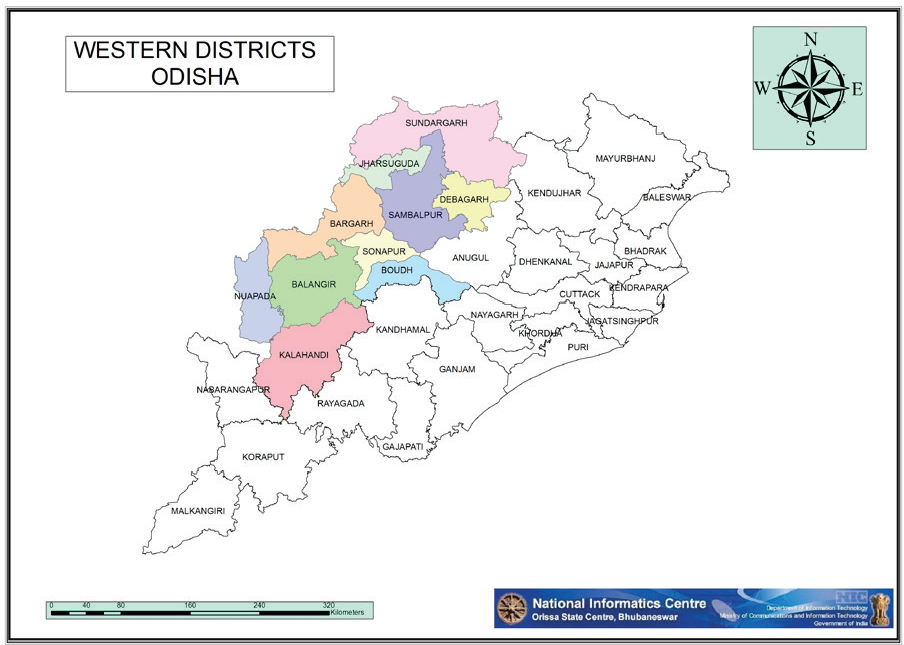
Moreover, with later development, a separate development board called WODC was established in 2000 8 to ‘accelerate development and advancement of the people residing in 10 districts and one sub-division of Angul district of Western Odisha’ 9 (see Figure 2). Again as per the provision, the council is eligible for a budget of 100 crores annually for this purpose (Western Odisha Development Council, n.d.).
Regional Imbalance Commission 2004
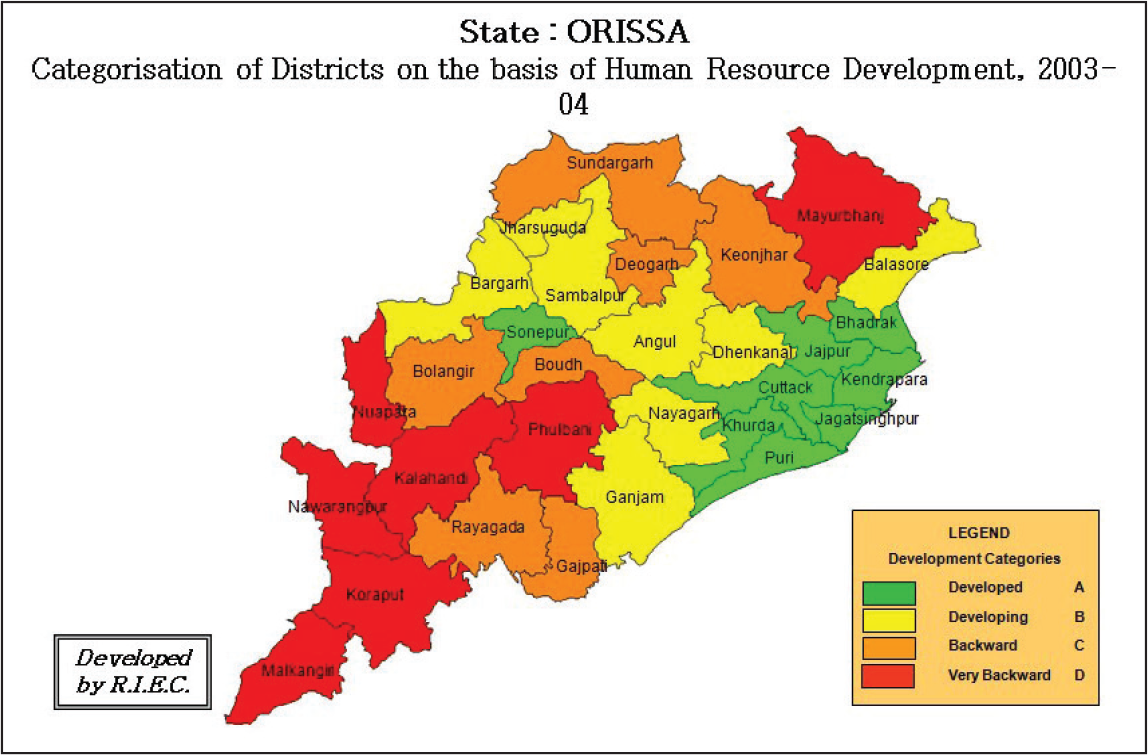
Similarly, the Regional Imbalance Inquiry commission under the chairmanship of Justice S. K. Mohanty (Retd) was constituted in 2004 to investigate the regional imbalances in development and come up with suitable measures to address it (Government of Odisha, 2008). Methodologically the commission divides the state into five geographical regions namely eastern, western, southern, northern and central 10 even though the approach of the analysis was district and block level. It used 26 indicators—within the sectors Agriculture, Industry, Infrastructure, Human Development, Macro-economic Development and the status of weaker sections. This way it reveals that the eastern or the eastern region is more ‘developed’ than the western, southern, central and northern regions in ‘overall development’ (see Figure 3) (Government of Odisha, 2008).

It is observed that in the eastern region four districts are ‘developed’ while four are in developing conditions and only one, that is, Nayagarh is under backward status. On the other hand in the western region, two districts are ‘developed’, two are ‘developing’, two are under ‘backward’ and another three districts are under the ‘very backward’ category. Again in the southern region, one district is under ‘developing’, two are under ‘backward’ and another three are under the ‘very backward’ category while in the northern region one is under the ‘very backward’ and another is under the ‘backward’ category. Likewise in the central region, two districts are enlisted as ‘developing’, one is ‘backward’ and another one is ‘very backward’ in overall development.
Similarly, in human development indicators, the report reveals that all the districts of the eastern region except Balasore and Nayagarh are in the ‘developed’ category while only the district of Sonepur from the western region and no other districts from the southern, northern and central region are under the ‘developed’ category (see Figure 4) (Government of Odisha, 2008).
It is again the same with infrastructural development where five districts out of nine from the eastern region are ‘developed’ while another two districts from the rest of Odisha are under the same category (Government of Odisha, 2008). In agricultural sector development, a large population is dependent on it but one can find six districts from the eastern, one each from the southern (Ganjam) and the western region (Bargarh) are ‘developed’ while no districts from the central and northern region are represented in the ‘developed’ category (Government of Odisha, 2008). Moreover, in weaker section development, six districts of the eastern region and one district of the central region are in the ‘developed’ category while rest of the districts are ‘developing’, ‘backward’ and ‘very backward’ categories (Government of Odisha, 2008).
Long-term Action Plan for KBK Districts
A long-term action plan with a special area development approach with an initiative of the government of India was launched from 1995–1996 to 2001–2002. The objective behind the programme was to ‘drought-proofing and the alleviation of poverty and development saturation’ of the KBK districts (KBK, n.d.). It was revised later in 1998 with an additional objective, to improve the quality of life for local people’ (KBK, n.d.). Later the programme was stopped by the central government from the financial year 2017–2018 but the state government continued the same in the name of Biju KBK Yojna as a long-term action plan with state funding. The current focus of the programme is to increase the electricity connections, road connectivity and water facilities in the KBK region (The Pioneer, 2019; Works Department, n.d.).
State Power in the Pre-Independence Era (1937–1952): An Era of Feudal Landlords
The previous sections illustrated the existing regional disparities about the eastern and western regions while the following sections elucidate the dynamics of power and politics of the state concerning it. The first era of state power after the formation of Orissa province to till independence was dominated by the feudal landlords in collaboration with the British. The first Prime Minister of the Orissa Province was the Maharaja Krushna Chandra Gajapati who was elected in 1937 for a short period due to the minority government (Bhuyan, 2010). However, there were governments formed by Raja Krushna Chandra Gajapati twice and once by Congress party. But it is interesting to note that the political parties of this period were mainly formed by the ex-ruler, except for the Congress party. For example the National Party of the Maharaja of Parlakhemundi; The United Party of (Raja) S. N. Bhanja Deo of Kanika; and the Independent Party of (Raja) Ramachandra Mardaraj Dev of Khallikote (Bhuyan, 2010). Moreover, Bhuyan (2010) further writes that due to the active presence of feudal landlords, there was no courage among common man to fight against the feudal landlords in the Congress tickets. In the second government that was formed in 1946, the same political parties led by feudal rulers participated along with another 31 representations from 26 feudatory states of western Odisha. So the number of legislators increases to 91 from earlier 60 in the second government. This was the time when Dr Harekrushna Mahata became the Prime Minister and later succeeded by Nabakrushna Chaudhury under the Congress party.
It is observed in the pre-independence era except for Congress party, all the political parties participating in the state election were formed by the respective feudal kings who were ruling for generations. Again within the congress party, mainly there was the domination of landlords and upper castes leaders like Sadasiva Das, Nabakrushna Chaudhury, Harekrushna Mahatab and others. On the other hand, with the 30 representations from all the feudal states, the pre-Independence assembly seems to be the government of the same kings and landlords. It is like an extension of the earlier feudal rule but in a new form in the British assembly system.
State Power in Post-Independence Era (1952–2020): Continuation of the Feudal-landlords Political Dynasty, Upper Castes and Eastern Domination
The post-independent politics and leadership have already undergone a journey of seven decades from the electorate of 1952. In these seven decades, the state has witnessed many regimes—their rise, fall and continuation. Many fundamental structural changes—in the economy, politics and society—have occurred from the beginning of a newly formed democratic state to the present state of 2020. There was a time at the dawn of independence where the absolute monopoly of power was exercised by the feudal landlords in the society, politics and economy but now that has transformed into a new form of ‘collaborative & sharing of power’ between feudal landlords of upper castes, with the present-day industrialist, businessman, contractor, etc., as it was argued by Chatterjee (2010) that in the political modernity the domination of earlier dominant castes groups surface on ‘building coalition and consensus making’. The new power dynamics that emerged have been greatly determined by the upper caste-class and the eastern area domination has implications on the state policies.
Continuation of the Dominance of Feudal-landlords and Present-day Political Dynasty in Odisha Politics and Leadership as a Coalition Partner
One of the characteristics of state power in Odisha is the continuation of the domination of the feudal-landlords along with other present-day political dynasties of upper castes industrialists, businessmen, contractors, etc. It is found that the pre-independence era of feudal-landlord rule continued in the post-independence era within a democratic system of party and politics and not in its previous forms. The same ex-rulers and landlords-turned-politicians continued to participate and dominate in state politics but in a coalition politics, unlike earlier unchallenged dominance. It is seen that the important leadership and political representations during the early independence to mid-1970s in western Odisha were the feudal rulers and landlords. It was dominated by the party called Ganatantra Parishad—a party founded by the ex-rulers of Patna and Kalahandi. Rajendra Narayana Sing Deo—the founder of the Ganatantra Parishad—was the last ruler of Patna state and became the chief minister of Odisha during 1967–1971. He was also the leader of the opposition from 1957–1959 and 1961–1967 and from 1972–1973 after he resigned from the position of chief minister of Odisha (Odisha Legislative Assembly, n.d.).
Similarly, in the Congress party, the early era of independence was dominated by some of the freedom fighters and Gandhian socialists like Biswanath Das, Nabakrushna Chaudhury and Sadasiba Tripathy, yet most of its leaders and workers were landlords. For instance, Dr Harekrushna Mahatab—who was chief minister in both pre- and post-independence Orissa 11 as well as the central minister from Congress party—belonged to a landlord family of Agarapada in Balasore district (Bhuyan, 2010). Nabakrushna Chaudhury—the first chief minister of independent Odisha—was also from a landlord family but due to his Gandhian thinking, he relinquished his inherited properties.
Likewise, many political dynasties of present-day state politics have a historical lineage. For instance, chief ministers of Orissa like Biju Patnaik, Rajendra Narayana Singh Deo and Nandini Sathpathy and their family members are active in the current state politics. Moreover, at the local level, landlords, kings and other political dynasties are still dominant. In this regard, Mr Deviprasad Prusti, a political activist 12 considering his experience of the last forty years says that ‘the state is ruled by only two families, namely Janaki Patnaik and Biju Patnaik one after another’ (see Table 1). Looking into the previous governments and chief ministers of Odisha the political activist says that, ‘Janaki Ballav Pattnaik was the chief minister of Odisha from 1980 to 1990 and followed by Biju Patnaik from 1990 to 1995. Then again Janaki Ballav Pattnaik returned as chief minister in 1995 and continued till 2000’. In between, there were two chief ministers, Hemananda Biswal and Giridhari Gamango, who both belonged to the tribal community from the western and the southern region respectively but they remained in the position for a short period before being removed from the position. Likewise, since the year 2000, Naveen Pattnaik, the son of former chief minister Biju Pattnaik has been the chief minister of the state consecutively for a record fifth term in 2019 with a thumping majority. He further said that ‘besides these two families there comes their followers, supporters, workers ministers, etc.,’ which he calls parisada-barga (council of ministers), gumustha (manager, personal attendant, clerk), chatukar (media and fan followers) indicating the whole network of people who are in support of the Patnaik-led government as chief minister and president of a political party.
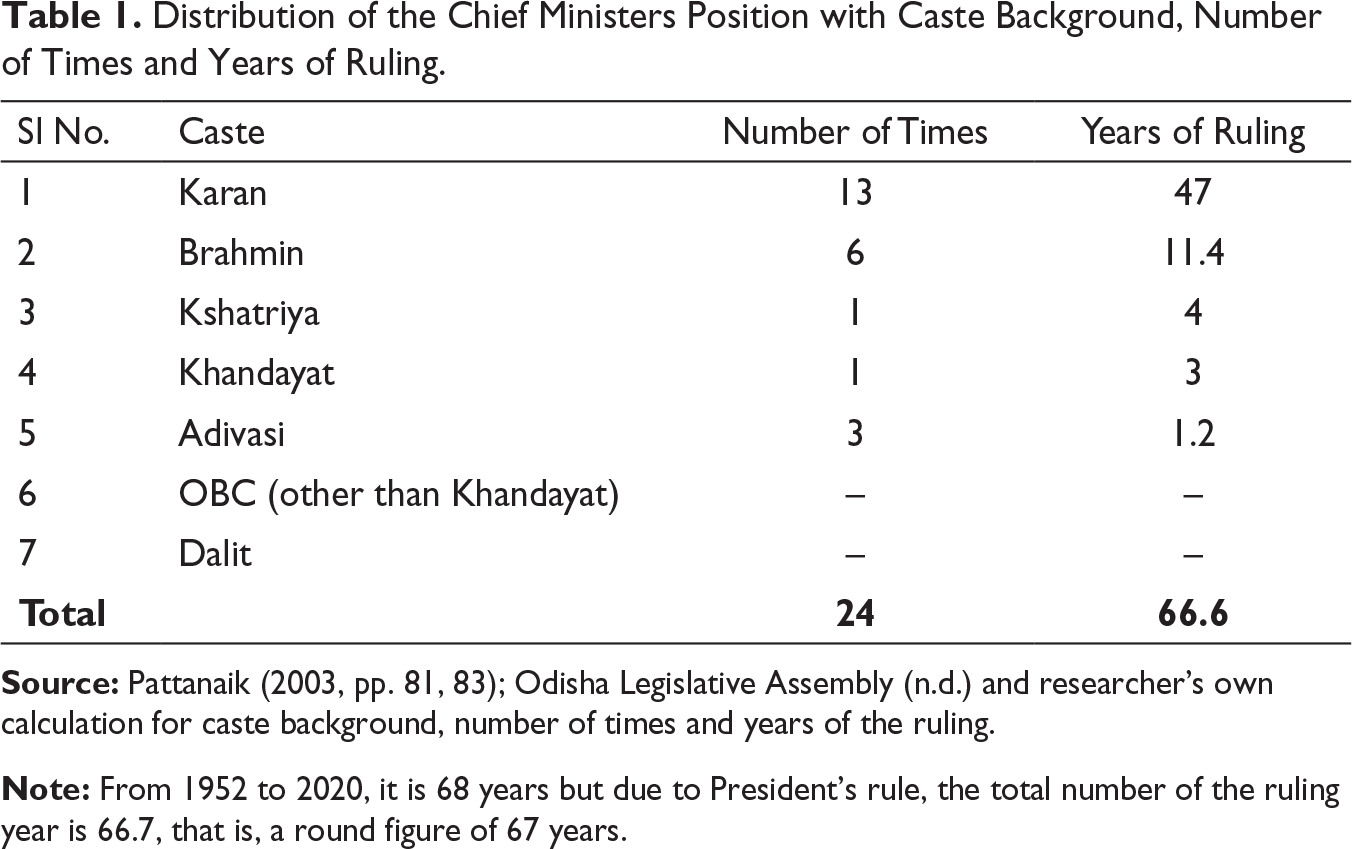
Distribution of the Chief Ministers Position with Caste Background, Number of Times and Years of Ruling.
Moreover, according to another social activist, Mr Lingaraj Pradhan, 13 ‘there has been an attempt to challenge the mainstream political power but that has not been so far successful. Leaders emerging from a resistance movement have not been able to create a space in mainstream politics and make it to leadership positions’. He further adds that, ‘those who are vocal about various local issues are not able to come to mainstream politics especially the leaders emerging from the various resistance movements. On the other hand, those who want to sustain in mainstream politics have to compromise their ideological position with their affiliated party high command and decisions otherwise no one can sustain in ongoing politics’ due to the ‘increasing role of money in politics’.
Similarly, another advocate-cum-political activist, Mr Pramod Mishra 14 also stressed in the context of western Odisha, that it is not like that new leadership is not emerging. But the domination of already existing political and feudal dynasts is so powerful that the new and dynamic leaders have not been able to emerge. According to him the role of money, muscle power and social networking play a significant role in politics and in the making of leadership where the existing political and feudal dynasts get the advantage from their earlier socio-cultural and political tradition, wealth and the prestige arising out of it.
Upper Caste and Class-dominated Politics and Leaderships
Another characteristic of politics and power of the state is the domination of upper castes and class industrialists, the king dynasty and landlords. Almost all the chief ministers in the past belong to the upper-castes community except for a short period (Table 1). It was, so far, shifting of power between the Brahmin and Karan castes irrespective of whether it was Congress- or Janta Dal- or Biju Janata Dal-ruled government. To this Mohanty (2014) argues that Odisha is under the persistence dominance of the Brahmin–Karan caste in electoral politics creating a crisis in democracy. It is seen that out of a total of 66–67 years of government rule, 13 times the chief minister has been from the Karan community who have ruled the state for 47 years constituting around 70% of the total ruling (see Table 1). Next is the Brahmin community, from which six times the chief ministers have seen ruling for a total of 11.4 years. Similarly, there was only one from the Kshatriya and one from the Khandayat community, each ruling for four and three years respectively. However, there are three times the chief minister has been from a tribal community but they have ruled altogether for only 1.2 years in total. On the other hand, there has been no chief minister from Dalit and OBC community other than Khandayats in Odisha.
The caste background of the chief minister plays a major role in the selection of his/her ministerial colleagues and the allocation of department portfolios. This depends upon the caste representation along with the factors like accommodation of the leaders from different interests and factions to balance the internal stability of the party (Pattanaik, 2003). It is further revealed that ‘from the year 1974 the ministerial position of the Khandayat community is on the upward move’ (Pattanaik, 2003). That means that joining in the dominant caste group of the Brahmin–Karan coalition, Khandayats are now making use of a new equation like Brahmin–Karan–Khandayat in Odisha politics and leadership.
To further explain the caste domination in state power, the social and political activist, Mr Lingaraj Pradhan (see Endnote 13) says that
[D]uring the movement for separate Odisha province in 1930s leaders were mainly feudal and landlords background who emerged as the first generation leaders during the British period. Again during the independence movement, another group of middle class emerged and they also came from the same ruling class of feudal and landlords family. However, in the later period, in the post-independence era, those who got first education like Brahmin and Karan caste groups occupied the politics and leadership and till now they are sharing the power with the earlier ruling class of feudal and landlords.
That means in the post-independence Odisha, leadership and political power remained in the hands of the Brahmins and Karans, like the upper-caste community which was earlier with the feudal dynasty and landlords. On the other hand, leadership from other marginalised social groups could not emerge in later phases as they did in southern India where Tamil and regional politics emerged with the participation of backward and Dalit communities in politics, or like northern India where after Mondal commission for backward classes an alternative political class emerged from the backward classes. But in the case of Odisha, so far social characteristics of the leadership have not changed in comparison to the southern and northern regions of India. The leaders emerging from a Dalit or Tribal background are because of the constitutional provision of reservation for SC and STs for the political representation. However, they became MLAs and MPs but could not rise to a state-level leadership positions or to a position whereby they could influence any policy according to their interests. That is reflected as no Dalit chief minister has been seen in the state till now. He further says that ‘there is a correlation between the interest of leadership and the nature of policy and programme to be implemented in a state’. So with the continuing pattern of leadership from a higher caste, ‘there is no possibility of having any significant change in policies with the interests of marginalised groups’. Therefore he added that with many other factors contributing to the emergence of leadership, ‘caste-based domination’ and ‘social system’ are the major factors, for which an alternative pattern of leadership has not emerged in Odisha.
These findings are complementary to the findings of Kohli (2010) that, in the southern states of India, the domination of Brahmins in politics has been challenged in the early twentieth century thereby political power in these states are in the hands of middle castes and classes and even lower classes in some cases. On the other hand in BIMARU states, the challenges to Brahminical domination are very recent.
Eastern Dominated Political Leadership
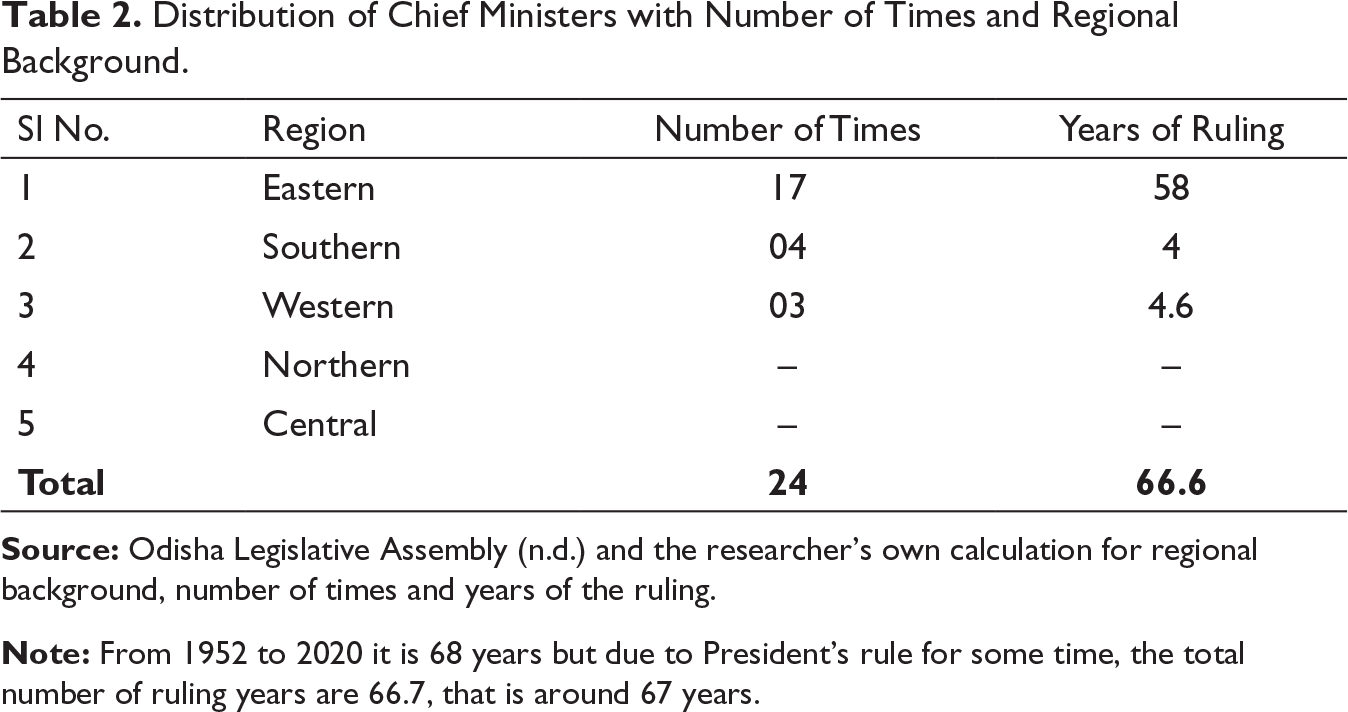
It is also seen that the politics and leadership of the state are dominated by eastern centric politics and leaders. It is observed that in the history of chief ministers, 17 of them are from the eastern regions who have ruled the state for 58 years all together while only three of them are from the western region ruling only 4.6 years in total. Similarly, from the southern region, four chief ministers are there with four years of ruling in total (see Table 2). That means no chief ministers from the western region in the past have ruled the state for a complete five-year term. The highest time ever was around four years by Rajendra Narayana Singh Deo while for Hemananda Biswal the maximum time was twice, for three months.
Distribution of Chief Ministers with Number of Times and Regional Background.
In this regard, one of the journalist-cum-social activists, Mr Saroj Mohanty 15 says that ‘eastern domination over the western and southern region existed because in the initial period of state formation the western region represented the opposition party’, that is, the Ganatantra Parishad as most of the elected representatives represented this party. Therefore, the eastern region has more voice in the government while the interest of the western region was neglected in the distribution of resources and implementation of programmes. He further says that ‘the characteristics of western leaders are the same as the leaders of eastern regions in terms of caste, class and political orientations. It is same with all kinds of western region leaders be it the one who accepted the domination of eastern leaders and established a second-class leadership in the western region or the one who rejected the leadership of the eastern leaders and dream for a separate eastern state, mainly the ex-ruler and feudal lords who continued to dominate the politics and leadership in western Odisha’.
That means, according to the journalist-cum-social activist, Mr Saroj Mohanty (see Endnote 15), the two categories of leadership that were produced from the western region in the post-independence era are similar to the characteristics of eastern leaders in caste, class and development perspectives. One category of leaders collaborated with the eastern region leaders and continued to enjoy power in the western region. They accepted the eastern leadership and established themselves as the second level of leadership. Similarly, the other group of leaders who did not accept the eastern leadership in the early post-independence era and demanded a separate eastern state are also taking the region for granted and treating it like a colony. They were mainly from the feudal/landlord categories, those that were once the rulers of feudal states and various Garjats—tributary states—of western Odisha.
One of the MLAs 16 , views the domination of eastern leaders in state power is due to the ‘location of the powerhouse, that is, the state secretariat and capital in the eastern region’. Again, an additional factor could be, all the political parties—both national and regional—are operating through the eastern region. It can be said that after the demise of the Ganatantra Parishad which was the western region feudal-based party, there is no such political party that emerged with the interest of the western region. There was a tribal-based party in the Sundargarh region but their scope was limited to only the Sundargarh region. As a result, western region leaders are bound to accept the leadership of eastern leaders. Further, it can be said that for a party ticket, as one participant 17 said, that western region leaders have to bow down to their eastern political high command. He says that ‘leaders from the western region touch the feet of eastern leaders to get a party ticket during the election’. He did not get the ticket at one point of time only because did not touch the feet of eastern leaders. He further says that there was a time when ‘party ticket was sought in favour of sex’. However, the veracity of the statement cannot be verified, but the possibility of the connection of sex and politics cannot be ruled out, seeing various incidents on different occasions. One such incident of recent times is the honey trap case of Madhya Pradesh where it is assumed that large numbers of political leaders, bureaucrats and other high-profile persons are trapped with the conspiracy of an organised sex net (The Economic Times, 2019). Moreover, he says that those who were able to give sexual favours to their senior leaders got party tickets to contest the election. However, on many occasions, there are allegations of party tickets for money, but this type of allegation has not come to public scrutiny so far.
Conclusion
There is a pattern of highly dominant, discriminatory and exclusionary nature and characteristics of state power operating in the state of Odisha (Currie, 2000; De Haan, 2004; Mohanty, 2014; Pati, 2012) with three broader distinct features like upper caste-class dominated politics and leadership; continuation of feudal-landlord and political dynastic leadership; and eastern-region dominated politics and leadership. That way there is a ‘domination of Brahmin–Karan’ (Mohanty, 2014) and ‘Khandayat’ (Pati, 2010) in the state politics and society. Hence it can be argued that there is a regular and frequent control of state power by the ‘Brahmin–Karan–Khandayat’ of eastern leaders as chief ministers and ministers. However, domination operates in collaboration with the continued upper-caste feudal and landlord rulers of the western region. The sharing of power is mediated through the caste, regional background and the possession of wealth as more numbers of chief ministers happen to be from the eastern region and upper-caste background. There is a coalition by all dominant upper castes of eastern and feudal-landlords of the western region like the dominant castes and class exercise their power through building coalitions in modern political institutions (Chatterjee, 2010).
That means the domination of ruling castes like the Brahmin–Karan–Khandayat’s of eastern region in collaboration with feudal-landlords, and present-day political dynasts of the western region have more to do with the existing regional disparities which directly influence the production and distribution of resources. Like the concept of politics of development explains, the development process involves the organisation, mobilisation and the combination of use and distribution of resources—capital, land, human beings or their combination—in new ways. However, that leads to inevitable disputes among individuals and groups or their combination on how such resources are to be used because of the calculation of gain and loss as a result of different configurations (Leftwich, 1984, 2000, 2004). That is very much relates with the Brahminical domination of earlier ruling castes in BIMARU states and the direct correlation with non-performing redistribution systems (Kohli, 2010). Therefore, it can be argued that eastern regional upper castes who dominated state power derived the maximum advantage over the western region in the creation, distribution and utilisation of state resources. On the other hand, the western region has remained under the control of upper castes feudals and landlords while sharing power with their eastern partners for self gain but did not do much for the progressive transformation in the redistribution of resources.
Footnotes
Declaration of Conflicting Interests
The authors declared no potential conflicts of interest with respect to the research, authorship and/or publication of this article.
Funding
This paper is derived from the PhD research of the corresponding author on “politics of development and regional disparities in Odisha”. Therefore, acknowledges all the supports received from the affiliated institution and the UGC-JRF.
