



Abstract
Abstract
The working population of the United Arab Emirates (UAE) in the private sector is characterized by a majority of expatriates and comparatively few UAE nationals. The UAE government encourages firms to hire Emirati nationals in the private sector through various incentives and policies. This article investigates UAE nationals’ preferences for material and non-material incentives in the workplace. The study is based on questionnaires distributed to Emirati nationals in the Emirate of Abu Dhabi. The findings of the research are expected to provide policymakers with insights into Emiratis’ preferred work incentives. In addition, it will, it is hoped, aid in developing appropriate nationalization policies for the UAE in general and UAE private organizations in particular.
Introduction
The United Arab Emirates (UAE), one of the Gulf Council Countries (GCC), is characterized by several economic and demographic factors shared by other GCC countries. The population’s per capita income from gross national product (GNP) is among the highest in the world. In addition, the population is characterized by the high proportion of expatriates in the total population. The oil revenue enabled a state welfare umbrella in health, education, and housing, among other things. However, the unemployment rate among nationals is considered a problem that has drawn the attention of several GCC states. National job seekers prefer the stability, security, and perquisites of governmental jobs (Mellahi, 2007). Moreover, the private sector firms prefer expatriates who ask lower wages than nationals demand. The government has taken several initiatives to encourage, and in certain cases enforce, the hiring of more UAE nationals in the private sector. Among these initiatives, it sets quotas in this sector for nationals (Mellahi, 2007).
UAE nationals nonetheless constitute a very low percentage of the workforce in the public sector and are almost invisible in the private sector, while facing a high unemployment rate. This recurrent unemployment occurs due to oil exploitation, which caused a massive influx of resources that have largely bypassed the social and economic development of the Emiratis and now, in a single generation, are imposing a world-class economy upon traditional Arab lands (Al-Qudsi, 2006). UAE nationals’ increased participation as workers is crucial for the country’s overall development. The UAE urgently needs to develop strata of commercial leaders and a supply of qualified and committed industrial professionals in finance, management, HR, IT, corporate governance, accounting, marketing, and other areas of paraprofessional support for corporate activities.
Literature Review
The literature of incentives in the workplace is rich in terms of quality and quantity because the studies in this subject started from the appearance of the behavioral school. Studies of incentives have contributed significantly to the localization of jobs in the GCC in general and in the UAE in specific, but it is still rare qualitatively and quantitatively. The study by Barhem, Younies, and Smith (2011) discusses the anticipation of future demand for managers’ skills in the UAE; it reveals that the most required attributes for UAE managers are a strong desire to go overseas, specific knowledge of overseas culture, the ability to adapt to time differences, and the capacity to deal with expatriate work assignments. From the standpoint of the UAE’s 2030 vision and the knowledge-based economy, such attributes would help diversify the economy to move from being exclusively oil-based to being global. Emiratis greatly prefer public sector employment over work in the private sector, with its English speakers, advanced technical skills, experienced workers, and very long working hours. Moreover, the public sector offers generous pay (Abdelkarim, 2001; Guang, 2002).
Since the enrichment of the UAE, it has been supporting children by free public education from primary school to university. The UAE University in Al Ain opened in November 1977 and by 2004 had 20,000 graduates in addition to other graduates from other public and private academic institutions. As a small nation, the UAE, despite its high development, is experiencing very low national participation. The reasons lie in the transitional phases that it has gone through, as follows.
“Major Influx”: From the early 1970s, when oil revenues supported infrastructural development, for almost a decade. “Asian Presence”: A sharp decline in oil prices during the 1980s, which acted as a cost-cutting measure until almost the mid-1990s. “Open Door Policy”: By attracting non-national labor, the policy played an important role in diversifying the economy from depending on oil production to service industries.
Localization is a term used in GCC countries for policies leading to the national replacement of non-national labor by nationals (Al-Enezi, 2002; Kapiszewski, 2000). In the UAE, it is termed Emiratization. This process consists of a national making a successful transition to a position previously occupied by a skilled non-national. In 2005, the number of UAE nationals who were unemployed reached 33,500, representing 9 percent of the workforce (Tanmia, 2005). As summarized by Moore (2005), the highly complex issue of localization involves the following difficulties:
1. The primary reasons according to various researchers who have reported on the inability and ineffectiveness of localization are a. Inappropriate education disciplines; b. Inadequate training systems; c. Compatibility of education with local labor market requirements; d. Skill mismatches. 2. The wages for a non-local are much lower than for a national. 3. Terminating the work contracts of non-performing expatriates is easier than fighting the protracted appeals processes for nationals. 4. Nationals find it hard to integrate with a multicultural private sector workforce. 5. Nationals find it hard to be in a minority in their own country. According to “Citizens and Expatriate Statistics based on Censuses,” only 20 percent of the total population of the UAE consists of nationals.
The study by Younies, Barhem, and Younis (2010) investigated how the medical sector employees in the private and public health sector in the UAE view the reward and recognition (RR) systems. Two lists, comprising 26 major approaches to RR, were prepared and its items prioritized by taking inputs from 250 employees working in more than 30 different public and private healthcare organizations in the UAE. The results show the ranking of non-material forms of reward and recognition: the UAE perspective revealed that pay and performance ranked first, training and education in second place, and opportunity to use new technology ranked third. Additionally, the study reveals that UAE healthcare workers prefer material rewards.
The study by Islam and Barhem (2007) revealed that high wages and good working conditions are similar in the preferences of the employees in UAE and Malaysia, where this item took first place.
It is more likely that many of the government agencies concerned lacked accurate information about the age of the unemployed nationals or the sectors in which they work (Rutledge, 2010). Possible reasons for this are as follows:
The job-seekers’ allowance system is standardized. Public-to-private employment ratios are hard to determine, since some private sector companies are in fact partially state-owned. The data related to the unemployment level among nationals are not regularly collected or standardized. The strategies for economic diversification confuse the statistics. The labor-nationalization (localization) policies confuse the statistics.
GCC National Employees’ Ratios per Industry
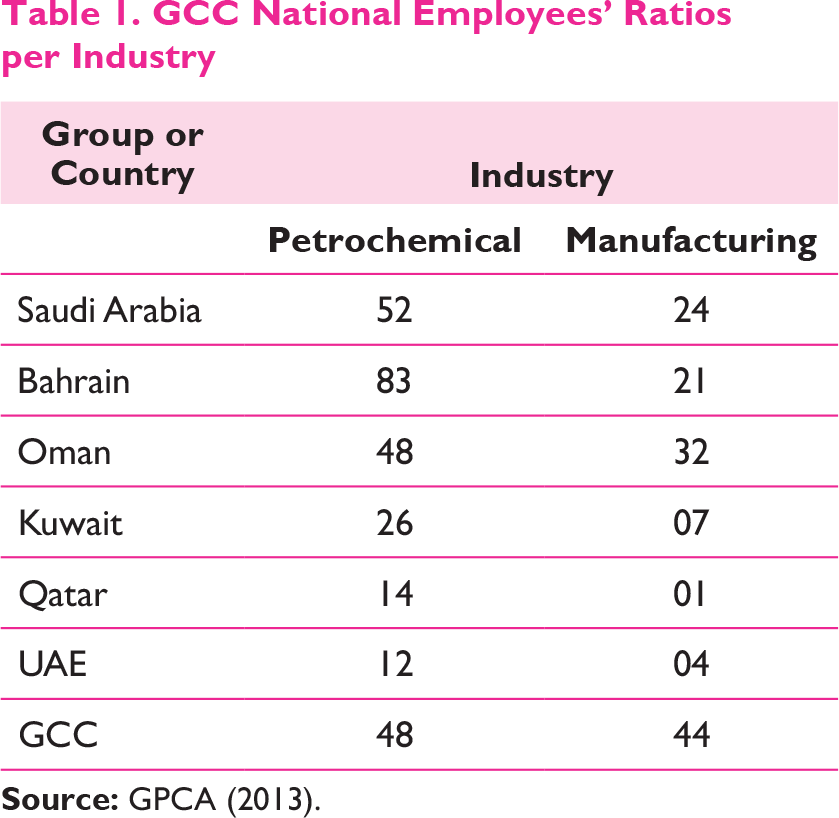
It is clear from Table 1 that the UAE has wide scope in both the petrochemical and manufacturing industries to increase the participation of its locals.
The UAE decided that any company with over 100 employees would be required to hire an Emirati as its HR manager. But in fact nationals not only share a negative perception of their fellow citizens but also, in many cases, they were more likely to choose an expatriate HR manager than a local candidate.
The most recent data on unemployment, published in 2011, indicate that the national unemployment rate in the UAE was 13.8 percent of the total national workforce, with 2.0 percent of its national males and 12.0 percent of its national females unemployed.
The labor nationalization program has, even so, increased the female participation in the workforce. Most of the UAE workforce is attracted to public sector jobs by the prospect of
Higher remuneration; Better working conditions; Job security; Short working hours; Generous vacations.
Emiratization as a policy began with structural reform in the education sector, through education to employment transit programs. The UAE Ministry for Labor and Social affairs has initiated funding to the private sector to encourage the employment and training of UAE nationals. In addition, the new regulations for national military service aim to prepare the UAE’s young citizens to be ready for the labor market and to motivate them to develop their skills and knowledge by creating categories in military service based on educational levels.
The Abu Dhabi Tawteen Council (ADTC) was established by HH Sheikh Khalifa Bin Zayed Al Nahyan as a government entity in December 2005. It reports to the Abu Dhabi Executive Council, the local executive authority of the country. The major objective of this council is to match the qualifications and skills of the national job seekers with the career requirements and needs of the Abu Dhabi labor market, and it presents a unique mixture of nomination and employment services as follows.
Helping UAE nationals aged between 16 and 60 who seek jobs in Abu Dhabi. Monitoring and analyzing the recent and future Emiratization challenges concerning human capital and employers in order to enhance Emiratization. Contributing to the continued social and economic development in the Emirate.
The vision of ADTC is “Emiratis to become the first choice of employment in Abu Dhabi” while its mission is “To ensure the full use of Emirati potential human capital for Abu Dhabi’s social and economic development through:
employment and up-skilling services for Emiratis in Abu Dhabi; development of Abu Dhabi labor market intelligence and policy-making.”
Hofstede (1984) has argued that Middle Eastern culture has its own characteristics, which affect business activities at both individual and organizational levels. The UAE element in Middle Eastern culture is characterized as follows:
PDI: High in power distance with a score of 90 means that power is equally distributed, centralization is popular, and with autocratic leadership subordinates are expected to be told about the job to be done. UAI: High in uncertainty avoidance with an 80 score reveals that the country prefers to avoid uncertainty. The population has an emotional need for rules, is hardworking, and resists innovation. INV: With a score of 25, the UAE is considered a collectivist society. More than group culture, in-group culture is active. Superior and subordinate relations are more likely to be perceived in moral terms. MAS: With a score of 50, the UAE is neither a masculine society nor a feminine society. It has elements of competition, achievement, and success along with the care for members of society and concern for the quality of life. LTO: At the latest update, the score for long-term orientation was not available for the UAE. It is not yet clear how its society must maintain its link with the past to deal with the challenges of the future as well as the present. IND: Even on indulgence, the UAE has yet to score. The UAE’s level of control over desires and impulses is still under study, as part of the latest scoring of Hofstede’s cultural dimension. Maybe this is the latest inclusion in the cultural dimensions as of 2011.
On January 11, 2011, unemployment among Emiratis had reached 13 percent of all UAE nationals. Analyses of the policies of the Federal Authority for Human Resources (FAHR) by the Federal National Council’s health, labor, and social affairs departments have accompanied these reports. Unemployment in the age group 15–24 was estimated at 23.1 percent. The committee’s report also revealed that the number of Emiratis in federal government jobs was too low compared to the number in local governments.
The managing director of the Dubai recruitment company Iris Executives, specializing in Emiratization, said that mandatory national service would boost the employability of young Emiratis in the private sector most of all.
In countries that have been exercising compulsory national service, the government has a strong shaping power in the lives of youth. It acts as a big brother that teaches youth discipline, teamwork, hard work and good attitudes. I suspect most youth will come back with a different outlook on life … In the long term, I think the market will benefit from more mature Emirati youth, with real life experience after their national service, which should make them more in line with market needs. (quoted in Croucher, 2014)
The organizations in the UAE can be classified as public, private, and semiprivate, that is, those where the government has ownership. This study aims at shedding light on Emiratis’ work preferences from intrinsic and extrinsic factors (Herzberg, 1966). The authors believe that knowing these preferences will help policymakers to create work policies that would increase retention rates and reduce turnover. In addition, enforcing such policies in the private sector will lead qualified people to view jobs in the private sector and the public sector as equally attractive.
The Objectives of the Study
It is crucial for the UAE decision-makers to strengthen and support job localization in the country. One of the mechanisms that they can adopt is to detect the most motivating factors for attracting young Emiratis to work in the private and public sectors. This article aims to investigate UAE nationals’ preferences for material and non-material incentives in the workplace, and to develop appropriate nationalization policies for the UAE in general and UAE private organizations in particular.
Methodology and Results
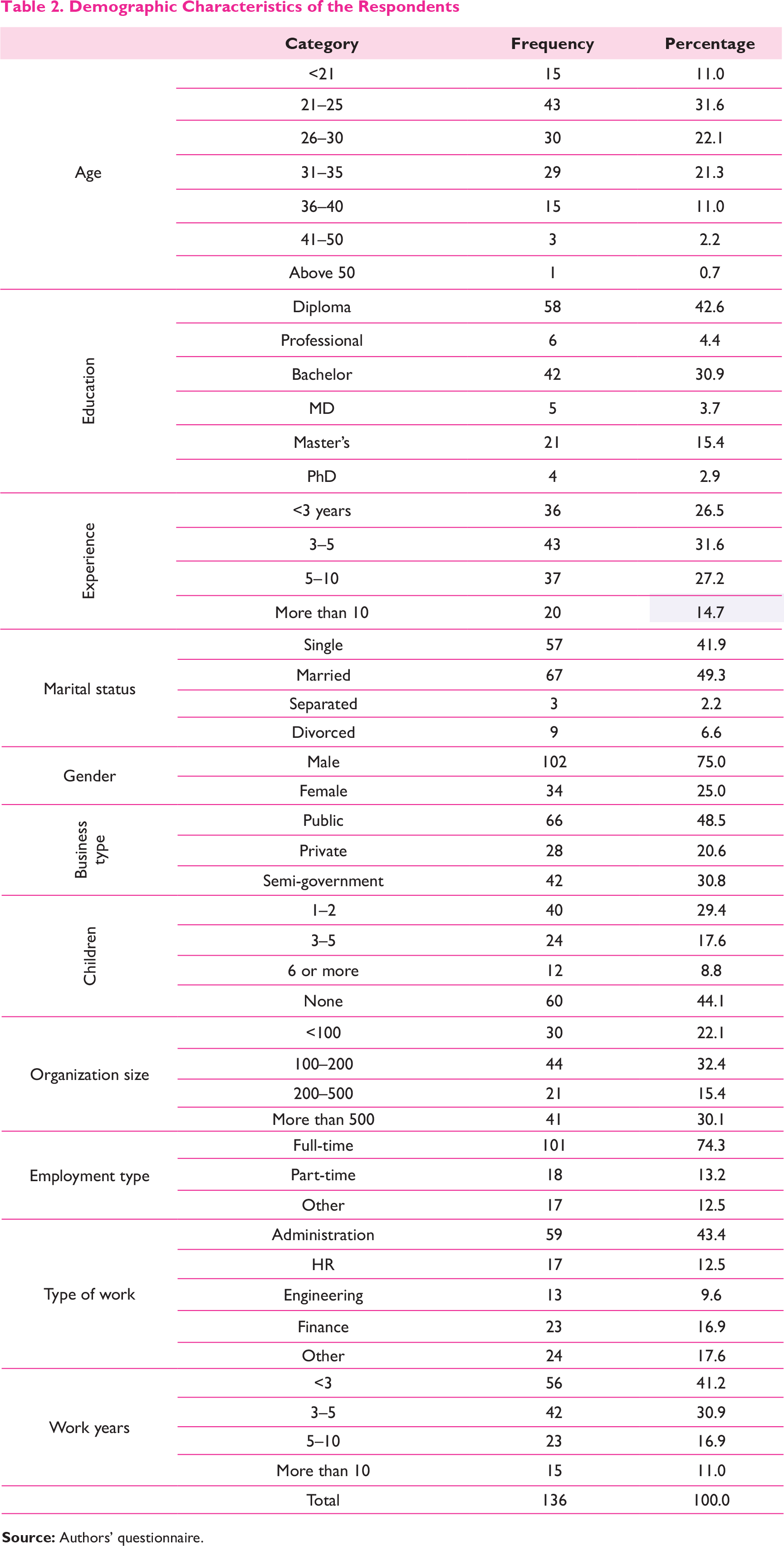
Demographic Characteristics of the Respondents
Ranking of Non-material Items

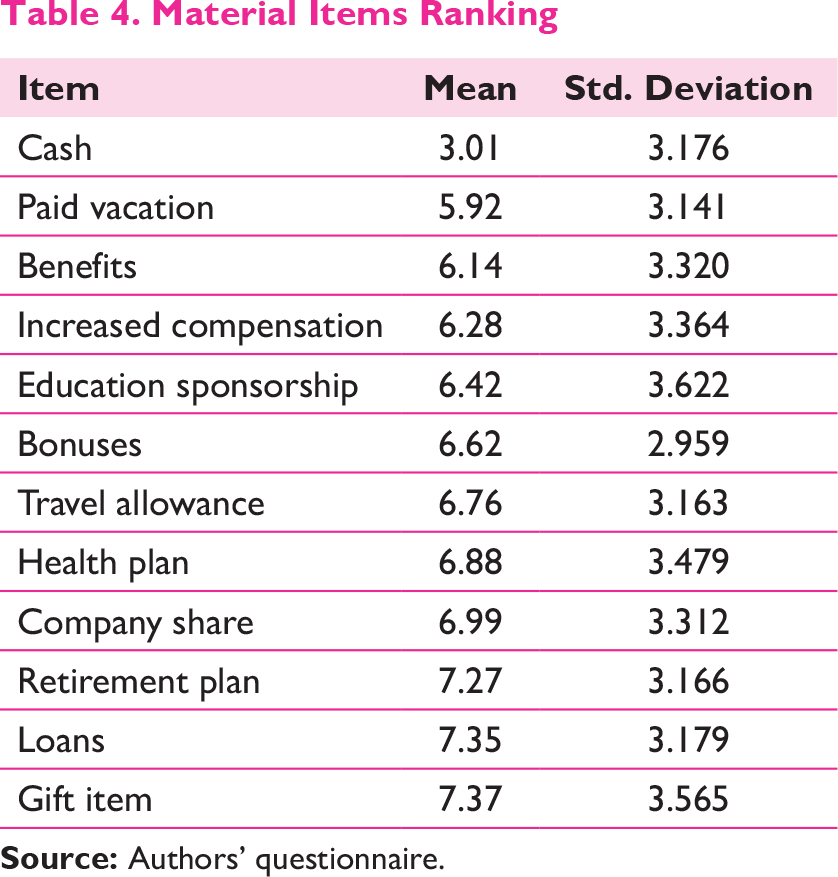
Material Items Ranking
Items with Group Difference

Conclusions
This study ranked the material and non-material incentives for Emirates nationals at work. The study found that cash is a major incentive among the material items, with no differences on the basis of education, gender, and so on, while among the non-material items power in the job ranked highest.
The study reveals significant difference in some items based on the length of experience, type of job, and other features. Since the government is trying to make the private sector more attractive, the items with significant differences between the public/private and semi-government categories need to be studied further. This study will help decision-makers streamline policies that reduce the difference in these items in such a way that the public and private sectors will hold the same appeal for Emirati nationals. Additional studies and research can help to categorize the most attractive jobs in the private sector which can offer more such incentives. Additionally, the future employment policies and human resource development strategies in the UAE could shed light on the results of our study.
Implications of the Study
The results of this study can help the decision-makers in UAE by offering insights into the tools to motivate Emirati young people to join the private sector by developing policies and programs to create a positive work environment which can satisfy their expectations of a future job. The UAE government applies many related mechanisms, and it is hoped that our study will contribute positively to sustaining and developing these mechanisms.
Limitations and Suggestions for Future Research
The major limitation in this study is the limited number of Emirati employees in the private sector who were surveyed; this limited our ability to reach a full sample. Future researchers can use the results of our study to investigate more variables that might attract Emirati job seekers to join the private sector or, for example, to create jobs by developing small and medium-sized enterprises (SMEs).
Future research can focus on adopting the results of this study and other related studies to develop an optimum model for the hire of Emirati job seekers in the private sector. The number of Emirati job seekers will not fill all the vacant jobs, but the model can help to direct the job seekers toward organizations which can satisfy their needs more.
Footnotes
Author’s Biography