



Abstract
Abstract
The study was carried out to examine the level of work engagement and whether socio-demographic and job-related characteristics influence work engagement level of Indian business executives. Study variables included gender, age, education, income, nature of organization, position in organizational hierarchy, and job tenure. A total of 404 business executives from select public and private sector organizations in India participated in the study. The study results suggest above-average level of work engagement among Indian business executives. Findings also suggest that there are significant differences in the work engagement level of employees with different demographic and job characteristics, such as age, nature of organization, position in the organizational hierarchy, income, etc. However, gender, education, and organizational tenure failed to contribute to our understanding of work engagement. By examining the level of work engagement among select Indian business executives and how it varies with respect to various socio-demographic and job-related variables, the study adds to the scarce literature on employee engagement, especially in Indian context, where little work has been undertaken in this direction.
Introduction
Globalization has turned entire globe in one entity for trade and commerce, investment of capital, movement of people-students, businessmen, and experts. Knowledge and technology have expanded manifold and their transfer and use have acquired global dimensions. In addition to various opportunities, these changes have brought tremendous challenges to both the country as well as individuals (Singh, 2010). The workplace environment and the nature of employment have changed significantly. In such an extremely turbulent and competitive business environment, characterized by uncertainty and ambiguity, employers are continuously struggling and searching for the ways to remain in competition (Chaudhary, 2005). In such an environment, the main concern for the organizations today is how to achieve and sustain significant competitive advantage (Colan, 2009).
With complexity flooding into every aspect of business, the traditional four P’s of business have become less important and a fifth P—people—has become increasingly important as a competitive factor (Colan, 2009). It is the people and the passion with which they perform that provide an organization an edge over others. How to ignite the passionate performance for organizational excellence? In this context, the phrase employee engagement has received a great deal of attention in recent years from the practitioner community, especially the consulting firms.
The challenge before HR managers is not only to attract or retain the talent but also to make them engaged in their work. Martel (2003) is of the opinion that, ‘in order to obtain high performance in post-industrial era, intangible work that demands innovation, flexibility, and speed, employers need to engage their employees’. A large number of research studies have related employee engagement with job satisfaction (Alarcon & Edwards, 2011; Saks, 2006), enhanced commitment (Halbesleben, 2010), discretionary effort (Bakker, Demerouti, & Verbeke, 2004; Gierveld & Bakker, 2005; Saks, 2006), lower absenteeism and turnover rates (Alarcon & Edwards, 2011), financial returns (Xanthopoulou, Bakker, Demerouti, & Schaufeli, 2009), greater business unit performance (Harter, Schmidt, & Hayes, 2002), and proactive and innovative behavior on the part of employees (Salanova & Schaufeli, 2008; Slatten & Mehmetoglu, 2011). Employee engagement, in fact, can make or break the bottom line (Lockwood, 2006).
Engaged employees are not only an asset for an organization but also tend to be less stressed, more satisfied with their personal lives, use less health care, and take fewer sick days than employees who are actively disengaged (Garrosa, Moreno-Jimenez, Rodrıguez-Munoz, & Rodrıguez-Carvajal, 2011). Thus, engagement has its benefits for both the organization and the individual.
The literature clearly establishes the importance of engagement for valued organizational outcomes. Since most of the research around work engagement has come from developed Western nations, such as Netherlands, Finland, and Canada, little is empirically known about the concept in Indian context. Despite the growing number of empirical studies on work engagement in developing countries, there is a lack of sufficient academic research to explain the status of work engagement in emerging economies.
Employee Engagement
Different scholars have defined engagement in their own ways with no consensus seems to be emerging over a single meaning of the construct, which has cluttered the understanding of the concept (Welch, 2011). The origin and emergence of work engagement literature could be traced back to the work of Kahn (1990). Kahn in his qualitative work on engagement defined personal engagement as ‘the harnessing of organization members’ selves to their work roles’ and he further adds, ‘in engagement, people employ and express themselves physically, cognitively, and emotionally during role performances’ (Kahn, 1990, p. 694). Burnout researchers define engagement as the positive antipode of burnout (Maslach, Schaufeli, & Leiter, 2001). The present study develops on the notion of engagement given by Schaufeli, Salanova, Gonzalez-Roma, and Bakker (2002) where engagement is defined as
a positive, fulfilling, work-related state of mind that is characterized by vigor, dedication, and absorption. Rather than a momentary and specific state, engagement refers to a more persistent and pervasive affective cognitive state that is not focused on any particular object, event, individual, or behavior
Vigor is characterized by high levels of energy and mental resilience while working. Dedication indicates a sense of significance, enthusiasm, inspiration, pride, and challenge. The final dimension of engagement, absorption, refers to degree of concentration and engrossment in one’s work.
Recent studies have revealed that the academic concept of engagement as opposed to practitioners’ use of the term differs both conceptually and empirically from the related concepts, such as job involvement and organizational commitment (e.g., Hallberg & Schaufeli, 2006; Schaufeli & Bakker, 2010). This stream of researchers have provided persuasive substantiation for uniqueness of the engagement concept and has established it as a meaningful construct worthy of serious research attention (Christian, Garza, & Slaughter, 2011; Schaufeli & Bakker, 2010).
The engagement level of employees is affected by a variety of factors. A number of studies have highlighted the importance of creating the conditions for engagement. Why is it that some employees are more engaged than others?
A number of studies have looked into how individual or job characteristics influence work engagement. However, only a few of them have made an attempt to explore socio-demographic differences in work engagement profiles of the respondents. As a result, the link between demographics and work engagement has largely been cloudy.
Socio-demographic Characteristics and Employee Engagement: Conceptual Framework
Increasing diversity at the workplace brings along with it a different set of challenges. Different demographic groups have different needs, wants, and priorities. The traditional blanket approach followed by employers where all employees were treated similar to each other in terms of their needs and demands will not work with such a diverse workforce. In most of the research works around work engagement, a diversity neutral stance has been assumed ignoring the issues of gender, age, education, religion, and class. Demographics can have influential impact on work engagement (Robinson, 2015). Thus, it is important to appreciate the impact of demographics while studying employee attitudes (Balain & Sparrow, 2009). Truss (2014) highlighted the potential for future research in this area.
In a survey on global employee engagement, Business World (2008) reported differences in engagement level of employees with different biographic and job characteristics. Also a research carried out by Institute for Employment studies (as reported by Robinson, Perryman, & Hayday, 2004) in 2003 in 14 organizations demonstrated the impact of biographical and job characteristics on employee engagement. In addition to demographic factors, differences were found in the engagement level of employees from different sectors and industries. The work engagement was also found to differ across the levels in the organizational hierarchy. Literature, however, presents mixed evidence with respect to the influence of various demographic factors, such as gender, age, education, tenure, position, and income, on employee engagement. In order to manage a multigenerational workforce, it is important for an employer to understand the needs and expectations of different age groups. The strategies for engaging different cohorts may not be same. In an era which presents equal opportunities for men and women in organizations, it is important to determine whether these demographic variables play a role in determining engagement level of employees.
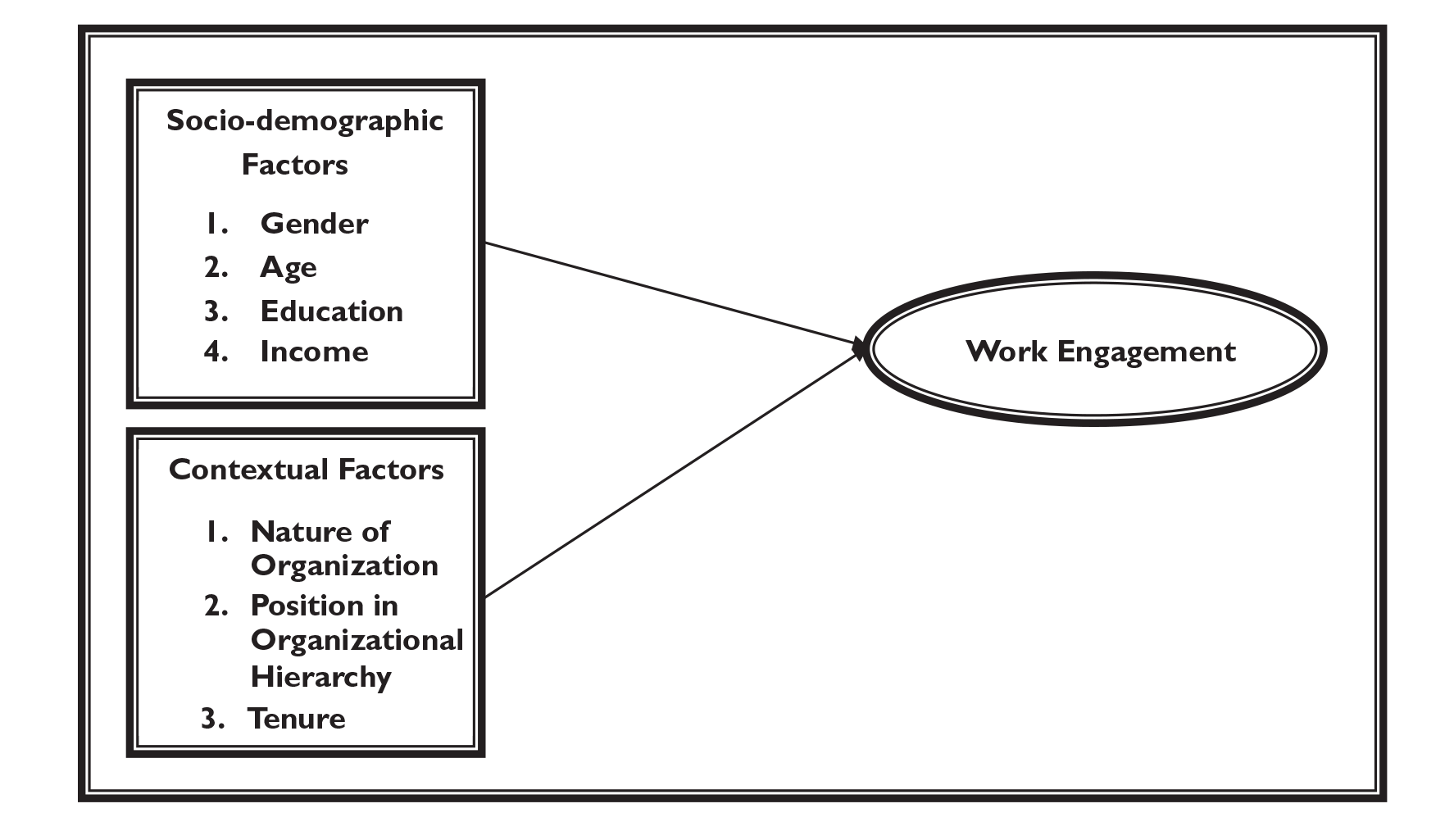
Although very salient for workplace behavior, socio-demographic and contextual factors are not studied under primary objectives and are undermined in discussion. To fill this gap and add to the growing body of knowledge on employee engagement in developing countries, the current study attempts to investigate the level of work engagement among Indian business executives and examine the impact of largely ignored socio-demographic and contextual characteristics on work engagement. Specifically, the present article aims to examine the impact of gender, age, education, tenure, position in organizational hierarchy, nature of organization, and income on work engagement levels of Indian business executives.
The following section examines and presents the relevant literature relating various socio-demographic and contextual factors with work engagement.
Review of Literature and Research Questions
Gender
The literature has largely remained inconsistent with respect to relation between gender and work engagement with some studies reporting higher engagement for women, some for men, and others reporting no differences at all. For instance, Schaufeli, Bakker, and Salanova (2006) in their scale validation study from nine countries reported weak and ambiguous relationship between gender and work engagement. For some countries, no correlation was observed, for some men were found to show higher engagement than women and reverse was true for others. However, for the overall sample, no significant differences were found in the work engagement levels of men and women. Mostert and Rothmann (2006) also reported no significant association between gender and work engagement in their study on South African police service officers. Coetzee and Rothmann (2005) also found no significant correlation between gender and work engagement in their study among employees of a higher educational institution in South Africa.
Wissing and Van Eeden (2002) reported significant differences in the psychological well-being of men and women. At the same time, it has also been reported that women displayed slightly higher level of exhaustion than men (Johnson, 1991; Maslach et al., 2001). Men were found to show relatively higher level of depersonalization (Maslach et al., 2001) and mental distance (Johnson, 1991) than women. According to Hobfoll (1989), this could be due to less accessibility of resources to women which could help them buffer stress and maintain wellness.
On the other hand, there are studies where women were found to display higher engagement levels than men (Avery, McKay, & Wilson, 2007; Coetzee & de Villiers, 2010; Mauno, Kinnunen, Makikangas, & Natti, 2005; Rothbard, 2001). For instance, Avery et al. (2007) in their research on UK employees reported higher level of work engagement among women when compared to men. Further, Coetzee and de Villiers (2010) in a study among employees of a South African financial institution reported significant differences in the work engagement levels of men and women employees. Women were found to score significantly higher than men on dedication, absorption, and overall engagement.
Age
Research evidence with respect to relation between age and work engagement have also been mixed. Schaufeli and Bakker (2003) in their multi-country study on testing the psychometric properties of Utrecht Work Engagement Scale (UWES) reported no significant correlation between age and work engagement for the overall sample. However, for separate samples from nine countries, mild positive correlation was observed between work engagement along with its all three dimensions and age. Thus, no strong and systematic relation between age and work engagement was witnessed as the size of the correlation (r < 0.020) was very small. Coetzee and Rothmann (2005) also found no significant differences in the work engagement levels of employees of different age groups.
Wissing and Van Eeden (2002) reported differences in psychological well-being for different age groups. Younger individuals were found to display lower level of psychological well-being than older ones. At the same time, younger employees have been repetitively shown to display higher levels of burnout than the employees in their late 30s and 40s (Maslach et al., 2001; Schaufeli & Enzmann, 1998). Mostert and Rothmann (2006) also reported significant positive association between age and work engagement in their study on 1,794 South African Police service officers. Further, Coetzee and de Villiers (2010) found that different age groups differ significantly with respect to only absorption dimension of work engagement. Absorption levels for employees in the age group 26–40 and above 40 were significantly higher than those for younger employees (age < 25 years).
On the contrary, Avery et al. (2007) in a study among UK employees reported that engagement decreases with age, that is, younger employees displayed higher engagement levels than the older ones. Further, Robinson, Hooker, & Hayday (2007) conveyed that engagement is highest among younger (age < 20 years) and older employees with a decline in the mid-career.
Education
Employees with more education can be assumed to display higher levels of engagement as they may have obtained an employment of their choice which they may find more psychologically meaningful (Avery et al., 2007). Vanam (2009) reported positive correlation between education and job engagement, that is, the more the respondents were educated, the higher their work engagement. However, Avery et al. (2007) failed to find any significant relation between education and work engagement.
Tenure
A number of academic and practitioner studies have reported inverse relationship between tenure and work engagement (Avery et al, 2007; Buckingham, 2001; Robinson et al., 2004), that is, engagement tends to decline with increasing organizational tenure. For instance, Coetzee and Rothmann (2005) in their study among employees of a higher educational institution found that employees with less than 5 years of work experience scored significantly higher on vigor dimension of engagement as compared to employees with more than 10 years of experience. Avery et al. (2007) found that employees with higher organizational tenure were less engaged than those with lower organizational tenure. Workers in the same organization for long are more likely to become stagnant and complacent which perhaps could be the reason for their low engagement. Also, with the increasing tenure, employees get more time and opportunities to experience disappointments and contract breaches which result in lower engagement levels (Deery, Iverson, & Walsh, 2006; Montes & Irving, 2008). New recruits may have better perceptions of the organizational life due to novelty effect, whereas individuals with longer tenure in the organization know more about the organizational loopholes and are likely to assess the organization more cynically.
On the other hand, Xu and Cooper-Thomas (2011) did not find any significant association between tenure and engagement. Robinson et al. (2007) is of the view that engagement varies with the length of service in organization depending upon the kind of experiences provided by the organization.
Nature of Organization
Since there are significant differences in the working of public and private sector business organizations, it becomes important to study the engagement level of employees in these different working environments. However, in the findings of the literature review by Scottish executive (2007), no discernible differences were observed in the dynamics of employee engagement between public and private sectors. Engagement level in government organizations was found to be considerably low when compared to high-tech and service-focused private organizations (Business World, 2008).
Position in Organizational Hierarchy
Autonomy and control have been found to relate positively with work engagement (Hallberg & Schaufeli, 2006; Salanova, Agut, & Peiro, 2005). Individuals higher up in the organizational hierarchy have greater autonomy to decide their flow of work and are more likely to have interesting and challenging role assignments. Senior executives in the organization are in a position to make meaningful and significant contribution to the organizational performance. Hence, executives at higher level in the organization can be expected to express themselves in more meaningful ways and display higher level of engagement (Robinson et al., 2004; Kahn, 1990; Xu & Cooper-Thomas, 2011). Also, employees at higher levels in the organization have greater access to organizational information and hence are likely to develop feelings of ownership and hence show higher engagement. The literature has found consistent support for the same. For instance, in a survey by Business World (2008), people higher up in the organizational hierarchy were found to experience higher work engagement. Avery et al. (2007) in their study on UK employees reported higher work engagement among executives and supervisors than lower level rank and file employees. Xu and Cooper-Thomas (2011) also reported positive association between organizational level and engagement. Further, Robinson et al. (2007) stated that engagement is highest among managers and is lowest for back end staff. Furthermore, Vanam (2009) found positive correlation between job level and job engagement, that is, the higher the respondents were placed in their jobs, the higher was their work engagement. In general, managers and professionals were found to display higher engagement levels than their contemporaries in supporting roles (Scottish executive , 2007).
Income
The relationship between income and work engagement has rarely been examined in the literature. In the present article, we propose to test whether engagement level varies by income based on the argument that employees receiving higher income and benefits may perceive their organization as valuing their contribution. Hence, based on social exchange theory, employees may like to reciprocate by being more engaged in their work.
Based on above literature review, the current research examines the following research questions:
Q1. What is the level of work engagement among Indian business executives? Q2. Are there any differences in work engagement levels of men and women business executives? Q3. Does age has a role in determining work engagement? Q4. Does education has a role in determining work engagement? Q5. How does tenure influences work engagement? Q6. Are there any differences in the work engagement levels in public and private organizations? Q7. Are there any differences in the work engagement levels of executives at different job levels in the organizational hierarchy? Q8. How does income influences work engagement?
Figure 1 presents the hypothesized research model proposed in the study.
Methodology
The Sample
Demographic Profile of the Sample

Measures
Work engagement (WE) was measured using UWES developed by Schaufeli et al. (2002). The scale consists of three subscales; vigor (six items; Cronbach’s alpha: 0.726), dedication (five items; Cronbach’s alpha: 0.745), and absorption (six items; Cronbach’s alpha: 0.766). The Cronbach’s alpha for the overall scale was found to be 0.893. All the 17 items were rated on a five-point frequency-based scale (1 = never, 5 = A = always).
Data Analysis
Data were analyzed using statistical software SPSS 20. T-test, analysis of variance (ANOVA), post hoc tests, and correlation analysis were used to analyze the data.
Results and Discussion
Our first research question pertained to examining the work engagement level among select Indian business executives. Table 2 presents the mean, standard deviation, and inter-correlations among overall work engagement and its three dimensions, that is, vigor, dedication, and absorption, for the study sample. Inter-correlations among work engagement dimensions varied from moderate to high. Descriptive statistics analysis revealed a mean score of 3.98 for overall work engagement which signals toward an above average level of work engagement among respondents. As can be observed, Indian business executives displayed slightly higher level of vigor when compared to other two dimensions of engagement. Executives were found to display almost the same level of dedication and absorption. This answers our first research question.
Descriptive Statistics and Inter-correlations for Work Engagement

These findings are in line with findings of some of the previous studies where no relation was observed between gender and work engagement (Coetzee & Rothmann, 2005; Mostert & Rothmann, 2006). However, it contradicts the findings of the studies where men and women were found to differ in their engagement levels (Avery et al., 2007; Coetzee & de Villiers, 2010; Mauno et al., 2005; Rothbard, 2001). These differences in findings could be attributed to different cultural context and the stage of economic development of the country in which the study was conducted. Also, the values of male and female are more likely to be similar in the present study which consisted of educated workforce with graduate, postgraduate, and PhD degrees unlike prior studies where sample was drawn from population in general.
Impact of Gender and Nature of Organization on Work Engagement

The results are in line with the findings of HR special survey by Business World magazine where they reported a low engagement score in the government sector in almost every country (Business World, 2008). At the same time, our results contradict the findings of Scottish executive where they observed no significant difference in the engagement level of employees in public and private sectors. According to their report, it is the organizational characteristics which govern the difference in engagement levels irrespective of the sector to which the organization belongs. Also, they reported that differences in public and private sectors have nothing to do with how engagement works. The performance of public sector was reported to be weak in the areas critical for employee engagement, such as strategic vision and change management (Scottish executive , 2007).
Influence of Age, Education, Tenure, Position, and Income on Work Engagement

Post hoc comparisons using the Turkey honest significant difference (HSD) test indicated significant differences in mean absorption scores of executives with age less than 25 years (M = 3.65, SD = 0.82) and those in age bracket of 25–40 years (M = 3.98, SD = 0.57). Executives between the age group of 25–40 were found to be more absorbed in work than the executives below 25 years of age. This is perfectly in line with the findings of Coetzee and de Villiers (2010) as discussed in the literature review section of the article. This could be due to the fact that youth below the age of 25 years are more prone to job hopping and value opportunity for growth and development more than stability. However, no significant differences were observed in vigor, dedication, and overall engagement scores for different age groups. This was in sync with majority of the studies in literature (Coetzee & Rothmann, 2005; Schaufeli & Bakker, 2003) where no significant differences were observed in engagement levels for different age groups.
To examine whether education plays a role in determining work engagement levels among India business executives, respondents were divided into three groups based upon their educational qualifications; undergraduates, postgraduates, and others (diploma/CA). Mean overall engagement score for postgraduates (M = 4.03, SD = 0.47) was found to be slightly higher than undergraduates and others. However, one-way ANOVA results, as shown in Table 4, indicate no significant differences in overall work engagement levels [F(2, 399) = 1.361, p = 0.258] of executives with different educational levels. For dedication and absorption dimensions also the differences were insignificant. Only for vigor, the differences were found to be significant at 0.10 level of significance [F(2, 399) = 2.399, p = 0.092]. However, post hoc analysis (Turkey HSD test) confirms the absence of any significant differences. This is in line with findings of some of the previous studies where no significant association between education and work engagement was observed (Avery et al., 2007). This probably depends more on the person–job fit.
Again, in order to examine whether tenure makes a difference in work engagement levels of Indian business executives, respondents were divided into four groups based on their length of service in current organization: less than 5 years, 5–10 years, 10–15 years and above 15 years. Data were analyzed using one-way ANOVA and results of the same are summarized in Table 4. As can be seen, no significant differences were found in work engagement levels of executives with varying tenure in the organization. Similarly, vigor, dedication, and absorption were found not to vary by tenure in the organization which was in contradiction to our expectations and findings of some of the previous studies where significant differences were reported in work engagement levels of executives with varying length of service (Avery et al., 2007; Buckingham, 2001; Coetzee & Rothmann, 2005; Robinson, D., Perryman, S., & Hayday, S.,2004). However, this was in line with the findings of Xu and Cooper-Thomas (2011) where no significant association was observed between tenure and engagement. This probably suggests that organizations under study were able to sustain the engagement level of employees even after first 6 months of honeymoon period by providing them with what they want and managing their needs and requirements well.
To answer whether work engagement varies at different levels in the organizational hierarchy, respondents were divided into three categories, namely, junior, middle, and senior, based on their position in the organization. One-way ANOVA results reveal significant effect of position in organizational hierarchy on work engagement at 0.05 level of significance for junior, middle, and senior levels [F(2, 400) = 4.425, p = 0.013]. Post hoc comparisons using the Turkey HSD test indicated that the mean engagement score for junior level executives (M = 3.92, SD = 0.612) was significantly different from that of senior business executives (M = 4.21, SD = 0.347). However, the mean engagement score for middle-level executives did not significantly differ from that of junior- and senior-level executives.
Differences in vigor, dedication, and absorption levels were also significant at different job levels. Post hoc analysis using the Turkey HSD test confirms significant differences in the vigor and absorption level of executives at junior and senior levels. However, no significant differences were found in the vigor and absorption levels of executives between middle and junior levels and between middle and senior levels. On the contrary, the mean dedication score did not differ significantly among executives at different levels as revealed by post hoc analysis.
The results are in line with our expectation and probably the reason could be that people at the senior level in the organization have the decision-making authority and have more voice in the important decisions affecting organizational success. This proximity to organizational goals makes them more engaged to the decisions which they make for the organizations. The results are in congruence with findings of number of studies which have reported similar relationship between position and work engagement (Avery et al., 2007; Business World, 2008; Xu & Cooper-Thomas, 2011).
In order to examine whether income made a difference in work engagement levels of Indian business executives, respondents were divided into three categories based on their income: less than 0.5 million, 0.5–1 million, and above 1 million. One-way ANOVA results [F(2, 381) = 3.845, p = 0.022] clearly reveal significant effect of income on work engagement at 0.05 level of significance. Except for dedication, the other two dimensions of engagement, that is, vigor [F(2, 381) = 4.159, p = 0.016] and absorption [F(2, 381) = 4.036, p = 0.018] were found to vary significantly at different income levels.
Results of post hoc analysis indicate that there were significant differences in the work engagement levels of executives with income range between 1 and 1.5 million (M = 3.88, SD = 0.55) and with those having income less than 0.5 million (M = 4.02, SD = 0.53) and those with income above 1.5 million (M = 4.08, SD = 0.46). However, no significant differences were found in the engagement level of executives with pay less than 0.5 million and those with pay greater than 1.5 million. In other words, engagement at both low- and high-income levels was significantly higher as compared to engagement at middle-income level. However, engagement at very high- and low-income levels did not differ significantly.
Managerial Implications
Maximizing the potential of a diverse workforce is not only a social imperative but could provide the organization with significant competitive advantage given the reality of current business environment (Rahmatallah, 2013). Findings of the study have certain important implications for the managers. The study established the importance of demographics in their own right. One size does not fit all when it comes to engaging and developing employees. Different engagement strategies need to be followed for diverse demographic groups of employees. The employers need to adopt more flexible approach while designing and developing engagement initiatives taking into account age, position, tenure, gender, organizational, occupational, generational, and educational differences. The study results indicate uniform engagement strategies can be followed irrespective of gender, education, and tenure of employees in the organization. However, they should be mindful of the differences in age, nature of organization, income, and position in the organizational hierarchy while planning engagement interventions. The study provides managers with better understanding of these demographic differences among employees which will enable them to devise and implement appropriate engagement strategies as per the needs and priorities of these groups of employees (Robinson, 2015).
However, managers and employers should not make any final decision about the employees’ work engagement solely on the basis of demographic characteristics as there may be other important individual and organizational level factors which may have a significant impact on work engagement levels of employees. In other words, demographic factors should not be seen in isolation as predictors of performance. As is rightly stressed by CIPD (2006) ‘good management practice and a conducive working environment can lead to high levels of engagement and performance amongst all groups of workers’.
Since significant difference was found in the engagement level of employees in public and private sectors, this has clear implication that the models of employee engagement are not equally applicable in both public and private sectors. Also, the positive factors which determine employee’s work engagement may not remain same in both public and private sectors. However, Scottish executive (2007) in their literature review of employee engagement in public sector reported that variations in employee engagement within sectors are far more significant and important than any reported variations between the public and private sectors. The challenge for the managers is to recognize the significance of employee engagement for their own organization’s success and to attend to it effectively.
Limitation and Scope for the Future Research
The present study analyzed the impact of demographic variables, namely, gender, age, education, income and job-related variables such as nature of organization, position in the organizational hierarchy, and tenure. However, in addition to these demographic and job-related factors, there are many attitudinal factors that have a direct impact on the engagement level of employees. There are various organizational factors, such as supervisory support and organizational climate, which may have a stronger impact on work engagement level of employees than the factors considered in the present study which alone are responsible for very small amount of variation in the engagement levels. Also, there can be various personal factors, such as occupational self-efficacy and optimism, which may have their impact on work engagement. However, the present study failed to take into account the above variables. Further studies can be carried out analyzing the impact of other variables on employee engagement which remained unmeasured here.
Conclusion
Results of the study suggest above average level of work engagement among Indian business executives. The study findings also suggest that there are significant differences in the work engagement level of employees with different demographic and job characteristics, such as age, nature of organization, position in the organizational hierarchy, income, etc. However, gender, education, and organizational tenure did not contribute to our understanding of work engagement. On the contrary, age, nature of organization, position in the organizational hierarchy, and income levels were found to explain variance in overall work engagement and its dimensions. By highlighting the salience of socio-demographic and contextual variables for work engagement, the study adds to the scarce literature on employee engagement especially in Indian context where little work has been undertaken in this direction.
Footnotes