



Abstract
Cities stand at the forefront of climate adaptation as they face the risk of disastrous climate change impacts. Indian cities are vulnerable to climate change impacts due their geographic location; therefore, they need to build climate-resilient infrastructure to survive, adapt, and grow. Investing in climate-resilient projects will help cities in preventing climate disaster cost and will result in swift recovery from disaster. However, several challenges are constraining Indian cities to finance climate-resilient projects. Cities can use novel ways to raise capital from mainstream financers. Innovative financial instruments, mechanisms, and business models and the judicious use of public capital can help municipalities attract private capital. Cities should smartly select projects and financial instruments and deploy appropriate financial strategy to raise capital from private financers.
Introduction
India’s urban population will nearly double over 2014–2050 to 814 million due to mass migration, with seven cities expected to exceed 10 million people each (United Nations Department of Economic and Social Affairs [UN DESA], 2014). This mass migration is seen to be putting increasing pressure on urban infrastructure and its delivery system. Climate change is exacerbating cities’ exposure to economic and physical impacts. Many major Indian cities are highly vulnerable to climate change impacts, as shown by a recent study on vulnerability profiles of 20 Indian cities (Parikh, Jindal, & Sandal, 2013). Cities face the risk of devastating climate change impacts such as rising sea levels, powerful coastal storms, heatwaves, and pollution. Even under modest global warming scenarios, climate change is expected to disproportionately harm the urban poor, who typically do not have the appropriate resources and know-how to fight conditions such as heavy rainfall, drought, and flooding.
Building infrastructure upfront can help cities avoid much greater damage and costs in the future and can improve cities’ capacity to survive, adapt, and grow. The development of climate-resilient infrastructure cities would require a massive amount of capital. It is noteworthy that climate-resilient projects are likely to be developed by the public authority. These projects do not generate regular cash flows, so they would not attract private investment. Still, the reliance on public capital will not be enough to fund the massive amount of capital required; hence, there will be a need of private capital. In this regard, the Government of India made several reforms in municipality financing. One of the key reforms was to create corporate municipal entities (CMEs), which are just like corporate entities that can access commercial financing without regulatory constraints imposed on municipal borrowings. The finance commission also suggests that cities would need to access capital from various sources, including capital market and borrowing from bilateral and multilateral agencies. The Reserve Bank of India (RBI) recently relaxed restrictions on foreign investment in municipal bonds through state development loans (SDLs) (Financial Express, 2019). Although the favorable regulatory measures and institutional drive enable the urban local bodies (ULBs) to accelerate sourcing of capital from the private sector, several barriers are still constraining ULBs from raising capital from the private sector.
This article offers various financial mechanisms and strategies that cities can utilize to raise capital from various private financers. It contributes to the existing literature on city financing in India, which will be useful for city authorities and policymakers.
Challenges to Accessing Capital
Although there is a huge financing requirement to develop cities; infrastructure in India, city authorities cannot fund the required infrastructure developments through their financial resources. The High-Power Expert Committee for Estimating the Investment Requirements for Urban Infrastructure Services report views the urban infrastructure opportunity in India to amount to $640 billion and the funding gap for infrastructure in India to amount to $100 billion up to 2030 (High Powered Expert Committee, 2011). Some of the key challenges to city financing are outlined further.
Limited Access to Capital Market
The ULBs have largely relied on funds from central and state governments to meet their funding needs; they do not have self-sustainable service models. Municipalities have shied away from accessing mainstream financers owing to a lack of adequate institutional capacities for project conceptualization and execution, archaic accounting practices, and weak information systems (Jain & Joshi, 2015). In addition, there are barriers related to the bankability of climate-resilient projects, lack of a viable project pipeline, and communication gap. Although some municipalities such as those of Pune, Indore, and Hyderabad have tried to improve upon these shortcomings and raised municipal bonds in the past three years, there is still a long way to go. The other 90-odd credit-rated municipalities need to follow them.
Low Credit Rating
No doubt, various capacity-building exercises have been undertaken, including credit rating, which is a mandatory component under Smart Cities and AMRUT schemes. Currently, almost all the ULBs in India are rated. However, a few of them meet creditworthiness thresholds that bond investors are attracted to; the institutional investors in India mostly invest in bonds rating AA or above. Out of 463 cities, only 35 are rated A- and above, while only 13 cities are rated AA or above (Ministry of Housing and Urban Affairs, 2019). The dependence on state and central funding, lack of institutional capacity to deliver services, and poor financing accounting, auditing, reporting, and disclosure results in a low credit rating of ULBs.
Bankability of Projects
In utility services, cities find it difficult to align the interests of various parties such as financiers, operators, and users. However, most of the time, it is favorable to users. Theoretically, the revenue generated by user charges is used to cover operating and maintenance expenses and capital costs. However, the user charge currently covers only 20 percent of the operating and maintenance expenses. The low user charges make projects commercially impractical from the perspective of private financers (Ahluwalia et al., 2019).
Lack of Knowledge and Capacity
In climate-resilient infrastructure, private investment has not scaled up yet, and development finance institutions use debt and/or equity products to facilitate private investment. However, the financing gaps arise because cities typically do not have enough capacity to develop commercially feasible climate infrastructure projects to attract bigger pools of capital needed for the sector, including from the private sector and development finance institutions. Generalists, not professionals, originate, structure, and operate projects in cities in India. Employees get transferred across departments and functions, which does not allow them to learn about a particular sector or its functions. Cities deficient in capacity often source external support from the private sector, like hiring urban infrastructure specialists or consultants based on a contract to undertake certain projects only after getting identified. So, cities not only fail to identify climate infrastructure projects but also fail to develop the project.
Financing Resilience: Ways to Raise Capital
Climate-resilient infrastructure projects are capital intensive, and there is a need for huge upfront capital costs while benefits are derived over a long period. The existing financial model of municipalities is mostly exhausted for short-term projects. However, municipalities can source capital to invest in climate resilience projects through innovative financial instruments and mechanisms such as blending financing, green bond, resilience bond, and catastrophic insurance. Since the state and central government grant capital is limited, cities can also deploy new ways to leverage the grant capital to attract private capital. Some of those financing instruments that cities can employ to raise capital to fund climate-resilient projects are given further.
Blended Financing
Application of Financial Instruments in Blended Financing Transactions.

Municipality Green Bond (Muni Green Bond)
Indian ULBs issued the first municipality bond in 1998; however, the total municipality bond issuance was only ₹41.4 billion by April 2021 (Subhashree, 2021) due to a weak credit profile and institutional capacity. However, the institutional pushes and regulatory reforms have enabled ULBs to access finance from the capital market by issuing municipality bonds (Muni bonds) in the last three years. The last three years have seen early re-emergence of municipal bonds on the back of regulatory support (SEBI guidelines for Muni issuance 2015) and incentives carved out by the Ministry of Housing and Urban Affairs.
Municipality green bond is a category of Muni bond designed to raise capital for climate-related and environmental projects in cities. Muni green bond has successfully broadened the appeal of municipal finance beyond the conventional investor base aiming to mitigate climate change risk. An internationally recognized green label helps access investment from investors who are either mandated or are committed to investing in green or climate-related projects. In addition, capital markets also help access longer-term private capital, which is otherwise not attainable through other modes of financing that are used by a municipal entity. Green bonds can help raise long-term capital at affordable rates by expanding and diversifying the investor base.
In the past five years, green bonds have mobilized more than US$10 billion of capital into green projects in India, exemplifying investors’ appetite to invest in the green space in India (Yes Bank, 2020). Indian ULBs can use green bonds to pull low-return-seeking, long-term investors to fund their climate resilience projects by creating a suitable financial structure. In 2021, Ghaziabad municipality became the first Muni green bond issuer in India (The Hindu, 2021). It was able to issue the bond at a competitive rate. The bond was oversubscribed and pulled international investors, reflecting investors’ strong interest in climate-related projects in cities.
Disaster Insurance Pool
Since the frequency and intensity of climate-related disasters are increasing, financially resilient cities must manage this risk to recover quickly. Insurance is one of the ways to shift risk to insurance companies that can manage it more efficiently. In case of disaster, insurance payout helps rebuild cities quickly. Disaster insurance pool acts a little differently. Instead of insuring one region, multiple regions are insured against disaster risk. Since all the regions are unlikely to be hit by a disaster simultaneously, the insurance risk premium would be lower. The Caribbean and the Pacific regions, which are regularly exposed to cyclones, immensely benefitted from regional risk pooling in the last decade (Martinez-Diaz, Sidner, & McClamrock, 2019). The Philippine City Disaster Insurance Pool has similar features but with a tweak—it has parametric insurance coverage instead of traditional insurance coverage. The parametric insurance payouts are determined based on the physical attributes of a natural hazard event, such as wind speed for typhoons, rather than on actual losses. However, losses are correlated with chosen indices (Asian Development Bank, 2018). As insurance companies do not have to evaluate the losses caused by the disaster, payouts to cities are expected to be quick, which enables cities to access recovery financing swiftly. Insurance can also reduce the price of premiums in several ways, such as diversification, economies of scale, and profit retention. Indian cities can join hands together and use this kind of financial Instrument to rebuild cities quickly if a disaster occurs. There was an earlier instance in India when ULBs collectively raised capital at a lower rate. In 2002, the Water and Sanitation Pooled Fund (WSPF) in Tamil Nadu was created to help multiple ULBs access long-term capital from the market (World Bank, 2016).
Resilient Bond
Resilience bond is an innovative financial mechanism that blends features of debt securities, performance-based bonds, and insurance policies (United Nations Development Programme [UNDP], 2018). Four entities engage in the resilient bond structure: the sponsor, issuer, investors, and insurance company (Figure 1). The municipality (as a sponsor) can set up a special purpose vehicle (SPV) who can play the role of an issuer. The issuer builds a climate-resilient infrastructure project (a sea wall, for example) from proceeds of bond payment that can reduce certain disaster losses. The issuer pays interest and principal on a timely basis to the investor until the disaster happens. The sponsor pays insurance premiums on the projects and receives contingent payment from the insurance company, through the SPV, in case of damage to the project from disaster. The novelty is that the insurance premium is determined by expected loss from the disaster. The better climate risk resilient the project, the lower the insurance payment, which incentivizes the SPV to build a better structure to reduce insurance premiums (Vajjhala & Rhodes, 2018). From the investors; perspective, the return on their investment is relatively safe as the project is resilient to catastrophic climate events. In this kind of structure, the cash-starved ULBs do not have to spend a huge upfront cost building climate-resilient projects and rebuilding the cities quickly in case of catastrophic events.

Finance Strategy
Cities’ utility service businesses are managed by either corporations or municipalities. Most of these corporations or municipalities are making losses, which doesn’t allow them to raise commercial capital. So, it is difficult for these entities to raise capital at the corporate level. So, the CME can set up a new SPV for resilient climate infrastructure businesses to avoid contamination risk of existing businesses and avoid making losses. The SPV would provide equity capital, and the possible debt financers would be banks, institutional investors, Multilateral Development Banks (MDBs), and environmental funds. The resilience bond structure can be added to incentivize ULBs to build projects that can mitigate disaster.
The first step for the SPV is to identify and evaluate the commercial viability of projects and to estimate the size and tenor of the funding. The second is to identify the most suitable financing structure, including designing the project’s structure, developing an appropriate business model, and determining the terms of financing. In bond issuance, two indicators are essential from the perspective of the size of the bond issuance—credit rating and size of the bond. The higher the size of the bond, the better the liquidity, which can attract substantial and long-term investors, which in turn helps in lowering the cost of capital. A better credit rating will attract low-risk- and stable-return-seeking long-term institutional investors, which will reduce the cost of funding and increase the investment horizon—the two essential financial requirements for climate-resilient infrastructure projects.
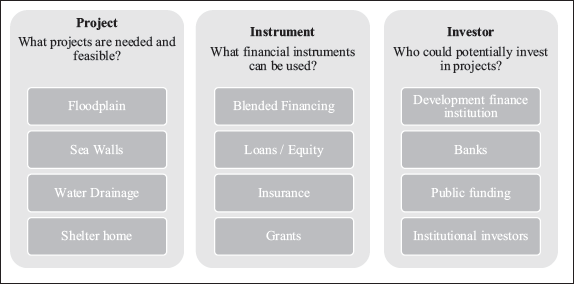
The cost of lending will be high if the SPV does not get concessional financing, likely too high for it to be attractive to project developers. The Instrument can also target the climate finance investors and governments with requisite supports of public finance in the initial stages of development. The development of projects will require public capital initially; commercial capital providers may be reluctant to fund the SPV entirely and/or provide debt capital at an attractive rate to the SPV. Public financial support can be used to improve the SPV’s creditworthiness, thereby reducing the cost of funding and helping the SPV to raise debt capital from mainstream investors such as banks (Figure 2).
Conclusion
Cities are at the forefront of climate action. The risk of catastrophic climate change impacts such as rising sea levels, powerful coastal storms, heatwaves, and pollution exacerbates cities’ exposure to economic and social impacts. Cities investing in and paying for climate resilience and prevention upfront can help avoid much greater damages and costs in the future. Indian cities are vulnerable to all climate-change-related disaster risks. Although Indian ULBs struggle to raise capital from private financiers to build resilience capacity, cities should look for innovative financial mechanisms to source essential long-term capital to fund resilience capacity. Developing a suitable project design, including financing mechanisms with adequate protection for private investors and an appropriate business model, can help cities source capital better to fund their climate resilience capacity.
Footnotes
Declaration of Conflicting Interests
The author declared no potential conflicts of interest with respect to the research, authorship, and/or publication of this article.
Funding
The author received no financial support for the research, authorship, and/or publication of this article.