



Abstract
Disaster risk funding is a well-established mechanism in India. It includes funds such as the National Disaster and Risk Management Fund (NDRMF), the State Disaster and Risk Management Fund (SDRMF), etc. These funds provide funding for listed disasters only, such as floods, droughts, landslides, and so on. However, states find this list very limited in its scope as many state/region-specific disasters are not covered in it. Hence, there are constant demands from the states to revise this list by including state-specific disasters such as snakebites, lightning, sea and riverbank erosion, bamboo flowering, and the like. However, these demands are rejected by the Finance Commission, a nodal agency of the central government for disaster risk funding, on many accounts. The present article analyzes the rationale for states’ demands to add certain region-specific disasters to the eligible list of disasters for funding and the Finance Commission’s response to them. The article utilizes primary sources such as Finance Commission reports and government orders, recommendations, and reports of the Ministry of Home Affairs and related agencies. It is supplanted with secondary sources as well.
Keywords
Evolution of Disaster Risk Funding in India: An Analysis
India is a union of states, and the central government generally owns a large share of revenue to maintain equity and efficiency in the national economy. The primary objective of public finances in a federal polity is cost management and sharing of revenue for public goods and ensuring the social security of the citizens. The central government holds a large share of revenue for this purpose. It has a primary role in resource mobilization, resource allocation, and redistribution. Fiscal arrangements in federal countries are decided by the central government, and different stakeholders participate to decide who will get what and how the resources will be managed (Trembly, 2023, p. 215). The fiscal distribution of power is shared between the union and states as mentioned in the Indian Constitution and protected by law. Fiscal federalism is based on two major principles, namely, (a) to address and adjust the vertical imbalances and (b) to manage the horizontal imbalances (Kelkar, 2019). Indian federalism provides larger roles to the union government as it collects around two-thirds of the revenue and, on the other hand, the state governments share two-thirds of expenditure responsibilities. This imbalance is desirous in a federal setup as it is the responsibility of the union government to share the resources to address horizontal imbalances and ensure equity in federal governance. These federal transfers to the states are carried out in two ways: first, by way of transfers recommended by the Finance Commission and non–Finance Commission transfers. The Finance Commission transfers include grants for disaster management among other grants (Rao, 2015). The non–Finance Commission transfers include central sponsored schemes and central sector schemes. These schemes also incorporate items such as embankments of rivers and forestation to address desertification and prevent droughts. In a way, central sponsored schemes and central sector schemes also finance disaster mitigation as the disaster mitigation fund under the DM Act, 2005 was not materialized by the union government on the pretext that the mitigation functions are taken care of by these central schemes (Sharma, 2021, p. 8). The states of India not only have a vast and diverse geographical makeup but also have different financial capacities. Therefore, the union government plays an important role by providing financial allocations meeting the capabilities of the states. States with feeble economic capacities are most vulnerable to managing disasters (Kelkar, 2010, p. 186). Disaster risk funding is a well-structured and periodically reviewed mechanism in India. Although, formally the Sixth Finance Commission was given the task to recommend “finance on relief expenditure,” it commenced with the Margin Money Scheme (MMS) of the Second Finance Commission. The Second Finance Commission (FC-II) found that states were not able to strike a balance between revenue and expenditure because of unaccounted expenditure on natural calamities and therefore they initiated MMS. This scheme continued till the Eighth Finance Commission with small changes. The Ninth Finance Commission found many gaps in the existing MMS and replaced it with the Calamity Relief Fund (CRF). The CRF was more flexible and easier to avail in comparison to the existing financial arrangements. The Tenth Finance Commission analyzed that CRF was limited in scope and not able to meet the expenditure of large-scale natural disasters. Henceforth, FC-X initiated the National Fund for Calamity Relief (NFCR) with a corpus of ₹700 crores to fund natural disasters, which because of its size and impact was out of the scope of CRF. The Eleventh Finance Commission has found certain incongruities in NFCR as it exhausted within three years of its composition. Hence, FC-XI replaced NFCR with the National Calamity Contingency Fund (NCCF) with an initial corpus of ₹500 crores to be contributed by a special levy on central taxes. It was in 2005 that the union government enacted the Disaster Management Act (DMA). It provides for the constitution of response and mitigation funds at the national, state, and district levels. The Thirteenth Finance Commission, following the mandate of DMA 2005, merged the existing CRF into the State Disaster Response Fund (SDRF) and NCCF into the National Disaster Response Fund (NDRF). The Fifteenth Finance Commission brought two major changes to the existing system of disaster risk funding. First, it fulfilled the longstanding demand for the creation of a mitigation fund. The second major change brought by the FC-XV is a change in methodology for deciding the share of states in the State Disaster and Risk Management Fund (SDRMF) (Sharma, 2022, p. 7). Earlier, it was entirely based on the past expenditure of the states, but now, 30 percent weightage is given to the Disaster Risk Index prepared by the inclusion of three indicators: (a) size of the state, (b) population of the state, and (b) vulnerability of the state by its exposure to natural hazards and the ratio of the population falling below the poverty line.
Disaster Risk Funding and List of Natural Calamities
Disaster risk funding has two major components, namely, State Disaster and Risk Management Fund (SDRMF) and National Disaster and Risk Management Fund (NDRMF). It is interesting to note that the funding is not available for all natural disasters; rather, it is available only for those natural disasters that are notified by the Ministry of Home Affairs (MHA). In addition, it is largely not available for man-made disasters. Initially, the Second Finance Commission covered six natural calamities under MMS, including floods, droughts, earthquakes, fires, cyclones, and hailstorms. Based on the inputs from the states and related agencies, the Finance Commission, from time to time, has revised the list. Presently, disaster risk funding is available for avalanches, cold waves, cloud bursts, cyclones, droughts, earthquakes, fires, floods, frosts, hailstorms, landslides, pest attacks, and tsunamis.
The Finance Commission has provided disaster risk funding through various schemes such as the Margin Money Scheme, Calamity Relief Fund, National Calamity Contingency Fund, and National and State Disaster Response Funds. FC-II, in its approach, maintained that special funds to the states should be provided for events that are beyond their control. It also maintained that if any state has already received such a fund, its scope might be expanded to cover all natural calamities (Santhanam, 1957, pp. 65–66). Moreover, this scheme was absent for man-made disasters. The Margin Money Scheme continued from the Third to the Seventh Finance Commission without any change in the approved natural calamities.
The Eighth Finance Commission had recommended that fire should also be included in the list of natural calamities. It maintained that fire is also a natural calamity like flood and is required to be funded under disaster risk funding (Rangarajan, 2004, p. 147). The Ninth Finance Commission had recommended replacing MMS with CRF. It stated that all the eligible disasters should be funded by the CRF but did not increase any new natural calamity in the list (Salve, 1990, p. 160). The Eleventh Finance Commission, in Para 14.66 of Disaster Risk Funding, recommended that the existing list of disasters, which includes cyclones, droughts, earthquakes, hailstorms, fires, and floods, should be eligible for funding from the CRF and expenditure over man-made and other disasters should be borne by the concerned units. It also recognized the fact that states were eligible to utilize funds on the approved list of calamities. Therefore, given the states’ demands to increase the list, it was recommended that a committee of experts be constituted periodically with representation from the states for review of the list (Khusro, 1998, p. 175).
Nevertheless, the scope of this scheme has been expanded over the period as the states constantly demanded that disaster risk funding was not meeting their requirements. Therefore, states listed their representations to successive Finance Commissions to enlarge the scope of disaster risk funding. The Twelfth Finance Commission, on the states’ request, recommended to include cloud bursts, pest attacks, landslides, and avalanches in the existing list of disasters eligible for funding (Rangarajan, 2004). FC-XII maintained that though it recommended the inclusion of more calamities to the list, however, other disasters related to industry and chemical, rail, and air accidents should be taken care of by the respective Ministries . In fact, the MHA also recommended to the FC-XII to include landslides and avalanches in the existing list of disasters (Chakarbati, 2009, p. 87).
FC-XIII also received a representation from states to include state-specific disasters such as sea erosion and lightning from Kerala; frost, cold waves, and heat waves from Rajasthan and Uttarakhand; and bird flu, rodent attack, snakebite, and sunstroke from other states. The MHA suggested to the FC-XIII to include cold waves, frost, lightning, and erosion in the existing list of disasters eligible for funding. It also recommended the inclusion of chemical, biological, radiological, and nuclear (CBRN) disasters in the list. The FC-XIII recommended continuing with the existing list of disasters and ruled out the demands for the inclusion of any new entry. It highlighted technical problems in including new demands as it is difficult to quantify frost, heat, and cold waves. Besides, the severity of these calamities will also differ from place to place. Sea erosion, it is believed, is a long-term phenomenon and can be addressed by mitigation efforts. It also stated that lightning is a local phenomenon and does not have a vast coverage area. FC-XIII also sidelined the demand to include human-made disasters in disaster risk funding as it maintained that man-made disasters have rare occurrences and, at best, may be funded by the NDRF. In addition, it recommended that the inclusion of man-made disasters required additional budgetary funds, and with existing allocations, the list of disasters eligible for funding largely catered to the requirements of the states. It reported that for man-made disasters, other channels of funding should be explored, for example, the Public Liability Insurance (PLI) Act 1991, which covers 179 explosives and sets up the liability of enterprises in dealing with toxic materials. An Environmental Relief Fund (ERF) of ₹285 crore was also constituted under the PLI Act in 2008. In the opinion of FC-XIII, it might be utilized for funding man-made disasters. Hence, FC-XIII recommended the existing list of disasters eligible for funding and ruled out the inclusion of any other disaster either natural or man-made (Kelkar, 2010, pp. 190–197).
The Fourteenth Finance Commission received similar requests from the states to include state-specific disasters such as forest fires, snakebites, cold waves/heat waves, frost, erosion of river banks and sea coast, bamboo flowering, and road/rail/boat accidents in the list of disasters eligible for funding. These demands were supported by the MHA and the National Disaster Management Authority (NDMA). States maintained that though these disasters had a local occurrence, however, their impact was very deep. Therefore, states strongly demanded to provide funding from SRDF/NDRF for these disasters. Considering the persistent demands by the states supported by the MHA and NDMA, FC-XIV recommended that 10 percent of the SDRF can be utilized for state-specific disasters provided that the state clearly notifies and includes these disasters approved by the State Disaster Management Authority (SDMA). Nevertheless, in the context of man-made disasters, FC-XIV upheld the earlier stand of FC-XIII and left it out of the scope of SDRF. However, it recommended that selected events be funded by NDRF (Reddy, 2015, pp. 129–136).
The Fifteenth Finance Commission also received demands from the states to include state- and location-specific disasters. FC-XV maintained that it would be difficult to quantify such disasters because of the difference in their severity. Therefore, FC-XV maintained that the existing list of notified disasters largely meets the requirements of the states and expressed no need to include region-specific disasters. However, FC-XV initiated seven disaster-specific mitigation funds in which it allocated ₹7,500 crores for mitigation of fire and coastal and river bank erosion, ₹5,000 crores for strengthening the fire management services, and ₹2,500 crores for mitigation of coastal and river bank erosion (Singh, 2020, pp. 257–258). Still, states are not satisfied with the list and continuously demand to include additional state-specific disasters in the list.
States’ Demands for Additions in the Notified List of Disasters
States never contended with the list of disasters eligible for funding. It is a closed list that puts states in a fix if they encounter a disaster that is not mentioned in the list. India is a vast country with different geographical features ranging from the Himalayas, desert, plains, plateau, and the sea. Indian states are exposed to different types of disasters. Therefore, the one-size-fits-all approach is not plausible in the case of disaster management. Moreover, from time to time, states raise their concerns to include location- and region-specific disasters in the list of disasters eligible for funding. Kerala maintained that it had a large coastline of approximately 580 km, which is prone to sea erosion mainly during the rainy season. In addition, every year around 50 people die because of snakebites. Therefore, Kerala demanded the inclusion of sea erosion and snakebites as natural calamities in the existing eligible list of disasters (Chakarbati, 2009, p. 77). States like Kerala and Uttarakhand are witnessing a lot of man-animal conflicts leading to the rising number of human casualties. It was on 6 March 2024 that Kerala declared man-animal conflict as a state-specific disaster and looking forward to including it in the central list of disasters (Indian Express, 2024). Rajasthan maintained that including Rajasthan, many farmers commit suicide in states such as Maharashtra, Madhya Pradesh, Chhattisgarh, and Andhra Pradesh. The focus should be on the relief to the distressed families. Therefore, it recommended that the CRF/ NCCF should finance all natural calamities including farmers’ suicides. It also stressed that frost and cold waves cause damage to rabi crops such as isabgol, mustard, coriander, barley, and so on. Hence, Rajasthan strongly demanded the inclusion of frost and cold waves in the list of disasters eligible for funding. Uttarakhand has also shared similar experiences and maintained that because of acute winter conditions, farmers lose their crops due to frost and cold waves. Therefore, it also demanded the inclusion of all disasters in the list of disasters eligible for funding (Chakarbati, 2009, p. 85). West Bengal stated that every year it experiences incidents of lightning and erosion. Both cause loss of life and damage to infrastructure. However, the state is handicapped in funding the victims and restoring the infrastructural damage as both are out of the ambit of the funding from CRF. Therefore, keeping in view the damages caused by lightning and erosion, West Bengal demanded the inclusion of both these disasters in the list of disasters eligible for funding under CRF.
The political representation in India is also concerned with region-specific disasters and their inclusion in disaster risk funding. In 2023, Members of Parliament Ms. Debasree Chaudhuri, V.K. Sreekandan, Dr. Sanjay Jaiswal, and Tirath Singh Rawat have raised questions to the minister of earth sciences regarding the rising incidents of lightning and whether the state has some schemes of funding for the suffering people and families. The minister of earth sciences responded that according to the National Crime Record Bureau’s (NCRB) data, 2,880 people died because of lightning in 2021 (NCRB, 2021, p. 9). In addition, the minister replied that lightning is not covered under the list of notified disasters by the Ministry of Home Affairs, and therefore, lightning is out of the scope of funding from the State Disaster Response Management Fund and the National Disaster Response Management Fund. The minister also replied that the Fifteenth Finance Commission considered the addition of region-specific disasters in the existing list of 12 disasters and did not find any merit in the request to expand the scope of the list (Chaudhuri, 2023). A similar question of lightning was also asked in 2021 by another Member of Parliament Mrs. Kanimozhi Karunanidhi with specific reference to Tamil Nadu (Karunanidhi, 2021). M. Mohammed Abdulla, another member of parliament, also raised a similar question with regard to heat waves and cold waves and the scope for disaster risk funding to the Minister of Home Affairs in February 2023. The minister of state of the MHA replied in a similar fashion and noted that these regional disasters are beyond the scope of the disaster risk funding as it is not covered in the 12 notified list of disasters (Abdulla, 2023). What appears from this analysis is that this demand for the inclusion of region-specific disasters in disaster risk funding is not only raised by the states but also well supported by both the political representations in the parliament at the national level and the people on the ground.
Mapping the Demands and Response
Disaster risk funding is seven decades old. Initially, there was no legal mandate on disaster funding. By convention, disaster management is considered a responsibility of the state, and the union governments performed a supportive function in it (Pant, 1999, p. 6). Disaster risk funding evolved with an initiative of the Second Finance Commission as it recommended funding six natural calamities by MMS. It was in 2005 that the union government enacted the DMA. This Act defines disaster as a
catastrophe, mishap, calamity or grave occurrence in any area, arising from natural or manmade causes, or by accident or negligence which results in substantial loss of life or human suffering or damage to, and destruction of, property, or damage to, or degradation of, environment, and is of such a nature or magnitude as to be beyond the coping capacity of the community of the affected area. (Government of India, 2005, p. 3)
A close analysis of this definition reveals that it includes both natural and man-made disasters. In addition, it clearly provides that disaster is a calamity that is beyond the coping capacities of the people living in the area. However, it did not provide an exhaustive list of natural and man-made disasters. Therefore, it leaves to the different agencies to define disaster according to their own wits. The Finance Commission has notified the disasters based on its understanding and included a few additional entries based on demands-cum-applied rationality and availability of funds. The Finance Commission has not adopted any scientific methodology for creating its list of eligible disasters for funding. However, unlike the DMA, the High-powered Committee on Disaster Management (HPC), 1999 has provided an exhaustive list of natural as well as man-made disasters (Table 1).
List of Natural and Man-made Disasters by the High-powered Committee on Disaster Management.
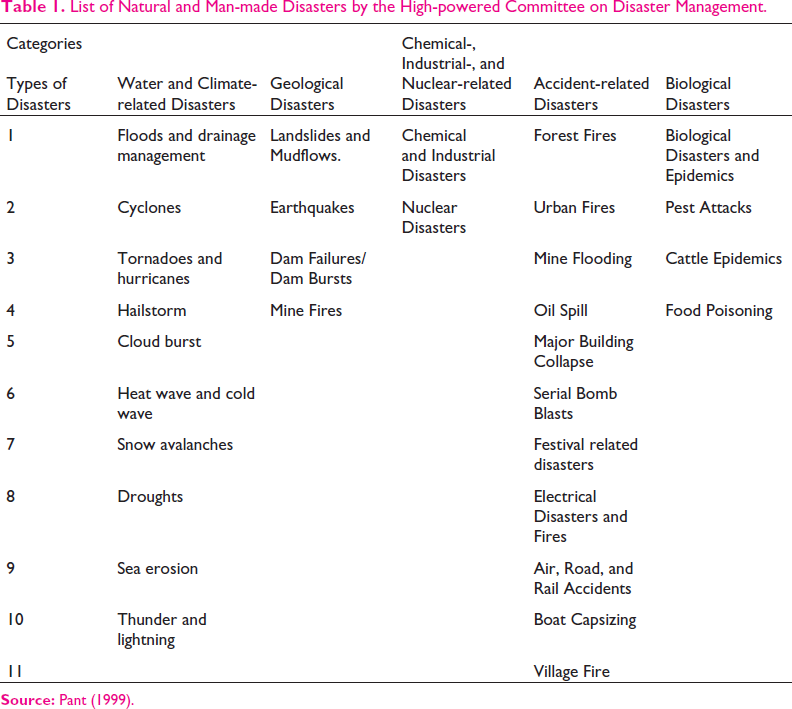
The HPC has listed 14 natural disasters in its report. However, presently, disaster risk funding is available for avalanches, cold waves, cloud bursts, cyclones, droughts, earthquakes, fires, floods, frosts, hailstorms, landslides, pest attacks, and tsunamis. Heat wave is a major concern that has not been considered a natural disaster by the Finance Commissions. India has witnessed heat waves across 16 states from March 11 to April 26, 2022 (Centre for Science Environment, 2022). Five states reported around 39 deaths due to heat waves, namely, Maharashtra, Telangana, Rajasthan, Odisha, and Jharkhand. In fact, climate change is also intensifying extreme weather conditions. The latest report of the Ministry of Earth Sciences maintains that heat and cold waves will increase with the rise of global average temperature (Krishnan, et al., 2020, pp. 224–226). The Intergovernmental Panel on Climate Change’s latest Sixth Assessment Report maintains that pre-industrial heat wave events occurred once in a decade but with the rise of 1.5°C in average temperature it is going to rise 4.1 times in a decade. Heat wave causes loss of life and destruction of infrastructure. Therefore, heat waves must be included in the existing list of disasters.
States such as Kerala and West Bengal are strongly demanding the inclusion of erosion in the existing list of disasters. Erosion is of two types: sea erosion and river bank erosion. The HPC has also recommended the inclusion of sea erosion as a natural disaster. Sea erosion is a common problem in coastal states. The National Centre for Coastal Research observed the coastline of India from 1990 to 2016 and came up with a report “National Assessment of Shoreline Changes Around Indian Coast” (Kankara, Ramana Murthy, & Rajeevan, 2018). It reported that over the 26 years, 34 percent of Indian coasts have witnessed erosion. It maintained that on the west coast, 24 percent coastline of Maharashtra, 12 percent of Goa, 22 percent of Karnataka, and 45 percent of Kerala eroded during the reported period. Similarly, on the east coast, 63 percent coastline of West Bengal, 57 percent of Puducherry, 28 percent of Odisha, 27 percent of Andhra Pradesh, and 41 percent of Tamil Nadu were reported to have eroded (Kankara, Ramana Murthy, & Rajeevan, 2018, p. 15). The Ministry of Earth Sciences also noted in its report that global warming led to the rise in sea level and is posing a threat in the form of coastal erosion. It is leading to a threat not only to human habitation but also to the infrastructure near the coastline of India (Krishnan et al., 2020, pp. 184–224). River bank erosion is another important concern raised by the states before the Finance Commission. NDMA in its guidelines of flood maintains that floods cause soil and river bank erosion. It is largely visible in the Ganga and the Brahmaputra River basins. States such as Assam, Uttarakhand, Uttar Pradesh, and Bihar are suffering from riverbank soil erosion. Assam has the largest river island Majuli, which was 1,250 sq km in 1890 but presently its size is around 350 sq km due to flood-led river bank erosion. NDMA along with MHA raised its concern over river bank erosion and its impact in the form of destruction of habitat, loss of agricultural land, and source of livelihood of the people (NDMA, 2021a).
Snakebites, a major concern in some states, are demanded to be included in the list of disasters eligible for funding from SDRMF and NDRMF. India experiences around 58,000 deaths by snakebite annually. These deaths are primarily reported from Rajasthan, Jharkhand, Odisha, Madhya Pradesh, Bihar, Uttar Pradesh, Andhra Pradesh, and Gujarat. It is reported that Odisha has more cases of snakebite deaths than that from cyclones. Odisha has reported 5,964 deaths due to snakebite since 2015. In fact, Odisha has declared snakebite as a state-specific disaster (Barik, 2022). Snakebite causes loss of life, and in most cases, the deceased person is the earning member of the family. It results in the derailment of normal life for many families. Considering the seriousness of snakebite, the World Health Organization (WHO) in 2017 declared it as a tropical neglected disease though it was previously removed from the list in 2013 (WHO, 2017).
Lightning is an additional state- and location-specific natural disaster that is requested by the states to be declared as a natural disaster by the Finance Commission. It is one of the major disasters causing a greater number of deaths in comparison to other disasters. The National Crime Record Bureau (NCRB) calculated the number of casualties by forces of nature in 2019. It found that 7,405 deaths were reported from forces of nature, out of which lightning caused 38.6 percent of deaths, which is the highest when compared with others like floods (11 percent), cyclones (9 percent), earthquakes (9 percent), landslides (10 percent), cold waves (10.5 percent), and sunstroke (12 per cent) (NCRB, 2020, p. 15). It also reported that lightning caused 429 deaths in Madhya Pradesh, 436 in Bihar, 336 in Jharkhand, and 304 in Uttar Pradesh. Studies are pointing out that with the rise in global temperature, incidents of lightning shall increase in the future (Romps, Seeley, Vollaro, & Molinari, 2014).
The HPC also listed 17 man-made disasters. Out of these, two, that is, pest attack and fire, have been included in the Finance Commission’s list of disasters. The HPC mentioned four types of fires, namely, forest fires, urban fires, electrical disasters and fires, and village fires. These four categories can be subsumed in a single entry of fire in the existing list. In the case of industrial disasters, the Environmental Protection Act of 1986 enacted the Hazardous Management, Handling, and Transportation Rules, 1987. It provides rules for chemical-related handling, storage, and transportation of hazardous waste. It was in 1991 that the Public Insurance Liability Act was enacted. This Act provides that, for any industrial disaster, the owner of the industry is liable to pay compensation to the victims (Government of India, 1991). It also established an Environment Relief Fund in 2008 with an initial corpus of ₹285 crores. Hence, these disasters need not be included in the list of disasters of the Finance Commission.
Nuclear and biological disasters are very threatening and cannot be ruled out in the future. Threats are from different sources such as an act of negligence, internal anti-state elements, terrorism, war with alien nations, and so on. NDMA has already issued its guidelines on the management of nuclear and biological disasters. These guidelines focus on preparedness and mitigation on all possible strategic sites such as airports, railway stations, and sites of nuclear plants (NDMA, 2009). These disasters should be handled by specialized agencies under related ministries.
Mine flooding may occur because of two probable reasons, one because of normal flooding outside, which is already included in the Finance Commission’s list of disasters. The second cause of mine flooding is internal mishappening, which is taken care of by the Public Insurance Liability Act, 1991. The HPC has also listed building collapses in man-made disasters. Generally, a building collapses because of a landslide, flood, earthquake, or tsunami. These reasons are already taken care of as these disasters are already on the list. However, some buildings also collapse because of several other reasons such as age, poor engineering and maintenance, excessive rain, etc. Such cases in the past resulted in many deaths and loss of income, shelters, and infrastructures. Therefore, major building collapses may be considered in the list of disasters eligible for funding.
The HPC suggested that oil spills and festival-related disasters be included in man-made disasters. India has a coastline of nearly 7,500 km. To date, India has rarely experienced any major oil spill on its coast; still, it may not be ruled out in the future. It causes a lot of ecological and livelihood issues as it may render many tourists and fishing-related activities inaccessible. Therefore, it must be considered by the Finance Commission. India is a land of festivals and mishappenings like stampede are not so uncommon in these large gatherings of people. Stampede may also be considered in the list, and the district administration should be given the responsibility to manage and calculate the loss by these disasters and access funds from disaster risk funding.
The HPC has also included biological disasters and epidemics, cattle epidemics, and food poisoning under man-made disasters. India and the world have recently witnessed the COVID-19 pandemic, where special grants were issued to the states under DMA 2005. States were allowed to utilize 10 percent of the opening balance of the SDRF for containment measures of COVID-19 (Government of India, 2021). In addition to it, NDMA also issued an ex gratia payment of ₹50,000 next to the kin of the person who died of COVID-19 (NDMA, 2021b). These pandemic and biological disasters are not common; therefore, these may be addressed under DMA at the time of their commencement. Cattle epidemics and food poisoning are also important. India ranks first in global milk production, and animal husbandry is the backbone of Indian farmers. It would be better if cattle epidemics were handled by a specialized agency like the Ministry of Agriculture. India witnesses casualties not only by food poisoning but also by country-made spurious liquor. Presently, there is no mechanism to compensate them. Victim’s families are at the mercy of political announcements by the chief ministers of the concerned states. Therefore, these incidents may be considered by the Finance Commission under the category of man-made disasters.
These natural disasters are not uniform, and they differ from region to region. The Finance Commission includes pan-India disasters and generally avoids region-specific disasters. Even the DMA 2005 does not provide a list of disasters and lays down that a disaster is a catastrophe, arising from natural or man-made causes, which results in substantial loss of life or human suffering and destruction of property of such a nature or magnitude as to be beyond the coping capacity of the community of the affected area. Therefore, in the absence of any empirical parameter, it is difficult to make a pan-India list of natural and man-made disasters. The Finance Commission in its approach has taken a holistic view and includes those disasters that are generally pan-India in nature. Therefore, state-specific disasters are left out without any financial assistance. The Finance Commission’s list of disasters provides a top-down approach where state concerns are listened to but not addressed properly. India is a union model of federalism (Singh, 2018, p. 4). It demands accommodations for states’ concerns in national decision-making. States’ concerns to include snakebites, lightning, and sea and river bank erosion are genuine in their place. These disasters may not be pan-Indian but are limited to a specific region, but these are equally disastrous to the concerned states. Therefore, the Finance Commission should also pay equal importance to regional disasters so India may have effective disaster risk funding.
Missing Link in the Notified List of Disasters Under Disaster Risk Funding
Disaster risk funding in India has evolved out of the discretion and consideration of the central government. Federalism reflects a well-maintained balance between unity with multiplicity and nationalism with sub-national identity. Federalism provides a channel of discourse between the central and state governments, and disaster management in India is one example of it. Federalism is a political union of the social and geographical diversity of a state. The federal principles of governance are based on “self-rule plus shared rule” (Elazar, 1987, p. 7). Disaster governance is an area of shared governance. However, by way of practice and convention, the primary responsibility of disaster response rests with the state governments in India. However, functions such as disaster response and disaster mitigation can be carried out with the availability of revenue. In the federal discourse of the notified list of disasters, states are demanding for inclusion of state/region-specific disasters from the Third Finance Commission onward. The response of the central government and Finance Commission is based on pan-India demand and the prevalence of a disaster, and they deny to find any merit in including region-specific disasters of the states. Snakebites, lightning, frost and cold waves, sea erosion, and farmers’ suicide may not be pan-Indian hazards but are specific to some states, and the impacts of these disasters are as much as those of notified disasters under the disaster risk funding. The approach of the central government looking at pan-Indian disasters also reflects the absence of a collaborative model and the dominance of a top-down approach in Indian federalism. The discourse between the states and the central government for the inclusion of region-specific disasters in the notified list of disasters is a serious concern and needs to be addressed to make Indian federal practices more accommodating and to realize the essence of shared governance in letter and spirit.
Conclusion
Disaster risk funding evolved from the Margin Money Scheme, in 1957, to the State/National Disaster Risk Management Scheme in 2022. However, disaster risk funding does not include all disasters but rather provides a list of selected disasters by the Finance Commission. Initially, this list consisted of 6 disasters, which are presently 13 in number. States are never satisfied with this list of disasters provided by the Finance Commission as this list does not address state-specific disasters such as snakebite, lightning, bamboo flowering, and erosion of sea coast and riverbank. In addition, disaster risk funding also does not include man-made disasters specifically in the SDRMF. Disaster governance started late in India, as from the Second to the Eleventh Finance Commission, all adopted the terminology “calamity”; it was in 2005 that the union government enacted the DMA, and the word “disaster” was used in successive Finance Commission. The shift in terminology in India’s governance and policy framework from “calamity” to “disaster” demonstrates a wider understanding of the need for a more thorough and proactive approach to disaster management. Even this Act fails to provide a list of stipulated natural and man-made disasters. It rests on the interpretation of the Act to declare a particular event as a disaster or not. This is virtuous in the way that the Finance Commission has an opportunity to include region-specific disasters. Disaster risk funding is exclusive as it provides funding for only a handful of disasters. India’s vast geography makes it vulnerable to a variety of disasters. The Finance Commission should consider it and make disaster risk funding more inclusive.
Footnotes
Declaration of Conflicting Interests
The author declared no potential conflicts of interest with respect to the research, authorship, and/or publication of this article.
Funding
The author received no financial support for the research, authorship, and/or publication of this article.