




Abstract
Abstract
Co-creation is said to take place in a variety of domains when two or more actors interact to create value. The topic of brand co-creation has been in the literature for 15 years. During this time, a multitude of concepts, constructs and behaviours about co-creation have been presented in the marketing literature. The result is a fragmented research area with little underlying consensus about how co-creation occurs between consumers and brands. The purpose of this article is to propose a brand co-creation typology, with the goal of consolidating existing work into a unified framework and providing a roadmap for practitioners to use co-creation in a more informed fashion. This typology creates avenues for future research through empirical testing.
Keywords
The notion that brands represent value for consumers has been accepted in the literature, but the notion that consumers eventually co-create value from and for brands is relatively new. Traditionally, firms have taken the role of creators of goods and services that offer value to consumers, while consumers have been viewed as the passive recipients of these goods and services. However, the power between firms and consumers has slowly shifted given the increased availability of information (Lowenstein, 2015; Prahalad & Ramaswamy, 2004; Ramaswamy & Ozcan, 2016). As such, in an increasingly global, dynamic and consumer-driven marketplace, companies are recognizing the need to relinquish some control of their brands and increase their level of engagement with consumers at different levels (Grönroos & Voima, 2013; Hatch & Schultz, 2010; Iglesias, Ind, & Alfaro, 2013; Ind, Iglesias, & Markovic, 2013; Kennedy & Guzmán, 2016; Schultz, 2016). As consumer power has augmented due to an increase of available information, and proliferation and higher levels of adoption of technological platforms, consumer engagement in the market has also increased (Asmussen, Harridge-March, Occhiocupo, & Farqhuar, 2013; Baldus, Voorhees, & Calantone, 2015; Harmeling, Moffett, Arnold, & Carlson, 2017; Iglesias & Bonet, 2012; Malthouse, Haenlein, Skiera, Wege, & Zhang, 2013; Vallaster & von Wallpach, 2013).
Co-creation is defined as the process where two or more parties collaboratively interact to create value (Bogoviyeva, 2011; Grönroos, 2011; Merz, Zarantonello, & Grappi, 2018; Prahalad & Ramaswamy, 2004; Vargo & Lusch, 2004, 2016). Businesses have taken to co-creation like a house on fire (e.g., self-checkouts, build-a-bear, customize your car, create your own flavour, to only name a few). As a result, there has been a dramatic increase of academic research on the topic, especially over the past 5 years, which academics agree is worth pursuing (Merz et al., 2018; Voyer, Kastanakis, & Rhode, 2017). However, despite the increase in research attention and the growing literature base, brand co-creation is not yet fully understood.
A specific co-creation example that helps illustrate this misunderstanding is how the brand WD-40 engages with consumers. The original WD-40 product was first introduced as a military product to protect metal from rust and corrosion. Through the years, employees and consumers discovered additional uses for the product. Currently, the WD-40 brand maintains a website that details the user-suggested uses of the product, and the company continues to prompt consumers to engage in this co-creation activity. What is not easily known, however, is the type of co-creation that occurs when the new uses of WD-40 are discovered. Is the consumer acting alone? Is the product used as originally intended?
Consumer Brand Co-creation Typology
Background
Researchers agree that value co-creation is the new market paradigm and that it occurs in a dynamic shared space where multiple stakeholders interact (Grönroos & Voima, 2013; Iglesias et al., 2013; Ind et al., 2013; Kazadi, Lievens, & Mahr, 2016; Kennedy & Guzmán, 2016; Kornum & Mühlbacher, 2013; Prahalad & Ramaswamy, 2004; Vallaster & von Wallpach, 2013; Vargo & Lusch, 2004, 2016). Although the notion of co-creation has been around for some time, especially in the services literature under the labels of inseparability and simultaneity of production and consumption of service (Grönroos, 2011, 2017; Lovelock & Gummesson, 2004; Perera, Albinsson, & Shows, 2017; Vargo, Archpru Akaka, & Vaughan, 2017), the term co-creation has come of age with the service-dominant logic (SDL) literature (Leclercq, Hammedi, & Poncin, 2016; Vargo & Lusch, 2004, 2016; Vargo et al., 2017; Wilden, Akaka, Karpen, & Hohberger, 2017). Co-creation also finds strong support in the concept of value-dominant logic (VDL) (Mahajan, 2017), as VDL focuses beyond the process of creating value, and rather focuses on the goal of creating it consciously, unconsciously, implicitly or explicitly for all actors within an ecosystem that interact with each other.
Recent research on co-creation and branding has focused on many different topics, including the implementation of a co-creation strategy (Ind et al., 2017), social marketing (Domegan, Collins, Stead, McHugh, & Hughes, 2013), collective action (Laamanen & Skålén, 2015), cultural differences (Voyer et al., 2017), customer co-creation value (Agrawal & Rahman, 2017; Merz et al., 2018), engagement (Black & Veloutsou, 2017; Conduit & Chen, 2017), actor roles (Biraghi & Gambetti, 2017; Kumar & Rajan, 2017; von Wallpach, Hemetsberger, & Espersen, 2017; Waseem, Biggemann, & Garry, 2017), brand communities (Kornum, Gyrd-Jones, Al Zagir, & Brandis, 2017; Roncha & Radclyffe-Thomas, 2016), value creation (Echeverri & Salomonson, 2017; Flores & Vasquez-Parraga, 2015; Grönroos & Voima, 2013; Merz et al., 2018; Skålén, Pace, & Cova, 2015), the outcome of co-creation (Alves, Fernandes, & Raposo, 2016; Cossío-Silva, Revilla-Camacho, Vega-Vázquez, & Palacios-Florencio, 2016; Kennedy, 2017; Navarro, Llinares, & Garzon, 2016) and the negative side of co-creation (Daunt & Harris, 2017; Greer, 2015; Plé, 2017; Smith, 2013). However, despite this impressive research attention and the resultant rich literature base, there is still not a clear picture of the different actors involved in co-creation, and the boundary conditions that make one type of co-creation more appropriate than another.
The slow shift of power from firms to consumers—and from firms to retailers—has emphasized the importance of the knowledge-based view of the firm (Grant, 1996), where the task of the firm is coordinating the knowledge integration of all stakeholders. But reality is that consumers, not being only passive recipients of goods and services, do not necessarily consume these goods and services as intended and thus many times create unique value for themselves and consequently for the brand. Furthermore, the levels of consumer engagement in the co-production or co-creation of value will not be equal for every product, service or brand. Past research has identified brand passion, brand trust and brand commitment (Merz et al., 2018), and social, fun, brand commitment, communication appeal and value compatibility (Kennedy & Guzmán, 2016) as factors that motivate consumers to co-create. Past research also identifies two primary forms of engagement marketing activities, task-based and experiential engagement initiatives (Harmeling et al., 2017).
With few exceptions (Baldus et al., 2015; Harmeling et al., 2017; Kennedy, 2017; Kennedy & Guzmán, 2017), existing brand co-creation models or frameworks do not provide insight into possible different levels or types of co-creation, and they simply assume that co-creation happens or not. Baldus et al. (2015) identify 11 different motivations for consumers to engage in online communities. Together with Harmeling et al.’s (2017) forms of engagement marketing, these two studies provide support to describe that firms can strategically enact marketing activities that promote consumer engagement. More specifically, Kennedy (2017) and Kennedy and Guzmán (2017) identify two forms of co-creation based on the strategic intent of a firm: prompted versus non-prompted. But what about the type of co-creation that can result from the different circumstances that a consumer faces when consuming a brand?
This article thus posits the following research question: does every stakeholder, especially the firm and its consumers, have to engage in co-creating at the same level? Given that technology, through which consumers have gained access to wide ranges of information and opportunities to interact with and influence a brand, has been identified as an enabler of co-creation (Asmussen et al., 2013; Malthouse et al., 2013; Ramaswamy & Ozcan, 2016; Vallaster & von Wallpach, 2013), and that this trend will likely continue as the line separating consumers and brands continues to blur, the purpose of the proposed typology is to create boundaries for different types of co-creation. These boundaries will help to guide future research in terms of the proposed domains, and whether a consumer is co-creating with others, with the firm, or individually. Concentrating exclusively on firms and consumers, the proposed consumer brand co-creation typology focuses on analysing how co-creation happens in the marketplace based on two domains: how a brand or product is used (usage domain) and under what circumstances it is used (interaction domain). This typology links how both consumers and firms allocate human, structural and relational resources.
Methodology/Approach
Typologies aim to provide a classification scheme that is hopefully comprehensive and parsimonious (Paswan, D’Souza, & Zolfagharian, 2009). Typologies provide an instrument to describe organizational phenomena that highlight and explain the interplay among organizational elements (Miller & Friesen, 1984). Typology development is a unique form of theory building that must meet certain criteria before being classified as theory (Doty & Glick, 1994). By synthesizing broad patterns from theory grounded in rich, multivariate descriptions, the configurational approach (i.e., typologies) helps consolidate past knowledge (Meyer, Tsui, & Hinings, 1993). In summary, typologies are essential for the consolidation and development of knowledge in a particular field, especially if it is fragmented. We believe that the field of co-creation has reached such a point.
The multiple discussions found in the literature on brand co-creation, as well of the existence of a significant body of knowledge and current research, are proof of the importance and relevance of the topic. While the existing literature on co-creation is impressive, it is very diverse and contingency centred. In addition, the literature on co-creation and SDL is at a watershed, with the traditional demarcation between goods and service getting blurred. Therefore, it seems to be the right time to follow the configurational approach and develop a typology that helps understanding this phenomenon.
This study uses two key dimensions for developing the typological framework—the actors involved or interaction domain and the resources involved or usage domain. The first dimension is anchored in the literal definition of co-creation. The prefix ‘co’ is rooted in Latin term ‘com’, gives the meaning ‘together, mutually, in common’, to another word. ‘Creation’ comes from the Latin term ‘creatio’ meaning ‘to produce’. Thus, for co-creation to take place, there has to be multiple actors producing an outcome. As previously discussed, past research has identified different factors that motivate consumers to co-create—brand passion, brand trust and brand commitment (Merz et al., 2018), and social, fun, brand commitment, communication appeal and value compatibility (Kennedy & Guzmán, 2016). So at the very minimum a consumer, in an attempt to satisfy any of these motivating factors, is going to co-create with him/herself as the dominant partner. Although as VDL posits, value creation can happen when an individual performs an action, for example, a student creates value for him/herself when studying for an exam (Mahajan, 2017), once a brand is involved even if the consumer uses the brand/product in private there is a certain degree of co-creation that can be either positive or negative. In other words, a consumer buys a product or service and co-creates or co-destructs value in his/her privacy, and a firm’s role in co-creation is to just make the value platform available. At this level, it could be argued that the motivation to co-create could be mainly driven by self-interest—that is, trying to satisfy any of the more self-driven motivating factors, such as brand passion, fun, brand commitment or value compatibility. The next level is where other social actors (besides the firm) are involved. In this situation, a consumer has to use a significant amount of his/her social capital. From this level on, it could be argued that the motivation to co-create or co-destruct could be a combination of self-interest (social status, recognition) and communal/group interests—that is, trying to satisfy any of the more communal-driven motivating factors such as the social or communication appeal. Finally, a third scenario is where the firm becomes actively involved in co-creation, beyond just offering the value platform. In this situation, both firms and the consumers have to use more complex resources—for example, the firm may use human, structural and relational capital, while the consumer may have to use some social capital. As also previously discussed, past research has classified the types of co-creation based in a firm’s strategic intent (Kennedy, 2017; Kennedy & Guzmán, 2017). While in the latter two levels co-creation might have occurred unprompted, at this level there is an explicit effort from the firm to engage with the consumer and most likely co-creation is being prompted. Likewise, it could be argued that in the latter two levels, co-creation is passive or unintentional, while in this level co-creation is active or intentional (Fliess, Dyck, & Schmelter, 2014; Mahajan, forthcoming). In sum, the theoretical anchoring for this dimension comes from social exchange theory (Emerson, 1962; Thibaut & Kelly, 1959). Furthermore, this differentiation finds support on past literature that has made important distinctions between how people behave when consuming in public versus in private (Bearden & Etzel, 1982). Relying on these theories, we argue that an actor derives different values from an activity depending on other actors involved in the social exchange.
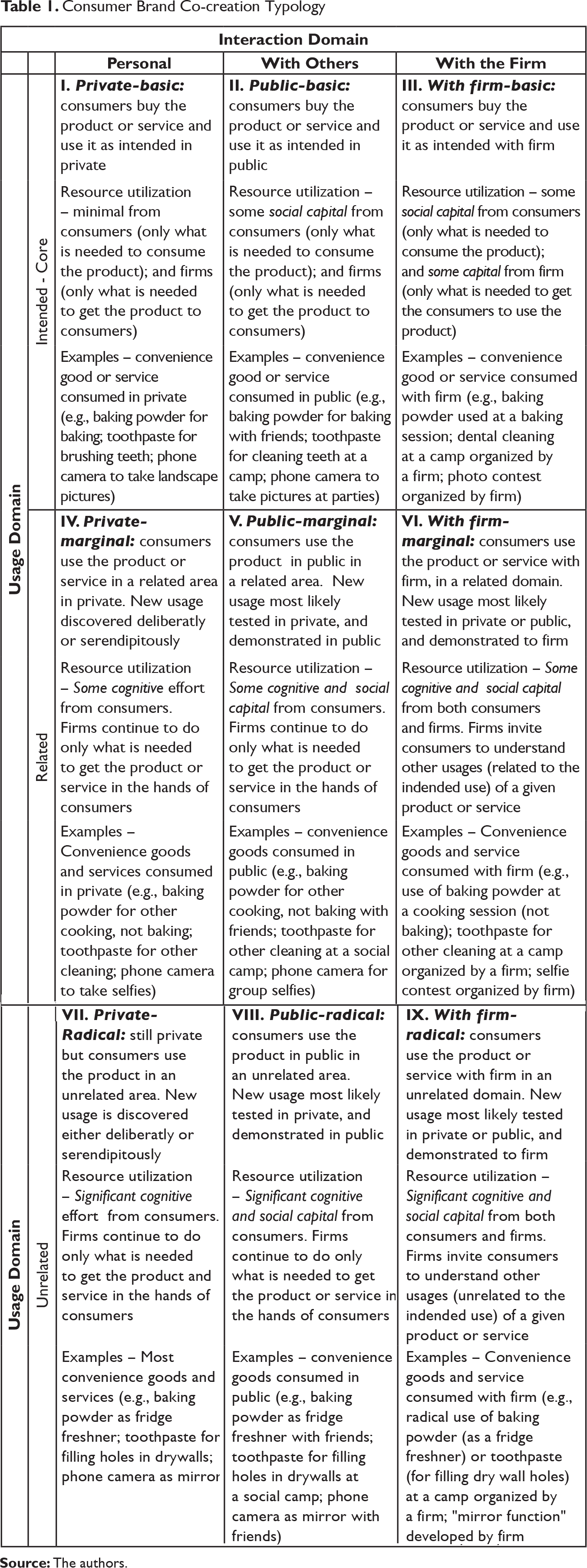
The second dimension revolves around the domain of usage, and involves resources, especially the cognitive resource used by the consumer. Again, at the very least, a consumer has to buy the product or service, but the usage is as intended and basic. The consumers have to use some of their financial resources but minimal cognitive resources. We use term ‘basic’ to represent this usage. The next level is when they use some cognitive resource to identify or develop related usages of the product or service purchased. We use the term ‘marginal’ to capture this enhanced value co-creation. Finally, the term ‘radical’ is used to capture a co-creation scenario where a consumer uses significantly more complex resources to either identify or develop new ways of value co-creation. In this scenario, the product usage is unrelated to what was intended by the provider. This notion of marginal and radical enhancement in value is anchored in innovation literature (Garcia & Calantone, 2002; Zhou & Li, 2012). Our second dimension also finds support in VDL (Mahajan, 2017) as many uses of the brand result in a creation of value that goes beyond the internal boundary of the firm. While it could be argued that in the first level (basic use) value is co-created within the brand’s business/social boundaries, in later two levels (marginal and radical uses) value is co-created beyond the brand’s business/social boundaries. The resultant 3×3 typological framework is presented in Table 1. The table also includes some contingent conditions for each of the nine types of co-creation, especially in terms of resource usage from both the consumers’ and firms’ side.
Discussion
The proposed consumer brand co-creation typology is a new direction for theory building in the field of branding that links traditional marketing thinking—how consumers allocate resources and perform cost–benefit analysis—to the current thinking based on SDL (Vargo & Lusch, 2004, 2016), customer-dominant logic (CDL) (Heinonen et al., 2010) and VDL (Mahajan, 2017). It also integrates the literature on intellectual capital—human (e.g., cognitive), structural or organizational, and relational or social capital (Bontis, 1998; Nahapiet & Ghoshal, 1998; Subramaniam & Youndt, 2005)—and the resource-based (Barney, Wright, & Ketchen, 2001) and knowledge-based (Grant, 1996) views of the firm to make sense of consumer co-creation. Finally, the framework also provides a multidimensional scheme that allows for both academics and practitioners to understand the different levels of engagement and the social context in which brand co-creation happens. For example, past research has shown the value in prompting consumers to co-create (Kennedy & Guzmán, 2017). The proposed typology, by establishing the usage and interaction domains, and whether a consumer is creating with others, with the firm, or individually, allows brands to classify the types of co-creation they wish to prompt from their consumers. Furthermore, it is worth noting that although value itself can be created by a customer alone (Mahajan, 2017), once there is a secondary actor—such as a brand—value becomes co-created or co-destroyed. In support of VDL, this typology highlights the importance of brands paying attention to intentional/prompted or unintentional/unprompted value co-creation beyond their internal boundaries.
The two identified domains demarcate conditions that determine different types of co-creation. The interaction domain relates to past literature on public versus private consumption (Bearden & Etzel, 1982), but by also including the engagement with the firm results in three types of co-created consumption. The interaction domain, given that it is determined by situational characteristics and/or the social context, also relates to a certain extent with what Harmeling et al. (2017) identify as the experiential form of engagement marketing initiatives. In other words, the interaction domain references who or what the consumer is interacting with. Sometimes, the consumer is interacting with the product alone in private. This could be something as simple as brushing their teeth, reading a book or taking a photograph. Next, the consumer is interacting with the product in a public place where other people are present. Here, the consumer can be reading a book in the park, taking pictures at a zoo or brushing their teeth in a public restroom after eating lunch with colleagues. Finally, the consumer interacts with the firm. This interaction could include a dental professional attending a conference or training programme hosted by a toothpaste company, a consumer taking photographs and submitting the pictures to a company’s photo campaign, or designing a pair of shoes on a company website.
On the other hand, the usage domain relates to past literature on innovation (Garcia & Calantone, 2002), but in this case the innovation is the outcome of the consumer usage—not the firm’s innovation—and results in three types of co-created consumption. The usage domain, given that it is determined by how consumers actually consume or do things with the product, also relates to a certain extent with what Harmeling et al. (2017) identify as the task-based form of engagement marketing initiatives. In the intended usage domain, a consumer is using the product as intended. This includes behaviour like using toothpaste to brush your teeth, using a camera within a phone to take pictures or using a set of dominos to play a game of 42. Related usage includes using a product for a similar use as the reason the product was developed. In this type of scenarios, value is being created within the firm’s boundaries (Mahajan, 2017). For example, toothpaste can be utilized for more than cleaning teeth. The product can be used to clean silver or other household items. While toothpaste was not created to clean silver, using the product that manner is still related to intended use of the product as a cleaner. Additionally, a consumer can use a set of dominos in the related usage domain of creating their own game instead of playing a traditional game. Finally, products can be used in ways not intended by the company producing the product. While a set of dominos was created for playing games like 42, consumers have taken the product into a new realm and will build domino towers or a snake, then knocking the dominos down. In this type of scenarios, value is being created beyond the firm’s boundaries (Mahajan, 2017).
The discussion of co-creation has been in the literature for 15 years, starting with Prahalad and Ramaswamy (2004) and Vargo and Lusch (2004), and the topic is not yet fully understood. In recent years, research into co-creation by academics and the practice of co-creation by industry professionals has blossomed, leading to a fractured literature base and industry practices. Researchers will now have guidelines to follow when examining the different types of co-creation behaviour related to the usage and interaction domain. The usage of this typology will help to align the literature and create a consistency throughout the broad field of co-creation.
The use of this typology will also add value to managers and consumers. The management of a company will now have actual boundaries on what domain of co-creation activities to introduce into the brand. For a company like Lego, who values creativity and looks for consumers to drive the imagination of the company, a co-creation domain of ‘with the firm’ and ‘unintended usage’ will generate new ideas and uses for the common Lego brick. Companies can strategically prompt co-creation practices to match the overall goals for the organization, following the co-creation typology matrix. Consumers will benefit from this typology due to the strategic actions taken by companies to prompt co-creation. Value will be added to the consumer by being exposed to relevant marketing activities from companies. For a consumer who follows Lego on social media or in other ways will be shown co-creation prompts for the ‘with the firm’ and ‘unintended usage’ domain. This could be an advertisement that asks the consumer to submit new Lego brick ideas to the company’s website. The VDL view (Mahajan, 2017) on co-creation also reminds managers of how this process can lead to negative value creation or co-destruction at any given level of the proposed typology.
The purpose of this article is to reconcile the literature and fill gaps in the understanding of the co-creation concept. A typology is needed when a field becomes fragmented. By proposing a consumer brand co-creation typology, this article seeks to consolidate and develop a consensus around this relevant topic, leaving for future studies its empirical validation. The application of the typology can later be tested and applied to areas of co-creation beyond brand co-creation, and will hopefully be useful to practitioners interested in creating value through brand co-creation.
Declaration of Conflicting Interests
The authors declared no potential conflicts of interest with respect to the research, authorship and/or publication of this article.
Funding
The authors received no financial support for the research, authorship and/or publication of this article.