



Abstract
Abstract
This article empirically investigates if women would be able to create more self-employed value if they had the same educational endowments as men in the unique gender disparity context of Nigeria. The article uses probit and Blinder–Oaxaca multivariate decomposition models to empirically conduct this analysis in a developing country taking advantage of two rounds of survey data. The analysis confirms that women would be able to create more self-employed value, particularly higher education self-employed value, if they had the same educational endowments as men. The article also highlights why gender parity does not exist in Nigeria and emphasizes the benefits of gender parity in this context.
Introduction
Value creation entails a plethora of activities that increase the worth of goods, services and businesses and improve the well-being and worth of individuals and organizations. The creation of value has been defined as the core purpose and central process of economic exchange and should not be equated with limited understandings and historic notions of the differential between labour cost and profit (Kabadayi & Stokes, 2017; Mahajan, 2017; Vargo, Maglio, & Akaka, 2008). The link between value creation and education is integral because education does not just improve output, productivity, efficiency and innovation, and it can also lead to healthier and happier lives. Education improves overall well-being, a central theme in the value creation literature (Davidow, 2018; Lepak, Smith, & Taylor, 2007). It is for this reason that it has been contended that value creation is the main aim of education (Amit & Han, 2017; Gebert & Joffee, 2007).
Theoretically, both self-employed individuals and paid employees, agents who create value, benefit from education because education reduces the time needed to create and sometimes enjoy value (Paswan & Guzmán, 2017). However, some families in developing countries send males into education but not females, thus limiting the type of value that females can create (Hannum, Kong, & Zhang, 2009; Kleven &Landais, 2017). The central aim of this article is to determine if it would be possible to create more self-employed value if educational endowments were equalized between genders in such a context.
Employment Status and Value Creation
Paid employees create value by being part of the global civil society, and performing all the relevant tasks, this entails such as being productive, innovative, efficient and law-obeying members of the society (Salamon, Sokolowski, & List, 2004). The self-employed also create employment, productive and innovative value. However, Earle and Sakova (2000) argue that on the one hand, a self-employed worker may be a successful business owner exploiting new opportunities and inventing new products, production processes and distribution methods. On the other hand, the self-employment status may result from the forced recourse to a residual sector in which the individual’s activities and income differ little from those in unemployment.
Society’s needs are large and growing, and contemporary society is increasingly asking businesses to step up. Specifically, there is currently a call for self-employed individuals and paid employees to fulfil business functions while simultaneously advancing the economic and social conditions in the communities that they operate in (Porter & Kramer, 2019). In these contexts, both the self-employed and paid employees have their part to play in creating societal value, especially in times when shared values are increasingly being called for (Jonker, O’Riordan, & Marsh, 2015). The research objectives for this article flow from such current issues and form the central aim of this article. Since self-employed individuals and paid employees create unique forms of societal value and the extant literature proposes that educational endowments significantly affect the probability of being either in self-employment or paid employment (Parker, 2004; Van der Sluis, Van Praag, & Vijverberg, 2005), it would be of empirical benefit to determine if it would be possible to create more of one type of value if educational endowments were equalized between two groups. The central aim of this article is to determine if it would be possible to create more self-employed value if educational endowments were equalized between genders in the developing country context of Nigeria.
Education, Self-employment and Paid Employment
Educational human capital has especially been a crucial factor influencing the occupational decision because although there are clearly exceptions, individuals should typically seek to maximize their returns on educational investment (Psacharopoulos, 1994). Education also serves as a prerequisite for most paid sector jobs and a signal to prospective employers in the job market, in addition to acting as a sorting mechanism for both job seekers and employers (Kucel, Róbert, Buil, & Masferrer, 2016; Livingstone, 2018).
According to the extant literature, economic theory would expect formal education and paid work to have a positive relationship (Fields & Pfeffermann, 2003; Gereffi & Fernandez-Stark, 2016). Since educational attainment is an affirmative sign of human capital endowments, prospective employers are likely to sort through potential candidates and employ individuals with relevant educational skill sets that are needed for the wage-earning job. Thus, educational qualifications have been identified as essential employment criteria across a wide range of studies (Fields, 1974; Parker, 2018). However, it is also argued that formal education and self-employment should have a positive relationship. This is because education should, theoretically, endow business owners with the needed expertise for success (Casson, 2005; Parker, 2018).
Gender Differences in Self-employment
The literature has long recognized that gender differences might exist in the nature of employment status. Boden (1996) reports that women are more likely than men to shoulder family-related obligations, especially child rearing, and there is evidence that this affects the female propensity to become self-employed. In addition, women might experience some discrimination in paid employment jobs, commonly called a ‘glass ceiling’ (Fernandez & Campero, 2017; Ng & Sears, 2017), and a gender inequality in terms of earnings has also been documented in the employment status literature (Huffman, King, & Reichelt, 2017; Hughes, 2003). Hence, while the value that women create in familial environments cannot be ignored, they still face a bias in the work place.
Related to this inquiry, Hundley (2000) reported that women tended to choose self-employment to facilitate household production while men choose to be self-employed to achieve higher earnings (probably to enable family provisions because males were traditionally viewed as breadwinners). Interestingly, Allen, Elam, Langowitz, and Dean (2007) in a study that sampled a collection of developed and developing countries found that in a majority of countries, participation rates of women in entrepreneurship were substantially lower than those of men. Indeed, researchers have reported that some countries have up to twice as many self-employed males as females (Bullough, Moore, & Kalafatoglu, 2017; Parker, 2018). Furthermore, numerous studies imply lower participation rates for women in business ownership compared to men (Bullough, Renko, & Abdelzaher, 2017; Meunier, Krylova, & Ramalho, 2017). These gender differences in self-employment imply that women are not creating the same self-employment value in such contexts as men and highlight the importance of the research carried out by this article.
Education, Gender and Employment Status in Nigeria
In developing countries, there might be some perceived gender roles for women and perhaps a cultural bias against women in formal paid employment which might ‘push’ females into self-employment (Klasen & Lamanna, 2009). For example, in Nigeria (the focus of this article), it is reported that one-third of its labour force are women, and although women occupy about 30 per cent of all posts in the public sector, they only occupy 17 per cent of senior positions. Women at every educational level also earn less than their male counterparts, which is evidence of a bias (NBS, 2016). Some families also send males into education but not females and women are also five times less likely to own land despite accounting for 70 per cent of the rural labour force (NBS, 2016). Nigeria also has large gender gaps in education, economic empowerment, income and political participation (Branisa, Klasen, Ziegler, Drechsler, & Jütting, 2014; Olarewaju, 2016).
Why Women in Nigeria Have Not Been Given Equal Opportunities?
The federal constitution of Nigeria prohibits discrimination on the grounds of gender. However, some customary and religious laws in Nigeria restrict women’s rights. Furthermore, certain states in the North of Nigeria follow Islamic (Sharia) law, although not exclusively and only in instances where Muslims make use of Islamic courts. Adherence to Islamic and customary law reinforces practices that are unfavourable to women, including those relating to freedom of movement, marriage and inheritance.
The Social Institutions and Gender Index (SIGI) groups countries into four categories based on the levels of perceived discriminatory social institutions against women; the latest round of data was conducted in 2014 and included 108 countries. Nigeria was categorized as having very high discriminatory social institutions preventing women from having equal opportunities (Branisa et al., 2014). Given these gender disparities in this context, this article will undertake empirical analysis to determine if women would be able to create more self-employed value in Nigeria if they had the same educational endowments as men.
Methodology
The central research question answered by the empirical investigations carried out by this article is as follows: ‘Would women be able to create more self-employed value if they had the same educational endowments as men in Nigeria?’ The methodology makes use of the probability of the incidence of self-employment using gender, education and control variables as a means of evaluation. A probit model specification and Blinder–Oaxaca multivariate decomposition for binary models proposed by Yun (2000) and expanded by Powers, Yoshioka, and Yun (2011) form the econometric analysis. The probit model specification is given by:

whereSelfemp is a binary indicator of employment status that takes the value one (1) for self-employed individuals and zero (0) for individuals in paid work/wage employment. E is the vector that includes the different levels of education, X is a vector of control variables, and e is the error term. The foundation of the Blinder–Oaxaca specification occurs where the dependent variable is a function of a linear combination of predictors and the regression coefficients:

where

The groups A and B in this case are male and female. This econometric research design is the best way to answer the central research question because the endowments effect will reveal the explained variation in self-employment incidence due to endowments between genders, while the coefficient effects will reveal the unexplained variation which might be due to discrimination, a bias or other unknown reasons.
Data
The database used for this analysis is from the Nigerian Living Standards Survey (NLSS) otherwise known as the Living Standards Measurement Survey (LSMS) for the years 2004 and 2009. The NLSS is an extensive micro-level household survey detailed in its coverage of various topics; it provides a solid basis for an in-depth analysis of individuals in the country. The survey was conducted by the Nigerian Bureau of Statistics (NBS), a body that has received support from the World Bank. The data cover the entirety of Nigeria (NBS, 2016; The World Bank, 2016).
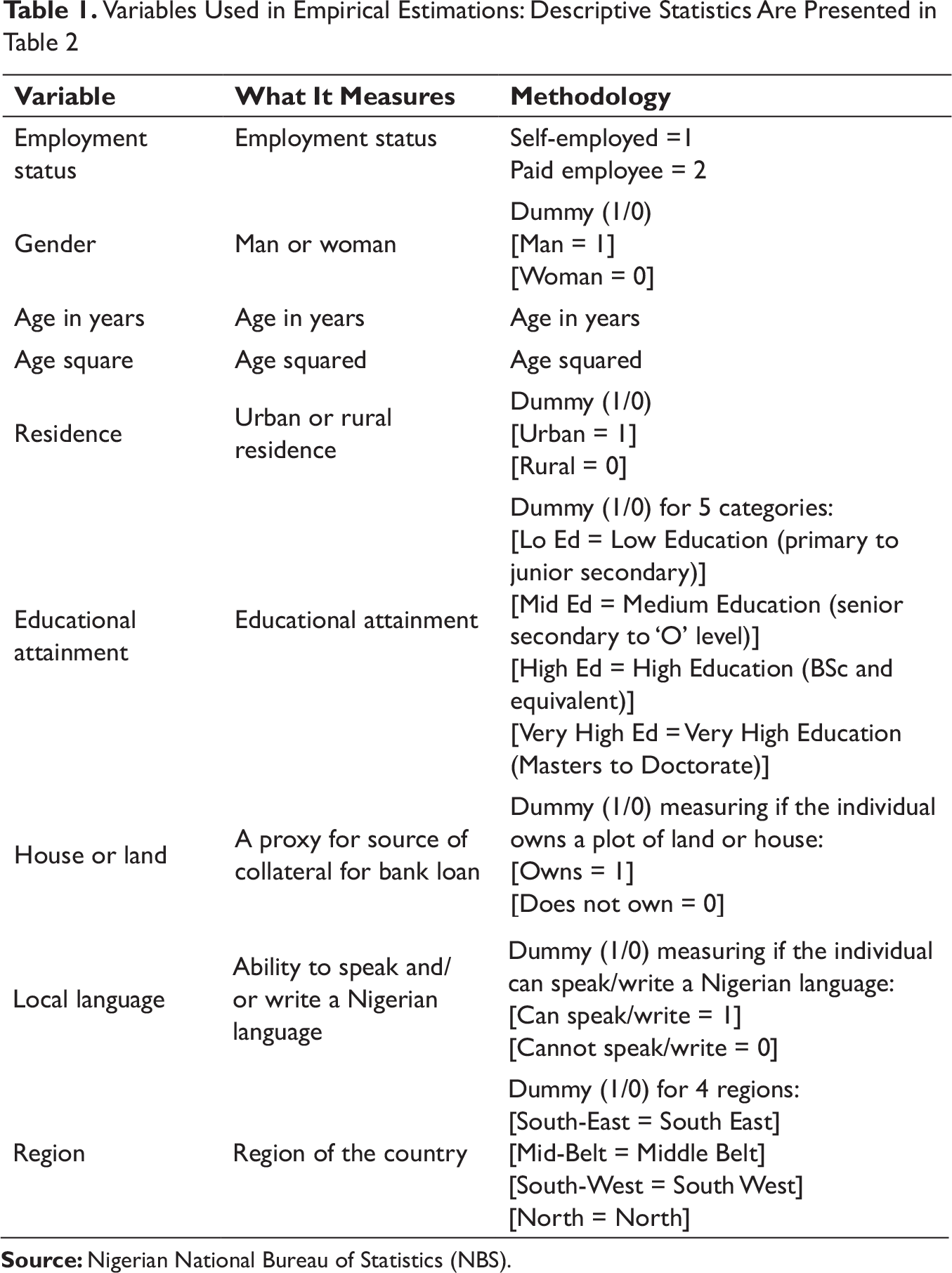
Variables Used in Empirical Estimations: Descriptive Statistics Are Presented in Table 2
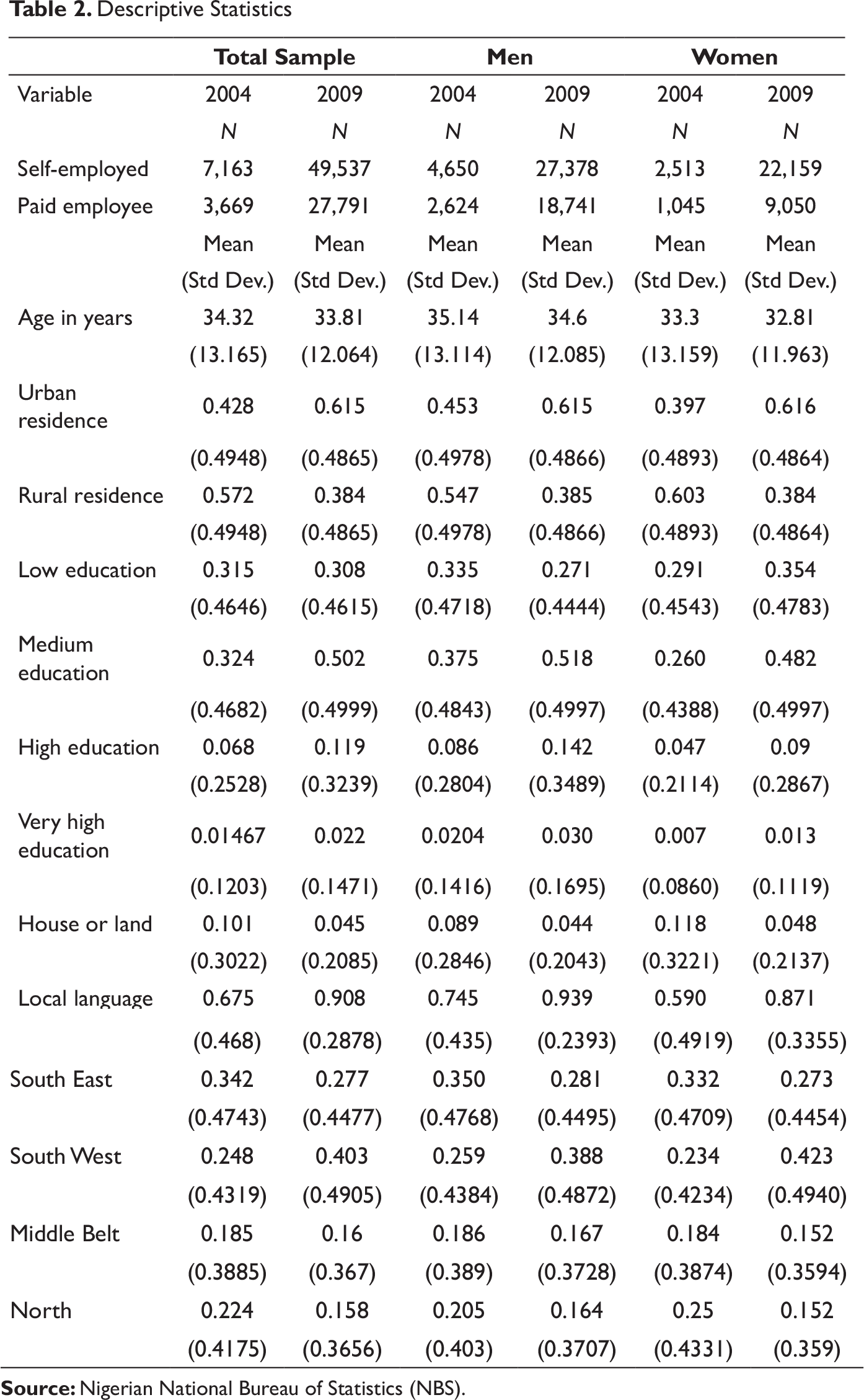
Descriptive Statistics
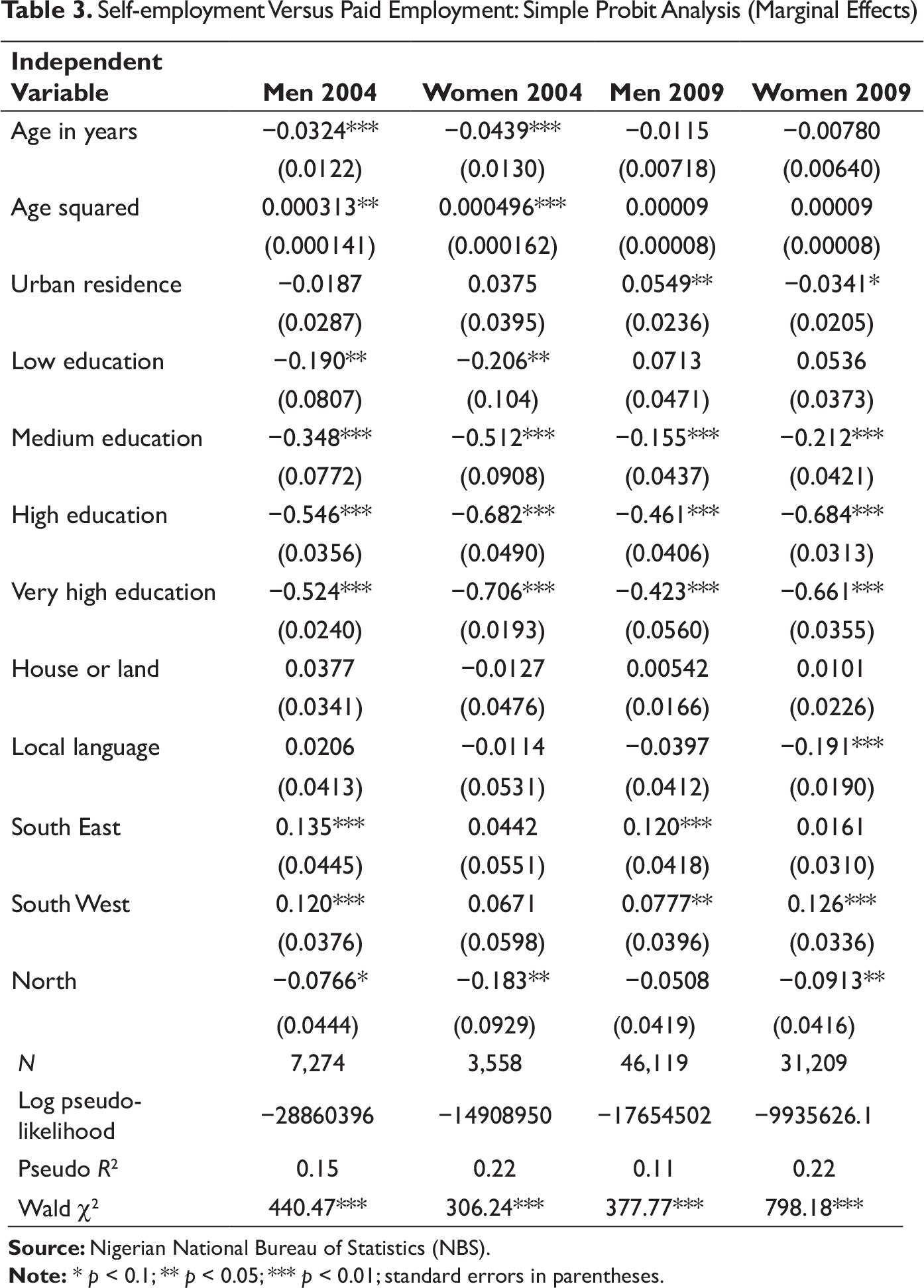
Self-employment Versus Paid Employment: Simple Probit Analysis (Marginal Effects)
Results
Table 3 presents the results of simple probit estimation [1.1] on both the 2004 and 2009 survey data. The Wald chi-square statistics, which are significant at the 1 per cent level, indicate that the regression specification is meaningful and the pseudo R2 shows that the regression gives a good fit. The results indicate that the probability of being in self-employment falls as educational attainment increases, especially for women. These regression estimates and standard errors are robust and consistent with different variations of the estimation.
The regression results indicate the following. First, in both years and across genders, educational attainments are the most consistent significant factors that influence the probability of being in either self-employed or paid employment. In agreement with other authors that have evaluated the link between employment and education in developing countries, the results indicate that the probability of being self-employed tends to fall as educational attainment increases (Maloney, 2004; Van der Sluis et al., 2005). The empirical results in Table 3 indicate that men in 2004 who possess a low degree of education are 19 per cent less likely to be in self-employment, and those who have a medium level of education are 34.8 per cent less likely to be in self-employment. For the highly educated, the probability of being self-employed drops to 54.6 per cent and for the very highly educated it is lower by 52.4 per cent. The empirical results in Table 3 also indicate that for men in 2009, the same pattern is observed generally, apart from the low education variable, which becomes positive but insignificant in this survey.
Results of Blinder–Oaxaca Decomposition: Endowment Differences

Table 4 reports the endowment results of the Blinder–Oaxaca decomposition estimation [1.2]; these results explain the sources of difference in the likelihood of being self-employed between the men and women samples. It is noted that the endowments effect tells us the explained variation in self-employment incidence due to endowments, while the coefficient effects tell us the unexplained variation which might be due to biases or other unknown reasons. The results indicate that for both 2004 and 2009, the endowment differences in education between men and women explain the dissimilarity in the likelihood of being self-employed to a large extent as can be seen by the constant significance of the educational endowment independent variables at the 1 per cent level.
Results of Blinder–Oaxaca Decomposition: Coefficient Differences
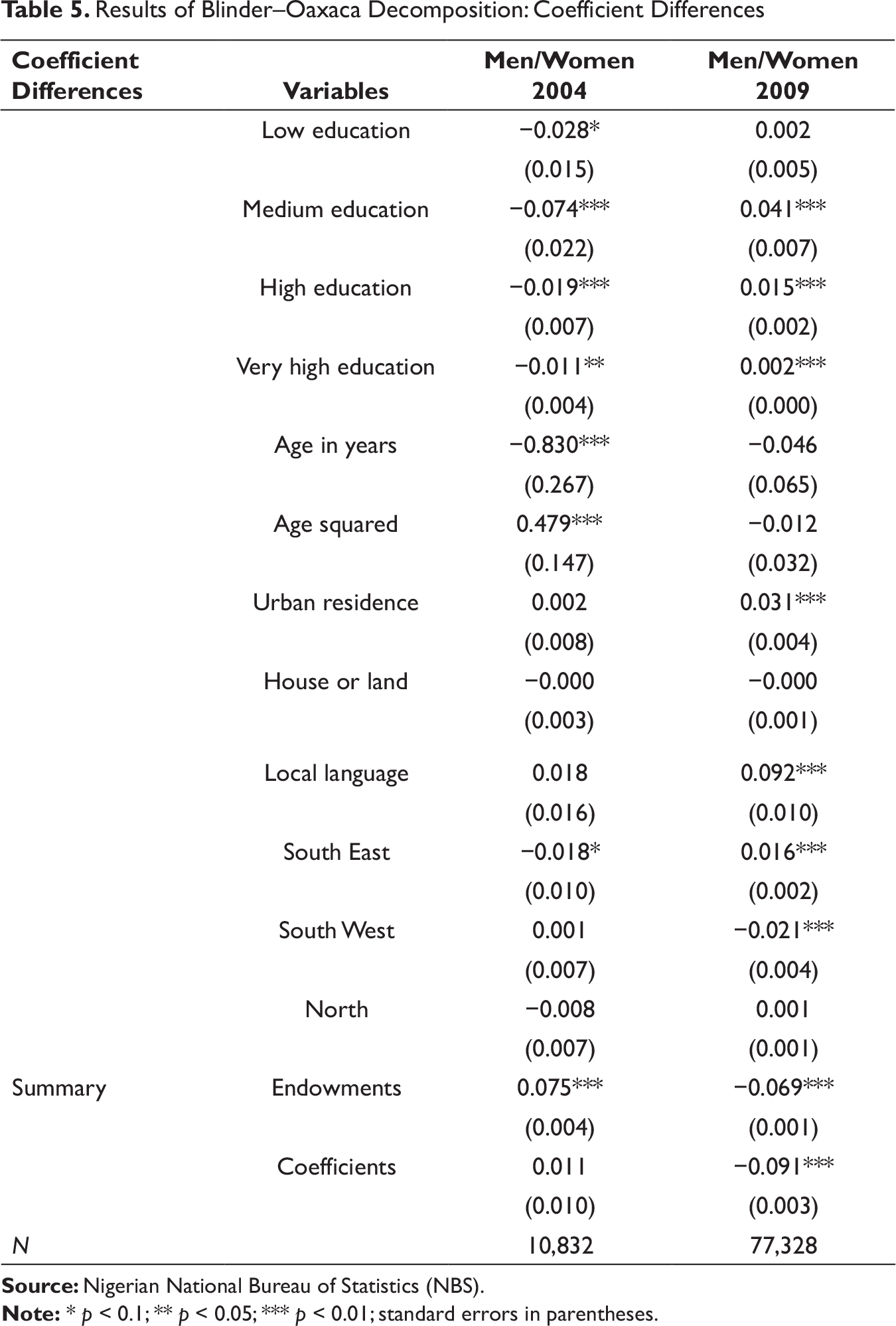
Table 5 shows the coefficient results of the gender-based Blinder–Oaxaca decomposition estimation [1.2]. They indicate that for 2004, educational coefficients account for 28 per cent, 74 per cent, 19 per cent and 11 per cent of the gender disparity from low, medium, high and very high educational attainments, respectively. For 2009, the gender coefficient disparity for medium, high and very high educational attainment is 41 per cent, 15 per cent and 2 per cent, respectively, confirming that women have lower educational endowments than men and these correlate with a higher proportion of women engaged in lower and medium education self-employment.
Is Gender Parity a Shrewd Policy Goal for Nigeria and Other Similar Countries?
The analysis conducted by this article has confirmed that gender parity in high education self-employment can be improved in Nigeria if educational endowments are equalized between Nigerian men and women. Sadly, Nigeria is not alone in exhibiting such gender inequalities (Huffman et al., 2017; Klasen, 2002). Would it be a useful policy goal for the Nigerian government and governments in similar countries to address the gender disparity found by this article?
Research indicates that raising female employment to be equal to male employment levels could increase GDP significantly in African countries. In addition, when women have more control over family resources, spending patterns tend to benefit children better and this improves the overall quality of life within the country (Borgen, 2017; Klasen & Lamanna, 2009). Empowering women boosts productivity, a benefit that could help countries rise out of poverty and related research reveals that placing more women in top jobs is a key ingredient for economic growth (Branisa et al., 2014; Elomäki, 2015). Higher education self-employed gender parity can introduce much-needed skills into the workforce, boost creativity and productivity, improve competitiveness and result in positive externalities.
Summary and Conclusions
The article has aimed to empirically investigate if women would be able to create more self-employed value if they had the same educational endowments as men in the unique context of Nigeria. Through the empirical analysis conducted in this article, it has been determined that if educational endowments were equalized between men and women in Nigeria, women would be able to create more self-employed value, particularly higher education self-employed value. The analysis carried out by this article is easily replicable with similar data and, in the future, it might be useful to conduct further research using other methodology in different contexts.
The article has also highlighted why gender parity does not exist in Nigeria and has further emphasized some implications for gender parity in the country. This article does not try to imply that the value created by self-employment is better than the value created by paid employees but reveals the gender bias that exists in the context. The findings have a number of significant implications as they confirm the importance of education in eliminating gender disparities in self-employment.
Declaration of Conflicting Interests
The author declared no potential conflicts of interest with respect to the research, authorship and/or publication of this article.
Funding
The author received no financial support for the research, authorship and/or publication of this article.