



Abstract
Abstract
Early research focused on complaint handling as a profit centre for organizations, but recently this approach has been shown to destroy value if not done correctly, due to the organization-centric rationale behind it. A new customer-centric approach, called complaint management, is shown to overcome the pitfalls of complaint handling and to act as a customer-centric compass for the organization leading to increased trust, profits and customer satisfaction. This approach not only creates value, but also helps integrate between the various departments in the organization. Finally, this article includes clear steps for implementation in any organization.
Introduction
Previous research (TARP, 1986) has highlighted the possibility of turning complaint handling into a profit centre in the organization. It is our belief that, while important, complaint handling does not go far enough towards preventing value destruction and in most cases may actually enhance the value destruction (see Customer Rage Study, 2017).
We suggest a customer-centric strategy (Fader, 2012) to offset the debilitating effects of value destruction by focusing on complaint management, thus allowing the organization to leverage customer complaints into a customer-centric compass for the organization while greatly increasing value creation.
This article will first focus on complaint handling, the strong vision and the sad reality of today. It will then discuss complaint management, its strengths and how it connects with customer centricity. The article will then finish with a practical look at implementing complaint management and its impact on value creation as a strategic resource for the organization.
Complaint Handling to the Rescue?
Complaint handling started to develop in the mid to late 1970s with a series of annual conferences on customer satisfaction, dissatisfaction and complaining behaviour, which later became the Journal of Consumer Satisfaction, Dissatisfaction and Complaining Behavior in 1988. TARP (1979) published its groundbreaking study on the profitability of complaint handling, which was later updated in 1986. Strong academic articles were published in the late 1980s (Fornell & Wernerfelt, 1987, 1988), as well as managerial articles (see Hart et al., 1990, for example) extolling the profitability of complaint handling. It seemed as if everyone was on the bandwagon, and yet, it did not really appear as if anything had changed. The first signs of cracks were highlighted by the first Customer Rage survey (Grainer et al., 2003). This survey has since been replicated every 2 years, taking a current and relatively dark look at the field of complaint handling. Where did we go wrong?
According to the first survey, 50 per cent of complainants never received an answer to their complaint. Of the complainants, 68 per cent experienced customer rage at the organization. Complainants had to connect with the organization 3.5 times on average to solve their complaint, but each extra connection lowered satisfaction from 40 per cent satisfaction for first call resolution (only 22% of respondents) to only 9 per cent satisfaction with three or more attempts to connect (58% of the respondents). These numbers have gotten much worse over the years. Clearly, something is not working.
It is our contention that the problem is not in the strategy but in the implementation of the strategy. According to Broetzmann and Grainer (2013), organizations are doing the right things but are doing them the wrong way. This would indicate that implementation is a serious issue. This author was able to show a return on investment (ROI) of 177 per cent on complaint handling, even before the appearance of sophisticated models of complaint handling. The concept does work, and it has worked for a lot of companies. But it does not work all the time, or even most of the time. How many organizations actually measure the ROI of complaint handling today? It is very informative to look at several reasons why the implementation might fail, even with the best of intentions.
Complaint handling deals with the
The three most important reasons why more consumers do not complain have been known for a long time. According to Goodman (1989), they are: it takes too much time, trouble and effort; no one really cares; and there is no useful channel of complaining. All three reasons can and should be addressed by organizations. Why have they not been?
Davidow (2014) found that organizational facilitation of submitting a complaint was the most critical factor influencing consumer satisfaction with the organizational response to their complaint. Sadly, this is an area where most organizations still fail. One key reason for this failure is the tendency to look only at the short term in order to minimize costs and become more efficient. Encouraging consumers to complain is not an efficient use of resources according to this view. By trying to minimize extra costs associated with complaint handling, or by outsourcing complaint handling, organizations are actually causing themselves long-term damage, by alienating customers, and lowering customer satisfaction.
Another key reason for the failure of the complaint handling strategy is because complaint handling is
What would happen if organizations take responsibility for all the problems—if they look for ways to prevent future problems, even if they were not the organization’s fault? We will discuss this in the next section.
The complaint typology is illustrated in Figure 1, focusing on both the organization and the consumer. Complaint handling is not focused on future improvement, but rather on doing the minimum necessary (efficiency) to handle the consumer complaint, thus reducing costs. It is, in effect, a cost centre for the organization to be minimized. By not focusing on the customer, organizations are not facilitating consumer complaints, thus leading to more consumers not complaining. This in turn keeps the number of complaining customers to a minimum, thus reducing the costs necessary to handle complaints. It is only in customer-centric organizations, where the focus is not only on handling the complaint today but also mainly on preventing future complaints, that the organization can reach complaint management, thus allowing the customer-centric organization to co-create value with the customers, by encouraging customer feedback and acting on it to prevent future complaints, thus turning it into a true profit centre in the organization. This will raise complaint handling costs in the short term, while significantly reducing complaints in the future, thus exponentially increasing long-term profits.

Complaint Management as a Value Creator
Complaint management, by contrast, is
Complaint management is
Complaint management as a value creation strategy works on two separate levels. On the basic level, it assumes that all complaints are subjectively legitimate. This is a major problem for organizations who tend to focus more on the functional aspects and look at the objective facts. Managers tend to forget that consumers look at things in a subjective manner. If managers are willing to focus on customer satisfaction and service quality (both very subjective), why will they not look at customer complaints with the same intensity? Davidow (2018) argued that functional/objective data does not cover the whole picture and does not take into account the subjective feelings of the customers. Managers tend to focus on the objective data only and tend to rate their performance very highly. Customers tend to look at the entire picture (including subjective issues) and thus tend to rate performance much lower. This leads to a huge gap between management perceptions and customer perceptions, as epitomized by the Bain research (reported in Meyer & Schwager, 2007) which found that while 80 per cent of companies surveyed thought they were giving a superior customer experience to customers, only 8 per cent of the customers surveyed felt that their experience was, in fact, superior. Managers need to focus on subjective matters as well as the objective ones; otherwise they are pushing away customers and inadvertently destroying value. Managers need to know what is important to customers, and need to give it to them better than the competitors. That is the competitive advantage.
There are several hurdles preventing consumers from complaining, as detailed earlier in this article. Organizations must therefore be actively searching for ways to encourage customer complaints, as this is a necessary but not sufficient condition of complaint management.
On the more advanced level, we analyse the complaints together with the customer (co-creation) (Vargo & Lusch, 2004). While complaint handling is inherently inefficient, as it is geared at each individual consumer, complaint management is geared at winning back each customer, and not at ‘winning’ the argument. This guarantees that the organization can protect the future stream of income from each customer over their customer lifetime value (Fader, 2012).
The procedure is simple: the organization settles each complaint as if it is justified (because subjective complaints are just as real as objective complaints). This is the customer’s story, and she/he is telling it to all her/his friends. No fuss, no argument, just an apology for the inconvenience and compensation for the damage done—this is the price of customer feedback.
Having mollified the customer, the organization now attempts to understand the source of the inconvenience. Utilizing the goodwill and trust generated by handling the complaint on the spot with no hassle, the customer is more than willing to share with the representative what caused the dissatisfaction in the first place, and what it would take to eliminate this pain point. This is the benefit to the organization. Having an open mind to the customer feedback will unlock a vast array of pain points that need fixing, and which customers were previously not sharing with the organization. Fixing these pain points will not only satisfy complaining customers today but will also eliminate thousands of future complaints, thus causing enormous value creation.
While this seems very simplistic, research has shown that consumers do not associate the word trust with the word business. Raphel (1990) reported that 90 per cent of Americans do not trust businesses, while in Australia, it was reported that 95 per cent of consumers do not trust businesses, and only 2.5 per cent of consumers believe organizations trust them (SOCAP Australia, 2003). Trust is taking the consumers at their word, and standing up to the organizational promise as well.
All complaints must therefore be handled (see Figure 2) in order to maximize value creation.
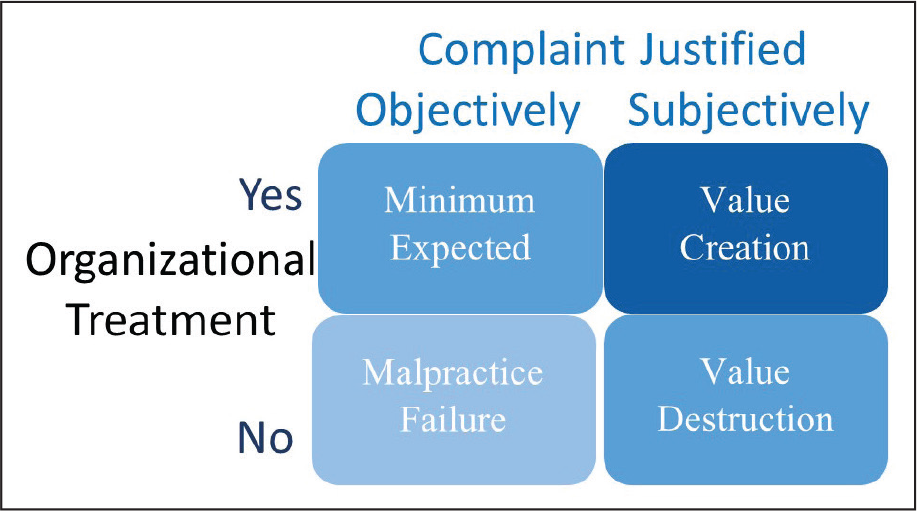
If the complaint is objectively true (organization responsible), we can locate the root cause and prevent it in the future, thus counteracting value destruction. This is the minimum expected of organizations today. Consumers are more concerned about wasting time than they are of a defective product (Customer Rage Study, 2017). Saving customers’ time and effort has become the new necessity.
Any company that does not handle an objective customer complaint is simply engaging in malpractice. At best it is negligence, or oversight. At worst it is incompetence. Either way, we are talking about the failure of the organization to right a wrong, thus causing value destruction. Not only is the customer upset at the original problem (objectively legitimate) but also now the organization has failed to correct the mistake. This double deviation will most likely cost the organization a customer in the short term, and may even cause the organization to cease to exist in the long term, if it is a common occurrence.
If the complaint is only subjectively true, then it is very likely that more consumers feel the same way. A poorly written advertisement or document or instructions may be understood the wrong way by consumers, thus destroying value. By focusing on the subjective complaint, it can be identified and corrected, thus again preventing thousands of future complaints (even though objectively the organization did nothing wrong). The organization is making every effort to identify customer pain points and to proactively eliminate them, even if they are not the formal responsibility of the organization. Solving customer problems is a great way to show trust and to create value. This will build customer trust in the organization in the short term, and customer loyalty and advocacy in the long term. This is the epitome of trustability (Peppers & Rogers, 2012), which leads to value creation.
A subjective complaint that is either ignored or not handled (as 50% are according to the Customer Rage Study, 2017) leads to value destruction. This is the problem with complaint handling, a myopic view which not only costs an organization future streams of revenue but also destroys current value by way of social media and word of mouth.
Complaint management is the customer-centric compass of the organization. It is the core of customer centricity. An organization which does not engage in complaint management cannot be customer-centric. It is not possible for an organization to act like it cares about the customer while ignoring customer complaints or hiding them in the basement. This causes the organization to appear two-faced or duplicitous.
Integrating Complaint Management
How can we integrate complaint management into the organization? As the core customer-centric capability in the organization, it has strong ties with the other departments in the organization and cannot be simply outsourced.
Take, for instance,
All current employees (including all senior management) should spend 1 week every quarter (1 month a year) re-training and working in complaint management by handling complaints. This will allow them to stay current on customer needs and issues. Having experienced employees handling complaints increases the likelihood of actually solving customer problems, thus preventing future complaints. It emphasizes to the employees the importance of taking care of the customer, and ensures that all policies and procedures pass the customer centricity test. It also stresses to new employees the importance the organization places on the customer relationship. It ensures that the new employees understand the importance of customer centricity, even after they have moved on to other departments.
Complaint management encourages impromptu teams forming to solve specific customer problems without waiting for formal procedures, to suggest changes in policies and procedures which have become outdated and now just interfere with helping the customer instead of actually helping them.
Customer centricity starts with complaint management. If an organization cannot be customer-centric in the face of a customer problem, then how will it be able to be customer-centric on a day-in-day-out basis? Complaint management is the ultimate ‘voice of customer’ and a strong facilitator of co-creation.
Complaint management is thus an effective customer-centric strategy to counteract value destruction because it focuses on the root source of the dissatisfaction from the consumer perspective and removes it from the public eye, thus greatly reducing value destruction not only for the complainers or for all dissatisfied consumers but also for all customers and consumers. Complaint management is a necessary but not sufficient condition for customer centricity.
How to Get Started
The first step on the path to complaint management is to actually measure the ROI of complaint handling in the organization. It is necessary to ascertain a baseline of complaint handling performance, so that it will be possible to measure progress.
Step two would involve intense discussions with the head of complaint handling and senior management in the organization. In service organizations, this should also include all service providers. What are the main complaints that the organization deals with today? What is being done to solve the problems? What more needs to be done? What are the new organizational goals for the complaint department?
Step three involves internal service. Customer centricity involves a team effort from every part of the organization. This will entail changing how we measure internal service. Current measures are not enough to solidify the necessary change in behavior. Complaint management is the tool that can bring the departments together working for a single cause: the success of the customer. Only when the internal service is excellent should we progress to the next step.
Step four involves unleashing the revamped complaint management on the complaining customers. Building on the previous steps will enable the complaint department to easily solve the critical pain points for the customer, relying on the internal service providers for key assistance along the way, and increase value creation to the customers, and lead to increased loyalty and profits to the organization.
Managerial Implications
Marketers tend to believe that filling customer expectations is enough to be successful. It is not. Organizations have to fill customer expectations better than the competition. It is not enough to know what customers want; managers have to know how they are doing relative to other companies. Complaint management is a necessary tool to allow organizations to understand where they are falling short and where they need to improve in order to be successful. The distinction between focusing only on objective (organization-centric) data and focusing on subjective (customer-centric) data is the difference between failure and success in the long run.
Complaint management is the customer-centric compass of the organization, showing everybody the path to success by focusing on the customer. The steps outlined in this article will allow any manager to change their organization into a customer-centric one. It is very simple to understand, but it is not very easy to do. It is very similar to dieting. It is very simple to understand how to lose weight. Eat less and exercise more, and the weight will drop. But it is not easy to do. Only the most determined organizations will be able to become customer-centric. There is no room for shortcuts, but the rewards are enormous.
Complaint management can transform any organization, but it needs the support of the entire organization in order to succeed. For those organizations that are really interested in putting the customer first and reaping the enormous benefits of increased customer satisfaction and loyalty and increased profits, this is the way to go. Complaint management signals trustability not only to employees, but also to consumers, who will advocate to their friends on behalf of the organization, thus eliminating the need for advertising. It is truly the competitive advantage that organizations are looking for.
Future Research
What is the impact of complaint management on internal service? How can we determine the ROI of reduced employee turnover, increased productivity and increased employee engagement due to a proactive approach to handling complaints, creating value and helping customers?
Value creation is an emotional construct, with value being in the eyes of the beholder—the customer. Service quality and satisfaction are also both determined by the customer, and the customer’s success is considered the foundation for the organization’s success. Being customer-centric is the best way to ensure the customer’s success, and complaint management is the best way to ensure customer centricity. The time is now.
Footnotes
Declaration of Conflicting Interests
The author declared no potential conflicts of interest with respect to the research, authorship and/or publication of this article.
Funding
The author received no financial support for the research, authorship and/or publication of this article.
