



Abstract
Over the years, value co-creation practices have become increasingly more important by supporting collaborative interactions and the achievement of sustainable and mutual competitive advantage between the ecosystem’ actors. In this direction, the oil and gas industry is proposing a sustainable re-use of offshore platforms based on value co-creation and resources exchange between the actors involved. According to this consideration, this work aims at re-reading the decommissioning of offshore platforms in the light of value co-creation practices, trying to capture the factors that governments and companies can leverage to pursue a sustainable development of local communities. To reach this goal, this work follows an exploratory approach by using, in particular, the case study. Specifically, one of the most notably projects in the Italian context have been chosen, the Paguro platform, in order to provide empirical insights into the nature of these value co-creation processes. Five value co-creation practices have been identified which highlight the importance of synergistic efforts of institutions, companies and technology-based platforms for improving the ability to co-create and capture value in the process of decommissioning. This exploratory work establishes a foundation for future research, and offers theoretical and managerial guidance in this increasingly important area.
Introduction
Value co-creation has brought a change in the marketing literature from the perspective of ‘making, selling and servicing’ to ‘listening, customizing and co-creating’ by rendering, in this way, the customer as the fulcrum of business (Mahajan, 2007, 2010, 2016; Payne et al., 2008). By successfully managing value co-creation practices (Frow et al., 2014; Hein et al., 2019), companies and organizations belonging to different fields can support collaborative interactions and contribute to sustainable and mutual competitive advantage with the actors involved in the ecosystem they shape (Iandolo & Cosimato, 2019; Palumbo et al., 2017; Vargo & Lusch, 2016). Moreover, the oil and gas industry activate processes of value co-creation involving all the actors of its ecosystem, by addressing issues in an innovative and sustainable way, such as the decommissioning of several offshore platforms existing all over the world. These, once the reservoir has been depleted or the structure has surpassed its shelf life, become large-scale structures whose disposal process is complex, expensive and impacting for the environment. Indeed, scholars have agreed that the reconversion of these platforms can deliver better environmental outcomes than their complete removal, in terms of biodiversity enhancement, provision of reef habitat and protection from bottom trawling (Henrion et al., 2015; Lakhal et al., 2009). This awareness has led some nations to leave obsolete structures as artificial reefs and/or to find alternative solutions for their sustainable reuse. In this direction, a multi-conversion of these assets can improve social well-being and local entrepreneurship initiatives and promote the sustainable value co-creation as the core purpose and the central process in the exchange of resources between the involved actors (Cosimato et al., 2020; Topham & McMillan, 2017; Zawawi et al., 2012).
Drawing on this consideration, this work aims at re-reading the decommissioning of offshore platforms in the light of value co-creation practices, trying to capture the factors that governments and companies can leverage to pursue a sustainable development of local communities. To reach this goal, this work follows an exploratory approach implementing the case study method. In particular, it has been chosen one of the most notably Italian projects, the Paguro platform, to provide empirical insights into the nature of these value co-creation processes. The Paguro wreck, a decommissioned oil and gas platform, has become today an important reference point among the natural and artificial reefs of the Adriatic. It is an interesting Rigs-to-reefs (RTR) that can be consider in perspective of offshore platforms, also known as multi-use platforms at sea (MUPS), as an example of win-win solution triggering both socio-economic development and environmental protection.
After a brief revision of the extant literature on value co-creation practices and the decommissioning in terms of co-created value, we illustrate the research methodology and the main findings. We then discuss the results and highlight the main implications and limitations of the research.
Theoretical Background
An Ecosystem Perspective on Value Co-Creation Practices
Over the last ten years, the value-dominant logic (V-D) has become increasingly more important by making the customer as the fulcrum of business (Mahajan, 2007, 2010, 2016). Assuming this perspective, all the processes and systems are designed within the organization with the aim to add value to the customer, which leads to value creation for the entire ecosystem of stakeholders, including employees, shareholders, suppliers and society. In a similar vein, the service-dominant logic (S-D) (Lusch & Vargo, 2006, 2014; Vargo & Lusch, 2008) considers all the exchanges as service-for-service exchange, that is, the reciprocal application of resources for others’ benefit. The creation of value is considered the final aim of maintaining and increasing the wellbeing and the viability of the several actors engaged in reciprocally beneficial service exchanges. Value creation impacts all the areas of service thinking and can be independent of and synergistic with service per se (Mahajan, 2017). In both approaches, the concept of ecosystem is central. Indeed, on the one hand according to V-D logic, all the actors involved in the ecosystem aim to create and to absorb value (Mahajan, 2017). On the other, considering S-D logic, the service ecosystem perspective is intended as a system of resource-integrating actors connected by shared institutional arrangements and mutual value creation through service exchange (Vargo & Lusch, 2016). Accordingly, the value is not limited to the evaluation of an individual person (or actor), but it is based on the ability of a system to adapt and prosper in its social environment in agreement with the institutions, that is, common rules which govern interactions and drive towards value creation and sustainable development (Barile et al., 2013; Frow et al., 2019). This is in line with the concept of sustainability which is based on the adoption of a multi-level perspective that starts at the micro level and ends at the macro to encourage social and political–institutional paths of shared growth (Iandolo and Cosimato, 2019; Palumbo et al., 2017). Indeed, the ecosystems’ view allows a multi-level analysis of co-creation practices and focus on stratified governance, decision-making and policy-making process at each level. In this regard, value co-creation practices refer to interactive activities between actors that share their resources to make value proposals in the social context (Frow et al., 2014; Hein et al., 2019; Pellicano et al., 2018). The interactions between the actors aimed to co-create value are based on dialog, access, risk-benefits and transparency (Prahalad & Ramaswamy, 2004). Generally, these practices can be beneficial, for instance by involving the final customer and carrying out innovative products or services (Prahalad & Ramaswamy, 2004; Russo-Spena & Mele, 2012; Spena & Di Paola, 2020). Moreover, these can be also negative bringing to the co-destruction of value (Echeverri & Skålén, 2011; Marcos-Cuevas et al., 2015). Recently, value co-creation practices are related to the use of platforms for integrating and sharing resources between each ecosystem actor (Golooba & Ahlan, 2013; Skålén et al., 2015). In this vein, some authors (Ciasullo et al., 2017; Frow et al., 2016) identified and described some different co-creation practices, for example, dedicated to health care domain, pointing out their positive or negative effects and providing indicative measures of co-creation. However, it is worth noting that companies and organizations coming from different domains also can benefit from the personalized application of these value co-creation practices, based on collaborative multi-actors interactions, their long-term engagement, and aimed at contributing to the achievement of a sustainable and mutual competitive advantage.
Decommissioning Offshore Platforms for Co-creating Value
The decommissioning of offshore oil and gas platforms consists of an expensive and environmentally impactful process based on the plugging of the hole in the earth’s surface and disposal of the equipment used. According to BCG (Zeldovich, 2019), it was estimated that more than 50,000 offshore wells and 10,000 offshore structures will be decommissioned worldwide along with hundreds of thousands of onshore wells, facilities and sites. However, due to the decommissioning costs and environmental impacts of the complete removal, many operators are considering alternative uses of these assets by creating MUPs according to the value co-creation principles (Basile et al., 2021; Capobianco et al., 2021; Loia et al., 2021). Indeed, scholars have agreed that the reconversion of these platforms can deliver better environmental outcomes than the complete removal in terms of biodiversity enhancement, provision of reef habitat and protection from bottom trawling (Henrion et al., 2015; Lakhal et al., 2009). This awareness has led some nations to leave obsolete structures as artificial reefs and/or to find alternative solutions for their sustainable reuse. This example comes from the Gulf of Mexico, where the ‘Rigs to Reefs’ (RTR) strategies have become successful case (Ajemian et al., 2015; Sayer & Baine, 2002) based on the adaptation of the platforms into an artificial reef. Such biotic reefs have been created from oil rigs in the United States, Brunei and Malaysia (Twomey, 2012). Furthermore, these platforms can be readapted for developing wind and waterpower generation systems (Jensen et al., 2020; Smyth et al., 2015; Sun et al., 2017). Another solution concerns the introduction of fish cages into the jacket of the decommissioned platform for creating an environment to support farming coastal fish or the integrated multi-trophic aquaculture (IMTA) based on the combination of fed aquaculture species (e.g., finfish) with inorganic extractive aquaculture species (e.g., seaweeds) and organic extractive species (e.g., suspension and deposit-feeders) cultivated in proximity. Such systems can offer several economic, socio and environmental benefits, including the recycling of waste nutrients (Troell et al., 2009).
The reconversion of these structures, which can become a point of interest for recreational, educational and sport activities, improves local seafaring tourism, thanks to the provision of innovative wellbeing outdoor services (Kruse et al., 2015). In this direction, a multi-conversion of these assets can improve social well-being, employment and local entrepreneurship initiatives by promoting the value co-creation as the core purpose and the central process between the actors involved (Topham & McMillan, 2017; Zawawi et al., 2012). However, even though the literature has highlighted the existence of value co-creation paths in the reconversion of offshore platforms, a better investigation of the co-creative practices which can help governments and companies to pursue a sustainable development of local communities still remains an open question.
Methodology
The case study method has been implemented with the purpose to re-read the decommissioning of offshore platforms in the light of value co-creation practices. As described by Punch (1998), this research technique can be defined as an empirical research where data is not produced in the form of numbers and offers several positive aspects such as the depth of analysis. Moreover, this method has a high conceptual validity, because it leads to deeply understand contexts and processes, also offering the possibility of promoting new hypotheses and new research questions (Yin, 2013). A case study can describe moments, problems and meanings that people attribute to a particular subject or event within a natural environment (Denzin & Lincoln, 1995; Sekaran & Bougie, 2013). In fact, this methodology can provide a detailed analysis aimed at gathering information about an object, event, or specific activity. Drawing on these considerations, an exploratory approach was adopted based on the single case model (holistic) (Yin, 2013). Therefore, to re-read the decommissioning of offshore platforms in the light of value co-creation practices, the case of an Italian platform located in Northern Adriatic Sea has been selected. This area is particularly relevant in Italy because it is characterized by 21 platforms which will be decommissioned by 2021–2022 (MISE, 2017). Furthermore, the Emilia-Romagna region of Italy located along the Northern Adriatic Sea is an area with the highest density offshore oil and gas in Italy as well as in the Mediterranean. In this zone the re-uses of facilities are potentially favoured due to the proximity to shore, the industrial port and oil and gas base, and well-developed coastal and maritime tourism and aquaculture sector. The selected case is the Paguro gas platform’s wreck, which is a significant example of RTRs that can be considered in perspective of MUP. The case study has been analysed collecting secondary data, retrieved from relevant documents and reports correlated to the Paguro platform. Secondary data offer several advantages, relating, for example, to the possibility of consulting large collections of information from online sources through appropriate search strategies and the ease of data retrieval (Hox & Boeije, 2005). The reinterpretation of the Paguro platform shed light on five value co-creation practices which highlight the importance of synergistic efforts of several actors for creating value at micro and macro level.
Paguro Gas Platform’s Wreck
In 1965, in the Adriatic Sea, the Paguro platform, during some methane gas extraction, exploded, it caught fire and sank to the bottom, creating a 35 metre crater. It is submerged in 10–33 metre water depth, within a depression caused by the blowout. Over time the site has become an oasis of life with a wild fauna and flora. The platform now rests 12 miles away from the port of Marina di Ravenna at a depth of 25 metres. In July 1995 it was declared biological protection zone (BPZ) by the Italian Ministry of Agricultural, Food and Forestry Policies (MiPAAF). This recognition, together with the establishment of the Paguro Association of Ravenna in 1996, contributed to the safeguard of marine life in the protected area. The association was created near the area to preserve, protect and enhance the wreck, as well as regulate the sportif, educational and scientific divings. With Commission Decision 2012/14/EU, the Paguro gas platform’s wreck was also designated as site of community importance (SCI code: IT 4070026) and a management plan was redacted, delineating further conservation constraints. In 2019 it was declared special area of conservation (SAC) of the biodiversity. It has become a valuable habitat and is now a European Protected Site under the Habitats Directive Natura 2000 ecological network. During the period of 1990–1991 and 1999–2000, dismantled jackets from about 20 other platforms were disposed in the area, creating an artificial reef, which is now a destination for intense diving activity. As a SCI, it is managed through a management plan with specific objectives of conservation and protection habitat and species, as well as raising social awareness and local population involvement. Related measures are therefore connected with a strict control of accesses to the site (leisure, training and scientific diving) and the prohibition of whichever type of fishing, also including continuous monitoring activities.
The non-governmental organization (NGO) Paguro Association of Ravenna is in charge for diving authorization and managing recreational activities. The NGO acts to promote the site’s cultural and natural heritage and relates to several diving schools, and organizes educational events (e.g., diving days). It is also connected with the National Museum of Underwater Activities in Marina di Ravenna, where historical, cultural and educational activities are carried out. Public institutions, research institutes and associations (such as, Forests and Mountain Development Service, Emilia-Romagna regional office, Environment Energy Prevention Agency of Emilia-Romagna (ARPAE), Dephne Oceanographic Unit, Marine Research Centre in Cesenatico, Paguro Association of Ravenna, the local Coast Guard in Porto Corsini) are responsible for the correct implementation of the Management Plan and that are involved in the environmental conservation of the site. Scuba diving associations, diving clubs and small and medium-sized enterprises (SMEs) such as dive centre and boat rentals, are engaged in the process of valorization of Paguro wreck as well as aim to offer a valuable tourism proposal.
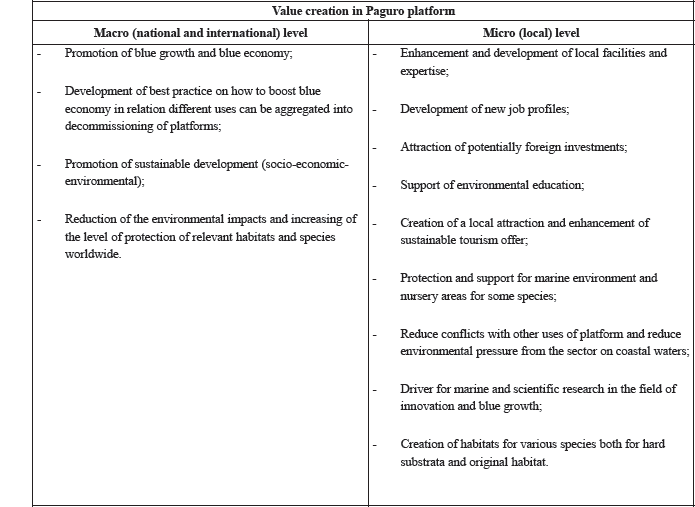
Therefore, Paguro, by representing a valuable combination of environmental protection and underwater cultural heritage, can contribute to the value creation at micro and macro level (Figure 1). This artificial reef, in the local system, by protecting marine environment, can increase the diving activities and tourism offer, develop new job profiles, as well as improve the local environmental education. In this way, a reconverted offshore platform can act as a driver for improving local tourism, profitability of SMEs in the area, and the local employment initiatives. At national and international level, the reuse of Paguro platform is a valuable case of promotion of blue growth and sustainable development, aimed at increasing the level of protection towards marine habitats and species.
Result Presentation and Discussion: A Focus on Value Co-creation Practices for Offshore Platforms
Institutional Practices
Institutional practices, which are based on common rules or norms (Barile et al., 2013; Frow et al., 2019) can influence the governance policies and management activities put in place for encouraging a sustainable re-use of offshore platform. In the case of Paguro platform several institutions, mainly public, research institutes and associations, have been responsible for the definition and correct implementation of the management plan aimed at environmental conservation of the site. In particular, numerous Italian ministries, such as the Ministry for Economic Development (MISE), the Ministry of Environment, Land, and Sea (MEIT), the Ministry of Cultural Heritage and Activities and Tourism (MiBAC), the Ministry of Agricultural, Food and Forestry Policies (MiPAAF), and the Ministry of Infrastructure and Transport (MIT), defined the institutional arrangements which govern the interactions between the other actors involved (tourist and marine entities, citizens, and so on) and drive towards the value co-creation. As well as the Emilia-Romagna region played an important institutional role by defining the biological protection zone as a site of community interest during 2010. From that moment, Paguro platform has acquired greater attention by the local citizens, and national and international tourists.
Also, Paguro Association had a recurring role from an institutional point of view. Indeed, to regulate diving and safeguard the life around the wreck, the Paguro Association was established in Ravenna, and since 21 July 1995 the area containing the wreck of the platform has been declared a biological protection zone by the Ministry of Agricultural Resources. The Paguro Association of Ravenna preserve, protect and enhance the Paguro wreck, regulate the sportif, educational and scientific divings.
Innovative Practices
Innovative practices refer to the development of innovative products or services driven by co-creation approaches such as co-ideation, co-valuation, co-design, co-testing and co-launching (Prahalad & Ramaswamy, 2004; Russo-Spena & Mele, 2012). In the case of Paguro, the collaboration between several actors, belonging to different field (tourism, environmental protection and underwater cultural heritage), with the institutional support, has led to the definition of the re-use/multi-use approach for the platform. The valuable and innovative example of Paguro was studied by several national and international scholars (Fauvelot et al., 2012; Ponti et al., 2002; Triossi et al., 2013) and helped to define RTR option, where decommissioned offshore oil and gas rigs can be converted into artificial reefs. Furthermore, there has been founded an innovative and creative wine farm called ‘Tenuta del Paguro’ in Romagna, which chose the Adriatic Sea to place its wines 30 metres deep in its waters for their ageing. In addition, Paguro Association has been granted permission to proceed to the placement of new structures, about one hundred meters from the Paguro wreck, to offer further refuge areas for marine fauna and to prevent any illegal fishing. In this way, the area, offering uncommon routes and scenarios to divers (both for sport and research purposes), has become a mega living laboratory for study and research in the open sea.
Educational Practices
Educational practices, based on shared language, symbols, signs and stories (Frow et al., 2016), cover an important role in the value co-creation process, by influencing the actors’ mental model. In the context of Paguro, educational practices regard several initiatives carried out with the aim to involve actors and raise social awareness about the sustainable development. Specifically, educational events, such as diving days to the site, or underwater watching projects, for monitoring the marine environment, have been organized to support environmental education.
Also, Paguro platform hosted several training courses for becoming diving guides. These activities were fundamental for training who was interested in working in Paguro context.
Resources Management Practices
An appropriate resources management is essential to ensure the survival of any service system which aims to interact for integrating resources and achieving a mutual advantage (Vargo & Lusch, 2008). In this sense, resources management practices define the necessary resources and operational methods for co-creating value between the several actors involved in the ecosystem (Frow et al., 2016; Skålén et al., 2015). In the offshore platform’s context, the actors, such as citizens, as well as scuba divers, tourists and environmental organizations, should be involved for enabling the resources exchange, for defining the market and answering to the customer needs. In this sense, online platforms can help to propose with greater intensity value propositions, integrate resources and offer better communication between the actors thanks to an adequate infrastructure. In several online platforms (such as the web portals of Emilia Romagna region, tourism websites, scuba online portals, Italian marine biology website), a section about Paguro platform has been developed for, on the one hand, promoting the project and strengthening the social participation; on the other hand, for acquiring the attention and creating interactions with local SMEs interested in working in Paguro ecosystem. Also, the website of Paguro Association 1 was created to regulate the sportif, educational and scientific divings.
Co-Destruction Practices
As highlighted by the consolidated literature, interactions do not always create value, but sometimes are associated with the value co-destruction which derives from the improper use of the resources by the actors (Echeverri & Skålén, 2011). To avoid potentially destructive collaborations, it is necessary to identify the interactive process associated with these negative results of co-creation practices (Jaworski & Kohli, 2006) or to choose collaborations and interactions which are less risky (Etgar, 2008). The co-destruction of value consists in a value exchange which, for one actor, can be positive, but for the other one who participates in the exchange, can be detrimental. This refers not only to the decline in value, but also to the negative change compared to high expectations on some delivery services. Considering the Paguro wreck context, there are some interactions which have led to a co-destruction of value. For instance, illegal fishing activities have occurred and have damaged the local marine ecosystem. Also, the phenomenon of abandoned, lost, or discarded fishing gear have caused several damages in terms of alteration of the marine ecosystems, risks for navigation and damage to boats, risk for diving activities. Accordingly, the controls were increased to enable the adequate environmental conservation of the site. Also, before reaching a project regulation, the lack of awareness in the operators of the tourism, diving, environmental sectors along with the bureaucratic, organizational and managerial obstacles has caused an inadequate planning about the Paguro wreck. However, the initial period of turbulence has pushed towards an adequate administration of the site thanks to the predisposition of the management plan.
Conclusions and Future Lines of Research
In the current context, decision-makers should adopt a customer-centric perspective based on a changing mindset aimed at creating value for all stakeholders belonging to the ecosystem (Mahajan, 2007, 2010, 2016). In this sense, the MUP, and specifically the case of Paguro, represents a valuable example of sustainable development and value co-creation for the entire ecosystem of stakeholders, including citizens, local firms and environmental organizations. Specifically, five value co-creation practices have been identified which highlight the importance of synergistic efforts of institutions, companies and technology-based platforms for improving the ability to co-create and capture value in the process of decommissioning. However, the work provides preliminary insights that pave the way for further investigation for a deeper understanding on this issue. In fact, the field of investigation should be broadened, being limited to a single case study. In this sense, the limited nature of the research does not allow us to generalize, although the insights that emerged from this first study can provide a useful stimulus for future studies based on multiple case studies. Future lines of research could concern a data driven analysis on a social network to frame the collective awareness on the MUP. Moreover, due to the relative scarcity of specific literature, it might be of interest to adopt an ecosystem perspective to highlight the different resources exchanged and value propositions that are pursued by the industry’s actors.
Footnotes
Acknowledgements
This research is part of a larger European offshore platform conversion project called PON-PlaCE (Offshore Platform Conversion for Eco-Sustainable Multiples Use - cod. ARS01_00891).
Declaration of Conflicting Interests
Funding
The authors received no financial support for the research, authorship and/or publication of this article.
