




Abstract
Arguably the most important Roman Catholic leader in postcolonial Uganda, Emmanuel Cardinal Nsubuga is largely unknown outside the country. As archbishop of Kampala between 1966 and 1990, Nsubuga hosted the first papal visit to sub-Saharan Africa in 1969 and started the Uganda Martyrs’ Shrine, now the largest pilgrimage destination in East Africa. Living under the authoritarian regimes of Milton Obote and Idi Amin, Nsubuga embodied three key emphases in modern Catholic mission in the public sphere: the option for the poor, ecumenism, and resistance to political dictatorship.
Tens of thousands of Ugandans streamed into Nakivubo Stadium in Kampala on October 30, 1966. The fans gathered not to see the national soccer team but rather to witness the consecration of Fr. Emmanuel Kiwanuka Nsubuga as Uganda’s second indigenous Catholic archbishop. Fr. Clement Kiggundu’s welcoming address captured the enthusiasm of the moment. “Half a million Catholics of his Archdiocese now have to look to him for instruction, advice, and guidance. . . . People of other creeds will also look on him as a leader, not merely in spiritual and ecclesiastical matters, but also in other fields.” 1 At the end of the Mass, Archbishop Nsubuga came forward to address the crowd. “It is true what the Pope’s representative has said, that I am your shepherd, your bishop. Do please heed what I shall be telling you, knowing fully well that I shall be doing so in the name of the Lord. I am not for Catholics only; I am for you all.” 2
Over a subsequent quarter-century marred by dictatorship, war, and gross human rights violations, Nsubuga embodied his vow to be a shepherd for all of the Ugandan people. As Uganda’s most important postcolonial Catholic bishop, he embodied three key emphases in modern Catholic mission in the public sphere: the option for the poor, ecumenism, and resistance to political dictatorship. Overshadowed in the past by his Anglican contemporary, Archbishop Janani Luwum, Nsubuga offers an important witness of Catholic leadership and mission in a continent rapidly becoming the vibrant heart of contemporary global Catholicism.
Personal background
Emmanuel Kiwanuka Nsubuga was born November 5, 1914, in Kisule Village, Singo County, Busuubizi Parish. 3 His home was located in the heart of Buddu Province, the Catholic bastion of the Buganda kingdom, settled by Catholic chiefs after the religious wars of the early 1890s. 4 Nsubuga was one of eight children in a family known for its deep Marian piety, a devotion inspired in part by the White Fathers, or Missionaries of Africa, the missionaries who had first arrived in the region in 1879. From the age of six, he lived with his paternal aunt in Bukuumi, seventy miles from his parental home. While attending primary school in Bukuumi, he encountered several of Buganda’s first African priests. Inspired by their witness, Nsubuga entered Bukalasa Minor Seminary at the age of sixteen. Here he struggled with a series of health setbacks. Despite concerns over his physical constitution, Nsubuga was promoted to Katigondo Major Seminary in 1937 and ordained a priest in December 1946 at the relatively advanced age of thirty-two.
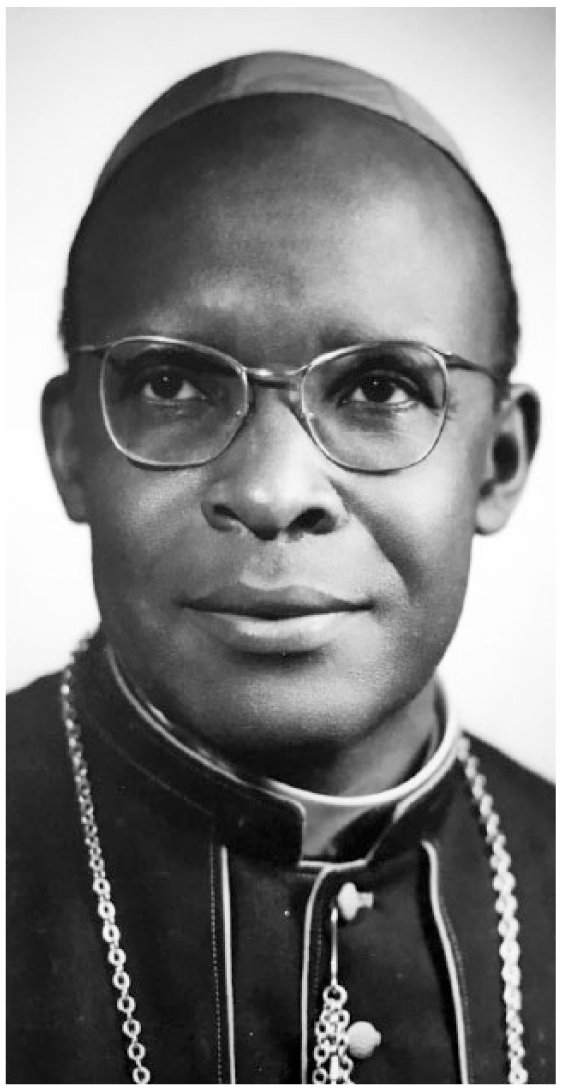
Emmanuel Kiwanuka Nsubuga was consecrated in October 1966 as Uganda’s second indigenous Catholic archbishop.
Over the next fifteen years, Nsubuga made his mark in two separate Catholic parishes, serving as school director, associate pastor, and pastor. He became known in the parishes for his motto “Let us pull up our socks and together we will succeed,” a sentence he used to try to wean local Catholics from dependence on foreign missions. 5 In June 1961 he was appointed vicar general of the Archdiocese of Rubaga. The archbishop of Rubaga, Joseph Kiwanuka, was the first modern African Catholic bishop in sub-Saharan Africa. Before his episcopal appointment in 1939, Kiwanuka had taught Nsubuga in the seminary. He now mentored him as a diocesan administrator. With Kiwanuka in Rome for the four sessions of Vatican II (1962–65), Nsubuga served as the de facto diocesan coordinator during the early 1960s. The two men were very close, and it was Nsubuga who gave Kiwanuka last rites when the latter died on February 22, 1966. It did not come as a surprise, then, when in August 1966 the Holy See appointed Nsubuga as the archbishop of the newly created Archdiocese of Kampala. Reflecting his deep Marian devotion, Nsubuga adopted as his episcopal motto “Mater profer lumen caecis,” or “Mother, give light to the blind.” 6
Nsubuga served as archbishop of Kampala between 1966 and 1990. Notable achievements included his invitation for, and hosting of, the first papal visit to sub-Saharan Africa, a mission made famous by Pope Paul VI’s call in Kampala that “you Africans may, and must, have an African Christianity.” 7 Nsubuga also oversaw the fundraising and construction of the Uganda Martyrs’ Shrine at Namugongo, outside Kampala. Finished in 1975, this shrine has become the premiere Catholic pilgrimage destination in Africa, drawing upward of three million visitors for the annual June 3 Feast of the Uganda Martyrs. 8 Pope Paul VI named him as the first Ugandan cardinal in 1976. In 1971 Nsubuga inaugurated St. Mbaaga’s Seminary as a formation house for older men entering the seminary and later spearheaded the development of Centennial Bank as the first Catholic-run banking network. Shortly after his retirement in 1990, Nsubuga died on April 20, 1991, while seeking medical care in Germany. His body was flown back to Uganda and displayed at the parliamentary building. For four days, mourners later filed past his body in Rubaga Cathedral. 9
The option for the poor
Since his election in March 2013, Pope Francis has insistently called on the Catholic Church to be a “poor church for the poor.” 10 This call has challenged the church not only to stand for the marginalized (e.g., the materially poor, refugees and immigrants, and the unborn) but also to embody a humbler, less grandiose institutional life. The pope himself has tried to match his words with witness, whether in moving from the grand papal apartments to a nearby Vatican hotel or in welcoming Syrian refugees to live in the Vatican. The pope’s insistent calls for a “preferential option for the poor” echo other key voices from the modern Catholic magisterium, including his papal predecessors Pope Benedict XVI and Pope John Paul II and the famous Latin American bishops’ conferences at Medellín (Colombia) and Puebla (Mexico). This missiological emphasis is perhaps best emphasized in the opening words of Vatican II’s Gaudium et spes, the 1965 Pastoral Constitution on the Church in the Modern World: “The joy and hope, the grief and anguish of the men of our time, especially of those who are poor or afflicted in any way, are the joy and hope, the grief and anguish of the followers of Christ as well” (§1).
If one is looking for an African Catholic embodiment of this “poor church for the poor,” Emmanuel Nsubuga would be a good model. In my interviews with survivors from the period, Nsubuga was repeatedly remembered as humble and non-elitist, a pastor with a common touch who visited parishes, comforted refugees, hugged children, and loved the poor. His 1969 Easter homily captures the ethos of Nsubuga’s preferential option for the poor. “Hope, to be Christian, has to be effective for our fellow men. That means in a concrete way. Our hope has to give hope to them who are poor and ‘left out’ in our society, our hope has to kindle hope in them who have lost confidence in themselves and trust in the others.” 11
Nsubuga matched his words with actions. Most notably, he started the Good Samaritan Sisters and the Amans Brothers, two new religious congregations dedicated to working primarily among the poor, the disabled, and the destitute. Nsubuga also approved Sr. Rose Mystica Muyinza’s Daughters of Charity, a lay religious community of social workers, war widows, and AIDS orphans working on the streets of Kampala and Masaka in the 1980s and 1990s. He covered wedding expenses for poor Catholic couples who wished to marry in Rubaga Cathedral. Nsubuga also started Nalukolongo Home for the Disabled, Aged, and Destitute, a place where he volunteered every Friday. In fact, he loved Nalukolongo so much that he requested to be buried there rather than the traditional burial place for bishops at Rubaga Cathedral. In the words of former Nalukolongo administrator Sr. Teresa Basemera, “He thought that if he was buried here, people will not forget the poor.” 12 His small shrine at Nalukolongo remains a popular spot for prayer in Kampala.
For an African Catholic hierarchy that has struggled at times to embody simplicity, Cardinal Nsubuga’s witness is a critical one. To echo Pope Francis, Nsubuga’s authority grew from his identity as a “shepherd who took on the smell of the sheep.” 13 Far from closeting himself away from the poor, he opened his life and his church to them.
Ecumenical solidarity
Since Vatican II, the Catholic Church has also embraced ecumenism and interreligious dialogue as constituent parts of its mission. In the words of Nostra aetate, Vatican II’s document on interreligious dialogue, “The Church, therefore, exhorts her sons, that through dialogue and collaboration with the followers of other religions, carried out with prudence and love and in witness to the Christian faith and life, they recognize, preserve and promote the good things, spiritual and moral, as well as the socio-cultural values found among these men” (§2). As with the option for the poor, this ecumenical commitment has been embraced by all post–Vatican II popes, including Pope Francis. Here too Nsubuga also made a major mark in Uganda.
Nsubuga continued and expanded on the legacy of his predecessor, Archbishop Joseph Kiwanuka, as a committed ecumenist. Kiwanuka had collaborated with his Anglican counterpart, Archbishop Leslie Brown, to start the Uganda Joint Christian Council (UJCC) in 1964. After 1966 Emmanuel Nsubuga served in the leadership of the UJCC, and he initiated a new UJCC Committee for Ecumenism in 1969. Later that year, he exchanged a ritual kiss of peace with his close friend Anglican bishop Dunstan Nsubuga. In the early 1980s he hosted the first-ever visit of the Anglican archbishop of Canterbury to Rubaga Cathedral. 14 His religious outreach also extended to Islam. In 1967 he became the first Catholic leader to pay a formal visit to a Muslim community, and he later supported the construction of a mosque and a Catholic church on the site where Muslims had hosted the first White Father missionaries in 1879. 15 For Nsubuga, ecumenical collaboration necessitated a “change of heart” on the part of both Catholics and Protestants, recapturing the spirit of ecumenical solidarity that marked the witness of the original Uganda martyrs. 16
Nsubuga’s ecumenical collaboration helped establish the Christian churches as independent bulwarks during periods of severe political repression in the 1970s. For example, between 1973 and 1975, Nsubuga worked with Anglican leaders to raise concerns with Gen. Idi Amin Dada, Uganda’s self-declared “Life President,” who had taken power in a military coup in January 1971. 17 Writing on behalf of the UJCC in May 1975, Nsubuga and new Anglican archbishop Luwum expressed their “anxieties and grave concerns” over Uganda’s growing abrogation of human rights and the severe punishments meted out for criminal infractions, such as instituting the death penalty for smuggling. 18 In August 1976 Nsubuga and Luwum called together Anglican, Catholic, and Muslim leaders to discuss the state of the nation. Although no public statements emerged from this gathering, the assembled leaders lamented the growing killings, looting, and abuses of the dreaded State Research Bureau and the Public Security Unit, and leaked minutes from this meeting reached Amin’s desk. 19 Inflamed at this growing ecumenical opposition, Amin in December 1976 took Archbishop Luwum’s and Cardinal Nsubuga’s Christmas sermons off the radio and threatened Christian leaders who “preach bloodshed rather than peace.” 20 In the case of Archbishop Luwum, Amin followed through on his threats, having him assassinated in February 1977. 21 For his part, Nsubuga lived under virtual house arrest through most of the remaining years of the Amin regime. Close confidants speculate that Nsubuga survived only because of Amin’s fears of the Vatican and international reaction. 22
Resistance to dictatorship
From Pope Saint John Paul II’s critical role in opposing Polish Communism to Blessed Oscar Romero’s opposition to a Salvadoran right-wing military regime, post–Vatican II Catholic leaders have also embraced a mission of resisting dictatorship on behalf of their suffering people. In part because he was not martyred like his contemporary Archbishop Luwum, Cardinal Nsubuga’s critical role in the political resistance to Uganda’s postcolonial dictatorships is not well known outside of Uganda. Yet, Nsubuga’s witness was the most important prophetic voice during Uganda’s brutal Luweero War in the early 1980s. 23
In April 1979 Amin fled Uganda just ahead of the United National Liberation Front (UNLF), a coalition of Ugandan exiles backed by Julius Nyerere’s Tanzanian army. Uganda cycled through three prime ministers over the next eighteen months, while the UNLF military leadership called the shots from behind the scenes. With the support of the military, Milton Obote returned from exile in May 1980 and in December won rigged elections. 24 Weeks later, Yoweri Museveni and other dissidents with the National Resistance Movement (NRM) fled into the bush. The Obote II regime responded with a brutal crackdown on perceived opponents of all stripes. Uganda descended into a scorched-earth civil war that proved even more violent than the blood-soaked Amin years. 25
Between 1979 and 1981 Nsubuga spoke out boldly in the midst of this increasingly violent regime. First, he collaborated with representatives of the Muslim, Anglican, and Orthodox traditions to lobby the government on Uganda’s worsening climate of political insecurity and violence. For example, in a September 1981 meeting with Obote, Nsubuga and several other religious leaders lamented that the “lack of [army] discipline has caused rampant torture, robbery, killing, and raping,” described Uganda as “bleeding to death,” and named specific abuses in ten different communities.
26
Second, Nsubuga worked with his fellow Catholic bishops to issue pastoral letters lamenting the people’s suffering and the government’s human rights abuses, particularly in the bishops’ Exodus-style 1980 pastoral letter “I Have Heard the Cry of My People.”
27
Third, Nsubuga in his own statements called out the perpetrators of this violence. For example, he dedicated his 1980 All Souls Day message to all victims of violence in Uganda, calling on Catholics to “pray for the nameless victims whose bodies are left on our city sidewalks, in ditches and garbage dumps. . . . Let us pray for the
Nsubuga also matched his prophetic words with pastoral care. Throughout the early 1980s he negotiated the release of political prisoners, provided pastoral care for relatives of the disappeared, and brought supplies to war zones. He once flew a papal flag on his car to facilitate the movement of a caravan of Red Cross trucks carrying refugees on the sixty-mile journey from Mityana to Kampala. 29 Between 1981 and 1982 he opened Rubaga Cathedral to over one thousand internally displaced people. Suspecting NRM guerrillas were mixing among the civilians, UNLF soldiers ransacked the cathedral and Nsubuga’s personal residence on Ash Wednesday 1982. Several days later, Nsubuga called a packed press conference to publicly denounce the Obote regime’s transgression of the principle of sanctuary, which led to a formal government apology. 30
By 1985 the tide of war had turned against Obote’s government. Obote fled the country in July, paving the way for a fresh round of negotiations between Gen. Tito Okello’s new government and Museveni’s NRM. Reflecting his moral stature inside Uganda, Nsubuga was called on to help mediate Nairobi peace negotiations between the two sides in late 1985. 31 In the final days of the war, Nsubuga called a press conference in which he made an impassioned appeal for peace. “Let me reiterate the outcry of the sons and daughters of Uganda: children, widows, orphans, displaced people, and everybody are appealing to all the fighting groups to stop shedding blood. I say all this FOR GOD AND MY COUNTRY.” 32 Five days later, Museveni’s NRM took Kampala and brought the war to an end, ushering in an era of NRM dominance that continues over thirty years later.
Conclusion: The leadership legacies of Cardinal Nsubuga
As Uganda’s preeminent modern Catholic bishop, Cardinal Nsubuga embraced key post–Vatican II Catholic missiological priorities in the public sphere concerning the preferential option for the poor, ecumenism, and resistance to dictatorship. I close by highlighting four key dimensions in Nsubuga’s model of Christian leadership. First and foremost, he embodied the role of a “shepherd for all.” This quality is seen in his initiatives to construct new seminaries and to build the Uganda Martyrs’ Shrine, his embrace of the poor, his commitment to ecumenism, and his prophetic stance against political injustice. For Nsubuga, this public witness reflected not the politicization of the church but rather the church’s obligation to stand with the people. “As a Religious Leader, it is not my task to run the politics of Uganda, but as a shepherd it is my obligation to work for peace among the people of God.” 33
Second, Nsubuga contributed to the upbuilding of the entire body of Christ. One of Nsubuga’s famous lines was his repeated joke that “I have no certificate but my baptismal certificate.” 34 One could argue that this basic baptismal identity undergirded Nsubuga’s ecumenical outreach, helping to defuse the Anglican-Catholic rivalry and the religiopolitical tribalism that had marked so much of Ugandan colonial history. His ecumenical relationships also helped church leaders present a more united opposition to Amin’s and Obote’s policies in the 1970s and 1980s. In the words of his nephew Henry Kiwanuka Nsubuga, “He was a lover of all peoples, all nationalities, all walks of life. He was not just for the Catholics. . . . He had a charism for drawing all people to himself.” 35
Third, Nsubuga offered a leadership style defined by the virtue of prudence. In this sense, he reminds us that there are faithful Christian leadership approaches between the opposing poles of “martyr” and “collaborator.” There is clearly a place for the martyrs in the Christian tradition, but their heroic example unto death can also be exaggerated to the exclusion of other forms of faithful public witness. Not only can a desire for martyrdom undergird spiritual pride, 36 but practical prudence and living to see another day can also benefit the long-term community.
Fourth, Nsubuga’s courage as a Christian leader and evangelist was grounded in his faith in the resurrection. Nsubuga’s much-ballyhooed fearlessness was not just a personality trait; it grew out of his abiding hope in God’s redemptive justice embodied in God’s raising of Jesus Christ from the dead. As Nsubuga proclaimed in his 1969 Easter homily, Christians should not fear death, since death is a bridge to fuller life rather than life’s ultimate boundary. 37 This quiet but unshakeable spiritual faith undergirded his efforts to defend and protect others. In summary, Nsubuga embodied two of the most common phrases attributed to Jesus Christ in the Gospels: “He spoke with authority, not as their scribes” and “Be not afraid!” 38 In this regard, Nsubuga is a shepherd well worth emulating. 39
Footnotes
Funding
Field research for this article was made possible by two summer faculty research grants provided by Creighton University’s Kripke Center for the Study of Religion and Society and the Center for Undergraduate Research and Scholarship (CURAS).
Notes
Author biography