



Abstract

From March 8 to 13, 2018, the World Council of Churches’ Conference on World Mission and Evangelism was held in Arusha, Tanzania. Over 1,000 delegates were in attendance, representing Christian communities from more than sixty countries. At the end of the meeting, Pittsburgh Theological Seminary’s Hunter Farrell made the following comment: “The WCC honors missionaries. An Anglican archbishop speaks of being born again. Evangelicals speak of the necessity of justice in God’s mission. A Pentecostal woman keynotes the WCC World Mission Conference. What is this new thing God is doing?”
As we take a step back and consider the state of the world Christian movement today, we encounter two indisputable facts, which may help account for the winds of change blowing in the WCC and which continue to call the world’s churches to serious theological and missional reflection and response. The first indisputable fact is that, after Latin-Rite Catholics (48.4%), Pentecostals and Charismatics now make up the second largest percentage (14.1%) of Christians in the world, and this figure does not include many “partially Pentecostalized” Christians who have been touched by the Pentecostal or Charismatic movements while remaining in historical churches. Ponder these figures in comparison with the percentages for the mostly older Christian groups worldwide (see note). 1
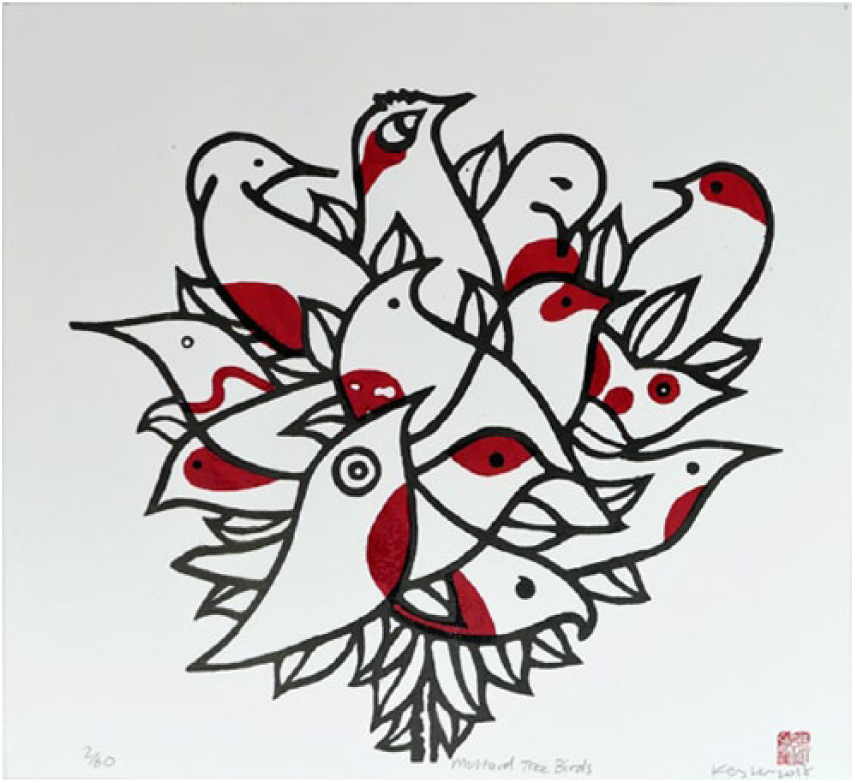
Keng Sen Chong, The Mustard Seed Birds, 2018, wood print on paper, 11 X 11 in. The image, reprinted with permission of Chong, who was the 2017–2018 OMSC artist in residence, is based on Mt. 13:31–32. For information on this artist, go to www.omsc.org/kengsenchong.
The second indisputable fact is the often-mentioned demographic shift of Christianity’s center from the so-called Global North to the so-called Global South. Since so much of the institutional wealth supporting churches, theological schools, and mission agencies is still concentrated in the Global North, this second fact may seem academic to Christians living in the West. To grasp this postcolonial sea change, consider that in 1970, seven of the ten countries with the most Christians were in the West (1. United States, 3. Germany, 5. Russia, 6. United Kingdom, 7. Italy, 8. France, and 10. Spain). By 2010 that number had dropped to only three (1. United States, 3. Russia, and 9. Germany). By 2020, with the United States remaining as number 1 (largely because of immigration) and Russia as number 5, the other eight countries with the most Christians will be, in order, Brazil, China, Mexico, Philippines, Nigeria, Democratic Republic of the Congo, India, and Ethiopia. 2 Soon there will be three times as many Christians in China as in Italy, the home of the head of the Roman Catholic Church, and twice as many as in Germany, the home of the Protestant Reformation!
How might our churches, schools of theology, and mission agencies prepare to respond to this new thing God is doing? Rather than seeing the diversity in Christian expression as a challenge we must somehow overcome, what might happen if we saw it as a good gift of God? Addressing this very question, one theologian asserts, “The recognition of Christian faith can and should be varied. The reason for this is as follows. Although its object, the Jesus Christ attested in Scripture and proclaimed by the community, is single, unitary, consistent and free from contradiction, yet for all His singularity and unity His form is inexhaustibly rich, so that it is not merely legitimate but obligatory that believers should continually see and understand it in new lights and aspects. For He Himself does not present Himself to them in one form but in many—indeed, He is not in Himself uniform but multiform. How can it be otherwise, when He is the true son of God who is eternally rich?” 3
To participate in this new thing God is doing, I propose that we will need a postcolonial renewal of the church’s evangelical and ecumenical witness, a Spirit-breathed movement focused on the ministry of Jesus as he comes to us clothed in his Gospel, and open to the amazing and expanding diversity of gifts in the worldwide Christian movement. For the churches of the West to participate in such a renewal, we will need the gifts of spiritual and institutional creativity.
What do I mean by spiritual creativity? We will need to be open to the differing perspectives of Christians from other traditions and places and to recognize, in humility, that the agendas we have set for our churches in the context of contemporary North American society may differ significantly from the agendas set by our sisters and brothers from other traditions and places. This spiritual creativity is key, since to insist on or impose our own agendas would be to repeat the worst offenses of the colonial-era missionaries without ever leaving home.
What do I mean by institutional creativity? We will need hospitable ecumenical and evangelical sites capable of transcending the divisions and suspicions of a bygone era, sites where genuine personal encounter and mutual learning may take place. One such site is the Overseas Ministries Study Center in New Haven, where year after year we welcome a new residential community of missionaries, church leaders, scholars, and artists from every nation and Christian tradition (www.omsc.org).
